587
REM, Int. Eng. J., Ouro Preto, 71(4),587-592, oct. dec. | 2018
Marcos Antônio Viana Júnior1
http://orcid.org/0000-0001-5672-4567 Carlos Antônio Silva2
Itavahn Alves Silva3
1Mestrando, Universidade Federal de Ouro Preto
– UFOP, REDEMAT – Rede Temática de Materiais, Ouro Preto - Minas Gerais – Brasil, Engenheiro Consultor da Ternium Brasil, Aciaria - Rio de Janeiro - Rio de Janeiro – Brasil.
[email protected], [email protected]
2Professor - Titular, Universidade Federal de Ouro Preto
- UFOP, Escola de Minas, Departamento de Engenharia Metalúrgica, Ouro Preto - Minas Gerais – Brasil. [email protected]
3Professor - Associado, Universidade Federal
de Ouro Preto - UFOP, Escola de Minas, Departamento de Engenharia Metalúrgica, Ouro Preto - Minas Gerais – Brasil.
Abstract
The developed model is an association of thermodynamic calculations for dis-solution of alloys, slag formers and the deoxidation reaction in the molten steel with two artificial neural network (ANN) models trained with industrial data, to predict the molten steel temperature drop from the blowing end of the BOF until the first mea-surement at secondary metallurgy. To calculate the associated energy for deoxidation, an experiment was designed to set up the parameters for oxygen partitioning among deoxidants, with timed aluminum addition during teeming being the main parameter. The temperature control in the teeming stage presented a standard deviation for the error of prediction of 5.46 oC, for transportation from the rinsing station to the sec-ondary metallurgy of 2.79 oC. The association of all calculations presented an error standard deviation of 7.49 oC. The operational validation presented superior accuracy compared with the current method for controlling the temperature, resulting in a re-duction in the aluminum consumption for heating at secondary metallurgy with a potential economy of U$ 4.07 million per year for a steel shop producing 5 million tons of steel yearly. The artificial neural network model confirmed its capacity for model-ing a complex multivariable process and the separation of thermodynamic calculation provides a better adaptability to different steel grades with different teeming strategies.
Keywords: molten steel temperature control, artificial neural network, thermody-namic calculations.
Hybrid model associating
thermodynamic calculations
and artificial neural network
in order to predict molten
steel temperature evolution
from blowing end of a BOF
for secondary metallurgy
http://dx.doi.org/10.1590/0370-44672017710191
Metallurgy and materials
Metalurgia e materiais
1. Introduction
Heat losses during steelmaking are unavoidable but should be as small and predictable as is possible. Extreme tem-peratures at the casting station could lead to defects related to segregation and grain size/shape distribution, and possibly to breakouts. A too high Basic Oxygen Fur-nace (BOF) end blow temperature implies on higher energy and lime consumption and refractory losses.
As already stressed by others, the complexity of the steelmaking process and
nonlinear relationship between the process parameters makes it difficult to model the input-output process parameters and fore-cast steelmaking operations (Laha, 2015). Due to this feature, statistical models and artificial neural networks (ANN) have been studied to model a variety of complex processes. Typical steelmaking operations, such as Ladle Furnace (LF), Tian (2008) and Sampaio (2006); BOF blowing end dynamic control of carbon and/or temperature were performed by Wei (2016), Liu (2014), Liu
588 REM, Int. Eng. J., Ouro Preto, 71(4),587-592, oct. dec. | 2018
Figure 1
Steel producing routes at steel plant A.
This study is concerned with temper-ature control between the BOF blowing end and the first temperature measure-ment at RS, T2 – T1 ; also with tempera-ture control between departempera-ture at RS and arrival at the secondary metallurgy (RH, AHS), T3-T2. A better prediction of both T2-T1 and T3-T2 leads to a more
predict-able casting temperature and smaller end blow temperature. In both cases, a hybrid Neural Networks – Thermodynamic model will be employed. Such model re-quires: 1- to estimate the thermal effects from additions of fluxes and alloying elements using the first principles of ther-modynamics); 2- to estimate the oxygen
partitioning among deoxidants as a func-tion of timing of addifunc-tion and relative proportion through a series of controlled experiments and thereafter, to estimate the thermal effect for deoxidation; 3- to train the artificial neural networks after discounting the known thermal effects and to validate the model.
2. Materials and methods
Three aspects are central to this model. Calculation of thermal effects due to
alloy-ing; estimation of oxygen partition among deoxidizers, and subsequent thermal effects;
ANN training after data filtering from these effects. They are described as follows.
Thermodynamic calculations
Thermal effects due to the addi-tion of CaO, MgO, Al2O3, SiO2, CaCO3,
MgCO3 and, C, Si, Mn, Al, Fe are taken into consideration. For each mol of a
given slag former, the thermal effects are given by:
∆
H
SlagFormer= (
H
T-H
298) +
x
∆
H
melting∆
H
Alloying= (
H
T-H
298) +
x
∆
H
dissolutionWhere ( HT-H298 ) stands for heat con-tent, x for fraction of molten oxide and ∆Hmelting for enthalpy of melting. Evaluat-ing the effects of carbonate addition in-cludes the heat of carbonate dissociation ( MCO3 = MO+ CO2) and carbon dioxide
heating. For each grade of steel, pro-cessing temperature, timing and mass of each addition the above-mentioned variables can be evaluated using ther-mochemical data from Slag Atlas(1995), Kelley(1961), Hultgren(1973) and
oth-ers (Morris, 2011).
A similar procedure is due to ad-ditions of alloying elements such as Silicon (and alike). Here the thermal contribution is given by
parameters were calculated by intelligent al-gorithm has been presented by Tian (2008) to control molten steel temperature at an LF. Fei et al(2014) describe a hybrid model built to predict the steel temperature from BOF to a caster passing through a Bubbling Station(BS) and an LF, both forwards and backwards; their model assesses the ladle thermal status defined by tracking the teeming ladle operational data, integrating it with ANN trained with other operational
factors, such as material addition.
The hybrid model herein proposed employs a combination of thermodynamic calculations and an ANN for each metal-lurgical station. Some heating/cooling effects such as those from alloy additions, deoxidation can be readily estimated using first principles. The ANN is trained with other operational factors correlated with molten steel temperature loss that present high mathematical complexity, such as the
589
REM, Int. Eng. J., Ouro Preto, 71(4),587-592, oct. dec. | 2018 Oxygen content at the BOF blow
end is, of course, a function of the blow pattern. The main sources of oxygen are the steel dissolved content, oxygen from the carried over slag and slag formation additions, oxygen from the atmospheric pick-up. Deoxidants and alloying elements
are added following a practice which in-cludes a shape (bulk, powder, wire, etc), the sequence of addition and oxygen af-finity specifics. Evaluating the fraction of oxygen reacting with a specific element, Zi, is a complex matter involving multi equi-libria reactions in a metal-slag-gas system;
evaluating this fraction is of considerable importance since, for each reaction, the amount of released heat varies remarkably.
Thus a series of experiments have been performed in order to assess Zi for a given grade of steel. The deoxidation mass balance can be written as
O
deoxidation= O
Al-deox+ O
Si-deox+ O
C-deox+ O
Mn-deoxThe amount of Aluminum spent for deoxidation purposes can be estimated as
O
Al-deox= {
M
Al-pouring-
%Al
RSM
steel⁄
100
}
2 M
Al3 M
OWhere MAl-pouring stands for the mass of aluminum added at the pouring station;
%AlRS aluminum content as sampled at the rinsing station; Msteel is the mass of steel; MO and MAl are the atomic masses of oxygen and aluminum. The other contributions are evaluated following the same procedure.
The material addition during the pouring phase was divided into two batches: the first batch lasts till 10% of the total pouring time; the second batch starts
at 30% or 50% of total pouring time. The steels targeted for these experiments show average end blow carbon and manganese contents of 0.03% and 0.10% and 600 ppm of oxygen; average additions are 50 kg of coke, 1100 kg of high carbon iron-manganese alloy and 500 kg of aluminum. The aluminum addition was made com-pletely in the second batch or 70% of the total mass in the first batch. Pouring from BOF was automatically interrupted if slag was detected inside the pouring channel.
The latter technique allowed to reduce the noise from the carryover slag. For all experiments, end blow temperature, oxy-gen content and steel sampling have been done by Multi-Lab Celox; temperature at RS, AHS and RH are given by immersion Pt-Pt/Rh thermocouples.
The heat for steel deoxidation during teeming ( ∆HDeoxidation ) can be estimated by
the sum of the thermal effects of each de-oxidizing reaction assuming that the avail-able oxygen is partitioned according to Zi.
Artificial Neural Network
According to BISHOP(1995) and SIMON(2001), the Artificial Neural Networks (ANN) have the capacity of inferring functions as a result of the supervised learning process. The regression problem to predict the temperature changes related to opera-tional factors other than from material additions in the molten steel will be addressed by two ANN models. The capacity for modeling complex mul-tivariable nonlinear functions from a noisy operational dataset and the low computational time needed to perform an online prediction are the main char-acteristics that make the ANN model a suitable tool to perform the calcula-tion of temperature loss of molten steel in an industrial environment. The ANN was developed using Statistica software, version 13.1. The models were a multi-layer perceptron (MLP), retro-propagation trained using the sum of squares as the error function.
A first ANN was developed for controlling/predicting the tempera-ture loss between the start of tapping at BOF and the first temperature measurement at RS, T2 – T1, taking into consideration the production of Ultra Low Carbon Steel (ULC) with the specification of C ≤ 0.003%, Si ≤ 0.034%, 0.105% ≤ Mn ≤ 0.155%, P ≤ 0.020%, S ≤ 0.015%, 0.020%≤ Al ≤ 0.045%, 0.050% ≤ Ti ≤ 0,090%. The ULC steel grades have been chosen because they are the simplest steel grades regarding the complexity of material addition during the teeming process, since the deoxidation and al-loying is performed at secondary metal-lurgy, requiring only 500 Kg of lime ( CaO = 92%, MgO=0.7%, SiO2=1.4%, C O2 = 3 . 3 0% , H2O = 2 .15% , Al2O3=0.2%, Fe2O3=0.2%) and 1500 Kg of synthetic slag (CaO = 54.5%, MgO=23.8%, SiO2=1.52%, CO2 = 12%, H2O = 5.50%, Al2O3=2.42%,
Fe2O3=0.2%). The thermal effects from these additions are discounted from measured T2-T1 to provide the tem-perature drop ∆TANN Teeming associated with other operational variables. Then training the ANN takes into consider-ation: ladle life (number of heats); time of empty ladle (time elapsed from end of casting and beginning of pouring); steel resting time at the ladle during the previous heat; time of empty BOF (time elapsed between successive heats); elapsed time between measuring tem-perature at blow end and starting of teeming; end blow temperature; rinsing time till first sampling at RS; pouring time; slag mass; and steel mass. Data from some 450 heats of ultra-low car-bon steel have been used for training with eleven hidden layers, and hyper-bolic tangent as activation function both at the hidden layer and exit layer.
The second ANN deals with tem-perature control (∆TANN RS) during the
Evaluation of oxygen partitioning among deoxidants
Where
∆
H
dissolution is the heat offorma-tion of a liquid Fe-Y soluforma-tion. Thermo-dynamic data are from sources such as Kelley(1964) and Hultgren (1973).
The calculated ∆H value is divided
by the heat capacity of molten steel to estimate the temperature variation ( ∆Tsteel ) regarding the additions of
syn-thetic slags and alloys. Calculations are straightforward and agreement with the
590 REM, Int. Eng. J., Ouro Preto, 71(4),587-592, oct. dec. | 2018 The experiments for determina-tion of oxygen partidetermina-tioning among deoxidants have shown that when 70% of total mass of aluminum for deoxida-tion and alloying the steel is added at the first batch of materials (10% of total pouring time) to be added during pour-ing phase, the obtained carbon yield measured after stirring time at ladle
rinsing station increases as expected. If the second batch of materials to be added during pouring phase is delayed to 50% of total pouring time and 100% of the aluminum mass is added only in the second batch, less aluminum pro-tection is provided. These effects can be seen in the factorial plot; notice that the carbon yield changes in Figure 2
(a). In accordance, the aluminum yield measured after stirring time at the ladle rinsing station is affected in an opposing way, if aluminum addition to the second batch of materials is delayed; its yield will naturally increase, since some of the oxygen has had the opportunity to react with other elements, such as carbon, see Figure 2 (b).
3. Results and discussion
Figure 2
Factorial plot for different configuration of aluminum addition during teeming to (a) carbon yield and (b) aluminum yield.
In order to save aluminum, the standard procedure comprises no alu-minum addition during the first batch (10% of the teeming time) and the total mass of aluminum being added at the second batch (50% of the teeming time). The average oxygen partition among deoxidants for the studied steel grade is calculated by the mass balance as
fol-lows: ZAl=0.92 ; ZC=0.07 ; ZMn=0.01 and
ZSi=0. These model parameters must be evaluated for each different steel grade deoxidized during teeming.
The resulting correlation coeffi-cient during the model validation with a new operational dataset was equal 0.85. The model error (measured value – predicted value) standard deviation
is equal 5.46oC, error mean = 0.301 oC and 95% of the prediction error is in the interval of -10.79 oC to +10.66 oC
Figure 3 shows a comparison between the temperature drop during teeming,( T2- T1)+∆TSlagForm, measured values against values given by the neu-ral network trained with ULC grade operational data.
(a) (b)
Figure 3
Temperature drop during teeming; a comparison between measured and predicted values.
The metallurgical work at the rinsing station is simpler than at the teeming station. It consists essentially of rinsing inert gas and keeping con-trol of composition and temperature.
Thus a much better prediction of temperature drop from temperature measurement at the rising station (T2) to first temperature measurement at secondary metallurgy (T3) can be
done, as is seen in Figure 4. As a mat-ter of fact, the resulting correlation coefficient during the model validation with a new operational dataset can be as high as 0.95.
transportation period from RS to sec-ondary metallurgy (RH or AHS), T3-T2. It takes into consideration only the thermal effects related to heat transfer phenomena. For this one, the main variables were: time elapsed between
the first temperature measurement at RS and RH degasser; rinsing time; time of empty ladle; refractory life (number of heats); the first temperature as mea-sured at the RS; and time with steel at the previous heat. Data from some 400
591
REM, Int. Eng. J., Ouro Preto, 71(4),587-592, oct. dec. | 2018
Figure 4 Temperature drop during transportation; a comparison between measured and predicted values.
When the quality of the prediction is improved, the standard deviation of the error during model validation drops to 2.79 oC. Other basic statistics are error mean= -0.042 oC and 95% of predic-tion error is in the interval of -5.58 oC to
+5.49 oC. The expected effects of elapsed time from temperature measurement at the rinsing station to first temperature measurement at secondary metallurgy and rinsing time can be obtained with a higher degree of confidence.
Consolidating the thermodynamic calculation, operational parameters for oxygen partitioning among deoxidants and the two artificial neural networks, the global model to calculate T3-T1 can be written as:
T3-T1 =
∆
T
SlagForm+
∆
T
Alloy+
∆
T
Deox+
∆
T
ANN Teeming+
∆
T
ANN RSWhere:∆TSlagForm, ∆TAlloy and ∆TDeoxare the steel temperature changes related to the addition of slag formers, alloying and deoxidation respectively. ∆TANN Teeming and ∆TANN RSare the temperature changes calculated by ANN
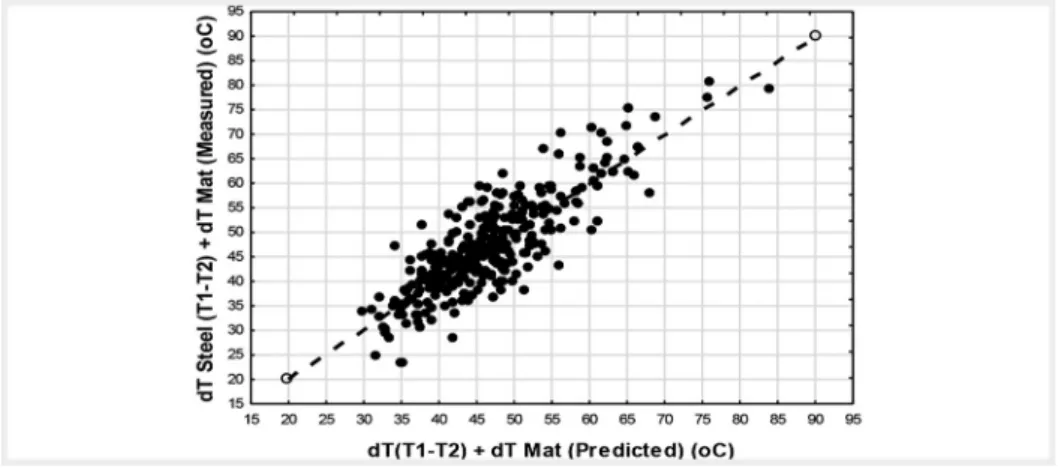
models for teeming and transportation from rinsing station to secondary metallurgy, respectively. The combined models have resulted in a global (T3-T1) model. Herein, 34 industrial runs have been analyzed using
this model. Figure 5 exemplifies the find-ings. There seems to be a good agreement between measured and predicted values for the first temperature measurement at the secondary metallurgy (T3).
Figure 5 Measured vs predicted values of first temperature at secondary metallurgy taking into consideration alloying, deoxidation and slag formers addition.
T h e e r ror s t a nd a rd d e v i a-tion of (T3-T1) model is 7.49 oC, while other basic statistics are error mean= -2.33 oC and 95% of the predic-tion error is in the interval of -11.67 oC to +16.33 oC. The heat complying with this model required for temperature ad-justment 0.1 Kg of Al/t steel and 1.77 Kg
of scrap/t of steel. The current values are 0.56 Kg of Al/t of steel and 1.74 Kg of scrap/t of steel. Taking into consideration a steel shop producing 5 Million tons of steel/year and aluminum costs of 1.77 U$/kg, the expected saving would be in the order of U$ 4.07 million/year. Less apparent, yet very important,
improve-ments are higher alloy yield and second-ary refining productivity. As less alumina is formed, the steel would be cleaner and less prone to cause nozzle blockage and internal defects.
The beneficial effects of implement-ing such hybrid ANN-Thermodynamics model are made apparent.
4. Conclusion
A hybrid ANN model coupled with first principles of thermodynamic esti-mations has been successfully developed in order to provide for a more accurate temperature prediction from the BOF
blowing end to treatment start at second-ary metallurgy. Filtering the raw data from known thermal effects allows a more precise ANN training. The oxygen partitioning among deoxidants must be
592 REM, Int. Eng. J., Ouro Preto, 71(4),587-592, oct. dec. | 2018
Acknowledgements
The authors thank to CNPq, CAPES, FAPEMIG and Ternium Brasil for financial support.
References
BISHOP, Christopher M. Neural networks for pattern recognition. Oxford university press, 1995.
BING-YAO, Cai, HUI, Zhao, YOU-JUN, Yue. Research on the BOF steelmaking en-dpoint temperature prediction. In: Mechatronic Science, Electric Engineering and Computer (MEC). In: INTERNATIONAL CONFERENCE ON. IEEE, 2011. p. 2278-2281.
CHEN, W., DUAN, G., OU, C. Neural network applied to predicting molten steel temperature profile from converter to continuous casting. Iron and Steel. China, v. 32, n. 8, p. 30-32, 1997.
EISENHÜTTENLEUTE, Verein Deutscher, ALLIBERT, M. Slag atlas. VerlagStah-leisen, 1995.
FEI, H. E. et al. Hybrid model of molten steel temperature prediction based on lad-le heat status and artificial neural network. Journal of Iron and Steel Research, International, v. 21, n. 2, p. 181-190, 2014.
HAYKIN, Simon. Redes neurais: princípios e prática. Bookman Editora, 2001. HULTGREN, Ralph et al. Selected values of the thermodynamic properties of
bina-ry alloys. National Standard Reference Data System, 1973.
KELLEY, Kenneth Keith, KING, E. G. Contributions to the data on theoretical me-tallurgy. US Government Printing Office, 1961.
LAHA, Dipak, REN, Ye, SUGANTHAN, Ponnuthurai N. Modeling of steel-making process with effective machine learning techniques. Expert systems with applications, v. 42, n. 10, p. 4687-4696, 2015.
LIU, Hui, WANG, Bin, XIONG, Xin. Basic oxygen furnace steelmaking end-point pre-diction based on computer vision and general regression neural network. Optik-In-ternational Journal for Light and Electron Optics, v. 125, n. 18, p. 5241-5248, 2014. MERADI, H., BOUHOUCHE, S., LAHRECHE, M. Prediction of bath temperature
using neural networks. World Academy of Science, Engineering and Technology,
v. 24, p. 946-950, 2008.
MORRIS, Arthur E., FINE, H. Alan, GEIGER, Gordon. Handbook on material and energy balance calculations in material processing, includes CD-ROM. John Wiley& Sons, 2011.
RAJESH, Narra, KHARE, Malaya Ranjan, PABI, Shyamal Kumar. Feed forward neural network for prediction of end blow oxygen in LD converter steel making.
Materials Research, v. 13, n. 1, p. 15-19, 2010.
SAMPAIO, Patrícia Teixeira, BRAGA, Antônio Pádua, FUJII, Takeshi. Modelagem térmica de um forno-panela utilizando redes neurais artificiais. Belo Horizonte: Universidade Federal de Minas Gerais, 2006. (Tese de Doutorado).
TIAN, Huixin, MAO, Zhizhong, WANG, Yan. Hybrid modeling of molten steel tem-perature prediction in LF. ISIJ international, v. 48, n. 1, p. 58-62, 2008.
WANG, Hong-Bing, JUN, C. A. I., KAI, F. E. N. G. Predicting the endpoint phospho-rus content of molten steel in BOF by two-stage hybrid method. Journal of Iron and Steel Research, International, v. 21, p. 65-69, 2014.
Wei Li, Xinchun Wang, XushengWanga, Hong Wanga. Endpoint prediction of BOF steelmaking based on BP neural network combined with improved PSO. Chemical Engineering Transactions, v. 51, p.475-480, 2016.
Received: 11 December 2017 - Accepted: 12 August 2018. eling nonlinear functions for complex
multivariable industrial processes.
Taking in consideration the high ton-nages related to the steelmaking industry
the potential savings in regard to alumi-num consumption are sizable.