MAIZE RESPONSE TO NITROGEN FERTILIZATION
TIMING IN TWO TILLAGE SYSTEMS IN A SOIL
WITH HIGH ORGANIC MATTER CONTENT
(1)Luis Sangoi(2), Paulo Roberto Ernani(3) & Paulo Regis Ferreira da Silva(4)
SUMMARY
No-tillage systems, associated to black oat as preceding cover crop, have been increasingly adopted. This has motivated anticipated maize nitrogen fertilization, transferring it from the side-dress system at the stage when plants have five to six expanded leaves to when the preceding cover crop is eliminated or to maize sowing. This study was conducted to evaluate the effects of soil tillage system and timing of N fertilization on maize grain yield and agronomic efficiency of N applied to a soil with high organic matter content. A three-year field experiment was conducted in Lages, state of Santa Catarina, from 1999 onwards. Treatments were set up in a split plot arrangement. Two soil tillage systems were tested in the main plots: conventional tillage (CT) and no-tillage (NT). Six N management systems were
assessed in the split-plots: S1 – control, without N application; S2 – all N (100 kg ha-1)
applied at oat desiccation; S3 – all N applied at maize sowing; S4 – all N side-dressed when maize had five expanded leaves (V5 growth stage); S5 – 1/3 of N rate applied at maize sowing and 2/3 at V5; S6 – 2/3 of nitrogen rate applied at maize sowing and 1/3 at V5. Maize response to the time and form of splitting N was not affected by the
soil tillage system. Grain yield ranged from 6.0 to 11.8 t ha-1. The anticipation of N
application (S2 and S3) decreased grain yield in two of three years. In the rainiest early spring season (2000/2001) of the experiment, S4 promoted an yield advantage
of 2.2 t ha-1 over S2 and S3. Application of total N rate before or at sowing decreased
the number of kernels produced per ear in 2000/2001 and 2001/2002 and the number of ears produced per area in 2001/2002, resulting in reduced grain yield. The agronomic efficiency of applied N (kg grain increase/kg of N applied) ranged from 13.9 to 38.8 and was always higher in the S4 than in the S2 and S3 N systems. Short-term N immobilization did not reduce grain yield when no N was applied before or at maize sowing in a soil with high organic matter content, regardless of the soil tillage system.
Index terms: Zea mays, nitrogen, immobilization, leaching, grain yield.
(1) Recebido para publicação em setembro de 2005 e aprovado em março de 2007.
(2) Professor do Departamento de Fitotecnia da Universidade do Estado de Santa Catarina – UDESC. Av. Luis de Camões 2090,
Caixa Postal 281, CEP 88520-000 Lages (SC). Pesquisador do CNPq. E-mail: [email protected]
(3) Professor do departamento de Solos, UDESC. Pesquisador do CNPq. E-mail: [email protected]
(4) Professor da Universidade Federal do Rio Grande do Sul – UFRGS. Av. Bento Gonçalves 7712, Caixa Postal 15100, CEP
RESUMO: RESPOSTA DO MILHO À ÉPOCA DE APLICAÇÃO DO FERTILIZANTE NITROGENADO EM DOIS SISTEMAS DE CULTIVO NUM SOLO COM ALTO TEOR DE MATÉRIA ORGÂNICA
O aumento na adoção do sistema de semeadura direta, associado à freqüente utilização da aveia-preta como cobertura de inverno, tem estimulado a antecipação da fertilização nitrogenada para a cultura do milho. Esta tem sido transferida da cobertura, feita quando a planta tem cinco a seis folhas expandidas, para o período de dessecação da cobertura de inverno ou da semeadura do milho. Este trabalho foi conduzido objetivando avaliar os efeitos de dois sistemas de preparo de solo e da época de aplicação de N sobre o rendimento de grãos do milho e a eficiência agronômica do N aplicado num solo com alto teor de matéria orgânica. Instalou-se um experimento num Nitossolo Vermelho, com 54 g kg-1 de
matéria orgânica, em Lages-SC, durante as estações de crescimento de 1999/2000, 2000/ 2001 e 2001/2002. Os tratamentos foram dispostos no delineamento experimental de parcelas sub-divididas. Dois sistemas de preparo de solo foram avaliados na parcela principal: convencional e semeadura direta. Seis sistemas de manejo da adubação nitrogenada foram avaliados nas subparcelas: S1 – testemunha sem N; S2- todo o N (100 kg ha-1) aplicado na dessecação da aveia; S3 – todo o N aplicado na semeadura do
milho; S4 – todo o N aplicado quando o milho tinha cinco folhas expandidas (estádio V5); S5 – um terço do N aplicado na semeadura do milho e dois terços no estádio V5; S6 – dois terços do N aplicados na semeadura e um terço em V5. A resposta do milho à época e ao tipo de fracionamento da adubação nitrogenada não foi afetada pelo sistema de preparo do solo. O rendimento de grãos variou de 6,0 a 11,8 t ha-1. A antecipação da fertilização
nitrogenada (S2 e S3) diminuiu o rendimento de grãos em duas das três safras. Na estação de crescimento com a primavera mais chuvosa (2000/2001), a produtividade obtida em S4 foi 2,2 t ha-1 maior do que a registrada em S2 e S3. A aplicação de todo o N antes ou
durante a semeadura do milho diminuiu o número de grãos por espiga em 2000/2001 e 2001/2002, bem como número de espigas por planta em 2001/2002, contribuindo para reduzir o rendimento de grãos. A eficiência agronômica do N aplicado (kg de aumento no rendimento/kg de N aplicado) variou de 13,9 a 38,8 e foi sempre maior em S4 do que em S2 e S3. A imobilização temporária de N não reduziu o rendimento de grãos do milho quando não se aplicou N antes ou durante a semeadura do milho num solo com alto teor de matéria orgânica, independentemente do sistema de preparo do solo.
Termos de indexação: Zea mays, nitrogênio, imobilização, lixiviação, rendimento de grãos.
INTRODUCTION
Maize requires high N amounts to warrant high yields. The crop takes up between 20 and 25 kg of soil N per ton of grain (Muzilli & Oliveira, 1992; Sangoi et al., 2001a). Nitrogen is the most unstable nutrient in the soil and is affected by several reactions such as volatilization, leaching, denitrification and immobilization. The diversity of reactions that influence N dynamics makes timing of N application a crucial issue to balance N requirements for optimum maize growth and to minimize N losses to the environment (Dinnes et al., 2002).
Recommended N rates for maize in Brazil range from 0 to 200 kg ha-1, depending on the soil organic
matter, the kind of rotation system, the type of preceding crop and the producer’s yield expectation (Amado et al., 2002). From the whole rate, 10 to 30 kg ha-1 is
applied at sowing and the rest when plants present
five to six expanded leaves and are 40 to 60 cm high (Comissão de Fertilidade do Solo-RS/SC, 2004). This timing of N fertilization was proposed based on field experiments conducted mostly in the conventional (chisel) tillage system (Ceretta & Fries, 1997).
A strong shift towards the no-tillage system has occurred during the last 20 years in Brazil. This change affects some soil characteristics, such as moisture content and temperature, which may also influence N dynamics (Torbert et al., 2001). No-tillage normally increases short-term N immobilization (Torbert & Wood, 1992; Ernani, 2003). Furthermore, the O2 amount of soils under no-tillage is lower than
Black oat (Avena strigosa) is presently most used as cover crop preceding maize in southern Brazil. It has low N contents and high C/N ratio. This may enhance N immobilization in the short term, impairing the early growth of the succeeding crop (Ceretta et al., 2002b; Kuo & Jellum, 2002). The increased use of no-tillage, frequently associated to black oat as preceding cover crop, has stimulated the proposal of new alternatives regarding the management of N fertilization for maize in these conditions. This new approach involves the anticipation of N fertilization, transferring it from the traditional side-dress carried out in V5-V6 to the time of winter cover crop desiccation or maize sowing (Sá, 1997; Lech, 2001).
Nitrogen application before or at planting may increase N availability in the soil during early plant growth, mitigating potential immobilization effects caused by the high C/N ratio of oat straw (Ceretta & Fries, 1997). In addition, it may decrease the disparity of yield losses due to N stress if rainy springs delay the planned side-dress application time (Scharf et al., 2002). Conversely, the anticipation of N fertilization may favor N loss by leaching due to the low N uptake capacity of maize in early growth stages (Blackmer et al., 1992; Scherer, 2001). Results of experiments comparing the effects of pre-sowing, sowing and side-dress N applications on maize performance in Brazil are highly variable, depending on weather conditions, soil characteristics, planting date and type of fertilizer application. Most of the information gathered on this issue by Argenta et al. (1999), Bortolini et al. (2001), Ceretta et al. (2002a,b) and Wolshick et al. (2002) is based on studies carried out in soils with low organic matter content (less than 50 g kg-1).
The definition of N application timing and rate that precisely match maize needs under different environmental conditions and soil types is very important since these factors improve nutrient uptake, decreasing N losses (Androski, 2000). This work was carried out to evaluate the effects of soil tillage systems and timing of N fertilization on maize grain yield and on the agronomic efficiency of applied N described by Mosier et al. (2004) in a soil with high organic matter content.
MATERIAL AND METHODS
The experiment was conducted in Lages - SC, southern Brazil, in the growing seasons of 1999/2000, 2000/2001 and 2001/2002 on an Oxisol (Hapludox). The soil organic matter content was determined by wet combustion with dichromate = 54 g kg-1; clay
content = 520 g kg-1; P (Mehlich-1) = 24 mg kg-1; K
(Mehlich-1) = 330 mg kg-1; water pH = 5.8; Ca =
9.5 cmolc kg-1; and Mg = 2.5 cmolc kg-1. The
experimental area had never been cultivated until spring 1997. Preceding the establishment of our trial,
two tomato (Lycopersicum esculentum Mill.) crops were grown. The soil was slightly disk-harrowed before planting tomato in both growing seasons.
The treatments were arranged in a randomized complete block design, in split plots with four replications. Two soil tillage systems were tested in the main plots: conventional tillage (CT), using moldboard plowing (twice) and disk harrowing (twice) to incorporate black oat residue into the soil, and no-tillage system (NT), sowing maize nearly three weeks after chemical desiccation of black oat without residue incorporation. The treatments of both oat residue management systems were carried out on the same day. Six N management systems were assessed in the split-plots: S1 – control, without N application; S2 – all N applied on the day of oat desiccation; S3 – all N applied at maize sowing; S4 – all N side-dressed when maize had five expanded leaves (The V5 growth stage according to Ritchie et al., 1993); S5 – 1/3 of N rate applied at maize sowing and 2/3 at V5; S6 – 2/3 of nitrogen rate applied at maize sowing and 1/3 at V5. A nitrogen rate of 100 kg ha-1 was broadcast on
the soil surface using urea. Nitrogen was side-dressed on 11/26/1999, 11/18/2000 and 11/23/2001.
Each split plot had six rows, 0.75 cm apart and 7.0 m long. All measurements were taken from the four central rows, leaving borders of 0.5 m at each row end. The N management systems were always applied to the same experimental site in each growing season.
Black oat was sown in mid May and chemically desiccated (NT) or incorporated into the soil (CT) always at the end of September. Maize (single-cross hybrid DKB 909) was sown 20 to 23 days afterwards at a density of 75,000 plants ha-1. On the sowing day,
80 kg P2O5 and 100 kg ha-1 K2O was surface applied
to the soil. Weeds and insects were chemically controlled when needed and the manual harvest always performed in April.
On the day the winter crop was desiccated, plant samples were taken using a square wooden box (0.5 m2 m surface area). The samples were oven-dried
at 65 °C and used to estimate oat dry mass yield and C/N ratio. Three weeks after maize emergence, five plants randomly chosen in the third row of each split-plot were marked with permanent ink. The tips of the fourth and eighth leaf of each plant were tagged, as a reference point to correctly estimate the total number of expanded leaves. These plants were also used to determine the number of green and senesced leaves at flowering.
Pluvial precipitation (mm)
1999/2000 2000/2001 2001/2002
Month
1st
half 2nd
half Total 1st
half 2nd
half Total 1st
half 2nd
half Total
Normal(1)
September 56.9 26.3 83.2 122.9 88.0 210.9 73.8 206.8 280.6 136.8
October 151.2 42.9 194.1 185.3 165.0 350.3 61.5 34.1 95.6 156.1
November 54.7 50.0 104.7 27.6 41.6 69.2 72.5 58.4 130.9 115.0
December 78.9 1.2 80.1 37.3 126.2 163.5 114.7 18.5 133.2 129.9
January 61.8 115.3 177.1 69.4 154.8 224.2 88.4 57.2 145.6 156.7
February 45.8 84.7 130.5 58.1 65.9 124.0 45.4 20.6 66.0 142.5
March 51.1 40.3 91.4 37.1 47.5 84.6 102.4 20.1 122.5 111.5
April 91.6 45.7 137.3 98.8 50.6 149.4 21.6 112.8 134.4 97.9
yield and yield components were determined based on plants harvested from each split-plot (9.0 m2). Yield
values were adjusted to 13% standard moisture. The agronomic efficiency of applied N (AEN), described by
Mosier et al. (2004), was calculated by the following expression: AEN (kg grain increase/kg applied N) =
(YN – Y0/FN) where YN is the crop yield at a certain level of N fertilizer applied (kg ha-1), Y
0 is the crop
yield measured in a treatment without N application and FN is the N rate (100 kg ha-1).
The analysis of variance was performed separately for each growing season using the F test. The F values for the main treatment effects and their interactions were considered significant (at P < 0.05) and the treatment means compared using Duncan’s test (at P < 0.05).
RESULTS AND DISCUSSION
Total rainfall during maize growing seasons (October to April) ranged from 828 mm in 2001/2002 to 1.165 mm in 2000/2001 (Table 1). These values were higher than the crop evapotranspiration in southern Brazil, which varies from 550 to 690 mm, depending on the environmental conditions. Pluvial precipitation from the 2nd half of September to the
end of the 1st half of November, a period that comprised
N fertilization at oat desiccation (S2) and maize sowing (S3) and preceded N side-dress, was high, especially in 2000/2001 (466 mm) and 2001/2002 (375 mm). No significant period of water deficit at maize flowering was observed (January) in the whole experimental period.
No significant single effect of soil tillage and interaction between soil tillage and N management system was detected for the evaluated variables during
the three experimental years. Consequently, the impacts of N timing and splitting are presented considering the mean values of conventional and no-tillage systems.
The lack of interaction between soil tillage and N management system contradicts the premise that no-tillage maize succeeding black oat requires larger amounts of N in the early crop development stages to compensate short-term N immobilization (Argenta et al., 1999). Oat dry mass yield at desiccation/ incorporation ranged from 4.05 t ha-1 (2001/2002) to
4.35 t ha-1 (1999/2000). The winter crop C/N ratio
varied from 37 (2000/2001) to 39 (2001/2002). The combination of high dry mass yield and a C/N ratio over 25–30 is favorable for short-term N immobilization. According to Below (2002), differences in N management practices, such as N dose or application timing, between no-tillage and conventional tillage system are only significant when N supply for maize is limited. Our data support this finding, showing that in clayey soils with high organic matter content the best time to apply N is not substantially affected by the soil tillage system. The same was observed by Torbert et al. (2001), who analyzed a Hust Black clayey soil in the US.
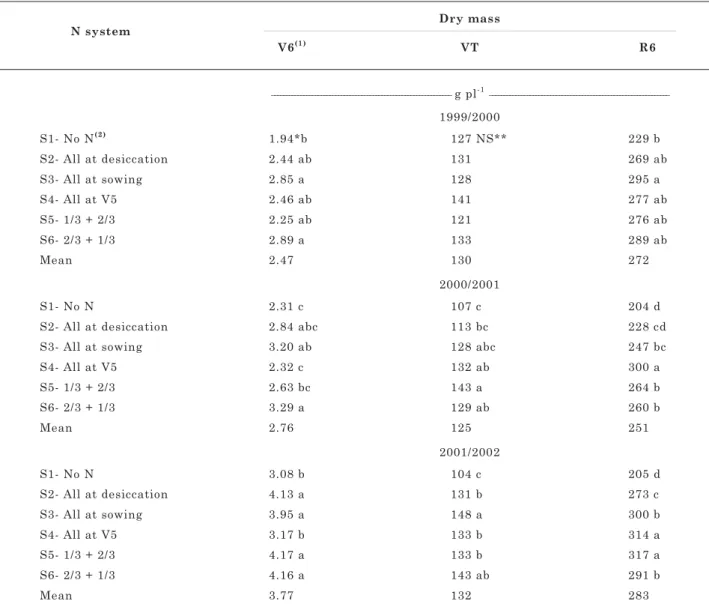
The application of all N after plant emergence (S4) reduced shoot dry mass at V6 in 2000/2001 and 2001/ 2002, compared to the systems where N was all applied during or before maize sowing (Table 2). An opposite trend was observed close to harvesting where postponing all N fertilization to V5 promoted higher shoot dry mass values at maize physiological maturity than anticipating N application to oat desiccation or maize sowing in 2000/2001 and 2001/2002. The performance of shoot dry mass confirmed observations of Ceretta et al. (2002a,b), Mai et al. (2003) and Wolshick et al. (2003). The anticipation of all N application to the time of oat desiccation or maize
Table 1. Monthly pluvial precipitation from September to April in Lages, Southern Brazil, from 1999 to 2002
sowing enhanced maize dry mass accumulation during the early crop growth but did not ensure higher dry mass accumulation at harvest.
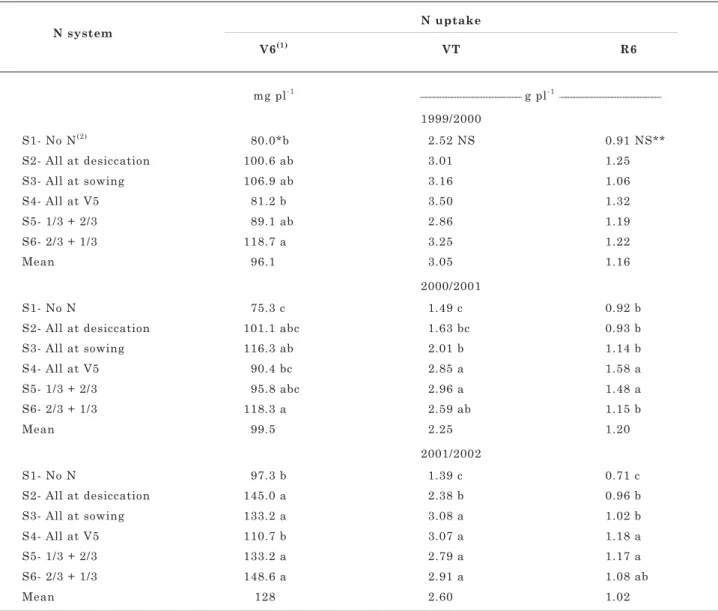
Shoot N uptake values ranged from 75.3 to 148.6 mg pl-1 in V6 (Table 3). The values were
generally higher for treatments with larger amounts of N applied before or at maize sowing. Nonetheless, there was no significant difference in shoot N content in V6 between S2, S3 and S5, showing that 30 kg ha-1
N at planting (current recommendation) provided similar tissue N contents at higher N rates (S2, S3 and S6). Conversely, moving all N fertilization to the time of oat desiccation or sowing decreased maize N
uptake at flowering in 2000/2001 and at grain physiological maturity in 2001/2002, when compared to the S4 and S5 management systems.
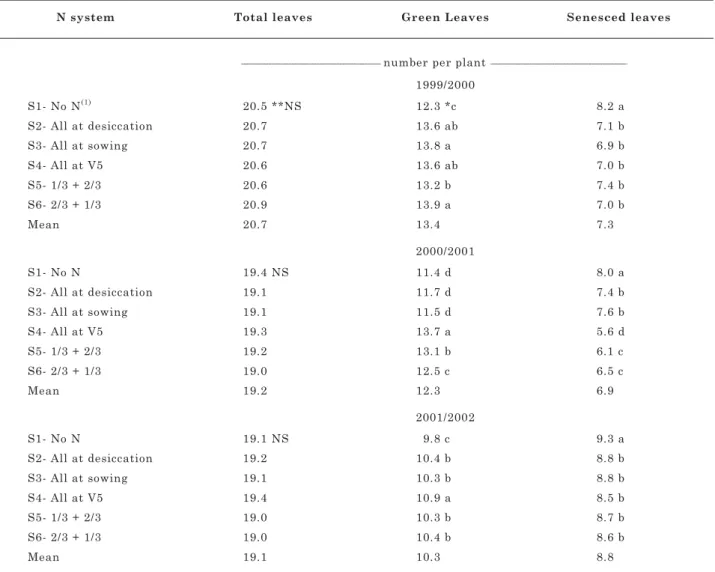
Total leaf number was not affected by N management system and varied little in the experimental period, ranging from 19.0 to 20.7 (Table 4). According to Sangoi et al. (2001b), the number of leaves is a strongly genotype-dependent trait, positively correlated with the number of thermal units each hybrid needs to flower. The control always had a lower number of green leaves and higher number of senesced leaves at flowering than the treatments that received N. In the first growing season, timing of N
Dry mass N system
V6(1) VT R6
______________________________________________________________g pl- 1______________________________________________________________
1999/2000
S1- No N(2) 1.94*b 127 NS** 229 b
S2- All at desiccation 2.44 ab 131 269 ab
S3- All at sowing 2.85 a 128 295 a
S4- All at V5 2.46 ab 141 277 ab
S5- 1/3 + 2/3 2.25 ab 121 276 ab
S6- 2/3 + 1/3 2.89 a 133 289 ab
Mean 2.47 130 272
2000/2001
S1- No N 2.31 c 107 c 204 d
S2- All at desiccation 2.84 abc 113 bc 228 cd
S3- All at sowing 3.20 ab 128 abc 247 bc
S4- All at V5 2.32 c 132 ab 300 a
S5- 1/3 + 2/3 2.63 bc 143 a 264 b
S6- 2/3 + 1/3 3.29 a 129 ab 260 b
Mean 2.76 125 251
2001/2002
S1- No N 3.08 b 104 c 205 d
S2- All at desiccation 4.13 a 131 b 273 c
S3- All at sowing 3.95 a 148 a 300 b
S4- All at V5 3.17 b 133 b 314 a
S5- 1/3 + 2/3 4.17 a 133 b 317 a
S6- 2/3 + 1/3 4.16 a 143 ab 291 b
Mean 3.77 132 283
Table 2. Effect of N management systems on plant dry mass accumulation at three growth stages, considering the mean of two tillage systems
(1) V6 – six expanded leaves; VT – tasseling; R6 – grain physiological maturity (after Ritchie et al., 1993). (2) S1- No N: without N
application did not alter the number of green and senesced leaves at flowering. During the subsequent years, side-dressing all N at V5 (S4) maintained the highest number of green leaves at flowering. Especially in years with early rainy springs, such as 2000/2001 (Table 1), N application before or at sowing (S2, S3) hastened leaf senescence, forcing the crop to flower with a lower number of green leaves.
The anticipation of N fertilization stimulated the early crop growth favoring N uptake and increasing plant dry mass at the beginning of the maize reproductive period. On the other hand, the
advantages of supplying all N before the beginning of the root system development disappeared at flowering. Nearly 75% of total N accumulated at harvest is taken up by maize from tassel differentiation (which happens close to V6) to silking (Bull, 1993).
Based on rainfall recorded from the end of September (oat desiccation) to the second half of November (N side-dress) and on shoot N uptake until flowering (Tables 1 and 3), it is possible to infer that in the growing seasons with wet early springs (2000/ 2001 and 2001/2002) the application of 100 kg of N at oat desiccation or at maize sowing probably favored
N uptake N system
V6(1) VT R6
mg pl- 1 ___________________________________g pl- 1___________________________________
1999/2000
S1- No N( 2) 80.0*b 2.52 NS 0.91 NS**
S2- All at desiccation 100.6 ab 3.01 1.25
S3- All at sowing 106.9 ab 3.16 1.06
S4- All at V5 81.2 b 3.50 1.32
S5- 1/3 + 2/3 89.1 ab 2.86 1.19
S6- 2/3 + 1/3 118.7 a 3.25 1.22
Mean 96.1 3.05 1.16
2000/2001
S1- No N 75.3 c 1.49 c 0.92 b
S2- All at desiccation 101.1 abc 1.63 bc 0.93 b
S3- All at sowing 116.3 ab 2.01 b 1.14 b
S4- All at V5 90.4 bc 2.85 a 1.58 a
S5- 1/3 + 2/3 95.8 abc 2.96 a 1.48 a
S6- 2/3 + 1/3 118.3 a 2.59 ab 1.15 b
Mean 99.5 2.25 1.20
2001/2002
S1- No N 97.3 b 1.39 c 0.71 c
S2- All at desiccation 145.0 a 2.38 b 0.96 b
S3- All at sowing 133.2 a 3.08 a 1.02 b
S4- All at V5 110.7 b 3.07 a 1.18 a
S5- 1/3 + 2/3 133.2 a 2.79 a 1.17 a
S6- 2/3 + 1/3 148.6 a 2.91 a 1.08 ab
Mean 128 2.60 1.02
Table 3. Effect of N management systems on N uptake per plant by maize shoot at two growth stages (V6 and VT) and by grain at physiological maturity (R6), considering the mean of the two tillage systems
(1) V6 – six expanded leaves; VT – tasseling; R6 – grain physiological maturity (after Ritchie et al., 1993). (2) S1- No N: without N
N leaching, decreasing the amount of N available in the soil from V6 to VT. The smaller number of green leaves recorded in the S2 and S3 systems, compared to S4, in the last two growing seasons, further reinforces this hypothesis.
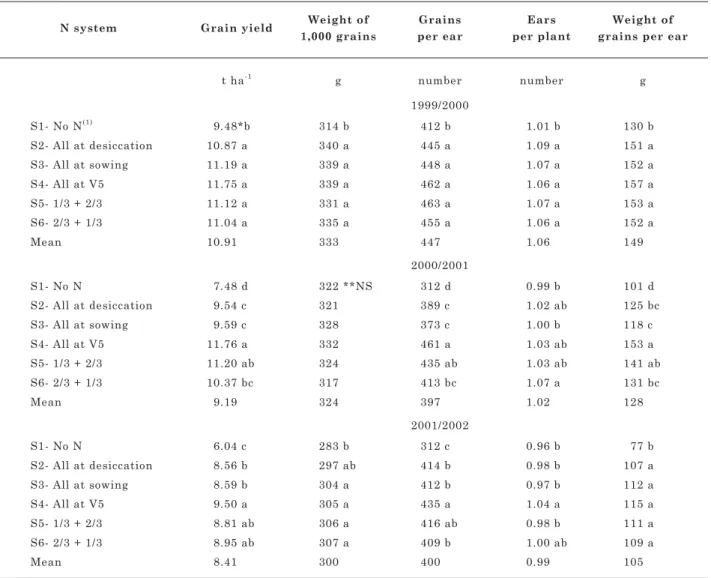
Grain yields ranged from 6.04 to 11.76 t ha-1
(Table 5), with a three-year average of 9.8 t ha-1. The
impact of N fertilization on grain yield increased from the beginning towards the end of the experimental period. Compared to the control, N addition increased grain yield by 18% (1.71 t ha-1) in 1999/2000, and by
40% (3.01 t ha-1) and 47% (2.84 t ha-1), respectively, in
the following years. The continuous succession of grass species (black oat and maize) over three years in the
N system Total leaves Green Leaves Senesced leaves
_________________________________________________number per plant________________________________________________
1999/2000
S1- No N( 1) 20.5 **NS 12.3 *c 8.2 a
S2- All at desiccation 20.7 13.6 ab 7.1 b
S3- All at sowing 20.7 13.8 a 6.9 b
S4- All at V5 20.6 13.6 ab 7.0 b
S5- 1/3 + 2/3 20.6 13.2 b 7.4 b
S6- 2/3 + 1/3 20.9 13.9 a 7.0 b
Mean 20.7 13.4 7.3
2000/2001
S1- No N 19.4 NS 11.4 d 8.0 a
S2- All at desiccation 19.1 11.7 d 7.4 b
S3- All at sowing 19.1 11.5 d 7.6 b
S4- All at V5 19.3 13.7 a 5.6 d
S5- 1/3 + 2/3 19.2 13.1 b 6.1 c
S6- 2/3 + 1/3 19.0 12.5 c 6.5 c
Mean 19.2 12.3 6.9
2001/2002
S1- No N 19.1 NS 9.8 c 9.3 a
S2- All at desiccation 19.2 10.4 b 8.8 b
S3- All at sowing 19.1 10.3 b 8.8 b
S4- All at V5 19.4 10.9 a 8.5 b
S5- 1/3 + 2/3 19.0 10.3 b 8.7 b
S6- 2/3 + 1/3 19.0 10.4 b 8.6 b
Mean 19.1 10.3 8.8
Table 4. Effect of N management systems on the number of leaves presented by maize at flowering (when the silks of at least 50 % of the plants on each split plot are visible), considering the mean of the two tillage systems
(1) S1- No N: without N application; S2- All at desiccation: all N applied before maize sowing at oat desiccation; S3- All at sowing: all N applied at maize sowing; S4- All at V5: all N side-dressed when maize plants were at V5; S5- 1/3 + 2/3: 1/3 of N rate applied at maize sowing and 2/3 side-dressed at V5; S6- 2/3 + 1/3: 2/3 of N rate applied at maize sowing and 1/3 side-dressed at V5. * Means followed by the same lower case letter in the column within each year are not significantly different by the Duncan’s test (P < 0.05). ** NS – no significant differences at P < 0.05.
same area probably improved grain yield response to N fertilization at the end of the experimental period. The anticipation of N fertilization to the time of oat desiccation or maize sowing decreased grain yield compared with the treatment where all N was applied in V5, in two out of three years. In the rainiest early spring season (2000/2001), the application of all N at V5 (S4) promoted an yield advantage of 2.2 t ha-1 over
management systems. The weight of 1,000 grains was a more stable yield component and was not affected by the time of N fertilization.
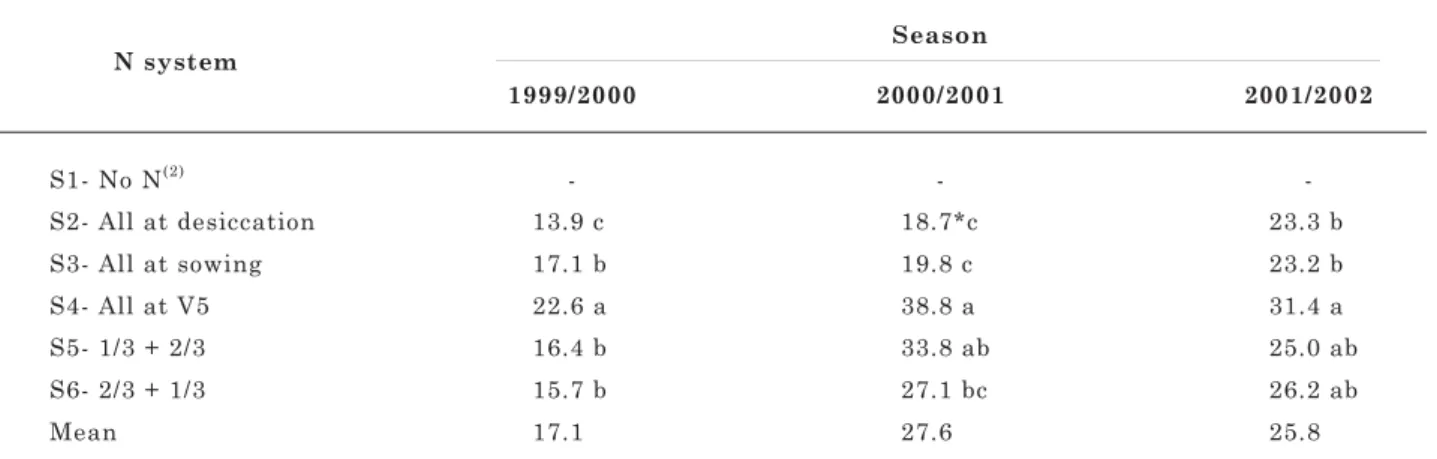
Each kilogram of N applied to the soil increased grain yield (AEN) from 13.9 to 38.8 kg, depending on
the N management system and growing season (Table 6). In all three seasons, one of the most efficient forms to manage N fertilization to produce grains was to side-dress the whole N rate in V5. An additional advantage of S4 is to apply all N in a single operation once split fertilization is more labor-intensive and increases fuel consumption. On the other hand, concentrating N fertilization at black oat desiccation or maize sowing decreased AEN. An adequate N supply
at flowering is fundamental to maintain a high
Table 5. Effect of N management systems on maize grain yield and its components, considering the mean of two tillage systems
N system Grain yield Weight of
1,000 grains
Grains
per ear
Ears
per plant
Weight of
grains per ear
t ha- 1 g number number g
1999/2000
S1- No N( 1) 9.48*b 314 b 412 b 1.01 b 130 b
S2- All at desiccation 10.87 a 340 a 445 a 1.09 a 151 a
S3- All at sowing 11.19 a 339 a 448 a 1.07 a 152 a
S4- All at V5 11.75 a 339 a 462 a 1.06 a 157 a
S5- 1/3 + 2/3 11.12 a 331 a 463 a 1.07 a 153 a
S6- 2/3 + 1/3 11.04 a 335 a 455 a 1.06 a 152 a
Mean 10.91 333 447 1.06 149
2000/2001
S1- No N 7.48 d 322 **NS 312 d 0.99 b 101 d
S2- All at desiccation 9.54 c 321 389 c 1.02 ab 125 bc
S3- All at sowing 9.59 c 328 373 c 1.00 b 118 c
S4- All at V5 11.76 a 332 461 a 1.03 ab 153 a
S5- 1/3 + 2/3 11.20 ab 324 435 ab 1.03 ab 141 ab
S6- 2/3 + 1/3 10.37 bc 317 413 bc 1.07 a 131 bc
Mean 9.19 324 397 1.02 128
2001/2002
S1- No N 6.04 c 283 b 312 c 0.96 b 77 b
S2- All at desiccation 8.56 b 297 ab 414 b 0.98 b 107 a
S3- All at sowing 8.59 b 304 a 412 b 0.97 b 112 a
S4- All at V5 9.50 a 305 a 435 a 1.04 a 115 a
S5- 1/3 + 2/3 8.81 ab 306 a 416 ab 0.98 b 111 a
S6- 2/3 + 1/3 8.95 ab 307 a 409 b 1.00 ab 109 a
Mean 8.41 300 400 0.99 105
(1) S1- No N: without N application; S2- All at desiccation: all N applied before maize sowing at oat desiccation; S3- All at sowing:
all N applied at maize sowing; S4- All at V5: all N side-dressed when maize plants were at V5; S5- 1/3 + 2/3: 1/3 of N rate applied at maize sowing and 2/3 side-dressed at V5; S6- 2/3 + 1/3: 2/3 of N rate applied at maize sowing and 1/3 side-dressed at V5. * Means followed by the same lower case letter in the column within each year are not significantly different by Duncan’s test (P < 0.05). ** NS – no significant differences at P < 0.05.
The grain yield values obtained with the S4 N management system over the whole experimental period indicates that side-dressing all N when plants had five expanded leaves did not jeopardize maize nutrient uptake from the soil or high yields. Our data evidence that short term N immobilization was not a key factor to reduce grain yield when no N was applied at maize sowing, regardless of the soil tillage system. This contradicts the proposal of Sá (1997) to move the time of N application from the traditional side-dress in V5 to the time of winter crop desiccation or maize sowing following black oat in no-till tillage systems. Three reasons may explain our results. The Oxisol had more than 50 g kg-1 of organic matter,
which probably inhibited N immobilization caused by the oat residues with high C/N ratio. Argenta et al. (1999), evaluating the response of grain yield to the timing of N application in two soils, found detrimental effects of side-dressing all N in V5 only when maize was grown under no-tillage after black oat in the soil with less than 30 g kg-1 organic matter.
Another aspect to consider is the time between oat desiccation and maize sowing. Nitrogen immobilization is a short-term process that is quite intense in the first 30 days after winter crop incorporation or desiccation (Torbet et al., 2001; Ernani et al., 2002). One strategy to minimize this process and its detrimental effect on grain yield is to avoid sowing maize right after black oat desiccation. Argenta et al. (1999) observed that waiting 20 days after oat desiccation until maize sowing is an efficient strategy to accelerate the decomposition of oat straw and to decrease its negative impact on maize growth. In our study, there was always an interval of at least three weeks between oat incorporation/desiccation and
Season N system
1999/2000 2000/2001 2001/2002
S1- No N( 2) - -
-S2- All at desiccation 13.9 c 18.7*c 23.3 b
S3- All at sowing 17.1 b 19.8 c 23.2 b
S4- All at V5 22.6 a 38.8 a 31.4 a
S5- 1/3 + 2/3 16.4 b 33.8 ab 25.0 ab
S6- 2/3 + 1/3 15.7 b 27.1 bc 26.2 ab
Mean 17.1 27.6 25.8
Table 6. Effect of N fertilizer systems on agronomic efficiency of applied N (AEN)(1) in maize, considering the
mean of the two tillage systems
(1) AE
N = (YN – Y0/FN) where YN is the crop yield at a certain level of fertilizer N applied (kg ha -1), Y
0 is the crop yield measured
in a treatment with N application and FN is the N rate (100 kg ha-1. (2) S1- No N: without N application; S2- All at desiccation: all
N applied before maize sowing at oat desiccation; S3- All at sowing: all N applied at maize sowing; S4- All at V5: all N side-dressed when maize plants were at V5; S5- 1/3 + 2/3: 1/3 of N rate applied at maize sowing and 2/3 side-dressed at V5; S6- 2/3 + 1/3: 2/3 of N rate applied at maize sowing and 1/3 side-dressed at V5. * Means followed by the same lower case letter in the column within each year are not significantly different by Duncan’s test (P < 0.05).
maize sowing. This probably attenuated the competition between soil microorganisms and maize for nitrogen.
Finally, the reduced period of early crop growth, usually observed with delayed N application when maize is sown after black oat, has less effect on grain yield when corn is planted in the beginning of spring (Russele et al., 1983; Scharf et al., 2002). At this time, air temperatures are low and maize grows slowly, which gives the crop more time to recover from early cycle stresses without compromising the formation of yield component (Sangoi, 1993). This experiment was sown in the beginning of the growing season (second half of October) at mild temperatures, ranging from 15 to 25 °C (data not shown), until plants reached the flowering stage.
CONCLUSION
LITERATURE CITED
AMADO, T.J.C.; MIELNICZUCK, J. & VEZZANI, F.M. Nova recomendação de adubação nitrogenada para o milho sob plantio direto no RS e SC adaptada ao uso de cobertura do solo. R. Plantio Direto, 3:30-35, 2002.
ANDROSKI, T.W.; BUNDY, L.G. & BRYE, K.R. Crop management and corn nitrogen rate effects on nitrate leaching. J. Environ. Qual., 29:1095-1103, 2000. ARGENTA, G.; SILVA, P.R.F.; RIZZARDI, M.A.; BARUFFI,
M.A. & BEHEREGARAY NETO, V. Manejo do nitrogênio do milho em semeadura direta em sucessão a espécies de cobertura de solo no inverno e em dois locais. I. Efeito sobre a absorção de N. Ci. Rural., 29:577-586, 1999. BASSO, C.J. & CERETTA, C.A. Manejo do nitrogênio no milho
em sucessão a plantas de cobertura de solo, sob plantio direto. R. Bras. Ci. Solo, 24:905-915, 2000.
BAYER, C. & MIELNICZUK, J. Características químicas do solo afetadas por métodos de preparo e sistemas de cultura. R. Bras. Ci. Solo, 21:105-112, 1997.
BELOW, F.E. Fisiologia, nutrição e adubação nitrogenada do milho. Inf. Agron., 99:7-12, 2002.
BLACKMER, A.M.; MORRIS, T.F. & BINFORD, G.D. Predicting N fertilizer needs for corn in humid regions: advances in Iowa. In: BOCK, B.R. & KELLEY, K.R., eds. Predicting N fertilizer needs in humid regions. Ames, National Fertilizer and Environmental Research Center, 1992. p.58-72.
BORTOLINI, C.G.; SILVA, P.R.F. & ARGENTA, G. Sistemas consorciados de aveia preta e ervilhaca comum como cobertura de solo e seus efeitos na cultura do milho em sucessão. R. Bras. Ci. Solo, 24:897-903, 2000.
BORTOLINI, C.G.; SILVA, P.R.F.; ARGENTA, G. & FORSTHOFER, E.L. Rendimento de grãos de milho cultivado após aveia preta em resposta a adubação nitrogenada e regime hídrico. Pesq. Agropec. Bras., 36:1101-1106, 2001.
BULL, L.T. Nutrição mineral do milho. In: BULL, L.C., ed. Cultura do milho: Fatores que afetam a produtividade. Piracicaba, Potafós, 1993. p.63-146.
CERETTA, C.A. & FRIES, M.R. Adubação nitrogenada no sistema de plantio direto. In: FRIES, M.R. & DALMOLIN, R.S.D., eds. Atualização em recomendação de adubação e calagem: Ênfase em plantio direto. Santa Maria, Universidade Federal de Santa Maria, 1997. p.112-124. CERETTA, C.A.; BASSO, C.J.; FLECHA, A.M.T.; PAVINATO,
P.S.; VIEIRA, F.C.B. & MAI, M.E.M. Manejo da adubação nitrogenada na sucessão aveia preta/milho, no sistema plantio direto. R. Bras. Ci. Solo, 26:163-171, 2002a. CERETTA, C.A.; BASSO, M.J.; HERBES, M.G.; POLETTO, N.
& SILVEIRA, M.J. Produção e decomposição de fitomassa de plantas hibernais de cobertura de solo e milho, sob diferentes manejos da adubação nitrogenada. Ci. Rural, 32:49-54, 2002b.
COMISSÃO DE FERTILIDADE DO SOLO-CFSRS/SC. Recomendações de adubação e calagem para os estados do Rio Grande do Sul e Santa Catarina. Porto Alegre, SBCS-Núcleo Regional Sul, 2004. 394p.
DINNES, D.L.; KARLEN, D.L.; JAYBES, D.B.; KASPAR, T.C.; HATFIELD, J.L.; COLVIN, T.S. & CAMBARDELLA, C.A. Nitrogen management strategies to reduce nitrate leaching in tile-drained midwestern soils. Agron. J., 94:153-171, 2002.
EARL, H.J. & TOLLENAAR, M. Maize leaf absorptance of photosynthetically active radiation and its estimation using a chlorophyll meter. Crop Sci., 37:436-440, 1997. ERNANI, P.R., Disponibilidade de nitrogênio e adubação
nitrogenada para a macieira. Lages, Graphel, 2003. 76p. ERNANI, P.R.; SANGOI, L. & RAMPAZZO, C. Lixiviação e imobilização de nitrogênio num Nitossolo como variáveis da forma de aplicação da uréia e da palha de aveia. R. Bras. Ci. Solo, 26:993-1000, 2002.
KUO, S. & JELLUM, E.J. Influence of winter cover crop and residue management on soil nitrogen availability in corn. Agron. J., 94:501-508, 2002.
LECH, V.A. Perdas de N e resposta do milho à adubação nitrogenada afetadas por sistemas de manejo dos restos culturais de aveia preta. Lages, Universidade do Estado de Santa Catarina, 2001. 85p. (Tese de Mestrado) MAI, E.M.M.; CERETTA, C.A.; BASSO, C.J.; SILVEIRA, M.J.;
PAVINATO, A. & PAVIANATO, S. Manejo da adubação nitrogenada na sucessão aveia preta/milho no sistema plantio direto. Pesq. Agropec. Bras., 38:125-131, 2003. MOSIER, A.R.; SYERS, J.K. & FRENEY, J.R. Agriculture
and the nitrogen cycle – assessing the impacts of fertilizer use on food production and the environment. Washington, Island Press, 2004. (Scope report, 65) MUZZILI,O. & OLIVEIRA, A. Nutrição e adubação. In:
INSTITUTO AGRONÔMICO DO PARANÁ. O milho no Paraná. Londrina, 1992. p.88-95.
RITCHIE, S.W.; HANWAY, J.J. & BENSON, G.O. How a corn plant develops. Ames, Iowa State University of Science and Technology, 1993. 26p. (Special Report, 48) RUSSELE, M.P.; HAUCK, R.D. & OLSON, R.A. Nitrogen
accumulation rates of irrigated corn. Agron. J., 75:593-598, 1983.
SÁ, J.C.M. Manejo do nitrogênio na cultura do milho no sistema de plantio direto. In: FANCELLI, A.L. & DOURADO-NETO, D., eds. Tecnologia de produção de milho. Piracicaba, Escola Superior de Agricultura Luiz de Queiroz, 1997. p.84-103.
SANGOI, L. Aptidão dos campos de Lages para produção de milho em diferentes épocas de semeadura. Pesq. Agropec. Bras., 28:51-63,1993.
SANGOI, L.; ALMEIDA, M.L.; LECH, V.A.; GRACIETTI, L.C. & RAMPAZZO, C. Desempenho de híbridos de milho com ciclos contrastantes em função da desfolha e da população de plantas. Sci. Agric., 58:271-276, 2001b. SANGOI, L.; ENDER, M.; GUIDOLIN, A.F. & KONFLANZ,
SCHERER, E.E. Avaliação de fontes e épocas de aplicação do adubo nitrogenado na cultura do milho no sistema plantio direto. Agropec. Catarinense, 14:48-53, 2001.
SCHARF, P.C.; WIEBOLD, W.J. & LORY, J.A. Corn yield response to nitrogen fertilizer timing and deficiency level. Agron. J., 94:435-441, 2002.
TEDESCO, M.J.; VOLKSVEISS, S.J. & BOHEN, H. Análise de solo, plantas e outros materiais. Porto Alegre, Universidade Federal do Rio Grande do Sul, 1995. 188p. (Boletim Técnico, 5)
TORBERT, H.A. & WOOD, C.A. Effects of soil compaction and water-filled pore space on soil microbial activity and N losses. Comm. Soil Sci. Plant Anal., 23:1321-1331, 1992. TORBERT, H.A.; POTTER, K.N. & MORRISON JR., J.E. Tillage system, fertilizer nitrogen rate, and timing effect on corn yields in the Texas Blackland Prairie. Agron. J., 93:1119-1124, 2001.