www.ccarevista.ufc.br ISSN 1806-6690
Application of superphosphate complexed with humic acid in an area
of sugarcane
1Aplicações de superfosfato complexado com ácido húmico em área de
cana-de-açúcar
Eduardo Zavaschi2, Risely Ferraz-Almeida2, Letícia Abreu Fária3, Rafael Otto2*, André César Vitti4 and
Godofredo Cesar Vitti2
ABSTRACT - In tropical soils, the efficiency of phosphorus (P) fertilization is low, due to P adsorption on the surface of the
clay. Superphosphate complexed with humic acid (SSP+HA) is presented as an alternative for improving P use efficiency and crop yields. The aim of this study was to investigate SSP+HA performance in sugarcane production including increases in plant dry matter (DM) and P content. The experiment was conducted with two sources of P (simple superphosphate – SSP, SSP+HA) and five doses (0, 45, 90, 135 and 180 kg ha-1 P
2O5). The dose of 135 kg ha -1P
2O5 was used to explain the residual effect of P,
collecting soil samples from the plant cane and first ratoon. Stalk, top and root samples were collected to determine DM and P content; both variables were used to calculate the P assimilation efficiency (PaE). Results showed that the application of SSP increased the DM and P content of the plants, with superior performance compared to SSP+HA. PaE was greater under SSP+HA, indicating that P was metabolized more efficiently; however this did not reflect in an increase in DM. AThe P rates increased the sugarcane yield in cane plant, but there was no effect of P applied in the first ratoon due to the residual effect of P applied in planting. SSP presented superior performance compared to SSP + SH in sugarcane planting. Further research is needed to better demonstrate the effect of SSP+HA on the absorption and translocation of P.
Key words: Soil fertilization. Phosphorus adsorption. Phosphorus dynamics.
RESUMO - Adubações com fósforo (P) apresentam baixa eficiência devido à adsorção de P na superfície da argila em solos
tropicais. O superfosfato complexado com ácido húmico (SSP+HA) é apresentado como uma alternativa para melhorar a eficiência do uso do P e a produtividade das culturas. Nesse sentido, o objetivo deste estudo foi investigar o desempenho do SSP+HA na produção de cana-de-açúcar com incrementos da matéria seca (MS) e conteúdo de P nas plantas. O experimento foi conduzido com duas fontes de P (superfosfato simples-SSP; SSP+HA) e cinco doses (0; 45; 90; 135 e 180 kg ha-1 de P
2O5).
A dose de 135 kg ha-1 foi usada para explicar o efeito residual do P, coletando solo na cana-planta e primeiro corte. Amostras
de caules, ponteiras e raízes foram coletadas para determinar MS e conteúdo de P; ambas variáveis foram usadas para calcular a eficiência de assimilação de fósforo (EaP). Os resultados mostraram que a aplicação de SSP aumentou MS e conteúdo de P nas plantas, com desempenho superior ao SSP+HA. A EaP foi maior no SSP+HA, indicando que o P foi metabolizado de forma mais eficiente, mas não refletiu no aumento de MS. As doses de P aumentaram a produtividade da cana-planta, mas não houve efeito do P aplicado em soqueira, devido ao efeito residual do P aplicado no plantio. O SSP apresentou desempenho superior ao SSP+SH no plantio da cana-de-açúcar. Mais pesquisas são necessárias para melhor ilustrar o efeito do SSP+HA na absorção e translocação do P.
Palavras-chave: Fertilização do solo. Adsorção do fósforo. Dinâmica do fósforo.
DOI: 10.5935/1806-6690.20200010 *Author for correspondence
Received for publication 03/10/2018; approved on 03/09/2019
1Trabalho extraído da Tese do primeiro autor apresentada ao Programa de Pós-Graduação em Solos e Nutrição de Plantas, Universidade de São
Paulo/USP - Escola Superior de Agricultura “Luiz de Queiroz”
2Departamento de Ciência do Solo, Universidade de São Paulo/USP - Escola Superior de Agricultura “Luiz de Queiroz”, Piracicaba-SP, Brasil,
[email protected] (ORCID ID 0000-0002-1328-3789), [email protected] (ORCID ID 0000-0003-0577-3961), [email protected] (ORCID ID 0000-0003-1472-298X), [email protected] (ORCID ID 0000-0003-1232-4734)
3Universidade Federal Rural da Amazônia/UFRA, Paragominas-PA, Brasil, [email protected] (ORCID ID 0000-0002-2506-2246) 4Secretaria de Agricultura e Abastecimento, Agência Paulista de Tecnologia dos Agronegócios/APTA, Piracicaba-SP, Brasil, [email protected]
INTRODUCTION
The cultivation of sugarcane (Saccharum spp.) is increasing in Brazil due to the demand for biofuel production (VRIES et al., 2010). Brazil is currently considered the global leader in sugarcane production, with about 10.2 million hectares under cultivation, mainly located in the Southeast of the country (FAOSTAT, 2018).
Sugarcane is expected to expand into areas of degraded pasture and low fertility, where fertilization of the soil will require suitable management to achieve greater production (JAISWAL et al., 2017; OTTO et al., 2016). The application of phosphorus (P) will play a prominent role in this scenario due to the importance placed on the yield and quality of the sugarcane, and the low P use efficiency that makes P a major limiting factor in sugarcane production (TEIXEIRA; SOUSA; KORNDÖRFER, 2014).
The usual P recommendation for plant cane
ranges from 150 to 200 kg ha-1 P
2O5, with the export of
≅ 30 kg P2O5 absorbed per 100 Mg
-1 of produced stalk
(VITTI; OTTO; FERREIRA, 2015). If it is considered that the mean for sugarcane production in Brazil was
72.6 Mg ha-1 in 2018/2019 (COMPANHIA NACIONAL
DE ABASTECIMENTO, 2019), this shows that≅ 90%
of the P2O5 applied during 2018/2019 (mean of 175 kg ha-1
P2O5), remained in the soil and stubble on the sugarcane
plantations.
This imbalance of P in the soil is not only influenced by both P adsorption on the positive charged surface of oxides and hydroxides of iron and aluminum in acidic soils, and P precipitation with calcium and magnesium in alkaline soils (TEIXEIRA; SOUSA; KORNDÖRFER, 2014), but also by the amount of each input (mainly the application of organic and inorganic fertilizer). The P that remains in the soil (adsorbed and precipitated) is considered residual P that can contribute to crop production in the long term (SATTARI et al., 2012). In the short term, the application of acidulated P fertilizers is the principal practice recommended for increasing available P in the soil, contributing to an increase between 10 and 20% in sugarcane yield (CALHEIROS et al., 2012; ZAMBROSI et al., 2012).
Superphosphate complexed with humic acid (SSP+HA) has been suggested as an alternative fertilizer for minimizing P adsorption in the soil (GUARDADO; URRUTIA; GARCIA-MINA, 2007; URRUTIA et al., 2014). Recent studies have shown a significant increase in available P in tropical soils with the application of SSP+HA (ROSA; SILVA; MALUF, 2018), with improvements in soil microbial biomass (GIOVANNINI et al., 2013), and root development, and an increase in the yield of grains
and legumes (ERRO et al., 2011; HERRERA et al., 2016). However, there has been no study demonstrating the results of SSP+HA on sugarcane yield or the residual effect in tropical soil, thereby justifying the present research under tropical conditions.
The aim of this study was to investigate the hypothesis that the application of SSP+HA increases the dry matter and P content of plant cane due to the increase in available P in the soil, and reduces the residual effect caused by P complexation with humic acid.
MATERIAL AND METHODS
Characterization of the siteThe experiment was conducted in an area of sugarcane located in Charqueada, in São Paulo, Brazil (22º33’15” S; 47º43’28” W; 600 m) from 2011 to 2012. The climate in the area is classified as Aw tropical by the Köppen classification. In 2011 and 2012, total precipitation was around 1,776.6 and 1,366.8 mm, with an average
temperature of 21.8 and 22.3oC, respectively.
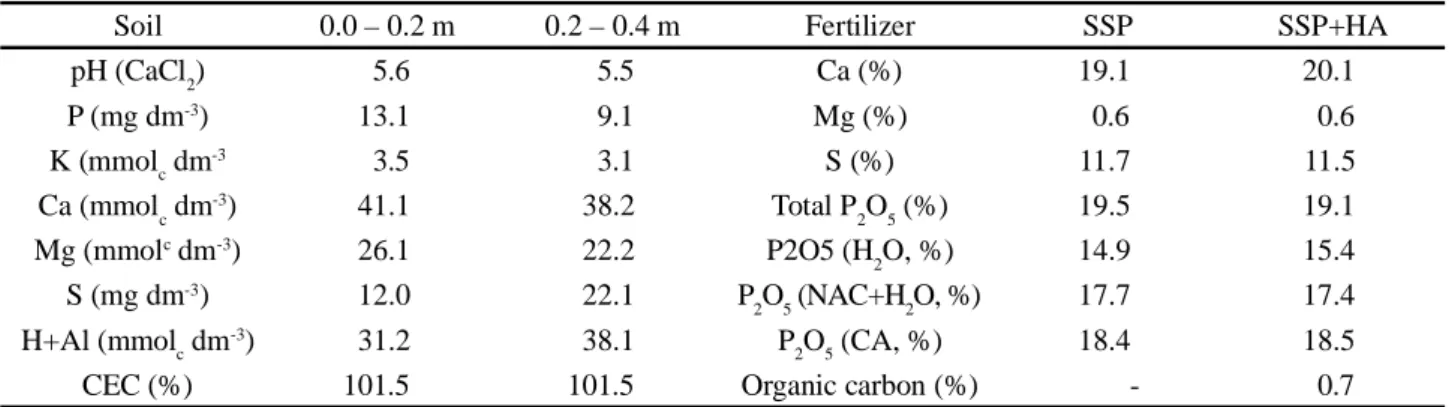
Before installing the experiment, soil samples were collected from six points (replications) at depths ranging from 0.0 to 0.2 m and 0.2 to 0.4 m. The samples were homogenized and submitted to chemical and physical characterization as per Camargo et al. (2009) and Van Raij et al. (2001), Table 1. The fertilizers (simple superphosphate – SSP, and superphosphate complexed with humic acid - SSP+HA), found as commercial products, were also analyzed chemically (Table 1). More details concerning SSP+HA can be found in Guardado, Urrutia and Garcia-Mina (2007).
The soil was classified as an ARGISSOLO VERMELHO Álico according to the Brazilian System for Soil Classification (EMPRESA BRASILEIRA DE PESQUISA AGROPECUÁRIA, 2018), corresponding to an Ultisol (SOIL SURVEY STAFF, 2014), with a clayey textural class, and clay, silt and sand content of 653, 85
and 262 g kg-1 respectively. According to the analysis, the
soil was classified as acidic (pH: 5.5 - 5.6) with low levels
of P (9.1 - 13.1 mg dm-3) in the 0.0-0.4 m layer (VAN RAIJ
et al., 1997).
Experimental design
The experimental design was of randomized complete blocks, with four replications. The treatments comprised two sources of P (SSP and SSP+HA) and five
doses (control: 0, 45, 90, 135 and 180 kg ha-1 P
2O5). The
dose of 135 kg ha-1 P
2O5 was used to explain the residual
Table 1 - Chemical characteristics of the soil and fertilizers (simple superphosphate – SSP, superphosphate complexed with humic acid
- SSP+HA)
with the split application of 45 + 90 kg ha-1 and 90 +
45 kg ha-1 P
2O5when planting and after the first harvest
respectively. The dose of 135 kg ha-1 P
2O5 was used as
it is well-established in sugarcane cultivation in Brazil (ROSSETTO; SANTIAGO, 2018). Each experimental unit consisted of ten rows, at a narrow spacing of 0.9 m and wide spacing of 1.50 m, with a length of 15 m, giving a total of 32 experimental units and 180 m² per experimental plot.
The sugarcane (var. CTC 14) was planted using the conventional system in November 2011. The soil was prepared along the furrow according to the soil analysis, and involved the distribution and incorporation (0.25 m) of dolomitic limestone 30 days before planting, to reach 70% base saturation (rate:
2 Mg ha-1; total relative neutralizing power of 90%).
Furrows for the sugarcane were opened and fertilized
with 50 and 120 kg ha-1 of nitrogen – N (urea: 45%
N) and potassium – K (potassium chloride: 60% K2O),
respectively. The treatments with the P fertilizers were applied manually, together with the application of the N and K. Sulfur fertilization (elemental sulfur; 90% sulfur) was also carried out in the control to balance the S content. After the
first harvest, N and K were applied at 100 kg ha-1, following
the usual practice described by Vitti, Otto and Ferreira (2015). Applications of P were carried out to study the residual effect at the first harvest.
Measurements and Statistical Analysis
During the tenth month of growth, stalks and tops were collected from the two central rows of each plot in the plant cane and the first ratoon. Roots were collected
from 0.11 m3 of soil (width: 0.4 m, length: 0.7 m, height:
0.4 m) from one representative row of each plot. In the laboratory, the roots were separated from the soil, and the stalk, top and root samples were weighed and dried
(65 °C) to determine the dry matter and P content as per Malavolta, Vitti and Oliveira (1997).
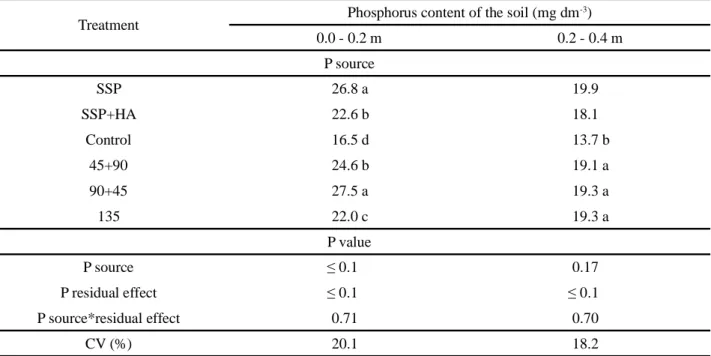
To explain the residual P, soil samples were collected in a furrow at the surface (0.0 – 0.2 m) and subsurface (0.2 - 0.4 m) of the first ratoon to determine the P content as per the resin method (VAN RAIJ et al., 2001).
Phosphorus assimilation efficiency (PaE) was calculated in the shoots (stalks and tops) following Equation 1, based on the study by Urrutia et al. (2014),
where DW is the shoot dry weight (Mg ha-1), P_DW is the
P content of the shoot dry weight (kg ha-1), and PaE is the
P content required to produce the DM.
PαE = Dw/P-Dw (1)
The assumptions of data normality (Shapiro-Wilk-Test; Sigmaplot v.10) and homogeneity of variance (Bartlett-Test; SPSS Statistics v.20) were evaluated. Outliers were removed when identified by the Grubb-Test (R v.3.6.1). The phosphorus applications were subject to analysis of variance (ANOVA; R v.3.6.1) based on the F-test, and when significant (p ≤ 0.1), the mean values were compared by the Regression test (P doses) and the LSD test (P sources and residual) at a confidence level of 0.1. The variables were correlated using the Pearson Correlation (p ≤ 0.05; Sigmaplot v.10).
RESULTS AND DISCUSSION
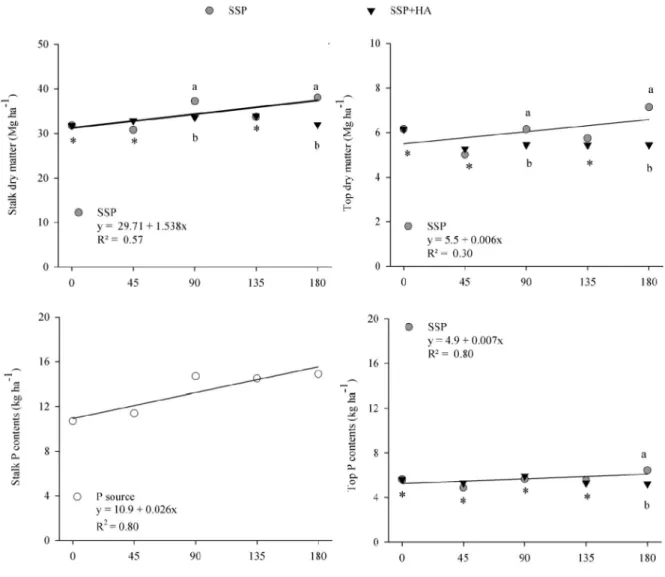
Phosphorus application in plant caneIn the plant cane, the SSP doses fitted linear
responses for stalk dry matter (R2 = 57%; p ≤ 0.1) and top
dry matter (R2 = 30%; p ≤ 0.1), as well for top P content
Soil 0.0 – 0.2 m 0.2 – 0.4 m Fertilizer SSP SSP+HA
pH (CaCl2) 5.6 5.5 Ca (%) 19.1 20.1 P (mg dm-3) 13.1 9.1 Mg (%) 0.6 0.6 K (mmolc dm-3 3.5 3.1 S (%) 11.7 11.5 Ca (mmolc dm-3) 41.1 38.2 Total P 2O5 (%) 19.5 19.1 Mg (mmolc dm-3) 26.1 22.2 P2O5 (H 2O, %) 14.9 15.4 S (mg dm-3) 12.0 22.1 P 2O5 (NAC+H2O, %) 17.7 17.4 H+Al (mmolc dm-3) 31.2 38.1 P 2O5 (CA, %) 18.4 18.5
CEC (%) 101.5 101.5 Organic carbon (%) - 0.7
pH: hydrogen potential (CaCl2); P: phosphorus; K: potassium; Ca: calcium; Mg: magnesium; S: sulfur; H+Al: hydrogen plus aluminum; CEC: cation
(R2 = 80%; p ≤ 0.1), achieving a highest mean value of
37.4 and 6.6 Mg ha-1, and 6.2 kg ha-1 respectively (Table 2;
Figure 1). These results agree with those of Albuquerque
et al. (2016) and Calheiros et al. (2012), who presented a
positive response for acidulated phosphate in plant cane. This is explained by the fast release of P by the acidulated phosphate (OLIVEIRA JUNIOR; PROCHNOW; KLEPKER, 2008) for both root development and the production of energy and sugar (TEIXEIRA; SOUSA; KORNDÖRFER, 2014). These results are confirmed by the positive correlation between the soil P content and the stalk dry matter (r: 0.43; p ≤ 0.05).
The application of SSP+HA did not positively affect sugarcane dry matter or top P content in the plant cane (Table 2; Figure 1). SSP showed better performance for top and stalk dry matter at a dose of 90 and 180 kg
P2O5 ha-1, and for top P content at a dose of 180 kg P
2O5
ha-1 (Figure 1). This was surprising, and the hypothesis
that the application of acidulated phosphate complexed with humic acid might promote a greater production of sugarcane dry matter was not accepted. It might be possible to detect the positive effect of SSP+HA if the experiment were conducted with a species that is more responsive to P application, such as soybean or maize. Herrera et al.
(2016), studying the response of soybean [Glycine max (L.) Merr.], maize (Zea mays L.) and wheat [Triticum
aestivum (L.) em. Thell], showed a positive effect on crop
production in soil with added organic matter and sources of P, in addition to a significant relationship between organic matter and P-fertilizer under tropical conditions. Li, Wang and Stewart (2011) described how soybean had a greater response to P application compared to maize, wheat or the pea (Pisum sativum L.) due to the rootsystem characteristics of the soybean (FÖHSE, CLAASSEN AND JUNGK, 1991; HEUER et al., 2017). In future studies using SSP+HA tests with maize or soybean are recommended due to the higher P use efficiency. The above explains the lack of results for root dry matter for any of the sources under study (Table 2).
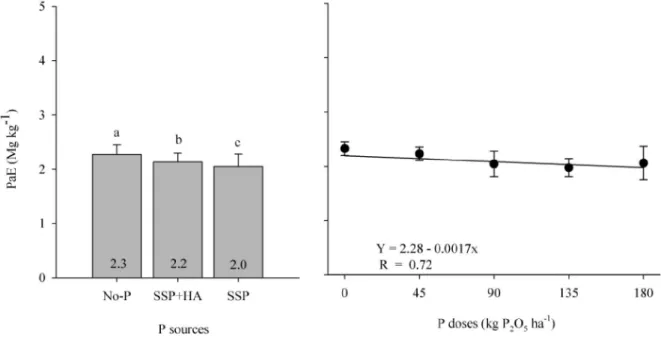
Even though SSP+HA did not increase the dry matter, the PaE was higher compared to under SSP (Figure 2), indicating that plants which received P from SSP+HA were able to optimize the metabolic P more efficiently. The higher PaE shows that the shoot P content was lower under SSP+HA than in plants fertilized with SSP. Urrutia et al. (2014) also found a higher shoot PaE (wheat and chickpea) in soil fertilized with SSP+HA. This result is explained by the association of P with the humic
Table 2 - Root, stalk and top dry matter, and stalk and top P content in soil fertilized with simple superphosphate (SSP) and superphosphate
complexed with humic acid (SSP+HA), using P doses (0, 45, 90, 135 and 180 kg ha-1 P
2O5) in plant cane
P dose/source
--- Dry matter --- --- P content
---Roots Stalks Tops Stalks Tops
g kg-1 soil --- Mg ha-1 --- --- kg ha-1 ---P source Control 9.8 31.8 6.2 10.7 c 5.7 SSP 11.2 34.9 6.0 15.4 a 5.7 SSP+HA 11.0 33.1 5.4 12.5 b 5.5 P dose (kg ha-1) 0 9.8 31.8 6.2 10.7 5.7 45 11.0 31.8 5.1 11.4 5.2 90 11.2 35.4 5.8 14.7 5.8 135 11.1 33.8 5.6 14.5 5.6 180 11.0 35.0 6.3 14.9 5.7 p value P source 0.13 ≤ 0.1 ≤ 0.1 ≤ 0.1 0.58 P dose 0.38 ≤ 0.1 ≤ 0.1 ≤ 0.1 0.30 P source*dose 0.63 ≤ 0.1 ≤ 0.1 0.27 ≤ 0.1 CV (%) 14.1 8.5 10.9 16.1 20.2
Root dry matter was calculated per kg of soil; CV: Coefficient of variation; Mean values were compared by the LSD test (P source) and the Regression test (P dose) at a confidence level of 0.1
Figure 1 - Stalk and top dry matter and phosphorus (P) content in soil fertilized with simple superphosphate (SSP) and superphosphate
complexed with humic acid (SSP+HA), using P doses (0, 45, 90, 135 and 180 kg ha-1 P
2O5) in plant cane. Mean values were compared
by the LSD test (P source) and the Regression test (P dose) at a confidence level of 0.1. *No significant difference
acid surface via an Fe and Al-bridge under SSP+AH (P – M – HA) (DELGADO et al., 2002; GUARDADO; URRUTIA; GARCIA-MINA, 2007). With the application of P complexed with HA, competition between the plant and the HA is probably necessary to obtain the P. This competition promotes a stress response, activating physiological and metabolic mechanisms to optimize P use in the shoots. Further investigation is needed to better illustrate the physiological and metabolic mechanisms of P complexed with HA on sugarcane development.
As expected, the application of P doses fitted
a negative linear response for PaE (R2 = 72%; p ≤ 0.1;
Figure 2), which is associated with luxury consumption by the plants, as described by Wijk et al. (2003).
Residual effect of phosphorus
In first ratoon sugarcane, the total or split
application of 135 kg P2O5 showed no difference in
difference in dry matter and P content of stalks (Table 3). This indicates that additional P fertilization is not
necessary after planting using a dose of 135 kg ha-1 P
2O5,
agreeing with the recommended dose of 120-140 kg ha-1
P2O5 for producing 100-150 Mg ha-1in plant cane (VAN
RAIJ et al., 1997). The residual effect of P is shown in several studies (JOHNSON et al., 2017; PASUCH
et al., 2012; SANTOS et al., 2014), and explained by
such characteristics of P as low mobility in the soil, the residual effect and the low demand of new varieties after the first harvest (JOHNSON et al., 2017).
The simple superphosphate promoted a greater residual effect in the soil, with a positive effect on top and root dry matter, and on top P content, with better
results compared to SSP+HA (Tables 3 and 4). This was expected, as the great advantage of SSP+HA is less P adsorption on the soil surface with a smaller residual
Figure 2 - Phosphorus assimilation efficiency (PaE; Mg kg-1) in the shoots (stalks and tops) in soil fertilized with simple superphosphate
(SSP) and superphosphate complexed with humic acid (SSP+HA), using P doses (0, 45, 90, 135 and 180 kg ha-1 P
2O5) in plant cane.
Mean values were compared by the LSD test (P sources) and the Regression test (P doses) at a confidence level of 0.1
P dose/source
--- Dry matter --- - P content
---Roots Stalks Tops Stalks Tops
g kg-1 soil --- Mg ha-1 --- --- kg ha-1 ---P sources Control 9.1 b 31.1 5.5 b 10.3 4.6 b SSP 10.9 a 33.9 7.1 a 8.7 6.0 a SSP+HA 9.4 b 33.5 5.6 b 8.8 4.9 ab P residual 45+90 8.6 b 31.4 5.3 b 8.1 4.4 b 90+45 11.1 a 34.4 7.3 a 9.4 6.3 a 135 10.7 ab 35.2 6.4 ab 8.8 5.4 ab P value Psource ≤ 0.1 0.71 ≤ 0.1 0.54 ≤ 0.1 Presidualeffect ≤ 0.1 0.48 ≤ 0.1 0.49 ≤ 0.1 Psource*residual 0.32 0.67 0.35 0.53 0.52 CV (%) 19.1 17.6 24.2 27.5 24.2
Root dry matter was calculated per kg of soil; CV: Coefficient of variation; Mean values were compared by the LSD test (P source and residual) and the Regression test (P dose) at a confidence level of 0.1
Table 3 - Root, stalk and top dry matter and phosphorus content in soil with applications of phosphorus (simple superphosphate:
SSP; and superphosphate complexed with humic acid SSP+HA) in plant cane and the first ratoon (45+90 and 90+45 kg ha-1 P 2O5
effect (GUARDADO; URRUTIA; GARCIA-MINA, 2007; URRUTIA et al., 2014), especially in tropical soils that are characterized by P adsorption on the surface of the clay (ROSA; SILVA; MALUF, 2018). According to Yan et al. (2016), the presence of HA reduces P adsorption for a given surface area of iron oxide (especially amorphous).
CONCLUSION
1. Applications of simple superphosphate increase the dry matter and P content of plant cane, with a greater residual effect than applications of superphosphate complexed with humic acid. On the other hand, superphosphate complexed with humic acid shows greater phosphorus assimilation efficiency, indicating that the P is metabolized more efficiently; this, however, does not reflect in greater dry matter production or greater phosphorus accumulation in the sugarcane;
2. Considering these results and others from the literature, the findings suggest that simple superphosphate is a better alternative as a source of P in plant cane. Further investigation is needed to better illustrate the effect of superphosphate complexed with humic acid on sugarcane yield, and on the process of absorption and translocation of complexed P.
Table 4 - Phosphorus content of the soil with applications of phosphorus (simple superphosphate: SSP, and superphosphate complexed
with humic acid SSP+HA) in plant cane and the first ratoon (45+90 and 90+45 kg ha-1 P
2O5 respectively)
CV: Coefficient of variation; The control represents no P application. Mean values were compared by the LSD test (P sources and residual effect) at a confidence level of 0.1
REFERENCES
ALBUQUERQUE, A. W. et al. Growth and yield of sugarcane as a function of phosphorus doses and forms of application.
Revista Brasileira de Engenharia Agrícola e Ambiental,
v. 20, n. 1, p. 29-35, 2016.
CALHEIROS, A. S. et al. Produção de biomassa, de açúcar e de proteína em função de variedades de cana e de adubação fosfatada. Semina: Ciências Agrárias, v. 33, n. 2, p. 809-818, 2012.
CAMARGO, O. A. et al. Métodos de análise química,
mineralógica e física de solo. 2. ed. Campinas: Instituto
Agronômico de Campinas, 2009. p. 77.
COMPANHIA NACIONAL DE ABASTECIMENTO.
Acompanhamento da safra brasileira de cana-de-açúcar.
2018. Disponível em: https://www.conab.gov.br. Acesso em: 15 ago. 2019.
DELGADO, A. et al. Phosphorus fertilizer recovery from calcareous soils amended with humic and fulvic acids. Plant
Soil, v. 245, n. 2, p. 277-286, 2002.
EMPRESA BRASILEIRA DE PESQUISA AGROPECUÁRIA.
Sistema brasileiro de classificação de solo. 4. ed. Rio de
Janeiro: Embrapa/CNPS, 2018. 353 p.
ERRO, J. et al. 31 P NMR characterization and efficiency of new types of water-insoluble phosphate fertilizers to supply plant available phosphorus in diverse soil types. Journal of
Agriculture and Food Chemistry, v. 59, n. 5, p. 1900-1908,
2011.
Treatment Phosphorus content of the soil (mg dm
-3) 0.0 - 0.2 m 0.2 - 0.4 m P source SSP 26.8 a 19.9 SSP+HA 22.6 b 18.1 Control 16.5 d 13.7 b 45+90 24.6 b 19.1 a 90+45 27.5 a 19.3 a 135 22.0 c 19.3 a P value P source ≤ 0.1 0.17 P residual effect ≤ 0.1 ≤ 0.1 P source*residual effect 0.71 0.70 CV (%) 20.1 18.2
FAOSTAT. FOOD AND AGRICULTURE ORGANIZATION OF THE UNITED NATIONS. Statistics. 2018. Disponível em: http://www.fao.org/faostat/en/#data. Acesso em: 15 ago. 2018. FÖHSE, D.; CLAASSEN, N.; JUNGK, A. Phosphorus efficiency of plants. Plant and Soil, v. 132, n. 2, p. 261-272, 1991. GIOVANNINI, C. et al. Effect of organic-complexed superphosphates on microbial biomass and microbial activity of soil. Biology and Fertility of Soils, v. 49, n. 4, p. 395-401, 2013.
GUARDADO, I.; URRUTIA, O.; GARCIA-MINA, J. M. Size distribution, complexing capacity, and stability of phosphate-metal-humic complexes. Journal of Agricultural and Food
Chemistry, v. 55, n. 2, p. 408-413, 2007.
HERRERA, W. F. B. et al. Crop yields and soil phosphorus lability under soluble and humic-complexed phosphate fertilizers.
Agronomy Journal, v. 108, n. 4, p. 1692-1702, 2016.
HEUER, S. et al. Improving phosphorus use efficiency: a complex trait with emerging opportunities. The Plant Journal, v. 90, n. 1, p. 868-885, 2017.
JAISWAL, D. et al. Brazilian sugarcane ethanol as an expandable green alternative to crude oil use. Nature Climate Change, v. 7, n. 1, p. 788-792, 2017.
JOHNSON, R. M. et al. Sugarcane yields do not respond to phosphorus fertilizer in ratoon crops of LCP 85-384 in Louisiana. Journal of American Society of Sugar Cane
Technologists, v. 37, n. 1, p. 1-12, 2017.
LI, S.; WANG, Z.; STEWART, B. A. Differences of some leguminous and nonleguminous crops in utilization of soil phosphorus and responses to phosphate fertilizers. Advances in
Agronomy, v. 110, n. 1, p. 125-249, 2011.
MALAVOLTA, E.; VITTI, G. C.; OLIVEIRA, S. B. Avaliação
do estado nutricional das plantas: princípios e aplicações. 2.
ed. Piracicaba: POTAFOS, 1997. 319 p.
OLIVEIRA JUNIOR, A.; PROCHNOW, L. I.; KLEPKER, D. Eficiência agronômica de fosfato natural reativo na cultura da soja. Pesquisa Agropecuária Brasileira, v. 43, n. 5, p. 623-631, 2008.
OTTO, R. et al. Nitrogen use efficiency for sugarcane-biofuel production: what’s next? Bioenergy Research, v. 9, n. 4, p. 1272-1289, 2016.
PASUCH, B. D. et al. Desenvolvimento, produtividade e composição bromatológica da primeira soqueira da cana-de-açúcar em função de fontes de fósforo. Comunicata Scientiae, v. 3, n. 4, p. 263-270, 2012.
ROSA, S. D.; SILVA, C. A.; MALUF, H. J. G. M. Humic acid-phosphate fertilizer interaction and extractable phosphorus in soils of contrasting texture. Revista Ciência Agronômica, v. 49, n. 1, p. 32-42, 2018.
ROSSETTO, R.; SANTIAGO A. S. Correção e adubação. Embrapa, 2018. Disponível em: http://www.agencia.cnptia. embrapa.br/gestor/cana-de-acucar/arvore/CONTAG01_6_ 711200516715.html. Acesso em: 15 ago. 2018.
SANTOS, D. H. et al. The effect of filter cakes enriched with soluble phosphorus used as a fertilizer on the sugarcane ratoons.
Acta Scientiarum Agronomy, v. 36, n. 3, p. 365-372, 2014.
SATTARI, S. Z. et al. Residual soil phosphorus as the missing piece in the global phosphorus crisis puzzle. Proceedings of the
National Academy of Sciences, v. 109, n. 16, p. 6348-6353,
2012.
SOIL SURVEY STAFF. Keys to soil taxonomy. 2014. Disponível em: https://www.nrcs.usda.gov/wps/PA_NRCSConsumption/ download?cid...ext = pdf. Acesso em: 15 ago. 2018.
TEIXEIRA, W. G.; SOUSA, R. T. X.; KORNDÖRFER, G. H. Resposta da cana-de-açúcar a doses de fósforo fornecidas por fertilizante organomineral. Bioscience Journal, v. 30, n. 6, p. 1729-1736, 2014.
URRUTIA, O. et al. Physico-chemical characterization of humic-metal-phosphate complexes and their potential application to the manufacture of new types of phosphate-based fertilizers. Journal of Plant Nutrition and Soil Science, v. 177, n. 2, p. 128-136, 2014.
VAN RAIJ, B. et al. Análise química para avaliação da
fertilidade de solos tropicais. 1. ed. Campinas: Instituto
Agronômico de Campinas, 2001. 285 p.
VAN RAIJ, B. et al. Recomendações de adubação e calagem
para o estado de São Paulo. 2. ed. Campinas: Instituto
Agronômico de Campinas, 1997. 88 p. (Boletim Técnico, 100). VITTI, G. C.; OTTO, R.; FERREIRA, L. R. P. Nutrição e adubação da cana-de-açúcar. In: BELARDO, G. C.; CASSIA, M. T.; SILVA, R. P. Processos agrícolas e mecanização da
cana-de-açúcar. 1. ed. Jaboticabal: Funep, 2015. cap. 7, p.
177-205.
VRIES, S. C. et al. Resource use efficiency and environmental performance of nine major biofuel crops, processed by first-generation conversion techniques. Biomass Bioenergy, v. 34, n. 4, p. 588-601, 2010.
WIJK, M. T. V. et al. Luxury consumption of soil nutrients: a possible competitive strategy in above-ground and below-ground biomass allocation and root morphology for slow-growing arctic vegetation? Journal of Ecology, v. 91, n. 1, p. 664-676, 2003.
YAN, J. et al. Preliminary investigation of phosphorus adsorption onto two types of iron oxide-organic matter complexes. Journal
of Environmental Sciences, v. 42, p. 152-162, 2016.
ZAMBROSI, F. C. B. Adubação com fósforo em cana-soca e sua interação com magnésio. Bragantia, v. 71, n. 3, p. 400-405, 2012.