Revista Gaúcha
de Enfermagem
How to cite this article:
Saraiva JM, Gouveia HG, Gonçalves AC. Factors associated with cesarean sections in a high complexity university hospital in southern Brazil. Rev Gaúcha Enferm. 2017;38(3):e69141. doi: http://dx.doi. org/10.1590/1983-1447.2017.03.69141.
doi: http://dx.doi.org/10.1590/1983-1447.2017.03.69141
Factors associated with cesarean sections in a high
complexity university hospital in southern Brazil
Fatores associados a cesáreas em um hospital universitário de alta complexidade do sul do Brasil
Factores asociados a cesáreas en un hospital universitario de alta complejidad en el sur de Brasil
Juliana Manera Saraivaa
Helga Geremias Gouveiab
Annelise de Carvalho Gonçalvesb
a Hospital Banco de Olhos. Porto Alegre, Rio Grande do Sul, Brasil.
b Universidade Federal do Rio Grande do Sul (UFRGS), Escola de Enfermagem, Departamento de Enferma-gem Materno-Infantil. Porto Alegre, Rio Grande do Sul, Brasil.
ABSTRACT
Objective: To identify the factors associated with cesarean sections in a high complexity university hospital in southern Brazil.
Methods: Cross-sectional study carried out at the Obstetric Hospital Unit of the Hospital de Clínicas de Porto Alegre. Data were gathered from questionnaires carried out with 361 puerperal women and maternal and neonatal records, from February to April 2013. For the analysis, Prevalence Ratio through Univariate Poisson Regression was used.
Results: The prevalence of cesarean sections was 31%. The category of hospitalization, cervix dilation and its characteristics, fetal presentation, and uterine dynamics, at the time of admission, were statistically related to cesarean sections; not having a previous cesarean section and night shift (from midnight to 6AM) were protective factors.
Conclusions: The prevalence of cesarean sections is above the rate recommended by the World Health Organization, but it is similar to rates found in other university hospitals, thus pointing out the need for the proposition of actions aimed at improving this indicator.
Keywords: Cesarean section. Women’s health. Obstetrics.
RESUMO
Objetivo: Identificar os fatores associados a cesáreas em um hospital universitário de alta complexidade do sul do Brasil.
Métodos: Estudo transversal, desenvolvido na Unidade de Internação Obstétrica do Hospital de Clínicas de Porto Alegre. Os dados foram obtidos por meio de questionário com 361 puérperas e prontuários materno e neonatal, de fevereiro a abril de 2013. Para análise, utilizou-se Razão de Prevalência mediante a Regressão de Poisson Univariável.
Resultados: A prevalência de cesárea foi de 31%. A categoria de internação, dilatação, características do colo, apresentação fetal e dinâmica uterina, no momento da admissão, estiveram estatisticamente associadas à realização de cesárea; não ter cesárea prévia e turno da meia-noite às 6h foram fatores de proteção.
Conclusões: A prevalência de cesárea está acima do recomendado pela Organização Mundial da Saúde, mas é semelhante a taxas de outros hospitais universitários, o que indica a necessidade de proposição de ações para melhoria desse indicador.
Palavras-chave: Cesárea. Saúde da mulher. Obstetrícia.
RESUMEN
Objetivo: Identificar los factores asociados a cesáreas en un hospital universitario de alta complejidad en el sur de Brasil.
Métodos: Estudio transversal desarrollado en la Unidad de Internación Obstétrica del Hospital de Clínicas de Porto Alegre. Datos obtenidos por medio de cuestionarios con 361 puérperas y prontuarios maternos y neonatales, de febrero a abril de 2013. Para el análisis, se utilizó la Razón de Prevalencia mediante la Regresión de Poisson Univariable.
Resultados: La prevalencia de cesáreas fue del 31%. La categoría de internación, dilatación, características del cuello de útero, pre-sentación fetal y dinámica uterina, en el momento de la admisión, estuvieron estadísticamente asociadas a la realización de cesárea; no tener cesárea previa y turnos desde la medianoche a las 6 de la mañana fueron factores de protección.
Conclusiones: La prevalencia de cesáreas está por encima de lo recomendado por la Organización Mundial de la Salud, pero las tasas son similares a las de otros hospitales universitarios, lo que indica la necesidad de propuestas para la mejora de ese indicador.
INTRODUCTION
The qualification of maternal and child care, with the implementation of practices based on scientific evidence, is crucial for reducing maternal and perinatal mortality rates. One effective measure for reducing these rates is the C-section, which under ideal conditions, is safe and presents a low rate of severe conditions. However, it is im-portant to point out that scientific evidence suggests that C-sections do not have benefits for women who do not need them(1).
Due to its incidence and controversies surrounding its purposes and outcomes, the C-section is considered a public health problem and, as a result, it has been the sub-ject of interest for studies(2).
From 2000 to 2010, C-section rates in Brazil have shown a rising trend in all regions of the country(3). In 2013, the
C-section rate in Brazil was 56.6% and in Rio Grande do Sul this rate was even higher, 62.6%(4).
High C-section rates are a great challenge for health policy, since its indiscriminate performance involves un-necessary risks for both mother and child, besides addition-al costs to the headdition-althcare system(5). C-sections should not
be trivialized, because they increase risks of complications for women, such as postpartum hemorrhage and mortality and, for the newborn, an increased need for mechanical ventilation support at birth and intensive care(6).
A systematic review that assessed the link between C-section and maternal, neonatal, and childhood out-comes shows that up to 10-15% of C-sections are associat-ed with a drop in maternal and neonatal mortality rates(7).
In contrast, these rates did not show a decrease related to the increase in the number of C-sections(8-9).
It is important to make efforts to change the obstetric care model in order to reduce interventions that, in most cases, are unnecessary, such as C-sections(3). Thus, the
as-sumption is that the interventionist care practice, currently carried out by some healthcare professionals, is related to high C-section rates in Brazil.
C-section rates will continue on the rise if reduction actions and strategies considering socio-cultural, demo-graphic, and obstetric characteristics, education and pro-fessional training, and structure of health services are not implemented; and for the explanation of the phenomenon, new studies are necessary(10). Corroborating authors point
out that the search for factors that justify the increase in C-section rates is crucial for solutions to be worked out(11).
Given this issue and the lack of current studies, there are indications of knowledge gaps on this topic, especially in high complexity educational institutions. Furthermore,
the state of Rio Grande do Sul has C-section rates higher than the rest of Brazil as a whole, which justifies the de-velopment of studies that could contribute to better un-derstand this situation, in a way to provide opportunity for proposing new strategies capable of reducing the high rates of this procedure.
Facing these considerations, the objective of this study was to identify the factors associated with C-sections in a high complexity teaching hospital in southern Brazil.
METHOD
This article is an extract from an undergraduate course conclusion paper entitled: “Cesarianas de um hospital uni-versitário: fatores associados”(12). This is a cross-sectional
quantitative study developed in the Obstetric In-Patient Unit of Hospital de Clínicas de Porto Alegre (HCPA). This is a teaching hospital, and reference institution in healthcare for high complexity and high risk pregnancies.
For sample size calculation, total amount of deliveries in the HCPA for 2011 and C-section rate were considered, with an absolute margin of error of 5% and confidence lev-el of 95%, whereas a minimum of 359 postpartum wom-en were necessary. However, there were 361 postpartum women that met the following inclusion criteria: births that occurred in the Obstetric Center Unit (OCU) of HCPA and had vaginal or C-section delivery (elective or emergency). Exclusion criteria were those with no psychological con-dition to answer the questions, fetal death cases, fetuses weighting less than 500 grams, and/or gestational age (GA) lower than 22 weeks.
The data were obtained through a structured question-naire (data on characteristics of women, history, obstetric, hospital admission date, and delivery date) and from ma-ternal and neonatal paper and electronic medical records.
The interviews were conducted on a daily basis, 24 hours after the labor, by researchers linked to the study. Data collection from medical records was concluded at the time of maternal and neonatal hospital discharge. The period of data collection was from February to April 2013.
oxy-tocin and/or misoprostol, amniotomy and hour in which the delivery took place).
Statistical analysis was carried out applying the Prevalence Ratio through Univariate Poisson Regression with robust vari-ances. A statistical significance level of 5% was established. Analyses were carried out using SPSS software, version 18.
The research was submitted to and approved by the Nursing School Research Commission of Federal University of Rio Grande do Sul (number 23998) and by the Research Ethics Committee of HCPA (Ruling number 120466 of Janu-ary 31, 2013), in conformity with the Brazilian legislation for human research. A Term of Responsibility for Institutional Data Use was presented to the institution.
All women that agreed to participate in the research signed a Free and Informed Consent form, and in the case of minors under the age of 18, it was signed by their guardian.
RESULTS
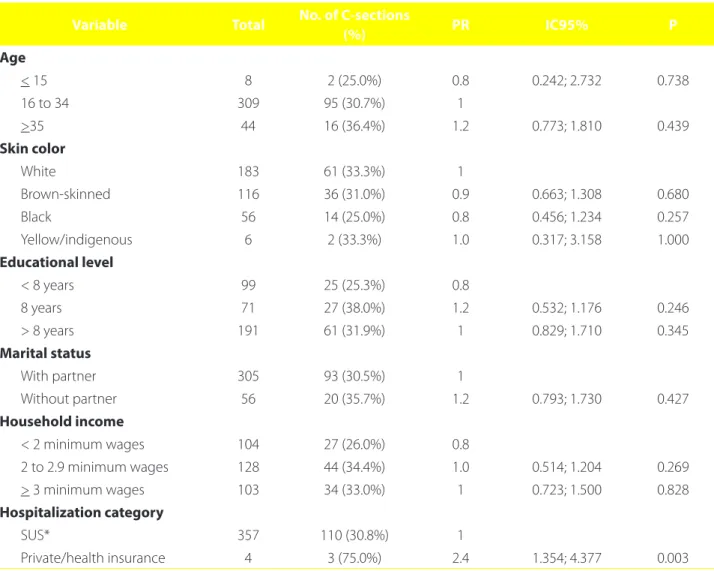
Of the 361 women who made up the sample, 31% un-derwent C-section. Analyzing the link between socio-de-mographic variables and C-section, only the admission category was statistically significant. During private hospi-talization or through a health insurance plan, C-section was 2.43 times more prevalent when compared to hospitaliza-tion through the Unified Healthcare System (SUS) (Table 1).
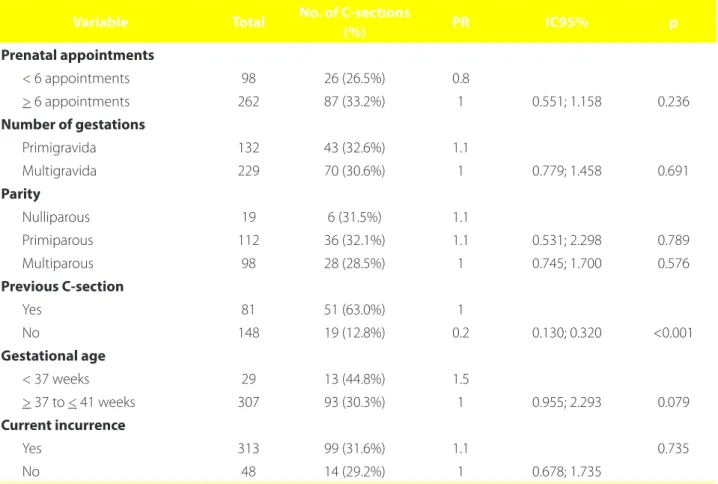
Regarding the prevalence ratios for C-section according to obstetric variables (Table 2), not having a previous C-sec-tion was a protective factor, since it was 80% less prevalent, a statistically significant data. The remaining variables were not statistically significant.
Dilation, cervix characteristic, presentation, and uterine dynamics variables showed significant results (Table 3).
Variable Total No. of C-sections
(%) PR IC95% P
Age
< 15 8 2 (25.0%) 0.8 0.242; 2.732 0.738
16 to 34 309 95 (30.7%) 1
>35 44 16 (36.4%) 1.2 0.773; 1.810 0.439
Skin color
White 183 61 (33.3%) 1
Brown-skinned 116 36 (31.0%) 0.9 0.663; 1.308 0.680
Black 56 14 (25.0%) 0.8 0.456; 1.234 0.257
Yellow/indigenous 6 2 (33.3%) 1.0 0.317; 3.158 1.000
Educational level
< 8 years 99 25 (25.3%) 0.8
8 years 71 27 (38.0%) 1.2 0.532; 1.176 0.246
> 8 years 191 61 (31.9%) 1 0.829; 1.710 0.345
Marital status
With partner 305 93 (30.5%) 1
Without partner 56 20 (35.7%) 1.2 0.793; 1.730 0.427
Household income
< 2 minimum wages 104 27 (26.0%) 0.8
2 to 2.9 minimum wages 128 44 (34.4%) 1.0 0.514; 1.204 0.269
> 3 minimum wages 103 34 (33.0%) 1 0.723; 1.500 0.828
Hospitalization category
SUS* 357 110 (30.8%) 1
Private/health insurance 4 3 (75.0%) 2.4 1.354; 4.377 0.003
Table 1 – Prevalence ratios for C-section according to maternal socio-demographic variables. Porto Alegre, RS. 2013
Regarding dilation, C-section was more prevalent among those who were admitted with an impervious cer-vix or with less than three centimeters of dilation, whereas 82.1% and 50.6%, respectively, were submitted to C-sec-tion. Thus, C-section was 4.6 times more prevalent in those who showed impervious cervix at admission and 2.5 times more prevalent in those with dilation lower than three cen-timeters, when compared to those with dilation greater than this.
Regarding cervix characteristics, C-section was more prevalent in those who were admitted with thick cervix (5.83 times prevalence of C-section occurrence when com-pared to those with thin cervix).
Regarding presentation, C-section was carried out in all of the breech presentation cases, with a prevalence of 3.58 times in relation to those with cephalic presentation.
Regarding the uterine dynamics, in case of its absence, C-section was 1.53 times more prevalent.
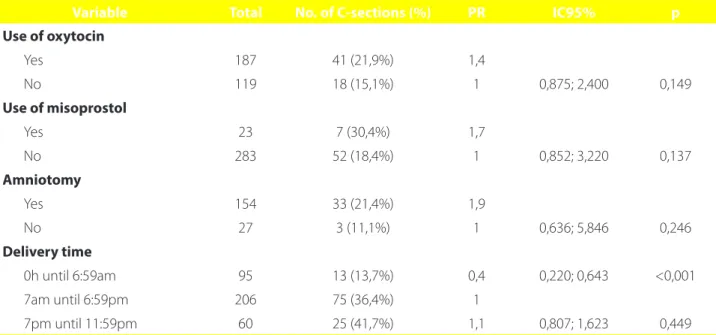
Analyzing the delivery variables (Table 4), the hour of the delivery was the only variable related to the perfor-mance of C-section. C-section that took place around
mid-night until 6:59 am was approximately 70% less prevalent; consequently, this hour can be seen as a protective factor, when compared to other hours.
DISCUSSION
As evidenced by this study, the C-section rate is above the percentage associated with the reduction in maternal and neonatal mortality rates, which is up to 10-15%.(7) This
indicator shows a significant variation among the stud-ies. The Brazilian studies carried out in university health institutions, conducted in Florianópolis(11) and in country
cities in the state of São Paulo(13), pointed to C-section
rates of 23% and 32.6%, respectively, whereas the latter is similar to that found in the current research. In contrast, in a Normal Childbirth Center, which serves low-risk parturi-ents, the C-section rate was even lower (14.9%). A higher prevalence of C-section was observed in high complex-ity hospitals (35.4%), with medical students (39.2%), and lower in those where there were only nursing/midwife students (26.7%)(14).
Variable Total No. of C-sections
(%) PR IC95% p
Prenatal appointments
< 6 appointments 98 26 (26.5%) 0.8
> 6 appointments 262 87 (33.2%) 1 0.551; 1.158 0.236
Number of gestations
Primigravida 132 43 (32.6%) 1.1
Multigravida 229 70 (30.6%) 1 0.779; 1.458 0.691
Parity
Nulliparous 19 6 (31.5%) 1.1
Primiparous 112 36 (32.1%) 1.1 0.531; 2.298 0.789
Multiparous 98 28 (28.5%) 1 0.745; 1.700 0.576
Previous C-section
Yes 81 51 (63.0%) 1
No 148 19 (12.8%) 0.2 0.130; 0.320 <0.001
Gestational age
< 37 weeks 29 13 (44.8%) 1.5
> 37 to < 41 weeks 307 93 (30.3%) 1 0.955; 2.293 0.079
Current incurrence
Yes 313 99 (31.6%) 1.1 0.735
No 48 14 (29.2%) 1 0.678; 1.735
Table 2 – Prevalence ratios for C-section according to obstetric history variables. Porto Alegre, RS. 2013
Variable Total No. of C-sections (%) PR IC95% p
Dilation (cm)*
Impervious 39 32 (82.1%) 5.7
< 3 cm 87 44 (50.6%) 3.5 4.020; 8.065 <0.001
> 3 cm 229 33 (14.4%) 1 2.405; 5.121 <0.001
Cervix characteristic
Thick 135 71 (52.6%) 5.8
Medium 105 27 (25.7%) 2.9 3.164; 10.771 <0.001
Thin 111 10 (9.0%) 1 1.454; 5.604 0.002
Presentation
Cephalic 333 93 (27.9%) 1
Breech 13 13 (100%) 3.6 3.013; 4.255 <0.001
Amniotic membrane
Intact 258 78 (30.2%) 1
Ruptured 99 35 (35.4%) 1.2 0.845; 1.618 0.345
AF characteristic
Colorless 132 36 (27.3%) 1
Meconium 19 8 (42.1%) 1.5 0.850; 2.803 0.153
Uterine dynamics
Present 258 58 (22.5%) 1
Absent 93 53 (57.0%) 2.5 1.902; 3.379 <0.001
Table 3 – Prevalence ratios for C-section according to hospital admission variables. Porto Alegre, RS. 2013
Source: Research data, 2013. * N=355; AF: Amniotic fluid
Variable Total No. of C-sections (%) PR IC95% p
Use of oxytocin
Yes 187 41 (21,9%) 1,4
No 119 18 (15,1%) 1 0,875; 2,400 0,149
Use of misoprostol
Yes 23 7 (30,4%) 1,7
No 283 52 (18,4%) 1 0,852; 3,220 0,137
Amniotomy
Yes 154 33 (21,4%) 1,9
No 27 3 (11,1%) 1 0,636; 5,846 0,246
Delivery time
0h until 6:59am 95 13 (13,7%) 0,4 0,220; 0,643 <0,001
7am until 6:59pm 206 75 (36,4%) 1
7pm until 11:59pm 60 25 (41,7%) 1,1 0,807; 1,623 0,449
Table 4 – Prevalence ratios for C-section according to delivery variables. Porto Alegre, RS. 2013
Presumably, the differences in childbirth care models are factors that interfere with C-section rates at different institutions. This fact can also be credited to cultural and socio-economic differences among women. This can im-ply that C-section rate is an indicator of a medicalized and interventionist childbirth care model.
Furthermore, C-section rates may be influenced ac-cording to hospitalization category, in which high rates are found among women that were hospitalized through health insurance plan/private admissions when compared to those admitted by the SUS(15).
Applying the time-trend analysis in the type of delivery rates according to financial source, it was found that C-sec-tion rates will continue to grow regardless of the financial source, unless new actions and strategies for reducing them are implemented(10).
Assessing the prevalence ratios for C-section according to the obstetric variables, it was found that not having a previous C-section was a protective factor, thus, stressing the importance of not performing unnecessary C-sections, taking into account that a previous C-section leads to greater risks of a new surgical delivery.
Although the scientific literature does not define “hav-ing a previous C-section” as an absolute indication for an-other C-section, studies demonstrate(8,11) that the
preva-lence of surgical delivery is higher among women with this characteristic.
The high rates of C-section among women who under-went a previous surgical delivery show this previous C-sec-tion as a significant factor for carrying out a new one(13,16),
which could reach a prevalence up to five times more(8,11,14).
In contrast, in a study(17) that included women eligible for
a delivery trial after the C-section, normal birthrate was higher when compared to C-sections (72.1% and 27.8%, respectively). Therefore, it is important to emphasize the possibility of carrying out a vaginal delivery in women with previous a C-section, since studies have shown successful outcomes in this situation.
C-sections in primigravidas must be performed with a precise indication. The prevention of C-sections in these women is extremely important to avoid cumula-tive effects of the previous C-section, especially in wom-en with normal gestational risk and with good outcome delivery(13).
In the presence of high-risk pregnancies, care must be continuous so any change can be identified and treated early. In these cases, careful monitoring of fetal vitality must take place to allow a safe evolution to normal delivery(18).
Therefore, the fact of being a high-risk pregnancy is not a defining condition for surgical delivery.
It is likely that the reduction of C-section rates would be higher if strategies, such as having a second opinion before the procedure, would focus on primigravidas with gestation of usual risk. That is because they represent a large segment of the pregnant population and, if they have C-section in the first delivery, they almost surely will have a C-section in the next gestations(18). In the present study,
a higher prevalence of C-section took place among primi-gravidas with no investigation related to the classification of gestational risk, and it was not possible to determine the link among these variables.
Despite being an intervention that saves lives, it is im-portant to emphasize that the C-section is a procedure that involves maternal and fetal risks when performed without justifiable factors. The probability of maternal morbidities, such as hysterectomy, transfusion, venous thrombosis, in-creases as women are submitted to subsequent C-sections and, in addition, there is no risk reduction in neonatal mor-bidity(19). The indication for elective C-section for pregnant
women with gestational age lower than 39 weeks is asso-ciated with higher neonatal morbidity and higher risk of intensive neonatal care(20).
Regarding the admission variables, the majority of pregnant women admitted with dilation equal or less than three centimeters were submitted to C-section. Studies that linked cervical dilation with the type of deliv-ery support the finding of this study(8,11,17,21). Thus, it can be
implied that early hospitalization, before the active stage of delivery, contributes to higher interventions that could lead to C-sections. However, in some situations, such as premature rupture of membranes, hospitalization is indi-cated even before the delivery. Therefore, it is up to health professionals to assess the overall condition of the preg-nant woman in order to decide the appropriate time for hospitalization, thus assuring good fetal vitality and ges-tation conditions.
Regarding fetal presentation, the breech presentation was related to a higher prevalence of C-section, a finding also corroborated by other studies(8,11,13). Taking into account
the reduction of perinatal mortality and neonatal morbidi-ty, C-sections are recommended for pregnant women with fetuses in breech presentation(1). This is observed on a daily
basis at maternities, in which health professionals advocate C-section as a resolution for this situation, for considering vaginal delivery as being complicated.
Other admission variables, such as cervix character-istics and uterine dynamics, in similar studies(11,14). were
variables was evidenced by the confirmation of their link with the C-section.
Time of delivery turned up to be related to the preva-lence of C-sections, and the period between midnight and 6:59am was a protective factor for C-section to take place. These data are similar to those found in another study, in which births between 7pm and 11:59pm had a lower association with C-section when compared to daytime. In relation to the nighttime period (midnight until 6:59am), this association is even lower and the results show that C-section is 40% less prevalent(8). These findings are
sup-ported by the current study(3), in which C-sections were less
frequent between 6pm and 5am.
The findings of this study could not explain the reasons for the occurrence of lower number of C-sections during the nighttime. Thus, there is a need for new studies capable of explaining this phenomenon.
CONCLUSION
The prevalence of C-section is above WHO recommen-dations, but similar to the rates of other teaching hospitals, possibly because they are high complexity and teaching laboratory institutions.
C-section performance has been associated with the hospitalization category (private/health insurance plan), dilation lower than three centimeters, thick and medium cervix and uterine dynamics absence during admission, and breech presentation. The protective factors for carry-ing out C-sections were: woman with no previous C-sec-tion and delivery time from midnight to 6:59am.
The detailed characteristics and obstetric condi-tions of women submitted to C-seccondi-tions allow a re-flection upon professional practice, and provide an op-portunity to search for qualified care during labor and childbirth. Decision-making of healthcare profession-als based on data unsupported by scientific evidence could be misleading, thus leading to unnecessary pro-cedures, and exposing women and newborns to un-necessary risks as well.
High C-section rates must be confronted with a less in-terventionist care, with a focus on humanized practice. The differences among parturients must be respected to assure their well-being, and in order to have healthy postpartum women and newborns as a result.
Therefore, providing an opportunity for vaginal deliv-ery to women with previous C-section might be one way to reduce high C-section rates. Only through joint and consistent actions, the healthcare team will be capable of providing better care to women and newborns, thus
reducing the number of unnecessary C-sections, and contributing for the reduction of maternal and perinatal morbidity and mortality rates.
It is also important to emphasize the applicability of the findings presented in this article to nursing practices, es-pecially in the management and care areas, since it could have an impact and contribute to the establishment and implementation of quality care actions.
REFERENCES
1. Comissão Nacional de Incorporação Tecnologias no SUS (BR). Diretrizes de aten-ção a gestante: a operaaten-ção cesariana. Brasília: Ministério da Saúde; 2015 [cited 2016 Jun 01]. Available from: http://conitec.gov.br/images/Consultas/Relato-rios/2015/Relatorio_PCDTCesariana_CP.pdf.
2. Riscado LC, Jannotti CB, Barbosa RHS. Deciding the route of delivery in Bra-zil: themes and trends in public health production. Texto Contexto Enferm. 2016;25(1):e3570014.
3. Rattner D, Moura, EC. Nascimentos no Brasil: associação do tipo de parto com variáveis temporais e sociodemográficas. Rev Bras Saúde Matern Infant. 2016;16(1):39-47.
4. Ministério da Saúde (BR). Datasus [Internet]. Brasília: Ministério da Saúde; c2016 [cited 2016 Jun 01]. Nascidos vivos: Brasil; [approx. 3 pages]. Available from: http://tabnet.datasus.gov.br/cgi/tabcgi.exe?sinasc/cnv/nvuf.def. 5. Objetivos de Desenvolvimento do Milênio: relatório nacional de
acompanha-mento. Brasília: IPEA; 2014 [cited 2016 Jun 01]. Available from: http://www. agenda2030.com.br/biblioteca/140523_relatorioodm.pdf.
6. Leal MC. Estar grávida no Brasil. Cad Saúde Pública. 2012;28(8):1420-1. 7. Betran AP, Torloni MR, Zhang J, Ye J, Mikolajczyk R, Deneux-Tharaux C, et al.
What is the optimal rate of caesarean section at population level? a systematic review of ecologic studies. Reprod Health. 2015;12:57.
8. Osava RH, Silva FMB, Tuesta EF, Oliveira SMJV, Amaral MCE. Caracterização das cesáreas em centro de parto normal. Rev Saúde Pública. 2011;45(6):1036-43. 9. Pallasmaa N, Alanen A, Ekblad U, Vahlberg T, Koivisto M, Raudaskoski T, et al.
Variation in cesarean section rates is not related to maternal and neonatal out-comes. Acta Obstet Gynecol Scand. 2013;92(10):1168-74.
10. Paris GF, Monteschio LVC, Oliveira RR, Latorre MRDO, Pelloso SM, Mathias TAF. Tendência temporal da via de parto de acordo com a fonte de financiamento. Rev Bras Ginecol Obstet. 2014;36(12):548-54.
11. Sakae TM, Freitas PF, D’Orsi E. Fatores associados a taxas de cesárea em hospital universitário. Rev Saúde Pública. 2009;43(3):472-80.
12. Saraiva, JM. Cesarianas de um hospital universitário: fatores associados [mono-grafia]. Porto Alegre (RS): Escola de Enfermagem, Universidade Federal do Rio Grande do Sul; 2013.
13. Sanches NC, Mamede FV, Vivancos RBZ. Perfil das mulheres submetidas à cesar-eana e assistência obstétrica na maternidade pública em Ribeirão Preto. Texto Contexto Enferm. 2012;21(2):418-26.
14. Pádua KS, Osis MJD, Faúndes A, Barbosa AH, Moraes Filho OB. Fatores as-sociados à realização de cesárea em hospitais brasileiros. Rev Saúde Pública. 2010;44(1):70-9.
16. Al Busaidi I, Al Farsi Y, Ganguly S, Gowri V. Obstetric and non-obstetric risk fac-tors for cesarean section in Oman. Oman Med J. 2012;27(6):478-81. 17. Abdelazim IA, Elbiaa AAM, Al-Kadi M, Yehia AH, Nusair BMS, Faza MA. Maternal
and obstetrical factors associated with a successful trial of vaginal birth after cesarean section. J Turk Ger Gynecol Assoc. 2014;15(4):245-9.
18. Haddad SEM, Cecatti JG. Estratégias dirigidas aos profissionais para a redução das cesáreas desnecessárias no Brasil. Rev Bras Ginecol Obstet. 2011;33(5):252-62.
19. Miller ES, Hahn K, Grobman WA. Consequences of a primary elective cesarean delivery across the reproductive life. Obstet Gynecol. 2013;121(4):789-97. 20. Resende MC, Santos L, Silva IS. Neonatal morbidity in term newborns born by
elective cesarean section. Acta Med Port. 2015;28(5):601-7.
21. Birara M, Gebrehiwot Y. Factors associated with success of vaginal birth after one cesarean section (VBCA) at three teaching hospitals in Addis Ababa, Ethiopia: a case control study. BMC Pregnancy Childbirth. 2013;13:31.
Corresponding author:
Helga Geremias Gouveia E-mail: [email protected]