Serum neutralization with different types and subtypes of
bovine herpesvirus 1 and 5
1Carine Lidiane Holz2,4, Samuel Paulo Cibulski2, Thais Fumaco Teixeira2,4, Helena Beatriz C.R. Batista3,4, Diógenes Dezen2,4, Fabrício Souza
Campos3,5, Ana Paula M. Varela2 and Paulo Michel Roehe2,3*
ABSTRACT.- Holz C.L., Cibulski S.P., Teixeira T.F., Batista H.B.C.R., Dezen D., Campos F.S., Varela A.P.M. & Roehe P.M. 2010. Serum neutralization with different types and subtypes of bovine herpesvirus 1 and 5. Pesquisa Veterinária Brasileira30(7):515-522. Instituto de Pesqui-sas Veterinárias Desidério Finamor, Fepagro Saúde Animal, Eldorado do Sul, RS 92990-000, Brazil. E-mail: [email protected]
The serum neutralization (SN) test is the gold standard method to measure neutralizing antibodies to bovine herpesviruses. However, in view of the further subdivisions of bovine herpesviruses in types/subtypes, defining which virus to use at challenge in SN tests may be difficult. In view of that, this study was carried out to re-evaluate (SN) sensitivity with different types/subtypes of bovine herpesviruses types 1 (BoHV-1) and 5 (BoHV-5) as challenge viruses. Bovine sera (n=810) were collected from two distinct geographic regions and tested by SN with three type 1 viruses (BoHV-1.1 strains “Los Angeles” and “EVI123/98”; BoHV-1.2a strain “SV265/96”) and three type 5 viruses (BoHV-5a strain “EVI88/95”; BoHV-5b strain “A663” and BoHV-5c “ISO97/95”). SN tests were performed with a 1 hour incubation of the serum-virus mixtures at 37ºC against 100 TCID50 of each of the viruses. SN sensitivity varied greatly depending on the challenge virus used in the test. The highest sensitivity (327 positive/810 total sera tested; 40.37%) was attained when the positive results to the six viruses were added together. No association could be found between any particular type or subtype of virus and the sensitivity of the test. When positive results to each single strain were considered, SN sensitivity varied from 41.7% to 81.7%, depending on the virus and the geographic region of origin of the sera. Variation was detected even when challenge viruses belonged to the same subtype, where disagreement between positive results reached 41%. These results indicate that one hour incubation SN tests against single viruses, as performed here, may display a significantly low sensitivity (p=0.05); performing SN tests against a number of different viruses may increase considerably SN sensitivity. Furthermore, the choice of virus used for challenge is critical in SN tests. In addition, sera from different geographic regions may give rise to disagreeing results with different strains of BoHV-1 and BoHV-5. This might be particularly relevant for control programs and in international trade, were maximum sensitivity should be targeted.
INDEX TERMS: Neutralization, cross-neutralization, BoHV-1, BoHV-5.
1 Received on May 29, 2009.
Accepted for publication on August 19, 2009.
2 Instituto de Pesquisas Veterinárias Desidério Finamor (IPVDF), Fepagro Saúde Animal, Estrada do Conde 6000, Cx. Postal 47, Eldorado do Sul, RS 92990-000, Brazil. *Corresponding author: [email protected] 3 Laboratório de Virologia, Departamento de Microbiologia (DM), Ins-tituto de Ciências Básicas da Saúde (ICBS), Universidade Federal do Rio Grande do Sul (UFRGS), Av. Sarmento Leite 500, sala 208, Porto Alegre, RS 90050-170, Brazil.
4 Programa de Pós-Graduação em Ciências Veterinárias, Faculda-de Faculda-de Veterinária, UniversidaFaculda-de FeFaculda-deral do Rio GranFaculda-de do Sul(UFRGS), Av. Bento Gonçalves 9090, Porto Alegre, RS 95320-000.
5 Programa de Pós-Graduação em Microbiologia do Meio Ambiente, DM, ICBS, UFRGS, Av. Sarmento Leite 500, Porto Alegre, RS 90050-170.
amostras “Los Angeles” e “EVI123/98”, BoHV-1.2a: amostra “SV265/96”) e três amostras do tipo 5 (BoHV-5a: “EVI88/95”; BoHV-5b: “A663” e BoHV-5c “ISO97/95”). Os testes de SN foram realizados com incubação de 1 hora a 37ºC da mistura soro-vírus, frente a 100 doses infectantes para 50% dos culti-vos celulares (DICC50) de cada um dos vírus. A sensibilidade da SN variou grandemente em função do vírus utilizado no teste. A maior sensibilidade (327 soros positivos/810 soros testados; 40.37%) foi alcançada quando os resultados positi-vos frente aos seis diferentes vírus foram somados. Nenhuma associação foi detectada entre determinado tipo/subtipo de vírus e a sensibilidade do teste. Quando resultados positivos frente a cada vírus foram considerados isoladamente, a sensibilida-de da SN variou entre 41,7% a 81,7%, sensibilida-depensensibilida-dendo do vírus sensibilida-de desafio e da região geográfica de origem das amostras de soro. Variação foi detectada mesmo quando as amostras de desafio pertenciam a um mesmo subtipo; a discrepância entre os resultados positivos atingiu até 41%. Estes resultados indi-cam que testes de SN contra amostras isoladas de vírus po-dem apresentar uma sensibilidade notadamente baixa; o em-prego de diferentes amostras de vírus de desafio pode aumen-tar consideravelmente a sensibilidade da prova. Além disso, a escolha da amostra de vírus para a realização do teste é críti-ca. Outro achado importante é que sorors de diferentes regi-ões geográficas podem dar resultados discordantes frente a diferentes amostras de BoHV-1 e BoHV-5. Estes achados são particularmente relevantes para programas de controle destas infecções e para o comércio internacional, onde a sen-sibilidade deve ser maximizada.
TERMOS DE INDEXAÇÃO: Neutralização, neutralização cru-zada, BoHV-1, BoHV-5.
INTRODUCTION
Bovine herpesvirus type 1 (BoHV-1) and type 5 (BoHV-5) belong to the order Herpesvirales, family Herpesviridae, subfamily Alphaherpesvirinae, genus Varicellovirus (Davison et al. 2009). With basis on antigenic and genomic properties, BoHV-1 isolates or have been divided into three different genotypes: BoHV-1.1 and BoHV-1.2a and BoVH-1.2b (Metzler et al. 1985, D’Arce et al. 2002, Souza et al. 2002). Subtypes 1.1 and 1.2a are regarded as most pathogenic and have been associated, respectively, to respiratory disease and abortions (Miller et al. 1991). BoHV-1.2b isolates are considered of moderate pathogenicity (Metzler et al. 1985) and may cause vulvovaginitis or balanopostitis, but have not so far been linked to abortions (Miller 1991, Smith et al. 1995). Regarding BoHV-5, these have been further subdivided in BoHV-5a, BoHV-5b and BoHV-5 “non-a, non-b”, or “c” (Pidone et al. 1999, D’Arce et al. 2002).
Different BoHV-1 and BoHV-5 types and subtypes display extensive serological cross-reactivity which can be evidenced in serum neutralization tests (Teixeira et al. 1998). This cross-reactivity precludes the use of SN to distinguish type-specific immune responses or to discriminate between infections with viruses of distinct types. However, the actual degree of serologic cross-reactivity induced by such viruses has not been evaluated in detail. Most diagnostic and research laboratories rely on SN
tests with a single challenge virus - usually a BoHV-1.1 strain - to evaluate serological responses to bovine herpesviruses (Perrin et al. 1993, 1994, Kramps et al. 1996, Van Oirschot 2000). As both virus types (and most subtypes) may circulate in herds, the choice of a challenge virus may significantly influence the test’s sensitivity (defined here as the capacity to detect positive sera within a population of serum samples). To check this hypothesis, in the present study the sensitivity of the SN test was evaluated using BoHV-1 and BoHV-5 strains of different types and subtypes as challenge viruses. The main aim of the study was to determi-ne which virus (or combination of viruses) would give rise to maximum sensitivity. In addition, as most laboratories make use of subtype BoHV-1.1 in SN tests, two strains of this subtype were included in order to determine whether sensitivity might also be affected by strain variation within a subtype.
As additional variation might also arise in function of the geographical region of origin of the sera to be tested, sera from two geographically distant regions were used in the comparative evaluations. The present article reports the findings of such experiments.
MATERIALS AND METHODS
Cells
The Madin-Darby Bovine Kidney (MDBK) cell lineage, originally obtained from ATCC (CCL-22), was multiplied in Eagle´s minimal essential medium (MEM; Gibco) supplemented with 10% fetal bovine serum (Soraly, Brazil) and antibiotics (penicillin and streptomycin) at usual concentrations (Paul 1970). All cells, sera and media were tested free of bovine viral diarrhea virus (BVDV), bovine herpesviruses or antibodies to such viruses. Cells were tripsinized every three to four days following standard procedures (Paul 1970).
Viruses
The following viruses were used: BoHV-1.1 strain Los Angeles (“LA”; Madin et al. 1956), BoHV-1.1 strain EVI123/98 (Roehe et al. 1997, Souza et al. 2002), BoHV-1.2a SV265/96 (Franco et al. 2002), BoHV-5a strain EVI88/95 (Roehe et al. 1997, Souza et al. 2002), BoHV-5b strain A663 (Carrillo et al. 1983, D’Arce et al. 2002) and BoHV-5 “non-a, non-b” (or “BoHV-5c”) strain ISO97/95 (Souza et al. 2002). Within the so far known BoHV-1 and BoHV-5 subtypes, only a representative of subtype BoHV-1.2b was not included in the present study, as it was not available in the laboratory. Virus multiplication and titrations were carried out on MDBK cells following standard procedures (Roehe et al. 1997).
Cattle serum samples
Sera from 810 cattle were examined in the present study; 502 were collected in Southern Brazil, state of Rio Grande do Sul (RS); 308 serum samples were collected from the Centro-Oeste region, state of Goiás (GO). All sera were obtained from adult cattle with no history of vaccination to bovine herpesviruses. All sera were heat inactivated and stored at -20oC.
Neutralization tests
Sera were diluted in twofold dilutions (½ and ¼) and the serum-virus mixtures (equal volumes of 50 μL) were incubated at 37oC
for 1 hour before the addition of MDBK cells (3 to 5 x 10⁴ cells/
well/50μL). Tests were performed separately against each of the six different virus strains, with about 100 fifty per cent tissue culture infectious doses (TCID50) in every case. Plates were incubated at 37oC in a moist atmosphere with 5% CO2 for up to
120 hours until the final reading, which was performed with basis on the presence or absence of a cytopathic effect. Results were calculated by the method of Reed and Muench (Lorenz & Bögel 1973) and expressed as positive (neutralizing antibody titre ≥2 or negative neutralizing antibody titre <2). The sensitivity of the test was here defined as the capacity to detect antibody-positive sera in relation to the maximum number of antibody-positive sera detected in samples from either of the two geographic regions or over the total number of positive sera and was calculated with a 95% confidence interval. Sera which reacted positively at SN with at least one of the viruses were considered positive; sera which reacted negatively with all six viruses were considered negative. All tests were repeated at least twice by different operators. Sera that gave rise to discrepant results (that is, disagreeing results to different SN challenge viruses) were tested at least three times against the different viruses.
Statistical analysis
Comparisons of results at SN tests with different viruses were performed with the McNemar ‘s test for related populations (Zar 1999) over the total number of sera considered as antibody-positive, with a 5% significance level and a 5% probability, calculated with the program Dag Stat (Mackinnon 2000).
RESULTS
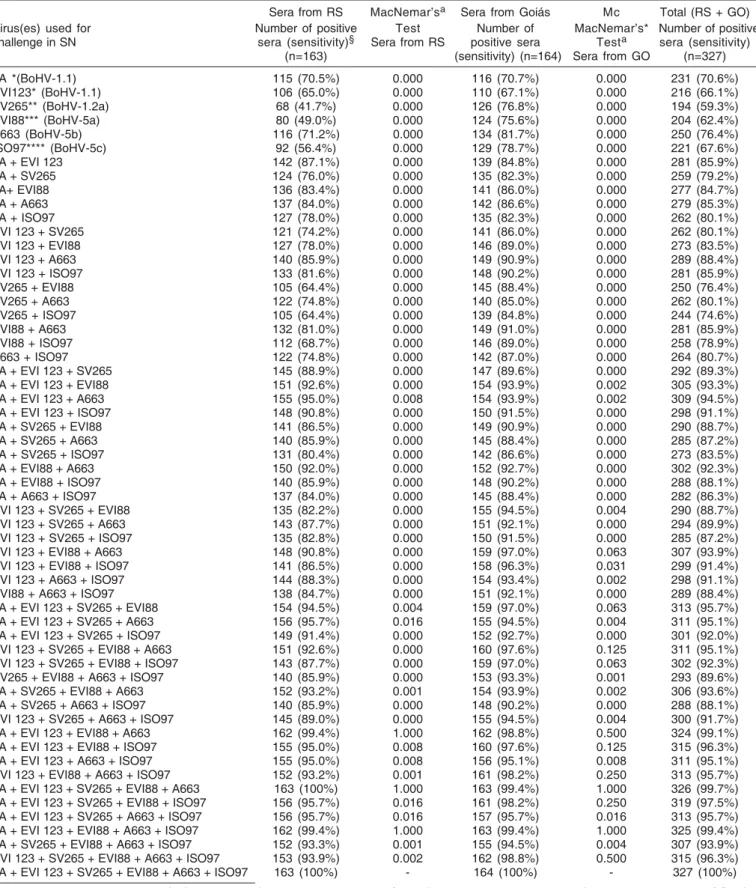
The results of the tests on the 810 bovine serum samples against the six different BoHV strains used as challenge viruses at SN tests are shown on Table 1. A total of 327 sera (163 sera from the state of RS and 164 sera from the state of GO) were considered positive for neutralizing antibodies to at least one of the viruses tested, whereas 483 sera were negative in all tests.
The sensitivity of the SN test was strongly affected by the strain used at challenge (Table 1). Maximum sensitivity was achieved by adding positive results obtained at SN with the six different viruses (327/810 sera; 40.37%) (Table 1). Results on Table 1 were expressed considering both “regionalized” positive sera (n=163 or 164) and the total number of sera which resulted positive to at least one of the viruses tested (n=327),
The larger the number of viruses considered at SN testing, the higher the sensitivity attained. The test challenge viruses which provided the highest sensitivities varied depending on the combination of viruses considered and the origin of sera (Table 1 and Fig.1).
On serum samples from RS, statistical analysis with the McNemar’s test revealed that least number of test challenge viruses to which the cumulative sum of positive results gave rise to a significant level of sensitivity (in this case 99.4%, or 162/163 positive samples) was achieved only when the positive results to four viruses (LA, EVI123, EVI88 and A663) were added (Table 1).
On the other hand, on serum samples from GO, the cumulative sum of positive results to three strains (EVI123, EVI88
and A663) was sufficient to give rise to significantly results at the McNemar’s test (that is, sensitivity equal to 97 %, or 159/ 164 positive samples detected) (Table 1).
When examining results to single challenge viruses or the cumulative sums of positive results to two viruses, no combination was sensitive enough (p=0.05). The single virus which detected most positive sera when used in SN tests was BoHV-5b strain A663. However, this strain detected only 116/163 (71.2%) positive sera from Rio Grande do Sul (RS) and 134/164 (81.7%) positive sera from Goiás (GO) (total 250/327; 76.4% of all sera positive with at least one virus). Therefore, if tests with only one of the six viruses were to be considered, the results could give would miss at least 23.6% of all neutralizing antibody-positive sera.
The second single strain which displayed the highest overall sensitivity was the classical LA strain, which detected about 70% of the positive sera, as it did on average with all sera tested (Table 1). However, in sera from GO, the virus which displayed the second highest sensitivity was BoHV-5c strain ISO97/95, which detected 129/164 (78.7%) positive sera from that state. Interestingly, strain ISO97/95 performed poorly with sera from RS (95/ 163; sensitivity 56.4%), what lowered its overall sensitivity (221/327 sera, or 67.6%).
When comparing the performances of viruses within a same subtype (BoHV-1.1 strains LA and EVI123/98) at SN, LA detected 231 (70.6%) and EVI 123/98 detected 216 (66.1%) of the total 281 positive sera detected by the two viruses added together (Table 1). This corresponds to an overall sensitivity of 85.9% over the total number of positive sera detected by the six viruses (281/327). Therefore, the single use of each of these two viruses in SN tests would give rise to negative results in between 29.4% and 33.9% of the tests which resulted positive with at least one of the six viruses tested (n=327). Moreover, within the sera which reacted positively to either of the two BoHV-1.1 strains, agreement on positive reactions was only found in 166/281 sera (59%); the remainder 115 sera gave rise to discrepant results, depending on which BoHV-1.1 test challenge strain was considered (Fig.1). Thus, it became evident that a large number of sera could give rise to discrepant results, not only with viruses of distinct types and subtypes, but also with viruses within a same subtype (Fig.1). Yet in any of such cases the results would reveal a significantly low sensitivity (p=0.05).
The neutralizing antibody-positive results obtained at SN were sparsely distributed between the different virus strains, in such a way that no pattern could be recognized in the reactivity profiles obtained (Fig.1). In Figure 2 it is shown that sera whose antibodies were recognized by 1, 2, 3, 4, 5 or 6 viruses were quite disperse.
Table 1. Performance (individualized and cumulative) of different bovine herpesvirus strains (BoHV-1 and BoHV-5) as challenge viruses in serum neutralization (SN) tests on sera with neutralizing antibody positive results to at least one of
the viruses tested, from two distinct geographical regions of Brazil (Rio Grande do Sul , RS, Goiás, GO)
Sera from RS MacNemar’sa Sera from Goiás Mc Total (RS + GO)
Virus(es) used for Number of positive Test Number of MacNemar’s* Number of positive challenge in SN sera (sensitivity)§ Sera from RS positive sera Testa sera (sensitivity)
(n=163) (sensitivity) (n=164) Sera from GO (n=327)
LA *(BoHV-1.1) 115 (70.5%) 0.000 116 (70.7%) 0.000 231 (70.6%)
EVI123* (BoHV-1.1) 106 (65.0%) 0.000 110 (67.1%) 0.000 216 (66.1%)
SV265** (BoHV-1.2a) 68 (41.7%) 0.000 126 (76.8%) 0.000 194 (59.3%)
EVI88*** (BoHV-5a) 80 (49.0%) 0.000 124 (75.6%) 0.000 204 (62.4%)
A663 (BoHV-5b) 116 (71.2%) 0.000 134 (81.7%) 0.000 250 (76.4%)
ISO97**** (BoHV-5c) 92 (56.4%) 0.000 129 (78.7%) 0.000 221 (67.6%)
LA + EVI 123 142 (87.1%) 0.000 139 (84.8%) 0.000 281 (85.9%)
LA + SV265 124 (76.0%) 0.000 135 (82.3%) 0.000 259 (79.2%)
LA+ EVI88 136 (83.4%) 0.000 141 (86.0%) 0.000 277 (84.7%)
LA + A663 137 (84.0%) 0.000 142 (86.6%) 0.000 279 (85.3%)
LA + ISO97 127 (78.0%) 0.000 135 (82.3%) 0.000 262 (80.1%)
EVI 123 + SV265 121 (74.2%) 0.000 141 (86.0%) 0.000 262 (80.1%)
EVI 123 + EVI88 127 (78.0%) 0.000 146 (89.0%) 0.000 273 (83.5%)
EVI 123 + A663 140 (85.9%) 0.000 149 (90.9%) 0.000 289 (88.4%)
EVI 123 + ISO97 133 (81.6%) 0.000 148 (90.2%) 0.000 281 (85.9%)
SV265 + EVI88 105 (64.4%) 0.000 145 (88.4%) 0.000 250 (76.4%)
SV265 + A663 122 (74.8%) 0.000 140 (85.0%) 0.000 262 (80.1%)
SV265 + ISO97 105 (64.4%) 0.000 139 (84.8%) 0.000 244 (74.6%)
EVI88 + A663 132 (81.0%) 0.000 149 (91.0%) 0.000 281 (85.9%)
EVI88 + ISO97 112 (68.7%) 0.000 146 (89.0%) 0.000 258 (78.9%)
A663 + ISO97 122 (74.8%) 0.000 142 (87.0%) 0.000 264 (80.7%)
LA + EVI 123 + SV265 145 (88.9%) 0.000 147 (89.6%) 0.000 292 (89.3%)
LA + EVI 123 + EVI88 151 (92.6%) 0.000 154 (93.9%) 0.002 305 (93.3%)
LA + EVI 123 + A663 155 (95.0%) 0.008 154 (93.9%) 0.002 309 (94.5%)
LA + EVI 123 + ISO97 148 (90.8%) 0.000 150 (91.5%) 0.000 298 (91.1%)
LA + SV265 + EVI88 141 (86.5%) 0.000 149 (90.9%) 0.000 290 (88.7%)
LA + SV265 + A663 140 (85.9%) 0.000 145 (88.4%) 0.000 285 (87.2%)
LA + SV265 + ISO97 131 (80.4%) 0.000 142 (86.6%) 0.000 273 (83.5%)
LA + EVI88 + A663 150 (92.0%) 0.000 152 (92.7%) 0.000 302 (92.3%)
LA + EVI88 + ISO97 140 (85.9%) 0.000 148 (90.2%) 0.000 288 (88.1%)
LA + A663 + ISO97 137 (84.0%) 0.000 145 (88.4%) 0.000 282 (86.3%)
EVI 123 + SV265 + EVI88 135 (82.2%) 0.000 155 (94.5%) 0.004 290 (88.7%)
EVI 123 + SV265 + A663 143 (87.7%) 0.000 151 (92.1%) 0.000 294 (89.9%)
EVI 123 + SV265 + ISO97 135 (82.8%) 0.000 150 (91.5%) 0.000 285 (87.2%)
EVI 123 + EVI88 + A663 148 (90.8%) 0.000 159 (97.0%) 0.063 307 (93.9%)
EVI 123 + EVI88 + ISO97 141 (86.5%) 0.000 158 (96.3%) 0.031 299 (91.4%)
EVI 123 + A663 + ISO97 144 (88.3%) 0.000 154 (93.4%) 0.002 298 (91.1%)
EVI88 + A663 + ISO97 138 (84.7%) 0.000 151 (92.1%) 0.000 289 (88.4%)
LA + EVI 123 + SV265 + EVI88 154 (94.5%) 0.004 159 (97.0%) 0.063 313 (95.7%)
LA + EVI 123 + SV265 + A663 156 (95.7%) 0.016 155 (94.5%) 0.004 311 (95.1%)
LA + EVI 123 + SV265 + ISO97 149 (91.4%) 0.000 152 (92.7%) 0.000 301 (92.0%)
EVI 123 + SV265 + EVI88 + A663 151 (92.6%) 0.000 160 (97.6%) 0.125 311 (95.1%) EVI 123 + SV265 + EVI88 + ISO97 143 (87.7%) 0.000 159 (97.0%) 0.063 302 (92.3%)
SV265 + EVI88 + A663 + ISO97 140 (85.9%) 0.000 153 (93.3%) 0.001 293 (89.6%)
LA + SV265 + EVI88 + A663 152 (93.2%) 0.001 154 (93.9%) 0.002 306 (93.6%)
LA + SV265 + A663 + ISO97 140 (85.9%) 0.000 148 (90.2%) 0.000 288 (88.1%)
EVI 123 + SV265 + A663 + ISO97 145 (89.0%) 0.000 155 (94.5%) 0.004 300 (91.7%)
LA + EVI 123 + EVI88 + A663 162 (99.4%) 1.000 162 (98.8%) 0.500 324 (99.1%)
LA + EVI 123 + EVI88 + ISO97 155 (95.0%) 0.008 160 (97.6%) 0.125 315 (96.3%)
LA + EVI 123 + A663 + ISO97 155 (95.0%) 0.008 156 (95.1%) 0.008 311 (95.1%)
EVI 123 + EVI88 + A663 + ISO97 152 (93.2%) 0.001 161 (98.2%) 0.250 313 (95.7%) LA + EVI 123 + SV265 + EVI88 + A663 163 (100%) 1.000 163 (99.4%) 1.000 326 (99.7%) LA + EVI 123 + SV265 + EVI88 + ISO97 156 (95.7%) 0.016 161 (98.2%) 0.250 319 (97.5%) LA + EVI 123 + SV265 + A663 + ISO97 156 (95.7%) 0.016 157 (95.7%) 0.016 313 (95.7%) LA + EVI 123 + EVI88 + A663 + ISO97 162 (99.4%) 1.000 163 (99.4%) 1.000 325 (99.4%) LA + SV265 + EVI88 + A663 + ISO97 152 (93.3%) 0.001 155 (94.5%) 0.004 307 (93.9%) EVI 123 + SV265 + EVI88 + A663 + ISO97 153 (93.9%) 0.002 162 (98.8%) 0.500 315 (96.3%) LA + EVI 123 + SV265 + EVI88 + A663 + ISO97 163 (100%) - 164 (100%) - 327 (100%)
* BoHV-1.1 strains Los Angeles (LA) and EVI123/98; ** BoHV-1.2a strain SV265/96; ***BoHV-5a strain EVI88/95; **** BoHV-5 strain ISO97/95. § Sensitivity calculated within a 95% confidence interval, over n=163 on sera from RS, on sera from GO: n=164; on total positive sera n=327.
no sera were available that had ever been tested against such a variety of BoHV-1 and BoHV-5 types/subtypes. Therefore, it is the belief of the authors that the best representatives of antibody-negative serum samples are in fact those tested here that were actually negative to all test challenge viruses. Likewise, truly antibody-positive samples can be considered those that revealed antibodies to at least one of the viruses employed here at challenge. False positive results may have accounted for some of the discrepant results observed here. Such possibility has also been raised in other studies where SN was examined (Perrin et al. 1993). Likewise, nonspecific crossreactions with other herpesviruses may also have played some role in these findings. As these possibilities were not specifically examined here, these cannot be ruled out. Nevertheless, the authors believe that the high number of test repetitions performed here would have diluted such effects, which would be expected to be rare events, rather than the rule. Therefore, occasional false positive sera or crossreactivity with other herpesviruses would not be expected to invalidate the bulk of findings reported here, although these cannot be completely ruled out and may have played some part in these studies.
No correlation was evident between the results at SN and each particular virus type or subtype tested here. Thus, type/ subtype-specific responses could not be detected with the screening method here employed. It might be expected that neutralizing antibody titrations might reveal differential levels of antibodies - at least to a particular virus type. However, in a previous study, type differentiation could not be achieved by neutralizing antibody titration, since titres would not differ significantly (≥four times) in about 92% of sera (Teixeira et al. 1998). Therefore, it seems that BoHV1 and BoHV5 types -and more so subtypes - do not induce a discriminative neutralizing antibody response that could be used as a type or subtype-specific marker. In addition, cattle may possibly be infected with more than one virus type/subtype.
Despite the lower sensitivity revealed here, single challenge SN tests have been used to support eradication programs, such as in Finland (though eventually replaced by ELISA; Nuotio et al. 2007). However, in that country, the number of infected flocks and seropositive animals was low, and the infecting virus was probably of a same origin, making strain variation less likely. In other situations where seroprevalence is expected to be high, as may be the number of circulating viruses, testing for antibodies by SN against a single virus will probably lead to misleading results and put eventual eradication or control strategies at risk.
Low sensitivity can compromise control efforts, what highlights the importance of the findings here reported. Particularly where eradication is to be achieved, and in view of the particularities of herpesvirus latency, false negative results might miss a significant population of potential virus shedders, thus compromising eradication policies and perpetuating the infection in flocks. Moreover, in situations were seronegativity is a mandatory requirement such as in the international trade of animals (Perrin et al. 1993, 1994, Kramps et al. 1996, Van Oirschot 2000), regulatory organs
Fig.2. Number of sera positive at serum neutralization (SN) recognized by 1, 2, 3, 4, 5 or 6 bovine herpesvirus strains at challenge (total positive sera=327).
Fig.3. Type specific reactivity. Serum samples which reacted positively in serum neutralization tests against (at least one of) different strains of BoHV-1, BoHV-5, or both.
DISCUSSION
It became clear in the present studies that the sensitivity of the 1 hour incubation SN test was significantly affected by the BoHV strain used as test challenge virus. When SN tests performed against each individual virus were taken as single results, the lack of sensitivity of the 1 hour SN was striking. These would lead to “false negatives” ranging from 58.3% of sera from RS with strain SV265/96 to 18.3% with strain A663, the latter the single most sensitive challenge virus. Yet, even with the most reactive test challenge virus, the number of “false negatives” obtained with such test would be highly significant (p=0.05). These results may be a cau-se for concern as many diagnostic laboratories perform 1 hour incubation SN with one test virus, as performed here.
Another point examined here was the role for the geographical area of origin of sera. This variable was examined since possible exposure of a particular cattle population to different viruses might lead to different serological responses. The results obtained here indicate that this was indeed the case. Despite the virus strain that detected sera with the highest sensitivity in sera from both RS and GO was the same, the differences between findings were striking.
should take into account the findings here reported if maximum sensitivity at testing is to be attained.
Another point which is inevitably raised from the analysis of the data presented here regards type-specific prevalence. From above, it is not possible to infer whether 1, BoHV-5 or both virus types are actually prevalent in sampled cattle. Likewise, looking back into the various studies performed on BoHV-1 prevalence performed in Brazil, based solely on testing with a single BoHV-1 at SN challenge (Lovato et al. 1995, Lage et al. 1996, Melo et al. 1997, Cerqueira et al. 2000, Barbosa et al. 2005) it would not be possible to measure the extent of BoHV-5 contamination of such data. So, to date, it is not possible to infer whether those reflect BoHV-1 prevalence, BoHV-5 prevalence or mixed infections. Perhaps the same might apply for other countries where BoHV-5 may be endemic, or where information on BoHV-5 is missing.
It is quite possible that other, more sensitive tests, such as ELISAs, might prove more adequate in serological studies than SN against single viruses (Collins et al. 1985). Nonetheless, ELISAs for antibodies to bovine herpesviruses should have their validation parameters redefined with sera tested against a wider number of viruses. This might reveal that perhaps many of the discrepancies found between results of SN and ELISAs may in fact be due to SN’s low sensitivity, what becomes evident particularly when tests are performed and compared within different laboratories (Perrin et al. 1993, 1994, Kramps et al. 1996). As previously reported, SN with a 24 hour incubation (Bitsch 1978, Perrin et al. 1993) is expected to be more sensitive than the one hour incubation SN. In view of that, a similar study with a 24 hour incubation SN is presently being performed in order to examine the effect of a longer incubation on SN’s sensitivity with different bovine herpesvirus types and subtypes (Varela et al. 2010).
Acknowledgements.- To Prof. Lucas Veiga (UFCSPA) for help with the statistical analyses. Financial support from CNPq, FAPERGS, CAPES, and the State Government of Rio Grande do Sul. During this work, CLH was a MSc fellow at the Programa de Pós-graduação em Ciências Vete-rinárias (PPGCV), Universidade Federal do Rio Grande do Sul (UFRGS); TFT and HBCRB are doctorate fellows of PPGCV/UFRGS. FSC is on receipt of a MSc grant from Programa de Pós-graduação em Microbiologia Agrícola e do Ambiente (PPGMAA), UFRGS. PMR is a CNPq 1C research fellow. We thank Luciana R. Roehe and Martha T. Oliveira for help with the SN and Dr. A.C. Franco for expert advice. Thanks also to Dr. Wilia D. Brito for the serum samples from the state of Goiás.
REFERENCES
Barbosa A.C.V.C., Brito W.M.E.D. & Alfaia B.T. 2005. Soroprevalência e fatores de risco para a infecção pelo herpesvírus bovino tipo 1 (BHV-1) no Estado de Goiás, Brasil. Ciência Rural 35(6):1368-1373. Bitsch V. 1978. The P24-37 modification of the infectious bovine rhino-tracheitis virus-serum neutralization test. Acta Vet. Scand. 19:497-505.
Carrillo B.J., Ambrogi A., Schudel A.A., Vazquez M., Dahme E. & Pospichil A. 1983. Meningoencephalitis caused by IBR virus in calves in Argentina. Zentralbl. Veterinärmed. B 30:327-332.
Cerqueira R.B., Carminati R., Silva J.M., Soares G.C., Meyer R. & Sardi S. 2000. Serological survey for bovine herpesvirus 1 in cattle from different regions in the state of Bahia, Brazil. Braz. J. Vet. Res. Anim. Sci. 37(6):497-500.
Collins J.K., Bulla G.A., Riegel C.A. & Butcher A.C. 1985. A single dilution enzyme-linked immunosorbent assay for the quantitative detection of antibodies to bovine herpesvirus type 1. Vet. Microbiol. 10(2):133-147. Davison A.J., Eberle R., Ehlers B., Hayward G.S., McGeoch D.J., Minson A.C., Pellett P.E., Roizman B., Studdert M.J. & Thiry E. 2009. The order Herpesvirales. Arch. Virol. 154:171-177.
D’Arce R.C.F., Almeida R.S., Silva T.C., Franco A.C., Spilki F.R., Roehe P.M. & Arns C.W. 2002. Restriction endonuclease and monoclonal antibody analysis of Brazilian isolates of bovine herpesviruses types 1 and 5. Vet. Microbiol. 88(4):315-324.
Franco A.C., Rijsewijk F., Flores E.F., Weiblein R. & Roehe P.M. 2002. Construction and characterization of a glycoprotein E deletion mutant of bovine herpesvirus type 1.2 strain isolated in Brazil. Braz. J. Microbiol. 33:274-278.
Kramps J.A., Perrin B., Edwards S. & Van Oirschot J.T. 1996. A European inter-laboratory trial to evaluate the reliability of serological diagnosis of bovine herpesvirus 1 infections. Vet. Microbiol. 53:153-161.
Lage A.P., Castro R.S., Melo M.I.V., Aguiar P.H.P., Filho J.B.B. & Leite R.C. 1996. Prevalence of antibodies to bluetongue, bovine herpesvirus 1 and bovine viral diarrhea/mucosal disease viruses in water buffaloes in Minas Gerais State, Brazil. Rev. d´Elev. Méd. Vét. Pays Tropic. 49(3):195-197.
Lorenz R.J. & Bögel K. 1973. Methods of calculation, p.329-332. In: Kaplan M.M. & Koprowsky H. (Eds), Laboratory Tecniques in Rabies. World Health Organization, Geneva.
Lovato L.T., Weiblen R., Tobias F.L. & Moraes M.P. 1995. Herpesví-rus bovino tipo 1 (HVB-1): inquérito soro-epidemiológico no rebanho leiteiro do estado do Rio Grande do Sul, Brasil. Ciência Rural 25(3):425-430.
Mackinnon A. 2000. A spreadsheet for the calculation of comprehensive statistics for the assessment of diagnostic tests and inter-rater agreement. Comput. Biol. Med. 30(3):127-134.
Madin S.H., York C.J. & McKercher D.G. 1956. Isolation of the infectious bovine rhinotracheitis virus. Science 129(1):721-722.
Melo C.B., Oliveira A.M., Figueiredo H.C.P., Leite R.C. & Lobato Z.I.P. 1997. Prevalência de anticorpos contra Herpesvírus bovino-1, vírus da diarréia viral bovina e vírus da leucose enzoótica bovina em bovinos do Estado de Sergipe, Brasil. Revta Bras. Reprod. Anim. 21(2):160-161.
Metzler A.E., Matile H., Gassmann U., Engels M. & Wyler R. 1985. European isolates of bovine herpesvirus 1: a comparison of restriction endonuclease sites. polypeptides. and reactivity with monoclonal antibodies. Arch. Virol. 85:57-69.
Miller J.M. 1991. The effects of IBR virus infections on reprodutive function of cattle. Vet. Med. 86(1):790-794.
Miller J.M., Whetstone C.A. & Van der Maaten M.J. 1991. Abortifacient property of bovine herpesvirus type 1 isolates that represent three subtypes determined by restriction endonuclease analysis of viral DNA. Am. J. Vet. Res. 52:458-461.
Nuotio L., Neuvonen E. & Hyytiäinen M. 2007. Epidemiology and eradication of infectious bovine rhinotracheitis/infectious pustular vulvovaginitis (IBR/IPV) virus in Finland. Acta Vet. Scand. 49(1):3. Paul J. 1970. Cell and Tissue Cultures. 4th ed. E. and S., Livingstone,
London.
Perrin B., Bitsch V., Cordioli P., Eliot M., Guérin B., Lenihan P., Rønsholt I., Van Oirschot J.T., Vanopdenbosch E., Wellemans G., Wizigmann G. & Thibier M. 1993. A European comparative of serological methods for the diagnosis of infectious bovine rhinotracheitis. Rev. Sci. Tech. Off. Int. Epiz. 12:964-984.
sera for use in the serological diagnosis of infectious bovine rhinotracheitis. Rev. Sci. Tech. Off. Int. Epiz. 13:947-960.
Pidone C.L., Galosi C.M., Etcheverrigaray M.E., Nosetto E.O. & Etcheverrigaray M.E. 1999. Restriction endonuclease analysis of BHV-1 and BHV-5 strains isolated in Argentina. J. Vet. Med. B 46(7):453-456. Roehe P.M., Silva T.C., Nardi N.B., Oliveira L.G. & Rosa J.C.A. 1997. Diferenciação entre os vírus da rinotraqueíte infecciosa bovina (BHV-1) e vírus da encefalite bovina (BHV-5) com anticorpos monoclonais. Pesq. Vet. Bras. 17(1):41-44.
Smith G.A., Young P.L. & Reed K.C. 1995. Emergence of a new bovine herpesvirus 1 strain in Australian feedlots. Arch.Virol. 140:599-603. Souza V.F., Melo S.V., Esteves P.A., Schmidt C.S., Gonçalves D.A., Schaefer R., Silva T.C., Almeida R.S., Vicentini F., Franco A.C., Oliveira E.A., Spilki F.R., Weiblein R., Flores E.F., Lemos R.A., Alfieri A.A., Pituco E.M. & Roehe P.M. 2002. Caracterização de
herpesví-rus bovinos tipos 1 (BHV-1) e 5 (BHV-5) com anticorpos monoclonais. Pesq. Vet. Bras. 22(1):13-18.
Teixeira M.F.B., Esteves P.A., Coelho C.S.S., Silva T.C., Oliveira L.G. & Roehe P.M. 1998. Diferenças em níveis de anticorpos neutralizan-tes contra herpesvírus bovinos tipos 1 (BHV-1) e 5 (BHV-5). Pesq. Agrop. Gaúcha 4(1):61-65.
Van Oirschot J.T. 2000. OIE Manual of Standards for Diagnostic Tests and Vaccines. 4th ed. Office International des Epizooties, Geneve, Switzerland, p.381-391.
Varela A.P.M., Holz C.L., Cibulski S.P., Teixeira T.F., Antunes D.A., Franco A.C., Dezen D., Cenci A. & Roehe P.M. 2010. Neutralizing antibodies to different subtypes of bovine herpesvirus type 1 (BoHV-1) and 5 (BoHV-5). Vet. Microbiol. 142:254-260.