RESUMO.- [Transferência de imunidade passiva e pro-teinograma sérico de bezerros das raças Crioula lage-ana e Holandesa preta e branca nos primeiros seis me-ses de vida.] O objetivo do presente trabalho foi veriicar e comparar a transferência de imunidade passiva e o protei-nograma em bezerros da raça Crioula Lageana (CL) e Ho-landesa Preta e Branca (HPB). Foram utilizados dois gru-pos sendo 13 bezerros da raça Crioula Lageana e 10 da raça HPB. Amostras de sangue foram colhidas para a mensura-ção da proteína sérica total, eletroforese das proteínas séri-cas, atividade da gama-glutamiltransferase e concentração de IgG pelo método de turvação pelo sulfato de zinco nos períodos entre 24 e 36 horas de vida, 15, 30, 60, 90, 120, 150 e 180 dias. A análise estatística foi realizada pelo teste
Transfer of passive immunity and serum proteinogram in
the ϐirst six months of life of Criollo Lageano and Black and
White Holstein calves
1William Timboni Teixeira2, Graziela Vieira Fonteque3, Alexandre Floriani Ramos4, Arthur da Silva Mariante4, Andrea Alves do Egito5, Vera Maria Villamil Martins6,
Mere Erika Saito6 and Joandes Henrique Fonteque6*
ABSTRACT.- Teixeira W.T., Fonteque G.V., Ramos A.F., Mariante A.S., Egito A.A., Martins V.M.V., Saito M.E. & Fonteque J.H. 2012. Transfer of passive immunity and serum protei-nogram in the ϐirst six months of life of Criollo Lageano and Black and White Holstein calves.Pesquisa Veterinária Brasileira 32(10):980-986. Departamento de Medicina Veteri-nária, Centro de Ciências Agroveterinárias, Universidade do Estado de Santa Catarina, Av. Luiz de Camões 2090, Lages, SC 88520-000, Brazil. E-mail: [email protected]
The objective of this study was to evaluate and compare the transfer of passive immu-nity and the proteinogram in Criollo Lageano (CL) and Black and White Holstein (BWH) calves. Two groups were utilized with 13 Criollo Lageano and 10 BWH calves. Blood sam-ples were collected for the measurement of total serum protein, electrophoresis of serum proteins, activity of the gamma glutamyl transferase, and concentration of IgG by the me-thod of the zinc sulfate turbidity in periods between 24 and 36 hours of life, 15, 30, 60, 90, 120, 150 and 180 days. Statistical analysis was performed by ANOVA and Tukey test at 5% signiicance level, and correlations between variables were calculated. Variations of serum proteins followed a pattern of physiological behavior over the irst six months of life and production of immunoglobulins was active earlier in BWH calves and slower in the Criollo Lageano, without causing any impact on their health. Gamma globulin in the irst days of life (24-36h) was correlated with IgG (r=0.87 for CL and r=0.89 for BWH), PTS (r=0.91 for CL and r=0.92 for BWH), Glob (r=0.99 for CL and r=0.98 for BWH) and GGT (r=0.14 for CL and r=0.83 for BWH). It was concluded that there was no failure in the transfer of passive immunity in Criollo Lageano calves but this failure occurred in the BWH calves. IgG values estimated by the zinc sulfate turbidity and serum proteins were considered good indica-tors of the transfer of passive immunity in calves between 24 and 36 hours of life.
INDEX TERMS: Immunoglobulins, bovine, serum proteins, native breeds.
1 Received on February 15, 2012.
Accepted for publication on June 25, 2012.
2 Acadêmico de Medicina Veterinária, Bolsista de Iniciação Cientíica (PIVIC/UDESC), Departamento de Medicina Veterinária, Centro de Ci-ências Agroveterinárias (CAV), Universidade do Estado de Santa Catari-na (UDESC), Av. Luiz de Camões 2090, Bairro Conta Dinheiro, Lages, SC 88520-000, Brazil.
3 Docente do Centro Universitário Facvest, Av. Marechal Floriano 947, Lages, SC 88501-103, Brazil.
4 Pesquisador da Embrapa Recursos Genéticos e Biotecnologia, Parque Estação Biológica PqEB, Av. W5 Norte (inal), Brasília, DF 70770-917, Brazil.
5 Pesquisador da Embrapa Gado de Corte, BR 262 Km 4, Cx. Postal 154, Campo Grande, MS 79002-970, Brazil.
de ANOVA e Tukey ao nível de 5% de signiicância, e corre-lações entre as variáveis. As variações das proteínas séricas obedeceram a um padrão de comportamento isiológico ao longo dos seis primeiros meses de vida e a produção ativa de imunoglobulinas foi mais precoce nos bezerros da raça Holandesa e mais lenta nos da raça Crioula Lageana, sem provocar qualquer impacto sobre a saúde dos mesmos. A gamaglobulina no primeiro dia de vida (24-36h) correla-cionou-se com a IgG (r=0,87 CL e r=0,89 HPB), PTS (r=0,91 CL e r=0,92 HPB), Glob (r=0,99 CL e r=0,98) e GGT (r=0,14 CL e r=0,83 HPB). Conclui-se que não houve falha na trans-ferência de imunidade passiva nos bezerros da raça Crioula Lageana e falha na raça Holandesa Preta e Branca. Os valo-res de IgG estimados pelo método da turvação pelo sulfato de zinco e das proteínas séricas foram bons indicadores da transferência de imunidade passiva nos bezerros entre 24 e 36 horas de vida.
TERMOS DE INDEXAÇÃO: Imunoglobulinas, bovino, proteínas sé-ricas, raças nativas.
INTRODUCTION
Brazil has several cattle breeds that have developed from breeds brought by the Portuguese settlers after the disco-very. Unlike other countries in the Americas Brazil received Spanish cattle breeds, the irst ones to step into the New World, as well as breeds of Portuguese origin, whose in-troduction was irst made 34 years after the discovery of Brazil (Mazza et al. 1994, Primo 2000). These breeds have been submitted to natural selection in different environ-ments, and developed speciic adaptive traits (Egito et al. 2002, Cardellino 2005). The Criollo Lageano breed origina-ted from cattle introduced to Rio Grande do Sul by the Je-suits (Araújo 1990). It is probable that many animals have been lost along the way, and looking for shelter in the woo-ds of the Plateau of Santa Catarina, began to form herwoo-ds in open ields of Lages. With the colonization of the Santa Ca-tarina Plateau, the settlers brought cattle, which probably crossed with cattle already existing in the region, leading to the formation of the Criollo Lageano breed. By the begin-ning of last century, The Criollo Lageano was the predomi-nant breed in the ields of Lages, and of the Plateau of Santa Catarina (Mariante & Cavalcante 2000, Camargo & Martins 2005, Martins et al. 2009), acquiring unique adaptive traits to the ecological niches where they have developed (Pri-mo 1993, Mariante et al. 1998). In Brazil, few studies have been conducted using naturalized cattle breeds (Egito et al. 2007, Spritze et al. 2003, Serrano et al. 2004, Bianchini et al. 2006). The study of these breeds can assist in developing future programs of animal breeding and of animal conser-vation (Egito et al. 2002, Serrano et al. 2004). Some bre-eds may contain alleles that confer resistance to diseases or adaptation to less favorable environmental conditions, which may be extremely important for genetic improve-ment (Woolliams et al. 1986). With the developimprove-ment of the cattle industry in Brazil, neonatal mortality has a great im-portance in dairy and beef herds and may affect between 6 and 85 of the newborns (Rogers et al. 1985, Petterson et al. 1987), but this percentage may reach 25 or even 50 % of
all newborns (Radostits et al. 1994). In dairy herds, appro-ximately 75% of deaths of animals under twelve months of age occur in the irst months of life (Radostits et al. 1994). Feitosa (1998) followed 40 Holstein calves from birth to one year of age and observed a mortality rate of 22.5%. According to the observations of Gonçalves et al. (1993) and Benesi (1996), mortality of calves in Brazil is mainly caused by diarrhea and pneumonia, and the mortality rate may reach 25%. According to Norheim & Simensen (1985), the rate of calves presenting hypogammaglobulinaemia is high, showing a high rate of failure in the transfer of passi-ve immunity. In some herds, these values reach 40% of the born animals (McGuire & Adams1982, Barragry 1997). Mc-Guire et al. (1976) and Wittum & Perino (1995) reported that the failure of passive transfer of immunity (FPTI) is the leading cause of death in neonates. According to Feitosa et al. (2010) the failure of passive transfer of immunity varies from 10 to 20% in Holstein and Nellore breeds, depending on the blood component and the standard values chosen for their estimation and interpretation. The physiology of the bovine placenta differs from other species, because the-re is no transfer of immunoglobulins through the placenta. This fraction of the serum protein is responsible for the humoral defense of the neonate against infectious agents, and should be absorbed soon after birth by the ingestion of colostrum. The colostrum is rich in immunoglobulins, whi-ch suffer greater absorption up to the irst 12 hours of the calf’s life (Zanetti et al. 1982). The absorbed colostral im-munoglobulins have a short half-life (20 days for IgG) in the circulatory system of the calf (Besser & Gay, 1994). Gene-rally, after the peak of serum concentration at 24 hours of life, there is an increasing reduction up to 30 or 45 days of age, when a new upward trend is established, which is due to the active synthesis of antibodies by the immune system (Ribeiro et al. 1983, Moraes et al. 1997, Fagliari et al. 1998, Feitosa 1998, Costa 2000, Pauletti et al. 2003). The objecti-ve of this work was to study the physiological aspects rela-ted to the transfer of passive immunity and serum protei-nogram in Criollo Lageano calves, and compare the results with the ones found for Black and White Holstein calves.
MATERIALS AND METHODS
and Rural Extension Corporation of Santa Catarina (EPAGRI), lo-cated in Lages/SC. The management at EPAGRI was semi-inten-sive, with good individual control and adequate nutritional and health management. During the experimental period there were two daily observations to identify the occurrence of births. The calves remained in constant contact with their mothers and did not receive any aid for ingestion of colostrum. In their irst day of life, the calves received an ear tag, and had their navel healed with an iodine-based product (2% tincture of iodine). During the six months of the experiment, the calves did not receive any vac-cine nor had any change in management. Blood samples were collected by jugular vein puncture into vacuum tubes without anticoagulant (Vacuum IIâ , Labnew, Sao Paulo, Brazil) in the
peri-ods between 24 to 36 hours after birth (M1), and at 15 (M2), 30 (M3), 60 (M4), 90 (M5), 120 (M6), 150 (M7), and 180 days (M8) of life. Whole blood was separated and the serum stored at -20°C to perform the analyses involving total protein concentration, activity of gamma glutamyl transferase and protein electropho-resis in agarose gel. The dosage of gamma glutamyl transferase, total serum protein and electrophoresis were performed at the Laboratory of Clinical Pathology, Londrina State University (UEL), Londrina/PR. The determination of total protein was done by the biuret method, employing commercial reagents (Gold Analisa) and spectrophotometry (200 Airone - Wienerlab) according to Jain (1993). The gamma glutamyl transferase activity was deter-mined by the colorimetric kinetic method according to the modi-ied technique of Szasz et al. (1969), using commercial reagents (Gold Analisa) and spectrophotometry (200 Airone - Wiener-lab). Serum concentrations of protein fractions albumin, alpha, beta and gamma globulins were determined by electrophoresis (Kremers et al. 1967) using agarose gel (Celmgel, CELM general agarose gel), Tris pH 9.5 (CELM) and an electrophoretic run for 20 min in a 100V current (SE-250 System, CELM). After the pro-cedure, the gel was stained with 2% black starch and bleached with 5% acetic acid. The proportion of each protein fraction was established by the software SDS-60 (CELM) of the SE-250 System (CELM) after reading through a scanner. The determination of
serum immunoglobulin G was estimated by the technique of the zinc sulfate turbidity with a spectrophotometry reading, accord-ing to the method employed by Pfeiffer et al. (1977) with modii-cations. A total of 0.1 mL of serum to 6 mL of a solution containing 208mg of ZnSO4•7H
2O per liter of distilled water. After one hour
rest, the absorbance of the mixture was measured spectrophoto-metrically (Cintra 5, GBC Scientiic Equipment) at a wave length of 620nm. Due to the instability of the solution, three readings were made and the considered result was the inal average. The amount of IgG was estimated using a standard curve previously drawn with known concentrations of bovine IgG (Single Radial Immunodiffusion Kit; VRMD, USA), as follows: zero (fetal bovine serum), 400, 800, 1600 and 3200mg/dL. Samples that exceeded the estimated value of 3200mg/dL were processed again after the dilution of the serum in saline solution at a 1:1 ratio. The statisti-cal analysis was performed by means of the analysis of variance for repeated measures (ANOVA) and Tukey test for comparison between means, assuming an error probability of 5%. Correlation coeficients were calculated among variables (Curi 1998).
RESULTS AND DISCUSSION
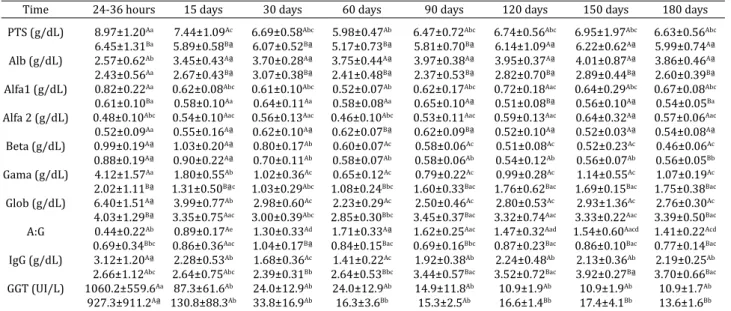
The results of total serum protein concentration, electro-phoretic proile of serum proteins in agarose gel, relation albumin: globulin, IgG concentration by the method of the zinc sulfate turbidity, and activity of gamma glutamyl trans-ferase (GGT) are shown in Table 1. During the conduction of this work two calves have been culled, one of the Criollo Lageano breed, due to transfer of his mother to another property, for management reasons, and the second one was a Black and White Holstein calf that came to death due to the failure on the passive immunity transfer (FPIT). The va-lue of total protein of the calf was 4.4g/dL from 24 to 36 hours, being considered a failure on the passive immunity transfer (FPIT) according to Donovan et al. (1998), that consider that a minimum value of 5.0g/dL. During the
ex-Table 1. Mean values and standard deviations (x ± s) of the concentration of total serum protein (TSP), albumin, alpha 1, alpha 2, beta and gamma globulin, relation albumin: globulin (A/G), immunoglobulin G (IgG ), and activity
of gamma-glutamyl transferase (GGT) of Criollo Lageano and Black and White Holstein calves at 24-36h (M1), 15 (M2), 30 (M3), 60 (M4), 90 (M5), 120 (M6), 150 (M7) and 180 days (M8) of life
Time 24-36 hours 15 days 30 days 60 days 90 days 120 days 150 days 180 days
PTS (g/dL) 8.97±1.20Aa 7.44±1.09Ac 6.69±0.58Abc 5.98±0.47Ab 6.47±0.72Abc 6.74±0.56Abc 6.95±1.97Abc 6.63±0.56Abc 6.45±1.31Ba 5.89±0.58Bª 6.07±0.52Bª 5.17±0.73Bª 5.81±0.70Bª 6.14±1.09Aª 6.22±0.62Aª 5.99±0.74Aª Alb (g/dL) 2.57±0.62Ab 3.45±0.43Aª 3.70±0.28Aª 3.75±0.44Aª 3.97±0.38Aª 3.95±0.37Aª 4.01±0.87Aª 3.86±0.46Aª 2.43±0.56Aa 2.67±0.43Bª 3.07±0.38Bª 2.41±0.48Bª 2.37±0.53Bª 2.82±0.70Bª 2.89±0.44Bª 2.60±0.39Bª Alfa1 (g/dL) 0.82±0.22Aa 0.62±0.08Abc 0.61±0.10Abc 0.52±0.07Ab 0.62±0.17Abc 0.72±0.18Aac 0.64±0.29Abc 0.67±0.08Abc 0.61±0.10Ba 0.58±0.10Aa 0.64±0.11Aa 0.58±0.08Aa 0.65±0.10Aª 0.51±0.08Bª 0.56±0.10Aª 0.54±0.05Ba Alfa 2 (g/dL) 0.48±0.10Abc 0.54±0.10Aac 0.56±0.13Aac 0.46±0.10Abc 0.53±0.11Aac 0.59±0.13Aac 0.64±0.32Aª 0.57±0.06Aac 0.52±0.09Aa 0.55±0.16Aª 0.62±0.10Aª 0.62±0.07Bª 0.62±0.09Bª 0.52±0.10Aª 0.52±0.03Aª 0.54±0.08Aª Beta (g/dL) 0.99±0.19Aª 1.03±0.20Aª 0.80±0.17Ab 0.60±0.07Ac 0.58±0.06Ac 0.51±0.08Ac 0.52±0.23Ac 0.46±0.06Ac 0.88±0.19Aª 0.90±0.22Aª 0.70±0.11Ab 0.58±0.07Ab 0.58±0.06Ab 0.54±0.12Ab 0.56±0.07Ab 0.56±0.05Bb Gama (g/dL) 4.12±1.57Aa 1.80±0.55Ab 1.02±0.36Ac 0.65±0.12Ac 0.79±0.22Ac 0.99±0.28Ac 1.14±0.55Ac 1.07±0.19Ac 2.02±1.11Bª 1.31±0.50Bªc 1.03±0.29Abc 1.08±0.24Bbc 1.60±0.33Bac 1.76±0.62Bac 1.69±0.15Bac 1.75±0.38Bac Glob (g/dL) 6.40±1.51Aª 3.99±0.77Ab 2.98±0.60Ac 2.23±0.29Ac 2.50±0.46Ac 2.80±0.53Ac 2.93±1.36Ac 2.76±0.30Ac 4.03±1.29Bª 3.35±0.75Aac 3.00±0.39Abc 2.85±0.30Bbc 3.45±0.37Bac 3.32±0.74Aac 3.33±0.22Aac 3.39±0.50Bac A:G 0.44±0.22Ab 0.89±0.17Ae 1.30±0.33Ad 1.71±0.33Aª 1.62±0.25Aac 1.47±0.32Aad 1.54±0.60Aacd 1.41±0.22Acd 0.69±0.34Bbc 0.86±0.36Aac 1.04±0.17Bª 0.84±0.15Bac 0.69±0.16Bbc 0.87±0.23Bac 0.86±0.10Bac 0.77±0.14Bac IgG (g/dL) 3.12±1.20Aª 2.28±0.53Ab 1.68±0.36Ac 1.41±0.22Ac 1.92±0.38Ab 2.24±0.48Ab 2.13±0.36Ab 2.19±0.25Ab 2.66±1.12Abc 2.64±0.75Abc 2.39±0.31Bb 2.64±0.53Bbc 3.44±0.57Bac 3.52±0.72Bac 3.92±0.27Bª 3.70±0.66Bac GGT (UI/L) 1060.2±559.6Aa 87.3±61.6Ab 24.0±12.9Ab 24.0±12.9Ab 14.9±11.8Ab 10.9±1.9Ab 10.9±1.9Ab 10.9±1.7Ab 927.3±911.2Aª 130.8±88.3Ab 33.8±16.9Ab 16.3±3.6Bb 15.3±2.5Ab 16.6±1.4Bb 17.4±4.1Bb 13.6±1.6Bb A Equal capital letters represent no signiicant difference (P<0.05) between groups.
perimental period some Black and White Holstein calves presented some health problems, like diarrhea, one calf had an umbilical hernia and another presented hemopara-sitosis. The thickening of the umbilical extracavitary struc-tures (omphalitis) was observed in one Criollo Lageano calf. Animals that required any type of treatment presented a good recovery. The concentrations of total protein and se-rum immunoglobulins observed in the irst day of life diffe-red (P<0.05) between the breeds, being higher in the
Criollo Lageano (Table 1). However, concentrations of IgG and GGT did not differ statistically, but again were higher in Criollo Lageano. Fagliari et al. (1998) reported higher va-lues of proteins and globulin in Nellore calve when compa-red to Holstein calves, without differences in average va-lues of GGT. Costa et al. (2008) found no signiicant difference when compared a Bos indicus breed (Nellore), with a Bos taurus breed (Limousin). According to Donovan
et al. (1998), FPIT can be indirectly assessed by the total serum protein values measured soon after birth, and are associated with morbidity and mortality of calves. Mortali-ty rate is higher when the protein concentration is less than 5.0g/dL. Therefore, it can be considered that the process of transfer of passive immunity was higher in Criollo Lageano compared to the Black and White Holstein calves. Three Black and White Holstein calves presented total serum pro-tein values below 5.0g/dL (4.4g/dL, 4.68g/dL and 4.30g/ dL) which, according to Donovan et al. (1998) indicates FPIT. One of the calves with FPIT came to death, and the other two remained in the experiment. According to Feito-sa et al. (2001a) there is a huge discrepancy of opinions among researchers about the deinition of an optimal con-centration of total serum protein, GGT and immunoglobu-lins of newborn calves that may give them an inadequate passive immunity. According to Naylor et al. (1977) this value would be 6.0 g/dL, while according to Heath (1992) would be 5.5g/dL and to Rea et al. (1996) would vary from 5.0 to 4.6g/dL. In comparison to beef breeds, breast feeding of dairy calves is associated with a high failure rate in the transfer of passive immunity, due to a delayed feeding asso-ciated with low intake of colostrum (Logan 1975, Rajala 1995). Differences between the methods of feeding beef and dairy calves signiicantly inluence the concentration of immunoglobulins in the neonate (Logan 1974, Rauprich 2000). According to Pritchett et al. (1991), Gay & Besser (1994) and Guy et al. (1994) the concentration of IgG is hi-gher in beef heifers than in dairy heifers, probably due to a larger milk production causing a greater dilution. When the concentration of gamma globulins and globulins were com-pared between breeds in the irst day of life, Criollo Lagea-no calves presented higher values (P<0.05) than the
Hols-tein calves (Table 1). However, IgG concentration showed no signiicant difference between breeds, but again the hi-ghest concentrations were found in the Criollo Lageano cal-ves. These results are in agreement with Gay & Besser (1994), Guy et al. (1994) and Suh et al. (2003) in which beef breeds presented higher concentrations of IgG when com-pared to dairy breeds, which may explain their higher re-sistance to infectious diseases. The serum concentration of IgG is considered critical in calves, and is identiied as an
Costa et al. (2008). However, when analyzing the curve of IgG concentration it was noted that in the Holstein calves the lowest values were observed at 30 days of age, and that the increase occurred earlier than in the Criollo Lageano calves. This result resembles the one found by Machado Neto et al. (2004) when studying Canchim and Nellore cal-ves. These indings show that the active synthesis of IgG in Criollo Lageano calves may occur later. However, this does not necessarily imply that these animals are more subjec-ted to infection during this period. However, it is assumed that the calf is more susceptible to infections at this critical age, that is marked by the time interval in which the serum concentrations of immunoglobulins are at their lowest, and is the period between the end of the degradation process of passively transferred immunoglobulins and their active production by competent immune system (Radostits et al. 2002). The change in the ratio albumin:globulin (A:G) is usually the irst sign of change in the normal protein proile (Costa et al. 2008). According to Leal et al. (2003) the lar-gest variations occur from birth to the irst month of life and are a result of alterations on the two types of protein. In the Black and White Holstein calves it was observed that the highest values of the albumin:globulin ratio were iden-tiied at 30 days of age, while in the Criollo Lageano this peak occurred at 60 days of age. Thereafter the values de-creased but remained higher for the Criollo Lageano. The albumin concentration was lower at birth and rose until the 60th day of life in Holstein and until the 90th day in the Criollo Lageano calves (Table 1). The reversal in the con-centrations of albumin and globulin led to an increase in the ratio A:G. This relationship tends to decrease after the onset of the endogenous production of immunoglobulins. The alpha1 and alpha2 fractions, as well as beta globulins showed little variation during the experimental period and were similar in both breeds. The gamma glutamyl transfe-rase (GGT) is a liver enzyme present in high concentration in the bovine colostrum and is absorbed by intestinal cells of newborn calves (Thompson & Pauli 1981, Braun et al. 1982, Fagliari et al. 1996, Zanker et al. 2001). One can con-sider that the activity of the serum GGT serves as an indi-rect indicator of the absorption capacity of immunoglobu-lins of the neonate (Feitosa et al. 2001a). In the studied breeds, GGT activity showed maximum serum activity from 24 to 36 hours of life, decreasing rapidly to reach physiolo-gical values at 60 days of age (Table 1). The highest values of total protein and serum GGT activity were observed be-tween 24h and 36h of life and declined signiicantly at day 15. These values are related to the activity of intestinal ab-sorption of the colostrum within the irst 24 hours of life. Within the irst hours of life occurs the largest absorption of immunoglobulins, which present a good correlation with the activity of GGT (Costa et al. 2008). Considering the va-lues obtained in the irst days of life (24-36h) and assuming the values of gamma globulin as a standard for comparison, there were high positive correlations between immunoglo-bulins and IgG (r=0.87 for CL and r=0.89 for BWH), PTS (r=0.91 for CL and r=0.92 for BWH) and Glob (r=0.99 for CL and r=0.98 for BWH), reinforcing earlier assertions that these variables are indicators of the transfer of passive
im-munity in calves (Naylor & Kronfeld 1977, Pfeiffer et al. 1977, Moraes et al. 1997, Feitosa et al. 2001a, Machado Neto et al. 2004, Costa et al. 2008). Although signiicant, the correlation between serum GGT activity and gamma globu-lin was weakly positive in the Criollo Lageano calves (r=0.14), but high in the Holstein calves(r=0.83). The corre-lation found in the Criollo Lageano contrasts with the ob-servations of Fagliari et al. (1996) and Feitosa et al. (2001a). According to Borges (1997) and Costa et al. (2008) this may be due to the large variability observed in the values of serum enzyme activity and the fact that, starting at 24 hours of life, the decline of GGT activity anticipates the de-cline of concentration of gamma globulins. The closer to the 24 hours of life of the calves samples are collected, the stronger the correlation will be. In this study, similarly to what was reported by Costa et al. (2008) due to operational dificulties and because many births occurred at night, the collection of a large number of blood samples took place after the calves have completed 30 hours of age. For the Holstein calves due to the proximity of the pens to the pro-perty, sampling occurred closer to the 24 hours of age of calves, increasing the correlation. Feitosa et al. (2010) point out that using a speciic value for any blood component, in order to establish whether a newborn calf is immunedei-cient or not, one must be cautious. Moreover, it is important to note that the serum concentrations necessary to confer protection to newborn calves are inluenced by various en-vironmental factors, by the pathogen load to which the ani-mals are exposed and by the concentration of speciic im-munoglobulins (Garry et al. 1993, Guy et al. 1994, Soares Filho et al. 2001, Feitosa et al. 2010).
CONCLUSIONS
It can be concluded that unlike the Black and White Holstein, there was no failure in the transfer of passive im-munity in Criollo Lageano.
Variations of serum proteins followed a pattern of phy-siological behavior over the irst six months of life and the active production of immunoglobulins appeared earlier in Holstein calves and later in the Criollo Lageano ones, wi-thout causing any health impact on the animals.
IgG values estimated by the zinc sulfate turbidity and by the total serum protein levels were good indicators of the transfer of passive immunity in calves between 24 and 36 hours of life.
Acknowledgements.- To the Brazilian Agricultural Research Corporation for inancial support (Macro Programs 3). To Professors Mara Regina Sti-pp Balarin, Júlio Augusto Naylor Lisboa and to the Veterinarian Evandro Doine Vettorato, of the Laboratory of Clinical Pathology of the Londrina State University (UEL) for assistance in sample processing. To the Brazi-lian Criollo Lageano Cattle Breeders Association (ABCCL) and the owners of Bom Jesus do Herval Farm (Ponte Alta/SC), Grande Farm (Painel/SC), Canoas Farm (Ponte Alta/SC) and to the Veterinarian Fabrício Ventura. To the Agricultural Research and Rural Extension Corporation of Santa Cata-rina (EPAGRI), for providing the Holstein calves.
REFERENCES
de mães com nutrição adequada ou inadequada em cobre e zinco. Tese de Doutorado em Clínica Veterinária, Faculdade de Medicina Veterinária e Zootecnia, Universidade Estadual Paulista, Botucatu, SP. 158p. Araújo R.V. 1990. Os Jesuítas dos 7 Povos. La Salle, Porto Alegre. 467p. Barragry T. 1997. Calf diarrhoea. Irish Vet. Journal 50(1):49-58.
Benesi F.J. 1996. Diarreia infecciosa neonatal dos bezerros. Anais 1º Sim-pósio Pizer sobre Doenças Infecciosas e Vacinas para bovinos, Guaru-lhos/RJ, p.15-24.
Besser T.E. & Gay C.C. 1994. The importance of colostrum to the health of the neonatal calf. Vet. Clin. North Am., Food Anim. Pract. 10(1):107-117. Bianchini E., McManus C., Lucci C.M., Fernandes M.C.B., Prescott E., Ma-riante A.S. & Egito A.A. 2006. Características corporais associadas com a adaptação ao calor em bovinos naturalizados brasileiros. Pesq. Agropec. Bras. 41(9):1443-1448.
Borges A.S. 1997. Avaliação da eicácia da administração de plasma, por via intravenosa, como tratamento da falência de transferência de imuni-dade passiva em bezerros da raça Holandesa. Dissertação de Mestrado em Clínica Veterinária, Faculdade de Medicina Veterinária e Zootecnia, Universidade de São Paulo, São Paulo/SP. 84p.
Braun J.P., Tainturier D., Laugier C., Bénard P., Thouvenot J.P. & Rico A.G. 1982. Early variations of blood plasma gamma-glutamyl transferase in newborn calves: A test of colostrum intake. J. Dairy Sci. 65(11):2178-2181.
Camargo M.A.R. & Martins V.M.V. 2005. Raça Bovina Crioula Lageana, um patrimônio genético. Hora Vet. 24(143):61-64.
Cardellino R.A. 2005. Status of the world’s livestock genetic resources: Preparation of the irst report on the state of the world’s animal genetic resources. International Workshop FAO, The Role of Biotechnology for the Characterization and Conservation of Crop, Forestry, Animal and Fi-shery Genetic Resources, Torino, Rome, p.1-6.
Costa J.N. 2000. Leucograma, metabolismo oxidativo dos neutróilos, proteinograma e imunoglobulinas de bovinos da raça holandesa (Bos taurus). Inluência do desenvolvimento etário e da suplementação com vitamina E (acetato de DL-alfa-tocoferol). Tese de Doutorado em Clínica Veterinária, Faculdade de Medicina Veterinária e Zootecnia, Universida-de Estadual Paulista, Botucatu/SP. 209p.
Costa M.C., Flaiban K.K.M.C., Coneglian M.M., Feitosa F.L.F., Balarin M.R.S. & Lisboa J.A.N. 2008. Transferência de imunidade passiva em bezerros das raças nelore e limousine nos primeiros quarto meses de vida. Pesq. Vet. Bras. 28(9):410-416.
Curi P.R. 1998. Metodologia e análise da pesquisa em ciências biológicas. 2a ed. Gráica e Editora Tipomic, Botucatu. 263p.
Donovan G.A., Dohoo I.R., Montgomery D.M. & Bennett F.L. 1998. Associa-tions between passive immunity and morbidity and mortality in dairy heifers in Florida, USA. Prev. Vet. Med. 34(1):31-46.
Egito A.A., Mariante A.S. & Albuquerque M.S.M. 2002. Programa brasileiro de conservação de recursos genéticos animais. Arch. Zootec. 51:39-52. Egito A.A., Paiva S.R., Albuquerque M.S.M., Mariante A.S., Almeida L.D.,
Cas-tro S.R. & Grattapaglia D. 2007. Microsatellite based genetic diversity and relationships among ten Creole and commercial cattle breeds rai-sed in Brazil. BMC Genetics 8(83):1-14. (Online)
Fagliari J.J., Oliveira E.C., Pegorer M.F., Ferrante Júnior L.C. & Campos Fi-lho E. 1996. Relação entre o nível sérico de gamaglobulinas e as ativi-dades de gama glutamiltransferase, fosfatase alcalina e aspartato ami-notransferase de bezerros recém-nascidos. Arq. Bras. Med. Vet. Zootec. 48(2):105-12.
Fagliari J.J., Santana A.E., Lucas F.A., Campos Filho E. & Curi P.R. 1998. Constituintes sangüíneos de bovinos recém-nascidos das raças Nelore (Bos indicus) e Holandesa (Bos taurus) e de bubalinos (Bubalis bubalus) da raça Murrah. Arq. Bras. Med. Vet. Zootec. 50(3):253-62.
Feitosa F.L.F. 1998. Dinâmica do proteinograma e da atividade da gama glutamiltransferase no soro sangüíneo de bezerros desde o nascimento até um ano de vida e de vacas antes e após o parto, da raça holandesa. Tese de Doutorado em Clínica Veterinária, Faculdade de Medicina Ve-terinária e Zootecnia, Universidade de São Paulo, São Paulo/SP. 219p.
Feitosa F.L.F. 1999. Importância da transferência da imunidade passiva para a sobrevivência de bezerros neonatos. Ver. Educ.Contin. CRMV-SP. 2(3):17-22.
Feitosa F.L.F., Birgel E.H., Mirandola R.M.S. & Perri S.H.V. 2001a. Diagnósti-co de falha de transferência de imunidade passiva em bezerros através da determinação de proteína total e de suas frações eletroforéticas, imu-noglobulinas G e M e da atividade da gama glutamiltransferase no soro sangüíneo. Ciência Rural 31(2):251-255.
Feitosa F.L.F., Birgel E.H., Mirandola R.M.S. & Perri S.H.V. 2001b. Proteino-grama sérico de bezerros holandeses do nascimento até um ano de vida. Revta Bras. Ciênc. Vet. 8(2):105-108.
Feitosa F.L.F., Camargo D.G., Yanaka R., Mendes L.C.N., Peiró J.R., Bovino F., Lisboa J.A.N., Perri S.H.V. & Gasparelli E.R.F. 2010. Índices de falha de transferência de imunidade passiva (FTIP) em bezerros holandeses e nelores, às 24 e 48 horas de vida: valores de proteína total, de gama-globulina, de imunoglobulina G e da atividade sérica de gamaglutamil-transferase, para o diagnóstico de FTIP. Pesq. Vet. Bras. 30(8):696-704. Garry F., Adams R. & Aldrige B. 1993. Role of colostral transfer in neona-tal calf management: Current concepts in diagnosis. Compend. Contin. Educ. Pract. Vet. 15:1167-1175.
Gonçalves R.C., Lisbôa J.A.N., Souza M.V., Almeida C.T. & Kuchembuck M.R.G. 1993. Doenças de bezerros. II Pneumonia. Aspectos clínicos e epidemio-lógicos na região de Botucatu-SP. Anais 6º Congresso Internacional de Medicina Veterinária em Língua Portuguesa, Salvador/BA. 289p. Guy M.A., McFadden T.B., Cockrell D.C. & Besser T.E. 1994. Regulation of
colostrum formation in beef and dairy cows. J. Dairy Sci. 77(10):3002-3007.
Guk-Hyun S., Tai-Young H., Dong-Soo S., Chang-Yong C., Young-Hun J., Bye-ong-Suk A., Chai-Yong L. & Chung-Gil L. 2003. Differences in the serum immunoglobulin concentrations between dairy and beef calves from birth to 14 days of age. J. Vet. Sci. 4(3):257-260.
Heath S.E. 1992. Neonatal diarrhea in calves: Investigation of herd ma-nagement practices. Compend. Contin. Educ. Pract. Vet. 14(3):385-95. Jain N.C. 1993. Essentials of Veterinary Hematology. Lea & Febiger,
Phila-delphia. 417p.
Kremers B., Briere R. & Batsakis J.G. 1967. Relectance densitometry of cellulose acetate protein eletrophoresis. Am. J. Med. Technol. 33(1):28-34.
Leal M.L.R., Benesi F.J., Lisbôa J.A.N., Coelho C.S. & Mirandola R.M.S. 2003. Proteinograma sérico de bezerras sadias, da raça holandesa, no primei-ro mês pós-nascimento. Braz. J. Vet. Res. Anim. Sci. 40(2):138-145. Logan E.F., McBeath D.G. & Lowman B.G. 1974. Quantitative studies on
se-rum immunoglobulin levels in suckled calves from birth to ive weeks. Vet. Rec. 94(16):367-370.
Logan E.F. & Gibson T. 1975. Serum immunoglobulin levels in suckled beef calves. Vet. Rec. 97(12):229-230.
Machado Neto R., Packer I.U., Prado G.V.B., Bessi R. & Pauletti P. 2004. Colostral immunoglobulins absorption in Canchim and Nelore calves. Revta Bras. Zootec. 33(6):1544-1547.
Mariante A.S. & Cavalcante N. 2000. Animais do Descobrimento: raças do-mésticas da história do Brasil. Embrapa-Cenargen, Brasília. 232p. Mariante A.S., Egito A.A., Albuquerque M.S.M., Luna N.M. & Abreu U.G.P.
1998. Bases e avanços do Programa de Conservação dos Recursos Ge-néticos Pecuários. Caso Brasil. Anais 4o Congresso Interamericano de Razas Autóctonas y Criollas, México, p.11-28.
Martins V.M.V., Veiga T.F., Martins E., Quadros S.A.F., Cardoso C.P. & Ribeiro J.A.R. 2009. Raça Crioula Lageana. O esteio do ontem, o labor do hoje e a oportunidade do amanhã. Editora Associação Brasileira dos Criadores da Raça Crioula Lageana (ABCCL), Lages. 98p.
Mazza M.C.M., Mazza C.A.S., Sereno J.R.B., Santos S.A. & Pellegrin A.O. 1994. Etnobiologia e conservação do bovino Pantaneiro. Embrapas-CPAP, Co-rumbá. 61p.
McGuire T.C. & Adams D.S. 1982. Failure of colostral immunoglobulin transfer to calves: Prevalence and diagnosis. Compend. Contin. Educ. Pract. Vet. 4(1):35-40.
Moraes M.P., Weiblen R., Silva A.M. & Tobias F.L. 1997. Evolução da imu-nidade passiva em fêmeas bovinas da raça Holandesa. Ciência Rural 27(3):435-40.
Naylor J.M., Kronfeld D.S., Bech-Nielsen S. & Bartholomew R.C. 1977. Plas-ma total protein measurement for prediction of disease and mortality in calves. J. Am. Vet. Med. Assoc. 171(7):635-638.
Norheim K. & Simensen E. 1985. An epidemiological study of factors affec-ting serum IgG levels in dairy calves. Nord. Vet. Med. 37(3):121-135. Pauletti P., Machado Neto R., Packer I.U. & Bessi R. 2002. Avaliação de
ní-veis séricos de imunoglobulina, proteína e o desempenho de bezerras da raça holandesa. Pesq. Agropec. Bras. 37(1):89-94.
Pauletti P., Machado Neto R., Packer I.U., D’Arce R.D. & Bessi R. 2003. Qua-lity of colostral passive immunity and pattern of serum protein luctua-tion in newborn calves. Scientia Agricola 60(3):453-456.
Petterson D.J., Bellows R.A., Burfening P.J. & Carr J.B. 1987. Occurrence of neonatal and postnatal mortality in range beef cattle. 1 calf loss inci-dence from birth to weaning, backward and breech presentation and effects of calf loss on subsequent pregnancy rates of dams. Theriogeno-logy 28(5):557-571.
Pfeiffer N.E., McGuire T.C., Bendel R.B. & Weikel J.M. 1977. Quantitation of bovine immunoglobulins: comparison of single radial immunodiffusion, zinc sulfate turbidity, serum electrophoresis, and refratometer methods. Am. J. Vet. Res. 38(5):693-698.
Primo A.T. 1993. Os bovinos ibéricos nas Américas. Anais Reunião Anual da Sociedade Brasileira de Zootecnia, Rio de Janeiro/RJ, p.183-199. Primo A.T. 2000. The discovery of Brazil and the introduction of
domes-tic animals. Anais 5th Global Conference on Conservation of Domestic Animal Genetic Resource. Embrapa Recursos Genéticos e Biotecnologia, Brasília/DF. (CD-ROM, CD59)
Pritchett L.C., Gay C.C., Besser T.E. & Hancock D.D. 1991. Management and production factors inluencing immunoglobulin G1 concentration in co-lostrum from Holstein cows. J. Dairy Sci. 74(7):2336-2341.
Radostits O.M., Leslie K.E. & Fetrow J. 1994. Herd Health: Food animal production medicine. 2nd ed. W.B. Sauders Company, Philadelphia. 631p.
Radostits O.M., Gay C.C., Blood D.C. & Hinchcliff K.W. 2002. Clínica Vete-rinária: Um tratado de doenças dos bovinos, ovinos, suínos, caprinos e eqüinos. 9ª ed. Guanabara Koogan, Rio de Janeiro, p.102-136.
Rajala P. & Castren H. 1995. Serum immunoglobulin concentrations and health of dairy calves in two management systems from birth to 12 we-eks of age. J. Dairy Sci. 78(12):2737-2744.
Rauprich A.B.E., Hammon H.M. & Blum J.W. 2000. Inluence of feeding diffe-rent amounts of irst colostrum on metabolic, endocrine, and health
status and on growth performance in neonatal calves. J. Anim. Sci. 78(4):896- 908.
Rea D.E., Tyler J.W., Hancock D.D., Besser T.E., Wilson L., Krytemberg D.S. & Sanders S.G. 1996. Prediction of calf mortality by use of tests for passive transfer of colostral immunoglobulin. J. Am. Med. Assoc. 208(12):2047-2049.
Ribeiro M.F.B., Salcedo J.H.P., Belém P.A.D. & Faria J.E. 1983. Hipogamaglo-bulinemia em bezerros. Arq. Bras. Vet. Zootec. 35(4):537-46
Rogers R.W., Martin S.W. & Meek A.H. 1985. Reproductive eficiency and calf survival in Ontario bovine cow-calf herds: A cross sectional mail survey. Can. J. Comp. Med. 49(1):27-33.
Selim S.A., Smith B.P. & Cullor J.S. 1995. Serum immunoglobulins in calves: Their effects and two easy reliable means of measurement. Vet. Med. 90:387-404.
Serrano G.M., Egito A.A., McManus C. & Mariante A.S. 2004. Genetic diver-sity and population structure of Brazilian native bovine breeds. Pesq. Agropec. Bras. 39(6):543-549.
Soares Filho P.M., Bélem P.A.D., Ribeiro Júnior J.I. & Salcedo J.H.P. 2001. Concentrações de imunoglobulinas G em colostro de vacas mestiças Holandês-Zebu. Ciência Rural 31:1033-1037.
Spritze A., Egito A.A., Mariante A.S., McManus C. & Egito A.A. 2003. Carac-terização genética da raça bovina Crioulo Lageano por marcadores mo-leculares RAPD. Pesq. Agropec. Bras. 38(10):1157-1164.
Suh G.H., Hur T.Y., Son D.S., Choe C.Y., Jung Y.H., Ahn B.S., Lee C.Y. & Lee C.G. 2003. Differences in the serum immunoglobulin concentrations between dairy and beef calves from birth to 14 days of age. J. Vet. Sci. 4(3):257-260.
Szasz G. 1969. A kinetic photometric method for serum gamma-glutamyl transpeptidase. Clin. Chem. 15(2):124-36.
Thompson J.C. & Pauli J.V. 1981. Colostral transfer of gamma glutamyl transpeptidase in calves. N. Z. Vet. Journal 29(12):223-226.
Wittum T.E. & Perino L.J. 1995. Passive immune status at postpartum hour 24 and long-term health and performance of calves. Am. J. Vet. Res. 56(9):1149-1154.
Woolliams J.A., Woolliams C., Suttle N.F., Jones D.G. & Wiener G. 1986. Stu-dies on lambs from lines genetically selected for low and high copper status. 2. Incidence of hypocuprosis on improved hill pasture. Animal Production 43(2):303-317.
Zanetti M.A., Lucci C.S. & Lobo R.B. 1982. Duração do período de absorção de imunoglobulina do colostro por bezerros recém-nascidos. Revta Soc. Bras. Zootec.11(4):612-621.