2012
Paulo Alves Figueiras
A framework for supporting knowledge
representation
–
An ontological based
approach
Dissertação para obtenção do Grau de Mestre em Engenharia Electrotécnica e de Computadores
Orientador: Professor Ricardo Jardim-Gonçalves, FCT-UNL
Co-orientador: Professor Celson Lima, UFOPA
III
COPYRIGHT
A framework for supporting knowledge representation - An ontological
based approach
PAULO ALVES FIGUEIRAS –TODOS OS DIREITOS RESERVADOS.
A FACULDADE DE CIÊNCIAS E TECNOLOGIA E A UNIVERSIDADE NOVA DE LISBOA
TÊM O DIREITO, PERPÉTUO E SEM LIMITES GEOGRÁfiCOS, DE ARQUIVAR E PUBLICAR
V
VII
ACKNOWLEDGEMENTS
I want to express my thanks firstly to my thesis advisor Professor Ricardo Gonçalves and co-advisor Professor Celson Lima for the idea for this work, and for all the support they always provided me during the preparation of this dissertation, and secondly to Ruben Costa without whom I could not have done this work.
VIII
RESUMO
Em apenas alguns anos, a World Wide Web teve um tremendo impacto tanto a nível social como empresarial, ao fazer com que a informação se tornasse instantâneamente disponível. Durante esse tempo, no qual os meios de transporte de informação passaram de físicos a electrónicos, o conteúdo e a codificação de tal informação permaneceu guardado como linguagem natural e apenas identificado pelo seu URL. Este é talvez o maior obstáculo para processos comerciais e empresariais pela Web. Para que tais processos possam ser executados sem intervenção humana, as fontes de conhecimento, tais como documentos, deverão ser facilmente entendidos por máquinas e deverão conter outra informação além do seu conteúdo principal e respectivo URL. A Web Semântica é uma visão de uma futura Web de informação perceptível por máquinas. Nesta Web, será possível que programas examinem facilmente do que tratam estas fontes de conhecimento.
O trabalho apresentado introduz uma estrutura conceptual e a sua implementação para auxiliar a classificação e descoberta de fontes de conhecimento, suportada pela visão introduzida em cima, na qual a informação contida em tais fontes é estruturada e representada através de um vector analítico que calcula a relevância semântica destas fontes de conhecimento em relação ao domínio de interesse de cada utilizador. Este trabalho também realiza o enriquecimento de tais representações de conhecimento, através do uso da relevância estatística de palavras-chave, baseada no conceito clássico do Vector Space Model, e extendendo-a com suporte ontológico, usando conceitos e relações semanticas contidos numa ontologia de domínio específico. Estes vectores semânticos são comparados uns com os outros para obter o grau de similaridade entre diferentes fontes de conhecimento, disponibilizando capacidades de procura e descoberta destas aos utilizadores finais.
Termos Chave: Representação do conhecimento, Web Semântica, Information Retrieval,
X
ABSTRACT
The World Wide Web has had a tremendous impact on society and business in just a few years by making information instantly available. During this transition from physical to electronic means for information transport, the content and encoding of information has remained natural language and is only identified by its URL. Today, this is perhaps the most significant obstacle to streamlining business processes via the web. In order that processes may execute without human intervention, knowledge sources, such as documents, must become more machine understandable and must contain other information besides their main contents and URLs. The Semantic Web is a vision of a future web of machine-understandable data. On a machine understandable web, it will be possible for programs to easily determine what knowledge sources are about.
This work introduces a conceptual framework and its implementation to support the classification and discovery of knowledge sources, supported by the above vision, where such sources’ information is structured and represented through a mathematical vector that semantically pinpoints the relevance of those knowledge sources within the domain of interest of each user. The presented work also addresses the enrichment of such knowledge representations, using the statistical relevance of keywords based on the classical vector space model concept, and extending it with ontological support, by using concepts and semantic relations, contained in a domain-specific ontology, to enrich knowledge sources’ semantic vectors. Semantic vectors are compared against each other, in order to obtain the similarity between them, and better support end users with knowledge source retrieval capabilities.
Keywords: Knowledge representation, Semantic Web, Information Retrieval, ontology engineering,
XII
TABLE OF CONTENTS
1 Introduction ... 1
1.1 Rationale & Motivation ... 1
1.2 Goals ... 2
1.3 Context of Development ... 4
1.4 Thesis Structure ... 4
2 Overview of the Main Areas Involved ... 7
2.1 Knowledge ... 7
2.2 Collaboration and Knowledge Management ... 8
2.3 Information Retrieval ... 11
3 Theoretical and Technical Foundations ... 13
3.1 Technical Foundations ... 13
3.1.1 The Semantic Web ... 13
3.1.2 Knowledge Extraction ... 23
3.1.3 Homologous and Non-homologous Concepts ... 24
3.2 Mathematical Foundations ... 25
3.2.1 TF-IDF Function Family ... 25
3.2.2 Euclidean Distance ... 26
3.2.3 Sparse-Matrix Multiplication ... 28
4 Requirements and Conceptual Model ... 31
4.1 Scenario ... 31
4.1.1 Actors ... 31
4.1.2 Preconditions ... 32
4.1.3 Assumptions ... 32
4.1.4 Post Conditions ... 33
4.2 Requirements ... 33
4.3 Conceptual Model ... 34
4.3.1 Functional Vision ... 34
4.3.2 Architectural Vision ... 42
5 SEKS Implementation ... 47
5.1 Adopted Tools and Technologies ... 47
5.2 Ontology ... 47
5.3 Databases ... 51
5.4 SEKS Process Detail ... 53
5.4.1 Knowledge Source Indexation and Semantic Vector Creation ... 53
XIII
5.5 SEKS Architecture ... 63
5.5.1 Static Vision ... 64
5.5.1.1 Basic ... 64
5.5.2 Dynamic Vision ... 68
5.6 Interfaces ... 69
5.6.1 Web Services Interface ... 69
5.6.2 User Interface ... 70
6 Assessment ... 73
7 Conclusions and Future Work ... 81
7.1 Synthesis ... 81
7.2 Research Contribution ... 83
7.3 Future Works ... 84
Bibliography ... 87
Appendix A ... 93
XIV
FIGURES INDEX
Figure 2.1: SECI Model (Nonaka & Takeuchi, 1995) ... 8
Figure 2.2: Levels of joint endeavor (Camarinha-Matos & Afsarmanesh, 2006) ... 9
Figure 2.3: Integrated Knowledge Management Model (Dalkir, 2005)... 10
Figure 3.1: A layered approach to the Semantic Web (Berners-Lee, et al., 2001) ... 14
Figure 3.2: The pyramid of Semantic Web Content (adapted from (Idehen, 2010)) ... 16
Figure 3.3: XML and Semantic Web Chronology (Bikakis, et al., 2012) ... 16
Figure 3.4: Homologous and non-homologous concepts (Li, 2009) ... 24
Figure 3.5: Euclidian distance between two vectors ... 27
Figure 4.1: Collaborative Project Environment ... 31
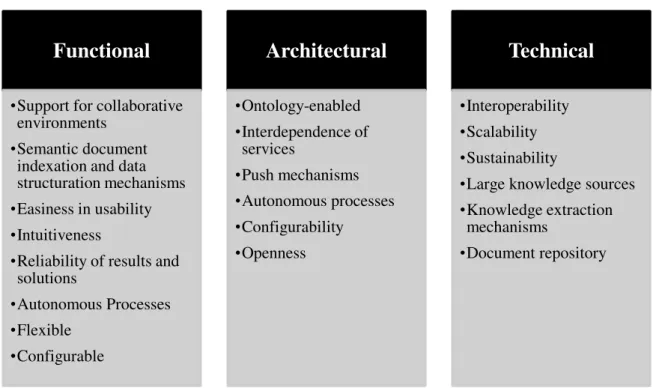
Figure 4.2: SEKS system main requirements ... 33
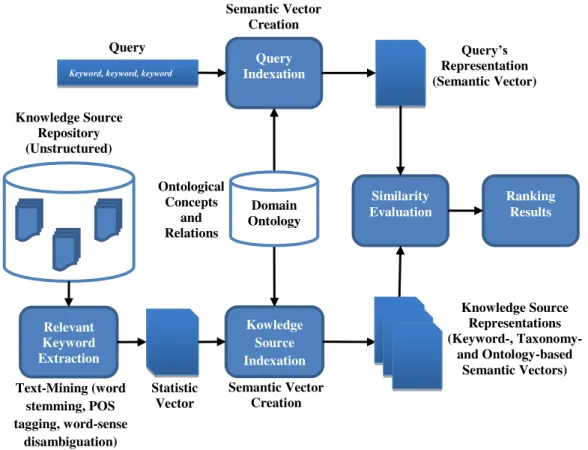
Figure 4.3: Knowledge source indexation and comparison ... 35
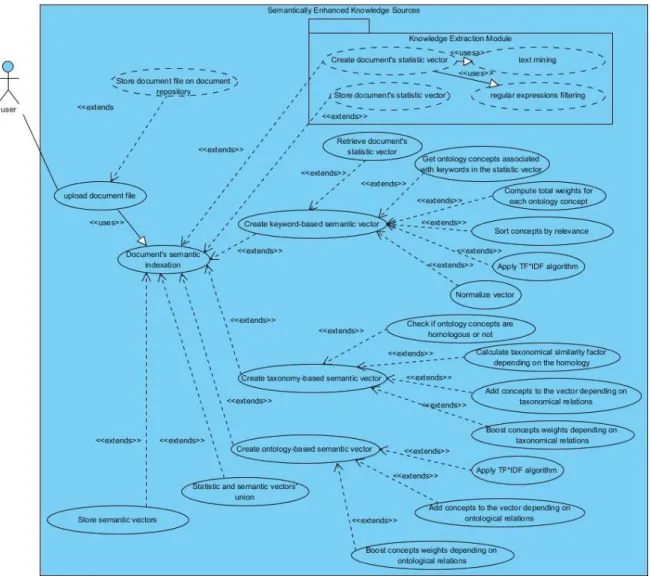
Figure 4.4: UML Use Case Diagram – Knowledge Source Indexation ... 38
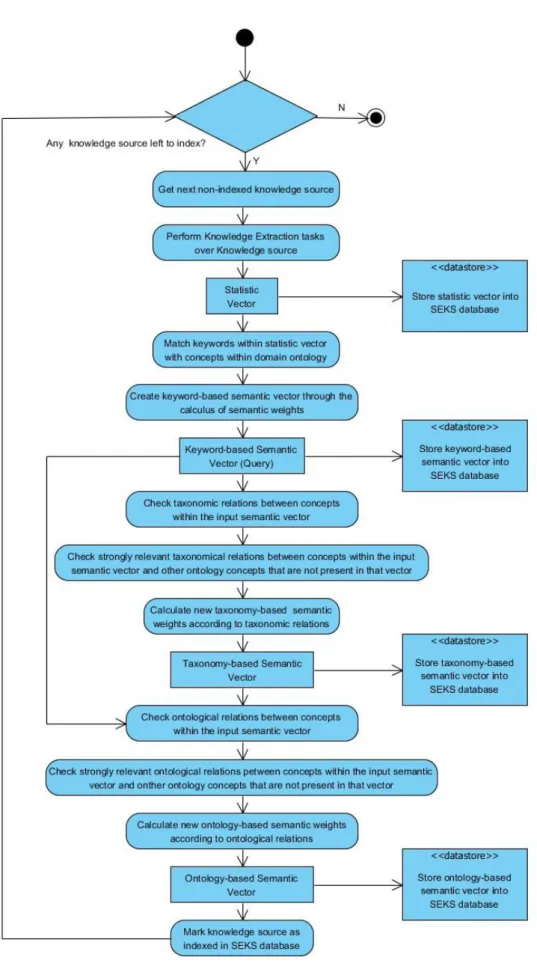
Figure 4.5: UML Activity Diagram - Knowledge Source Indexation ... 39
Figure 4.6: UML Use Case Diagram – Knowledge source search ... 41
Figure 4.7: UML Activity Diagram - Knowledge source search ... 42
Figure 4.8: SEKS Architecture ... 43
Figure 4.9: Entity-Relation Diagram for SEKS system database ... 45
Figure 5.1: Main concepts of SEKS ontology ... 49
Figure 5.2: Subclasses for concept 'Actor', ‘Design Actor’ and ‘Engineer’ ... 49
Figure 5.3: Individual and keywords for concept 'Architect' ... 50
Figure 5.4: Knowledge source indexation process ... 54
Figure 5.5: Query Indexation Process ... 61
Figure 5.6: SEKS system class structure ... 64
Figure 5.7: UCD - Plain Old Java Objects (POJOs) classes... 65
Figure 5.8: UCD - Calculus Services classes and interfaces ... 65
Figure 5.9: UCD - Database Services classes and interfaces ... 65
Figure 5.10: UCD - Ontology Services classes and interfaces ... 66
Figure 5.11: UCD - Serialization Services classes and interfaces ... 66
Figure 5.12: UCD - Semantic Vector Services and Document Comparison Services classes and interfaces . 67 Figure 5.13: UCD - Query Treatment Services classes and interfaces ... 68
Figure 5.14: UCD - Web Services Interface classes ... 70
Figure 5.15: UCD – User Interface classes ... 71
Figure 5.16:SEKS User Interface ... 71
Figure 6.1: User Interface - Upload knowledge source function ... 73
Figure 6.2: User Interface - Keyword-based search and autocomplete function ... 77
Figure 6.3: User Interface - Visual ontology tree and ontology concept-based search ... 79
Figure A.1: USD - Create a document's keyword-based semantic vector ... 93
Figure A.2: USD - Create a document's taxonomy-based semantic vector ... 94
XV
Figure A.4: USD - Create a query's statistic vector ... 96
Figure A.5: USD - Create a query's semantic vector ... 97
Figure A.6: USD - Get shared concepts between two semantic vectors ... 98
XVI
TABLE INDEX
Table 5.1: Examples of ontological properties or relations ... 50
Table 5.2: SEKS Database MySQL routines ... 51
Table 6.1: Example of a stored statistic vector ... 73
Table 6.2: Example of a keyword-based semantic vector, matched: Matched ontology concepts and keywords, and respective weights ... 75
Table 6.3: Old keyword-based semantic weights and new taxonomy-based semantic weights ... 76
Table 6.4: Example of a query's semantic vector ... 78
Table 6.5: First five results for query "architect, door frame" ... 78
XVII
SYMBOLS AND NOTATIONS
AJAX Asynchronous JavaScript And XML
API Application Programming Interface
CoSKS CoSpaces Knowledge Support
DAML DARPA Agent Markup Language
DL Description Logic
DARPA Defense Advanced Research Projects Agency
ERD Entity-Relation Diagram
HTML HyperText Markup Language
IDE Integrated Development Environment
IDF Inverse Document Frequency
IP Integrated Project
IR Information Retrieval
JAX-WS Java API for XML Web Services
JSON JavaScript Object Notation
KM Knowledge Management
MVC Model View Controller
OIL Ontology Inference Language
OWL Web Ontology Language
RDF Resource Description Framework
RDFS Resource Description Framework Schema
RPC Remote Procedure Call
SECI Socialization, Externalization, Combination, Internalization
SEKS Semantically Enhanced Knowledge Sources
SGML Standard Generalized Markup Language
SPARQL SPARQL Protocol and RDF Query Language
TF Term Frequency
UCD UML Class Diagram
UML Unified Modeling Language
URI Universal Resource Identifier
URL Universal Resource Locator
USD UML Sequence Diagram
VSM Vector Space Model
WSDL Web Service Definition Language
W3C World Wide Web Consortium
1
1
INTRODUCTION
1.1
Rationale & Motivation
Knowledge is a key factor in all aspects of today´s industries, and in their effort to keep up on such a competitive environment (Ichijo & Nonaka, 2007). This fact is established by accounting for how much knowledge is gathered and shared between companies in their projects’ life spans. Usually, a project achievement strongly relies on a truly exchange of knowledge and competencies. Project information, budgets, human resources lists, time schedules, manuals and guides, video tutorials, material lists, documents and all other forms of knowledge sources are, basically, created or recycled knowledge. From the organisation point of view, knowledge goes through a spiral progression denominated as knowledge lifecycle (Nonaka & Takeuchi, 1995). In this configuration, knowledge is created and nurtured in a continuous flow of conversion, sharing, combination, and dissemination, where all the aspects and contexts of a given organisation, are considered, such as individuals, communities, and projects. Knowledge assets are the basic foundations for sustainable work, collaboration and organization within a company and between different companies, due to knowledge’s ability to be recycled, shared and reused between different users and teams and in different formats, saving time and money spent on investigation and information gathering, on behalf of employers and employees.
Today’s World Wide Web has had a tremendous impact on such collaboration and knowledge sharing processes by making knowledge instantly and universally available within and across companies. With the rapid increase of knowledge assets on the Web, and during the transition from physical to electronic means for their transmission, the content and encoding of such assets has remained natural human language. The current World Wide Web is, basically, a huge library, or database, of knowledge assets (web pages, documents, video and audio files, etc.) interconnected by a hypermedia of unique links, or identifiers, for each asset, and it acts as an applications and multimedia platform (Goble, et al., 2001). Thus, the World Wide Web can be defined as the Syntactic Web, because computers present information (usually in HTML) to human users, without any attempt to evaluate, classify or interpret the outputted information. It is up to the user to decide which of the presented knowledge is relevant (Breitman, et al., 2007). So, the question is: Why leave the process of creation of concepts’ mental representations and contextualization through semantic relatedness to humans?
2
achieving an optimized maintenance and capitalization throughout the entire knowledge lifecycle (Alavi & Leidner, 1999). Specifically, in a project oriented context, teams of professionals can improve their work performance if supported by knowledge indexation and transfer mechanisms as part of a collaborative working environment. Hence, the industrial medium has the need to develop new ways of collaborative work, specifically, electronic collaboration (e-collaboration), supported by effective knowledge management (KM) and indexation mechanisms within their Information Retrieval (IR) tools, thus improving efficiency and enabling added-value ways of operation between collaborative projects’ partners (Costa, et al., 2010).
Over the last years, a vision of structured, contextualized and semantically relevant knowledge over the World Wide Web has been developing: the term “Semantic Web” (Berners-Lee, et al., 2001) refers to W3C’s vision of the Web of linked data. The Semantic Web fosters a common framework that allows contextualized, structured data to be shared and reused across application, enterprise, and community boundaries (World Wide Web Consortium (W3C), 2004). Due to the growing interest in semantic technologies and the advent of the Semantic Web, the above issues and limitations of today’s World Wide Web are being addressed, by making computers able to measure semantic relatedness or similarity1 between concepts or expressions on large-scale information sources, through semantic-based knowledge indexation mechanisms.
The presented work, along with the Semantically Enhanced Knowledge Sources (SEKS) system, approaches one particular issue of the IR area of research: semantic knowledge indexation of knowledge sources in order to retrieve them by its semantic relevance and context within a given domain or environment (i.e., the organisation itself or a collaborative workspace), improving collaboration between different parties at different stages of a given project life cycle and ensuring that relevant knowledge is properly capitalised in similar situations (Lima, et al., 2010).
1.2
Goals
As referred before, the aim of this work is to formalize knowledge representation techniques for knowledge sources, supported by Semantic Web technologies, developing a contribution for KM and IR areas. In order to achieve this, SEKS system enriches the representation of knowledge sources with knowledge extracted from metadata, annotations and a domain-specific ontology. In this work, the knowledge domain of the used ontology is the building and construction domain and the test-bed for the presented work was collaborative engineering projects.
SEKS is not implemented to be a semantic search engine, but rather a semantic knowledge source indexation and extraction framework. Nevertheless, a search engine-like interface will allow users, that play some role on such collaborative engineering projects, to express their information needs in terms of keywords, but at the same time will use the semantic knowledge regarding the
3
domain of the application, explicit on the domain-specific ontology, to obtain semantically relevant results that often are not achieved in traditional syntax-based search engines, like Google (Google Inc., 2012) or Yahoo! (Yahoo! Inc., 2012). Then the system performs knowledge indexation through the creation of semantic vectors2 for each knowledge source, and posterior semantic similarity analysis between user queries and sources’ vectors (queries are considered pseudo -knowledge sources), under the scope of the Building and Construction domain.
Therefore, the research question for this work can be formulated as: Will the inclusion of a
semantic dimension on knowledge representation techniques allow the creation of better
representations of knowledge sources? The knowledge representation topic is approached in Chapter 2. More specifically, the goals for the presented work are:
Extract underlying knowledge from main contents of knowledge sources and associated metadata, through the utilization data- and text-mining tools, in order to build a statistic vector of term occurrences and positioning in such sources;
Given a set of keywords or terms that occur frequently in a knowledge source, or that have a position of relevance in that source (e.g.: term in a document’s title), build keyword -based semantic vectors by matching these keywords with ontological concepts;
Given a set of ontological concepts and respective statistical weights, build a keyword-based semantic vector keyword-based on such concepts’ semantic relevance, not only within a particular knowledge source, but also their relevance across all sources within the SEKS knowledge source universe;
Given a keyword-based semantic vector, analyze the relevance of concepts present in such vector in terms of their taxonomic relationship, and build a semantic vector according to concepts related by a hierarchical relation (taxonomy-based semantic vector). This taxonomy-based vector takes into account the families, or bags, of terms. For instance, “Design Actor” and “Architect” may be seen as taxonomically related, being “Architect” a child concept of “Design Actor”, much in the same way as concepts “Dog” and “Animal”.
Given a keyword-based or taxonomy-based semantic vector, analyze the relevance of concepts present in such vector in terms of their ontological relations, and build an ontology-based semantic vector. This ontology-based vector is based on the underlying semantic relationships between ontology concepts. For instance, concepts “Architect” and “Building” may be considered linked by a semantic relation, such as “designs” or “is designed by”.
2 Semantic vectors are represented as two columned matrixes or vectors: The first column contains the terms
4
Compare semantic vectors using a similarity measure that allows analyzing whether or not those vectors are semantically similar or not. If two vectors are semantically similar, then the knowledge sources associated to them are also similar, in terms of their meaning and context.
1.3
Context of Development
The work presented here was firstly developed for UNINOVA, under the CoSpaces Integrated Project (IP) (CoSpaces Project Consortium, 2010), funded by the European Comission. The aim was to implement a knowledge management system to use on the CoSpaces collaborative workspace, comprised by three main modules: First, the knowledge extraction module, or Miner, would extract data from a project’s knowledge source, like databases and knowledge source repositories, mining over text and data to build a statistic representation of available knowledge sources. Secondly a semantic knowledge indexation mechanism, named CoSpaces Knowledge Support (CoSKS) (Lima, et al., 2010) and considered the first development iteration for the presented work, would build semantic representations and contextualize knowledge assets according to actors, projects, issues, meetings, etc. Finally, knowledge assets were presented to users depending on their necessities by the Companion module, an autonomous proactive and reactive software infrastructure (Antunes, 2010). The work developed under the CoSpaces IP led to the creation of several conference approved articles (Lima, et al., 2010; Costa, et al., 2010). CoSKS is the main contributor for this work: CoSKS ontology was modified to create SEKS ontology; most of the ontology interaction methods used on SEKS were implemented for CoSKS; and both architectures are similar.
1.4
Thesis Structure
Besides this introductory chapter, the thesis structure comprises six more chapters as follows:
Chapter 2 – Overview of the Main Areas Involved
This chapter provides an overview over the main areas involved in the presented work, and points the way to this work’s goals and requirements.
Chapter 3 – Theoretical and Technical Foundations
A focus on the theory behind concepts, models and mathematical functions behind the SEKS system is presented in this chapter.
Chapter 4 – SEKS Requirements and Conceptual Model
5
Chapter 5 - SEKS Implementation
A detailed view of all implementation aspects regarding SEKS system, adopted technologies, ontology, database, processes and architecture is the subject for this chapter.
Chapter 6 – Assessment
This chapter covers examples and assessments made for the presented proof of demonstration, presenting functionalities and results.
Chapter 7 - Conclusions and Future Work
7
2
OVERVIEW OF THE MAIN AREAS INVOLVED
This chapter summarizes the current state of the art of the main areas involved in the presented work, divided into three subchapters, namely: Knowledge, Collaboration & Knowledge Management and Information Retrieval.
2.1
Knowledge
Looking back at human History it is easily realizable that knowledge is the key element behind the evolution of mankind and it has always been captured and passed among people from different parts of the globe, using different techniques and tools, and its growth has always depended on human interaction (Costa, et al., 2010). For example, one can recall that Egyptians used papyrus to store information that could be transformed into knowledge for coming generations; Sumerians used clay tablets for the same purpose; and Alexandria’s library was, in a given period of history, probably the largest source of knowledge available on earth, gathered from and shared by many different sources, from Greek to Ancient Muslim authors.
Knowledge is one (if not the) major factor that makes personal, organisational, and societal intelligent behaviour possible (Wiig, 1993). There are many definitions for knowledge and it is a very ambiguous philosophical concept, varying its definition depending on the context it is being approached. Research on the matter defines knowledge either as a state of mind, an object, a process, a condition of having access to information or a capability (Alavi & Leidner, 1999). In the organizations’ point of view, knowledge is embedded in and carried through multiple entities including organization culture and identity, routines, policies, systems and documents, as well as individual employees. Specifically, knowledge is a justified belief that increases an entity’s capacity for taking effective action (Nonaka, 1994). For the sake of clarity, it is important to distinguish three basic concepts commonly referred throughout the presentation, namely: data, information and knowledge. Data3, in its most simple context, represents stored information to be examined and used. Information is comprised by facts or details about a specific topic, presented within a context. Knowledge is the awareness and cognitive skills acquired through experience or education.
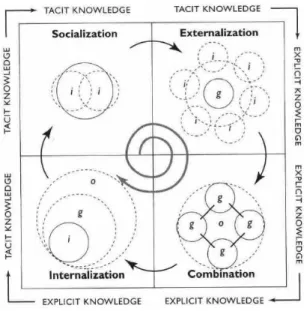
The knowledge structure model used on this work is based on the above knowledge categorization and considers that knowledge goes through an evolving spiral when it is transformed from tacit knowledge (the inner knowledge, intangible) to explicit knowledge (visible, the tangible one) (Nonaka & Takeuchi, 1995). Explicit knowledge is described in formal, systematic details, and can be expressed in words and numbers, whereas tacit knowledge is described as a knowledge
8
built on experiences, and it is difficult to capture and share, because it is highly personal and not easily visible or expressed.
Such knowledge evolution process is represented by the SECI (Socialization, Externalization, Combination and Internalization) Model, shown in Figure 2.1, which comprises the four transformation processes involving the two knowledge types, namely: Socialization (from tacit to tacit), Externalization (from tacit to explicit), Combination (from explicit to explicit), and Internalization (from explicit to tacit).
Figure 2.1: SECI Model (Nonaka & Takeuchi, 1995)
The presented work takes into account this dynamic dimension of knowledge represented in the SECI Model, by constantly assessing knowledge update and creation processes, and building knowledge representations according to such assessment.
2.2
Collaboration and Knowledge Management
Collaboration may be defined as the partnering of activities, knowledge and assets by multiple workers in a dynamic environment, aiming at gaining business and expertise advantage (Mathew, 2002). Collaboration occurs when people within an organization or across different organizations implement something together through joint effort and decision making, and share ownership of the final product or service (Linden, 2002).
9
the defined subtasks, and with increasing necessity of integrating the knowledge and experience of the development partners (Costa, et al., 2010).
Figure 2.2: Levels of joint endeavor (Camarinha-Matos & Afsarmanesh, 2006)
Knowledge sharing during collaboration processes is essential to its proper capitalization. On one hand knowledge sharing is heavily dependent on technical capabilities and, on the other hand, since the social dimension is very strong during collaboration, there is also an increased need to take into account how to support the culture and practice of knowledge sharing. For instance, issues of trust are critical in collaborative enginnering projects, since the distribution of knowledge and expertise means that it becomes increasingly difficult to understand the context in which the knowledge was created as well as to identify who knows something about the issue at hand, and so forth.
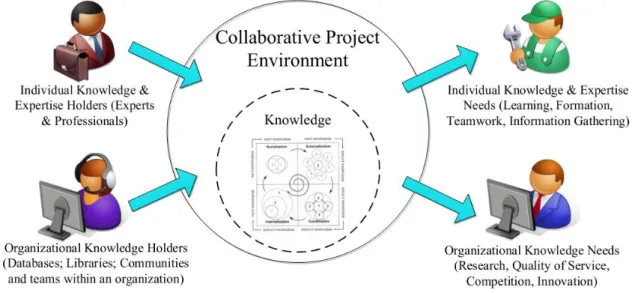
The sharing and capitalisation of knowledge and expertise within a project is highly amplified through the use of the Internet, since it can reach a bigger audience in a more effective way. With the exponential development of the Internet, most organizations and companies have moved their approach to e-business or e-collaboration where the internet is the main platform to interact with each other and with their customers (Antunes, 2010). Two new and intertwined concepts have emerged in order to face the new challenge posed by collaboration over Internet: Collaborative environment and collaborative workspace, with the difference between them being that the latter is a particular case of the first, directed only to work- or project-based collaboration. Collaborative environments are virtual environments in which individual participants or teams, from geographically dispersed locations, can work in a common project and collaborate with each other through a single combined online environment as if they were virtually in the same room, with the aim of solving the challenge of geographically spread collaboration among organizations.
10
and needs of the collabration partners, in order to be proper capitalised in terms of the collaboration context and (iii) enriched with the appropriate support of knowledge organization tools and models (Costa, et al., 2010). Thus, knowledge management (KM) is of primary importance due to the myriad of created and combined knowledge which has grown to unconceivable levels, materialized with the introduction of collaborative environments over the Web. Such growth brings other issues, such as the lack of structured and organized knowledge on the Web, the ambiguity of contexts attributed to a concept on the panoply of Web pages and Web documents existent and the scattered
distribution of knowledge over databases, documents, emails, etc
.
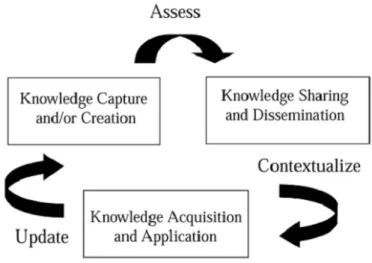
KM is a set of techniques, tools or technologies that identify, organize, collect, present, and create knowledge from a collection of data or individuals’ expertise, and facilitate the communication between knowledge creators and receivers, enabling them to use the achieved knowledge to make supported decisions or take well-thought actions (Rezende & Souza, 2007). There are several KM models or cycles (Wiig, 1993; von Krogh, 1998; Nonaka, et al., 2001). However, research over an integrated and unified KM model, built according to previous works, has realized the Integrated KM Model (Dalkir, 2005), shown in Figure 2.3. The presented work is based on this knowledge management model, in order to maintain knowledge representations of knowledge sources updated and contextualized in terms of their consistency with the source itself and with all other sources present in the system’s knowledge source repository.
Figure 2.3: Integrated Knowledge Management Model (Dalkir, 2005)
11
will validate usefulness, will signal when it becomes out of date or when this knowledge is not applicable and will help validate the scope of the content or how generalizable the best practices and lessons learned can be. They will also, quite often, come up with new content, which they can then contribute to the next cycle iteration (Dalkir, 2005). One important aspect to keep in mind is that an organization cannot share all of the knowledge that it produces: there is a great amount of knowledge assets within a company that is considered to be confidential or private. Such confidential information must be preserved on the act of collaboration, and specially in knowledge sharing. This means that, for companies willing to collaborate and as a consequence, to share knowledge, privacy issues must be taken into account, and also to enable a secure collaboration in order to build trust between organizations, must be implemented by security and trust policies. There are mechanisms that manage security and privacy on collaborative environments but, as referred before, they are not part of the developed work.
The main purpose for the use of KM technologies in the presented work is to provide a way for knowledge structuration and indexation, which are processes linked to the next subject to be presented: the Information Retrieval area. In some sense, KM technologies aim to provide better Information Retrieval tools, by organizing knowledge in ways in which they can be easily found and retrieved to the user. The indexation process output is a knowledge representation of a knowledge source. There are many knowledge representation techniques, divided into hierarchical-based, rule-based and logic-based representations but they will not be subject to further explanation on the presented work. Sufficed it is to say that this work uses a knowledge representation approach based on an ontology, semantic vectors and the Vector Space Model4, all subjects of Chapter 3.1.1.
2.3
Information Retrieval
IR can be defined in a broad set of senses and contexts. However, as an academic field of study, IR might be defined as (Manning, et al., 2008):
Information retrieval (IR) is finding material (usually documents) of an unstructured nature
(usually text) that satisfies a need for information from within large collections (usually stored on
computers).
In the past, IR was an activity that only a few people engaged in, such as librarians, paralegals, and similar professional searchers. With the advent of the Internet and the World Wide Web, hundreds of millions of people started engaging in IR in a day-to-day basis by using a web search engines or searching their email. IR is the dominant form of information access, overtaking traditional database style searching, which requires specific identification. IR can also solve other
4 The Vector Space Model will be further explained in Chapter 3.1.1.3. For now, it is sufficed to say that the
12
knowledge problems. The term “unstructured data” refers to data which does not have clear, semantically overt, easy-for-a-computer structure. It is the opposite of structured data, the canonical example of which is a relational database, of the sort companies usually use to maintain product inventories and personnel records (Manning, et al., 2008).
The field of IR also covers supporting users in browsing or filtering collections of knowledge sources, or further processing a set of retrieved sources. Given a set of knowledge sources, clustering is the task of coming up with a good class grouping such sources based on their contents. Given a set of topics, textual information needs, or other kind of collections, indexation is the task of deciding which class or classes, if any, each set of sources belongs to.
Three research works in the IR area, or that presented a contribution for the IR area, were used both as inspiration and comparison objects. (Castells, et al., 2007) propose a system focused in the IR area and based on an ontology, just as in the presented work’s case. It also uses the TF*IDF algorithm, matches knowledge sources’ keywords with ontology concepts, creates semantic vectors and uses the Euclidian distance to compare created vectors. A major difference between this IR system and the presented work is that ontology relations are not considered, nor the hierarchical relations between concepts (taxonomic relations). (Li, 2009) present a way of mathematically quantifying such hierarchical or taxonomic relations between ontology concepts, based on relations’ importance and on the co-occurrence of hierarchically related concepts, and reflect this quantification in semantic vectors of knowledge sources, as presented in Subchapter 5.4.1. This work’s aim is to create an IR model based on semantic vectors to apply over personal desktop knowledge sources, and has no relation to Web IR applications, as is the case of SEKS system. Nevertheless, this work has some manual input parameters that the presented approach tries to insert automatically.
13
3
THEORETICAL AND TECHNICAL FOUNDATIONS
This chapter provides a summarized theoretical background over all relevant subjects used to design and develop the SEKS system. First, a brief description of the technical foundations supporting the presented work is given. Afterwards the focus will be directed to the mathematical bases behind the semantic knowledge source indexation and search mechanisms developed for SEKS system.
3.1
Technical Foundations
This subchapter presents the technical foundations under which this work was developed. The first subject to be approached is the Semantic Web. Afterwards, a brief introduction over Knowledge Extraction mechanisms and an explanation about homologous and non-homologous concepts are given.
3.1.1 The Semantic Web
The term “semantics” is defined as the meaning or relationship of meanings of a sign or between a set of signs (Kashyap, et al., 2008). Other references define semantics as the study of the meaning of words in terms of their context (Larousse, 1994). Nowadays there is still no formal definition for the Semantic Web, and it often leads to different definitions of it, according to different groups of individuals. Nevertheless, the term “Semantic Web” was originally created by the World Wide Web Consortium (W3C) and introduced on the article “The Semantic Web” (Berners-Lee, et al., 2001). Two different definitions for the Semantic Web from relevant sources are presented below:
The Semantic Web provides a common framework that allows data to be shared and reused
across application, enterprise, and community boundaries (World Wide Web Consortium (W3C), 2011).
The Semantic Web is the extension of the World Wide Web that enables people to share content beyond the boundaries of applications and websites (semanticweb.org, 2011).
14
Semantic Web. The layered structure for the Semantic Web is shown in Figure 3.1 (Berners-Lee, et al., 2001) (Antoniou & Harmelen, 2004).
Figure 3.1: A layered approach to the Semantic Web (Berners-Lee, et al., 2001)
Supporting documents or, in this work’s case, knowledge sources, are Unicode document encoding and document URIs. Besides their main contents and X Markup Language structures, selfdescriptive documents comprise document annotations and metadata. Metadata and annotations refer to domain- or application-specific embedded descriptions of knowledge sources, which will be used over the Semantic Web to annotate such sources, and are represented by XML-based languages. Above documents is the RDF and RDFS layer. RDFS provides modeling primitives for organizing RDF resources into hierarchies, or taxonomies. Schemas, like RDFS, are a particular case of structured metadata which may contain semantic information (Kashyap, et al., 2008). The Ontologies layer lies down on top of RDF and RDFS. Ontologies refer to the underlying vocabulary and semantics of the metadata annotations, allowing the representation of more complex relationships between Web knowledge sources. Collections of domain-specific ontological concepts may extract underlying domain-specific contexts and meanings from main contents of such Web sources.
15
In order to achieve this layered perspective on the Semantic Web, two conditions must be satisfied: Downward compatibility and upward partial understanding. Downward compatibility implies that applications oriented to the use of a specific layer, for instance, the ontology layer, must be able to take full advantage of knowledge from lower layers, for example the RDF and RDFS layer. Upward partial understanding entails that although an application is using a lower layer of information, like RDF and RDFS, it must be capable of extract some knowledge from upper layers, as the ontology layer, by using only the primitives of RDF and RDFS present within ontologies, and disregarding other upper layer primitives.
Semantic protocols used to infer over the desired logic and proof and, at the same time, provide query support to semantic markup languages, like RDF and OWL, are already available: SPARQL for RDF (World Wide Web Consortium (W3C), 2008) and SPARQL-DL for OWL-DL (World Wide Web Consortium (W3C), 2011). The presented work uses SPARQL-DL indirectly, through a semantic framework that enables query execution over taxonomies and ontologies, Jena Semantic Framework (The Apache Software Foundation, 2011), so it does not deserve much more attention in this presentation. More insights on this semantic framework will be given on Chapter 5.
3.1.1.1 Annotations, Taxonomies and Ontologies
Both annotations and ontologies are, as previously referred, based in structured languages, like XML. In fact, structured languages are intrinsically related to the advent of the Semantic Web, as can be seen in because such languages are designed to be both human- and machine-readable, and can contain semantic content and relations associated to data.
Annotations are comprehended by structured information embedded in knowledge assets that define contexts and meanings to knowledge assets main contents’ unstructured data. Often they are based on XML or RDF. Taxonomies are hierarchical structures that organize concepts in bags, under a specific domain, and are normally represented in RDF. Concepts are related by kin, or familiarity, meaning that existing relations define concepts’ parenthoods by stating that some concepts are particular forms of other concepts (“Architect” is a particular form of a construction environment “Actor”). Ontologies are taxonomies that enable machine assertions or claims about relations between concepts that are not taxonomically related, and are represented using the Web Ontology Language, or OWL.
16
comprise structural information, like annotations. It is a purely a document format and display language.
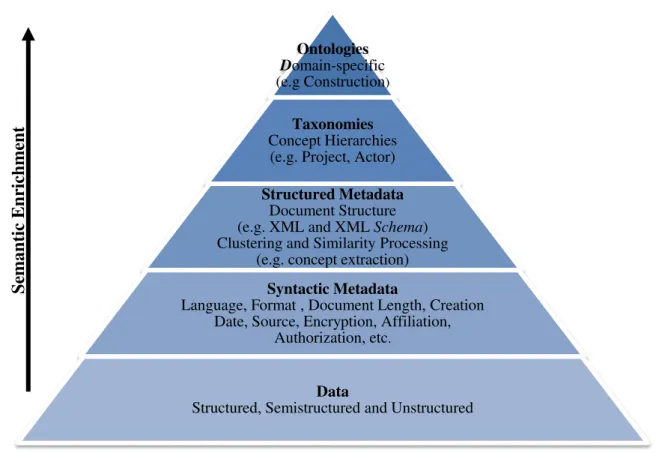
Figure 3.2: The pyramid of Semantic Web Content (adapted from (Idehen, 2010))
XML development was driven by shortcomings of HTML. Both HTML and XML use a data representation model supported by tags. Both permit to structure information, through the introduction of tags nested within other tags. Both are markup languages, meaning that they allow the distinction between content and underlying structured data, describing the role that content plays, and both are human- and machine-readable. In contrast to HTML, XML documents are far more easily readable by machines, because every piece of information within it is described, and underlying relations are also defined through the nesting structure.
Figure 3.3: XML and Semantic Web Chronology (Bikakis, et al., 2012) Ontologies
Domain-specific
(e.g Construction)
Taxonomies
Concept Hierarchies (e.g. Project, Actor)
Structured Metadata
Document Structure (e.g. XML and XML Schema)
Clustering and Similarity Processing (e.g. concept extraction)
Syntactic Metadata
Language, Format , Document Length, Creation Date, Source, Encryption, Affiliation,
Authorization, etc.
Data
Structured, Semistructured and Unstructured
17
It is this evolution in markup languages that serves as foundation for the extraction of meaning and context from unstructured information behind the Semantic Web, and not the mentioned languages themselves. Over time, other languages and information structures were implemented to bring the Semantic Web’s concept to what it is today: RDF and OWL languages and taxonomic and ontological structures, described below.
3.1.1.1.1 Taxonomies and RDF
The Semantic Web introduces new usage possibilities to recently developed XML-based languages. The next iteration of XML-based languages towards the Semantic Web vision is RDF (Resource Description Framework). RDF is a data-modeling language based on XML syntax which defines statements about resources and relations among them.
Resources define domain concepts, meaning “things” belonging to a certain domain. For instance, “Actor”, “Project phase” or “Architect” are concepts, or resources, which have particular meanings in the construction environment domain. Every resource has a Universal Resource Identifier (URI) that identifies it. In RDF, resources can be arranged in taxonomic arrays of classes, and respective sub-classes, of concepts using the nesting ability of XML. XML does not offer any explicit way to represent the hierarchy of information in a taxonomic fashion, and it is up to each application to interpret the nesting of tags.
RDF permits machines to reason the hierarchical taxonomy of concepts regarding a certain domain. A class is said to be a subclass of another class if every resource in is also included in . For instance, one can easily see that “Architect” is a sub-class of “Actor”, meaning that architects are one type of actor in the construction environment. In such cases one can state that the concept “Architect” is an instance of “Actor”. Properties, or relations, are a particular type of resources, they describe relations between resources, for instance, the relation “is a”. Using again the example given above, one can comprehend that an “Architect” “is an” “Actor” in the construction domain’s context. RDF properties are also identified by URIs. The idea of using URIs to identify concepts and relations because it introduces a global unique naming scheme, which reduces homonym issues in data representation (Antoniou & Harmelen, 2004).
Statements assert the properties of resources. Each RDF statement is built according to a triplet form, comprising a subject (resource), a predicate (property or relationship) and an object (property value). Statement objects can either be resources or literals, which are atomic values that can be integers, strings, real numbers, etc. (Baker & Cheung, 2007).
18
which type of resources and what values are permitted describes the domain-specific connections between resources and implements the concepts’ class hierarchy. This means that RDFS makes semantic information, represented in RDF, machine-accessible.
Even so, RDF, and consequently RDFS, present problems to the Semantic Web vision of linked data. RDF only allows binary properties, meaning that a statement is always comprised by one subject, one property and one object. Much of the times humans use predicates with more than two resources as arguments. These can be simulated by binary statements, but such simulation is not simple and does not look natural. Another issue is property handling. On RDF, properties are regarded as a special type of resource, which means that they can be used also as statements’ objects or subjects. This approach can be flexible, but it entails modeling complexity and can sometimes be confusing to human modelers or users. This issue is also verified in statements. RDF allows statements about statements, which introduces complexity levels not suited for a foundational layer for the Semantic Web.
Recapitulating, RDF and RDFS are widely- and commonly-used standards in the Semantic Web context, but neither is expressive enough to provide the formal knowledge representation support that is intended for computer processing. While RDF and RDFS allow representations of some ontological knowledge, like vocabulary organization in typed hierarchies: subclass and subproperty relationships, domain and range restrictions and instances of classes, their expressivity is deliberately limited: RDF is limited to binary ground predicates and RDFS is limited to subclass and property hierarchies. Other Semantic Web’s important features are missing (Antoniou & Harmelen, 2004):
Properties’ local scope. RDFS defines the range of a property as global, meaning that one cannot declare range restrictions that apply only to some resources.
Disjoint classes. RDFS only permits statements about subclass relationships (“male” and “female” are subclasses of “person”), not allowing the definition of disjoint or contrary classes (“male” and “female” are disjoint concepts).
Boolean combinations of classes. RDFS does not comprise Boolean interactions between classes, which entails that classes cannot be united, intersected or complemented with each other, to form new classes.
Cardinality restrictions. RDFS does not allow the placement of restrictions on how many distinct values a property can or must have.
19
Hence, a richer ontology language that provides the above features is needed. More profoundly, the number of particular use-cases for the Semantic Web that would require much more expressiveness than provided by RDF and RDFS led to an initiative between research groups both in the United States of America and Europe to define a richer ontology modeling language. DAML+OIL (DARPA Agent Markup Language + Ontology Inference Language) (Antoniou & Harmelen, 2004). This language was the starting point for the definition of the W3C Web Ontology Group’s (World Wide Web Consortium (W3C), 2001) Web Ontology Language, or OWL, the next subject to be discussed.
3.1.1.2 Ontologies and OWL
The term “ontology” has its origins defining a subfield of philosophy, the study of the nature of existence, meaning the identification of types of things that exist, and how to describe them. However, in the Semantic Web’s point a view, “an ontology” can be described as a formal description or conceptualization of a domain of knowledge, consisting of a collection of classes and the relations between these classes. Classes denote domain concepts and are arranged hierarchically, just as in taxonomies. Ontologies provide a shared understanding of a specific domain. Apart from subclass relationships, ontologies contain other types of knowledge, such as properties (e.g. “builds” ), value restrictions (e.g. “only can build ”), disjointness statements (not available in RDF and RDFS), and specification of logical relationships between objects (e.g. “ is built by at least ten ’s”).
OWL is the W3C current standard for representing ontologies on the Web, and aims to solve RDF and RDFS’s lack of expressiveness issues mentioned above. Furthermore, OWL’s main requirements are a well-defined syntax, a formal semantics, convenience of expression, efficient reasoning support and sufficient expressive power. A well-defined syntax is important for obvious reasons: enable better machine-processing over knowledge. RDF, RDFS and OWL all comply with this condition. On the other side, the syntax should easily readable by human users, condition poorly satisfied by any of the mentioned languages. Nevertheless, condition is not absolutely necessary, for ontologies will be developed using ontology development tools, for instance Protégé ontology development environment ( Stanford Center for Biomedical Informatics Research, 2011).
20
Class Membership. If is an instance of a class , and is a subclass of then is also an instance of .
Class Equivalence. If a class is equivalent to class , and class is equivalent to class , then is also equivalent to .
Knowledge Consistency. If is an instance of a class and is a subclass of the union
and also subclass of , then, considering and as disjoint classes, the ontology has an inconsistency regarding the knowledge rules already imposed, because has the instance in it, but due the disjointness of and , should be empty.
Knowledge Classification. If certain property-value pairs are a sufficient condition for membership in class and if an individual satisfies such condition, then must be an instance of class .
The panoply of requirements for an ontology language, specially reasoning support and the combination between an expressive language, as RDFS, and the power of description logic, led W3C’s Web Ontology Group to define OWL as comprised by a full logic-driven language with a powerful expressiveness, OWL Full, which fulfills the complete set of requirements stated above, and two sublanguages, geared towards a better computational efficiency and to be user-friendly, not provided by OWL Full: OWL DL and OWL Lite (Yu, 2011) (Antoniou & Harmelen, 2004). To regain the lost computational efficiency of OWL Full, OWL DL (Description Logic) was created. OWL DL restricts how OWL and RDF tags, or constructors, may be used. Although OWL DL is not fully RDF and RDFS compatible, it permits efficient reasoning support. Other iteration to OWL regarding efficiency and towards being more user-friendly is OWL Lite. It excludes enumerated classes, disjointness statements and arbitrary cardinality. Although it has a limited expressivity, it is easier to implement and to understand than OWL DL. All OWL languages use RDF and RDFS for their syntax and their instances are declared as in RDF. OWL classes, datatype properties and object properties are specializations of their RDF counterparts.
The SEKS project’s ontology is an OWL DL ontology, because both good expressiveness and reasoning efficiency are needed for semantic knowledge source indexation. The SEKS project’s ontology is an OWL DL ontology, because both good expressiveness and reasoning efficiency are needed for effective semantic knowledge source indexation. The ontology is used by SEKS system to infer about underlying semantic relations between ontological concepts to achieve semantically enhanced knowledge representations of knowledge sources and user queries.
3.1.1.3 Semantic Vectors and the Vector Space Model
21
physical, biological, social, psychological, or conceptual entity (Dubin, 2004). VSM was developed for the SMART IR system by Gerard Salton and his colleagues (Salton, Wong, & Yang, 1975). SMART system was pioneer in the development of many of the concepts that are still in use in modern search engines (Manning, et al., 2008).
VSM formulates and approaches the statistical semantics hypothesis: if statistical patterns are applied over human syntactic word formation and natural language term usage, then it is possible to understand the underlying meaning behind that usage (Turney & Pantel, 2010). The statistical semantics hypothesis is supported by several more specific hypotheses that are relevant to the context of the presented work: bag of word hypothesis, distributional hypothesis, extended distributional hypothesis and latent relation hypothesis.
The bag of words hypothesis states that one can estimate the underlying relevance of knowledge sources in relation to a query by representing both sources and queries as bags of words. Hence, the frequencies of occurrences of a query’s words in knowledge sources tend to represent the relevance of each source in relation to the query. This hypothesis is the building block that supports the application of VSM in IR (Salton, et al., 1975). The distributional hypothesis affirms that words or expressions that occur in similar contexts tend to have similar meanings (Harris, 1954) (Sahlgren, 2008). The distributional hypothesis enables the application of the VSM in word similarity measures. The extended distributional hypothesis is based on the concept that patterns that co-occur with similar pairs of expressions or words also tend to have similar meanings. As the name implies, this hypothesis is an extension to the distributional hypothesis. Pattern similarity can be used to infer that one sentence is a paraphrase of another (Lin & Pantel, 2001). Finally, the latent relation hypothesis states that pairs of words or expressions that co-occur in similar patterns tend to have similar semantic relations (Turney, 2008).
Through the application of the above hypotheses, VSM has several attractive properties for Semantic Web applications (Turney & Pantel, 2010). VSMs use automatic knowledge extraction over a given corpus, which requires lesser computation power than other approaches to semantics. VSMs are considered a very powerful tool when measuring the similarity of meaning between words, phrases, and documents. Most search engines use VSMs to measure the similarity between a query and a knowledge source (Manning, et al., 2008).
22
distance (decreasing semantic similarity) from the query and then presented to the user (Turney & Pantel, 2010). Formally, VSM-based IR methods mainly use three types of matrixes as output: term-document, word-context and pair-pattern matrixes (Turney & Pantel, 2010).
SEKS system uses VSM to realize knowledge representations of both knowledge sources and queries, and to define a common format between these representations, allowing comparisons between them. Specifically, SEKS uses approximations to term-document vectors in its methods to build statistic and semantic vectors. Term-document matrixes (Salton, et al., 1975) are used to measure document similarity. The matrix’s row vectors correspond to terms or expressions and the column vectors correspond to documents, with the document vector representing the corresponding document as a bag of words.
In the presented work, statistic vectors are an approximation to term-document matrixes, built with extracted words and expressions from knowledge sources and with a quantification of the relevance of those expressions in the source, also called weight. The difference between the traditional term-document matrixes and SEKS system’s statistic vectors is that instead of having a column for each knowledge source and a row for each expression, the matrix has two rows: one with expressions, or keywords, and another with the respective relevance quantification for each expression. The whole matrix is a statistic representation of the knowledge source.
Semantic vector models include a family of related models for representing concepts with vectors in a high dimensional vector space (Widdows & Ferraro, 2008). Semantic vector creation is supported by the VSM and it is the basis for the presented approach because it implements the extraction of knowledge and meaning from knowledge sources and the agglomeration of this knowledge in a matrix form, better suited for mathematical applications than the raw text form of documents. Furthermore, semantic vectors present the following advantages (Widdows & Ferraro, 2008):
They can be built using entirely unsupervised distributional analysis of free text.
While they involve some nontrivial mathematical machinery, they make very few language-specific assumptions (e.g., it is possible to build a semantic vector model provided only that one has reliably tokenized text).
Similar techniques have been used in other areas, e.g., for image processing.
The ease with which very simple distributed memory units can collaboratively learn and represent semantic vectors has been noted for its potential cognitive significance.
23
The presented work again uses an approximation to the term-document matrix concept but, as in the case of statistic vectors, semantic vectors are matrixes with two rows that represent knowledge within a knowledge source. The difference is, instead of expressions that occur in a particular source, semantic vectors have a row for semantic concepts that comprise a large number of expressions or words. For instance, expressions like architecture, architectonics, building design or urban planning may refer to a semantic concept, in other words, a concept that extends its meaning to these expressions. In this case, the concept of architect may be considered to embrace all of the previous expressions in its context.
3.1.2 Knowledge Extraction
Knowledge extraction is usually a process embracing three stages: word extraction, regular expressions filtering, and statistic vector creation. Word extraction is the process in which words and expressions are extracted from a knowledge source and divided by data- and text-mining techniques. Text mining corresponds to the extension of more traditional data mining approach to unstructured textual data and is concerned with various tasks such as extraction of information implicitly contained in collections of knowledge sources, similarity-based structuring and visualization of large sets of texts (Rajman & Besançon, 1998). Another responsibility of text mining tools is regular expression filtering, which is the process of removing frequently occurring terms that have no relevance for the context of a particular source, but normally appear several times in all knowledge sources, such as grammatical articles (the, a/an, some), pronouns (mine, yours, me, she anybody, etc.), prepositions (for, in, under, toward, etc.) or adverbs (much, few, quite, slowly, etc.).
This process is performed by noise reduction and filtering procedures, such as stemming filters, which cut words to their stem forms (e.g. the stem form of painting is paint). The last stage, statistic vector creation, is the process that builds the statistical representation of a knowledge source, through the analysis of each term extracted from the source, in terms of its frequency, emphasis and position within the corpus of such source. The statistic vector is organized in matrix form and is composed by the extracted terms, or keywords5, and by the statistical weight of each keyword within the knowledge source, based on the frequency analysis introduced above. This vector of keywords and respective weights is represented by an approximation to the term-document matrix vector, which is denominated statistic vector. This vector is the main input parameter for the SEKS system.
There are many state-of-the-art data-mining and text-mining frameworks and techniques available. Knowledge extraction techniques are the basis for IR, supporting syntactical comparison
5Throughout the text, the author uses the words “keyword” and “term” in a way that may appear ambiguous. The word “keyword” is applied whenever the author means the terms extracted from the document. The word “term” is applied
24
between users’ queries and words or expressions contained in knowledge sources. Most search of today’s Web search engines function according to this principle. The software used to create SEKS statistic vectors was RapidMiner (Rapid-I GmBH, 2011), which is a knowledge extraction tool in the form of an easy-to-use IDE, and that builds statistic vectors of knowledge sources over sources’ corpora. RapidMiner has several filter tools, such as stemming and lemmatization filters, and provides access to MySQL (Oracle Corporation, 2011) databases, storing itself the statistic vectors created.
A particular type of filter used in knowledge extraction mechanisms is stemming filters. A stem is the part of a word that contains no inflectional morphology (Kroeger, 2005): for instance, the stem word for “decentralization” is “centralize”, being “de-” the prefix and “-ation” the suffix. Stem filtering is used in knowledge extraction because it reduces time in word comparison processes, by getting the essential part of a set of words with just one stem word.
3.1.3 Homologous and Non-homologous Concepts
A kin relation is represented as a “is-a” taxonomic relation. For instance, one can say that the concept “design phase”, defining a construction project’s designing phase, is related to the more general concept “phase”, defining any phase on the project’s development. One can also say that “design phase” “is-a” “phase”. This relation traduces the fact that “phase” is an ancestor node for “design phase” in the ontological tree structure. Specifically, the kin relations can be expressed through the following definitions (Li, 2009):
Definition 3.1: In the hierarchical tree structure of the ontology, concept and concept
are homologous concepts if the node of concept is an ancestor node of concept (Figure 3.4). Hence, is considered the nearest root concept of , ( ). The taxonomical distance between and is given by:
( ) | ( ) ( )| | ( ) ( )| (1)
In Equation 1, ( ) is the depth of node in the hierarchical tree structure, with the ontological root concept’s depth being zero (0).
25
Definition 3.2: In the hierarchical tree structure of the ontology, concept and concept
are non-homologous concepts if concept is neither the ancestor node nor the descendant node of concept , even though both concepts are related by kin; If is the nearest ancestor of both and , then is considered the nearest ancestor concept for both and concepts, ( ); The taxonomical distance between and is expressed as:
( ) ( ) ( ) (2)
The taxonomical similarity, ( ), is calculated differently to both homologous and non-homologous taxonomical relations defined previously:
( ) ( ( ) ) ( ) ( ) ( )
( )
(3)
( ) ( ( ( )) ) ( ) ( ) ( ) ( )
( )
(4)
( ) ( ) (5)
In the above functions, ( ) represents the total number of nodes in the sub-tree with root . The cited author (Li, 2009) states that parameters α and β are managed by filed experts. Equation 5, states that if the distance between two concepts is null, or equal to zero (0), then those two concepts are the same concept.
3.2
Mathematical Foundations
This chapter introduces the basic mathematical foundations needed for the implementation of the presented work.
3.2.1 TF-IDF Function Family
One of the first measures of term relevance on documents used in IR was the inverse document
frequency (IDF) (Jones, 2004). The IDF measure is defined by the number of documents in a
document set which are indexed by, or contain, a specific term, word or expression. It is basically a heuristic implementation of the idea that a term that occurs in a great number of documents should have less relevance, or weight, than one that occurs in few documents.