Repositório ISCTE-IUL
Deposited in Repositório ISCTE-IUL:
2018-07-02
Deposited version:
Post-print
Peer-review status of attached file:
Peer-reviewed
Citation for published item:
Freitas, A., Brito, L., Baras, K. & Silva, J. (2017). Overview of context-sensitive technologies for well-being. In 2017 International Conference on Internet of Things for the Global Community (IoTGC). Funchal: IEEE.
Further information on publisher's website:
10.1109/IoTGC.2017.8008971
Publisher's copyright statement:
This is the peer reviewed version of the following article: Freitas, A., Brito, L., Baras, K. & Silva, J. (2017). Overview of context-sensitive technologies for well-being. In 2017 International Conference on Internet of Things for the Global Community (IoTGC). Funchal: IEEE., which has been published in final form at https://dx.doi.org/10.1109/IoTGC.2017.8008971. This article may be used for non-commercial purposes in accordance with the Publisher's Terms and Conditions for self-archiving.
Use policy
Creative Commons CC BY 4.0
The full-text may be used and/or reproduced, and given to third parties in any format or medium, without prior permission or charge, for personal research or study, educational, or not-for-profit purposes provided that:
• a full bibliographic reference is made to the original source • a link is made to the metadata record in the Repository • the full-text is not changed in any way
The full-text must not be sold in any format or medium without the formal permission of the copyright holders. Serviços de Informação e Documentação, Instituto Universitário de Lisboa (ISCTE-IUL)
Av. das Forças Armadas, Edifício II, 1649-026 Lisboa Portugal Phone: +(351) 217 903 024 | e-mail: [email protected]
Overview of Context-Sensitive Technologies for
Well-Being
André Freitas, Lina Brito, Karolina Baras
Madeira Interactive Technologies InstituteFunchal, Portugal
{andre.freitas, lina.brito, karolina.baras}@m-iti.org
José Silva
Madeira Interactive Technologies Institute Instituto Universitário de Lisboa (ISCTE-IUL),
ISTAR-IUL Lisboa, Portugal [email protected]
Abstract—Today smart devices such as smartphones,
smartwatches and activity trackers are widely available and accepted in most developed societies. These devices present a broad set of sensors capable of extracting detailed information about different situations of daily life, which, if used for good, have the potential to improve the quality of life not only for individuals but also for the society in general. One of the key areas where this type of information can help to improve the quality of life is in healthcare since it allows to monitor and infer the current level of well-being of the smart devices carriers. In this paper, some of the available literature about well-being sensing through context-aware data is reviewed. Also, the main types of mechanisms used in these studies are identified. These mechanisms are related to monitoring, generalization, inference, feedback, energy management and privacy. Furthermore, a description of the mechanisms used in each study is presented.
Keywords—Healthcare; Well-being; Context-sensing; Data analysis; IoT;
I. INTRODUCTION
The IoT (Internet of Things) can be described as the intercommunication via the internet between everyday objects, enabling them to exchange data. Most of these objects present some type of sensors that enable them to extract contextual data. One of the main areas where IoT technologies are being used with great success is healthcare. This kind of technologies is being applied to several branches of healthcare such as acute care (in hospital), long-term care (nursing homes) and community-based (usually, home care) [1].
Given that smartphones today are very common, accessible, almost ubiquitous, carry a wide range of sensors, are capable extracting, processing, and communicating detailed data about different everyday situations, they naturally become one of the best ways to interact with other IoT enabled devices by being able to combine and complement contextual data with personal data. These two kinds of data can be combined to make an extensive profiling about the current patient health status. This branch of healthcare is designated as mHealth (mobile healthcare).
Some of the most frequently reported benefits of mHealth are related to the improvement of the interaction between patient and physician, increased access to healthcare related
services, higher treatment compliance, and saving costs by reducing hospitalization needs and intensive care [2].
There are several categories of mHealth applications [2]. Some are focused in cyber therapy which oversees variables related to specific health issues (e.g., diseases). Others try to improve general well-being, by being more focused on the prevention of health-related issues. This last kind of mHealth applications informs the users about their current well-being status. Some of those applications can create feedback that allows users to make better future decisions and as such prevent serious health issues related to their current lifestyle.
Well-being can be affected by factors such as sleeping hours [3], level of sociability [4], physical activity [5], personality [6], among others. These can be reflected in the general mood state [7]. Since mood has a proven influence in our decisions and consequently in our behavior [8], it becomes a worthwhile subject of study. Usually sensing well-being studies use smartphone applications as the main platform to extract and process data. Studies such as, MoodScope [9] and StudentLife [10], already shown the existence of some correlations between smartphone usage and well-being, mood and behavior. This kind of apps presents several types of mechanisms which can be decomposed in five main groups: monitor mechanism; generalization and inference mechanisms; feedback mechanism; energy management mechanism; privacy mechanism.
In this paper, we focus on a subset of studies that make use of mHealth applications capable of detecting, monitoring and/or improving the general user well-being. Namely, we focus on aspects related to the study conditions and common abstract modules used in each application.
The rest of paper is organized as follows. Section II presents a short overview about nine studies in which the main goal is to measure, monitor and infer parameters related with being. In Section III, a description of each type of well-being sensing mechanism is provided followed by some examples of usage. Section IV discusses the previously mentioned studies. The concluding remarks are presented in Section V.
This research is supported by the Fundação para a Ciência e Tecnologia (FCT) within the project scope UID/EEA/50009/2013.
II. STUDIES OVERVIEW
There are numerous studies which main objective is well-being evaluation. In this section, a summary of nine studies that use smartphone-based applications to detect and monitor well-being related parameters is described. These studies were selected because they use different techniques to predict well-being. Consequently, they allow to compare, not only the differences between studies, but also the variations in each of the techniques used. Other criteria for the selection of these studies was the date of publication and relevance, in terms of number of citations; most of these studies present a high number of citations and were published after 2010.
A study in the scope of the StudentLife project [10] was carried out with the goal of evaluating what variables influence the academic performance among students. It also evaluated the students’ behavior over time. This study was done through an application that collects data that can be used to measure the impact of workload on stress levels, sleep, physical activity, mood, sociability, mental well-being and academic performance. Also, this app triggers surveys about the users’ mood several times a day. It also uses smartphone sensors to evaluate the parameters previously identified. This study was made with 48 students over 10 weeks. In terms of results, it proves that there is a significant number of correlations between the extracted data from smartphone sensors and mental health with students’ academic performance. It was identified that a low number of sleeping hours, lack of sociability and low mobility are directly related to high levels of stress and depression and, consequently, with poor academic performance. It was also found that, as the exam dates approach, the sociability levels are prone to decrease, stress tends to increase, the number of sleeping hours decreases and the physical activity is increasingly reduced.
In another study, a mobile app called MoodScope [9] was developed aiming the inference of the user's mood based on the smartphone usage. This app can act as a sensor that can be integrated into other applications through an API. This software was based on a previous study where factors such as the history of communications (SMS -Short Message System -, emails, calls), patterns in the mobile application usage, location and web browser history were analyzed. This study was done by collecting data from 32 users over 2 months. In the pre-study phase the participants were asked about how they communicate with other people and about their opinion regarding information sharing. Subsequently, a concrete field study was carried out to identify the existence of a correlation between the smartphone usage and the user mood. The application generated questionnaires about mood 4 times a day with intervals of, at least, 3 hours between each one. Finally, in the post-study phase, the participants were asked about the usability and efficiency of the application. In the data analysis phase, an initial generic mood model was defined for all users. It presented an accuracy of 66%. This value was substantially improved (93%) with the usage of a customized model for each user, after 2 months of training. In the creation of these user models the SFS (Sequential Forward Selection) algorithm [11] was used, which allowed the selection of a small number of parameters that were designated as relevant. Subsequently, the multiple linear regression over the data of each user was
applied. Another aspect to emphasize about this software is its low level of energy consumption (3.5 milli-watts hour).
Another example of an application capable of measuring well-being is BeWell [12]. Based on the smartphone sensors, this app is capable of continuously monitoring health-related parameters, such as sleep, physical activity, and social interaction. The main purpose of this application is to detect behavioral patterns and show feedback about these patterns in a dynamic wallpaper (aquatic ecosystem) that varies according to the level of well-being. BeWell introduces an adaptation module to different types of users. It also introduces a component that adapts the application's energy consumption to the user's welfare needs. Tests were performed with 27 people for 19 days, and the main findings were that: i) the user adaptive mechanism used in this study is capable of conciliate health norms with restrictions that limit short-term user lifestyle changes; ii) The users who take into account the multidimensional feedback of the BeWell application are prone to make positive changes in their behavior; iii) The energy management module is able to allocate resources to monitor factors that have a low level of performance while also adjusting to changes in lifestyle; and iv) Most users had a positive test experience with the BeWell app.
A study carried out by Bogomolov et al. [13] could determine daily stress levels considering behavioral metrics that are based on factors such as smartphone activity, weather conditions, and personality traits. It involved 111 people over 7 months with an accuracy of 72.28%. The collected data included the phone calls, SMSs, proximity to other participants (measured every 5 minutes through Bluetooth) and surveys about personality traits. Daily questionnaires were also created on the smartphone to obtain data about stress levels directly from the user. Data about the user’s personality was extracted through surveys made at the beginning of the study. Data on the weather conditions were extracted from variables such as mean temperature, pressure, total precipitation, humidity, visibility and wind speed. Data on calls and SMSs were obtained from 4 categories: General use of the mobile phone (total number of calls received, made, missed and total number of SMSs sent and received), active behavior (percentage of calls made during the night, percentage of SMSs initiated during the night), regularity (time between calls and SMSs) and diversity (which includes the number of different contacts, entropy of contacts, the ratio of interactions with different contacts) were also extracted. The selection of the relevant parameters was done through the usage of several algorithms which selected the most relevant factors that presented a high level of correlation with each other. In terms of results, it was verified the existence of interdependence of factors, such as personality traits, mobile phone activity, and weather, that allowed to determine the correlation between these and stress.
In another study [14], researchers performed data mining techniques on data collected using several sensors available in a smart bracelet (accelerometer and skin conductance) and a smartphone (phone calls, SMSs, location, and screen status). Some types of questionnaires were also applied using the smartphone (stress, mood, sleep, fatigue, general health, caffeine and alcohol intake and use of electronic equipment). This study was carried out in order to identify psychological or
behavioral traits related to stress. Data analysis was done using correlation methods and a learning mechanism to understand what is the current stress level. In terms of accuracy, this methodology, obtained a value of 75%. This study was performed with 18 participants during 5 days. The main results were that high levels of stress are directly related to a poorer sleeping quality and consequently to the presented personality traits (Low Conscientiousness, Low Agreeableness, High Neuroticism). Other factors correlated with daily stress are the mood and health levels, as well as the physical activity.
The objective of the study [15] was to observe the relationship between data extracted from smartphones sensors and other wearable devices with academic performance, quality of sleep, stress levels and mental health. In this study, an application was developed that stores data about phone calls, SMSs, location, Internet usage and time the screen remains connected. The app also generates surveys with questions about academic, extracurricular activities, exercise, sleep, caffeine ingestion, social interaction, general health levels, mood, attention, fatigue and levels of stress. Also, wearable sensors were used in the shape of 2 smart bracelets, one placed on the dominant hand that measures skin conductance, skin temperature, and accelerometer data and the other bracelet placed on the non-dominant hand to measure the physical activity and light intensity. This study was made with 66 participants, during 30 consecutive days. The level of accuracy about the extracted data ranged from 67% to 92%. In terms of results, a relationship between the achieved grades and the number of hours spent in academic activities was found. Also, some correlations between the sleep quality, the agreeableness personality trait and the academic performance were identified. Another two correlated aspects are the stress level and sleeping hours. As well, a relationship between the high level of stress, low regularity of sleep and worse levels of health was identified. Additionally, the relationship between neuroticism personality trait and poor academic performance was found.
As a result of another study the MoA2 application [16] was
developed. This application had the purpose of recognizing and evaluating mood, fatigue and stress levels in a non-intrusive way, based on smartphone sensor readings. The level of ease of use of the identified application was 90%. The studied variables related with user data consider location and time aspects. The evaluation of these parameters is done through the correlation of factors such as sound, phone call history, physical activity and the result of surveys about levels of mood, fatigue and stress. In terms of used sensors, it is possible to identify the following: location (GPS and Wi-Fi), apps usage, microphone, SMSs, phone call history, ambient light sensors, wireless type of connection, scheduled calendar events, type of physical activity. This study was done with 9 people who used the app during 4 days. In terms of results, a relationship between a low level of mood and high level of fatigue or stress was found. Another correlation was found between the geographical location, the day of the week and the mood levels. An accuracy of 76% was obtained when sensing mood values.
In another study [17] the objective was also to determine the level of stress in a non-invasive way by analyzing data
related to the behavior and context of the user from the smartphone. Data were obtained via audio recording, gyroscope, accelerometer, light conditions, screen status (on / off), current stress level and physical activity level. Several models were used to determine the level of stress, and those that showed greater precision considered the level of physical activity. One of the methods used to determine the stress level consisted in the creation of one survey per hour on the smartphone, being the moment of the questionnaire creation randomly chosen within the current hour. The maximum precision obtained during this study to obtain the stress level was 75.81%.
A slightly different approach was taken in a study [18] that uses data obtained from heterogeneous sources whether they present data in text format, like social networks (Twitter and Facebook) and SMSs, or in other formats (smartphone sensors, location, wireless networks, battery level, phone calls, phone settings, accelerometer, light sensor, etc.), to determine which factors are possibly related to well-being. This approach also considers the psychological traits of each user. This study was performed with 29 people during a period of 4 months. Data about the user's mood was obtained through surveys displayed on the smartphone. The textual data was analyzed with the purpose of identifying words, expressions and topics that are related to possible feelings or emotions that were later catalogued and counted. The data analysis was done through several linear regression methods to compare them. The maximum coefficient of determination (R2Erro! A origem da
referência não foi encontrada.) was calculated ranging from
0.71 - 0.76 and the Spearman’s Rho (ρ) of 0.68 - 0.87, which is higher than other studies accuracy.
III. WELL-BEING SENSING TYPES OF MECHANISMS In this section, the main categories of mechanisms used in each study will be described, namely: monitoring mechanism; generalization and inference mechanisms; feedback mechanism; energy management mechanism; privacy mechanism. Those mechanism types are defined by the functionalities that each one provides to the smartphone system, as a whole.
A. Monitoring Mechanisms
A monitoring mechanism can be described as a module capable of extracting user data. The source of data may have several origins such as smartphone sensors, communications (phone calls and SMSs), self-report surveys, social networks, wearables, camera and microphone, application usage and browser history.
Studies related with well-being sensing use smartphone sensors as the primary source of data. They allow extracting a rich set of data about user context, where we can highlight GPS (location), microphone (noise and sociability), accelerometer (physical activity), network data (location), light sensor (sleep) and Bluetooth (location). For example, in StudentLife [10] data is extracted from the accelerometer to get the status of movement (walking, running, driving, stationary, etc.). They also extract periodic GPS data samples to get the outdoor location. To obtain indoor location they analyze Wi-Fi data
logs. The microphone is used to infer human voice to measure the sociability level. They also measure the sleeping level through the combined usage of sensors like microphone and light sensor.
Data related to the communications pattern is commonly used to infer sociability. For instance, communications data (phone calls and SMSs) can be extracted to quantify the number of communications (in/out, received/missed), the uniqueness and entropy of contacts, the contacts interaction ratio and the regularity of communications [13]. In this study, the main goal of extracting communications data was to find if there was a pattern that correlated sociability and user personality with stress.
Another type of input that most of the applications make use of are the self-report surveys triggered at certain time of the day. This kind of input provides accurate information which most inference mechanisms make use of to establish a correlation between sensor readings and well-being. There are several formats of surveys commonly taken. One example that makes use of this kind of mechanism is MoodScope [9]. The application contains a module described as a “mood journaling system”. This system generates a small survey four times a day, which follows the circumflex mood model [19] where two dimensions are defined: the pleasure dimension, which measures how happy the user feels, and the active dimension, which defines how likely the user is to take action under his current mood. The main objective in extracting this kind of information is to create a mood model that relates smartphone usage with user input about their self-reported mood. In another, slightly different example of the usage of this kind of mechanism [15], the user is asked to respond to a set of questions, related with study habits, physical activity, extracurricular activities, sleeping habits, level of sociability, happiness, sluggishness, healthiness and calmness, twice a day. In this study, the main objective of the extracted information is to correlate not only the mood but also the student lifestyle and personality with his academic performance.
An additional type of input that some studies make use of is the social network usage data. This type of information allows creating an even more accurate perception of the social component [18]. In this case, textual data from Facebook and Twitter posts and SMSs are extracted in order to find words, expressions, topics related to feelings and emotions and then quantify and catalog them.
Despite of being a complex and very CPU intensive process, the analysis of voice and facial expression can also be used as a monitoring mechanism [20]. It allows to get an accurate approximation about current well-being levels. In the StudentLife study [10], audio and conversation classifiers were used to infer human voice and consequently, extract data related to conversation duration and frequency per day, allowing to determine the socialization level.
According to Rana, Margee, Reilly, Jurdak and Soar (2016), another factor almost never monitored during this kind of studies is opportunistic facial expression, being this a factor that allows inferring the current mood state with high accuracy [20].
Furthermore, web browser history can also be analyzed. In this case, the number of visits to each web domain are counted and the category that it belongs to is registered [9]. Finally, some studies collect information related with apps usage to evaluate the categories of used apps and how much time the user spent in each category [16]. This kind of data, like web browser history, allows to analyze the user habits.
B. Generalization and Inference Mechanisms
Generalization and inference mechanisms can be described as modules capable of processing long term user data to create a model of the user well-being over time and then try to deduce how the user is feeling.
Not all studies need an inference mechanism. Some of them select a population sample and then collect a large set of data about them to correlate with well-being parameters and then create a generalization for a population. For instance, in StudentLife study [10], a group of 48 students that were attending the same class was selected for data collection. Also, their GPA (Grade Point Average) scores were registered. Pearson correlation was used in the analysis phase. In terms of results, they found several factors directly correlated with depression, namely, sleeping hours, conversation frequency and stress. They also found some parameters correlated with the flourishing scale [21], like sociability and PAM (Photographic Affect Meter) [22] self-report surveys answers. Another factor that showed several correlations was stress level through the PSS (Perceived Stress scale) [23]. This factor was correlated with other factors such as conversation duration and frequency, sleeping hours, self-reported stress and PAM self-report surveys answers. Also, loneliness presents a significant correlation with activity duration, distance traveled, indoor mobility and self-reported surveys about stress and PAM. There was also a correlation between poor academic performance and lack of indoor mobility, poor socialization and lack of use of the class website.
Some studies use feature selection algorithms combined with inference approaches, that allow to create a model about user profile and try to predict what kind of mood/behavior is expected from the user or how well the user is feeling. A clear example of this is MoodScope [9] where SFS [11] is used to choose a subset of features that present the minimum error while calculating a multi-linear regression through the least squares approach. Using this method, three possible approaches to create mood models are defined: the Personalized Mood Model approach where a model for each user is defined based on individual data; the All-User Mood Model approach that defines the same mood model for all users sharing the data between them; the Hybrid Mood Model approach where individual data is combined with the population data. The last model is more advantageous since it does not require extensive training for new users to generate mood data and shows high accuracy after a significant set of individual data is collected.
C. Feedback mechanisms
A feedback mechanism can be described as a module capable of presenting data to the users that allow them to
improve their well-being levels. Taking this into consideration, some of the applications used in the analyzed studies present a feedback mechanism that informs the user about the current well-being level and/or some methods to improve it. In the BeWell study [12] the feedback is provided not only through the smartphone app but also through a web portal. In the smartphone app, the feedback is shown in an animated wallpaper where a turtle, a clown fish and a school of fish are shown. The turtle represents the level of sleep, the clownfish represents the activity level and the school of fish represents the social level. Besides the described animation, the information is also presented textually. The web portal associated to the mobile app shows detailed information, more like a diary where scores are presented on a timeline. Data sensors and inferred data are also shown.
D. Energy Management Mechanisms
An energy management mechanism can be described as a module capable of optimizing the level of energy used by an application without compromising the app main functionalities. Since sensors’ usage consumes a lot of battery, in some studies, apps are developed with energy management functions capable of turning on and off the sensors as needed. In other cases, apps are developed to be able to change the sampling frequency based on rules that determine their priority level. In BeWell [12], the developed app is capable of, dynamically, allocate resources to monitor factors that have a low level of performance while reducing the usage of other sensors that monitor parameters which present high-performance levels.
There are several studies that present data about the app energy consumption. For example, MoodScope [9] claims an energy consumption of 3.5 milliWatt-hour. In the case of BeWell [12], the claimed battery life is about 15 hours for a 3200 mAh battery.
E. Privacy Mechanisms
A privacy mechanism can be described as a module capable of protecting personal user data from external entities.
Extracting user data can raise privacy issues especially when extracting information related to personal data. With this in concern some studies, like BeWell [12], take some measures like extracting small chunks of audio data (+/- 5 seconds) to reduce the probability of storing an audio section that contains full conversations with sensitive information. In MoodScoope [9] and StudentLife [10] studies, the security measures considered are the hashing of all private data, like contact ID in the phone calls and SMSs. Also in StudentLife [10], the SSL (Secure Socket Layer) protocol is used which allows the encryption of data during the communication with servers.
IV. DISCUSSION
In the previous sections, nine studies on context-aware mobile well-being monitoring were analyzed. A combination of monitoring, generalization and inference, feedback, energy management and privacy mechanisms were identified in each of them. All of these studies try to measure parameters related to well-being, like mood, stress, fatigue, or sleep quality.
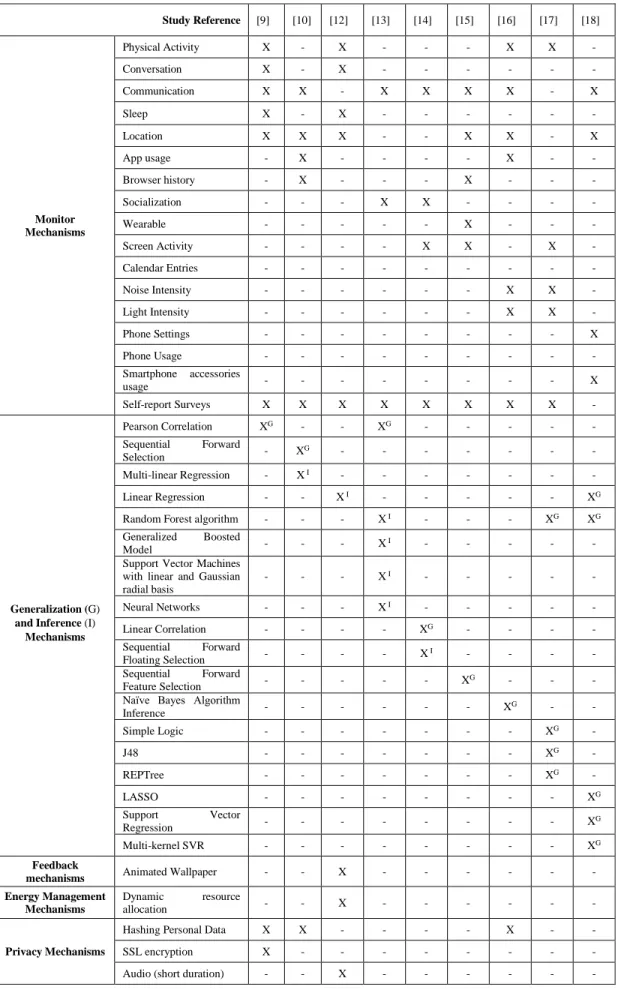
As shown in Table I, the most commonly used monitoring mechanisms are: location, communication, phone usage, sleep monitoring, physical activity and self-reported surveys. This kind of information allows to create a generalization for an entire population or for a single person. The algorithms used to make a generalization can vary a lot. Some studies use more than one generalization algorithm to evaluate their accuracy and performance. Most studies present a level of accuracy over 65%.
Some studies try to model individual user behavior. In this case, they make use of inference mechanisms which allow achieving a great level of accuracy after some training. By analyzing Table I, it is possible to verify that, similarly to the generalization mechanisms, the inference mechanisms also can vary a lot.
Since sensor usage reduces significantly smartphone battery life, some studies try to optimize energy usage. Despite this fact, the papers lack some more detail when describing what kind of energy mechanisms were used, making only a generic reference to this topic and presenting a short comment about the energy consumption values reached by each application.
Also, another aspect that most studies lack are feedback mechanisms. Only one of the analyzed studies presents a feedback mechanism. BeWell [12] uses an aquatic ecosystem to represent aspects related to the level of socialization, sleep and physical activity to make the users more aware about their current lifestyle. In our opinion, this kind of feedback can be insufficient to improve well-being levels because it does not present any kind of concrete technique/hint that may lead to improvements or positive changes to socialization, sleep or physical activity levels.
Finally, Table I also shows that four out of nine studies make use of some privacy mechanisms, such as hashing methods and/or use of encrypted connections with servers, to protect user’s privacy, being this another aspect that most studies lack.
Study Reference [9] [10] [12] [13] [14] [15] [16] [17] [18] Monitor Mechanisms Physical Activity X - X - - - X X - Conversation X - X - - - - Communication X X - X X X X - X Sleep X - X - - - - Location X X X - - X X - X App usage - X - - - - X - - Browser history - X - - - X - - - Socialization - - - X X - - - - Wearable - - - X - - - Screen Activity - - - - X X - X - Calendar Entries - - - - Noise Intensity - - - X X - Light Intensity - - - X X - Phone Settings - - - X Phone Usage - - - - Smartphone accessories usage - - - X Self-report Surveys X X X X X X X X - Generalization (G) and Inference (I)
Mechanisms Pearson Correlation XG - - XG - - - - - Sequential Forward Selection - X G - - - - - - - Multi-linear Regression - X I - - - - - - - Linear Regression - - X I - - - - - XG
Random Forest algorithm - - - X I - - - XG XG
Generalized Boosted
Model - - - X I - - - - - Support Vector Machines
with linear and Gaussian radial basis - - - X I - - - - - Neural Networks - - - X I - - - - - Linear Correlation - - - - XG - - - - Sequential Forward Floating Selection - - - - X I - - - - Sequential Forward Feature Selection - - - X G - - -
Naїve Bayes Algorithm
Inference - - - X G - - Simple Logic - - - XG - J48 - - - XG - REPTree - - - XG - LASSO - - - XG Support Vector Regression - - - XG Multi-kernel SVR - - - XG Feedback
mechanisms Animated Wallpaper - - X - - - -
Energy Management Mechanisms
Dynamic resource
allocation - - X - - - -
Privacy Mechanisms
Hashing Personal Data X X - - - - X - - SSL encryption X - - - - Audio (short duration) - - X - - - -
V. CONCLUSION
This article reviewed some of the available literature about well-being sensing through context-aware technologies, being most of them, typically, based on smartphone applications. To do this, the usage of those technologies in the context of several studies were compared, distinguishing the differences that existed among these. In particular, the study conditions (objectives, accuracy, sample size, and duration) and the mechanisms used in the smartphone applications were analyzed.
Also, five categories of mechanisms that most studies make use of were identified. These include monitoring (module capable of extract user data), generalization and inference (modules capable of processing long term user data to create a model of the user well-being over time and then try to deduce how the user is feeling), feedback (module capable of present data to the users that allow them to improve their well-being levels), energy management (module capable of optimizing the level of energy used by an application without compromise the app main functionalities) and privacy (module capable of protecting personal user data from external entities) mechanisms. The definitions of these mechanisms were based on the functionality that each one presents to the system.
During the analysis, it was found that most well-being sensing studies make use of monitoring mechanisms that allow the extraction of contextual data. This information is used, most of the times, to make a generalization and/or inference of parameters related with well-being like mood, stress, fatigue, sleep, academic performance, etc. In some studies, a user profile is modeled based on those parameters. In other situations, a general profile to all users of a population is generated. Only one of the analyzed studies presents a
feedback mechanism capable of showing information to the users about their current well-being levels and/or presents
some techniques to improve it. However, an appropriate response that allows the users to improve their current well-being levels is needed. For example, as the response to high levels of stress, relaxation techniques could be suggested. Other relevant characteristics in this kind of studies are related to user’s privacy and energy management. Although there are a few studies that include some kind of privacy conserving mechanisms, most of the analyzed studies do not present a complete solution that ensures the security of all personal data extracted.
In terms of future work for context-sensitive technologies for well-being, since most of the analyzed studies lack in areas, such as, privacy, energy management and feedback mechanisms it could worth to make further developments in those areas.
Most of the cited mechanisms will serve as guidelines to implement an application that will be used in the scope of an upcoming study, which main objectives are the monitoring and improvement of the well-being among students. The monitoring component will make use of smartphone sensors and the improvement of well-being will be done through the presentation of some feedback that considers the monitoring component current readings. The provided feedback will contain data about specific methods such as relaxation
techniques, studying techniques and others. This study will be carried out with a group of students.
REFERENCES
[1] Laplante, P. and Laplante, N. (2015). A Structured approach for describing healthcare applications for the Internet of Things. 2015 IEEE 2nd World Forum on Internet of Things (WF-IoT).
[2] Gaggioli, A. and Riva, G. (2013). From mobile mental health to mobile well-being: Opportunities and challenges. Studies in health technology and informatics, (184), pp.141-7.
[3] Steptoe, A., O'Donnell, K., Marmot, M. and Wardle, J. (2008). Positive affect, psychological well-being, and good sleep. Journal of Psychosomatic Research, 64(4), pp.409-415.
[4] Sandstrom, G. and Dunn, E. (2014). Social Interactions and Well-Being. Personality and Social Psychology Bulletin, 40(7), pp.910-922. [5] Ojiambo, R. (2013). Physical Activity and Well-being: A Review of the
Health - Benefits of Physical Activity on Health Outcomes. Journal of Applied Medical Sciences, pp.69-78.
[6] Kaufman, S. (2017). Which Personality Traits Are Most Predictive of Well-Being?. [online] Scientific American Blog Network. Available at: https://blogs.scientificamerican.com/beautiful-minds/which-personality-traits-are-most-predictive-of-well-being/ [Accessed 21 Feb. 2017]. [7] Yardley, J. and Rice, R. (1991). The relationship between mood and
subjective well-being. Social Indicators Research, 24(1), pp.101-111. [8] Riddle, T. (2017). How Your Moral Decisions are Shaped by a Bad
Mood. [online] Scientific American. Available at: https://www.scientificamerican.com/article/how-your-moral-decisions-shaped-by-mood/ [Accessed 21 Feb. 2017].
[9] LiKamWa, R., Liu, Y., Lane, N. and Zhong, L. (2013). MoodScope. Proceeding of the 11th annual international conference on Mobile systems, applications, and services - MobiSys '13.
[10] Wang, R., Chen, F., Chen, Z., Li, T., Harari, G., Tignor, S., Zhou, X., Ben-Zeev, D. and Campbell, A. (2014). StudentLife. Proceedings of the 2014 ACM International Joint Conference on Pervasive and Ubiquitous Computing - UbiComp '14 Adjunct.
[11] Jain, A. and Zongker, D. (1997). Feature selection: evaluation, application, and small sample performance. IEEE Transactions on Pattern Analysis and Machine Intelligence, 19(2), pp.153-158. [12] Lane, N., Mohammod, M., Lin, M., Yang, X., Lu, H., Ali, S., Doryab,
A., Berke, E., Choudhury, T. and Campbell, A. (2011). BeWell: A Smartphone Application to Monitor, Model and Promote Well-being. Proceedings of the 5th International ICST Conference on Pervasive Computing Technologies for Healthcare.
[13] Bogomolov, A., Lepri, B., Ferron, M., Pianesi, F. and Pentland, A. (2014). Daily Stress Recognition from Mobile Phone Data, Weather Conditions and Individual Traits. Proceedings of the ACM International Conference on Multimedia - MM '14.
[14] Sano, A. and Picard, R. (2013). Stress Recognition Using Wearable Sensors and Mobile Phones. 2013 Humaine Association Conference on Affective Computing and Intelligent Interaction.
[15] Sano, A., Phillips, A., Yu, A., McHill, A., Taylor, S., Jaques, N., Czeisler, C., Klerman, E. and Picard, R. (2015). Recognizing academic performance, sleep quality, stress level, and mental health using personality traits, wearable sensors and mobile phones. 2015 IEEE 12th International Conference on Wearable and Implantable Body Sensor Networks (BSN).
[16] Bachmann, A., Klebsattel, C., Budde, M., Riedel, T., Beigl, M., Reichert, M., Santangelo, P. and Ebner-Priemer, U. (2015). How to use smartphones for less obtrusive ambulatory mood assessment and mood recognition. Proceedings of the 2015 ACM International Joint Conference on Pervasive and Ubiquitous Computing and Proceedings of the 2015 ACM International Symposium on Wearable Computers - UbiComp '15.
[17] Sysoev, M., Kos, A. and Pogačnik, M. (2015). Noninvasive stress recognition considering the current activity. Personal and Ubiquitous Computing, 19(7), pp.1045-1052.
[18] Tsakalidis, A., Liakata, M., Damoulas, T., Jellinek, B., Guo, W. and Cristea, A. (2016). Combining Heterogeneous User Generated Data to Sense Well-being. In: Proceedings of COLING 2016, the 26th International Conference on Computational Linguistics. pp.3007-3018. [19] Posner, J., Russell, J. and Peterson, B. (2005). The circumplex model of
affect: An integrative approach to affective neuroscience, cognitive development, and psychopathology. Development and Psychopathology, 17(03).
[20] Rana, R., Hume, M., Reilly, J., Jurdak, R. and Soar, J. (2016). Opportunistic and Context-Aware Affect Sensing on Smartphones. IEEE Pervasive Computing, 15(2), pp.60-69.
[21] Diener, E., Wirtz, D., Tov, W., Kim-Prieto, C., Choi, D., Oishi, S. and Biswas-Diener, R. (2009). New Well-being Measures: Short Scales to Assess Flourishing and Positive and Negative Feelings. Social Indicators Research, 97(2), pp.143-156.
[22] Pollak, J., Adams, P. and Gay, G. (2011). PAM. Proceedings of the 2011 annual conference on Human factors in computing systems - CHI '11. [23] Cohen, S., Kamarck, T. and Mermelstein, R. (1983). A Global Measure