UNIVERSIDADE DO ALGARVE
FACULDADE DE CIÊNCIAS E TECNOLOGIA
SARDINE (Sardina pilchardus) DELAYED MORTALITY
ASSOCIATED WITH PURSE SEINE SLIPPING:
CONTRIBUTING STRESSORS AND RESPONSES
(Tese para obtenção do grau de doutor no ramo das Ciências e Tecnologias das Pescas, Especialidade em Avaliação de Recursos)
ANA LUÍSA BARRETO MARÇALO
FARO 2009
UNIVERSIDADE DO ALGARVE
FACULDADE DE CIÊNCIAS E TECNOLOGIA
SARDINE (Sardina pilchardus) DELAYED MORTALITY
ASSOCIATED WITH PURSE SEINE SLIPPING:
CONTRIBUTING STRESSORS AND RESPONSES
(Tese para obtenção do grau de doutor no ramo das Ciências e Tecnologias das Pescas, Especialidade em Avaliação de Recursos)
ANA LUÍSA BARRETO MARÇALO
Tese orientada pelo Doutor Karim Erzini, Professor Associado da Faculdade de Ciências e Tecnologia da Universidade do Algarve e co-orientada pelo Doutor Georgios Stratoudakis, Investigador Auxiliar da Unidade de Recursos Marinhos e Sustentabilidade do Instituto Nacional de Recursos Biológicos (IPIMAR-INRB/IP)
FARO 2009
O júri
Presidente Doutor João Pinto Guerreiro
Professor Catedrático da Universidade do Algarve e Reitor da mesma Doutor João José Oliveira Dias Coimbra
Professor Catedrático do Instituto de Ciências Biomédicas Abel Salazar
Doutor Adelino Vicente Mendonça Canário
Professor Catedrático da Faculdade de Ciências e Tecnologia da Universidade do Algarve
Doutor Karim Erzini
Professor Associado com Agregação da Faculdade de Ciências e Tecnologia da Universidade do Algarve (orientador)
Doutor Henrique Manuel Roque Nogueira Cabral
Professor Auxiliar com Agregação da Faculdade de Ciências da Universidade de Lisboa
Doutor Georgios Stratoudakis
Investigador Auxiliar do Instituto Nacional de Recursos Biológicos, I.P.- IPIMAR (orientador)
Doutor Jorge Manuel dos Santos Gonçalves
Investigador Auxiliar do Centro de Ciências do Mar da Universidade do Algarve
“O cardume, que foi força e vida misteriosa, que formou um só corpo e passou obedecendo não sei a que instinto ou a que inteligência superior, cai sobre Lisboa – como vem de Setúbal, do Algarve e das praias ignoradas de toda a costa lusitana, das grandes armações e dos pequenos barcos. É espalhada pelo país. Comem-na assada na brasa os trabalhadores da estrada e os homens esfaimados do campo com um pedaço seco de broa. De inverno é magra, mas pelo S. João pinga no pão. No Norte o lavrador espera-a para o jantar: é o seu melhor conduto. Os pobres fregem-na numa gota de azeite, e salgada ou saltando no cesto, fresquinha da barra, viva de Espinho, gorda, antes da desova, sem cabeça e escruchada, com a guelra em sangue, ou laivos amarelos de salmoura, constitui um manjar para pobres e para ricos. Entra em todas as casas. Há quem goste dela de caldeirada e quem a prefira simplesmente assada deixando cair no lume a gordura que rechina. Há os que só saboreiam a grande, de lombo gordo e preto, e os que acham melhor a miúda, que se chama petinga e que se devora com escama e tudo, afirmando com uma convicção respeitável que a mulher e a sardinha quer-se pequenina...”
i CONTENTS Page TABLE OF CONTENTS --- i AKNOWLEDGEMENTS --- v RESUMO --- vii ABSTRACT --- ix LIST OF FIGURES --- xi LIST OF TABLES --- xv CHAPTER 1 – Introduction --- 1
1.1 - Purse seine fishing --- 2
1.1.1 - General overview --- 2
1.1.2 - Purse seining off the Portuguese continental coast: considerations on fleet characteristics, fisher behavior, fishing operations and catches --- 5
1.1.3- Atlantic sardine (Sardina pilchardus) and the Atlanto-Iberian Stock --- 9
1.2 - Fisheries discards --- 12
1.2.1- General overview --- 12
1.2.2- Purse seine fishery discards --- 15
1.2.3- Preliminary observations of discards (“slipping”) along the Portuguese coast --- 16
1.3 - Stressors contributing to discarded fish delayed mortality --- 17
1.4 - Responses to stressors --- 19
1.5 - Assessment of fishing impact on discarded fish and escapees: Field vs captivity/laboratory studies --- 21
1.6 – Aims and structure of this dissertation --- 23
1.7 – References 26 CHAPTER 2 – Sardine (Sardina pilchardus) stress reactions to purse seine fishing --- 37
2.1 – Abstract --- 38
2.2 – Introduction --- 39
ii
2.4 – Results --- 46
2.5 – Discussion --- 54
2.6 – References --- 60
CHAPTER 3 – Sardine early survival, physical condition and stress after introduction to captivity --- 63
3.1 – Abstract --- 64
3.2 – Introduction --- 65
3.3 – Material and Methods --- 67
3.3.1 – Capture and transfer of live fish --- 67
3.3.2 – Maintenance in captivity --- 70 3.3.3 – Short-term monitoring --- 72 3.3.4 – Laboratory analysis --- 74 3.3.5 – Data analysis --- 76 3.4 – Results --- 77 3.5 – Discussion --- 86 3.6 – References --- 91
CHAPTER 4 - Fishing simulation experiments for predicting effects of purse seine capture on sardines (Sardina pilchardus) --- 95
4.1 – Abstract --- 96
4.2 – Introduction --- 97
4.3 – Material and methods --- 98
4.3.1 - Collection of fish for experiments --- 98
4.3.2 – Experimental set up --- 99
4.3.3 – Experiment 1: Effect of simulated fishing duration at low temperature --- 101
4.3.4 – Experiment 2: Effect of simulated fishing duration and density --- 102
4.3.5 – Experiment 3: Effect of simulated fishing duration at high temperature ---- 102
4.3.6 – Laboratory sampling --- 102
4.3.7 – Statistical analysis --- 104
4.4 – Results --- 105
iii
4.6 – References --- 122
CHAPTER 5 - Behavioral responses of sardines facing predators after simulated purse-seine fishing --- 127
5.1 – Abstract --- 128
5.2 – Introduction --- 129
5.3 – Material and Methods --- 131
5.3.1 - Collection of fish for experiments --- 131
5.3.2 - Experimental set-up --- 131
5.3.3 – Experiments --- 132
5.3.4. - Behavioural observations --- 134
5.3.5. - Measuring lethal predation --- 136
5.3.6 – Statistical analysis --- 137
5.4 – Results --- 137
5.5 – Discussion --- 142
5.6 – References --- 148
v AKNOWLEDGMENTS
I want to thank Yorgos for his special support as an advisor, his friendship, credibility and giving me confidence at harsh times. I owe him the chance to fulfil my dream to return to Portugal and work in fisheries biology.
I want to thank Professor Karim Erzini for his advice and orientation. I must thank Dr. Pedro Pousão-Ferreira for his initial input in pursuing a PhD and allow me to develop my experimental work at Estação Piloto de Piscicultura de Olhão (EPPO).
I want to thank Fundação para a Ciência e Tecnologia for the financial support with the scholarship SFRH/BD/23053/2005. I must also thank project PELAGICOS funded by the Portuguese Ministry of Science (MLE 013/2000) for the initial financial support of my thesis work and project SARCAPT for support of my experimental work at the EPPO.
A special gratitude goes to the president of Centro Litoral OP, António Miguel Lé that allowed me to embrace the subject of my study by supporting my work as a fisheries observer onboard the purse seiners in Figueira da Foz. I want to thank all the purse seine skippers and crew members that I´ve worked with, especially in Figueira da Foz and Olhão.
Special gratitude goes to many colleagues and friends at IPIMAR for their help, support and advice. A warm thank you goes to all members of the EPPO team the whole time I´ve been around. They are so many, and their help was so important at the practical and emotional level that without them I have to realize that this work would not be possible. With no order of importance I want to thank Cláudia Bandarra, Marisa Barata, Lídia Nicolau, João Araújo, Marco Cerdeira, Ezequiel Rodrigues, Miguel Silva, Andrea Cabrita, Sara Castanho, Mestre Paulinho, Ângelo Canas, Ana Isabel, Carole, Andrea Alves, Ico, Francisco Aldinhas, Isabel, Jorge, Elsa Dores, Paulo Jorge, Zé João, Sr. Luís and many interns that worked at the station. I also want to thank some
vi
colleagues at the IPIMAR-Olhão headquarters whose initial help in bringing live sardines to the station was crucial. I will never forget the support of Tibério, Zé Luis, Pedro Lino and Paulo Vasconcelos at the docks to offload the first tank carrying live sardines.
I want to thank some co-authors in some of the papers, especially Rob Fryer and Tiago Marques. I am thankful to Luísa Mateus, Pedro Serra, Professor José Henrique Duarte Correia and all the technicians at the Veterinary Laboratory of the Technical University in Lisbon for their important help and advice in the physiology analysis.
I want to thank my special “biology friend” Susana Garrido for her friendship, support in my work, companionship and many laughs, and other friends and colleagues that at one point were directly connected to IPIMAR in Lisbon, specially Sandra Farinha and Alexandre Morais.
I want to thank many friends that have always supported my work and were so patient listening to my stories about the sea and sardines and were always curious enough to bring up the subject allowing me to develop it, or were able to sheer me up with their warm friendship and love when motivation was not at its best. I am grateful to Ana for the important support and light, especially in the last stages of my work. Rita, Fátima, Lúcia, baby Maria Carolina, Susana, Teresa, Rosa, Michelle, Mário, Inês, Marisa, Nélia, and Iria, at specific and unique moments in this journey, you are forever in my heart.
Last but not least, I want to thank all my family. My grandparents that fulfilled my imaginary with their stories of the sea, uncles and cousins, and specially my parents and my sister, for their unconditional support, love and encouragement in pursuing my dreams all my life.
vii RESUMO
Esta tese tem por objectivo estudar o impacto das operações da pescaria de cerco na sardinha (Sardina pilchardus) deliberadamente desperdiçada através de “slipping”, procurando avaliar níveis de sobrevivência do peixe libertado e estudar os factores que levam à morte à posteriori. No decorrer das operações de pesca comercial foi avaliado o stress fisiológico em sangue de sardinhas. Foram realizados ensaios de captura, transporte, introdução e ambientação da espécie em cativeiro como ferramenta auxiliar para o procedimento de experiências de simulação de pesca em laboratório. Experiências de simulação testaram factores de stress operacionais (tempo de pesca e densidade da captura) e ambientais (temperatura da água) e o seu efeito nas sardinhas ao nível da sobrevivência, fisiologia, danos físicos e comportamento face a predadores. Os resultados revelaram que a pesca causa stress fisiológico a curto prazo nas sardinhas com a alteração significativa dos parâmetros analisados (cortisol, glucose, hematócrito, hemoglobina, equilibrio iónico e ATP e seus metabolitos) em função principalmente do tempo dentro da rede. O trabalho laboratorial mostrou que a sobrevivência das sardinhas desperdiçadas é inversamente proporcional ao tempo dentro da rede e que este impacto é acrescido com o aumento da temperatura da água. Os parâmetros de stress a curto prazo (fisiológicos) não se correlacionam com os níveis de sobrevivência observados para os vários graus de intensidade dos factores aplicados. No estudo dos parâmetros fisicos, comparou-se individuos vivos com os que morreram, onde os resultados demonstraram que a perda de escama é miníma em indivíduos que sobrevivem, o que leva a crer que este parâmetro fisíco é muito importante como causa directa de morte. Stress a longo prazo revela-se em todos os peixes desperdiçados, nomeadamente com a inibição do sistema reprodutor e imunitário. O comportamento das sardinhas é alterado significativamente com a pesca (diminuição de distância ao predador, capacidade de acardumar e velocidade de natação) o que aumenta a sua vulnerabilidade na presença de predadores.
Palavras-chave: Pescaria de cerco, Sardina pilchardus, slipping, reacções de stress, mortalidade à posteriori, interacções presa-predador
ix
ABSTRACT
This dissertation aims to study the impact of commercial purse seine fishing operations on slipped sardines (Sardina pilchardus), accounting for the survival rates of the escapees and studying the main factors/stressors that may lead to delayed mortality. Field work onboard commercial seiners allowed to study the early dynamics of sardine (Sardina pilchardus) stress reactions and identify likely stressors during fishing operations. Appropriate methodology for capturing, transporting and maintaining sardines in captivity after live capture was optimized in order to use the species for laboratory fishing simulation studies. Laboratory fishing simulations were used to study some operational and environmental factors that lead to variable physical, physiological and behavior responses and result in delayed mortality after slipping. Results showed variable stress responses of sardines during purse seining operations with the significant effect of fishing duration in several physiological blood parameters (cortisol, glucose, haematocrit, haemoglobin, ionic balance, and ATP and its metabolites). Laboratory fishing simulations revealed that survival rates decrease significantly with time inside the net, with temperature having an additional effect on mortality. Fish short term stress responses (physiological) immediately after fishing do not correlate with observed delayed mortality. Scale loss is an important variable of physical injury directly related with the probability of dying. Long term stress responses such as the inhibition of the immune and reproductive systems affects all escapees (whether surviving or not). Sardine suffer behavioral impairments such as lower swimming speed, shorter predator approaches and larger nearest neighbor distances (wider school area) regardless of fishing stressor severity, what indirectly may increase their vulnerability to predation.
Key words: Purse seine fishing, Sardina pilchardus, slipping, stress reactions, delayed mortality, predator-prey interactions
xi
LIST OF FIGURES
Chapter 1 Page
1.1 General overview of a purse seine net after shooting and as the purse is being formed. From SEA FISH INDUSTRY Authority Industrial Development Unit, Technical report nº 288, 1986.
4
1.2 Details on net shooting (a-b), close-up of the net into a purse (c-d) and net hauling after the purse is formed (e-f). Adapted from Kim et al. 2007.
4
1.3 Relative importance of Portuguese ports for landings (in tons) of the four main species (sardine, horse mackerel, chub mackerel and anchovy) targeted by purse seiners along the continental coast for 2002-2007 (DGPA, 2003-2008b)
6
1.4 Vessel characteristics between one port of the Northern coast (Matosinhos), one port of the Southern/Algarve coast (Portimão) and all vessels operating in Continental Portugal (anonymous data, 2009).
7
1.5 Annual landings of sardine in ICES sub-areas IXa-CN (Northern west Portugal), IXa-CS (Southern west Portugal), IXa-S (South Portugal/Algarve), and total landings off Portugal (figure from ICES WGMHSA Report 2007).
11
Chapter 2
2.1 Diagram showing sequence of events during purse seining operations and sampling. Average operation time (minutes) and standard deviations for the ten trips are indicated in parenthesis. Increasing sampling intensity is indicated at the top of the diagram as net volume decrease facilitated the capture of fish.
42
2.2 Observed (points) and fitted (lines) effect of time from onset of fishing on the haematocrit (left) and haemoglobin (right) of sardine in the purse seine net (filled circles: females; open circles: males). Sex was marginally significant in the haemoglobin model (solid line: fitted effect for females; broken line: fitted effect for males).
49
2.3 Observed (points) and fitted (lines) effect of time from onset of fishing on glucose (left) and cortisol (right) levels in the plasma of sardine blood. Fish with larger fat deposits (open circles) had a significantly higher level of blood glucose than fish with lower fat deposits (solid line: time effect for fat fish; broken line: time effect for thinner fish).
xii
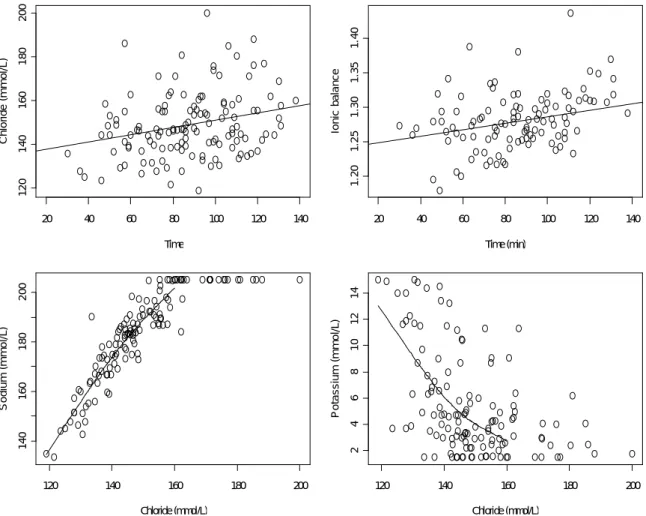
2.4 Top panels: Observed (points) and fitted (line) chloride concentration (left) and ionic balance (right) in the plasma over time spent in the net. Bottom panels: chloride vs sodium (left) and chloride vs potassium (right) concentrations in the sampled fish. Lines in panels c and d correspond to smooth splines on 3 degrees of freedom.
51
2.5 Evolution of ATP and its catabolites in the sardine muscle along the duration of the purse seine fishing operations. Lines correspond to the fitted effect on mixed models with a significant time variable. Points correspond to observations.
53
Chapter 3
3.1 Sardine cumulative survival in the main storing tank during the first month in captivity. A different line type is used for each trial (numbered 1 to 5). A description of sea and land operations for each trial are provided in Tables 1 and 2 respectively.
78
3.2 Sardine scale loss (%) during the first week in captivity, separately for fish sampled dead (open circles) and alive (crosses) in trials 3 to 5 (first three panels). Sampling day for live fish is shifted by 0.5 days to improve clarity. In trial 3, scale loss was only evaluated on dead fish. Lines indicate fitted GLM (shown in Table 4; solid line for live fish, broken line for dead fish). Last panel shows distribution (boxplots) of scale loss for all sardines that died during transport (day -1) and the first two days in captivity (days 0 and 1) in the three sampled trials.
81
3.3 Sardine fin damage factor (%) during the first 10 days in captivity, separately for fish sampled dead (open circles) and alive (crosses) in trials 4 and 5. Sampling day for live fish is shifted by 0.5 days to improve clarity. Lines indicate fitted GAM (solid for live fish, broken for dead fish).
82
3.4 Sardine early dynamics of cortisol, glucose and chloride in blood collected in the first two days in captivity (trial 2). Lines indicate fitted GAM with a normal distribution also considering the effect of fish density in the tank (solid line for high density, broken line for low factor level).
83
3.5 Boxplots of haematocrit, glucose, cortisol, chloride, sodium and potassium distribution in the plasma of sardine blood collected weekly during the first two weeks in captivity (trial 3). Mean observations at the beginning (solid line) and at the end of purse seine fishing operations (broken line) are calculated from Table 3 in Marçalo et al. (2006).
xiii
3.6 Sardine gonadosomatic index (GSI) distribution (boxplots) along the first two weeks in captivity for two trials that took place during the early (October – trial 3) and late (March – trial 4) 2005/2006 spawning season. Lines indicate mean GSI for fish sampled during the day of capture.
85
Chapter 4
4.1 Diagram showing (A) the 10m3 subdvided tank; arrows represent direction of the operations. (B) Netting device
100
4.2 Boxplots of physiological parameters (cortisol and haematocrit - top row) and physical parameters (scale loss and fin factor – bottom row) as a function of pre or post stress condition, pooled across experiments and tanks (treatments). The box stretches from the 25th percentile to the 75th percentile. The line across the box represents the median. The ends of the vertical line indicate the minimum and maximum data values. Individual points are considered outliers. Mean observations at the beginning (solid line) and at the end of purse-seine fishing operations (dashed line) for the physiological parameters are calculated from Marçalo et al. (2006).
108
4.3 Boxplots of physical parameters of dead fish and alive fish (survivors at termination day), pooled across experiments and tanks (treatments). The box stretches from the 25th percentile to the 75th percentile. The line across the box represents the median. The ends of the vertical line indicate the minimum and maximum data values. Individual points are considered outliers.Also shown are median observations for pre stress (solid line) and immediate post stress (dashed line).
111
4.4 Treatment survival (Kaplan-Mayer survival estimators) as a function of observation day for each experiment. Solid line for 1 and dashed lines for 2-4 represent 95% confidence intervals for the survival curves obtained by a nonparametric bootstrap. Numbers refer to treatments in each experiment (more detail in table 4.1)
112
4.5 Experiment survival (Kaplan-Mayer survival estimators) as a function of observation day for each fishing time treatment level, showing a temperature effect. Dashed lines represent the 95% confidence intervals for the survival curves obtained by a nonparametric bootstrap.
113
4.6 Weight frequency distributions of fish dead and alive at termination day. Horizontal dashed lines represent mean weight.
xiv
Chapter 5
5.1 Experimental tank design and filming apparatus with predator-prey disposal before combination (A). Removable separation panels (dashed lines) were lifted after fishing simulation allowing the interaction of predators and prey. Grids with 10 x 10 cm squares placed at the bottom of each compartment for video recording reference (B).
135
5.2 Mean sardine distance to predator (+ SE) for all treatments after simulated purse seine fishing. Sardines exposed to sea bass at day 0.
140
5.3 Mean nearest-neighbor distances (+ SE) for sardine exposed to sea bass predators for all treatments after simulated purse seine fishing. Day -1 refers to mean data before sea bass exposure; sardines exposed to sea bass at day 0.
141
5.4 Mean swimming speed (+ SE) for sardine exposed to sea bass predators for all treatments after simulated purse seine fishing. Day -1 refers to mean data before sea bass exposure; sardines exposed to sea bass at day 0.
142
5.5 Image showing sardine behavior aspects in the control tank (top) and in a fished tank (bottom)
xv
LIST OF TABLES
Chapter 2 Page
2.1 Summary of operational and environmental characteristics of the sampled purse seine trips off northern Portugal in 2002. Luminosity is the proportion of the fishing operation after sunrise. Catch is the biomass caught per set (tons) and landings the biomass transferred on deck (the difference is the biomass slipped per set).
43
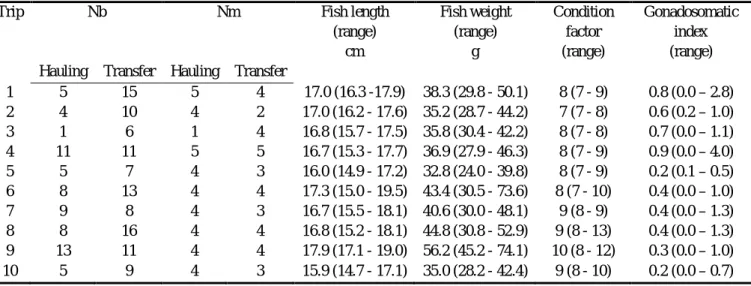
2.2 Summary of sampling effort and biological data (mean and range) for the ten purse seine trips followed by an observer off northern Portugal in 2002 (Nb: blood samples; Nm: muscle samples).
47
2.3 Summary of the fitted linear mixed model for each biochemical variable, separately for the fixed and random parameter estimates. Intercept of the fixed model effect refers to the mean concentration after one hour spent in the net and slope to the rate of change per minute. Random effects are summarized by the standard deviation (SD) between trips (random trip effect accounted by the model) and between fish (residual standard deviation).
52
Chapter 3
3.1 Summary information of field operations (from fishing to arrival at the station) in the 5 trials used to provide sardine for maintenance in captivity. N, number of fishes collected; SST, sea surface temperature; NA, not analysed.
69
3.2 Summary of maintenance conditions in captivity and observations during the short-term monitoring of sardine in the five trials. Mean values for temperature and oxygen saturation, ranges are presented in parentheses. N, number of sardines stocked; T, temperature; O2, oxygen saturation in the water;
ppm, parts per million; OTC, oxytetracycline.
71
3.3 Summary of biological data (mean) for a random sample of sardines at the day of capture in the five trials. Values in parentheses are the range. LT, total
length; MT, total mass; FC, condition factor; IG, gonadossomatic index; NA, not
analysed.
73
3.4 Summary statistics of GLMs fitted to fish scale loss as a function of time in captivity (days) and state (dead or alive) for each sampled trial (in trial 3, scale loss was only evaluated in dead fish). The exponent of the intercept corresponds to the mean percentage of scale loss on the first day in captivity while the slope indicates the mean daily reduction (proportion) in scale loss. In the models for trials 4 and 5, significant differences in the intercept were found between dead and alive fish, while in trial 5 the difference in slope was also significant. S.E., standard error.
xvi
Chapter 4
4.1 Summary information of field and captivity operations to provide sardines used in the 3 experiments. Biological data presented as mean (values in parentheses indicate the standard deviation). LT, total length (cm); MT total mass
(grams); FC, condition factor; T, temperature; LD, Low density; HD, High
density; Treat, treatment; Accl, acclimation; Obs, observation.
106
4.2 ANOVA values for operational and environmental variables affecting physiological parameters at pre- fishing and post- fishing conditions. Mean squares (MS), F-statistic value (F-value), degrees of freedom (df) and P-value.
109
4.3 Cox proportional regression model output for sardine survival data from the three experiments as a function of operational (fishing time and fish density), environmental (water temperature) and biological (fish total weight) variables. “exp(coef)”=1 indicates absence of change in hazard due to a given variable, a value larger than 1 means a larger risk and lower than 1 a lower risk (or protection factor) associated with the corresponding variable.
114
Chapter 5
5.1 Summary information on acclimation operations and fishing and predation survival effects for the three experiments. T, temperature; n, number of sardines
132
5.2 Summary of biological data (mean + S.E) for sardines (prey) and sea bass (predator) used in the 3 experiments.
137
5.3 ANOVA and tukey test values for treatments affecting predator approach, nearest-neighbor distance and swimming speed up to 3 days after purse seining simulation.
CHAPTER 1
2
Fish discarding is one of the most important issues affecting marine fisheries management and an added source of uncertainty to stock assessments, due to the implied mortality of discarded fish or fish that escape from the fishing gears (Alverson et al., 1994). Discard quantification has been a priority mostly directed to less selective and more abrasive fishing gears, namely towed gears (Broadhurst et al. 2006), and major efforts have been made to reduce trawling discards, especially through gear modifications that improve species and size selection (Davis, 2002). However, only a few studies are available of the direct and indirect effects (leading to immediate or delayed mortality respectively) of fishing operations on fish condition and of estimates of the unaccounted mortality or survival of fish discarded or that escape (Chopin and Arimoto, 1995; Chopin et al. 1996; Suuronen et al., 1996a, 1996b; Sangster et al. 1996; Broadhurst et al., 1997). Further, detrimental effects of severe exercise caused by fishing and interactions with several environmental and biological factors responsible for delayed mortality after release, have been relatively well studied in aquaculture systems and species (Barton and Iwama, 1983), but to a lesser extent in commercial fisheries (Davis, 2002). Regarding pelagic purse seine fisheries, even fewer studies are available, mainly because of the general perception that these fisheries are highly selective (usually take hauls with low diversity of species and sizes) and with widely variable and sporadic discarding behavior (Borges et al. 2008).
1.1– Purse seine fishing
1.1.1 – General overview
Purse seining is a fishing practice particularly used to capture large (e.g. tunas) or small pelagic fish (e.g. mackerels, sardines and anchovies) that aggregate or school
3
close to the surface (FAO). Once the school is located, mostly using acoustic electronic fish detection devices, it is quickly surrounded by a wall of netting up to 1,000m in length and over 100 m deep (Figure 1.1). Usually, a smaller auxiliary boat is used to hold one end of the net until the larger vessel (or seiner) comes around the school to complete the encircling. As the seiner encircles the fish, a process named shooting, the net is released. The net floats at the top with the use of a cork line (headline), and in the bottom has a number of lead rings (also used as weights). The rope (or purse line) that passes through the rings is then pulled, drawing the rings close to one another to form a purse with a bag shape which prevents the fish from diving and escaping (Figure 1.2). The bag is closed up alongside the boat and the net gradually dried up (a process usually referred to as hauling) reducing the volume of the purse, and crowding the fish into a smaller area until the density of the catch becomes sufficiently high to start loading the boat and transferring the fish either by brailing (dipping them out with large dip nets called brails) or with fish pumps, while the rest of the capture is maintained in the water. In some fisheries, the gear can be modified to target demersal fish species, although the basic operational/net apparatus concept is maintained (Borges et al., 2001; Erzini et al., 2002; Gonçalves et al., 2008).
4
Figure 1.1 – General overview of a purse seine net after shooting and as the purse is being formed. From SEA FISH INDUSTRY Authority Industrial Development Unit, Technical report nº 288, 1986.
a) b) c)
d) e) f)
Figure 1.2 – Details on net shooting (a-b), closing-up of the net into a purse (c-d) and net hauling after the purse is formed (e-f). Adapted from Kim et al. 2007.
5
1.1.2 – Purse seining off the Portuguese continental coast: considerations on fleet characteristics, fisher behavior, fishing operations and catches
Off Portugal, purse seining is one of the most important commercial fishing activities (49 % and 43 % of continental only and total national annual landings respectively) (DGPA, 2008a). Sardine (Sardina pilchardus) is the main target species of the fishery (> 70 % of total landings and value; DGPA, 2008a), with horse mackerel (Trachurus trachurus), chub mackerel (Scomber japonicus) and anchovy (Engraulis
encrasicolus) accounting for a smaller part of the landings (Stratoudakis and Marçalo
2002; Wise et al. 2005; DGPA, 2008a). The present Portuguese purse seine fleet (137 vessels in the mainland) consists of mostly old vessels (around 50 % vessels are over 20 years old) of medium size (mean total length of 17 meters, ranging from 6 to 27 meters), equipped with engines from 15 to 600 HP (mean of 265 HP) and operating with large nets (up to 1000 meters long and 120 meters deep), with a minimum mesh size of 18 mm (Parente, 2001; Stratoudakis and Marçalo, 2002; Wise et al. 2005; DGPA, 2008a; anonymous data). The vessels are based mainly in the ports of Póvoa do Varzim, and Matosinhos and Figueira da Foz in the northern coast, Nazaré and Peniche in the center, Setúbal, Sesimbra and Sines in the southern/west coast, and, Quarteira, Portimão and Olhão in the southern/Algarve region. The most important landing ports for species targeted by Portuguese purse seiners are in decreasing order of importance Matosinhos, Peniche, Figueira da Foz, and Sines in the west coast, and Olhão e Portimão in the Algarve (Fig 1.3; DGPA, 2003, 2004, 2005, 2006, 2007, 2008b). Landing data from figure 1.3 also shows that Póvoa do Varzim and Quarteira are relative important home ports but landings at both locations are not significant, while the opposite occurs in the ports of Aveiro in the northern coast and Lagos in the Algarve.
6
Figure 1.3 - Relative importance of Portuguese ports for landings (in tons) of the four main species (sardine, horse mackerel, chub mackerel and anchovy) targeted by purse seiners along the continental coast for 2002-2007 (DGPA, 2003-2008b)
Vessel characteristics differ between ports and regions. In general, the newer, larger, more potent and better equipped vessels are found in the northern and central coasts of Portugal (Fig. 1.4.; with the exception of a fleet operating off Póvoa do Varzim with smaller boats often called “Tucas”, mostly of < 10m) (Stratoudakis and Marçalo, 2002; anonymous data). The fleet in some center ports, namely Peniche and Nazaré, and in both southern regions (west coast and Algarve) is very diverse in length, with 40 % of the vessels having very small dimensions. In the Algarve region we find the oldest vessels (e.g. two of the seiners operating in the region date from 1929 and 1937) and smaller vessels called “rapas”, that often modify their gear for the capture of demersal species (Borges et al. 2001; Erzini et al. 2002; Gonçalves et al. 2008). Crew members on board differ in number depending on vessel size and can reach 24 men in the larger boats (Parente, 2000).
7 Matosinhos Portimão Portugal
19 40 19 80 Port Y e ar
Matosinhos Portimão Portugal
5 10 15 20 25 Port S iz e
Matosinhos Portimão Portugal
0 10 0 30 0 50 0 Port H p
Matosinhos Portimão Portugal
0 2 0 4 0 6 0 80 Port T o n
Figure 1.4 - Vessel characteristics between one port of the Northern coast (Matosinhos), one port of the Southern/Algarve coast (Portimão) and all vessels operating in Continental Portugal (anonymous data, 2009).
Operations occur within coastal areas (on the continental shelf) and daily activity is regulated by national legislation that is not rigorously enforced. The legislation tentatively comprehends a maximum of 180 fishing days per year and capture limits set annually and distributed among Producer Organizations. European legislation specifies minimum landing sizes (e.g. 11 cm for sardine, 12 cm for anchovy, 15 cm for horse mackerel and 20 cm for chub mackerel). Despite national laws determining purse seining fishing activities, there are differences in patterns among regions that are mostly related to the season (e.g. seasonal bans, departure time influenced by the season of the year/sunset time influences the behavior of the target species) or market demands. In
8
Wise et al. (2005) we find that regional variations are also related to the vessel characteristics, differences in species abundance and possibly socio-economic factors. Further, although in all the ports purse seine fishing is allowed for only 5 days per week, the weekend regime differs, leading to changes in the first departure of the week. In some ports the first departure occurs on Monday dawn and the last on Friday evening/dawn, (e.g. Figueira da Foz) (Wise et al. 2005), while in others the first departure occurs on Monday afternoon/Tuesday dawn and the last on Saturday dawn/morning (e. g. Olhão) (A. Marçalo, unpublished data).
In the northern and center regions, where the sardine is more abundant, catches are usually higher, and sardine is the only target and the main landed species (e.g. for 2007, sardine landed was 83.3%, 85.7%, 79.5 % of the total catch for Matosinhos, Figueira da Foz and Peniche, respectively; DGPA, 2008), trips are generally shorter and the net usually is set only once per trip (Stratoudakis and Marçalo, 2002; Wise et al., 2005). On the other hand, in the southern regions where sardines are less abundant, catches consist mainly of horse and chub mackerel and demersal species, fishing trips are longer, and the net is often set more than once per trip (Wise et al. 2005, Gonçalves et al., 2008). A fishing trip starts when the vessel leaves the port, after which searching immediately starts as the skipper turns on the echo sounder. Depending on fish intensity, echo sounder markings can be considered low, moderate or high and determine if the search should continue (e.g. low marks or inadequate fish aggregation in the water column), end (e.g. no fish detected) or if the fishing operation should start (Stratoudakis and Marçalo, 2002; Carvalho et al., 2008). Net setting occurs rapidly with the help of an auxiliary vessel (6-7 meters), a power block is used to haul most of the heavy purse seine, and final stages of hauling comprehend a largely manual operation involving all crew members alongside the seiner. Preferably, sets occur mainly around
9
sunrise and a typical fishing operation lasts around 2 hours. In general, the number of purse seiners operating in the north and center regions is double the number of boats operating in the southern regions but the number of trips per year is less in the north and center regions. However, while fishing effort per vessel is lower in the northern and center regions, total fishing efforts are higher for these regions compared to the South. (Parente et al. 2000; Wise et al. 2005).
1.1.3 – Atlantic sardine (Sardina pilchardus) and the Atlanto-Iberian Stock Sardine (Sardina pilchardus) is an ecologically and commercially important small pelagic clupeoid widely distributed from the northern North Sea to Mauritania/Senegal and from the Azores to the eastern Mediterranean, with the biggest populations and most important fisheries concentrated in the Atlantic coasts of North Africa and Europe (Parrish et al. 1989). It is targeted by purse-seine fisheries across most of its distribution area and by pelagic trawlers mainly in African waters. The largest sardine populations and the more productive sardine fisheries are situated off Morocco (stockbiomass of 1–5 million tonnes; with landings of around 600 000 t in recent years; FAO, 2003), whereas abundance and fishing intensity are low in the Mediterranean (Silva et. al, 2008). Within Atlantic European waters, the sardine is considered to belong to a single stock for assessment purposes, the Atlanto-Iberian stock, with a stock biomass of around 450 000 t and landings of approximately 90000 t in recent years (ICES, 2007; Silva et al. 2009). The Atlanto-Iberian sardine stock is delimited by the French/Spanishborder in the north and by the Strait of Gibraltar in the south(ICES Divisions VIIIc and IXa) and is exploited mainly by thepurse-seine fleets of Spain and Portugal.
10
In Portugal (ICES Division IXa), sardines represent approximately half of the annual fish landings and the bulk of purse seine catches (> 70 % of total landings), which reflects the socio-economic importance of the resource and the fishery for the country (Pestana, 1989). Atlanto-Iberian sardines are short lived (7/8 years) and experience a variety of oceanographic conditions, from temperate shelf to sub-tropical upwelling with temperatures < 10ºC and > 22ºC respectively (Coombs et al 2006). This water temperature regime influences the spawning season in different regions, although in Portuguese waters sardine spawn from the fall (September/October) to the spring (March/April), with some variation along the coast (Stratoudakis et al. 2007). Because the stock is intensely exploited, its abundance and distribution depend on good recruitment years that are directly linked to environmental factors, namely good upwelling conditions favored by North wind regimes, observed mostly in the Portuguese Northern and center coasts during summer months, leading in general to better recruitment in these areas and greater sardine abundance (Santos et al., 2001).
Historical time series data (ICES, 2007, 2008) reveal that the Atlanto-Iberian sardine stock has shown high fluctuations in abundance and high inter-annual variability in recruitment. Values for the Northern coast present a sharp decrease in 1998-2000, increasing slowly with some fluctuations afterwards, being quite stable for the next few years. Aa strong recruitment in the Northern coast in 2000 resulted in an important stock recovery that year and an increasing trend in stock abundance until 2003 (Marques et al. 2003) with a decrease in landings in 2004 and 2005 followed by an increase in 2006 and 2007. The Southern west coast population also remains relatively stable, although with some fluctuations and slight decreases for 2006 and 2007. Values for the Algarve region shows an accentuated decreasing trend since 2000 and landings in 2007 were at their lowest for the 1995-2007 period. In 2007, 35 % of the total
11
Portuguese commercial catches of sardines were taken off the Northern coast, 44 % off the center coast, 13,6 % in the Southern west coast, and approximately 7 % in the Algarve, (DGPA, 2008) (Fig. 1.5).
Figure 1.5 – Annual landings of sardine in ICES sub-areas IXa-CN (Northern west Portugal), IXa-CS (Southern west Portugal), IXa-S (South Portugal/Algarve), and total landings off Portugal (figure from ICES WGMHSA Report 2007). For stock abundance
estimation purposes, the center coast is included in the Northern coast.
Official landings data for both Portugal and Spain are used for the annual stock assessment of the Atlanto-Iberian stock of sardine. Management of the stock relies largely on national measures in Spain and Portugal (time and area closures) and, in recent years, recovery plans have been established in both countries following a series of years of poor recruitment and declining stock biomass, especially since 1995 (ICES, 2002). In Portugal, landing limits for the fleet have been set annually since 1997, and distributed among Producer Organizations (POs) and the few non-associated vessels. Since 1999, POs in northern Portugal have voluntarily introduced daily landing limits on their vessels in an attempt to manage the annual quota of the PO as a function of local market-price fluctuations (Stratoudakis and Marçalo, 2002).
12
1.2 – Fisheries discards
1.2.1 – General overview
A widespread component and undesirable consequence of commercial fisheries is the release of a significant portion of the catch, a process named discarding (Alverson et al. 1994). In general, by-catch and subsequent discarding is inevitable, due mostly to insufficient size selectivity of different fishing gears. Reasons for discarding are highly variable, depending mainly on the gear characteristics (e.g. mesh sizes, hanging ratios) and fishing operations, and usually occur as the interaction between market (species – target/noncommercial/low value species, quality), management (minimum fish size, landings restrictions/quota limits and fishing days), operational (boat loading and processing capacity), economic (market demands), human (e. g. decision making – catches below the minimum landing size) and biological (sex, condition) factors (Hall, 1996; Stratoudakis et al., 1998; Borges et al., 2001; Davis, 2002, Gonçalves et al. 2007).
Concerns about at-sea discarding have long been recognized by fisheries scientists (Jean, 1963), as discards are seen as an important source of waste, mortality and of information bias in stock assessment of many species. There is also increasing evidence that discards can have effects at the biodiversity and community levels, through impacts on top predators, removal of individuals of many species or by elimination of prey (Hall, 2000; Kelleher, 2005). However, awareness about the extent of the discard problem and the need for mitigation is relatively recent. Alert was given by the pioneering, comprehensive study of Saila in 1983, which triggered a number of studies, especially in the last decade of the 20th century, first following reactions to the incidental capture of charismatic species such as dolphins in tuna purse seine nets (Hall, 1996), turtles in shrimp trawls (Epperly et al., 2002), and also marine mammals, birds,
13
turtles and sharks in high seas squid driftnets (McKinnell and Seki, 1998; Rogan and Mackey, 2007), then spreading rapidly to fish species in many fisheries worldwide where discarding of unmarketable, undersized or damage fish is a common practice (Alverson et al. 1994).
Since Alverson et al. (1994) estimated global discards in commercial fisheries to be almost one third of the total catch (average of 27 million tones yearly),the consensus is that discard rates are high, variable and their estimation difficult (as illustrated by the wide range of the estimate - 17.9-39.5 million tones). Present global estimations based on the fishery-by-fishery approach are at 8 percent (proportion of the catch discarded) with an annual total discards estimate of 7.3 million tones (Kelleher, 2005). Most discards are associated with trawl fisheries targeting shrimp and demersal finfish (over 50 percent of total estimated discards), while most purse-seine, handline and small-scale fisheries are considered to have low discard rates (Kelleher, 2005, Broadhurst et al. 2006).
Development of improved methodology at the global level has contributed to the updating of discards estimates, and these are currently used in the annual stock assessment of some commercially important fish species worldwide (e.g. ICES 1996, 2000; Kelleher, 2005). However, this reported discard information is considered generalist and based on incomplete data for most fisheries, since studies have been mostly directed towards fisheries considered more detrimental or easier to sample (e.g. towed fishing gears and recreational fisheries; Ferguson and Tufts 1992; Sangster et al. 1996; Suuronen et al. 1996; Broadhurst et al. 2006; Suski et al. 2007; Gingerich et al. 2008).
Estimates are based on discard data collected by fisheries observers onboard commercial fishing vessels as part of extensive national and international sampling
14
programmes (Borges et al. 2001, 2006; Rochet et al. 2002; Stratoudakis et al. 1999), and sampling designs generally rely on variable assumptions (e.g. discards are proportional to catch or to effort, length composition of the catch determines discard amounts and size, market prices promote discarding due to sorting criteria; quotas create incentives for discarding; Rochet and Trenkel, 2003). On a general basis, estimation of discards is difficult, stock assessments for many important commercial species in fisheries worldwide still lack discard data and studies focusing on discarding practices, discard quantification and composition continue to be scarce (Borges et al. 2005). Yet, for most of the explored stocks, the sampling level of the landings is considered adequate for assessment purposes (ICES, 2002).
Specifically, fisheries management studies carried out in the Iberian Region along the eastern Atlantic shelf (which is considered an upwelling area with high productivity and characterized by a large number of commercial and non-commercial fish species), focus on fisheries of a typically multispecies nature and deal with highly variable fish stocks. Here, different kinds of Spanish and Portuguese fleets operate, from trawlers to long liners, hand-liners to purse seiners. Consistent discard data for Portugal on most important fisheries is only available since 2002 (IPIMAR, unpublished data) and some other published studies on by-catch and discard estimates are experimental or preliminary observations. Such examples are the work on the beach seine fishery in central Portugal (Cabral et al. 2003), a few studies on fisheries in the southern (Algarve) Portuguese coast and the Mediterranean (Borges et al., 2001, Monteiro et al. 2001; Erzini et al., 2002; Gonçalves et al., 2007; Costa et al., 2008), Spanish bottom trawl fisheries (Lema et al., 2006; Días et al, 2008), and only one study on the purse seine fishery operating off the Northern Portuguese coast (Stratoudakis and Marçalo, 2002).
15
1.2.2 - Purse seine fishery discards
The nature of purse seine fisheries, that mostly target pelagic or schooling fish, taking hauls of low diversity of species and sizes, contributes to a more sporadic discarding behavior than in demersal fisheries (Broadhurst et al. 2006; Borges et al. 2008). Thus, reported discard rates are usually low (5.1 % and 1.6 % for purse seine fisheries targeting tuna and fisheries targeting small pelagic fish respectively; Kelleher, 2005). Discards in purse seining occur mainly as “slipping”, a term used to describe the phenomenon where part of the catch is released after drying-up of the net but without the fish being drawn aboard, by rolling the fish over the headline (floating line) of the net (Pawson and Lockwood, 1980; Lockwood et al, 1983; Mitchell et al., 2002; Stratoudakis and Marçalo, 2002). Thus, as the catch never leaves the water before being released, purse seining is considered to have a low impact on escapees, and for most fisheries, slipping is not accounted for and fish released in such condition are expected to survive (Lockwood et al. 1983).
However, increased awareness of purse seining discards occurred in tuna fisheries, mainly due to incidental catches of dolphins, although reported rates of discards of non-commercial or undersized tunas and many species of elasmobranchs are also common for these fisheries (Megalofonou et al., 2005; Kelleher, 2005; Hall, 1998). To a lesser extent, studies focusing on purse seine discard quantification have also been reported for small pelagic fisheries in northern Europe targeting mackerel (Scomber
scombrus) and herring (Clupea harengus; Lockwood et al., 1983; Pawson and
Lockwood, 1980; Misund and Beltestad, 1995; ICES 2000), southern and Northern Portugal (Borges et al., 2001, Erzini et al., 2002, Stratoudakis and Marçalo, 2002) targeting Atlantic sardines (Sardina pilchardus) and Western Australia (Sardinops
16
in several of these fisheries, with some assuming that because the excess fish were swimming in the bunt of the net prior to release (slipping), all the fish would survive when discarded by slipping (Lockwood et al., 1983), while others believe that not only did most of the slipped fish die, but they also negatively affected other fish in the area, thus leading the fishers to either avoid the practice or temporarily leave the fishing grounds (Mitchell et al. 2002, A. Marçalo, unpublished data). These few studies brought attention to the variable magnitude of the slipping events, differences in survival and mortality rates and their difficult estimation within each fishery. Further, awareness was raised on the extremely delicate condition of small pelagics, and their high susceptibility to suffer physical injury and stress from handling and retention in the nets.
Consequently, attempts have been made to improve the selection in some fisheries, where minimum legal sizes are implemented by introducing the use of sorting grids. However, relatively high mortalities (>40 %) were recorded for mackerel that escaped, leading to abandonment of the idea of recommending the size-selection device in commercial fishing (Misund and Beltestad, 2000). Yet, studies focusing on more precise quantification and factors leading to unaccounted mortality of slipped fish are still scarce and in general, little is still known of the impact of purse seining discards on the marine ecosystem and at the species and population level, thus reducing the accuracy of stock assessments that are mostly based on commercial catch statistics.
1.2.3 – Preliminary observations of purse seining discards (“slipping”) along the Portuguese coast
Studies focusing on estimation of slipping during purse seining activity along the Portuguese coast have been carried out only since the beginning of the century (Borges et al., 2001, Erzini et al., 2002, Stratoudakis and Marçalo, 2002, Wise et al., 2005),
17
demonstrating firsthand the existence of the phenomenon and its variability for different years and seasons. Borges et al. (2001) reported a mean discard rate varying from 20-30 % of the total catch for purse seiners in the south coast of Portugal (Algarve), while Stratoudakis and Marçalo (2002) found that the purse seiner fleet in one port of the northern coast slipped an estimated 69 % of the total catch for the Summer/Fall 2001 season, decreasing to 24 % in the following year (Spring/Summer 2002 season). Further, slipping rates of 22 % of the total purse seining catch for Summer/Fall 2003 are reported by Wise et al. (2005) for seiners from several ports along the west coast.
For sardine, magnitude of slipping seems to correlate with seasonal and regional variations, and in particular, positive correlations are observed with years of good recruitment and increasing stock biomass, as demonstrated by the strong recruitment in 2000, which resulted in high observed slipping rates in 2001 for the Northern coast (Stratoudakis and Marçalo, 2002). In the northern and center coasts, the main factors leading to slipping are related with market demands, namely the applied quota regime, followed by fish size limitations, while in the southern west coast and the Algarve, slipping occurs mainly due to the quality of the catch (e.g. multispecies sets that decrease the price, and small catches not worth the time and crews´ physical effort - Stratoudakis and Marçalo, 2002; Wise et al., 2005).
1.3 – Stressors contributing to discarded fish delayed mortality
Several studies have demonstrated that most fishing methods lead to mortality of discarded fish or escapees (Davis, 2002). There are a variety of stressors or factors associated with capture and escape (e. g. net entrapment, mesh passage, inter-individual abrasion, contact with net walls, sustained swimming until exhaustion, air exposure, confinement and overcrowding) directly related to gear type (trawl, purse seine, hook,
18
gill net, etc.), operation mode (fishing time, pressure, light conditions, water and air temperatures, anoxia, sea conditions, time on deck and handling procedures), environmental (water temperature, pressure, light conditions) and biological (fish behavior, size and species) conditions (Wassenberg & Hill, 1993; Chopin et al. 1996a; Olla et al., 1997, 1998; Ryer & Olla, 2000; Davis, 2002; Davis & Olla, 2001, 2002; Davis & Ryer, 2003, Broadhurst, 2006, Gingerich et al. 2007). Interactions between these stressors have been identified as the direct and indirect cause of mortalities that may occur at the point of escape (immediate) or at some time after escape (delayed) due to injury and stress. How a fish reacts to one or more stressors depends on the species, fish condition and magnitude of the stressor, which in turn are responsible for the associated variable degree of physical damage (injury), fatigue, stress and mortality (Davis, 2002).
Detrimental effects of many stressors and their interaction have been studied in a number of recreational or commercial towing fisheries, and include among others, interaction of air exposure duration effects, water temperature challenges, fishing durations or differences in light conditions during capture, all known to cause impairments at the physiological, behavioral and physical level (Strange et al., 1977; Ferguson and Tufts, 1992; Olla et al. 1998; Davis et al. 2001; Farrell, 2002; Farrell et al., 2003; Davis and Parker, 2004; Davis and Schreck, 2005; Meka et al., 2005; Gingerich et al. 2007; Siepker et al. 2007; Crossing et al., 2008; White et al., 2008).
Comparing towed and purse seining fishing gear effects specifically, one can say that pelagic fish targeted by purse seining are less likely to suffer from pressure and water temperature changes or air exposure on deck than demersal fish species captured by towing gears, that are more susceptible to barotraumas and thermoclines as the fishing gear is retrieved. However, we cannot ignore the fact that considerable pelagic
19
fish discard/escape mortality rates have been associated with increased susceptibility to scale loss when compared with some demersal species (e.g. gadids; Suuronen at al. 1996a, 1996b). Purse seine fishing targeting small pelagics, often results in catches of a considerable size (several tons) and as the net is being hauled, fish swimming behavior inside the net is characterized by frequent escape attempts, mostly consisting of bursts against the net walls (Misund, 1993; Misund and Beltestad, 1995). Moreover, when the net is completely bunted prior to fish transfer onboard, excessive fish densities are attained, leading to physical damage and stress (Pawson and Lockwood, 1980; Lockwood et al., 1983; Mitchell et al., 2001), all contributing to variable immediate mortality as well as unaccounted delayed mortality.
1.4 – Responses to stressors
Responses to stressors are generally related to the associated induction of stress by the fishing operation (Wood et al. 1983, Barton and Iwana, 1991, Wandelaar Bonga, 1997). Stress by definition is “a condition in which the dynamic equilibrium of animal organisms called homeostasis is threatened or disturbed as a result of the actions of intrinsic or extrinsic stimuli, commonly referred as stressors”, and it can vary from an acute behavioral or physiological response to compensate or adapt to the disturbance, enabling the animal to overcome the threat, to maladaptive or dysfunctional responses if the animal experiences chronic stress leading to mortality (Barton and Iwana, 1991). On a general basis, stress reactions affect fish in a variety of ways and at different levels based on the level of the stressors, their interaction, and depending on the level of injury (physical damage; e.g. scale loss) and the species. The most immediate or direct effects act at the individual biological and biochemical level, starting with primary responses (hormonal) such as the cortisol and catecholamine increase, that will play a role in the
20
chain of reactions that follow, namely, moving towards secondary reactions at the metabolic (e.g. plasma glucose and lactic acid increase, depletion of muscle and liver glucogen), hematological (e.g. haematocrit and haemoglobin increase, deviation of blood cell numbers), hydromineral (e.g. ionic dysfunction) and structural (e.g. variations on condition factor) levels, and finally tertiary responses such as inhibition of growth and reproduction, disease resistance and swimming performance (Barton and Iwana, 1991; Wendelaar Bonga, 1997; Mommsen et al. 1999; Lee et al., 2003; Lupes et al. 2006). Consequently, alterations in fish behavior also occur at different levels, like increasing vulnerability of discarded fish and escapees to predators, which in turn will be an additional source of delayed mortality (Olla et al., 1992, 1995; Ryer, 2002; Masuda and Ziemann, 2003; Ryer et al. 2004, 2008).
Studies of the response to stressors during capture are scarce for small pelagics captured by purse seining. Pawson and Lockwood (1980) and Lockwood et al. (1983) mostly described the impact of the fishing process (fish density and duration) on the physical condition and mortality of Atlantic mackerel (Scomber scombrus). Misund and Beltestad (1995) investigated the survival of Atlantic herring after simulated purse seine bursts, which indicated that there could be a high mortality associated with the net burst, caused by severe scale loss and resultant osmoregulation difficulties. However, the only information available on the physiological and biochemical responses of small pelagics and their relationships to stressors are attempts to study gas exchange during capture (Holeton et al. 1981; Boutilier et al. 1983) and some blood physiological components (Swift, 1982, 1983) for Atlantic mackerel, or nutrient release promoted by purse seine fishing for sardines (Sardina pilchardus, Stratoudakis et al. 2003). Yet, none of these studies fully associated the response with the critical stressors or factors and their
21
interactions acting during capture, and therefore do not further our knowledge of the probable causes of mortality after discarding.
1.5 – Assessment of fishing impact on discarded fish and escapees: Field vs captivity/laboratory studies
Research efforts have been directed to quantify and minimize discard rates and mortality prior to discarding, applying measures such as allowing fish to escape from fishing gear, especially in towed gears (as a result of gear modifications that improve species and size selection), or management policies to restrict fishing effort and fishing areas (Hall, 1996, 2000; Davis, 2002; Davis and Ryer, 2003; Broadhurst et al. 2006). However, less attention has been brought to the associated collateral delayed mortality of discarded fish after being brought on board or of escapees (fish that are caught and escape or are allowed to escape), which is generally unmeasured or very difficult to measure and an added source of uncertainty in stock assessments, with negative impact at the stock and population (e.g. mortality of undersized individuals or juveniles, effects on biodiversity), trophic (e.g. removal of top predators, elimination of prey) and ecosystem (e.g. transfer of biomass between water layers) levels (Hall, 2000).
In order to facilitate estimation efforts, for most fisheries it is generally assumed that all discarded fish die (Chopin et al. 1996) and all escapees survive (Pascoe and Revill, 2004). However, studies on the fate of released fish have shown that there can be a wide variation either in discarded fish survival or escapee mortality depending mostly on the species or the gear type. For organisms either discarded or escaping, estimated mortality rates range from 0-100%, although more commonly mortality is less than 20 % (Broadhurst et al., 2006). Most of these studies (> 80 %) have been conducted in the field, involving commercial fishing operations that focused on studying capture and
22
gear effects, which can lead to variable degrees of physical injury. Subsequent monitoring of discards and escapees mortality is either directly made at sea (using net pens) or in the laboratory (Lockwood et al., 1983; McLoughlin et al., 1991; Chopin and Arimoto, 1995; Sangster et al. 1996; Suuronen et al. 1996a; Suuronen et al., 1996b; Mitchell et al. 2002). However, these studies have some limitations, providing only qualitative assessments of the discard status, they are expensive, short-term (observations limited to few days or 1 to 2 weeks maximum), and they do not include the study of the interaction of stressors with other factors operating during capture that may contribute to direct or delayed discard or escapee mortality.
Most recently, some approaches have moved completely to the laboratory. Here limitations are also present, since in most cases it is not possible to simulate the entire fishing, escape or discard practice. However, laboratory approaches can provide useful information particularly on short or long term observations after discards, by measuring the interaction of the fishing practice and associated stressors along with the species biological aspects (e.g size and condition), physiological and physical responses, and using these aspects as indicators of either recovery or delayed mortality following capture, which was not possible to measure in the field (Olla et al. 1997; Olla et al. 1998; Olla et al. 2000; Ryer and Olla, 2000; Davis et al. 2001; Davis, 2002). Understanding of the interactive role of the stressor and responses can provide fundamental knowledge on the causes that lead to delayed mortality. Only then, can adjustments be made in the field by changing fishing practices so that discarded fish or escapee mortality is decreased.
23
1.6 – Aims and structure of this dissertation
Seasonal and regional purse seine discarding occurring along the Portuguese coast can lead to a variable magnitude of slipped fish (fish deliberately allowed to escape at the end of the operations; Borges et al. 2001; Erzini et al. 2002; Stratoudakis and Marçalo, 2002; Wise et al. 2005). The aim of this thesis is the study of the impact of commercial purse seine fishing operations on slipped fish, while accounting for the survival rates of the escapees and studying the main factors/stressors that may lead to delayed mortality. Work was carried out on Atlantic sardines (Sardina pilchardus) since it is the main pelagic resource along the Portuguese coast and the target species of the fishery. To attain the objective described above, a combined field and laboratorial approach was applied, subdivided in the respective chapters described below:
1) The work described in chapter 2 relates to the study of the early dynamics of sardine (Sardina pilchardus) stress reactions and identifies likely stressors during the commercial fishing operation. In situ observations allowed the description of fishing manoeuvers, catches, the evaluation of the scale of the slipping problem and the determination of the main reasons that lead to the event, while identifying stressors (mainly operational at this stage) during fishing operations that affected survival of the escapees. In contrast with other fisheries such as trawling or hook and line, purse seining is a fishery that allows sampling along the whole fishing operation, from early stages of net hauling to the final component of the operations when fish are transferred to the seiner. Thus, as revealed in this work, it allowed the integral study of the evolution of physiological parameters that lead to variable stress responses of sardines during purse seining operations.
2) Chapter 3 explores a mix of field and the beginning of the laboratory approach in this thesis. The work presented here, was subdivided in two tasks. In the first, the