A
F
RAMEWORK FOR COMPARINGT
RANSMISSIONP
ROCESSES OFM
ATHEMATICS TO THEA
MERICAS1Gert Schubring
Universität Bielefeld - Deutschland
(encaminhado em fevereiro de 2002)
Abstract
Mathematical activity develops in every culture. Growth of these activities beyond a certain basic level uses to follow, however, models from countries with an established structure of a mathematical community. The emulation of such model structures implies a process of reception - according to the own situation - of what is transmitted from a metropolitan centre which happens to exert a dominant rôle, due to certain political, economical or cultural reasons.
The growth of mathematical communities in the Americas presents a particularly salient case for studying such transmission processes, since entire America became colonized by a number of European states after 1500, states not only adhering to different structural patterns of scientific activity, but also changing their types and forms. Even more revealing is that mathematics changed its status within some of the respective cultures and achieved extraordinary functions affecting the modes of mathematical productivity decisively. On the other hand, the colonies in the Americas won independence, in varying periods, and adopted, at least in a first time, structures transmitted from countries culturally attractive or pace-setting than rather from their former colonizing powers.
Moreover, these processes of transmission and reception permit to reassess the myth of the "German" research university as the allegedly only acceptable model for developing a scientific infra-structure. Since the French model was for a long time dominant in the countries of the Americas throughout the 19th century, its effective importance is reassessed here and contrasted to the more recent and limited function of the research ideal.
The analytical categories elaborated in this paper enable to caracterize the differences between the stages of emergence undergone by new national mathematical communities and the later stages during which new metropolitan centres arose, in particular, but rather recently, in North America.
1 Revised version of the paper given at the October 1998 meeting "Mathematics in the Americas and the Far East:
Resumo
Atividades matemáticas desenvolvem-se, de um lado, em cada cultura. Crescimento de tais atividades além de um certo nível básico seguem em geral, no entanto, modelos de países com uma estrutura estabelecida de uma comunidade matemática. A adoção destas estruturas modelo implicam um processo de recepção - segundo as próprias condições - do que consegue ser transmitido por um centro metropolitano que exerce um papel dominante, seja por razões políticas ou seja econômicas ou culturais.
O nascimento de comunidades matemáticas nas Américas apresenta um caso particularmente revelador a fim de investigar tais processos de transmissão porque toda a América foi colonizada por certos países Europeus desde 1500: e estes países não só praticaram estruturas diferentes das atividades científicas mas eles mudaram-nas durante estes séculos. E é ainda mais significativo que a Matemática mudou o seu estatuto em algumas destas culturas e conseguiu a funções extraordinárias com um impacto decisivo aos modos de produtividade matemática. De um outro lado, as colônias conseguiram - em momentos diferentes - a sua independência e adaptaram antes, ao menos nos primeiros períodos, às estruturas para as ciências transmitidas por países atrativos ou dominantes culturalmente do que pelos poderes dominantes anteriormente.
Além disso, esses processos de transmissão e de recepção permitem reavaliar o mito da universidade "alemã" de pesquisa que parece venerado como única finalidade aceitável de desenvolvimento de uma infra-estrutura científica. Como o modelo francês foi dominante no século XIX nos países das Américas, a sua importância efetiva é reavaliada aqui e contrastada com a função do ideal de pesquisa realizado só num período recente e numa maneira limitada. Pelas categorias de análise expostas no artigo se mostra as diferenças entre as etapas de surgimento de novas comunidades matemáticas nacionais e as etapas ulteriores onde se formaram novos centros metropolitanos, particularmente (mas só agora) na América do Norte.
My intention is to elaborate structural patterns which permit to compare transmissions of mathematics from different European metropolitan countries to the emerging educational systems at the periphery in the Americas, and the eventual transformation of some of these systems to new, even metropolitan centres.
Just as for Europe, the period around 1800 constitutes for the Americas the decisive break from traditional functions and structural patterns for mathematics to a modernization, or at least to its beginning. In order to evaluate the depth of this break, it is necessary to compare the situation before 1800 in Western Europe with that in the Americas.
For such a comparison to provide structural insights instead of remaining a collection of raw data, more general patterns have to be looked for which may underly the processes of development of mathematics within the respective educational systems. There is one such general pattern which characterizes the institutional role of mathematics and which is constitutive for much of the ambiguity in the development of this discipline: One might call it the propaedeutical function of mathematics, which the teaching of mathematics had to realize for almost the entire time of its existence within teaching institutions, whereas an independent function for mathematics has existed only since relatively recent times, and is not necessarily stable.
The propaedeutical function is an indication of an inherent ambiguity or contradiction between a foundational role and an instrumental role. Erwin Papperitz, mathematics professor at a German technical college at the turn to the 20th century, summed up this contradiction as follows while reflecting on the anti-mathematical movement prevailing among German engineers at the end of the 19th century:
"For technical education, mathematics constitutes a foundational discipline, it is a necessary part. For later practice, mathematics changes, however, to become just an auxiliary discipline" (Papperitz
1899, 45-46; my translation, G.S.).
This contradiction is identical with the ambiguity of the polytechnical function of mathematics. At the famous École Polytechnique, where both this formula and its practice were first realized, mathematics enjoyed a relatively comfortable role in basic formation, but was reduced to an auxiliary status at the so-called application schools (écoles d'application).
For the intended historical evaluation up to 1800, it must be noted that it was already a major achievement when the propaedeutical function ascribed to mathematics by theoretical principles was indeed realized in teaching practice as well.
A brief look at Antiquity and the Middle Ages
Upon looking at the social functions of mathematics, it becomes clear that mathematics exerted an essential instrumental function for the early civilizations in Antiquity to maintain the high level of administration for the first states, and that mathematics thus constituted together with writing / language, the basic content of the first institutionalized forms of teaching. This basic function could also be understood as a service function by its users for other social areas which, however, might be valued higher.
This social value dimension is exacerbated by another problem: matters of more basic character have to be taught first - implying that more basic matters are propaedeutic for others, say, more complex or more composite contents of teaching. They have to be taught to younger people, hence, while the other subjects address the older. As is well known, however, matters mainly addressing younger people are of less social value than those for older.
Mathematics shared this fate of devaluation with language, its complement in teaching institutions during the time of the first civilizations.
This unstable status is well exemplified by the medieval universities in Europe and the function of the trivium and quadrivium therein. This means that the development of the function of mathematics (and language) is largely identical with that of the faculty of arts within the general studies and the universities, respectively. Within the medieval faculties of arts, the trivium disciplines and the quadrivium disciplines did not function in the same way: whereas the trivium belonged to the normal teaching curriculum ("libri pro formam legendi"), the quadrivium - and that meant essentially mathematics – was for a long time part of the extraordinary teaching subjects in all the various European university models.
Functional changes in the aftermath of Humanism
A decisive change in this low level of mathematics exerting a propaedeutical function was brought about by Humanism since the beginning of pre-modern times in Europe. Due to the high value the propagators of Humanism attributed to mathematics as a science of classical Greece, mathematics was to have a firm position as a major teaching subject to be taught by experts competent in that science, and no longer by young magistri chosen each term by drawing lots. Mathematics faced two problems after these reforms had been introduced into the universities:
- reforms did not originate from within the universities, rather they were imposed by the respective sovereigns - hence they met with resistance from the corporate bodies
- in general, no such mathematical experts were available within the universities; they had to be recruited from outside.
These practitioners, named "Wandermathematiker" ("itinerant mathematicians") by Chr. Schöner, had no academic degrees. They were thus unacceptable as full corporate members; hence, they were, at first, no faculty members, and their chairs had to be "free" chairs: within the university corporation, but not integrated into the all-important faculty structures (Schöner 1994).
Humanism did not only reinforce the position of teaching mathematics, it also brought about a second change: a structural one which decisively affected the propaedeutical functions of all the disciplines taught in the realm of the arts faculty: First established by Johannes Sturm in Straßburg, the Gymnasien were introduced as a new type of teaching institution. In a structural perspective, this innovation meant in its consequences the introduction of secondary schools, and therefore a segregation of secondary schools from the faculties of arts, while it implied a competition for the propaedeutical function between the arts faculties and the new schools for the immediate future. The importance of this institutional split or differentiation, however, can hardly be overrated: By thus differentiating the propaedeutical functions, the more elementary functions came to be attributed to the
secondary schools, while the faculties of arts were able to concentrate on a scientific propaedeutic. They were thus to improve their status, achieving some elements of equivalence to the "professional" faculties, the process being marked by changing their name to "Philosophical Faculty", at least in Northern Germany. Shedding the elementary propaedeutical functions enabled Philosophical Faculties to develop independent scientific functions for their disciplines.
Functional differentiation according to religious splits
To promote this separation and thus to overcome the confinement to exclusively propaedeutical functions for these disciplines, however, proved, to be a highly complex and long-term evolution which was clearly dependent on political and religious structures. In pre-modern Europe, the process of separation and transformation was successful to a substantial degree only in the countries dominated by one of three major Christian religions: in the Lutheran-Protestant countries and territories. And even there, only the modernized state of the early 19th century was able to establish the irreversibility of the sequential structure of secondary schools and university studies as well as the obligation to graduate from secondary education before taking up university studies.
For countries dominated by the other Christian beliefs - Catholicism, Calvinism and Anglicanism - it took well until the middle or even the second half of the 19th century for analogous structural separations to become effective.
In Western Europe, we find three different models of coping with the institutional competition between the artes / Philosophical faculty and secondary school:2
In Catholic Countries, in general, there remained no independent artes faculty: its teaching duties were taken over by the colleges - first founded by the Jesuit order - where it was possible to realize strict disciplinary control. Due to the curriculum of the Ratio Studiorum, mathematics suffered from having only a rather marginal role, being taught only during part of the last class; moreover, mathematics was not highly valued, in line with the Jesuits' specific appreciation of Aristotelism.
In the Lutheran-Protestant territories, however, the former artes faculty began to rise in status, changing its name to Philosophical Faculty. Mathematics became institutionalized here by professorships of its own, providing a still propaedeutical function in teaching mathematics. The secondary schools in these countries were understood as a stage preliminary to university studies, thus constituting a step in the ladder. Elementary mathematics teaching at these schools did not mean to compete with propaedeutical teaching within the universities, as mathematics was rarely taught in the schools up to the 18th century - in contradiction to their statutes.
2 The transformation of the artes Faculty under the condition of religious split is analyzed in more detail in: Schubring
The education systems of Calvinist territories - in the Netherlands, Germany, and Switzerland - are not well researched. It seems that secondary schools constituted a part of universities there - as "lower school" of the artes faculty, while the "upper school" offered the genuine teaching subjects of the artes courses.
The Anglican system in England, though showing similarities to the Calvinist countries, exhibit analogies to the Catholic System - at least since the Elizabethean reforms of the 1570s and 1580s; mathematics became a rather marginal teaching subject. All the more astonishing is the sudden rise of mathematics at Cambridge university since about 1730, where the final exam of the artes faculty relied mainly on mathematics - while, at the competing Oxford university, this exam focused on the classical humanities. The general structural pattern of English universities was that of a "collegiate" university: i.e. the predominance of tutored teaching in residence-like colleges providing general studies, while the faculties were more or less reduced to examinatory bodies for the various degrees. First transmissions to the Americas
If we compare this state of functional development with that in the two Americas, we can observe that - at least up to the middle of the 18th century - the structures for teaching and practising mathematics in the North and in the South did not differ essentially. With the exception of Brazil where the Portuguese had been unwilling to establish genuine teaching institutions, we find the structures of the collegiate university both in the North and in the South. With regard to the functioning of these "general studies", Catholic countries - i.e. Spanish and French colonies - adhered roughly to the same principles as the Anglican colonies and the various dissenters and denominations which - despite their religious controversies - all adopted the classical models set by Oxford and Cambridge.
The first universities on the new continent were founded by the Spanish, and the very first already in 1538, in Santo Domingo, on the island of Haiti. The initiative for this foundation was taken by the Dominican order, according to their express intention to treat the subjected indigenous population as having equal rights with the conquerors. Santo Domingo and the next foundations (this time royal Spanish ones) - Mexico and Lima in 1551 and Bogota in 1573, all adhered to the structure of the University of Salamanca as a model, and that meant largely applying a medieval model of collegiate studies with a dominance of propaedeutical functions and with only a marginal role for mathematics and the sciences (Steger 1965, 37 ff.).
The next series of foundations were all Jesuit dominated universities, and this meant adopting the Jesuit curriculum, the Ratio Studiorum, which constituted the Catholic Counter-Reformation answer to Humanism and the Protestant Reform. It contained, therefore, again rather the ideals of the medieval general studies, emphasizing discipline and collegiate life and the dominance of language, rhetoric and dialectic within the propaedeutical studies (ibid., 39 f.).
It seems that the originally marginal role of mathematics thus implied was extended in Spanish America earlier than in Catholic Europe: Mathematics was formally introduced in
Mexico and in Lima by the end of the 17th century. A reason for this promotion was that - in the colonies - mathematics used to be aligned to the study and the practice of navigation (Góngora 1979, 37).
In the French colonies in North-America, it were largely again the Jesuits who founded colleges, so that we have in the French domain a structure which is analogous to the Spanish.
The only non-Catholic colleges were established in the English colonies, but - beginning with Harvard College in 1643 - these colleges were moulded by Oxford-trained persons and therefore adopted the same structures as those in England since the Elizabethan reforms, again enhancing the propaedeutic functions and collegiate study life. The main purpose of these few early colleges was to supply learned clergymen and "a youth [...] piously educated in good letters and manners" (F. Rudolph 1965, 6 f.). While in Spanish America, the Dominican order and the Jesuit order competed - as an intra-Catholic rivalry - for domination of colleges and universities, the Anglican religion, as well as the other dissenting denominations, were trying to ensure their respective orthodoxy by their fellow colleges.
The few colleges in English America were in no sense popular institutions. They were shaped by aristocratic traditions and served the aristocratic elements of the colonial society (ibid., 18). The colleges were too expensive and their curriculum was not attractive due to their bias on classical languages, as practised in Oxford. Innovation came only in 1727, when mathematics became partially introduced at Harvard and was promoted to full and regular teaching subject later, and after even applications had been introduced eventually (ibid., 28).
We can sum up this first comparison by stating that a form for hosting mathematics and the sciences had been transmitted to the two Americas which represented in Europe the most traditional form of a propaedeutical function for these sciences.
Socio-economic reforms in the late 18th century and their impact on learning
Evidently, the period around 1800 constituted the decisive break with these structures in Europe, and we will have to analyse how these changes were transmitted to the Americas, but before we will have to briefly discuss the second half of the 18th century, since during this time a number of important changes were either prepared or were brought about in some European countries.
One of the characteristic patterns of these changes is that structures were no longer homogenous for all countries belonging to the same religious denomination, but that structures rather became now specific for particular states. In the Catholic states, these changes often went along with a sort of Gallicanism, i. e. the intention to become emancipated from the Pope's universal jurisdiction.
It is obvious from the structural split that the strongest impulse for changes was evident in the Catholic states. Typically, these changes in general implied an enhancement of mathematics and the sciences. Reform initiatives were already underway in a number of Catholic states, when the most radical break occurred: the dissolution of the Jesuit order.
While some states had already expelled the order after 1759 on their own, the Pope eventually dissolved it entirely in 1773. Since the Jesuits had tended to dominate the entire educational system of these countries, their disappearance prompted a fundamental restructuration. Only a few states, however, tackled such a complex task - all the more complicated, as in most of the states the central government, notwithstanding their absolutist regime, only had limited local power due to the feudal structure.
The most profound reforms in this early period were achieved in Portugal after the expulsion of the Jesuits in 1759. The omnipotent minister Pombal realized - among other things - a restructuration of Coimbra University (the only one in Portugal!) which was the first to establish an independent function for mathematics - combined with a service function, and making for the first time, too, allowance for specialized degrees in mathematics, up to the doctoral degree. This was achieved by establishing two new faculdades: a mathematics faculty and a "philosophy" faculty, the latter actually being the faculty of science, which functioned analogously, i.e. providing propaedeutical service for other faculties and forming graduates in the sciences (Silva da Silva 1991).
In France, there were no decisive structural changes before the Revolution, but in Italy, where the position of mathematics had generally remained quite marginal all over the 18th century, there was nevertheless an interesting structural development: at some Northern Italian universities, the formation of engineers was entrusted to the professors of mathematics, ensuring an emerging new institutional structure.3 Its result for the 19th century was coexistence between universitarian and engineers' training.
This period of transition is characterized by the establishment of a series of new institutions, in particular of so-called academies for the nobility, which offered a curriculum focusing on mathematics and the sciences, with less emphasis on classical subjects.
Important changes took place in the Protestant countries, too: Interestingly enough mainly within secondary education. Besides the "Ritterakademien" which combined secondary and higher education for the nobility, there emerged schools enhancing mathematics and the sciences: 'Franse scholen' in the Netherlands, 'Realschulen' in Germany. In Germany, this competitive situation led to a change within the Gymnasien which constituted the main secondary schools: their almost exclusive orientation on classical Antiquity had to be abandoned, and mathematics and the sciences were introduced in this traditional type of secondary schools as well. This extension of mathematics teaching entailed, however, competition between the propaedeutical function between the Gymnasium and the Philosophical Faculty.
Which of these changes during the second half of the 18th century were transmitted to the Americas? Brazil was yet not affected by the reforms in Portugal. The newly constituted United States did not change their college structures, either; the college system became, however, somewhat enlarged, and state influence more marked so that exclusive religious control was reduced (Rudolph 1965, 40).
3
In Spanish-America we find, on the other hand, several of the innovations introduced in Catholic Europe: Academies for the nobility as well as some military and engineering schools with a more important role for mathematics (Steger 1965, 44).
The French Revolution: the écoles spéciales model
The Revolution in the educational sector in general, and in the functioning of mathematics in particular, brought about by the French Revolution, deeply influenced the Americas and especially Latin America, yet this transmission has only been poorly studied by historiography.
It is not necessary, obviously, to present the changes achieved by the Revolution and the subsequent ones until the Napoleonic period in any detail. In order to discuss their transmission to the Americas, however, I have to mention some structural features.
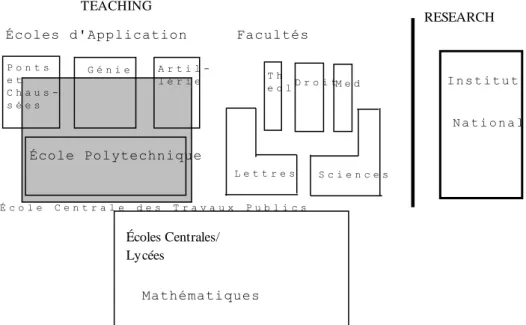
As a decisive impact of the French Revolution on the educational sector, a clear-cut consecutive and hierarchical order between general, propaedeutical education and professional higher learning defined, for the first time, boundaries between secondary schools and special schools for the learned professions (see figure). Thus, a remarkable number of special schools emerged in higher learning: for engineers on the one hand (civil engineers, military engineers for the brightest (génie), and the artillery for "low" achievers), and the two civil professions on the other hand. And all preparatory or general education was conferred to the secondary schools where mathematics by now enjoyed a relatively stable function as an element of general education.
This seemingly consistent and in fact quite attractive system showed a few inconsistencies: When the special schools for the civil professions aggregated, in 1808/10, to "faculties" in the frame of Napoleon's administrational unity called "Université Impériale" (regrouping the secondary schools and the facultés in all of France) -, something had to be done for the ever refractory and obstinate humanities (lettres): As continuation of secondary schooling and as complement to it, they were again assigned a propaedeutic function: as
faculté des lettres for the law faculty and the newly introduced theology faculty (which always
met with resistance by the Pope), and a small independent function for teachers' preparation. By symmetry, then, a science faculty had to be established which had to function as a propaedeutic for the medicine faculty and likewise independently for teacher training (see figure 1; Schubring 1991, 296 ff.).
One might wonder why the École Polytechnique was not mentioned up until now. Actually, this school can be understood as the most ambitious lobbying project ever undertaken by a scientific discipline and probably also as the greatest success ever achieved.
In its original form, as École Centrale des Travaux Publics (from 1794 to 1795), all training for the sciences, for engineering, for the arts was to be mathematics (made possible by the specific French form of rationalism). In its definitive form, from 1795 on, the École
Polytechnique - and by this mathematics, too - was reduced to a propaedeutical function
again. In the long run, mathematics - although now proud of its "polytechnical" name - fared no better than in more traditional forms of propaedeutics so when later in the 19th century the
science faculties gradually attained a better status, mathematicians preferred to develop this institutional field. As is well known by H. Gispert's work, this switch of institutional focus considerably changed the orientation of mathematical production: from geometry and mechanics to analysis and foundations (cf. Gispert 1991).
Écoles Centrales/ Lycées Mathématiques École Polytechnique Écoles d'Application P o n t s e t C h a u s - s é e s G é n i e A r t i l - l é r i e É c o l e C e n t r a l e d e s T r a v a u x P u b l i c s Facultés L e t t r e s S c i e n c e s T h e o lD r o i tM e d I n s t i t u t N a t i o n a l TEACHING RESEARCH
Fig. 1 Basic structure of institutions for secondary and higher learning and research in 19th century France, since 1794/1808
One might object that this French structure represents only teaching and not research. There had been separate institutions established for research since 1795, however, the Institut National, with its different classes, which comprised all the disciplines from the humanities to the sciences and the arts (see figure 1). The underlying conception was one of
complementarity between research and teaching so that full time academicians were, in fact,
not engaged in teaching institutions. In the beginning, complementarity was practiced in this way; Legendre and Lagrange constitute instructive examples.
The professors at the special schools were supposed to be competent in their science, to follow the progress of science and to maintain thus the quality of their teaching, but not to function as researchers bent on extending the frontiers of knowledge (Schubring 1991, 302).
The complementarity of the various institutions in France seems to constitute a highly functional structure for that period.
Yet, the few historiographers who have dealt with 19th century history of higher learning in Latin America have looked nevertheless bewildered at implementations of the
écoles spéciales model in many of these countries. The usual emphasis is to report it as a
positive feature only when proper universities were created there eventually (see Teixeira 1979; Pereira da Silva 1999, 77). The same phenomenon can be observed for the United States where the genuine history of the "American University" does not begin before the implementation of the "German" model.
The limited case of the Prussian research university
Before looking more concretely at the 19th century reforms in the Americas, I have therefore to discuss in how far the German structures functioned differently from the French, and what made them so attractive. In the general opinion, the characteristic essence of the German university is its research pattern. In the original conception of the actually not generally German, but just Prussian university its structural feature, distinguishing it from the French - which constituted then the predominantly Continental European model - was quite different.
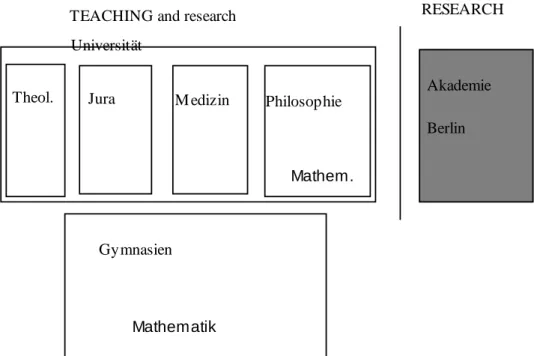
To begin with, the basic structure was essentially the same: a strict separation between secondary schools and the universities ensured a consecutive order and provided general, propaedeutical education in the reformed Gymnasien, whereas graduating from them, the Abitur, entitled to take up professional studies at either of the four faculties of the reformed universities (1810 Berlin, 1818 Bonn). The essential difference, however, was constituted by the Philosophical Faculty, which not only continued to exist due to W. v. Humboldt's reforms in contrast to the Continental European trend, but which also changed decisively in status and function: according to Karl Marx's dictum, "vom Kopf auf die Füße gestellt"4. It attained not only a professional function making it equivalent to the other three faculties - by ascribing to it the function to train the teachers for the new Gymnasien, it also enjoyed a leading role as the intellectual "task force", in the neohumanist conception of reformist administration.
In this neohumanist vision, the Philosophical Faculty and the Gymnasien incorporated the spirit of "pure" science. Contrary to France, this contrasted to an only poorly developed system of civil and military engineers' formation.
Now what about the famous research function of the Prussian university professors, and their so-called unity of research and teaching quoted ever and again?
In Prussia, too, research had originally been institutionalized separately, in the Berlin
Akademie der Wissenschaften. This was where cooperative and large-scale research had to be
undertaken. What W. v. Humboldt had in mind with his famous formula of the never exhaustible nature of knowledge was an imperative for the individual university professor to unravel new aspects of knowledge while restructuring and reorganizing it for teaching.
4
There were two reasons, however, why the Berlin Philosophical Faculty eventually was able to usurpate the Academy's research task and to thus serve as a model for the other Prussian Philosophical faculties: Due to financial restrictions, the first professors for the new university were chosen among the Academy's members, resulting in large staff congruences between the faculty and the Academy (one of the few professors never admitted to the Academy was Hegel); and, secondly, the Academy represented only disciplines also present in the Philosophical Faculty, and none from the other faculties (Schubring 1991, 309 ff.).
Gymnasien
Mathematik Universität
Theol. Jura M edizin Philosophie
Mathem.
Akademie Berlin RESEARCH TEACHING and research
Fig. 2 Basic structure of higher learning in 19th century Prussia, with diminishing rôle of the Academy
By the end of the 19th century research undertaken by universitarian entrepreneurs had developed so dynamically that substantial research could no longer be performed within the university. Separate research institutions were established - thus again confirming a necessary complementarity between university and research institutes.
Evaluating this functional comparison between the French and the Prussian model, we can observe no decisive differences for the early 19th century (except the weak form of institutionalized engineering formation). Even Charles Villers, the germanophile French intellectual teaching at Göttingen university in the Napoleonic period, who had published a
booklet in 1808 to show the superiority of the German university structure and prevent the transformation of Göttingen into a collection of écoles spéciales, had not brought forward really convincing arguments. He named as advantages of the "German" university structure: - easier change of the subjects of studies for the student,
- better providing a general scientific culture (Villers 1808, 54 ff.).
The reasons for the attractiveness of the Prussian/German model have therefore to be searched on another level than that of functionality of teaching and studying. In fact, there is such a level: the university is more than the sum of its faculties. Their union more easily results in a corporative structure which assures at least some elements of the earlier, rather medieval corporate autonomy. Understood in this way, the advantage of the university model becomes a part of the political history of the respective country. In fact, student struggles for universitarian autonomy (in contrast to direct state control on the écoles spéciales) became a major part of the political movements in Spanish America, at least after the great reforms achieved in 1918 at Córdoba University in Argentina (Albornoz 1979).
The first two thirds of the 19th century: domination by the French model in the Americas
If we now look at the transmission of the revolutionary changes from Europe to the Americas after 1800, we have to state first that there was almost no direct staff transfer of mathematicians or other scientists, not even after the restoration of the old dynasties. In general, the behaviour of the new governments was much more temperate than in the 20th century. An extreme exception was the restorated Bourbon monarchy in Naples, who had in 1799 several mathematicians murdered who had been politically active before (Mazzotti 1998, 690). Even in France, only Monge fell merely into disgrace under Restoration and the only mathematician exiled was Carnot. He was too old, however, to explore new Continents and just sought refuge - first in Poland and later in Prussia. One leading exponent of the French Revolution, however, made his way to North America: Lakanal, not only one of the top
Idéologues, but even one of the creators of the écoles spéciales conception in the 1790s. He
became president of a university in Louisiana and it would be highly interesting to know what his activities were. Actually, as he told Lacroix in a letter of the late 1830es, Lakanal had written three volumes about his experience of presidentship.5 Unfortunately, these volumes were never published and when I asked Lewis Pyenson to look for the manuscript, as he is living nearby since a certain time, he came up with the news that Lakanal seems to have burnt the manuscript before his death.
5
The only exception of an active mathematician exiled to the Americas was the North-Italian Ottaviano Fabrizzio Massotti who went to Argentina (from 1827 to 1835) after first fleeing to London in 1823, due to political pursuit in the restoration period.6
Another type of exceptional transfer and transmission is represented by Brazil, and I will begin with it to evaluate the transmission of the new concepts to the Americas. The exceptional situation for Brazil was that it suddenly changed from a terra almost incognita for science to rather a new center for learning. The Portuguese King, fleeing in 1808 to Brazil after the French troops had invaded Portugal, transformed Brazil into his new metropolis. He had not only brought the royal court with him, but also the first printing press ever to be installed in Brazil, and an entire scientific and technical library and a selection of modern-minded military officers, engineers and scientists besides. Among them was the mathematician Borja Garção de Stockler, educated at the new mathematical faculty of Coimbra University, and practising himself an algebraized mathematical approach.7 Brazil maintained this role as an independent center even after the King had returned to Portugal in 1821, since the former poorly developed colony Brazil became the new Empire of Brazil. Immediately (1810), a school for military and civil engineers - modelled according to the École Polytechnique - was established, the Academia Real Militar, and an intensive activity of translating and publishing the modern French books began. The first generation of professors at this school were almost all graduates from the reformed Coimbra University, and mainly from its mathematics faculty. German natural scientists were called already since the 1810s to explore the Flora of this vast country.
Within this new system, secondary and higher education were clearly instituted separatedly, too, starting with the foundation of the Collegio Don Pedro II in Rio de Janeiro in 1837, which became the leading secondary school in Brazil. Moreover, complementary special schools were écoles spéciales for law, for medicine, for mining, etc. Thus, a truly original structure emerged in Brazil: With regard to the traditional, civil professions, the more recent French model was adopted for professionalized faculties. With regard to engineering training, we observe an interesting mixture: while the military Academy or Polytechnical school was considerably moulded according to the Paris model, it maintained characteristic patterns of the Coimbra mathematics faculty - in particular an extended teaching of mathematics, and the possibility to graduate in mathematics.
This Coimbra tradition - unique for this period - was reinforced in 1842, when the right to confer a doctoral degree in mathematics, based on a written thesis, was accredited to the Polytechnical School (Pereira da Silva 1999, 69). By this, the Rio de Janeiro School functioned for mathematics analogously to the Coimbra mathematics faculty, which had been given this right in the 1772 reform, with the intention to qualify mathematics teachers for schools, and professors for the faculty.
6 Paper "Ottaviano Fabrizio Massotti and the London-Buenos-Aires Axis in the 1820s" by Eduardo Ortiz, given at the
Congress I Matematici nella Vita Politica, 1789-1848, 10 to 14 October 1994, Cortona (Italy).
7 I have just finished an extensive study of the development of basic notions in the calculus where I have shown the
The Brazilian institutional structure for science in general, and for mathematics in particular, seems to me to have been quite ahead of contemporary national educational structures in other countries of the two Americas during the first two thirds of the 19th century.
With regard to the countries of Latin America, I have the impression that the 19th century history of mathematics in Brazil is the relatively best explored. At least, a volume of 1979, discussing the history of Latin America universities, affirms that the 19th century constitutes the least investigated period (Góngora 1979, 48). Nevertheless, Brazilian historians use to either accuse entire Brazil for not having founded "true" universities right from the start, or to blame the positivism of Auguste Comte for having retarded scientific progress in Brazil.
In 1989, the Brazilian Clovis Pereira da Silva has collected and documented all the mathematical dissertations elaborated for a doctoral degree at the Polytechnic School (Pereira da Silva 1989).8 Admittedly, the quality of these theses, covering a broad range of subjects, is quite mixed, but if we look in a catalogue of the theses elaborated at the French facultés des
sciences, we observe that their quality is likewise heterogeneous. In fact, a comparative
perspective is absent in most of this historical literature.
A particularly telling characteristic is the usual harsh criticism voiced against the professionalized formation at the French minded écoles spéciales: For Hispano-America as well as for Brazil, the leading social classes and parents in general are blamed for pressing their sons into studies for immediate professional application, discouraging interest in the development of science for itself (cf. Góngora 1979, 54 ff.). There is no reflection as to whether such scientific institutions would be viable in an agrarian society. In fact, the authors arrive at their condemnation of the professionalized type of schools by even accumulating anachronisms and ever repeatedly by heroizations of Humboldt's so-called university ideal (cf. Teixeira 1979)9: The École Polytechnique in Paris is falsely classed as a research institution, and universities in general are held to be the institutions for scientific research. Likewise, the American University is depicted as a graduate school which should have served as a model for creating universities in Brazil as well.
It must be admitted that Comte's positivism increasingly changed its nature by the end of the 19th century to become an inflexible set of dogmas for mathematics, but one has to consider that Comtism constituted a decisive means for forging a national identity in these new states (cf. Silva da Silva 1999). And in fact, for almost the entire 19th century, there is no justification for an inferiority complex for Latin America with regard to the USA.
For the United States we can observe that the first true structural innovations came about as receptions of the French model, too: The founding of the first US engineering training institution was the Military Academy at West Point in 1802, appreciated as the
8 His book of 1992 is a revised version of this doctoral thesis.
9 Even Paim starts in his excellent book from the conviction that the establishment of “institutos isoldados” was
“inusitado” as compared to an alleged common “tradição europeía” to unite faculdades into universities (Paim 1981, 21).
"national center of scientific study"; it is remarkable for the intensity of translations of modern French science textbooks long before such activities were taken up in former mainland England. In 1824, the Rensselaer Polytechnic Institute followed as the next innovative institution promoting applied science according to the French model, too (Rudolph 1965, 228 ff.). No analogous structural reforms were realized or even proposed within the traditional college system, so that for the first half of the 19th century, the Brazilian and the Chilean system seem to have enjoyed a relatively advanced position in the two Americas.
In fact, the traditional college in the US sought to provide a four-year regime conductive to piety and strength of character. The expansion of the so-called land-grant colleges since Independence and during the first half of the 19th century reinforced this de-emphasizing of science: The colleges had to provide a civilizing complement to the physical seizing of the land (Maier, Weatherhead 1979, 7). There is even mention of a collegiate anti-intellectualism.
The rise of a split between the Americas
The glorious history of the American University began in fact quite late, in the 1870es, with the bold foundations of Johns Hopkins University (1876) and of the University of Chicago (1892). This establishment of graduate schools, following the Prussian model, meant a bold venture where a viable existence could not be foreseen. Actually, it proved to be successful: but not as an evident process - rather its success was the consequence of deep structural changes in the US society: the civil war eventually brought about the change from an agrarian society to a largely industrialized one (cf. Veysey 1965).
Furthermore, one has to consider that the American University constituted an infinitesimally small top portion of the entire system: at the beginning there were only three modern universities, incorporating elements of the Prussian model: Johns Hopkins, Clark, Chicago. Moreover, for the United States, it had not been possible either to create professor-researchers from scratch: rather, research had to be organized by importing of qualified scientists from Europe. Johns Hopkins began with professors who had obtained their doctoral degrees in Germany (Rudolph 1965, 264 ff.).
In concluding this section for the 19th century, I should make some remarks about the development of the structures for higher learning in Hispano-America. The entire century is characterized by the domination of professionally oriented Écoles Spéciales.
In Argentina, whereto a number of the French Idéologues had emigrated, the University of Buenos Aires was created. It seems that it functioned in the Napoleonic sense. What used to be the artes faculty became organized as "preparatory studies" with mathematics. This department is regarded as an anticipation of the subsequent separation of secondary education from higher learning.10
For Bogotá (Columbia), an analogous structure is reported (Góngora 1979, 51). Chile established a strict system of professional schools (ibid., 54 ff.). In Uruguay, a university
10
was founded in 1845 which applied French structures.11 In Mexico, an obstinate struggle between liberal movements and the Catholic Church took place over several decades concerning the control of the university. While the liberals sometimes were able to achieve a French professional structure, sudden political changes effected returns to the old structures. In 1860, an Escuela Nacional Preparatoria became established - as successor of the former
artes faculty (ibid., 52, 60).
In Cuba, under Spanish rule, the Universidad de la Habana still applied the Spanish structures. Separate secondary schools were founded in 1863. Mathematics was by now independently represented in one of the five faculties: in that for mathematics and the sciences. The first mathematician in the new faculty exposed only an elementary level of teaching. At the same time, he directed a private secondary school (Sanchez 2000).
A conclusion
A main consequence seems to be therefore that science cannot be transplanted or transmitted artificially, but that it needs concrete women and men who live for the values of scientific teaching and research. This is confirmed by the respective history in the 20th century: The decisive factor for establishing larger research communities in the two Americas was a-side-effect of the period of dictatorships in so many European countries: it caused a brain-drain also among mathematicians, from which the Americas, however, profited in an unequal manner. While Argentina and Uruguay had to share one Spanish mathematician (Julius Rey Pastor),12 and while Brazil enjoyed the presence of one exiled Portuguese mathematician (António Aniceto Montero), the USA were provided with an enormous number of mathematicians and scientists (cf. Siegmund-Schultze 1998).
11 Paper by Mario H. Otero at the same Oberwolfach meeting: On the origins of the Uruguayan school of
mathematics.
12 It has to be noted that Rey Pastor arrived in Argentina already before the time of Franco, and that he maintained his
Bibliography
Alessandra Fiocca, Luigi Pepe, "L'Università e le scuole per gli Ingegneri a Ferrara", Annali
dell'Università di Ferrara, Sezione VII - Scienze Matematiche, 1986, 32: 125-166.
Hélène Gispert, "Features of the French mathematics development and the higher education institutions(1860-1900)", 'Einsamkeit und Freiheit' neu besichtigt, ed. G. Schubring (Stuttgart: Franz Steiner Verlag 1991), 198-213.
Mario Góngora, "Origin and Philosophy of the Spanish American University", in: Maier, Weatherhead (eds.), 1979, 17-64.
Joseph Maier, Richard W. Weatherhead (eds.), The Latin American University (Albuquerque: Univ. of New Mexiko Press, 1979).
Joseph Maier, Richard W. Weatherhead, "The Latin American University: An Introduction", in: Maier, Weatherhead (eds.), 1979, 1-16.
Massimo Mazzotti, "Mathematics and Reaction in the Kongdom of Naples", ISIS, 1998, 89: 674-701.
Antonio Paim, A UDF e a Ideía de Universidade (Rio de Janeiro: tempo brasileiro, 1981). Erwin Papperitz, Die Mathematik an den deutschen technischen Hochschulen: Beitrag zur
Beurteilung einer schwebenden Frage d. hoeheren Unterrichtswesens (Leipzig: Veit, 1899).
Clóvis Pereira da Silva, Uma historia social do desenvolvimento da matemática superior no
Brazil: de 1810 a 1920. Tese de doutorado, Universidade de São Paulo, 1989.
Clóvis Pereira da Silva, A Matemática no Brasil. Uma história de seu desenvolvimento (1992; segunda edição: São Leopoldo: Unisions, 1999).
Frederick Rudolph, The American college and university: a history (New York: Vintage, 1965).
Carlos Sanchez Fernandez, "La Matemática en la Universidad de la Habana en un entorno del 98, in eds. Elena Ausejo, Carmen Beltrán, La Enseñanza de las Ciencias: Una
Perspectiva Historica. Cuadernos de Historia de la Ciencia. 11-II (Zaragoza, Universidad de
Zaragoza, 2000), 77-86.
Luis Saraiva, "Garção Stockler and the Foundations of the Calculus at the End of the 18th Century", Revista Brasileira de História da Matemática, 2001, 1: 75-100.
Christoph Schöner, Mathematik und Astronomie an der Universität Ingolstadt im 15. und 16.
Jahrhundert (Berlin: Duncker & Humblot, 1994).
Gert Schubring, "Spezialschulmodell versus Universitätsmodell: Die Institutionalisierung von Forschung", in: G. Schubring (ed.) 'Einsamkeit und Freiheit' neu besichtigt, (Stuttgart: Franz Steiner Verlag 1991), 276-326.
Reinhard Siegmund-Schultze, Mathematiker auf der Flucht vor Hitler: Quellen und Studien
zur Emigration einer Wissenschaft (Braunschweig: Vieweg, 1998).
Circe M. Silva da Silva, "Die Gründung der mathematischen Fakultät 1772 in Coimbra - ein Beginn fachlicher Spezialisierung", in: G. Schubring (ed.) 'Einsamkeit und Freiheit' neu
Circe M. Silva da Silva, A Matemática Positivista e sua Diffusão no Brasil (Vitória: Edufes, 1999).
Hanns-Albert Steger (ed.), Grundzüge des lateinamerikanischen Hochschulwesens: eine
Einführung in seine Probleme (Baden-Baden: Nomos Verl.-Ges., 1965).
Anísio Teixeira, "Origin and Philosophy of the Brazilian University", in: Maier, Weatherhead (eds.), 1979, 65-86.
Laurence R. Veysey, The emergence of the American university (Chicago: Univ. of Chicago Pr., 1970).
Charles Villers, Coup d'Oeil sur les Universités et le mode d'instruction publique de
l'Allemagne protestante; en particulier du Royaume de Westphalie (Cassel: Imprimérie
Royale, 1808).
Gert Schubring
Institut für Didaktik der Mathematik, Universität Bielefeld , Universitätsstr. 25, D-33615 Bielefeld
Alemanha