Arq. Bras. Med. Vet. Zootec., v.67, n.6, p.1669-1674, 2015
Behaviour of cockatiels (Nymphicus hollandicus) at two temperatures in captivity [Comportamento de calopsita (Nymphicus hollandicus) sob duas temperaturas em cativeiro]
T.S.G. Carvalho¹, M.G. Zangeronimo¹, C.E.P. Saad¹*, R.R. Alvarenga¹,V.D.L. Assis²,
V.M. Pereira³, J.D. Scalon¹, J.P. Silva¹
1Universidade Federal de Lavras Lavras, MG
²Universidade Federal de Goiás Goiânia, GO
3Universidade Federal de Minas Gerais Belo Horizonte, MG
ABSTRACT
Behavioural studies with cockatiels (Nymphicus hollandicus) in captivity are scarce. Due to the need for
appropriate management of these animals, this study was performed to examine the behaviour of cockatiels kept in captivity at two temperatures. Sixteen cockatiels were individually housed in cages (62cm high x 43cm long x 27cm wide) and fed with a commercial ration and seed mixture for psittacids. Water was provided ad libitum. The eight-day experiment was divided into two stages of four days each.
In the first stage, the birds were kept at room temperature (25°C) with 70% relative humidity during 24 hours. In the next stage, they were kept at 35°C from 06:00 to 18:00h and 25°C from 18:00 to 06:00h, also at 70% relative humidity. The behaviour of the birds was assessed by the analysis of video recordings taken from 6:00 to 18:00h. Lateral displacement on the perch, walking on the wire net, resting on the abdomen, stopping on the wire net, standing on the drinker or feeder, seed intake, cleaning the wings and shaking the plumage were not influenced (P>0.08) by temperature. Undesirable activities such as gnawing the perch or the wire net also showed no influence of temperature (P>0.15). At 35°C, the birds remained on the cage floor less often (P<0.02) and more often on the perch. Flapping or gnawing the feeder increased as did the consumption of ration (P<0.01). Increase in temperature from 25 to 35°C changed the behaviour of the cockatiels, although these behaviours were not characterised as responses to temperature stress.
Keywords: birds, Psittaciformes, parrot, thermal comfort, captivity, animal welfare
RESUMO
Estudos comportamentais com calopsitas (Nymphicus hollandicus) em cativeiro são escassos. Devido à necessidade de um manejo adequado desses animais, este estudo foi realizado para avaliar o comportamento de calopsitas mantidas em cativeiro em duas temperaturas. Dezesseis calopsitas foram alojadas individualmente em gaiolas (62cm de altura x 43cm de comprimento x 27cm de largura) e alimentadas com ração comercial e mistura de sementes para psitacídeos. A água foi fornecida ad
libitum. O período experimental foi de oito dias, dividido em duas fases de quatro dias cada. Na primeira fase, as aves foram mantidas à temperatura ambiente (25°C), com 70% de umidade relativa, durante o dia e a noite. Na etapa seguinte, elas foram mantidas a 35°C de 6-18h e 25°C de 18-6h, também com 70% de umidade relativa. O comportamento das aves foi avaliado através de filmagem de 6-18h. Os comportamentos, deslocando lateralmente no poleiro, andando na tela da gaiola, repousando sobre o ventre, paradas na tela da gaiola, de pé sobre o bebedouro ou comedouro, ingestão de sementes, limpeza das asas e sacudindo a plumagem, não foram influenciados (P>0,08) pelas duas temperaturas testadas. Atividades indesejáveis, tais como roer o poleiro ou a tela da gaiola também não foram influenciadas (P>0,15). Sob a temperatura de 35°C, as aves permaneceram menos frequentemente no chão da gaiola (P<0,02) e mais frequentemente no poleiro. Nessa temperatura, bater as asas e roer o comedouro
Recebido em 7 de agosto de 2014 Aceito em 7 de julho de 2015
*Autor para correspondência (corresponding author)
aumentaram com o aumento do consumo de ração (P<0,01). Concluiu-se que o aumento da temperatura de 25 para 35°C alterou o comportamento das calopsitas, embora esses comportamentos não pudessem ser caracterizados como respostas ao estresse térmico.
Palavras-chave: aves, Psittaciformes, psitacídeo, conforto térmico, cativeiro, bem-estar animal
INTRODUCTION
The cockatiel (Nymphicus hollandicus) is an
Australian bird belonging to the order Psittaciformes, family Psittacidae, subfamily Cacatuinae (BirdLife International 2012). The smallest species of existing cockatoo, measuring approximately 30-32 cm long (Forshaw, 2010; Gorman, 2010) and almost universally regarded as the most docile of all parrots, cockatiels can be found in open woodlands, farmlands, urban parks and gardens. They are extremely attractive and showy and can live up to 20 years or more (Gorman, 2010). Because of this, the maintenance of psittacids in captivity has increased in some countries and is regulated by local official organisations.
The environment in which the birds are kept is considered an important aspect of their survival. Factors such as temperature, humidity and air movement, which represent the thermal conditions of the environment, can directly influence the behaviour of the birds. Studies have shown that the optimal conditions for maintenance in the wild differ from those kept in captivity. Environmental temperature, for example, plays an important role. Exposure to high ambient temperature causes physiological dysfunction (Mujahid et al., 2007) due to the
secretion of corticosteroids, which severely depresses the animal’s health due to their catabolic nature. In most cases, confinement provides little space for the behavioural adjustments necessary to maintain thermal homeostasis. Because of this, captivity can represent a limiting factor that leads many animals to express different behaviours, most of which are considered undesirable, such as
route-during the night. In some countries, such as Brazil, the temperature during the day can sometimes surpass the thermal comfort zone of some species of animals. In Australia, the maximum average summer temperature is 33 ºC, while during the winter, the minimum average temperature is 9 ºC (Quensland Government, 2004).
Little information was found in the literature about the influence of temperature on the behaviour of captive cockatiels. Understanding the activities of wild birds in captivity is important for the ideal management of these animals and for reducing at least the main stressful factors. Thus, the aim of this study was to evaluate the behaviour of captivity cockatiels (Nymphicus hollandicus) kept in a thermal
comfort and in a heat temperature.
APPROACH
The survey was conducted from April–May 2013 in the climatic chamber of the Department of Animal Science, Federal University of Lavras (UFLA), which is located in Lavras, Minas Gerais, Brazil. The experimental protocol was approved by the Ethics Committee on Animal Use (CEUA) of the same institution under the number 029/13.
temperature was monitored daily inside the rooms at 8:00, 13:00 and 18:00 h using maximum and minimum thermometers placed at half the height of the animals. The lighting program used was 24 hours of artificial light with infrared light 250w (Ecolume, Belo Horizonte, Brazil).
Sixteen cockatiels (N. hollandicus) (eight males
and eight females) born in a commercial hatchery that were approximately one year old were housed individually in cages (62cm high x 43 cm long x 27cm wide) made of galvanised wire and adapted with two plastic feeders each, one for ration and another for seed mixture. Individual round ceramic drinkers (10 cm diameter) were used to provide water. The distance between the cages was 40cm.
The animals were fed a commercial ration for psittacids (Complete Food for Parrots, CC Bio Tron, Rio Claro, São Paulo, Brazil) and a seed mixture (50% millet, 30% canary seed, 15% oats and 5.0% sunflower) commonly used in some commercial hatcheries in Brazil (Torloni, 1991). Water was supplied ad libitum.
The birds were subjected to a period of acclimation to the experimental conditions for one week. The experimental time was eight days, divided into two stages of four days each. In the first stage (T25), the birds were maintained at an ambient temperature of 25°C and 70% relative humidity during the day and night. In the next stage (T35), the birds were maintained at an ambient temperature of 35°C from 06:00 to 18:00h and 25°C from 18:00 to 06:00h, also at 70% relative humidity. The seeds and ration provided and the waste produced were measured daily.
The behaviour of the birds was assessed in the last day of each period by filming from 6:00 to 18:00h with a camcorder (8.0 mm CCD Colour
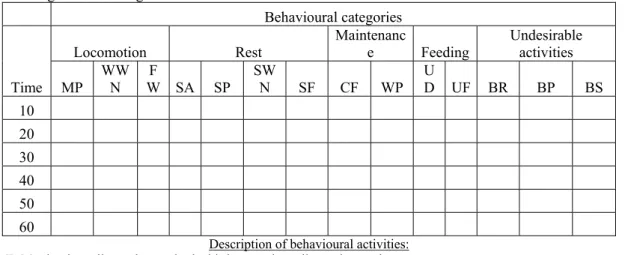
Camera 1/3 Infrared ST1230, Campina Grande do Sul, Paraná, Brazil). The images of each bird were analysed by the same evaluator. Every ten minutes, the activities of the animals were recorded following the focal sampling technique adapted from Altmann (1974) in a pre-defined ethogram (Fig. 1) based on the observations of Prestes (2000), who evaluated the spectacled parrot (Amazona pretrei) of the order Psittaciformes also in captivity. The focal
sampling technique consisted of registering the type of activity performed by the animal at a specific time. All birds were observed at the same time during the analysis of the videos. Using the total number of behaviours registered for each animal, the percentage of each behaviour was calculated for each bird.
The body temperature was always measured at 18:00h using the FLIR E50 device (Nashua, USA). The feed and seed intake was determined based on the difference between the amount provided and the waste.
Division of Wildlife / Department of Animal Science / Federal University of Lavras Behavioural Observation Activities and Environmental Enrichment Date: ____________ Schedule: _____________ Responsible: ________________ Cage / Species:_____________________
Ethogram: MP-moving laterally on the perch; WS-walking on the screen cage; FW-flapping the wings; SB-standing on the belly; SP-standing on the perch; SS-stopping on the screen; SF-stopping on the cage floor; CF-clearing feathers with its beak; WP-wagging its plumage; UD-perching upon the drinker or drinking water; UF-perching upon the feeder or eating; BR-biting the roost; BP-biting the pot supply; BS-biting the screen cage.
Behavioural categories
Time
Locomotion Rest Maintenance Feeding Undesirable activities
MP WWN W SA SP F SWN SF CF WP UD UF BR BP BS 10 20 30 40 50 60
Description of behavioural activities: MP-Moving laterally on the perch: the bird moves laterally on the perch.
WWN-Walking on the wire net: the bird moves on the screen of the cage, both on the floor and on the side. FW-Flapping wings: the bird flaps its wings several times without shaking its plumage.
SA-Standing on the abdomen: the bird rests, standing with its legs bent, its weight on its belly, and its claws under the chest.
SP-Standing on the perch: when on the perch in a neutral posture, the bird keeps its legs slightly apart. The feathers are not ruffled, and the neck is in a normal position.
SWN-Stopping on the wire net: the bird remains on the screen of the cage, showing no movement. SF-Stopping on the floor of the cage: the bird is standing on the cage floor, showing no movement.
CF-Clearing feathers with its beak: the bird uses its beak to clean its feathers. This act can be performed either at the tip or near the belly, with its head toward the back. The bird bends its body corresponding to the wing. WP-Wagging its plumage: the bird’s feathers bristle on the body, especially the neck, chest, and back, accommodating feathers after two or three jolts throughout the body.
UD-Perching upon the drinker or at drinking water: the bird perches on the drinker of water or drinks water from the pot’s nozzle.
UF-Perching upon on the feeder or eating: the bird remains on the feeder, stopping or eating. BP-Biting the perch: the bird tries to destroy the roost cage by biting it with its beak.
BD-Biting the drinker of feeder: The bird tries to destroy the feeder by gnawing it with its beak. BS-Biting the screen cage: the bird tries to destroy the screen cage by biting it with its beak.
An increased consumption of ration was observed (P<0.01) at this temperature. Activities such as flapping or gnawing the feeder were detected at T35.
Behavioural studies in cockatiels of the species
N. hollandicus kept in captivity are scarce. The
choice of temperatures used in this experiment was based on the fact that the range of thermal
comfort for cockatiels lies between 18.0 and 23.8°C, and the temperatures of thermal discomfort are considered to be below 12.7°C or above 32.2 °C (Gorman, 2010). In the second period of this study (T35), the birds were subjected to a temperature of 35°C from 06:00 to 18:00 h to simulate the natural environment of cockatiels (i.e., higher temperatures during the daytime and lower temperatures at night).
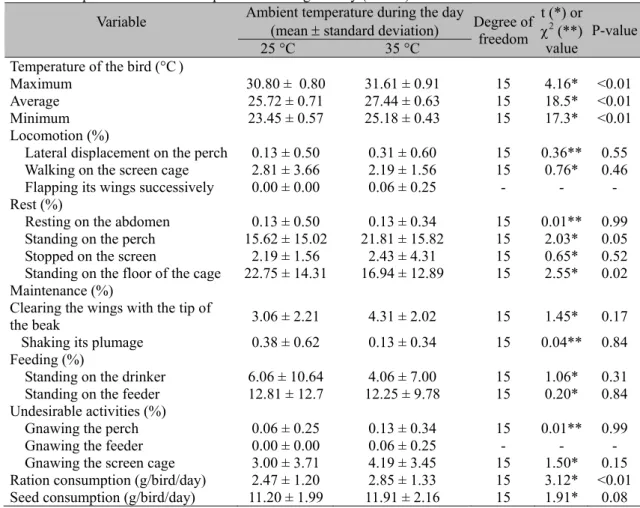
Table 1. Behavioural, feed intake, body surface temperature, and seed consumption variables for cockatiels kept at two ambient temperatures during the day (n = 16)
Variable Ambient temperature during the day (mean standard deviation) Degree of freedom
t (*) or
2 (**)
value P-value 25 °C 35 °C
Temperature of the bird (°C)
Maximum 30.80 ± 0.80 31.61 ± 0.91 15 4.16* <0.01 Average 25.72 ± 0.71 27.44 ± 0.63 15 18.5* <0.01 Minimum 23.45 ± 0.57 25.18 ± 0.43 15 17.3* <0.01 Locomotion (%)
Lateral displacement on the perch 0.13 ± 0.50 0.31 ± 0.60 15 0.36** 0.55 Walking on the screen cage 2.81 ± 3.66 2.19 ± 1.56 15 0.76* 0.46 Flapping its wings successively 0.00 ± 0.00 0.06 ± 0.25 - - - Rest (%)
Resting on the abdomen 0.13 ± 0.50 0.13 ± 0.34 15 0.01** 0.99 Standing on the perch 15.62 ± 15.02 21.81 ± 15.82 15 2.03* 0.05 Stopped on the screen 2.19 ± 1.56 2.43 ± 4.31 15 0.65* 0.52 Standing on the floor of the cage 22.75 ± 14.31 16.94 ± 12.89 15 2.55* 0.02 Maintenance (%)
Clearing the wings with the tip of
the beak 3.06 ± 2.21 4.31 ± 2.02 15 1.45* 0.17 Shaking its plumage 0.38 ± 0.62 0.13 ± 0.34 15 0.04** 0.84 Feeding (%)
Standing on the drinker 6.06 ± 10.64 4.06 ± 7.00 15 1.06* 0.31 Standing on the feeder 12.81 ± 12.7 12.25 ± 9.78 15 0.20* 0.84 Undesirable activities (%)
Gnawing the perch 0.06 ± 0.25 0.13 ± 0.34 15 0.01** 0.99 Gnawing the feeder 0.00 ± 0.00 0.06 ± 0.25 - - - Gnawing the screen cage 3.00 ± 3.71 4.19 ± 3.45 15 1.50* 0.15 Ration consumption (g/bird/day) 2.47 ± 1.20 2.85 ± 1.33 15 3.12* <0.01 Seed consumption (g/bird/day) 11.20 ± 1.99 11.91 ± 2.16 15 1.91* 0.08
The environmental conditions studied significantly interfered with few of the behaviours exhibited by the birds. Compared to 25°C, the high temperature caused the birds to remain more often on the perch instead of on the floor of the cage. This can be explained by the fact that the animals prefer well-ventilated areas, facilitating body heat dissipation (Kenny and Jay, 2013). Behavioural adjustments can occur quickly and at a lower cost than physiological adaptations. Thus, the behaviour of animals
represents a direct tool that a wild bird has to defend itself from dangers in the surrounding environment. Parrot species that are kept as pets often exhibit behavioural problems, such as escape attempts, panic, and aggression, that are considered typical in captive environments (Meehan et al., 2004). In the present study,
The surface body temperature of the cockatiels increased when the ambient temperature was increased from 25 to 35°C. Increased skin temperature is a result of a high ambient temperature or increased blood flow at the body surface (Simeone et al., 2004). Previous studies
indicate that birds have the ability to adapt morphologically, physiologically, and behaviourally to achieve thermal homeostasis, but factors such as feather coverage, sex, age, and degree of acclimatisation can interact with relative humidity to define responses to high ambient temperatures (Balnave, 2004). In the present study, behavioural changes, such as remaining on the perch, were more important in maintaining thermal homeostasis.
The ingestion of ration increased when the temperature increased from 25 to 35°C. This result may be related to the increase in the behaviour "gnawing the feeder" when the higher temperature was applied. The proximity of the bird to the ration may have stimulated the ingestion of feed.
In general, cockatiels are psittacines from the desert regions of Australia (Forshaw, 2010). Despite domestication over the years, they are genetically adapted to elevated temperatures. Because of this, no behaviour that suggested stress was observed in the present study.
CONCLUSION
The increase in temperature from 25 to 35°C changed the behaviour of the cockatiels, increasing permanence on the perch, flapping and gnawing the feeder; however, due to the higher feed intake, these behaviours were not indicative of thermal stress, condition which would result in reduced feed intake.
ACKNOWLEDGEMENTS
We would like to thank the Coordenação de
REFERENCES
ALTMANN, J. Observational study of behaviour: sampling methods. Behaviour. v.49, p.227–267,1974. ANNUAL temperature study report. Data Analysis Report. 2004. Available in:< http://www.hpw.qld.gov.au/SiteCollectionDocuments/ TemperatureStudyAnnualReport2002-03.pdf> Accessed Jun. 2015.
BALNAVE, D. Challenges of accurately defining the nutrient requirements of heat-stressed poultry. Poultry Sci. v.83, p.5-14, 2004.
BIRDLIFE INTERNATIONAL. 2012. Nymphicus hollandicus. In: IUCN red list of threatened species. Version 2013.1. Available in: <http://www.iucnredlist.org.>. Accessed: Aug. 2013. FORSHAW, J.M. Parrots of the world. Princeton: Princeton University Press, 2010.
GORMAN, M. The cockatiel handbook. New York: [s.n.], 2010. (Barron's educational series)
KENNY, G.P.; JAY, O. Thermometry, calorimetry, and mean body temperature during heat stress. Compr. Physiol., v.3, p.1689–1719, 2013.
MEEHAN, C.L.; GARNER, J.P.; MENCH, J.A. Isosexual pair housing improves the welfare of young Amazon parrots. Appl. Anim. Behav. Sci., v.81, p.73-88, 2003.
MEEHAN, C.L.; GARNER, J.P.; MENCH, J.A. Environmental enrichment and development of cage stereotypy in orange-winged Amazon parrots (Amazona amazonica). Dev. Psychobiol., v.44, p.209-218, 2004.
MUJAHID, A.; AKIBA, Y.; TOYOMIZU, M. Acute heat stress induces oxidative stress and decreases adaptation in young white leghorn cockerels by downregulation of avian uncoupling protein. Poultry Sci., v.86, p.364–371, 2007.
PRESTES, P.N. Description and quantitative analysis of etogram of Amazon petrei in captivity. Ararajuba, v.8, p.25-42, 2000.