UNIVERSIDADE DO ALGARVE
Faculdade de Ciências e Tecnologia
Modulation of bone metabolism and mineralization in
gilthead seabream (Sparus aurata) fed various vegetable oil
sources
Carmen Lucía Barrios Guzmán
Dissertação apresentada para a obtenção do grau de Mestre em Aquacultura e Pescas com especialização em Aquacultura
UNIVERSIDADE DO ALGARVE
Faculdade de Ciências e Tecnologia
Modulation of bone metabolism and mineralization in
gilthead seabream (Sparus aurata) fed various vegetable oil
sources
Carmen Lucía Barrios Guzmán
Dissertação apresentada para a obtenção do grau de Mestre em Aquacultura e Pescas com especialização em Aquacultura
Sob a supervisão de: Dr. Jorge Proença Dias
Modulation of bone metabolism and mineralization in
gilthead seabream (Sparus aurata) fed various vegetable oil
sources
Declaração de autoria de trabalho
Declaro ser o autor deste trabalho, que é original e inédito. Autores e trabalhos consultados estão devidamente citados no texto e constam da lista de referências incluída.
_____________________________________________________________ Carmen Lucía Barrios Guzmán
Copyright. A Universidade do Algarve tem o direito, perpétuo e sem limites geográficos, de
arquivar e publicitar este trabalho através de exemplares impressos reproduzidos em papel ou de forma digital, ou por qualquer outro meio conhecido ou que venha a ser inventado, de o divulgar através de repositórios científicos e de admitir a sua cópia e distribuição com objetivos educacionais ou de investigação, não comerciais, desde que seja dado crédito ao autor e editor.
1
Dedicatoria
A:
Dios, por darme la oportunidad de vivir y por estar conmigo en cada paso que doy, por fortalecer mi corazón e iluminar mi mente y por haber puesto en mi camino a aquellas personas que han sido mi soporte y compañía durante todo este periodo.
Mi papi Víctor Barrios por los ejemplos de perseverancia y constancia que lo caracterizan y que me ha infundado siempre, por el valor mostrado para salir adelante y por su amor. Mi mami Yoly de Barrios por apoyarme en todo momento, por sus consejos, sus valores, por la motivación constante que me ha permitido ser una persona de bien, pero más que nada, por su amor.
Mi hermana Candy Barrios por ser el ejemplo de una hermana mayor, de la cual aprendo siempre y apoyarme en momentos difíciles, pero sobre todo gracias por estar en otro momento tan importante en mi vida.
Mi abuelito José Salomón Guzmán y mi tía Ana Virginia Guzmán por quererme y apoyarme siempre, esto también se lo debo a ustedes. Gracias por tenerme en sus oraciones porque sé que siempre lo hacen.
Mi abuelita Celina Sánchez de Guzmán, a mi tío Oscar Fernando Guzmán fueron centro de motivación e inspiración, aun sus recuerdos brillan en mi corazón, y con ellos una sonrisa porque a pesar del tiempo que ha pasado desde su partida, forman parte de mi vida. Siempre están presentes en mente y corazón.
También a mis abuelitos Candida Rosa Maldonado Barrios y Herman Barrios Sandoval, porque sé que desde el cielo me cuidan y protegen.
Diego a ti por compartir conmigo buenos y malos momentos, y sobre todo por tu apoyo y los ánimos de seguir adelante.
2
Agradecimentos
Em primeiro lugar quero agradecer a meu orientador Doutor Jorge Dias, pela oportunidade, confiança e apoio no desenvolvimento da minha experiencia em Portugal, por todas as oportunidades profissionais, pela amizade e os conselhos dados.
Quero agradecer à Prof. Doutora Maria Teresa Dinis pela oportunidade de pertencer ao grande grupo de investigação, e pelos conselhos.
Ao prof. Luis Franco, pela ajuda e motivação de continuar o estudo da aquacultura marinha, e sobre tudo pelo apoio em Guatemala.
Ao Aquagruop por tudo o apoio que me deram durante os 3 anos que levo de compartir com o grupo.
Agradeço ao professor Karim Erzini pelo apoio e orientação durante tudo este processo.
É essencial agradecer a todos os meus colegas do laboratório de aquacultura especialmente Filipa, Lena, Rita, Sara, Denise, Cátia; pela ajuda durante tudo este tempo, o apoio, e os conselhos que eram e são bem-vindos.
Patri agradeço tudo o apoio, compreensão, orientação, e sobre tudo a nossa amizade, Vera Rodrigues agradeço tu apoio tudo este tempo.
A vocês também Carmen, Javi, Mauri, Ana, André; por dar-me forças para continuar adelante, por todas as coisas boas que compartimos, e sobre tudo pela grande amizade.
Stélio agradeço todo o apoio que de uma forma o outra diste durante tudo este tempo, sabes que eres um grande amigo.
Este trabalho teve o apoio do projecto FATTYBONE project “Dietary fatty acids as
modulators of bone metabolism in gilthead seabream (Sparus aurata)”
(PTDC/MAR/70855/2006) funded by Fundação para a Ciência e Tecnologia (MCTES-FCT, Portugal).
3
Index
Dedicatoria………..1 Agradecimentos……….………...2 Index……….…………..3 List of Tables………..4 List of Figures……….5 Resumo………...6 Abstract...7 1. Introduction...81.1 Replacement of fish oil by vegetable oil sources in Aquaculture feeds……….8
1.2 Skeletal bone in fish………...8
1.3. The role of nutrients on bone remodeling………...9
1.4 Objectives……….10
2. Material and Methods...11
2.1 Experimental diets...11
2.2 Fish and rearing conditions………14
2.3 . Analytical methods………..14 2.4 Statistical analysis………..16 3. Results...17 4. Discussion...22 6. References………...27
4
List of Tables
Table 1. Ingredients and proximate composition of experimental diets………..12 Table 2. Fatty acid composition of the experimental diets (% of total FAME)………...13 Table 3. Growth performance and proximate composition of vertebral bone of seabream
(IBW: 39.3 1.4 g) fed the experimental diets………17
Table 4. Fatty acid composition of lipids extracted from seabream vertebral bone (% of total FAME)………..19
5
List os Figures
Figure 1. Mineral deposition in tetracycline-marked vertebrae at the end of the feeding period of 46 days with the various dietary treatments……….18 Figure 2. Association between experimental diets and vertebral bone polyunsaturated fatty acid (PUFA) profile………..20 Figure 3. Activity of ALP and TRAP in seabream vertebral bone homogenates……….21 Figure 4. Activity of total PLA2 and cPLA2 in seabream vertebral bone……….22
6
Resumo
Este estudo visa avaliar o efeito de fontes de lípidos na dieta como elementos moduladores da composição óssea em ácidos gordos, da mineralização e metabolismo ósseo em juvenis de dourada. Doze grupos homogêneos de 25 juvenis de dourada (peso inicial médio de 39.3 1.4 g) foram colocados em tanques de 90 L e alimentados durante 46 dias com uma de quatro dietas experimentais. Estas dietas experimentais eram isoprotéicas (proteína bruta, 46% de MS), isolipídicas (15% MS) e isoenergéticas, mas com fontes de óleos variáveis. As fontes de lípidos testadas foram: a) óleo de fígado de bacalhau (FO, uma fonte de n-3 LC-PUFA), b) óleo de soja (SBO, uma fonte de de ácidos gordos n-6), c) óleo de linhaça (LSO, uma fonte de ácidos gordos da série n-3, mas não LC-PUFA), e d) óleo de palma (PO, uma fonte de ácidos gordos saturados). Critérios associados ao crescimento em peso e à composição proximal do peixe inteiro não foram significativamente afetadas pelas dietas experimentais (P>0,05). A composição de ácidos gordos do osso foi alterada pelo perfil de ácidos gordos da dieta, mas sugere a existência de mecanismos de conservaçãos de alguns ácidos gordos específicos, nomeadamente do DHA. Embora o teor de cálcio do osso tenha sido pouco afetado pelos tratamentos alimentares, o nível de fósforo no osso de douradas alimentadas com a dieta de óleo de fígado de bacalhau foi significativamente superior (P<0,05) do que aqueles encontrados nos peixes alimentados com as dietas de óleo vegetal. A observação microscópica de tetraciclina marcado nas vértebras mostraram que a deposição mineral em vértebras de peixes alimentados com a dieta LSO foi significativamente menor (P<0,05) do que a encontrada nos peixes alimentados com dietas FO e SBO. Actividade da fosfatase ácida resistente ao tartarato (TRAP) em homogeneizado de osso foi positivamente correlacionada (r = 0,658) com ácido α-linolénico (ALA, 18:3 n-3), ao passo que um aumento da ingestão de EPA (r = -0,478) e DHA (r = -0,536) teve tendência a reduzir a atividade TRAP. Atividade de fosfatase alcalina (ALP) em homogeneizados de osso foi positivamente correlacionada com a ingestão de EPA (r = 0,763) e DHA (r = 0,793). Em comparação com os peixes alimentados com a FO e LSO dietas, aqueles alimentados com as dietas SBO e PO mostrou uma redução significativa (P <0,05) do total de fosfolipase A2 (PLA2) atividade em homogeneizados ósseos. No entanto, estas alterações não foram claramente associadas à actividade da PLA2 citosólica. Os resultados deste trabalho, confirmam que os lípidos alimentares desempenham um papel importante na modulação do metabolismo ósseo da dourada.
7
Abstract
Little information exists on the role of dietary lipids on the bone metabolism in fish. A trial was undertaken to evaluate the effect of dietary lipid sources as modulators of bone fatty acid composition, mineralization and skeletal metabolism in fast-growing seabream juveniles. Twelve homogenous groups of 25 seabream juveniles each (mean initial body weight of 39.3
1.4 g) were stocked in 90 L tanks and fed one of four semi-purified experimental diets formulated to be isonitrogenous (crude protein, 46% DM), isolipidic (15% DM) and isoenergetic, but with variable oils sources. The dietary lipid sources under testing were: a) cod liver oil (FO, a source of n-3 LC-PUFA); b) soybean oil (SBO, a source of n-6 fatty acids); c) linseed oil (LSO, a source of non-LC-PUFA n-3 fatty acids); and d) palm oil (PO, a source of saturated fatty acids). Overall growth performance criteria and whole-body composition of fish were not significantly affected by the various dietary experimental treatments (P>0.05). Bone fatty acid composition was altered by the dietary fatty acid profile, but suggests the existence of conservative mechanisms for some specific fatty acids, namely DHA. While the calcium content of bone was little affected by the dietary treatments, bone phosphorus level in seabream fed the cod liver oil diet was significantly higher (P<0.05) than those found in fish fed the vegetable oil diets. Microscopic observation of tetracycline-marked vertebrae showed that mineral deposition in vertebrae of fish fed the LSO diet was significantly lower (P<0.05) than that found in fish fed the FO and SBO diets. Tartrate-resistant acid phosphatase (TRAP) activity in bone homogenate was positively correlated (r = 0.658) with αlinolenic acid (ALA, 18:3n3) intake, while an increased intake of EPA (r = -0.478) and DHA (r = -0.536) tended to reduce TRAP activity. Alkaline phosphatase (ALP) activity in bone homogenates was positively correlated with intake of EPA (r = 0.763) and DHA (r = 0.793). In comparison to fish fed the FO and LSO diets, those fed the SBO and PO diets showed a significant reduction (P<0.05) of total phospholipase A2 (PLA2) activity in
bone homogenates. However, such changes could not be clearly attributable to cytosolic PLA2. Overall data confirm that dietary lipids are important modulators of bone metabolism in a marine teleost, such as gilthead seabream.
8
1. Introduction
1.1 Replacement of fish oil by vegetable oil sources in Aquaculture feeds
According to estimates of the International Fishmeal & Fish Oil Organisation, in 2009 the aquaculture sector used about 81% of global fish oil (FO) production. Since industrial FO has to be shared with other users, such as land animal feeds, human nutritional supplements and pharmacology, the future expansion of aquaculture production can only continue if suitable and sustainable alternatives to FO are introduced in commercial fish feeds. Current trend on the aquafeed industry towards the lower usage of marine-derived ingredients promotes the use of vegetable oils devoid of n-3 long chain polyunsaturated fatty acids (LC-PUFA) (Drakeford and Pascoe, 2008; Miller et al., 2008; Turchini et al., 2009). In marine fish species, such as gilthead seabream, the use of vegetable oils as a sole lipid source is limited by the low ability of these species to convert linoleic (LA-18:2n-6) and ALA, abundant in many vegetable oils, into arachidonic (ARA – 20:4n-6), eicosapentaenoic (EPA – 20:5n-3) and docosahexaenoic acids (DHA – 22:6n-3) which are essential for marine fish (NRC, 2011). But the partial substitution (up to 60%) of FO by blends of vegetable oils (VO) does not seem to compromise growth, survival, feed utilization or major fillet organoleptic properties in seabream, although altering the fatty acid composition of flesh (Izquierdo et al., 2005; Benedito-Palos et al., 2009; Fountoulaki et al., 2009; Wassef et al., 2009; Benedito-Palos et al., 2010). Most studies involving FO replacement by VO sources show clear changes in the pattern and ratios of fatty acids circulating in plasma and stored in various tissues, but the effects at a metabolic level and on immune response of such changes are still poorly understood in fish (Caballero et al., 2004; Ganga et al., 2005; Montero et al., 2010; Montero and Izquierdo, 2010; Bouraki et al., 2011, Cruz-Garcia et al., 2011).
1.2 Skeletal bone in fish
Bone is a complex and multifunctional organ that consists of a structural framework of mineralized matrix that may contain heterogeneous populations of osteoblasts chondrocytes, osteoclasts, endothelial cells, monocytes, macrophages and lymphocytes. Bone modeling relies on the collective action of cells that produce, mineralize and resorb bone matrix. Osteoblasts produce and mineralize bone matrix, while bone resorption is performed by osteoclastic cells with hematopoietic origin. However in modern teleosts bone is mostly devoid of osteocytes, and osteoclasts are mostly mono-nucleated cells (Witten and Huysseune, 2009).
9
The combined and cooperative activities of osteoblasts and osteoclasts result in a bone architecture that provides mechanical support and protection for the body (Watkins et al., 2001). Similarly to land tetrapods, in teleost fish the skeleton is subject to remodelling, however showing several specific differences, related to the aquatic life of teleosts, to certain traits in conserved teleosts (but lost in mammals) and to several advanced characters that specifically evolved in the lineage of modern bony fish (Metscher and Ahlberg, 1999). Fish skeleton is a complex metabolically active tissue that undergoes continuous remodeling throughout their life. The skeletal system consists of bones and cartilage and serves multiple physiological functions. However, by far the most important function is to support the structural integrity of the body for normal posture, development and locomotion (Witten et
al., 2004). Morphologically, fish bones consist of the dermal head bones, internal skeleton,
and scales. However, fishes do not have any hematopoietic elements within the bones. Skeletal development in bony fish (Teleostei) follows the pattern that has been conserved during vertebrate evolution (Huysseune, A., 2000, Witten et al., 2004). There are two types of fish bones, cellular and acellular. The skeletal tissue of higher orders of teleost fish such as Perciformes is unique among vertebrates in that they lack osteocyte cells. Acellular bones are formed by osteoblast cells which move away from the site of mineralization as bone deposition occurs and are therefore incapable of extensive modeling (Moss, 1963). The tissues of acellular bone may not be directly involved in Ca metabolism under normal conditions (Taylor, 1985). Skeletal disorders are a reoccurring problem in fish hatcheries and commercial farms that affect growth, development and survival as well as market value of the final product (Lall and Lewis-McCrea, 2007).
1.3. The role of nutrients on bone remodeling
Protein is part of the organic matrix of bone for collagen structure and is essential to maintain the production of hormones and growth factors that modulate bone synthesis (Heaney, R. P. 1993). Approximately 60% of the magnesium in the body is in bone. As with calcium, magnesium is at risk for being deficient in the diet. Deficiency of this mineral could affect bone growth, osteoblastic and osteoclastic activity and alter calcium metabolism (Fatemi, et al., 1991). Manganese is needed for the biosynthesis of mucopolysaccharides in bone matrix formation and is a cofactor for several enzymes in bone tissue (Clegg, et al., 1998). Fish and other aquatic organisms absorb Ca and P from water and their Ca requirement is met by their ability to absorb this element directly from water.
10
However, the concentration of P is low in both freshwater (FW) and seawater (SW), The absorbed calcium is deposited in bone, scale and skin (Lall, 2002). Osteoblasts, cells involved in bone formation, are target cells for retinoids. Osteoclasts are cells that are responsible for bone resorption. These cells are stimulated by vitamin A, specifically all-trans retinoic acid and 9-cis-retinoic acid (Kindmark, et al. 1995). Vitamin E is important for proper skeletal development, especially to combat endogenous and exogenous free radicals that can cause damage to osteoblasts and stimulate osteoclasts (Arjmandi, et al., 2002) Both vitamins E and C are integral in the intracellular defence mechanism used to protect bone cells from free radicals (Xu, et al. 1995). Roy (2002) reported that dietary vitamin K supplementation had no detectable effect on the quantity of haddock bone matrix, however, a deficiency of this vitamin did affect the quality of bone matrix in haddock indicating its role in bone health of this species. Various studies supports the hypothesis that dietary lipids play an important role in skeletal biology and bone health in terrestrial vertebrates (Watkins et al., 2000; 2001; Poulsen et al. 2007; Lukas et al., 2011) and fish (Cahu et el., 2003; Villeneuve et al., 2006; Lall and Lewis-McCrea, 2007; Kjørsvik et al., 2009: Berge et al., 2009; Fjelldal et al., 2010; Gil-Martens et al., 2010; Sandel et al., 2010; Ytteborg et al., 2010; Viegas et al., 2012). The mechanism mediating such effect of dietary lipids on bone remodeling has been largely attributed to altered prostaglandin E2 (PGE2) synthesis in bone (Poulsen et al., 2007, Berge et
al., 2009; Gil-Martens et al., 2010). PGE2 is synthesized by the metabolism of phospholipase
A2 (PLA2)-derived arachidonic acid to prostaglandin G/H2 via cyclooxygenase (COX)
isoforms (COX-1 or COX-2), followed by the activity of prostaglandin E synthase (Calder, 2009). Similarly to what is found in humans, it is generally recognized that altering the amounts and types of dietary LC-PUFA from the n-6 and n-3 series can influence the spectrum of eicosanoids (leukotrienes, prostaglandins and thromboxanes) and docosanoids produced in fish (Bell et al., 1996; Mourente et al., 2005; Ganga et al., 2005; Petropoulos et al., 2009).
1.4. Objectives
The objective of this thesis was to evaluate the effect of various dietary lipid sources as modulators of bone remodeling in seabream juveniles. Study comprised the assessment of:
Overall growth performance of fish
Bone fatty acid and mineral composition
11
2. Material and Methods
2.1. Experimental diets
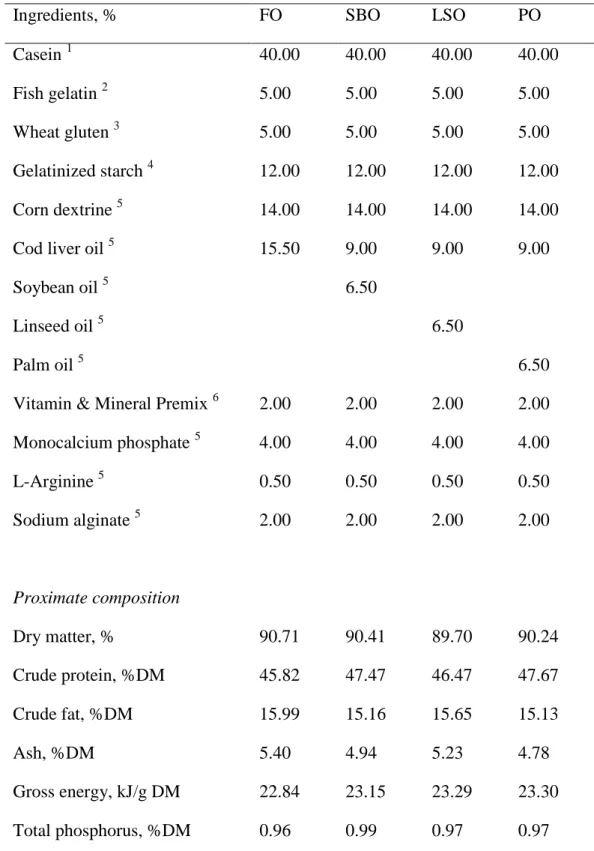
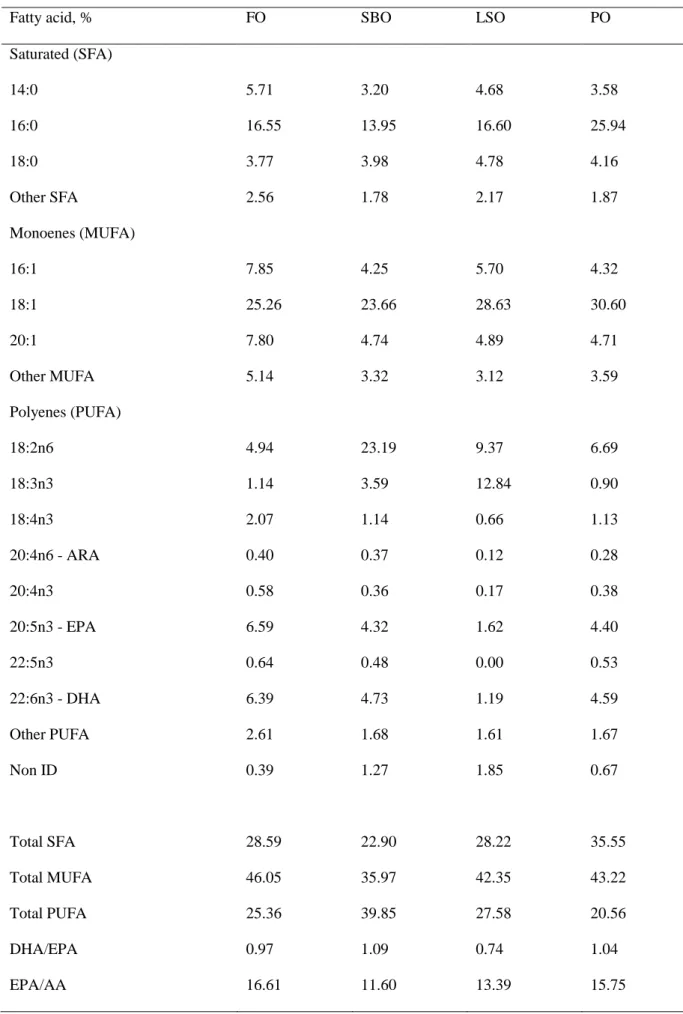
Four isoproteic (crude protein, 46% DM) and isolipidic (15% DM) experimental diets were formulated to fulfill the known nutritional requirements of juvenile seabream. Diets were formulated with purified ingredients to allow a detailed control over its composition and isolate the target dietary changes. The dietary lipid sources under testing were: a) cod liver oil (FO, a source of n-3 LC-PUFA); b) soybean oil (SBO, a source of n-6 fatty acids); c) linseed oil (LSO, a source of n-3 fatty acids, but non LC-PUFA); and d) palm oil (PO, a source of saturated fatty acids). The vegetable oils were incorporated at the expenses of fish oil, at a 40% replacement level (Table 1).
Main ingredients were grinded (below 250 micron) in a micropulverizer hammer mill (Hosokawa Micron, SH1, The Netherlands). Powder ingredients and oil sources were then mixed accordingly to the target formulation in a paddle mixer (Mainca RM90, Spain). All diets were manufactured by temperature controlled-extrusion (pellet size: 2.0 mm) by means of a low shear extruder (Italplast P55, Italy). Upon extrusion, all feed batches were dried in a convection oven (OP 750-UF, LTE Scientifics, United Kingdom) for 3 hours at 40°C. Throughout the duration of the trial, experimental feeds were stored refrigerated. Samples of each diet were taken for proximate composition and fatty acid analysis (Tables 1 and 2).
12
Table 1. Ingredients and proximate composition of experimental diets.Ingredients, % FO SBO LSO PO
Casein 1 40.00 40.00 40.00 40.00
Fish gelatin 2 5.00 5.00 5.00 5.00
Wheat gluten 3 5.00 5.00 5.00 5.00
Gelatinized starch 4 12.00 12.00 12.00 12.00
Corn dextrine 5 14.00 14.00 14.00 14.00
Cod liver oil 5 15.50 9.00 9.00 9.00
Soybean oil 5 6.50
Linseed oil 5 6.50
Palm oil 5 6.50
Vitamin & Mineral Premix 6 2.00 2.00 2.00 2.00
Monocalcium phosphate 5 4.00 4.00 4.00 4.00 L-Arginine 5 0.50 0.50 0.50 0.50 Sodium alginate 5 2.00 2.00 2.00 2.00 Proximate composition Dry matter, % 90.71 90.41 89.70 90.24 Crude protein, %DM 45.82 47.47 46.47 47.67 Crude fat, %DM 15.99 15.16 15.65 15.13 Ash, %DM 5.40 4.94 5.23 4.78 Gross energy, kJ/g DM 22.84 23.15 23.29 23.30 Total phosphorus, %DM 0.96 0.99 0.97 0.97 1
Acid casein: 90% CP (PLIMON, Spain).
2
Fish gelatin: 88 CP% CP (LAPI Gelatine SPA, Italy).
3
VITEN: 85.7% CP, 1.3% CF (ROQUETTE, France).
4
Paygel 290 wheat starch (ADM, The Netherlands).
5
Sigma Aldrich Quimica S.A (Portugal).
6
13
Table 2. Fatty acid composition of the experimental diets (% of total FAME).Fatty acid, % FO SBO LSO PO
Saturated (SFA) 14:0 5.71 3.20 4.68 3.58 16:0 16.55 13.95 16.60 25.94 18:0 3.77 3.98 4.78 4.16 Other SFA 2.56 1.78 2.17 1.87 Monoenes (MUFA) 16:1 7.85 4.25 5.70 4.32 18:1 25.26 23.66 28.63 30.60 20:1 7.80 4.74 4.89 4.71 Other MUFA 5.14 3.32 3.12 3.59 Polyenes (PUFA) 18:2n6 4.94 23.19 9.37 6.69 18:3n3 1.14 3.59 12.84 0.90 18:4n3 2.07 1.14 0.66 1.13 20:4n6 - ARA 0.40 0.37 0.12 0.28 20:4n3 0.58 0.36 0.17 0.38 20:5n3 - EPA 6.59 4.32 1.62 4.40 22:5n3 0.64 0.48 0.00 0.53 22:6n3 - DHA 6.39 4.73 1.19 4.59 Other PUFA 2.61 1.68 1.61 1.67 Non ID 0.39 1.27 1.85 0.67 Total SFA 28.59 22.90 28.22 35.55 Total MUFA 46.05 35.97 42.35 43.22 Total PUFA 25.36 39.85 27.58 20.56 DHA/EPA 0.97 1.09 0.74 1.04 EPA/AA 16.61 11.60 13.39 15.75
14
2.2. Fish and rearing conditionsHomogenous groups of 25 seabream juveniles each, with a mean initial body weight of 39.3 g were stocked in 12 circular plastic tanks (volume: 90 L; water-flow rate: 3.5 L·min-1), supplied with flow-through seawater (temperature: 24±2°C; salinity: 33-34 g·L-1, dissolved oxygen above 6 mg·L-1). A 12/12 fluorescent light/dark cycle was adopted. Each dietary treatment was tested in triplicate tanks over 46 days. Fish were fed to apparent satiety, by hand, four times a day (twice a day during weekends) and feed intake was recorded on a weekly basis. Utmost care was taken to avoid feed losses. All fish were individually weighed at the beginning, bulk weighed every three weeks and at the end of the trial, following one day of feed deprivation. At the beginning and immediately before the end of the trial, fish from each tank were immersed for 5 min in a 0.1% tetracycline bath to label the mineral deposition in fish bone and to allow the subsequent assessment of the mineralization patterns associated to experimental feeding period. Six fish from the initial stock and from each tank at the end of the trial were sampled for subsequent analysis of whole-body composition. Vertebral column (freed of soft tissue) were collected in both initial and final fish (2 pools of three fish per replicate tank) and frozen at -80°C until subsequent analysis of bone of fatty acid profile, calcium and phosphorus content and assay activities of bone metabolic enzymes. Vertebrae from tetracycline marked fish were fixed in 4% phosphate buffered formalin until further histological processing.
2.3. Analytical methods
Diets were grinded prior to analysis of proximate composition. Frozen whole-body samples were minced, mixed, a representative sample freeze-dried and homogenized with a laboratory mill prior to analysis. The chemical composition analysis of the diets and whole fish was made using the following procedures: dry matter after drying at 105ºC for 24 h; ash by combustion at 550ºC for 12 h; crude protein (N×6.25) by a flash combustion technique followed by a gas chromatographic separation and thermal conductivity detection (LECO FP428); fat by dichloromethane extraction (Soxhlet); gross energy in an adiabatic bomb calorimeter (IKA).
Analysis of total phosphorus in whole-body and vertebral bone ashed samples was done according to the ISO/DIS 6491 method using the vanado-molybdate reagent and calcium in ashed vertebral bone by spectrophotometry with the QuantiChrom Calcium Assay Kit (DICA-500).
15
Prior to assays of enzyme activities, vertebral bone samples were pulverized under liquid nitrogen, homogenised in a 0.1% Triton X-100 solution and then centrifuged at 16 000 x g for 2 minutes. Supernatants were used for assay of bone alkaline phosphatase (ALP) with p-nitrophenylphosphate as substrate according to Bessey et al. (1946) and bone tartrate resistant acid phosphatase (TRAP) using p-nitrophenol phosphate as substrate (Goto and Tsukamoto 2003). For the extraction of phospholipase A2 fractions in bone homogenates, samples were
incubated for 2 hours at 37ºC with a 0.1M Tris-HCL buffer, pH 7.8, containing 1mM EDTA, centrifuged at 10 000 x g for 15 minutes at 4ºC and supernatants used for enzymatic assays with commercial kits. Total (Total PLA2) and cytosolic phospholipase A2 (cPLA2) using
arachidonoyl thiol-PC as substrate (Kit 765021, Cayman Chemical) and secreted phospholipase A2 (sPLA2) using diheptanoyl thiol-PC as substrate (Kit 765001, Cayman
Chemical). Protein was determined by means of the Bradford method (Bradford, 1976) using bovine serum albumin as standard.
Fatty acid composition of the diets and vertebral bone was determined through the analysis of methyl esters, according to the procedure described by Lepage and Roy (1986) and modified by Cohen et al. (1988). Acid catalyzed transmethylation of fatty acids was done through methylation of 300 mg of sample in 5 ml of acetyl chloride:methanol (1:19, v/v). Following vigorous vortexing, samples were placed in a water bath at 80 °C for 1 h. After cooling, 1 ml of water and 2 ml of n-heptane were added to the samples, which were then vortexed and left to rest, to allow separation of the liquid and organic phases. The organic phase was collected and filtered through a column prepared with cotton and sodium sulphate anhydrous, to remove any moisture, and placed in a vial for subsequent analysis by gas–liquid chromatography. The separation of the different methyl esters was performed using a Varian Star CP 3800 GC (Walnut Creek, CA), equipped with auto sampler and flame ionization detector. Samples were vaporized in the injector at 250 °C using helium as carrier gas (100:1 split ratio) in a polyethylene glycol capillary column DB-WAX (Folsom, CA, USA) (30 m x 0.25 mm id, film thickness: 0.25 µm) kept at 180 °C for 2 min, heating at 4 °C min-1 for around 10 min and holding at 220 °C for 25 min. The separated compounds were detected at 250 °C. Identification of fatty acid methyl esters was achieved by comparison of their retention times with those of mixed chromatographic standards (Sigma Aldrich). Peak areas were determined using the Varian software. Results were expressed as relative percentage of total fatty acids.
16
The first 5 caudal vertebrae from tetracycline marked fish were dissected, fixed in 4% formalin and then histologically processed by glycol-methacrylate embedding followed by sectioning at 7 m. The extent of mineral deposition was determined by measuring the distance between the two bands deposited tetracycline labeling under a fluorescence-microscope (Olympus IX-81). Points of active bone resorption were identified by observing interruptions in the marked tetracycline bands.
2.4. Statistical analysis
Data are presented as mean of three replicates standard deviation. Data were subjected to a one-way analysis of variance, and when appropriate, means were compared by the Student-Newman-Keuls test. Parameters expressed as percentages were subjected to arcsin square root transformation. A correlation matrix between parameters of bone fatty acid composition or enzyme activities and individual fatty acid intakes (calculated per unit body weight) was also computed. Statistical significance was tested at 0.05 probability level. All statistical tests were performed using the SPSS V18 software.
17
3. Results
As expected, analysis of the fatty acid composition of the experimental diets reflected that of dietary oil sources, confirming that FO diet had the highest level of n-3 LC-PUFA, SBO diet the highest level of n-6 fatty acids, in particular linoleic acid (LA, 18:2n-6), LSO diet a high level of n-3 non LC-PUFA (mainly α-linolenic acid, 18:3n-3) and PO diet the highest level of saturated fatty acids (Table 2).
Overall growth performance criteria were not significantly affected by the various dietary treatments (P>0.05). Over a period of 46 days, fish more than doubled their initial body weight, reaching a final body weight ranging from 85 to 90 g (Table 3). Specific growth rate varied between 1.68 and 1.80. Feed efficiency ranged from 0.72 to 0.79. Whole-body composition of fish was not affected by dietary treatments (data not shown). Given this relative constancy of weight gain, feed intake and whole-body composition of fish, values for protein and fat retention were also unaffected (P<0.05) by dietary changes (data not shown).
Table 3. Growth performance and proximate composition of vertebral bone of seabream (IBW: 39.3 1.4 g) fed the experimental diets.
FO SBO LSO PO FBW, g 85.08 ± 1.10 88.55 ± 3.43 86.03 ± 4.89 90.16 ± 5.50 Wt. Gain, %IBW/day 2.33 ± 0.05 2.50 ± 0.16 2.39 ± 0.24 2.58 ± 0.29 SGR, %/day 1.68 ± 0.03 1.76 ± 0.09 1.70 ± 0.12 1.80 ± 0.14 FE 0.72 ± 0.00 0.76 ± 0.03 0.76 ± 0.06 0.79 ± 0.10 VFI, %IBW/day 3.26 ± 0.07 3.26 ± 0.07 3.15 ± 0.07 3.27 ± 0.06 PER 1.72 ± 0.00 1.82 ± 0.08 1.82 ± 0.14 1.89 ± 0.24 Bone composition Dry matter, % 55.55 ± 0.35 56.13 ± 0.64 55.22 ± 0.76 54.29 ± 0.89 Protein, % DM 46.27 ± 1.07 46.55 ± 1.89 44.65 ± 1.14 43.61 ± 2.26 Lipids, % DM 26.72 ± 1.67 25.82 ± 2.35 26.73 ± 2.44 28.89 ± 1.24 Ash, % DM 26.59 ± 0.58 26.92 ± 0.61 26.44 ± 0.54 26.30 ± 0.31 Bone minerals Phosphorus (g/mg ash) 2.97 ± 0.36 b 2.08 ± 0.27 a 1.94 ± 0.26 a 2.22 ± 0.35 a Calcium (g/mg ash) 108.95 ± 2.40 103.16 ± 1.24 107.20 ± 3.07 104.09 ± 2.01
Data is presented as mean and standard deviation (n=3).
Values in a row with different superscripts are significantly different (P<0.05). IBW (g): Initial mean body weight.
FBW (g): Final mean body weight.
Specific growth rate, SGR (%/day): (Ln FBW – Ln IBW) x 100/days. Feed efficiency, FE: weight gain / crude feed intake.
Voluntary feed intake, VFI (%BW/day): (crude feed intake/IBW/days) x 100. Protein efficiency ratio, PER: wet weight gain/crude protein intake.
18
The proximate composition of vertebral bone was not affected (P>0.5) by dietary treatments (Table 3). Similarly, the calcium content on vertebral bone was little affected (P>0.05) by the various dietary oil sources. However, bone phosphorus content in fish fed the fish oil rich diet (FO) was significantly higher (P<0.05) than those found in seabream fed the diets with the inclusion of vegetable oils (Table 3). Microscopic observation of tetracycline-marked vertebrae from fish fed the various experimental diets allowed us to identify active points of bone remodeling. In comparison to fish fed diets FO and SBO, mineral deposition in vertebrae of fish fed the LSO diet was significantly reduced (P<0.05) (Figure 1).
Figure 1. Mineral deposition in tetracycline-marked vertebrae at the end of the feeding period of 46 days with the various dietary treatments.
Data is presented as mean and standard deviation (n=20).
Bars with different superscript letters are significantly different (P<0.05).
a a b ab 0.0 3.0 6.0 9.0 12.0 FO SBO LSO PO Dietary treatment M in er al d ep os it io n ( µ m )
19
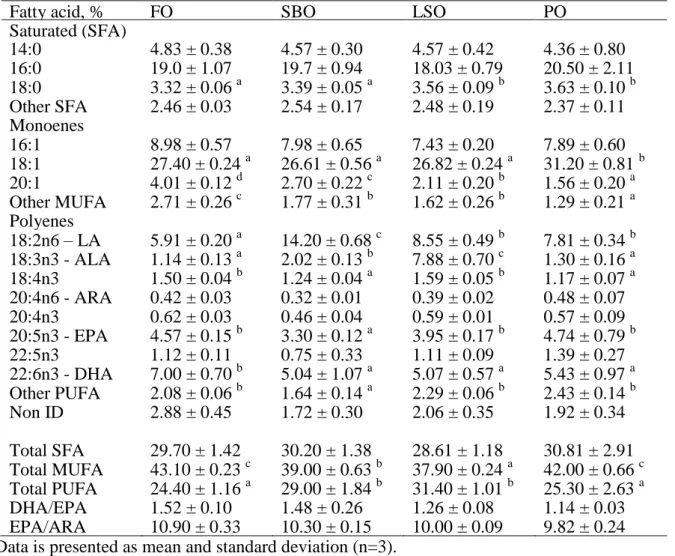
Table 4. Fatty acid composition of lipids extracted from seabream vertebral bone (% of total FAME).Fatty acid, % FO SBO LSO PO
Saturated (SFA) 14:0 4.83 ± 0.38 4.57 ± 0.30 4.57 ± 0.42 4.36 ± 0.80 16:0 19.0 ± 1.07 19.7 ± 0.94 18.03 ± 0.79 20.50 ± 2.11 18:0 3.32 ± 0.06 a 3.39 ± 0.05 a 3.56 ± 0.09 b 3.63 ± 0.10 b Other SFA 2.46 ± 0.03 2.54 ± 0.17 2.48 ± 0.19 2.37 ± 0.11 Monoenes (MUFA) 16:1 8.98 ± 0.57 7.98 ± 0.65 7.43 ± 0.20 7.89 ± 0.60 18:1 27.40 ± 0.24 a 26.61 ± 0.56 a 26.82 ± 0.24 a 31.20 ± 0.81 b 20:1 4.01 ± 0.12 d 2.70 ± 0.22 c 2.11 ± 0.20 b 1.56 ± 0.20 a Other MUFA 2.71 ± 0.26 c 1.77 ± 0.31 b 1.62 ± 0.26 b 1.29 ± 0.21 a Polyenes (PUFA) 18:2n6 – LA 5.91 ± 0.20 a 14.20 ± 0.68 c 8.55 ± 0.49 b 7.81 ± 0.34 b 18:3n3 - ALA 1.14 ± 0.13 a 2.02 ± 0.13 b 7.88 ± 0.70 c 1.30 ± 0.16 a 18:4n3 1.50 ± 0.04 b 1.24 ± 0.04 a 1.59 ± 0.05 b 1.17 ± 0.07 a 20:4n6 - ARA 0.42 ± 0.03 0.32 ± 0.01 0.39 ± 0.02 0.48 ± 0.07 20:4n3 0.62 ± 0.03 0.46 ± 0.04 0.59 ± 0.01 0.57 ± 0.09 20:5n3 - EPA 4.57 ± 0.15 b 3.30 ± 0.12 a 3.95 ± 0.17 b 4.74 ± 0.79 b 22:5n3 1.12 ± 0.11 0.75 ± 0.33 1.11 ± 0.09 1.39 ± 0.27 22:6n3 - DHA 7.00 ± 0.70 b 5.04 ± 1.07 a 5.07 ± 0.57 a 5.43 ± 0.97 a Other PUFA 2.08 ± 0.06 b 1.64 ± 0.14 a 2.29 ± 0.06 b 2.43 ± 0.14 b Non ID 2.88 ± 0.45 0.4 1.72 ± 0.30 2.06 ± 0.35 1.92 ± 0.34 0.3 Total SFA 29.70 ± 1.42 30.20 ± 1.38 28.61 ± 1.18 30.81 ± 2.91 Total MUFA 43.10 ± 0.23 c 39.00 ± 0.63 b 37.90 ± 0.24 a 42.00 ± 0.66 c Total PUFA 24.40 ± 1.16 a 29.00 ± 1.84 b 31.40 ± 1.01 b 25.30 ± 2.63 a DHA/EPA 1.52 ± 0.10 1.48 ± 0.26 1.26 ± 0.08 1.14 ± 0.03 EPA/ARA 10.90 ± 0.33 10.30 ± 0.15 10.00 ± 0.09 9.82 ± 0.24
Data is presented as mean and standard deviation (n=3).
Values in a row with different superscripts are significantly different (P<0.05).
Data on the individual fatty acid profile of bone (Table 4) shows that its composition is altered by the dietary fatty acid profile. Total saturated fatty acids were not affected by dietary treatments, but vertebral bone of fish fed the FO and SBO diets showed significantly lower (P<0.05) levels of stearic acid (C18:0) than fish fed the LSO and PO diets. Total monounsaturated fatty acids were affected (P<0.05) by the dietary lipid sources, being higher in fish fed FO and PO, intermediate in those fed SBO and lowest in LSO fed fish. These changes were mainly due to relevant changes on oleic acid (C18:1n-9) and gondoic acid (C20:1n-9) and in close association to dietary profiles. Total levels of polyunsaturated fatty acids (PUFA) in vertebral bone were significantly higher (P<0.05) in seabream fed SBO and LSO than in fish fed FO and PO diets. This increase was mainly associated to a significantly increase (P<0.05) of LA and ALA in fish fed diets SBO and LSO, respectively. Bone ARA levels were not affected (P>0.05) by dietary treatments. EPA was significantly reduced
20
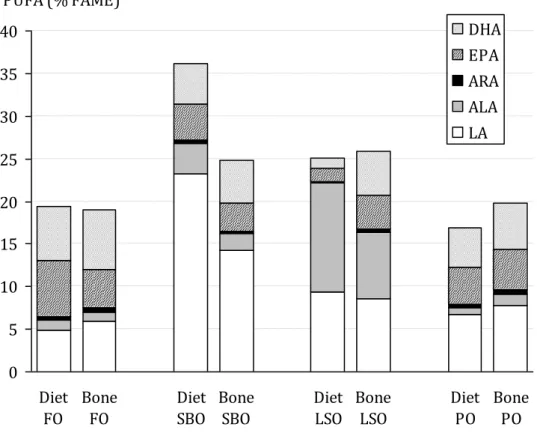
(P<0.05) in bone of fish fed the SBO, while DHA was significantly higher (P<0.05) in fish fed the FO diet. The association between dietary and vertebral bone PUFA levels are presented in Figure 2.
Figure 2. Association between experimental diets and vertebral bone polyunsaturated fatty acid (PUFA) profile.
LA: linoleic acid (C18:2n-6); ALA: α-linolenic acid (C18:3n-3); ARA: arachidonic acid (C20:4n-6); EPA: eicosapentaenoic acid (C20:5n-3); DHA: docosahexaenoic acid (C22:6n-3).
Activities of alkaline phosphatase (ALP) and tartrate-acid resistant phoshatase (TRAP) in bone homogenates are presented in Figure 3. In comparison to fish fed the FO diet, those fed the LSO diet showed a significant reduction (P<0.05) of ALP activity. Moreover, the activity of ALP in bone homogenates was positively correlated with intake of EPA (r=0.763) and DHA (r=0.793). Highest value of TRAP activity was found in fish fed the SBO diet, being significantly different (P<0.05) from those found in fish fed the LSO diet. TRAP activity was positively correlated (r = 0.658) with LA intake, but an increased intake of EPA (r = -0.478) and DHA (r = -0.536) tended to reduce TRAP activity.
PUFA (% FAME) 0 5 10 15 20 25 30 35 40 Diet FO Bone FO Diet SBO Bone SBO Diet LSO Bone LSO Diet PO Bone PO DHA EPA ARA ALA LA
21
Figure 3. Activity of ALP and TRAP in seabream vertebral bone homogenates.Data is presented as mean and standard deviation (n=6).
Bars with different superscript letters are significantly different (P<0.05).
Activities of total phospholipase A2 in fish bone homogenates were significantly affected
(P<0.05) by dietary lipid sources, being higher in fish fed FO and LSO than in those fed SBO and PO diets. However, such chances can not be clearly associated to the altered levels of the intracellular Ca2+-dependent cytosolic family (cPLA2), which were little affected by dietary
treatments. The activity of the secretory PLA2 fraction in seabream bone homogenates was below the detection limit of the analytical kit.
b ab a ab 0.00 0.50 1.00 1.50 2.00 FO SBO LSO PO Dietary Treatment AL P (m U /m g pr ot ei n) ab a b ab 0.000 0.100 0.200 0.300 0.400 0.500 FO SBO LSO PO Dietary Treatment T R AP ( m U /m g pr ot ei n)
22
Figure 4. Activity of total PLA2 and cPLA2 in seabream vertebral bone.Data is presented as mean and standard deviation (n=3).
Bars with different superscript letters are significantly different (P<0.05).
4. Discussion
The aquaculture industry has, in recent times, experienced dramatic growth and currently provides approximately 50% of the global fish and seafood supply (FAO, 2010). However, such growth poses great challenges in accommodating the sustainable use of natural resources. About 35% of the global aquaculture production relies on the use of industrial compound feeds containing marine harvested resources in the form of fish meal and fish oil (Tacon and Metian, 2008). Therefore the replacement of fish oil with renewable land-based products such as vegetable oils has been extensively researched and the results incorporated into currently used commercial aquafeeds. Overall available knowledge supports that the partial replacement of fish oil by vegetable oils in diets for marine species, such as gilthead seabream, is possible without affecting good feed utilization and growth performance (Izquierdo et al., 2005; Benedito-Palos et al., 2008). However, care as to be taken, to guarantee that the supply of such alternative dietary lipids is balanced for optimal growth, but also preserve the nutritional quality of fish (Fountoulaki et al., 2009; Benedito-Palos et al., 2009; 2010), and do not compromise the immune functions and broader welfare status of fish
a b a b 0.00 0.10 0.20 0.30 FO SBO LSO PO Dietary treatment T ot al P LA 2 ( n m ol /m g p ro te in ) 0.00 0.10 0.20 0.30 FO SBO LSO PO Dietary treatment cP LA 2 ( n m ol /m g p ro te in )
23
(Montero et al., 2010; Montero and Izquierdo, 2010). The growth performance data of our trial, confirms that provided that the requirements for the essential fatty acids (EPA, DHA and ARA) are covered, the replacement of 40% of fish oil by soybean oil, palm oil or linseed oil does not impair growth or feed utilization in juvenile seabream. Similar results have been reported by Izquierdo et al. (2005) and Fountoulaki et al. (2009). Another relevant aspect of our work is the fact that by covering the essential fatty acid requirements of gilthead seabream juveniles (Kalogeropoulos et al., 1992; Ibeas et al., 1994; NRC, 2011) the use of purified diets sustained a good growth performance of fish, which more than doubled their weight in 46 days and in agreement with performance data from Couto et al. (2008) for a similar weight class and rearing temperature.
Most studies involving FO replacement by VO sources show clear changes in the pattern and ratios of fatty acids circulating in plasma and deposited in various tissues of fish (Menoyo et al., 2004; Caballero et al., 2006). Dietary lipids were shown to alter the fatty acid composition of bone compartments in rodents (Watkins et al., 2000; Weiler et al., 2002; Lau et al., 2010). Data on the composition of bone and its modulation by dietary factors is limited in fish. The lipid content of fish bone is highly variable, ranging from 23 g·kg-1 in cod to 509 g·kg-1 in mackerel, and seems to be associated to the general classification of fatty and lean fish (Toppe et al., 2007). Our data suggests that the vertebral bone of gilthead seabream is positioned in the mid-range, with a total lipid content of 260 g·kg-1, a value lower than that reported in a more fatty fish such as Atlantic salmon by Berge et al. (2009). But more important in the scope of the study, the various dietary lipid profiles had no marked effect on the total fat content or overall proximate composition of seabream bone. Similarly, Atlantic salmon fed fish oil or soybean oil diets showed no changes on the total fat content of bone (Berge et al., 2009). While the calcium content in the vertebral bone of seabream was little affected by the various dietary lipid sources, we found that bone phosphorus levels in seabream fed the fish oil rich diet was significantly higher than in fish fed the diets with the inclusion of vegetable oils. Berge et al. (2009) reported that the content of phosphorus in Atlantic salmon vertebrae tended to be higher (P=0.06), in fish fed a fish oil based diet in relation to those fed a soybean oil diet. In humans and other terrestrial vertebrates high intake of saturated fats is generally related to detrimental effects on skeletal mineralization (Corwin et al., 2006). Additionally, palm oil and palm olein (its low melting fraction) generally used on infant milk formulas have been associated to lower calcium absorption and bone mineralization, due to the formation of unabsorbable calcium-fatty acid-soap complexes (Koo et al., 2006).
24
Our data regarding the calcium content in vertebral bone does not support an impairment of calcium absorption by high levels of palmitic acid in fish fed the palm oil rich diet (PO). But it is also known, that significant changes on tissue calcium levels are particularly difficult to demonstrate in fish, given their ability to absorb waterborne calcium (NRC, 2011).
As expected, our data in seabream juveniles supports the general findings that the fatty acid profile of vertebral bone reflects that of dietary intake (Gil-Martens et al., 2010; Berge et al., 2009). For instance, the experimental feed incorporating soybean oil contained a high level of linoleic acid (18:2n-6) and consequently, this fatty acid was markedly increased in bone lipids of seabream fed the SBO diet. Similar associations can be found for α-linolenic acid (18:3n-3) in fish fed the linseed oil diet (LSO) and DHA in fish oil rich diet (FO). However, it should be noted that the fatty acid composition of seabream vertebrae did not exactly mirrored that of the diets. It is the case of ARA and EPA, which were provided at significantly lower levels in the LSO diet, but were found in the vertebrae at similar levels to those found with the other vegetable oil based diets. It seems clear that dietary fatty acids are not simply deposited in fish bone, but as in other tissues, undergo different metabolic processes, involving the utilization for energy production (beta-oxidation), bio-conversion (chain elongation and desaturation) and lipogenesis (Tocher, 2003). Thus, similarly to what is found in fish fillets (Benedito-Palos et al., 2008; Turchini et al., 2011), there seems to exist a biological ‘‘buffering” on the overall fatty acid composition of fish bone. In future studies, it would be interesting to characterize the dietary modulation of bone fatty acid profile in respect to the neutral and phospholipid classes, since it is known that the extent of such conservative mechanism is variable among this lipid classes.
In terrestrial vertebrates, several studies showed that dietary lipids, by altering the fatty acid composition of bone compartments, impact the local production of factors influencing bone modelling in animals (Watkins et al., 2001). The mechanism for such effects has been largely attributed to reduced prostaglandin E2 (PGE2) synthesis in bone (Poulsen et al. 2007; Kruger
et al., 2010). PGE2 is a primary product of arachidonic acid metabolism and is synthesized via
the cyclooxygenase (COX) and prostaglandin synthase pathways. Although not clearly established for fish, PGE2 is a potent regulator of bone metabolism in mammals, since at low
concentrations they can increase in vitro both bone resorption and bone formation, but at high concentrations may have the opposite effect leading to inhibition of collagen synthesis and bone formation (Poulsen et al., 2007). Only few studies have attempted to relate the dietary modulation of PGE2 levels and bone remodeling in fish. Atlantic salmon fed a soybean oil
25
based diet and subjected to lyposaccharide injection had a significantly elevation of plasma PGE2 levels compared to those fed a fish oil based diet (Gil-Martens et al., 2010).
Additionally, by means of an in vitro approach, Ytteborg et al. (2010) reported that the addition of DHA to the osteoblast media resulted in a reduction of PGE2 production and
increased expression of osteocalcin in Atlantic salmon cells. However, Petropoulos et al. (2009) found no dietary effects and high individual variation in plasma ARA-derived PGE2
levels after the substitution of dietary fish oil with a blend of vegetable oils in three strains of Atlantic salmon. Phospholipase A2 (PLA2) constitutes a superfamily of enzymes that catalyze
the hydrolysis of the phospholipid sn-2 ester bond, generating a free fatty acid and a lysophospholipid. The PLA2 reaction is the primary pathway through which ARA is liberated
from phospholipids. By measuring the activities of total PLA2 and intracellular Ca2+
-dependent cytosolic fraction (cPLA2) in seabream bone homogenates, we intended to get an
approximate indication of the utilization of ARA in bone. Despite the relatively constant ARA levels found in bone, we observed lower activities of total PLA2 in fish fed the soybean oil
and palm oil rich diets. However, a clear explanation of the mechanisms behind this modulation is relatively difficult, since the levels of free arachidonic acid available for eicosanoid production are controlled by the rate of deacylation by PLA2 and by competing
processes such as reacylation into phospholipid and efflux from cells (Balsinde et al., 2002). Furthermore, a series of negative feedback regulation loops (e.g. via cAMP, cellular calcium levels, lipid oxidation metabolites) have been associated to the modulation of PLA2 activity
(Balsinde et al., 2002; Leslie, 2004; Burke and Dennis, 2009). In this same context, despite the absence of statistical significance, Berge et al (2009) reported that Atlantic salmon fed a fish oil diet presented consistently higher levels of COX-2 mRNA expression than those fed the soybean oil diet. This occurrence was possibly explained by a PGE2-mediated negative
feedback mechanism in relation to the dietary EPA:ARA ratios.
Alkaline phosphatase (ALP) is a by-product of osteoblast activity essential for calcification and elevated levels indicate an active bone formation status (Goto and Tsakumoto, 2003). The results of the current experiment show that in comparison to fish fed the fish oil diet (FO), those fed the linseed oil diet (LSO) showed a significant reduction of ALP activity. Moreover, the activity of ALP in seabream bone was found to be positively correlated with both EPA and DHA intake. This trend is also in agreement with our bone mineralization data, in which the microscopic observation of tetracycline-marked vertebrae showed us that in comparison to fish fed diets FO and SBO, the mineral deposition in vertebrae of fish fed the linseed oil diet
26
was significantly reduced. Taken together, these results suggest that attention should be taken when assessing the role of n-3 PUFA in bone metabolism, since effects seem to be dependent with the carbon chain length. On the other hand, we found that the activity of tartrate acid-resistant phosphate (TRAP), which is secreted by osteoclasts during bone resorption, was positively correlated with LA intake and negatively correlated to EPA and DHA intake. Again, this observation suggests that diets with lower levels of highly unsaturated fatty acids of the n-3 series (EPA and DHA) tend to promote bone a resorption status in fish.
The results of the current experiment suggest that vegetable oil as a replacement for fish oil influence the bone metabolic status of seabream juveniles and cause a tendency towards reduced vertebrae mineralization. However given the short duration of the trial, future efforts should encompass long-term feeding periods, a detailed assessment of any detrimental effects in terms of skeletal deformities and a broader range of deposited minerals. Additionally, these results should be viewed in more global perspective of practical feed formulation, in which both fish meal and fish oil are being simultaneously replaced by vegetable-based ingredients. Such formulation practices comprise not only changes on the dietary fatty acid supply, but also inherent changes on selected minerals, vitamins, phytosterols, phytoestrogens and cholesterol levels, all substances with a clear association to bone remodeling processes.
27
5. ReferencesArjmandi, B.H., Juma, S., Beharka, A., Bapna, M.S., Akhter, M., Meydani, S.N., 2002. Vitamin E improves bone quality in the aged but not in young adult male mice. J. Nutr. Biochem 13, 543–549.
Balsinde, J., Winstead, M.V., Dennis, E.A., 2002. Phospholipase A2 regulation of arachidonic
acid mobilization. FEBS Lett. 531, 2-6.
Bell, J.G., Ashton, I., Secombes, C.J., Weitzel, B.R., Dick, J.R. Sargent, J.R., 1996. Dietary lipid affects phospholipid fatty acid compositions, eicosanoid production and immune function in Atlantic salmon (Salmo salar). Prostaglandins Leukot. Essen. Fatty Acids 54, 173-182.
Benedito-Palos, L., Navarro, J. C., Kaushik, S., Pérez-Sánchez, J., 2010. Tissue-specific robustness of fatty acid signatures in cultured gilthead sea bream (Sparus aurata L.) fed practical diets with a combined high replacement of fish meal and fish oil. J. Anim. Sci. 88, 1759-1770.
Benedito-Palos, L., Navarro, J.C., Bermejo-Nogales, A., Saera-Vila, A., Kaushik, S., Pérez-Sánchez, J., 2009. The time course of fish oil wash-out follows a simple dilution model in gilthead sea bream (Sparus aurata L.) fed graded levels of vegetable oils. Aquaculture, 288, 98-105.
Benedito-Palos, L., Navarro, J.C., Sitjá-Bobadilla, A., Bell, J.G., Kaushik, S., Pérez-Sáchez, J., 2008. High levels of vegetable oils in plan protein-rich diets fed to gilthead sea bream (Sparus aurata L.): growth performance, muscle fatty acid profiles and histological alterations of target tissues. Br. J. Nutr. 100, 992-1003.
Berge, G.M., Witten, P.E., Baeverfjord, G., Vegusdal, A., Wadsworth, S., Ruyter, B., 2009. Diets with different n-6/n-3 fatty acid ratio in diets for juvenile Atlantic salmon, effects on growth, body composition, bone development and eicosanoid production. Aquaculture 296, 299-308.
Bessey, O.A., Lowry, O.H. & Brock, M.J., 1946. A method for the rapid determination of alkaline phosphatase with five cubic millimetres of serum. J. Biol. Chem. 164, 321–329.
28
Bouraqui, L., Sánchez-Gurmaches, J., Cruz-Garcia, L., Gutiérrez, J., Benedito-Palos, L., Pérez-Sánchez, J., Navarro, I., 2011. Effect of dietary fish meal and fish oil replacement on lipogenic and lipoprotein lipase activities and plasma insulin in gilthead sea bream (Sparus
aurata). Aqua. Nutr. 17, 54–63.
Bradford, M.M., 1976. A rapid sensitive method for the quantitation of microgram quantities of protein utilising the principle of protein-dye binding. Anal. Biochem. 72, 248–254.
Burke, J.E., Dennis, E.A., 2009. Phospholipase A2 structure/function, mechanism, and
signaling. J. Lipid Res. 50, S237-S242.
Caballero, M.J., Izquierdo, M.S., Kjorsvik, E., Fernandez, A.J., Rosenlund, G., 2004. Histological alterations in the liver of seabream Sparus aurata, caused by short- or long-term feeding with vegetable oils: recovery of normal morphology after feeding fish oil as the sole lipid source. J. Fish Dis. 27, 531–541.
Caballero, M.J., Torstensen, B.E., Robaina, L., Montero, D., Izquierdo, M., 2006. Vegetable oils affect the composition of lipoproteins in sea bream (Sparus aurata). Br. J. Nutr. 96, 830-839.
Cahu, C., Zambonino Infante, J., Takeuchi, T., 2003. Nutritional components affecting skeletal development in fish larvae. Aquaculture 227, 245-258.
Calder, P.C., 2009. Polyunsaturated fatty acids and inflammatory processes: New twists in an old tale. Biochimie 91, 791–795.
Clegg, M.S., Donovan, S.M., Monaco, M.H., Baly, D.L., Ensunsa, J.L., and Keen, C.L. 1998. The influence of manganese deficiency on serum IGF-1 and IGF binding proteins in the male rat. Proc. Soc. Exp. Biol.Med., 219:41–47.
Cohen, Z., Von Shak, A., Richmond, A., 1988. Effect of environmental conditions on fatty acid composition of the red algae Porphyridium cruentum: correlation to growth rate. J. Phycol., 24, 328-332.
Corwin, R.L., Hartman, T.J., Maczuga, S.A., Graubard, B.I., 2006. Dietary saturated fat intake is inversely associated with bone density in humans: analysis of NHANES. J. Nutr. 136, 159-165.
29
Couto, A., Enes, P., Peres, H., Oliva-Teles, A., 2008. Effect of water temperature and dietary starch on growth and metabolic utilization of diets in gilthead sea bream (Sparus aurata) juveniles. Comp. Biochem. Physiol. 151A, 45-50.
Cruz-Garcia, L., Sánchez-Gurmaches, J., Bouraoui, L., Saera-Vila, A., Pérez-Sánchez, J., Gutiérrez, J., Navarro, I., 2011. Changes in adipocyte cell size, gene expression of lipid metabolism markers, and lipolytic responses induced by dietary fish oil replacement in gilthead sea bream (Sparus aurata L.). Comp. Biochem. Physiol. 158A, 391-399.
Drakeford, B., Pascoe, S., 2008. Substitutability of fishmeal and fish oil in diets for salmon and trout: a meta-analysis. Aqua. Econ. Manag. 12, 155-175.
FAO, 2010. State of World Fisheries and Aquaculture 2010. Rome, Italy, FAO 2010, 197 pp. Fatemi, S., Ryzen, E., Flores, J., Endres, D.B., and Rude, R.K. 1991. Effect of experimental human magnesium depletion on parathyroid hormone secretion and 1,25-dihydroxyvitamin D metabolism. J. Clin. Endocrinol.Metab., 73:1067–1072.
Fjelldal, P.G., Nordgarden, U., Wargelius, A., Taranger, G.L., Waagbø, R., Olsen, R.E., 2010. Effects of vegetable feed ingredients on bone health in Atlantic salmon. J. Appl. Ichthyol. 26, 327–333.
Fountoulaki, E., Vasilaki, A., Hurtado, R., Grigorakis, K., Karacostas, I., Nengas, I., Rigos, G., Kotzamanis, Y., Venou, B., Alexis, M.N., 2009. Fish oil substitution by vegetable oils in commercial diets for gilthead sea bream (Sparus aurata L.); effects on growth performance, flesh quality and fillet fatty acid profile: Recovery of fatty acid profiles by a fish oil finishing diet under fluctuating water temperatures. Aquaculture 289, 317-326.
Ganga, R., Bell, J.G., Montero, D., Robaina, L., Caballero, M.J., Izquierdo, M.S., 2005. Effect of dietary lipids on plasma fatty acid profiles and prostaglandin and leptin production in gilthead seabream (Sparus aurata). Comp. Biochem. Physiol. 142B, 410-418.
Gil-Martens, L., Lock, E.-J., Fjelldal, P.G., Wargelius, A., Araujo, P., Torstensen, B., Witten, E., Hansen, T., Waagbo, R., Ørnsrud, R., 2010. Dietary fatty acids and inflammation in the vertebral column of Atlantic salmon (Salmo salar) smolts: a possible link to spinal deformities. J. Fish Dis. 33, 957-972.
30
Goto A., Tsukamoto, I., 2003. Increase in tartrate-resistant acid phosphatase of bone at the early stage of ascorbic acid deficiency in the ascorbate-requiring osteogenic disorder shionogi (ODS) rat. Calc. Tiss. Inter. 73, 180-185.
Heaney, R.P. 1993. Nutritional factors in osteoporosis. Ann. Rev. Nutr., 13:287–316.
Huysseune, A., 2000. Skeletal system. In: Ostrander, G.K. (Ed.), The Laboratory Fish. Part 4. Microscopic Functional Anatomy. Academic Press, San Diego, pp. 307–317.
Ibeas, C., Izquierdo, M.S., Lorenzo, A., 1994. Effect of different levels of n−3 highly unsaturated fatty acids on growth and fatty acid composition of juvenile gilthead seabream (Sparus aurata). Aquaculture 127, 177-188.
Izquierdo, M.S., Montero, D., Robaina, L., Caballero, M.J., Rosenlund, G., Ginés, R., 2005. Alterations in fillet fatty acid profile and flesh quality in gilthead seabream (Sparus aurata) fed vegetable oils for a long term period. Recovery of fatty acid profiles by fish oil feeding. Aquaculture 250, 431-444.
Kalogeropoulos, N., Alexis, M.N., Henderson, J.J., 1992. Effect of dietary soybean and cod-liver oil levels on growth and body composition of gilthead bream (Sparus aurata). Aquaculture 104, 293– 308.
Kindmark, A., Melhus, H., Ljunghall, S., Ljunggren, O., 1995. Inhibitory effects of 9-cis and all-trans retinoic acid on 1,25 (OH)2 vitamin D3 induced bone resorption. Calcif. Tissue Res. Int. 57, 242–244.
Kjørsvik, E., Olsen, C., Wold, P.A., Hoehne-Reitan, K., Cahu C.L., Rainuzzo, J., Olsen, A.I., Øie, G., Olsen, Y., 2009. Comparison of dietary phospholipids and neutral lipids on skeletal development and fatty acid composition in Atlantic cod (Gadus morhua). Aquaculture 294, 246–255.
Koo, W.W.K., Hockman, E.M., Dow, M., 2006. Palm olein in the fat blend of infant formulas: effect on the intestinal absorption of calcium and fat, and bone mineralization. J. Am. Coll. Nutr. 25, 117-122.
Kruger, M.C., Coetzee, M., Haag, M., Weiler, H., 2010. Long-chain polyunsaturated fatty acids: Selected mechanisms of action on bone, Prog. Lip. Res. 49, 438-449.
31
Lall, S.P., 2002. The minerals, In: Halver, J.E., Hardy, R.W. (Eds.), Fish Nutrition, 3rd edition. Academic Press Inc., San Diego, pp. 259–308.
Lall, S.P., Lewis-McCrea, L.M., 2007. Role of nutrients in skeletal metabolism and pathology in fish - An overview. Aquaculture 267, 3-19.
Lau, B.Y., Fajardo, V.A., McMeekin, L., Sacco, S.M., Ward, W.E., Roy, B.D., Peters, S.J., LeBlanc, P.J., 2010. Influence of high-fat diet from differential dietary sources on bone mineral density, bone strength, and bone fatty acid composition in rats. Appl. Physiol. Nutr. Met. 35, 598-606.
Lepage, G., Roy, C.C., 1986. Direct trans-esterification of all classes of lipids in one-step reaction. J. Lip. Res. 27, 114-119.
Leslie, C.C., 2004. Regulation of arachidonic acid availability for eicosanoid production. Biochem. Cell Biol. 82, 1-17.
Lukas, R., Gigliotti, J.C., Smith, B.J., Altman, S., Tou, J.C., 2011. Consumption of different sources of omega-3 polyunsaturated fatty acids by growing female rats affects long bone mass and microarchitecture. Bone 49, 455-462.
Menoyo, D., Izquierdo, M.S., Robaina, L., Ginés, R., Lopez-Bote, C.J., Bautista, J.M., 2004. Adaptation of lipid metabolism, tissue composition and flesh quality in gilthead sea bream (Sparus aurata) to the replacement of dietary fish oil by linseed and soyabean oils. Br. J. Nutr. 92, 41-52.
Metscher, B.D., Ahlberg, P.E., 1999. Zebrafish in context: uses of a laboratory model in comparative studies. Develop. Biol. 210, 1–4.
Miller, M.R., Nichols, P.D., Carter, C.G., 2008. n-3 Oil sources for use in aquaculture – alternatives to the unsustainable harvest of wild fish. Nutr. Res. Rev. 21, 85–96.
Montero, D., Izquierdo, M., 2010. Welfare and health of fish fed vegetable oils as alternative lipid sources to fish oil. In G.M. Turchini , W.-K. Ng, and D.R. Tocher (Editors), Fish Oil Replacement and Alternative Lipid Sources in Aquaculture Feeds. CRC Press, Boca Raton, pp. 439–485.
32
Montero, D., Mathlouthi, F., Tort, L., Afonso, J. M., Torrecillas, S., Fernández-Vaquero, A., Negrin, D., Izquierdo, M.S., 2010. Replacement of dietary fish oil by vegetable oils affects humoral immunity and expression of pro-inflammatory cytokines genes in gilthead sea bream
Sparus aurata. Fish Shellfish Immunol. 29, 1073-1081.
Moss, M.L., 1961. Studies of the acellular bone of teleost fish. 1. Morphological and systematic variations. Acta Anat. 46, 343–462.
Mourente, G., Good, J. Bell, J., 2005. Partial substitution of fish oil with rapeseed, linseed and olive oils in diets for European sea bass (Dicentrarchus labrax L.): effects on flesh fatty acid composition, plasma prostaglandins E2 and F2α, immune function and effectiveness of a fish oil finishing diet. Aqua. Nutr. 11, 25–40.
National Research Council (NRC), 2011. Nutrient requirements of fish and shrimp. The National Academies Press, Washington, D.C., 376 + XVI pp.
Petropoulos, I., Thompson, K., Morgan, A., Dick, J., Tocher, D., Bell, J.G., 2009. Effects of substitution of dietary fish oil with a blend of vegetable oils on liver and peripheral blood leucocyte fatty acid composition, plasma prostaglandin E2 and immune parameters in three
strains of Atlantic salmon (Salmo salar). Aquaculture Nutrition 15, 596–607.
Poulsen, R.C., Moughan, P.J., Kruger, M.C., 2007. Long-chain polyunsaturated fatty acids and the regulation of bone metabolism. Exp. Bio. Med. 232, 1275-1288.
Roy, P.K. 2002. Phosphorus in haddock (Melanogrammus aeglefinus L.) nutrition and bone metabolism. Ph. D. thesis, Dalhousie University, Halifax, Canada.
Sandel, E., Nixon, O., Lutzky, S., Ginsbourg, B., Tandler, A., Uni, Z., Koven, W., 2010. The effect of dietary phosphatidylcholine /phosphatidylinositol ratio on malformation in larvae and juvenile gilthead sea bream (Sparus aurata). Aquaculture 304, 42-48.
Tacon, A.G.J., Metian, M., 2008. Global overview on the use of fish meal and fish oil in industrially compounded aquafeeds: Trends and future prospects. Aquaculture 285, 146–158. Tocher, D.R., 2003. Metabolism and functions of lipids and fatty acids in teleost fish. Rev. Fish. Sci. 11, 107–184.
Taylor, C.W., 1985. Calcium regulation in vertebrates: an overview. Comp. Biochem. Physiol. 82A, 249–255.
33
Toppe, J., Albrektsen, S., Hope, B., Aksnes, A., 2007. Chemical composition, mineral content and amino acid and lipid profiles in bones from various fish species. Comp. Biochem. Physiol. 146B, 395-401.
Turchini, G.M., Torstensen, B.E., Ng, W.K., 2009. Fish oil replacement in finfish nutrition. Rev. Aqua. 1, 10–57.
Turchini, G.M., Francis, D.S., Keast, R.S.J., Sinclair, A.J., 2011. Transforming salmonid aquaculture from a consumer to a producer of long chain omega-3 fatty acids. Food Chem. 124, 609-614.
Viegas, M.N., Dias, J., Cancela, M.L., Laizé, V., 2012. Polyunsaturated fatty acids regulate cell proliferation, extracellular matrix mineralization and gene expression in a gilthead seabream skeletal cell line. J. Appl. Ichthyol. (in press).
Villeneuve, L.A.N., Gisbert, E., Moriceau, J., Cahu, C., Zambonino Infante, J.L., 2006. Intake of high levels of vitamin A and polyunsaturated fatty acids during different developmental periods modifies the expression of morphogenesis genes in European sea bass (Dicentrarchus
labrax). Br. J. Nutr. 95, 677-687.
Wassef, E.A, Saleh, N.E., El-Abd El-Hady, H.A., 2009. Vegetable oil blend as alternative lipid resources in diets for gilthead seabream, Sparus aurata. Aqua. Int. 17, 421-435.
Watkins, B.A., Li, Y., Allen, K.G.D., Hoffmann, W.E., Seifert, M.F., 2000. Dietary ratio of (n-6)/(n-3) polyunsaturated fatty acids alters the fatty acid composition of bone compartments and biomarkers of bone formation in rats. J. Nutr. 130, 2274-2284.
Watkins, B.A., Li, Y., Lippman, H.E., Seifert, M.F., 2001. Omega-3 polyunsaturated fatty acids and skeletal health. Exp. Biol. Med. 226, 485-97.
Weiler, H.A., Fitzpatrick-Wong, S.C., 2002. Modulation of essential (n-6):(n-3) fatty acid ratios alters fatty acid status but not bone mass in piglets. J. Nutr. 132, 2667-2672.
Witten, P.E., Huysseune, A., Franz-Odendaal, T., Fedak, T., Vickaryous, M., Cole, A., Hall, B.K., 2004. Acellular teleost bone: primitive or derived, dead or alive? Palaeontol. Newsl. 55, 37–41.
34
Witten, P.E., Huysseune, A., 2009. A comparative view on mechanisms and functions of skeletal remodelling in teleost fish, with special emphasis on osteoclasts and their function. Biol. Rev. 84, 315–346.
Xu, H., Watkins, B.A., Seifert, M.F., 1995. Vitamin E stimulates trabecular bone formation and alters epiphyseal cartilage morphometry. Calcif. Tissue Int. 57, 293–300.
Ytteborg E., Vegusdal, A., Witten, P.E., Berge, G., Takle, H., Østbye, T.K., Ruyter, B., 2010. Atlantic salmon precursor cells from white muscle differentiate into osteoblasts in vitro: polyunsaturated fatty acids and temperature influence gene expression and PGE2 production. Biochim. Biophys. Acta, 180, 127–137.