REM WORKING PAPER SERIES
The Interaction Between Macroprudential Policy and Financial
Stability
Zoë Venter
REM Working Paper 0123-2020
April 2020
REM – Research in Economics and Mathematics
Rua Miguel Lúpi 20, 1249-078 Lisboa,
Portugal
ISSN 2184-108X
Any opinions expressed are those of the authors and not those of REM. Short, up to two paragraphs can be cited provided that full credit is given to the authors.
REM – Research in Economics and Mathematics
Rua Miguel Lupi, 20 1249-078 LISBOA Portugal
Telephone: +351 - 213 925 912 E-mail: [email protected] https://rem.rc.iseg.ulisboa.pt/
The Interaction Between Macroprudential Policy and Financial
Stability
1Zoë Venter
2Abstract
In this paper, an index of domestic macroprudential policy tools is constructed and the effectiveness of these tools in controlling credit growth is studied using a dynamic panel data model for the period between 2000 and 2017. The empirical analysis includes two panels namely an EU panel of 27 countries and a Latin American panel of 7 countries, and the paper also looks at a case study of Chile, Colombia, Japan, Portugal and the UK. Our main results find that the cumulative index of macroprudential policy tools does not have a statistically significant impact on credit growth when considering a panel of 27 EU countries. When considering the case of Japan, a tighter capital conservation buffer leads to a decrease in the credit supply. When looking at a panel of 7 Latin American countries, our main results show that a tightening of the capital conservation buffer results in an increase in the credit supply. A tightening of the loan-to-value ratio results in a decrease in the credit supply in the panel of 7 Latin American countries. Lastly, a tightening in the overall macroprudential policy tool stance results in a decrease in credit supply in Japan and an increase in credit supply in Portugal. JEL Classification: E58, F55, G01
Keywords: Macroprudential Policy, Credit Booms, Capital Flows, Financial Stability, Systematic Risk, EU, Latin America
1I am grateful to Luis Costa, Ana Venâncio, Isabel Proença and André Teixeira for their useful comments. I am
also grateful to António Afonso for his useful comments. Any omissions or exclusions are exclusively the author’s own.
2ISEG - Lisbon School of Economics and Management, Universidade de Lisboa; UECE – Research Unit on
Complexity and Economics. R. Miguel Lúpi, 20, P - 1249-078 Lisbon, Portugal. UECE is supported by Fundação para a Ciência e a Tecnologia. E-mail: [email protected].
1. Introduction
The deregulation of the US financial system in the time leading up to the Global Financial Crisis (GFC) and the subsequent growth of the ‘Shadow Banking’ system resulted in the spurred use of complex derivatives such as credit default swaps (CDSs) and collateralised debt obligations (CDOs) as well as the rapid growth of both the US housing market and the market for subprime mortgages. When extremely high home prices were no longer supported, prices plummeted and a severe credit freeze ensued in both the US and in the global economy. European banks had substantial balance sheet exposures to the US housing market and both public and private debt in many European countries skyrocketed, Latin American commodity exporting countries were affected by the weaker US dollar and the drop in external demand severely impacted the Japanese economy. The unexpected interconnectedness, vulnerabilities and the general contagion that encompassed the GFC confirmed the idea that an alternative policy framework needed to be implemented by Central Banks in an effort to manage financial instability and the ideal solution was the implementation of a comprehensive macroprudential policy framework. Crockett (2000), FSB/IMF/BIS (2011) and IMF (2013) state that macroprudential policy is the use of prudential tools in an effort to limit systematic risk and although macroprudential policy tools were included in the policy frameworks of emerging economies well before the crisis, macroprudential policy use is now broader as the crisis experience prompted its inclusion in policy frameworks. In 2017, Vítor Constâncio3 said that “macroprudential policy emerged from the crisis as a new tool to deal with systemic risk in the financial sector.
Recognition that micro-supervision of individual institutions was not sufficient to ensure financial stability led to the emergence of a new policy area. A new authority was needed to be accountable and responsible for monitoring and preventing the build-up of endogenous systemic risk in the financial sector.” Galati and Moessner (2011) identify two main ingredients for the implementation of a successful macroprudential policy framework. Firstly, the financial system “must be robust to external shocks” (Allen and Wood, 2006) and secondly, the financial system must be “resilient to shocks originating within the financial system” (Houben et. al., 2004).
The purpose of this paper is to study the impact of the impact of macroprudential policy on financial stability for both an EU panel of 27 countries and a Latin American panel of 7 countries. A case study is also considered focusing on Chile, Colombia, Japan, Portugal and the UK. An index of domestic macroprudential policy tools is constructed and the effectiveness of these tools in controlling credit growth is studied using a dynamic panel data model for the period between 2000 and 2017. A monthly index, iMaPP database constructed by Alam et al. (2019), of macroprudential policy tools implemented in the relevant countries is used as a starting point. This index is coded through 2016:Q4, and is then cross checked using the Cerutti et al. (2017) index and extended using both the 2017 IMF Macroprudential Survey and the IMF Macroprudential Data Query report. The monthly index is cumulated to create the quarterly database used in this paper.
Our main results show that the cumulative index of macroprudential policy tools does not have a statistically significant impact on credit growth when considering a panel of 27 EU countries, this result is in line with earlier literature that finds that the impact of macroprudential policy tool implementation is less significant when considering developed, open economies (Cerutti et al., 2017). When considering the case of Japan, a tighter capital conservation buffer leads to a decrease in the credit supply. A negative coefficient on the interaction term between credit growth and the macroprudential policy choice index implies that an inverse relationship exists between the growth in credit and the level of the macroprudential policy choice index. In these cases, the macroprudential policy stance should be tightened in times of financial instability in an effort to curb credit growth and hence, to stabilise credit supply. When looking at a panel of 7 Latin American countries, our main results show that a tightening of the capital conservation buffer results in an increase in the credit supply. A tightening of the loan-to-value ratio results in a decrease in the credit supply in the panel of 7 Latin American countries. The success of caps on loan-to-value ratios (LTV) is in line with previous literature, most recently Gambacorta and Murcia (2019) show that macroprudential policy tools aimed at controlling credit cycles are found to be effective at reducing credit growth, Claessens et al. (2013) find that debt-service-to-income ratio (DSTI) caps and LTV caps more effectively manage asset growth than capital requirements. Lastly, a tightening in the overall macroprudential policy tool stance results in a decrease in credit supply in Japan and an increase in credit supply in Portugal.
The rest of the paper is as follows: Section 2 surveys existing literature; Section 3 discusses the methodology and the data used; Section 4 discusses the empirical results; and Section 5 concludes.
2. Literature Review
The widespread use of macroprudential policy tools emerged in the aftermath of the GFC when Central Bankers and policy makers realised that a policy framework with a focus on constraining systematic risk was needed. Allen and Gale (2007), Schularick and Taylor (2012) and Gourinchas and Obstfeld (2012) point out that systematic crises usually occur after periods of rapid and strong credit growth instead of being random, exogenously caused events. Borio (2003) points out that an important difference between a microprudentialist and a macroprudentialist is that a microprudentialist deems it sufficient to maintain the stability of individual institutions to ensure the stability of the entire financial system while a macroprudentialist would challenge this. The Committee on Global Financial System (2010) states that macroprudential policy “complements the micro-prudential focus on safety and soundness of individual institutions” and Caruana (2010) states that the aim of macroprudential policy is “to reduce systemic risk by explicitly addressing the interconnections between financial institutions and their common exposures and the pro-cyclicality of the financial system”.
Lim et al. (2011) study the role of macroprudential policy instruments in the reduction of systematic risk in 49 countries between 2000 and 2010 using a dynamic panel data model. They find that reserve requirements are indeed effective in reducing the procyclical behaviour of credit growth. Kuttner and Shim (2013) find that both the level of housing prices and the level of credit were effectively lowered after the implementation of macroprudential policy tools in 57 countries between 1980 and 2011. Borio and Drehman (2009) and IMF (2014) note that rising home prices combined with increases in credit supply (mortgage) may signal a procyclical build-up of risks in housing market. The role of the housing market in the GFC has made it pertinent to study the impact of macroprudential policy implementation on both credit growth and housing prices. Ahuja and Nabar (2011) find that caps on loan-to-value ratios had a decelerating effect on property price growth, specifically in Hong Kong, between 2000 and 2010. Ahmed and Zlate (2013) focus on both the pre and post-crisis periods and by considering capital flows to emerging markets, they find that capital controls implemented in these countries were able to manage capital flows.
Vandenbussche et al. (2012) find that higher capital ratios and marginal reserve requirements on foreign funding effectively abate increases in house prices when considering central, eastern and south-eastern Europe between the late 1990s and 2010. The Hong Kong Monetary Authority (2011) also finds that loan-to-value caps have indeed been effective at reducing systematic risk in the housing market in Hong Kong, Kim (2014) comes to the same conclusion when looking at the implementation of loan-to-value and debt-to-income caps in Korea. Kim (2014) finds that Korean loan-to-value ratios and debt-to-income ratios were successful at reducing mortgage credit supply however, these tools are accompanied by unintended side effects.
Cerutti et al. (2017) use a new database to study the impact of five types of prudential policy tools. The IBRN Prudential Instruments Database includes quarterly changes for 64 countries over the period between 2000 and 2014. The index includes changes in capital buffers, concentration limits, interbank exposures, loan-to-value ratios and reserve requirements on both foreign and domestic currency. The authors find that loan-to-value ratios experience changes in policy most frequently, loan-to-value ratios and reserve requirements also exhibit salient countercyclical properties in line with policy objectives. Akinci and Olmstead-Rumsey (2015) analyse the impact of macroprudential policy tool implementation on the real domestic credit growth rate while controlling for the level of the VIX index. They find that targeted macroprudential policy tools are indeed effective at managing real domestic credit growth in 57 emerging and advanced economies. Agénor et al. (2012) make use of a DSGE model to show that macroprudential policy in a small open economy may help with the policy tensions attached to shifts in capital flows. Tovar et al. (2012) use dynamic panel VARs to analyse the impact that reserve requirements have on real private bank credit growth and find that in the Latin American countries considered, there is a modest slowing in credit growth following policy implementation and there is a complementary relationship between conventional monetary policy tools and reserve requirements. Federico et al. (2012) also look at Latin American countries using a VAR analysis to study the effects of changes in legal reserve requirements on the macroeconomy and Baba and Kokenyne (2011) perform a qualitative assessment of the impact of capital controls in emerging markets. They find that capital controls that do not cover the majority of inflows may not have the macroeconomic impact that is expected even if they are successful at reducing targeted flows.
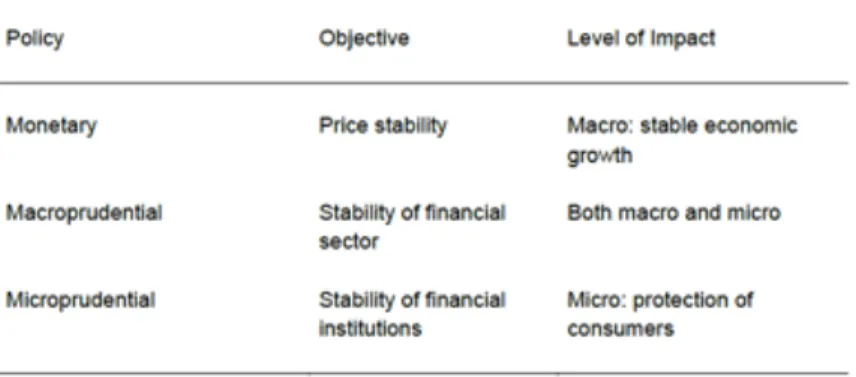
Lopez and Bruni (2019) note that the macroprudential policy framework implemented needs to be “an adaptable and flexible global network” and they define both the objectives and levels of impact of each of the different policy frameworks implemented by Central Banks and policy makers (see Table 1). Peydró (2016) points out that financial crises are often followed by credit crunches, the same is noted by Reinhart and Rogoff (2009) who note that long-lasting recessions with falling aggregate welfare and employment are often preceded by financial crises. Jiménez et al. (2015) analyses the impact of dynamic provisioning and countercyclical bank capital buffers on credit supply cycles in Spain. The authors find that countercyclical bank capital buffers have a mitigating effect on credit supply however, the impact of dynamic provisioning is not significant as any reduction in credit availability disappears after three quarters. Gupta et al. (2009) find that countercyclical macroprudential policy tools are able to shorten the duration of crises. Claessens (2017) notes that globalisation has resulted in a reduced ability to control domestic finance and the author shows that macroprudential policy tool implementation is less effective in developed markets.
Table 1 - Objectives and Impact of Policy Frameworks
Source: Lopez and Bruni (2019).
Cerutti et al. (2017) make use of a manually coded index of the macroprudential instruments implemented in 85 countries between 1990 and 2015. The authors find that a tighter macroprudential policy stance reduces household credit supplied by banks which are more dependent on foreign sources of funding, the results are even more pronounced for foreign currency denominated credit. Cerutti et al. (2017) also find that credit growth in higher risk foreign currencies in periods of low risk aversion hence, a low level of the VIX index, as well as periods of low foreign policy rates is more effectively controlled by macroprudential policy.
Angelini et al. (2012) note that “Macroprudential policy should be concerned with the setting of the structural features of the financial system, with a view to limiting risk, reducing procyclicality and increasing resilience by building up adequate buffers in good times for use in bad times. Only if these structural parameters are properly set will there be room left for discretionary and countercyclical macroprudential policy”. Montoro and Moreno (2010) consider the cases of Brazil, Colombia and Brazil and find that macroprudential policy plays a supporting role for monetary policy as policy dilemmas involving capital flows, the transmission mechanism of conventional monetary policy and lastly credit growth management are dealt with. Bruno et al. (2014) look at 12 Asia-Pacific countries and find that policies targeting the banking sector and bond market capital flows effectively manage bank inflows and bond inflows respectively. The authors also find that, in some cases, macroprudential policy implementation may be more successful when policies are implemented in such a way that they complement tighter monetary policy instead of competing policy frameworks being implemented. Agur and Demertzis (2015) find that monetary policy still has the ability to affect financial stability in the presence of macroprudential policy tools.
Macroprudential policy is implemented in an effort to target two dimensions namely, the ‘time dimension’ and the ‘cross-sectional dimension’4 Zhang and Zoli (2014) show that a number of capital flow measures implemented in 46 countries were effective in managing house price growth, credit growth, bank leverage and equity flows. More specifically, taxes on housing, foreign currency related measured and loan-to-value ratios were most effective. Crowe et al. (2011) and Cerutti et al. (2015) also find that loan-to-value ratios and similar measures have the greatest potential to manage real estate booms. Dell’Ariccia et al. (2012) find that macroprudential policy tool implementation has both the ability to mitigate credit booms as well as the ability to reduce the likelihood of booms leading to financial catastrophes. Dumičić (2018) look at macroprudential policy tool implementation in Central and Eastern European countries, the authors find that macroprudential policy tool implementation was more effective at decreasing credit availability to households than credit to the non-financial corporate sector. The authors also show that macroprudential policy tools are an effective measure for the alleviation of systematic crises. Lastly, Habermeier et al. (2011) show that macroprudential policy tools effectively manage capital inflows and reduce credit growth in some cases however, are unable to manage price inflation of assets.
4Vulnerabilities associated with the build-up of risks over time and vulnerabilities associated with the
3. Methodology and Data 3.1. Methodology
An index of domestic macroprudential policy tools is constructed and the effectiveness of these tools in controlling credit growth is studied using a dynamic panel data model. A dummy variable with value +1 is assigned in the presence of a tightening of macroprudential policy, -1 is assigned when macroprudential policy is loosened and 0 is assigned when there is no change to the macroprudential stance. A cumulative index of the macroprudential policy stance is also included. When two or three macroprudential policy tools are implemented or tightened, the cumulative index takes a corresponding value of +2 or +3. In the case where a number of policy tools are loosened, the cumulative index takes a corresponding value of -2 or -3. The impact of macroprudential policy implementation on credit growth is measured while controlling for the business cycle, the level of global risk aversion and interest rate changes.
The regression equations are as follows:
Credit_Growthit = 𝜑" + β1Credit_Growthit-1 + β3iit-1 + β4VIXit-1
+ β6Macrorudential_Indexit-1 + β7yit-1 +𝜀"$, (1)
Credit_Growthit = 𝜑" + β1Credit_Growthit-1 + β2Credit_Growth_Macroprudential_Indexit-1
+β3iit-1 + β4VIXit-1 + β5VIX_Macroprudential_Indexit-1 + β6Macrorudential_Indexit-1
+ β7yit-1 + β8y_Macrorudential_Indexit-1 +𝜀"$, (2)
where, Credit_Growtht is the quarterly year-on-year growth in the level of credit, VIXt is the
quarterly year-on-year growth in the level of the VIX index, it is the quarterly year-on-year growth in the interest rate, Macrorudential_Indexit is the value of the macroprudential policy
index, yit is the quarterly year-on-year GDP growth rate, 𝜑i are country fixed effects to account
for unobserved cross-country heterogeneity and 𝜀it is a disturbance term satisfying standard
conditions of zero mean and constant variance.
Four panel unit root tests are run to test for the presence of panel unit roots in both the panels as well as the individual country cases. Firstly, three first-generation panel unit root tests (Maddala and Wu test, the Fisher-Type Phillips-Perron test and the Fisher-Type Augmented Dickey-Fuller test) are included which assume that cross sectional units are independent while
the second-generation panel unit root test (Pesaran test) allows for cross sectional dependence. The first-generation Maddala and Wu test (Table B1 in Appendix B) tests for the presence of panel unit roots, and we fail to reject the null hypothesis of panel unit roots when considering the lagged interest rate growth for Chile, lagged GDP growth for Colombia and lagged credit growth for Portugal. The null hypothesis of all panels containing unit roots is rejected for both the Latin American panel as well as the EU panel. The first-generation Fisher-Type test (Phillips-Perron test, Table B2 in Appendix B) tests for the presence of a unit root and shows that we reject the null hypothesis of a unit root for all variables in both the Latin American panel and the EU panel. We also reject the null hypothesis of a unit root for all variables in all five country cases with the exception of the lagged GDP growth for Chile and Portugal and the lagged interest rate growth for the UK and Portugal. The first-generation Fisher-Type unit root tests therefore show that the lagged first-differenced variables have an order of integration of I(0) implying that, the lagged first differenced variables are stationary for the majority of cases with the exception of the lagged first differenced interest rate for the cases of Portugal and the UK. Although, the Phillips-Perron test for the presence of a unit root indicates that four of the series contain a unit root, when considering the Augmented Dickey-Fuller test, this result changes. The results of the ADF test indicate that the null hypothesis of a unit root is rejected in all cases and hence, none of the series contain a unit root. The Phillips-Perron test corrects for the presence of serial correlation and heteroskedasticity in the errors and it is shown that the second regression equation does indeed suffer from serial correlation for the case of Portugal, in this case, the use of the unit root test that specifically corrects for serial correlation is the most appropriate.
One should proceed with caution when analysing the results of unit root tests with small, finite samples as the results of both the Phillips-Perron unit root test as well as the results of the Augmented Dickey-Fuller test may be severely size distorted. These unit root tests may not have the ability to distinguish between persistent stationary processes and nonstationary processes although, our test regressions exclude trends and instead, only include a constant term which may improve the reliability of the above tests.
The second-generation Pesaran test (Table B3 in Appendix B) tests for the presence of panel unit roots allowing for cross sectional dependence, we fail to reject the null hypothesis of all panels containing unit roots when considering the lagged growth in VIX for both the Latin American panel as well as the EU panel.
The problem of endogeneity may also present itself in the analysis as one may assume that the macroprudential policy stance of Central Banks and hence, the macroprudential policy tool index studied in this paper may be subject to some cross-correlation between the index and the error term or a reverse causality. A reverse causality is evident in many empirical analyses dealing with financial development, output growth and financial stability with an example being the relationship between banking sector development and output growth as discussed by Peia and Roszbach (2015), a reverse causality between inequality and financial development is also discussed by Bazillier and Hericourt (2016).
Therefore, in this paper, a reverse causality may exist between the macroprudential policy tool index and the level of credit growth. It is highly likely that the level of credit growth would influence the macroprudential policy stance of policy makers and Central Banks as the macroprudential policy stance is directly related to the policy makers’ view of the financial stability (as proxied by credit growth in this paper) of the system at any given point in time. The macroprudential policy tool index is indeed cointegrated with the level of credit growth and a post-regression estimation test indicates that granger causality does indeed exist between the two variables. In Nier et al. (2012), it is proposed that lagged variables should be included in the empirical analysis in an effort to mitigate the endogeneity problem and the lagged regression results should then be compared with those of the unlagged variables in an effort to identify any issues caused by the relationship between the potentially affected variable and the error term. Further work could be conducted in an effort to identify a measure of financial stability that does not exhibit a reverse causality with the macroprudential policy tool index however, the chance of identifying such a variable is slim.
Endogeneity may lead to biased and inconsistent coefficient estimates and the issue of endogeneity usually presents itself because of a reverse causality between the dependent and independent variables. Endogeneity is also more likely to be an issue when considering macro analyses (in comparison to micro analyses) as it is more difficult to isolate the individual effects of the observable variables. To account for endogeneity in the model, one would need to include an IV estimator that is correlated with the endogenous variable however, uncorrelated with the error term. It is unlikely that one would find a variable that meets these requirements when focusing on the macroprudential policy tool index. Hence, the macroprudential policy tool index is lagged by one period which should mitigate the effect of endogeneity as discussed
in Nier et al. (2012). To err on the side of caution and in line with Nier et al. (2012), the estimated coefficients are interpreted based on significance and sign instead of the value thereof. Bruno and Shin (2013) lag all quarterly variables in the analysis by one quarter in an effort to mitigate endogeneity issues that may present themselves and in this paper, all variables are also lagged by one quarter. The lagging of all of the explanatory variables should mitigate any other endogeneity issues that may arise in the analysis.
To add to the robustness of this paper, an additional regression is run (Table C1 in Appendix C) that includes an IV estimator. Regulatory quality, which “reflects perceptions of the government to formulate and implement sound policies and regulations that permit and promote private sector development” (Kaufmann et al., 2010), is included as an IV estimator to account for any endogeneity in the model caused by the potentially endogenous variable, the macroprudential policy tool index. Regulatory quality is chosen as an appropriate IV estimator due to the likely correlation with the macroprudential policy tool index as the quality of regulation undoubtedly has an influence on the level of macroprudential policy intervention. Regulatory quality is unlikely to directly impact credit growth and instead, impacts credit growth through the macroprudential policy tool index while being uncorrelated with the error term.
The Wooldridge test for autocorrelation (Table B4 in Appendix B) in panel data shows that both the Latin American panel as well as the EU panel do indeed suffer from serial correlation, the Modified Wald test for heteroskedasticity (Table B5 in Appendix B) shows that both panels also suffer from the presence of heteroskedasticity, the main results (Table 3 to Table 7) therefore include regression results with corrections for both heteroskedasticity and serial correlation. The sum of macroprudential policy choices is the relevant variable for the statistical tests however, the results hold for capital conservation buffers, countercyclical capital buffers, loan-to-value ratios as well as reserve requirements. The Modified Wald test for heteroskedasticity is not an issue in the individual country cases, the Durbin-Watson test for autocorrelation shows (Table B4 in Appendix B) that there is no first order correlation for the case of Colombia for all macroprudential policy choices analysed as well as the sum of macroprudential policy choices.
There is no serial correlation present for the case of the UK for all cases except when considering loan-to-value ratios for both regression equation 1 and 2 and reserve requirements
for the second regression equation. For the Chilean case, the result of the Durbin-Watson test is inconclusive due to the test statistic falling between the lower and upper bound for all cases except the loan-to-value ratio for the first equation. For the Portuguese case, the result is inconclusive when considering reserve requirements for both regression equations and the second regression equation when considering the sum of macroprudential policy choices. Lastly, for the Japanese case, the result is inconclusive for all cases as the test statistic falls between the lower and upper bounds of the Durbin-Watson test in all cases. The final results for the country cases therefore include corrections for serial correlation when considering reserve requirements (both equation 1 and 2) as well as the sum of macroprudential policy choices (regression equation 2) for Portugal. The correction for serial correlation is included when considering loan-to-value ratios (both equation 1 and 2) and reserve requirements (regression equation 2) for the UK. The correction is included for all cases for Japan and for all cases except the first regression equation when considering loan-to-value ratios for Chile. In the remaining cases, notably all regressions for Colombia, no serial correlation is present and hence, standard fixed effects regression results are included.
3.2. Data
Allen and Gale (2007), Schularick and Taylor (2012), Gourinchas and Obstfeld (2012) and Borio (2018) note that credit growth is often a precursor of financial crises. Credit growth is thus included as a proxy for financial stability. A monthly index, iMaPP database constructed by Alam et al. (2019), of macroprudential policy tools implemented in the relevant countries is used as a starting point. This index is coded through 2016:Q4, this index is then cross checked using the Cerutti et al. (2017) index and extended using the 2017 IMF Macroprudential Survey. The extension through 2017:Q4 is cross checked using the IMF Macroprudential Data Query Report. The 2017 IMF survey is used as the deciding source and hence, when policy choices are reflected in the Data Query Report but not in the 2017 IMF Survey, these policy choices are not included. The monthly iMaPP index is cumulated to create the quarterly database used in this paper. The impact of macroprudential policy tool implementation on credit growth is studied for the period 2000:Q1 to 2017:Q4. The relevant countries are identified in Table 2. The relevant variables are as follows:
• Credit growth as a proxy for financial stability (BIS total credit statistics and IMF); • The growth in the level of the VIX index is included as a proxy for the level of global
• The GDP growth is included as a proxy for the business cycle (Federal Reserve Economic Data and OECD Stats);
• The interest rate growth is included as a proxy for the cost of borrowing (World Development Indicators, International Financial Statistics and Central Bank of Argentina);
Table 2 - Countries Included in the Analysis
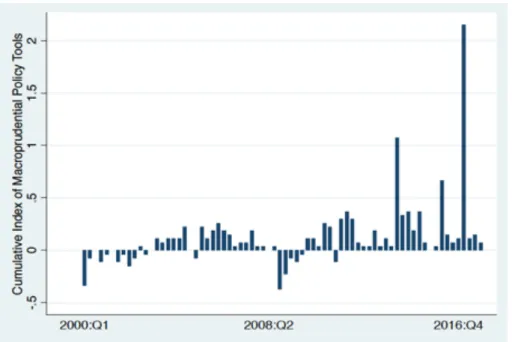
Figure 1 shows the cumulative index of macroprudential policy tools implemented in 27 European countries between 2000:Q1 and 2017:Q4 while Figure 2 shows the cumulative index of macroprudential policy tools implemented in 7 Latin American countries between 2000:Q1 and 2017:Q4. The graphs below show that the number of instances where macroprudential policy tools were implemented or the stance was tightened increased between 2000:Q1 and 2017:Q4 in the European panel, in the case of the Latin American panel, it is evident that the number of instances where macroprudential policy tools were either implemented or tightened increased in the time around the GFC. The macroprudential stance of Latin American countries became more active in the time around the GFC.
Figure 1 - Cumulative Index of Macroprudential Policy Tools Implemented in 27 European Countries
Source: Author’s Index based on Alam et al. (2019), Cerutti et al. (2017) and IMF (2018, 2019).
Figure 2 - Cumulative Index of Macroprudential Policy Tools Implemented in 7 Latin American Countries
Source: Author’s Index based on Alam et al. (2019), Cerutti et al. (2017) and IMF (2018, 2019).
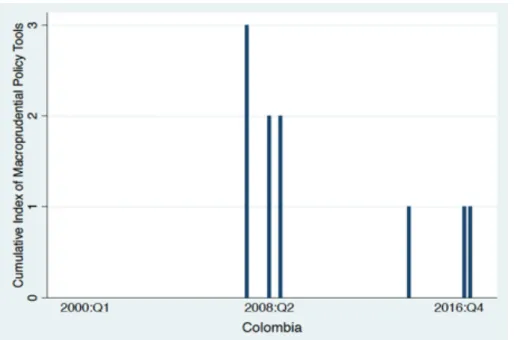
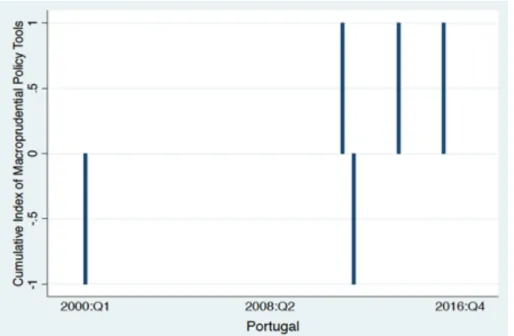
Figure 3 shows the cumulative index of macroprudential policy tools implemented in Chile between 2000:Q1 and 2017:Q4, Figure 4 shows the cumulative index of macroprudential policy tools implemented in Colombia between 2000:Q1 and 2017:Q4 and Figure 5 shows the cumulative index of macroprudential policy tools implemented in Japan between 2000:Q1 and
2017:Q4. Figure 6 shows the cumulative index of macroprudential policy tools implemented in Portugal between 2000:Q1 and 2017:Q4 while Figure 7 shows the cumulative index of macroprudential policy tools implemented in the UK between 2000:Q1 and 2017:Q4. The graphs below show that the macroprudential stance of Chile has been somewhat limited with the only adjustment to the policy stance occurring in the time around the GFC. Figure 4 shows that the macroprudential policy stance in Colombia became more active in the time around the GFC and again in 2016. The macroprudential policy stance in Japan has become more active in recent years and the same applies to Portugal. Lastly, Figure 7 shows that the macroprudential policy stance became more active in the case of the UK in the period after the GFC while, the policy stance has once again been active since 2016.
Figure 3 - Cumulative Index of Macroprudential Policy Tools Implemented in Chile
Figure 4 - Cumulative Index of Macroprudential Policy Tools Implemented in Colombia
Source: Author’s Index based on Alam et al. (2019), Cerutti et al. (2017) and IMF (2018, 2019).
Figure 5 - Cumulative Index of Macroprudential Policy Tools Implemented in Japan
Figure 6 - Cumulative Index of Macroprudential Policy Tools Implemented in Portugal
Source: Author’s Index based on Alam et al. (2019), Cerutti et al. (2017) and IMF (2018, 2019).
Figure 7 - Cumulative Index of Macroprudential Policy Tools Implemented in The United Kingdom
4. Results
4.1. Regression Results: Capital Conservation Buffer
Table 3 shows the results o regressing credit growth on its lagged value, the lagged value of the macroprudential policy choice index, lagged GDP growth and the lagged level of VIX (with country fixed effects). Table 3 focuses on the capital conservation buffer and the value of the macroprudential policy choice index is therefore indicative thereof. The coefficient on the lagged credit growth is positive and statistically significant when considering the Latin American panel and the five country cases in both the first and the second regressions. The coefficient on the interaction term between credit growth and the macroprudential policy choice index, in this case the capital conservation buffer, is positive and statistically significant when considering the Latin American panel however, the coefficient is negative and statistically significant in the case of Japan.
Table 3 - Regression Results for Capital Conservation Buffer
Note: The R2 value quoted is the adjusted R2 value, the p-value quoted is associated with an F-test. The value quoted for each variable is the coefficient value with the value in parenthesis being the standard error.
* Represents statistical significance at 10%, ** at 5% and *** at 1%. (0, .) indicates results omitted due to cointegration.
4.2. Regression Results: Countercyclical Capital Buffer
Table 4 shows the results of regressing credit growth on its lagged value, the lagged value of the macroprudential policy choice index, lagged GDP growth and the lagged level of VIX (with country fixed effects). Table 4 focuses on the countercyclical capital buffer and the value of the macroprudential policy choice index is therefore indicative thereof. The coefficient of the lagged value of credit growth is positive and statistically significant in all cases except that of the EU panel where the sign is positive however, not statistically significant for both regressions. The coefficient on the macroprudential policy choice index is negative and statistically significant in the case of the UK for the first regression equation.
Table 4 - Regression Results for Countercyclical Capital Buffer
Note: The R2 value quoted is the adjusted R2 value, the p-value quoted is associated with an F-test. The value quoted for each variable is the coefficient value with the value in parenthesis being the standard error.
* Represents statistical significance at 10%, ** at 5% and *** at 1%. (0, .) indicates results omitted due to cointegration.
4.3. Regression Results: Limits on Loan-to-Value Ratios
Table 5 shows the results of regressing credit growth on its lagged value, the lagged value of the macroprudential policy choice index, lagged GDP growth and the lagged level of VIX (with country fixed effects). Table 5 focuses on limits on loan-to-value ratios and the value of the macroprudential policy choice index is therefore indicative thereof. The coefficient on the lagged value of credit growth is once again both positive and statistically significant for all cases except that of the EU panel for both regression equations. The coefficient on the interaction term between VIX and the macroprudential policy choice index, in this case limits on loan-to-value ratios is positive and statistically significant when considering the Latin American panel in the second regression equation, the coefficient on the macroprudential policy choice index is also positive and statistically significant in the second regression equation when considering the Latin American panel. Finally, the coefficient on the interaction term between credit growth and the macroprudential policy choice index is negative and statistically significant for the second regression equation for the Latin American panel.
Table 5 - Regression Results for Limits on Loan-to-Value Ratios
Note: The R2 value quoted is the adjusted R2 value, the p-value quoted is associated with an F-test. The value quoted for each variable is the coefficient value with the value in parenthesis being the standard error.
* Represents statistical significance at 10%, ** at 5% and *** at 1%. (0, .) indicates results omitted due to cointegration.
4.4. Regression Results: Reserve Requirements
Table 6 shows the results of regressing credit growth on its lagged value, the lagged value of the macroprudential policy choice index, lagged GDP growth and the lagged level of VIX (with country fixed effects). Table 6 focuses on reserve requirements and the value of the macroprudential policy choice index is therefore indicative thereof. The coefficient on lagged credit growth is once again positive and statistically significant in all cases except that of the EU panel for both regression equations. The coefficient on the macroprudential policy choice index, in this case reserve requirements, is negative and statistically significant when considering the first regression equation for the case of Portugal.
Table 6 - Regression Results for Reserve Requirements
Note: The R2 value quoted is the adjusted R2 value, the p-value quoted is associated with an F-test. The value
quoted for each variable is the coefficient value with the value in parenthesis being the standard error.
* Represents statistical significance at 10%, ** at 5% and *** at 1%. (0, .) indicates results omitted due to cointegration.
4.5. Regression Results: Sum of Macroprudential Policy Choices
Table 7 shows the results of regressing credit growth on its lagged value, the lagged value of the macroprudential policy choice index, lagged GDP growth and the lagged level of VIX (with country fixed effects). Table 7 focuses on the sum of macroprudential policy choices and the value of the macroprudential policy choice index is therefore indicative thereof. The coefficient on lagged credit growth is positive and statistically significant for all cases in the second regression and positive and statistically significant for all cases except that of the EU panel when considering the first regression equation.
Table 7 - Regression Results for Sum of Macroprudential Policy Changes
Note: The R2 value quoted is the adjusted R2 value, the p-value quoted is associated with an F-test. The value quoted for each variable is the coefficient value with the value in parenthesis being the standard error.
* Represents statistical significance at 10%, ** at 5% and *** at 1%. (0, .) indicates results omitted due to cointegration.
The coefficient on the macroprudential policy choice index is negative and statistically significant for the case of Portugal when considering both the first regression equation as well as the second regression equation and the coefficient is positive and statistically significant for the case of the UK when considering the second regression equation. The interaction term
between credit growth and the macroprudential policy choice index is positive and statistically significant for the case of Portugal in the second regression, the interaction term between VIX and the macroprudential policy choice index is also positive and statistically significant when considering the case of Portugal in the second regression equation.
The results of a number of robustness checks5 are similar to those of the main results discussed, noticeably, the coefficient on the macroprudential policy choice index is negative and statistically significant for the EU panel for both regressions, where the correction for heteroskedasticity and serial correlation is not included, when considering reserve requirements. The interaction term between credit and the macroprudential policy choice index is also negative and statistically significant in the second regression when considering reserve requirements for the EU panel, the same is true when considering the sum of macroprudential policy choices for the EU panel when the correction for heteroskedasticity and serial correlation is not included.
The interaction term between credit growth and the macroprudential policy choice stance is negative in the majority of cases however, the regression results are only statistically significant in a small number of cases. An inverse relationship between credit growth and the macroprudential policy choice index, as can be seen a negative coefficient on the interaction term between credit growth and the macroprudential policy choice index, would imply that higher levels of credit growth are associated with lower levels of the macroprudential policy choice index and hence, a looser macroprudential policy stance results in higher credit availability. A tightening of the capital conservation buffer results in a decrease in the credit supply when looking at the case of Japan, in Latin America, a tightening of the capital conservation buffer results in an increase in the credit supply. A tightening of the loan-to-value ratio results in a decrease in the credit supply in Latin America. Lastly, a tightening in the overall macroprudential policy stance results in an increase in the credit supply in Portugal and a decrease in the credit supply in Japan.
5. Conclusion
In the aftermath of the GFC, policy makers around the world came to the realization that traditional prudential policy frameworks with monetary policy as a prioritized policy tool lacked the scope to prevent financial crises and the financial turmoil that often accompanies these. The US housing bubble had severe effects on both the US economy as well as the global economy and although, the Federal Reserve and other Central Banks were unable to contain the turmoil, macroprudential policy frameworks emerged with the aim of achieving both financial and economic security and stability going forward as well as ensuring that bubbles never again grow to the disproportionately dangerous levels experienced prior to the GFC. This paper studies the impact of macroprudential policy on financial stability for both an EU panel of 27 countries and a Latin American panel of 7 countries. A case study looking at the cases of Chile, Colombia, Japan, Portugal and the UK is also included. A monthly index, iMaPP database constructed by Alam et al. (2019), of macroprudential policy tools implemented in the relevant countries is used as a starting point. This index is coded through 2016:Q4, this index is then cross checked using the Cerutti et al. (2017) index and extended using the 2017 IMF Macroprudential Survey and the IMF Macroprudential Data Query report. The monthly index is cumulated to create the quarterly database used in this paper. The extended and updated index is then used to study the effectiveness of macroprudential policy tools in controlling credit growth using a dynamic panel data model for the period between 2000:Q1 and 2017:Q4.
Our main results find that the impact of the cumulative macroprudential index of policy choices is not statistically significant when considering a panel of 27 EU countries, this result is in line with earlier literature that finds that the impact of macroprudential policy tool implementation is less significant when considering developed, open economies (Cerutti et al., 2017). An inverse relationship between credit growth and the macroprudential policy choice index, as can be seen a negative coefficient on the interaction term between credit growth and the macroprudential policy choice index, would imply that higher levels of credit growth are associated with lower levels of the macroprudential policy choice index and hence, a looser macroprudential policy stance results in higher credit availability. A tightening of the capital conservation buffer results in a decrease in the credit supply when looking at the case of Japan. When looking at a panel of 7 Latin American countries, our main results show that a tightening of the capital conservation buffer results in an increase in the credit supply. A tightening of the
loan-to-value ratio results in a decrease in the credit supply in the panel of 7 Latin American countries. The success of caps on loan-to-value ratios (LTV) is in line with previous literature, most recently Gambacorta and Murcia (2019) show that macroprudential policy tools aimed at controlling credit cycles are found to be effective at reducing credit growth, Claessens et al. (2013) find that debt-service-to-income ratio (DSTI) caps and LTV caps more effectively manage asset growth than capital requirements. Lastly, a tightening in the overall macroprudential policy tool stance results in a decrease in credit supply in Japan and an increase in credit supply in Portugal. In light of these results, policy makers should tighten both their overall macroprudential policy stance as well as their capital conservation buffers in Japan in times of financial stress and in an effort to curb surges in credit supply. Policy makers should tighten their loan-to-value ratios in times of financial stress and credit abundance in Latin America however, in contrast, policy makers should loosen their capital conservation stance in times of credit abundance in an effort to stabilise credit supply. Lastly, the overall macroprudential policy stance should be loosened in Portugal in times of financial instability.
Appendix A
A.1. Variable Sources
Table A1 - Sources of Variables
A.2. Variable Definitions
A.3. Summary Statistics
Table A3 - Summary Statistics for Chile, Colombia, Japan, Portugal and the UK
Appendix B
B.1. Maddala and Wu Test (Maddala and Wu, 1999) for the Presence of Panel Unit Roots
Table B1 - Results of Fisher Type Unit Root Tests
Note: First generation Maddala and Wu Test for panel unit roots (Maddala and Wu, 1999) results based on: Ho:
All panels contain unit roots and Ha: At least one panel is stationary. The results of an Inverse Chi-squared (2) test are presented in the above table with both the Test Statistic as well as the p-value being quoted. The presence of a unit root is rejected for the cases where the p-value < 0.1. Statistical test results based on regression equations with sum of the macroprudential policy choices included as the index value.
B.2. First Generation Fisher Type Tests (Phillips–Perron Test) for the Presence of Panel Unit Roots
Table B2 - Results of Fisher Type Unit Root Tests
Note: First generation Fisher Type test for panel unit roots (Phillips–Perron test) results based on: Ho: All panels
contain unit roots and Ha: At least one panel is stationary. The results of an Inverse Chi-squared (2) test are presented in the above table with both the Test Statistic as well as the p-value being quoted. The presence of a unit root is rejected for the cases where the p-value < 0.1. Statistical test results based on regression equations with sum of the macroprudential policy choices included as the index value.
B.3. Second Generation Pesaran Test (Pesaran, 2007) for the Presence of Panel Unit Roots
Table B3 - Results of Fisher Type Unit Root Tests
Note: Second generation Pesaran test for panel unit roots (Pesaran, 2007) results based on: Ho: All panels
contain unit roots and Ha: At least one panel is stationary. The results of an Inverse Chi-squared (2) test are presented in the above table with both the Test Statistic as well as the p-value being quoted. The presence of a unit root is rejected for the cases where the p-value < 0.1. Statistical test results based on regression equations with sum of the macroprudential policy choices included as the index value.
B.4. Wooldridge Test for Autocorrelation in Panel Data and Durbin Watson Test for Autocorrelation:
Table B4 - Results of Wooldridge Test for Autocorrelation in Panel Data and Durbin Watson Test for Autocorrelation
Note: Wooldridge Test for Autocorrelation results based on: Ho: No First-Order Autocorrelation and Ha: First
Order Autocorrelation. The results of the F-test and the corresponding p-values are presented in the above table. The null hypothesis of no first-order autocorrelation is rejected for the cases where the p-value < 0.1. Durbin Watson test for Autocorrelation results based on: Ho: No Autocorrelation and Ha: Positive Autocorrelation or Inconclusive Results. The Durbin Watson Test Statistic is quoted in the table above, the upper and lower Durbin Watson bounds from Savin and White at a 1% Confidence Interval are also quoted in the above table. Test Statistic values above the upper bound result in the null hypothesis not being rejected and hence, no positive serial correlation is present. A Test Statistic below the lower bound results in the assumption that positive serial correlation is present and a Test Statistic within the bounds results in an inconclusive result. Statistical test results based on regression equations with sum of the macroprudential policy choices included as the index value.
B.5. Modified Wald Test for Heteroskedasticity:
Table B5 - Results for Modified Wald Test for Heteroskedasticity
Note: Modified Wald Test for Heteroskedasticity results based on: Ho: No Heteroskedasticity present and Ha:
Heteroskedasticity present. The results of a Chi-squared (1) test are presented in the above table with both the Test Statistic as well as the p-value being quoted. The absence of Heteroskedasticity is rejected for the cases where the p-value < 0.1. Statistical test results based on regression equations with sum of the macroprudential policy choices included as the index value.
Appendix C
C.1. Additional Regression Results: Sum of Macroprudential Policy Choices with Instrumental Variables
Table C1 shows the results of regressing credit growth on its lagged value, the lagged value of the macroprudential policy choice index, lagged GDP growth and the lagged level of VIX. Table C1 focuses on the sum of macroprudential policy choices and the value of the macroprudential policy choice index is therefore indicative thereof. An instrumental variable (Regulatory Quality) is included to account for any measurement error, omitted variable bias or simultaneity bias that may occur due to the endogeneity of the macroprudential policy tool index. The coefficient on lagged credit growth is positive and statistically significant for the cases of the Latin American panel, Chile, Japan and Portugal in the second regression and positive and statistically significant for all the cases of the Latin American panel, Chile and Japan when considering the first regression equation. The sign on the interaction term between credit growth and the macroprudential policy tool index is negative and statistically significant for the case of Japan. This result is in line with the results in Table 7 where an instrumental variable is not included in the regression. The sign on the credit growth remains positive throughout in both regressions when moving from a regression with no instrumental variable to a regression including an instrumental variable with the exception of Portugal in the first regression.
Table C1 - Regression Results for Sum of Macroprudential Policy Changes with Instrumental Variables
Note: The R2 value quoted is the adjusted R2 value, the p-value quoted is associated with an F-test. The value quoted for each variable is the coefficient value with the value in parenthesis being the standard error.
* Represents statistical significance at 10%, ** at 5% and *** at 1%. (0, .) indicates results omitted due to cointegration.
Appendix D
D.1. Policy Instruments
Table D1 - Summary of Various Macroprudential Policy Instruments
Source: Alam et al. (2019)
D.2. iMaPP Database and Other Existing Databases
Table D2 - Summary of Data Sources and Coverage of the iMaPP Database, constituting Databases as well as Other Macroprudential Databases
Source: Alam et al. (2019)
Note (As Defined by Alam et al. 2019):
1.) The classification of instruments differs across databases. The column "Instruments" shows the number of categories, including subcategories, available in each dataset, without standardizing classification.
2.) "T/L indexes" is the dummy-type indexes for tightening and loosening actions of macroprudential policy measures.
References
Agénor, PR, Alper, K and Pereira da Silva, L. 2012: Sudden Floods, Macroprudential Regulation and Stability in an Open Economy. Banco Central do Brazil.267.
Agur, I and Demertzis, M. 2015: Will Macroprudential Policy Counteract Monetary Policy’s Effects on Financial Stability? IMF Working Paper WP/15/283, December 2015.
Ahmed, S and Zlate, A. 2013: Capital Flows to Emerging Market Economies: A Brave New World? Board of Governors of the Federal Reserve System International Discussion Papers 1081, June 2013.
Ahuja, A and Nabar, M. 2011: Safeguarding Banks and Containing Property Booms: Cross Country Evidence on Macroprudential Policies and Lessons from Hong Kong SAR. IMF Working Paper WP/11/284, December 2011.
Akinci, O and Olmstead-Rumsey, J. 2015; How Effective are Macroprudential Policies? An Empirical Investigation. International Finance Discussion Papers 1136.
Alam, Z, Alter, A, Eiseman, J, Gelos, G, Kang, H, Narita, M, Nier, E and Wang, N. 2019: Digging Deeper – Evidence on the Effects of Macroprudential Policies from a New Database. IMF Working Paper WP/19/66, March 2019.
Allen, F and Gale, D. 2007: Understanding Financial Crises. Clarendon Lectures in Finance, http://www.sfu.ca/~dandolfa/Allen%20and%20Gale%202007.pdf, accessed 8 April 2020.
Allen, WA and Wood, G. 2006: Defining and achieving financial stability. Journal of Financial Stability. Elsevier 2(2): 152-172, June 2006.
Angelini, P, Nicoletti-Altimari, S and Visco, I. 2012: Macroprudential, microprudential and monetary policies: conflicts, complementarities and trade-offs. Banca d’Italia, Questioni di Economia e Finanza, Occasional Papers 140, November 2012.
Baba, C. and Kokenyne, A. 2011: Effectiveness of Capital Controls in Selected Emerging Markets in the 2000s. IMF Working Paper WP/11/281, December 2011.
Bazillier, R and Hericourt, J. 2017: The Circular Relationship between Inequality, Leverage, and Financial Crises. Journal of Economic Surveys 31(2): 463-496.
Borio, C. 2003: Towards a macroprudential framework for financial supervision and regulation? BIS Working Papers 128, February 2003.
Bruno, V, Shim, I and Shin, HS. 2015: Comparative Assessment of Macroprudential Policies. BIS Working Paper 502, June 2015.
Caruana, J. 2010: Macroprudential policy: working towards a new consensus. Remarks at the high-level meeting on “The Emerging Framework for Financial Regulation and Monetary Policy” jointly organised by the BIS’s Financial Stability Institute and the IMF Institute, Washington DC, 23 April, https://www.bis.org/speeches/sp100426.pdf, accessed: 8 April 2020.
Cerutti, E, Dagher, J and Dell’Ariccia, G. 2015: Housing Finance and Real-estate booms: A Cross-Country Perspective. IMF Staff Discussion Note SDN/15/12, June 2015. Cerutti, E, Claessens, S and Laeven, L. 2017: The use and effectiveness of macroprudential
policies: new evidence. Journal of Financial Stability 28: 203–24.
Cerutti, E, Correa, R, Fiorentino, E and Segalla, E. 2017: Changes in Prudential Policy Instruments- A New Cross-Country Database. International Journal of Central Banking 13(S1), March 2017.
Claessens, S, Ghosh, S and Mihet, R: 2013. Macro-prudential policies to mitigate financial system vulnerabilities. Journal of International Money and Finance 39: 153–85. Claessens, S. 2017: Macroprudential policies: Seven issues and seven questions. BIS,
Session II: Macroprudential Policy Issues Banco de Portugal Conference on Financial
Stability Lisbon, 17 October 2017,
https://www.bportugal.pt/sites/default/files/ii_1_stijn_claessens.pdf, accessed: 8 April 2020.
Constâncio, V. 2017: Macroprudential Policy in a Changing Financial System. Second ECB Macroprudential Policy and Research Conference in Frankfurt, European Central
Bank, 11 May 2017,
https://www.ecb.europa.eu/press/key/date/2017/html/ecb.sp170511.en.html, accessed: 8 April 2020.
Crockett, A. 2000: Marrying the Micro- and Macro-prudential Dimensions of Financial Stability. Eleventh International Conference of Banking Supervisors, held in Basel, 20-21 September 2000, https://www.bis.org/speeches/sp000921.htm, accessed: 8 April 2020.
Crowe, CW, Igan, D, Dell’Ariccia, G and Rabanal, P. 2011: How to Deal with Real Estate Booms, IMF Staff Discussion Note 11/02.
Dell’Ariccia, G, Igan, D, Laeven, L and Tong, H. (with Bakker, B and Vandenbussche) 2012: Policies for Macrofinancial Stability: How to Deal with Credit Booms. IMF Staff Discussion Note 12/06.
Dumičić, M. 2018: Effectiveness of macroprudential policies in Central and Eastern European countries. Public Sector Economics 42 (1): 1-19.
Federico, P, Vegh, C, and Vuletin, G. 2012: Effects and role of macroprudential policy: Evidence from reserve requirements based on a narrative approach. Manuscript, November, http://www.norges-bank.no/pages/90658/Vegh_paper.pdf, accessed 8 April 2020.
Financial Stability Board, International Monetary Fund, and Bank for International Settlements. 2011: Macroprudential Tools and Framework. Update to G20 Finance
Ministers and Central Bank Governors, February,
https://www.imf.org/external/np/g20/pdf/021411.pdf, accessed: 8 April 2020.
Galati, G and Moessner, R. 2011: Macroprudential policy - a literature review. BIS Working Papers 337, Bank for International Settlements.
Gambacorta, L and Murcia, A. 2019: The impact of macroprudential policies in Latin America: an empirical analysis using credit registry data. Journal of Financial Intermediation 100828.
Gourinchas, PO and Obstfeld, M. 2012: Stories of the Twentieth Century for the Twenty First. American Economic Journal: Macroeconomics 4(1): 226–265.
Gupta, S, Mulas-Granados, C and Baldacci, E. 2009: How Effective is Fiscal Policy Response in Financial Crises? Fiscal issues and central banking in emerging economies. IMF Working paper WP/09/160.
Habermeier, K, Kokenyne, A and Baba, C. 2011: The Effectiveness of Capital Controls and Prudential Policies in Managing Large Inflows. IMF Staff Discussion Note SDN 11/14, August.
Hong Kong Monetary Authority. 2011: Loan-to-value ratio as a macroprudential tool Hong Kong SAR’s experience and cross-country evidence. BIS Research Papers, BIS 57.
Houben, A, Kakes, J and Schinasi, G. 2004: Towards a framework for financial stability. DNB Occasional Studies 201, Netherlands Central Bank, Research Department. International Monetary Fund. 2014: Staff Guidance Note on Macroprudential Policy.
December 2014, https://www.imf.org/external/np/pp/eng/2014/110614.pdf, accessed: 8 April 2020.
International Monetary Fund. 2016: Elements of Effective Macroprudential Policies: Lessons from International Experience. IMF-FSB-BIS, 31 August 2016, https://www.imf.org/external/np/g20/pdf/2016/083116.pdf, accessed: 8 April 2020.
Jiménez, G, Ongena, S, Peydró, JL and Saurina, J. 2017: Macroprudential Policy, Countercyclical Bank Capital Buffers and Credit Supply: Evidence from the Spanish Dynamic Provisioning Experiments. Journal of Political Economy 125(6): 2126-2177. Kaufmann, D, Kraay, A and Mastruzzi, M. 2010: The Worldwide Governance Indicators: Summary of Methodology, Data and Analytical Issues. World Bank Policy Research Working Paper 5430, World Bank: Washington, D.C.
Kim, C. 2014: Macroprudential policies in Korea – Key measures and experiences. Financial Stability Review 18(April): 121-130, Banque de France.
Kuttner, KN and Shim, I. 2013: Can non-interest rate policies stabilise housing markets? Evidence from a panel of 57 economies. BIS Working Papers 433 (November). Lim, C, Columba, F, Costa, A, Kongsamut, P, Otani, A, Saiyid, M, Wezel, T and Wu, X.
2011: What Instruments and How to Use Them? Lessons from Country Experiences. IMF Working Paper WP/11/238, October 2011.
Lopez, C and Bruni, F. 2019: The Macroprudential Policy Framework Needs to Be Global. International Financial Architecture for Stability and Development/ Crypto
Assets and Fintech, March 2019, https://t20japan.org/wp
content/uploads/2019/03/t20-japan-tf2-6-macroprudential-policy-framework-needs-to be-global.pdf, accessed: 8 April 2020.
Montoro, C and Moreno, R. 2011: The Use of Reserve Requirements as a Policy Instrument in Latin America. BIS Quarterly Review, March.
Nier, EW, Kang, E, Mancini, T, Hesse, H, Columba, F, Tchaidze, R and Vandenbussche, J. 2012: The interaction of monetary and macroprudential policies: background paper, International Monetary Fund, December.
Peia, O. and Roszbach, K. 2015: Finance and growth: Time series evidence on causality. Journal of Financial Stability 19(C): 105-118.
Peydró, JL. 2016: Macroprudential Policy and Credit Supply. Swiss Journal of Economics and Statistics 152 (4): 305–318.
Reinhart, C, and Rogoff, K. 2009: This Time is Different: Eight Centuries of Financial
Folly, In: Economics Books, Princeton University Press,
https://econpapers.repec.org/bookchap/puppbooks/8973.htm, accessed 8 April 2020. Schularick, M and Taylor, AM. 2012: Credit Booms Gone Bust: Monetary Policy, Leverage
Cycles, and Financial Crises, 1870–2008. American Economic Review 102:1029 1061.
Tovar, CE, Garcia-Escribano, M and Martin, MV. 2012: Credit Growth and the Effectiveness of Reserve Requirements and Other Macroprudential Instruments in Latin America. IMF Working Paper WP/12/142, June 2012.
Vandenbussche, J, Vogel, U and Detragiache, E. 2012: Macroprudential Policies and Housing Prices – A New Database and Empirical Evidence for Central, Eastern, and Southeastern Europe. IMF Working Paper Series 12/303 (December), IMF, Washington, D.C.
Zhang, L and Zoli, E. 2014: Leaning Against the Wind: Macroprudential Policy in Asia. IMF Working Paper 14/22.