CIÊNCIAS DA VIDA E DA SAÚDE LIFE AND HEALTH SCIENCES
CIENCIAS DE LA VIDA Y LA SALUD
mill
e
nium
23
Millenium, 2 (6), 23-31.
COMPLICAÇÕES DA FLUIDOTERAPIA EM PACIENTES COM PANCREATITE AGUDA: UMA CONTRIBUIÇÃO
COMPLICATIONS OF FLUIDOTHERAPY IN PATIENTS WITH ACUTE PANCREATITIS: A CONTRIBUTION
COMPLICACIONES DE LA FLUIDOTERAPIA EN PACIENTES CON PANCREATITIS AGUDA: UNA CONTRIBUCIÓN
Carla Henriques
1Jorge Pereira
2Ana Cristina Matos
3Catarina Afonso
21Polytechnic Institute of Viseu, Centre for Studies in Education, Technology and Health of Viseu (CI&DETS), Centre for Mathematics of
the University of Coimbra (CMUC), Portugal.
2
General Surgery Department, Tondela-Viseu Hospital Centre, Viseu, Portugal.
3 Polytechnic Institute of Viseu, Centre for Studies in Education, Technology and Health of Viseu (CI&DETS), Viseu, Portugal.
Carla Henriques - [email protected] | Jorge Pereira - [email protected] | Ana Cristina Matos - [email protected] | Catarina Afonso - [email protected]
Corresponding Author
Carla Henriques
RECEIVED: 11th September, 2017
ACCEPTED: 08th
F
ebruary, 2018Escola Superior de Tecnologia e Gestão de Viseu Campus Politécnico
3504-510 Viseu
Henriques, C., Pereira, J., Matos, A. C. & Afonso, C. (2018). Complications of fluidotherapy in patients with acute pancreatitis: A contribution.
Millenium, 2(6), 23-31. DOI: https://doi.org/10.29352/mill0206.02.00160
m
24
6
RESUMO
Introdução: A fluidoterapia agressiva é frequentemente sugerida no tratamento da pancreatite aguda. No entanto, há alguma
controvérsia sobre o efeito desta opção relativamente ao aparecimento de complicações clínicas e à necessidade de cirurgia.
Objetivos: Explorar a relação entre administração de fluidos nas primeiras 48 horas e o desenvolvimento de complicações, locais ou
sistémicas, a fim de contribuir para esclarecer algumas questões nesta matéria.
Métodos: Este estudo é baseado em registros de 109 pacientes internados na Unidade de Cuidados Cirúrgicos Intermédios do Centro
Hospitalar Tondela Viseu, entre 2007 e 2012, com diagnóstico de pancreatite aguda. Foi feita a exploração dos dados e aplicados testes estatísticos de modo a identificar variáveis que diferenciavam pacientes com complicações. As curvas ROC (Receiver Operating Characteristic) permitiram relacionar a quantidade de fluidos administrados nas primeiras 48h com a ocorrência de cada complicação. Modelos de regressão logística foram utilizados para identificar fatores de risco independentes para cada complicação.
Resultados: Não se registou relação significativa entre a terapia de fluidos às 48 horas com a morte nem com a ocorrência de
complicações sistémicas. Ao contrário, a fluidoterapia às 48 horas revelou-se associada a complicações locais e tardias, presença de infeção e necessidade de cirurgia.
Conclusões: Níveis elevados de fluidos administrados nas primeiras 48 horas registaram-se associados ao desenvolvimento de
complicações.
Palavras-chave: Pancreatite aguda; Fluidoterapia; Complicações; Curvas ROC; Regressão logística
ABSTRACT
Introduction: Aggressive fluid therapy is frequently suggested in the treatment of acute pancreatitis. However, there is some
controversy about the effect of this therapy concerning the development of clinical complications and the need for surgery.
Objectives: To explore the relationship between fluid administration in the first 48 hours and the development of local or systemic
complications, to contribute to clarifying some open questions on this subject.
Methods: This study is based on records of 109 patients admitted to the Surgical High Dependency Unit of Tondela Viseu Hospital
Centre, between 2007 and 2012, with the diagnosis of acute pancreatitis. Data were explored, and statistical tests were used to identify variables that differentiate patients with complications. Receiver operating characteristic (ROC) curves allowed to relate the amount of fluids at 48 hours with the occurrence of each complication. Logistic regression models were used to identify independent risk factors for each complication.
Results: There was no significant relationship between fluid therapy at 48 hours with death nor with the occurrence of systemic
complications. As opposed, fluid therapy at 48 hours revealed to be associated with local and late complications, presence of infection and need for surgery.
Conclusion: High levels of fluid therapy in the first 48 hours were associated with the development of complications. Keywords: Acute pancreatitis; Fluidotherapy; Complications; ROC curves; Logistic regression.
RESUMEN
Introducción: La fluidoterapia agresiva se sugiere con frecuencia en el tratamiento de la pancreatitis aguda. Sin embargo, existe cierta
controversia sobre el efecto de esta terapia con respecto al aumento/reducción de complicaciones clínicas y la necesidad de cirugía.
Objetivos: Explorar la relación entre la administración de fluidos en las primeras 48 horas y el desarrollo de complicaciones locales y
sistémicas, con el fin de contribuir a aclarar algunas preguntas abiertas en este tema
Métodos: Este estudio se basa en los registros de 109 pacientes ingresados en la Unidad de Cuidados Intermedios Quirúrgicos del
Centro Hospitalario Tondela Viseu, entre 2007 y 2012, con diagnóstico de pancreatitis aguda. Se exploraron los datos y se utilizaron pruebas estadísticas para identificar las variables que diferencian a los pacientes con complicaciones. Las curvas ROC (Receiver Operating Characteristic) permiten relacionar la cantidad de fluidos a las 48 horas con la aparición de cada complicación. Se usaron modelos de regresión logística para identificar factores de riesgo independientes para cada complicación.
Resultados: No hubo una relación significativa entre la fluidoterapia a las 48 horas con la muerte ni con la aparición de complicaciones
sistémicas. Por el contrario, la fluidoterapia a las 48 horas reveló estar asociada con complicaciones locales y tardías, presencia de infección y necesidad de cirugía.
Conclusións: Los altos niveles de fluidoterapia en las primeras 48 horas se asociaron con el desarrollo de complicaciones. Palavras Clave: Pancreatitis aguda; Terapia de fluidos; Complicaciones; Curvas ROC; Regresión logística.
Henriques, C., Pereira, J., Matos, A. C. & Afonso, C. (2018).
Complications of fluidotherapy in patients with acute pancreatitis: A contribution.
Millenium, 2(6), 23-31. DOI: https://doi.org/10.29352/mill0206.02.00160
m
5
25
INTRODUCTION
The pancreas is a solid organ located in the upper abdomen, behind the stomach, responsible for a double function, both endocrine and exocrine (see, e.g., Blumgart, 2016). Its main endocrine purpose is regulation of blood glucose levels. To put through its exocrine function, the pancreas produces a series of digestive enzymes, capable of digesting sugars, lipids, and proteins. The premature activation of these enzymes within the pancreatic parenchyma produces a disease called acute pancreatitis. The cause of the enzyme activation is diverse (direct toxicity – ethanol, duct hypertension – cholelithiasis (Pollock, 1959), for example), but once triggered, initiates a cascade reaction that leads to self-digestion of the organ. The degree of initial inflammatory response will determine the severity of the disease and the autodigestion (Glasbrenner and Adler, 1993). The condition of local tissue microcirculation is thought to play an essential role in this sequence, hence the volume and type of fluids administered in the first hours to maintain hemodynamic stability may play an important role in preventing complications and avoiding severe forms of the disease (Nasr and Papachristou, 2011).
The study explores the relationship between fluid administration in the first 48 hours and the development of local or systemic complications, early or late in the course of the disease, to contribute to clarifying some open questions in this subject.
1. THEORETICAL FRAMEWORK
Acute pancreatitis is, in most cases, a self-limiting and benign disease. In a variable percentage of patients, around 15% to 20% (Dupuis et al., 2013), complications develop that can significantly overshadow the prognosis of acute pancreatitis (Banks et al., 2012). Reasons for this disparate evolution are not fully known and are surely multifactorial (Yang, Chen, Phillips, Windsor and Petrov, 2014). Fluid therapy in the first hours of disease installment, especially in the first 48 hours, seems to have some influence on the development of these complications in a way not yet fully understood. Hemodynamic stability and maintenance of euvolemia appear to be important factors in maintaining pancreatic microcirculation, preventing ischemia and necrosis of pancreatic tissue, one of the most severe local complication (Nasr and Papachristou, 2011). Aggressive fluid therapy (infusion of high fluid volumes) seems to contribute to the maintenance of the microcirculation (Janisch and Gardner, 2016). On the other hand, it produces excess volume in the extracellular space which also contributes to the development of complications (Stigliano, Sternby, de Madaria, Capurso, and Petrov, 2017). We are far from knowing all the factors that lead to complications that worsen the course of acute pancreatitis. And with fluid therapy, it would be important to find a balance to avoid the deleterious effects of its use.
According to the last review of Atlanta 2012 (Banks et al., 2012), acute pancreatitis complications can be divided in local and systemic, and they can appear early or late in the course of the disease. Local complications result from the collection of fluid in or around the pancreas and/or presence of pancreatic necrosis, diagnosed through CT scan (Balthazar, 2002). Both of these types of local collection can suffer secondary infection, which worsens the prognosis. Systemic complications refer to the exacerbation of pre-existing illnesses, as cardiac or respiratory disease. In this regard, it is easy to understand the influence that fluid therapy may have on the appearance or worsening of complications. The maintenance of euvolemia and hemodynamic stability are important to avoid the onset of ischemia and necrosis, requiring administration of fluid (Tenner, Baillie, DeWitt and Vege, 2013). On the other hand, excessive volume administration can produce tissue edema and hypervolemia, worsening pre-existing cardiac, pulmonary or other conditions (Gardner, Vege, Pearson and Chari, 2008). Still, another aspect introduced by the Atlanta review was the importance of organ failure in the progress and prognosis of acute pancreatitis. In this matter, pancreatitis can be divided in mild, if no organ failure is present, moderate if a transient organ failure ensues (less than 48 hours) and severe, with persistent organ failure. Pancreatic necrosis is the worst local complication possible, more so if infection emerges (Pereira, Constantino, Duarte, Pinho and Pinheiro, 2015). In close relation to the concept of organ failure is tissue oxygenation. It depends on several factors but, above all, on patient's volume state and oxygen carrying capacity. This not only stresses the importance of the fluid volume to administer but also its type. The need to increase volume to maintain hemodynamic stability, which can be accomplished with crystalloids, may be associated with the need for oxygen transport capacity, as erythrocyte concentrate transfusion (Kalkwarf and Cotton, 2017).
2. DATA AND METHODS
This retrospective study included all the records of the 109 patients admitted to the Surgical High Dependency Unit of Tondela Viseu Hospital Centre, between 2007 and 2012, with the diagnosis of acute pancreatitis (according to the Atlanta 2012 revision). Statistical analysis was performed using IBM SPSS Statistics (version 24). Numerical variables are described by mean±standard deviation (SD) or by the median and interquartile range (IQR). Categorical variables are described with percentages. For each complication, two groups of patients were considered: those who presented and those who did not present the complication.
Henriques, C., Pereira, J., Matos, A. C. & Afonso, C. (2018). Complications of fluidotherapy in patients with acute pancreatitis: A contribution.
Millenium, 2(6), 23-31. DOI: https://doi.org/10.29352/mill0206.02.00160
m
26
6
The relationship between each complication and the variables under study was analyzed using the Mann-Whitney test for numerical variables and the Chi-square test, or Fisher's exact test, for categorical variables. Receiver operating characteristic (ROC) curves were used to relate the amount of fluid at 48 hours with the occurrence of each complication. The area under the curve (AUC) was used to measure the performance of the fluid quantity at 48 hours to determine the occurrence of complications. ROC analysis also allowed to establish cutoff values for the amount of fluid at 48h that optimally predicted the occurrence of complications. Logistic regression was used to assess the significance of the fluid therapy relationship with the occurrence of each complication, along with other significant variables, with the objective of identifying independent risk factors/markers to each complication. Besides the amount of fluid received at 48h, all variables with p<0.1 in the univariate analyses were considered to enter in the regression model. Non-significant variables were eliminated from the model. Statistical significance was set at p <0.05.
Several clinical variables were considered in this study. Two clinical scores were used to assess the severity of the disease, Ranson, and APACHE II criteria. To assess organ failure, Marshall R (respiratory status), K (Kidney status) and C (Cardiovascular status) were considered.
Other clinical variables studied were: - C-reactive protein (CRP); - Hematocrit;
- Type of pancreatitis (edematous, necrotizing); - Amount of fluids administrated in the first 48 hours;
- Etiology (ethanol, gallstones, mixed, drugs, others, unknown); - Glycemia (controlled, uncontrolled);
- Comorbidities (respiratory, cardiac, haematological, endocrine, others); - Use of colloid (Starch, gelatine, Albumin, none);
- Glucose containing fluid (yes, no);
- Crystalloid (Ringer’s Lactate, Normal Sodium chloride, Normal polyelectrolytic solution) - Nutrition (yes, no).
3. RESULTS
The sample included 61.5% of males and 38.5% of females. Age ranged from 21 to 95 years old, with a mean of 67.9 years old and a standard deviation of 17.6. Table 1 summarizes the clinical characteristics of the patients.
Table 1 - Clinical characteristics of the patients
% or mean±SD or median (IQR:25th -75th) Ranson 3 (2-3) APACHE II 9 (6-13) Marshall R 1 (0-1) Marshall K 0 (0-1) Marshall C 0 (0-0) CRP 20.7±13.1 Hematocrit 41.8±5.5 Type of pancreatitis edematous 89,9% necrotizing 10,1% Fluids at 48h 7312.9±2280.2 Etiology ethanol 25.7% gallstones 46.8% mixed 11.9% drugs 0.9%
Henriques, C., Pereira, J., Matos, A. C. & Afonso, C. (2018).
Complications of fluidotherapy in patients with acute pancreatitis: A contribution.
Millenium, 2(6), 23-31. DOI: https://doi.org/10.29352/mill0206.02.00160
m
5
27
% or mean±SD or median (IQR:25th -75th) others 2.8% unknown 11.9% Glycemia (controlled) 42.2% Comorbidities respiratory 13.8% cardiac 53.2% haematological 8.3% endocrine 35.8% others 46.8% Use of colloid Starch 17.4% gelatine 5.5% Albumin 0% none 77.1%
Glucose containing fluid (yes) 97.2% Crystalloid
Ringer’s Lactate 18.3% Normal Sodium chloride 52.3% Normal polyelectrolytic solution 29.4% Nutrition (yes) 39.4%
In the following, results of the analysis will be described separately for each complication.
a. Acute Local Complications
Acute local complications included acute fluid collection and acute necrotic collection and were present in 13% of the patients. None of the clinical scores considered in this study, Ranson, APACHE II and Marshall scores, revealed any association with the existence of local complications, that is, these clinical scores could not differentiate patients with and without local complications. However, patients with local complications were younger (56±16 vs. 70±17 p=0.004), had higher values of hematocrit (45.8±5.4 vs 41.2±5.3 p=0.008) and higher values of CRP (33.3±12.7 vs 18.8±12.1, p<0.0005) and were significantly more frequent in patients with necrotizing pancreatitis relative to patients with edematous pancreatitis (81.8% vs 5.1%, p<0.0005). Furthermore, significant differences between patients with and without local complications were found in the type of colloid; a higher percentage of patients with no colloids used was found in patients without local complications (82.1% vs. 42.9%, p=0.006). Moreover, among patients with local complications, the percentage of those who had Ringer’s Lactate was significantly higher (42.9% vs. 14.7%, p=0.037). As for the fluid therapy at 48hours, higher values were found for patients with local complications (10231.7±3874.4 vs. 6882.8±1562.7, p<0.0005), that is, when local complications were present, patients had significantly higher values of fluids administrated in the first 48 hours.
ROC curves were used to evaluate the performance of fluid therapy at 48h to differentiate patients with and without local complications. The area under the ROC curve (AUC) was equal to 0.81 (95%CI 0.67 – 0.95; p<0.0005), suggesting an excellent discriminant performance (Hosmer and Lemeshow, 2000). ROC analysis also revealed the cutoff value of 7182 ml, as one with a good compromise between sensitivity (0.86) and specificity (0.66). This means that a fluid therapy above 7182 ml pinpoints 86% of patients with local complications, while 66% of those without local complications are identified by having a fluid therapy below 7182 ml.
Resorting to logistic regression, a model was constructed to predict local complications. All variables that revealed a significant association with local complications (at the level of p<0.1) were included in the model at first, but were then eliminated if they did not reach significance in the model.
Henriques, C., Pereira, J., Matos, A. C. & Afonso, C. (2018). Complications of fluidotherapy in patients with acute pancreatitis: A contribution.
Millenium, 2(6), 23-31. DOI: https://doi.org/10.29352/mill0206.02.00160
m
28
6
The final model only included the Type of pancreatitis and Fluidotherapy at 48h above 7182 ml (see Table 2). This model suggests that administration of more than 7182 ml of fluids in the first 48 hours is related to the occurrence of local complications regardless of the type of pancreatitis.
Table 2 - Logistic regression model to predict local complications
Coef S.E. p
Fluids at 48h>=7182 2.805 1.162 0.016
Acute pancreatitis of type necrotizing 4.721 1.189 <0.0005 Constant -4.758 1.130 <0.0005
b. Late Local Complications
Late complications (Pseudocyst; Walled-off necrosis) occurred in 12% of the patients and were significantly associated with: - Younger age (52±16 vs 70±17, p=0.001);
- Higher CRP (31.8±15.4 vs 19.1±12.0, p=0.008)
- Type of colloid (in 53.8% of patients with late complications no colloids were used, while this percentage rises to 80.2% in patients without late complications, p=0.046)
- Type of acute pancreatitis (38.5 % of patients with late complications were of the type necrotizing, while this percentage is only 6.3% in patients with no late complications, p=0.003)
- Higher values of fluids taken in the first 48 hours (9387.2±3291.3 vs. 7032.0±1968.3, p=0.012)
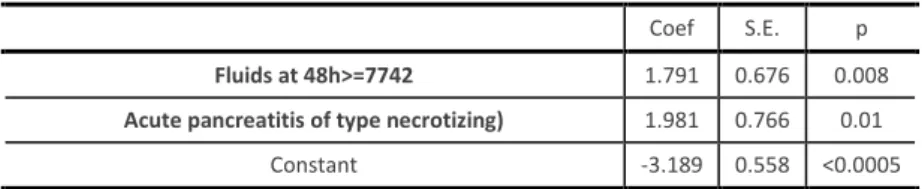
The AUC for the ROC curve of the fluids administrated at 48 hours was 0.72 (95%CI 0.53 – 0.91; p<0.012), suggesting an acceptable discriminant ability to distinguish patients with and without late complications. The ROC curve yielded the cutoff of 7742 ml for the amount of fluid, corresponding to a sensibility of 69.2% and a specificity of 76%. Thus, a fluid therapy above 7742ml pinpoints 69.2% of patients with late complications, and below 7742ml identifies 76% of patients with no late complications. Logistic regression modeling yielded the model presented in Table 3, which demonstrates that administration of more than 7742 ml of fluid in the first 48 hours is associated with late complications, regardless of the type of pancreatitis.
Table 3 - Logistic regression model to predict late complications
Coef S.E. p
Fluids at 48h>=7742 1.791 0.676 0.008
Acute pancreatitis of type necrotizing) 1.981 0.766 0.01 Constant -3.189 0.558 <0.0005
c. Presence of infection
The percentage of patients with infection was 12.8% and, again, this was associated with: - Younger age (55±15 vs 70±17, p=0.002);
- Type of colloid (in 57.1% of patients with infection no colloids were used, while this percentage rises to 80% in patients without infection, p=0.04)
- Type of acute pancreatitis – again a higher percentage of patients with necrotizing pancreatitis was present in patients with infection (50% vs 4.2%, p<0.0005);
- Higher values of fluids taken in the first 48 hours (9539.4±4274.3 vs 6984.8±1612.5, p=0.036).
The ROC curve for the amount of fluid given in the first 48h to depict the presence of infection had an AUC equal to 0.67 (95%CI 0.48 – 0.87; p=0.099), which is not significantly different from 0.5, meaning that there is no evidence that the amount of fluid at 48 hours can perform better than chance discriminating the patients with and without infection. Nevertheless, the ROC curve was used to choose a cutoff for the amount of fluid, for which a good compromise between sensitivity and specificity could be obtained. The cutoff identified was of 8556 ml with a sensitivity of 57.1% and a specificity of 86.3%.
Regression modeling yielded the model summarized in Table 4, from which we could deduce that independently of the type of pancreatitis, administration of more than 8556 ml of fluids in the first 48 hours is associated with the presence of infection.
Henriques, C., Pereira, J., Matos, A. C. & Afonso, C. (2018).
Complications of fluidotherapy in patients with acute pancreatitis: A contribution.
Millenium, 2(6), 23-31. DOI: https://doi.org/10.29352/mill0206.02.00160
m
5
29
Table 4 - Logistic regression model to predict presence of infection
Coef S.E. p
Fluids at 48h>=8556 1.685 0.704 0.017
Acute pancreatitis of type necrotizing) 2.736 0.79 0.001 Constant -3.003 0.495 <0.0005
d. Surgery Need
Only 14 patients (12.8%) required surgery and, again, this was associated with: - Younger age (59±17 vs 69±17, p=0.038);
- Type of colloid (in 57.1% of patients with need for surgery no colloids were used, while this percentage rises to 80% in patients without need for surgery, p=0.04)
- Type of acute pancreatitis – again a higher percentage of patients with necrotizing pancreatitis was present in patients with need for surgery (50% vs. 4.2%, p<0.0005);
- Amount of fluids taken in the first 48 hours (9712.1±4170.7 vs. 6959.3±1607.6 , p=0.005).
Additionally, need for surgery was associated with comorbidities (other than respiratory, cardiac, hematological and endocrine), which were present in 21.4% of patients with need for surgery and in 50.5% in those who did not need for surgery (p=0.042). The AUC of the ROC curve for the amount of fluid given in the first 48h was 0.73 (95%CI 0.56 – 0.91; p<0.005), and this again suggests an acceptable discriminant ability to distinguish patients with and without the need for surgery. A good compromise between sensitivity and specificity was found for the cutoff of 7182 ml, with a sensitivity of 71.4% and specificity of 64.2%. Hence, of all patients needing for surgery, 71.4% received more than 7182ml of fluids in the first 48h, while 64.2% of those without the need for surgery received less than that amount of fluids. The final model found by logistic regression modeling is presented in Table 5. The final model includes only the fluids variable, which means that no other variable could increase significantly the model’s explanatory ability.
Table 5 - Logistic regression model to predict surgery need
Coef S.E. p
Fluids at 48h>=7182 1.501 0.629 0.017 Constant -2.725 0.516 <0.0005
e. Systemic Complications and death
Systemic complications were present in 64% of the patients, while death only occurred in 11.9%. Patients with systemic complications had with higher values of CRP (23.7±13.4 vs. 15.0±10.4, p=0.001). No other variables revealed to be significantly associated with systemic complications. Concerning death, significantly higher values were found for the clinical scores. The APACHE II score had a median value of 12 (IQR 10-16) for the deceased, while for the survivors the median was 8 (IQR 6-12) (p=0.016). Ranson’s scores taken at 48h also tended to be higher in the group of deceased patients (p=0.007). In fact, the median value was equal to 2 (IQR 2-3) in the group of deceased patients, but only of 1 (IQR 1-2) in the group of survivors. For Marshall R, the median value was of 1 in both groups, but the interquartile range was 0-1 in the survivor's group and of 1-2 in the deceased group (p=0.009). Furthermore, CRP values were also significantly higher for the deceased patients (29.1±14.1 vs. 19.6±12.6, p=0.013).
Fluid therapy at 48 hours was not significantly associated with either of these two complications. Consequently, neither ROC curves nor logistic regression models were constructed to further explore the relation of fluid therapy at 48 hours with these two complications.
4. DISCUSSION
The importance of fluid therapy in acute pancreatitis cannot be overstressed and has been shown in several studies, as well as its relation to the development of complications (Stigliano et al. 2017). In this particular setting, literature has not been consensual, avoiding to give strict indications on the volume to administer because the results are quite disparate. Some authors advocate aggressive fluid therapy (Tenner et al. 2013) while others suggest some care and tighter surveillance (Gardner et al. 2008; Janish et al. 2016). In this study, fluid administration in the first 48 hours revealed an association with local, acute and late
Henriques, C., Pereira, J., Matos, A. C. & Afonso, C. (2018). Complications of fluidotherapy in patients with acute pancreatitis: A contribution.
Millenium, 2(6), 23-31. DOI: https://doi.org/10.29352/mill0206.02.00160
m
30
6
complications, the presence of infection and need for surgery. However, no significant relationship was observed between fluid therapy at 48 hours and death, nor with the occurrence of systemic complications. This, of course, raises the question of the “critical” value of fluids associated with each of the first four mentioned complications. Using ROC curves, cutoff values were found for each complication, trying to obtain a good compromise between sensitivity and specificity. For the first four mentioned complications, these values were between 7000 ml and 8600 ml, which means around 150 – 180 ml/hour. Furthermore, the binary variables defined by these cut-off values were significantly associated with the occurrence of the respective complication, demonstrating that exceeding these quantities in the administration of fluids at 48 hours is directly related to their appearance. For each complication, this association remained significant when investigated with multiple regression modeling. This study gives a contribution to the controversy about the effects of aggressive fluid therapy concerning the development of clinical complications and the need for surgery. It suggests that an aggressive fluid therapy may not be free from objections concerning the occurrence of some complications, which is also suggested in the literature (Mao et al., 2009). It is odd that no relationship was found between fluid therapy and the occurrence of death, given the importance of volume resuscitation in the treatment of acute pancreatitis and its association with several prognostic indicators as infection and need for surgery (Pereira et al., 2015). Eventually, the retrospective nature and sample size may contribute to this finding. Sample size and the convenience sampling procedure used in this study compromises the generalizability of the results. Indeed, this needs further investigation as this is an ongoing observational study, with more records being collected in other to further look into this matter.
CONCLUSIONS
High levels of fluid therapy in the first 48 hours were associated with the development of complications in this study, mainly acute local and late local complications. Also, patients with more aggressive fluid therapy had higher infection rates and needed more surgery in the treatment of their disease.
ACKNOWLEDGEMENTS
This work is financed by national funds through FCT - Fundação para a Ciência e Tecnologia, I.P., under the project UID/Multi/04016/2016. Furthermore, we would like to thank the Instituto Politécnico de Viseu and CI&DETS for their support. Additionally, this work was partially supported by the Centre for Mathematics of the University of Coimbra -- UID/MAT/00324/2013, funded by the Portuguese Government through FCT/MEC and co-funded by the European Regional Development Fund through the Partnership Agreement PT2020.
REFERENCES
Balthazar, E. J. (2002). Acute Pancreatitis: Assessment of Severity with Clinical and CT Evaluation. Radiology, 223(3), 603–613. http://doi.org/10.1148/radiol.2233010680
Banks, P. A., Bollen, T. L., Dervenis, C., Gooszen, H. G., Johnson, C. D., Sarr, M. G., Tsiotos, G. G. & Vege, S. S. (2012). Classification of acute pancreatitis--2012: revision of the Atlanta classification and definitions by international consensus. Gut, 62(1), 102– 111. http://doi.org/10.1136/gutjnl-2012-302779
Blumgart L. (2016). Surgery of the liver, biliary tract, and pancreas. Philadelphia, PA: Saunders Elsevier.
Dupuis, C. S., Baptista, V., Whalen, G., Karam, A. R., Singh, A., Wassef, W., & Kim, Y. H. (2013). Diagnosis and management of acute pancreatitis and its complications. Gastrointestinal Intervention, 2(1), 36–46. http://doi.org/10.1016/j.gii.2013.03.001 Gardner, T. B., Vege, S. S., Pearson, R. K. & Chari, S. T. (2008). Fluid Resuscitation in Acute Pancreatitis. Clinical Gastroenterology and
Hepatology, 6(10), 1070–1076. http://doi.org/10.1016/j.cgh.2008.05.005
Glasbrenner, B. & Adler, G. (1993). Pathophysiology of acute pancreatitis. Hepatogastroenterology. 40(6):517-521. Hosmer, D. W. & Lemeshow, S. (2000). Applied Logistic Regression (2nd edition). New York: John Wiley & Sons.
Janisch, N. H. & Gardner, T. B. (2016). Advances in Management of Acute Pancreatitis. Gastroenterology Clinics of North America, 45(1), 1–8. http://doi.org/10.1016/j.gtc.2015.10.004
Kalkwarf, K.J. & Cotton, B. A. (2017). Resuscitation for Hypovolemic Shock. Surgical Clinics of NA, 97(6), 1307–1321. http://doi.org/10.1016/j.suc.2017.07.011
Mao, E.Q., Tang, Y.Q., Fei, J., Qin, S., Wu, J., Li, L., Min, D. & Zhang, S.D. (2009). Fluid therapy for severe acute pancreatitis in acute response stage. Chinese Medical Journal, 122(2), 169–173. http://doi.org/10.3760/cma.j.issn.0366-6999.2009.02.011
Henriques, C., Pereira, J., Matos, A. C. & Afonso, C. (2018).
Complications of fluidotherapy in patients with acute pancreatitis: A contribution.
Millenium, 2(6), 23-31. DOI: https://doi.org/10.29352/mill0206.02.00160
m
5
31
Nasr, J. Y. & Papachristou, G. I. (2011). Early Fluid Resuscitation in Acute Pancreatitis: A Lot More Than Just Fluids. Clinical Gastroenterology and Hepatology, 9(8), 633-634. http://doi.org/10.1016/j.cgh.2011.03.010
Pereira, J., Constantino, J., Duarte, L., Pinho, H., & Pinheiro, L. (2015). Surgical treatment of severe acute pancreatitis: After 15 years of practice. International Journal of Hepatobiliary and Pancreatic Diseases, 5, 74-81. http://doi.org/10.5348/ijhpd-2015-38-OA-13
Pollock, A. V. (1959). Acute pancreatitis; analysis of 100 patients. British Medical Journal, 1(5113), 6–14.
Stigliano, S., Sternby, H., de Madaria, E., Capurso, G., & Petrov, M. S. (2017). Early management of acute pancreatitis: A review of the best evidence. Digestive and Liver Disease, 49(6), 585–594. http://doi.org/10.1016/j.dld.2017.01.168
Tenner, S., Baillie, J., DeWitt, J. & Vege, S. S. (2013). American College of Gastroenterology guideline: management of acute pancreatitis. The American Journal of Gastroenterology, 108(9), 1400–1415. http://doi.org/10.1038/ajg.2013.218
Yang, C. J., Chen, J., Phillips, A. R. J., Windsor, J. A., & Petrov, M. S. (2014). Predictors of severe and critical acute pancreatitis: A systematic review. Digestive and Liver Disease, 46(5), 446–451. http://doi.org/10.1016/j.dld.2014.01.158