DIMAS DE CASTRO
E SILVA NETO
CONTRIBUTOS PARA OS PROCESSOS DE
GOVERNANÇA E RENEGOCIAÇÃO DAS
PARCERIAS PÚBLICO-PRIVADAS NO BRASIL
CONTRIBUTIONS TO THE GOVERNANCE AND
RENEGOTIATION PROCESSES OF
DIMAS DE CASTRO
E SILVA NETO
CONTRIBUTOS PARA OS PROCESSOS DE
GOVERNANÇA E RENEGOCIAÇÃO DAS
PPPS BRASILEIRAS
Tese apresentada à Universidade de Aveiro para cumprimento dos requisitos necessários à obtenção do grau de Doutor em Engenharia Civil, realizada sob a orientação do Doutor Carlos Paulo Oliveira da Silva Cruz, Professor Auxiliar do Departamento de Engenharia Civil, Arquitetura e Georecursos do Instituto Superior Técnico da Universidade de Lisboa e coorientação da Doutora Maria Fernanda da Silva Rodrigues, Professora Auxiliar do Departamento de Engenharia Civil da Universidade de Aveiro e do Doutor Paulo António dos Santos Silva, Professor Auxiliar do Departamento de Ciências Sociais, Políticas e do Território da Universidade de Aveiro.
Este trabalho teve apoio financeiro da Fundação Cearense de Apoio ao Desenvolvimento Científico e Tecnológico – FUNCAP/SECITECE, Brasil, através da bolsa de doutoramento do PROGRAMA DE BOLSAS DE DOUTORADO FORA DO ESTADO – EDITAL No. 07/2015.
DIMAS DE CASTRO
E SILVA NETO
CONTRIBUTIONS TO THE GOVERNANCE AND
RENEGOTIATION PROCESSES OF PUBLIC-PRIVATE
PARTNERSHIPS IN BRAZIL
This thesis is submitted to the University of Aveiro to fulfil the necessary requirements for the degree of Doctor of Philosophy in Civil Engineering, performed under the scientific supervision of Carlos Paulo Oliveira da Silva Cruz, Assistant Professor of the Department of Civil Engineering, Architecture and Georesources at the Instituto Superior Técnico of the University of Lisbon, and the co-supervisions of Maria Fernanda da Silva Rodrigues, Assistant Professor of the Department of Civil Engineering at the University of Aveiro, and Paulo António dos Santos Silva, Assistant Professor of the Department of Social, Political and Terrritorial Sciences at the University of Aveiro.
This work was funded by Fundação Cearense de Apoio ao Desenvolvimento Científico e Tecnológico - FUNCAP / SECITECE, Brazil, through the doctoral scholarship of the PROGRAMA DE BOLSAS DE DOUTORADO FORA DO ESTADO – EDITAL No. 07/2015.
o júri
presidente Doutor Eduardo Anselmo Ferreira da Silva
Professor Catedrático, Universidade de Aveiro
Doutor Humberto Salazar Amorim Varum
Professor Catedrático, Universidade do Porto
Doutor José Manuel Cardoso Teixeira
Professor Associado Com Agregação, Universidade do Minho
Doutor Amílcar José Martins Arantes
Professor Auxiliar, Universidade de Lisboa
Doutora Marlene Paula Castro Amorim
Professor Auxiliar, Universidade de Aveiro
Doutor Carlos Paulo Oliveira da Silva Cruz
the jury
chairman Doctor Eduardo Anselmo Ferreira da Silva
Full Professor, University of Aveiro
Doctor Humberto Salazar Amorim Varum
Full Professor, University of Porto
Doctor José Manuel Cardoso Teixeira
Associate Professor with Aggregation, University of Minho
Doctor Amílcar José Martins Arantes
Assistant Professor, University of Lisboa
Doctor Marlene Paula Castro Amorim
Assistant Professor, University of Aveiro
Doctor Carlos Paulo Oliveira da Silva Cruz
agradecimentos /
acknowledgements Throughout this challenging and enriching journey many were the people who, in many ways, gave me support and encouragement. First of all, my thanks to Professors Humberto Varum (Faculty of Engineering of the University of Porto) and Miguel Branco (Univeristy Fernando Pessoa), who together with Professor Paulo Silva, were the first supervisors of this work. To these, my great thanks for the attention in the early stages of the research, which with generosity and readiness contributed to structure the embryo of this thesis. I thank all my colleagues, professors, workers, PhD students and researchers from the Civil Engineering Departments of the University of Aveiro and the Superior Technical Institute of the University of Lisbon - UL, for the support and camaraderie. My gratitude also to the colleagues of the Science and Technology Center, the Civil Engineering Course and the Superior Administration of the Federal University of Cariri, namely Professors Fernando Silva (now a professor at the Federal University of Ceará), Ary Ferreira, Jeová Torres and the Magnificent Rector Ricardo Ness for always help and assist me in the accomplishment of this journey. I would also like to thank Professor Joaquim Sarmento (Institute of Economics and Management of the UL) for his valuable academic contribution in the theme of renegotiations. I also thank the Secretaries of the Brazilian State Governments and their staff, who kindly analysed and answered the questionnaires sent by me, so useful and that gave robustness to this thesis. I want to thank gratly the new supervisor and co-supervisor, Professors Carlos Oliveira Cruz and Fernanda Rodrigues, who very kindly accepted the invitation to guide this PhD and effectively dedicated a lot of time, knowledge and patience, without which this thesis would not be possible. By the fellowship and friendship of all these, I am very grateful and indebted for ever and ever. Finally, I dedicate this work to my parents and sisters, to whom I owe everything I am. To my friends, old and new, especially Emerson Araújo, Pedro Jorge de Castro, Margarete, Lucimar, Eulália Pontes, Rui Costa, Thiago Silva and Regina Modolo, who have helped me so much in this crossing. My girlfriend Caroline Câmara, great motivator and companion of all hours. My daughter Maria Alice, for the sacrifice caused by my absence during this period, compensated by my unconditional love and by the belief that children are inspired by their parents' example.
palavras-chave Parcerias Público-Privadas, Desenho de Contratos, Governança, Renegociação.
resumo Proposta: O acelerado desenvolvimento económico registado nas economias emergentes, como o Brasil, vem colocar nos últimos anos uma pressão acrescida no desenvolvimento de infraestruturas com impactos relevantes ao nível das necessidades de financiamento. A Parceria Público-Privada (PPP) é um instrumento, utilizado mundialmente, para contratação pública de projetos de grande porte. Sua utilização se dá pela concessão de obra ou serviço público a um parceiro privado, por um determinado período de tempo, incluindo significativo financiamento do privado. As PPPs são vistas como aceleradoras do desenvolvimento, pois se caracterizam como uma maneira rápida de aprovar e executar projetos de infraestrutura. No entanto, na América Latina e mais especificamente no Brasil, as experiências recentes resultaram num grande número de renegociações contratuais que transformam os benefícios sociais e econômicos, esperados por parte dos setores público e privado, em prejuízos de ordem financeira e atrasos na entrega e operação destas infraestruturas.
O objetivo deste trabalho é revisar a literatura sobre o tema das PPPs, com o foco nas áreas de governança e renegociações, e assim analisar e comparar com as experiências das PPPs brasileiras, apontando debilidades e sugerindo melhoramentos nestes processos que resultem em ganhos de qualidade em sua aplicação.
O método utilizado para o desenvolvimento desta pesquisa será: o descritivo, conduzido através de revisão bibliográfica de caráter exploratório buscando um maior conhecimento sobre o assunto em estudo, seguido de estudos de caso, análise dos resultados e a proposição de melhoramentos nestes processos.
Resultados: A investigação apresenta contributos nos processos de governança e renegociação das PPPs Brasileiras que resultem em ganhos de qualidade, aplicabilidade e viabilidade na aplicação desta modalidade de contrato.
Conclusão: A investigação obteve um conjunto de contributos nos processos de governança e renegociação de contratos, que auxiliam os setores público e privado na otimização dos resultados económicos e financeiros nas PPPs Brasileiras.
keywords Public-Private Partnership, Contract Design, Governance, Renegotiation.
abstract Proposal: The rapid economic development registered in emerging economies, such as Brazil, have in recent years placed increased pressure on infrastructure development with significant impacts in terms of financing needs. The Public-Private Partnership (PPP) is an instrument, used worldwide, for public procurement of major projects. Its use occurs through concession projects or public service to a private partner, for a specified period of time, including significant funding from the private. PPPs are seen as accelerators of development, since they are characterized as a quick way to approve and implement infrastructure projects. However, in Latin America and more specifically in Brazil, recent experiences have resulted in a large number of contractual renegotiations that transform the expected social and economic benefits of the public and private sectors into financial losses and delays in delivery and operation of these infrastructures.
The objective of this study is to review the literature on the subject of PPPs, with the focus on the areas of governance and renegotiations, and thus to analyze and compare with the experiences of Brazilian PPPs, pointing weaknesses and suggesting improvements in these processes that would result in quality gains in its application.
The method used for the development of this research are: the descriptive, conducted through exploratory literature review seeking a better understanding of the subject under study, followed by case studies, analysis of results and proposing improvements in these processes.
Results: The research presents contributions in the processes of governance and renegotiation of Brazilian PPPs resulting in gains of quality, applicability and feasibility in applying this type of contract.
Conclusion: The research obtained a set of contributions in the processes of governance and renegotiation of contracts, to assist the public and private sectors in the optimization of economic and financial results in the Brazilian PPPs.
i
Table of Contents
Chapter 1 – Introduction
1
1.1 Preliminary remarks 2
1.1.1 The need of infrastructure in developing countries 2
1.1.2 Lack of infrastructure in Brazil: barriers to the growth 3
1.1.3 Disadvantages of the PPPs: learning with the mistakes 3
1.2 Objectives 4
1.3 Research questions 5
1.4 Methodological structure 5
1.5 General organization 7
Chapter 2 – PPP Projects: Literature Review
92.1 Introduction 10
2.2 Methodology and data 13
2.3 Literature analysis 14 2.3.1 Number of papers 15 2.3.2 Journals 15 2.3.3 Research areas 16 2.3.4 Research origins 17 2.3.5 Geographic scope 18 2.3.6 Project sector 19 2.3.7 Research topics 20
2.3.8 Most cited papers 23
2.4 Research limitations of the literature review 25
2.5 Partial conclusions 25
Chapter 3 – PPP Units and Governance
27
3.1 Introduction 28
3.2 Literature review on PPP units and governance 34
3.3 Brazilian´s PPP program review 38
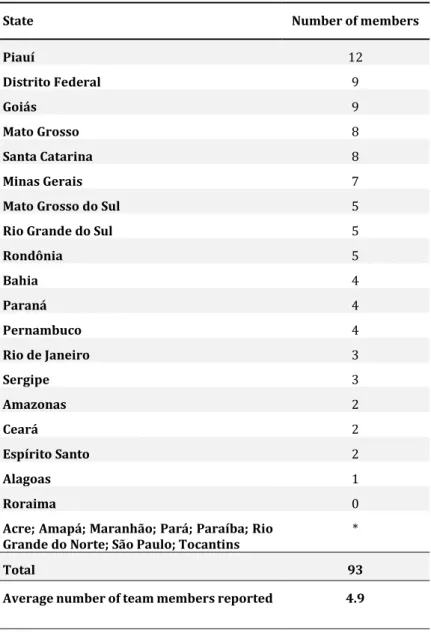
ii 3.5 Comparative analysis 43 3.5.1 PPP unit governance 43 3.5.1.1 Sponsoring departments 43 3.5.1.2 Staff 44 3.5.1.3 Number of PPP laws 45 3.5.1.4 Transparency 46 3.5.2 PPP infrastructure growth 48
3.5.2.1 Number of PPP projects identified per state 48
3.5.2.2 Projects sectors 50
3.5.2.3 Type of projects 51
3.5.2.4 Type of concession 52
3.5.2.5 Procurement process 52
3.5.3 PPPs´ Contract Management 53
3.5.3.1 Number of PPPs per stage 53
3.5.3.2 Number of contracts amended and contractual amendments 54
3.6 Research limitations of the PPP units and governance 56 3.7 Results discussion and partial conclusions 57
Chapter 4 – Overview of Brazilian Renegotiations
61
4.1 Introduction 62
4.2 Literature review of PPPs and renegotiations 65
4.3 Methodology and data 70
4.4 Results and discussion 72
4.4.1 Renegotiations per sector 72
4.4.2 Renegotiations by region (State) 76
4.4.3 Renegotiations by year and motives 78
4.4.4 Renegotiations by demand risk 85
4.4.5 Renegotiations by type of shareholders 86
4.4.6 Renegotiations by electoral cycle and political party 88
4.4.7 Econometric analysis 91
4.5 Policy implications 92
iii
Chapter 5 – Renegotiation determinants and consequences 95
5.1 Introduction 96
5.2 PPPs, renegotiations and the Latin American context 98
5.3 Data and Methodology 102
5.4 The Brazilian experience in transport PPPs 106
5.5 Results 108 5.6 Policy implications 113 5.7 Partial conclusions 116
Chapter 6 – Conclusions
117
6.1 General findings 118 6.2 Governance 119 6.3 Renegotiations 120 6.4 Further developments 122References
123
Appendix
137
S.1 PPP papers identified in the bibliometric analysis from 1991 to 2014 137 S.2 PFI papers identified in the bibliometric analysis from 1991 to 2014 154 S.3 PPP projects identified in the Brazilian states’ governments 158
v
Index of figures
Figure 1. Infrastructure investment as percentage of GDP 2
Figure 2. Thesis structure 7
Figure 3. Number of papers per year 15
Figure 4. Ranking of top 10 journals publishing PPP and PFI papers 16 Figure 5. Number of papers in the top 10 rankings by research areas 17
Figure 6. Number of papers per country 18
Figure 7. Number of papers by rank of countries´ geographic scope 18 Figure 8. Number of papers per topic of United Kingdom, China and United States 23 Figure 9. Number of sponsoring departments responsible for PPP units 44
Figure 10. Number of PPP laws approved per year 46
Figure 11. Number of projects per stage and state 49
Figure 12. Projects contracted or appraised by sector 50 Figure 13. Projects contracted and appraised for type of project 51 Figure 14. Number of projects per type of concession 52 Figure 15. Number of biddings documents published and contracts signed per year 53
Figure 16. Number of projects per PPP stage 54
Figure 17. Number of contracts amended and contractual amendments per state 55
Figure 18. PPPs and renegotiation events per year 79
vii
Index of Tables
Table 1. Summary of recent PPP literature reviews 12
Table 2. Profile of the analyzed publications 14
Table 3. Number of papers per project sectors 19
Table 4. Research topics, related description of issues, and number of papers 21
Table 5. Top 10 papers in number of citations 24
Table 6. Summary of Brazilian´ PPP units 31
Table 7. Summary of recent PPP units´ academic research 35 Table 8. Profile of the analyzed Brazilian states´ PPP units 42
Table 9. Number of staff members per PPP unit 45
Table 10. Type of information available in the PPP unit’s websites 48 Table 11. Synthesis of renegotiations’ academic research 66 Table 12. Determinants of PPP renegotiations in Latin America 69
Table 13. Data collected for each concession 70
Table 14. Renegotiation events per sector (Panel A – Totals per sector) 74 Table 15. Renegotiation events per sector (Panel B – Data per PPP) 75
Table 16. Renegotiation events per state 77
Table 17. Renegotiation motives 80
Table 18. PPPs renegotiated per State by sector and main motives for renegotiation 83
Table 19. Renegotiations per type of demand risk 86
Table 20. Renegotiations per type of shareholder: type of shareholder per PPP 87 Table 21. Renegotiations per type of shareholder: renegotiations by type of shareholders 88 Table 22. Renegotiations during the years of government 89 Table 23. Number of State mandates per type of political party
(Panel A – Mandates by political party) 90
Table 24. Number of State mandates per type of political party
(Panel B – Number of renegotiations by political party) 91
Table 25. Results from the probit model 91
Table 26. Determinants of PPPs renegotiations in Latin America 100
Table 27. Variables definition 105
viii
Table 29. Sector data 109
Table 30. Transport Renegotiations events 110
Table 31. Renegotiations motives (in Transport sector PPPs) 111
ix
Acronyms
AC State of Acre
ANAC Agência Nacional de Aviação Civil
AL State of Alagoas
AP State of Amapá
AM State of Amazônia
ASCE American Society of Civil Engineers
BA State of Bahia
CE State of Ceará
CITTA Centro de Investigação do Território Transportes e Ambiente
CM Contract Management
CP Contract Performance
CPPP Coordenação de Parcerias Público-Privadas DF Brazilian Federal District
ECGI European Corporate Governance Institute EOI Procedure for expression of interest ES State of Espírito Santo
GO State of Goiás
GPD Gross Domestic Product
GPPPP Gerência do Programa de Parcerias Público-Privadas FEUP Faculdade de Engenharia da Universidade do Porto FIFA International Federation of Association Football IBGE Instituto Brasileiro de Geografia e Estatística IPP Investment Partnerships Program
ISI Web of Science
MG State of Minas Gerais
MP Ministério do Planejamento, Desenvolvimento e Gestão MS State of Mato Grosso do Sul
MT State of Mato Grosso
PFI Project Finance Initiative
x
PE State of Pernambuco
PI State of Piauí
PI Performance Indicators
PPIAF Public-Private Infrastructure Advisory Facility PPP Public-Private Partnership
PR State of Paraná
PSC Public Sector Comparator
PSDB Partido da Social Democracia Brasileira
PT Partido dos Trabalhadores
P3 Public-Private Partnership
P³ Public-Private Partnership
RJ State of Rio de Janeiro RN State of Rio Grande do Norte RS State of Rio Grande do Sul
RO State of Rondônia
RR State of Roraima
SC State of Santa Catarina
SE State of Sergipe
SEAD Secretaria de Administração
SEDEME Secretaria de Desenvolvimento Econômico, Mineração e Energia SEDES Secretaria de Estado de Desenvolvimento
SEDEIS Secretaria de Desenvolvimento Econômico Energia Ind. e Serviços SEFAZ Secretaria da Fazenda do Estado da Bahia
SEGOV Secretaria de Governo
SEPLAG Secretaria de Estado do Planeamento, Gestão e Patrimônio SEPLAN Secretaria de Palnejamento
SEPOG Secretaria do Planeamento e Gestão
SP State of São Paulo
SUPARC Superintendência de Parcerias e Concessões
TO State of Tocantins
UK United Kingdom
URL Uniform Resource Locator
xi
USP Unsolicited proposal
1
2
1.1 Preliminary remarks
1.1.1 The need of infrastructure in developing countries
The rapid economic development of Brazil in recent years demand costly infrastructure investments. Brazil, as well as others developing countries, needs many of these projects and demand solutions to make them feasible. The Public-Private Partnership (PPP) is a tool used worldwide to enable large projects. Its use occurs through delegation of the public goods or services to the private sector. In Brazil, the insufficient existent infrastructure has limited the volume of private investment and slowing the nation's economic growth, compared to other emerging countries such as China and India (see Figure 1). The PPPs in this context are presented as an option in solving this problem (Frischtak, 2008).
Figure 1. Infrastructure investment as percentage of GDP
Source: Adapted from Frischtak (2008)
PPPs are viewed as accelerators of development, since they are characterized as a quick way to approve and implement infrastructure projects. Currently, Brazil has started the implementation of this form of contract, demonstrating their interest through the implementation of PPP programs in the three spheres: municipal, state and federal. According to Radar PPP (2016), there were 86 PPPs contracts signed in Brazil: one is
15,40% 9,90% 7,30% 6,20% 5,80% 5,63% 3,60% 2,03% Thailand Vietnam China Chile Colombia India Philippines Brazil
3
under federal jurisdiction, 48 under state jurisdiction and 37 developed by municipalities.
1.1.2 Lack of infrastructure in Brazil: barriers to the growth
Designed as an alternative to financial inability of governments to invest in infrastructure, PPPs have been regulated nationwide for 15 years, by Federal Law no. 11,079/04 (President of the Republic of Brazil, 2004). Before that, some Brazilian states, such as Minas Gerais and São Paulo, had already published their own laws establishing the state programs of PPP. São Paulo´s metro yellow line number 4 was the first Brazilian project applying PPP, followed by the state of Minas Gerais with the PPP of MG-050 highway and the state of Bahia with the project of the outfall sewer. Since then, all states, and some wealthier cities, have invested in the idea of PPPs contracts for the development of their infrastructures and economies (Radar PPP, 2016).
Beyond these infrastructure demands for the growth of investments in the industry, there is a growing interest of private companies and public sector in forming partnerships that will meet the developing countries demands of infrastructure, such large projects. In the Brazilian case, as example, the WORLD CUP 2014 and the 2016 Olympic Games were recently among the major PPP challenges of civil engineering and financial arrangements.
1.1.3 Disadvantages of the PPPs: learning with the mistakes
PPPs have been devised to serve the public's interest in providing infrastructure to improve the quality of life of the citizen and the progress of the nation. In spite of that, public power has not always been able to extract from these PPPs the social and economic benefits simultaneously. In seeking a solution to this, establish and strengthen PPP units are essential in order to help both public and private sector to develop and successfully implement PPP projects (Dutz et al. 2006, Istrate and Puentes, 2011). Brazil, as a developing country, has its budget constrained and cannot afford to
4
have losses from poorly managed contracts that result in financially disadvantageous renegotiations.
1.2 Objectives
The main objective of the thesis is to review the literature on the subject of PPPs, with the focus on the areas of governance and renegotiations, and thus to analyse and compare with the experiences of Brazilian PPPs, pointing weaknesses and suggesting improvements in these processes that would result in quality gains in its application. Narrowing down, it is possible to disaggregate in several smaller objectives:
• Identify the gaps of PPP management by literature research available on the Web of Knowledge, and examine the academy's interest in the subject of PPPs; the most searched infrastructure sectors; the most studied subjects within the theme of PPPs; • Analyse the Brazilian state PPP units and programs´ development, identifying the challenges in the governance of PPPs in Brazil, looking at three main dimensions of governance model, PPP infrastructure growth and PPP contract management, pointing out the most fragile areas and proposing mitigation strategies;
• Identify the patterns of PPP renegotiations for infrastructure projects in Brazil, the recurring problems of contract renegotiation, who caused, when and the reasons why it occurs to suggest improvements on the processes, increasing the chances of successful PPPs;
• Understand, from the previous experience in Latin America, the main drivers for Brazilian PPPs renegotiation, what are the main determinants and consequences, in order to improve institutional and regulatory framework, decreasing the likelihood of renegotiation.
5
1.3 Research Questions
In order to achieve the above-mentioned objectives, some targeted research questions were developed:
• Where are the literature gaps? There is growing interest in the subject? Where and who has developed the publications on these issues? What are the most searched infrastructure sectors? What are the more covered research areas and research topics? • Who are the state Brazilian PPP Units? How these PPP Units are organized and what the main results they have been? What are the main obstacles of PPPs in Brazil? What are the main challenges? What are the solutions and general recommendations to overcome these obstacles?
• What are the main determinants and motives of Brazilian PPP renegotiations? Who were responsible for triggering the renegotiation? What are the implications involving renegotiations by electoral cycle and political party?
• How to improve the Brazilian PPP programs, to reduce and minimize the likelihood and unwanted consequences of renegotiation?
1.4 Methodological structure
The current thesis is organized into two parts, with different methodological structures. In the initial part, an overview of PPP and Project Finance Initiative (PFI) academic researches is investigated and depicted as the thesis background for the accomplishment of the research that will be developed in the next chapters. In the following part, the contributions to improve the PPPs governance and renegotiation processes will be pointed out.
In a close view, the initial part consists on an exhaustive research of existing literature, examining more than 600 papers published in Web of Knowledge journals, between 1991 and 2014. It was performed a bibliometric analysis, focusing on the fields covered
6
by the papers, the main authors, countries, or sectors, among other types of information.
The contributions part focused on the Brazilian PPP experience, to improve the program, in two main areas: governance and renegotiations of contracts. The focus on these two areas arises from a crosscheck analysis between the main critical questions identified in Part I, the identification of literature gaps, and the considerable evidence regarding the difficulty encountered from public and private sectors to create robust contracts that reduce renegotiation events, thus achieving the initially wished projects´ results. In each area the approach consisted in using real data, developing schemes to analyse and compare the data to propose improvements in these processes.
The methods adopted in each chapter, were selected according to the specificity of the questions to be answered, and each methodology will be detailed and explained further. In these two areas, it is believed that substantial contributions to the Brazilian PPP experience have been made.
7
1.5 General Organization
The proposed methodology resulted in the following organization of the thesis, as illustrated in Figure 2.
Figure 2. Thesis structure
Chapter 5. Conclusion & Further
Developments
Part II – Contributions for improving Brazilian PPPs Part I – Overview of PPP academic research
Chapter 1. Introduction Chapter 2. Literature Review Thesis structure PPP life cycle Chapter 4. Overview of Brazilian Renegotiations Chapter 3. PPP Units & Governance Project Appraisal Feasibilty studies Briefing Contract Stages Operation & Maintenance Construction Termination Procurement Preparation Feasibilty studies Briefing Chapter 5. Renegotiations determinants and consequences
9
Chapter 2.
10
2.1 Introduction
1PPPs are a procurement model used to deliver public infrastructure and/or services, typically in the sectors of transport, energy, environment, health, security or education. The economic rationale of the PPP model is that when exposed to risk, or with the probability of losses, the private sector can achieve a higher level of efficiency, thus increasing the value for money of the projects (Bennett and Iossa, 2006; and Meda, 2007). PPP development is built upon the possibility of achieving higher efficiency gains and the access to private capital in a context of public funding shortage, providing an alternative for Governments to develop their infrastructure development plans. But these potential upsides are not “free of charge”. There are many costs, or pitfalls, the most relevant being the vulnerability to uncertainty of long-term contracts, often renegotiated, with severe impacts on the public sector and/or directly on users (e.g. increase in fares, decreases in the level of quality of the service, etc.) (Hart, 1988; Guasch, 2004).
PPP have been mentioned in the literature with different acronyms, as example: PPP, PFI, P3 or P³. The most popular, and worldwide used, is PPP, although PFI was the very first term adopted by British government and the term used in the first published paper addressing the subject in 1950, question the role of private financing in hospitals (Mignon, 1950). Since then, according to the Web of Science database, less than 70 papers were published until 1991. Is particularly after 2000 that the literature on PPPs has expanded significantly, with a stronger growth rhythm over the last 5 years. The theory has followed the practice in the case of PPPs, considering that it was in the late 1980’s and early 1990’s that the model became more used.
This chapter intends to provide a unique overview of the evolution and trends of PPP papers in the academia. This type of analysis is highly conditioned by the database used (existing data bases, simple search over the web, etc.), and it was adopted a well-established repository – Web of Science – to decrease the discretionary of the search. Historically, there have been papers addressing literature reviews on PPPs although
1 The content of this chapter was published in the paper “Bibliometric analysis of PPP/PFI literature:
11
with limit focus (sample), areas and industries, or type of analysis. A summary of these papers is presented in Table 1.
This bibliometric analysis has identified all publications in the Web of Science on PPP and PFI, in a total of more than 600 papers, in more than 300 high quality journals, since 1990. This provides the largest database ever used. The papers were analysed and classified in 14 topics, almost the double of the size of the widest previous researchs attempt of previous papers.
12
Table 1. Summary of recent PPP literature reviews
Literature review Al-Sharif and Kaka (2004) Weihe´s (2008) Kwak et al. (2009) Ke et al. (2009) Tang et al. (2010) Papajohn et al. (2011) Marsilio et al. (2011) Andon (2012) Garvin and Gross (2012) Chen et al. (2015) Current research Number of journals analysed 4 - - 7 6 - - ≥ 25 Google Scholar 140 - 310 Number of papers 34 - - 170 107 - 298 97 278 95 575 Period of analysis 1998-2003 - - 1998-2008 1998-2007 - 2008 2010 1997-2010 2002-2014 1991-2014 Research categories 3 4 (approaches) - 7 - - - - 8 5 14 Type of research No bibliometric No bibliometric No bibliometric No bibliometric No bibliometric Questionna rie Bibliometric analyses * Partial bibliometric analyses** Bibliometric analyses*** Meta-analyses Bibliometric analyses *
Research area Construction
journals Not specific Not specific
Construction journals
Construction journals
Transporta
tion Not specific Accounting
Transportati on
Transpor
tation All areas
Geographical
scope Not specific Not specific Not specific Not specific Not specific
United
States Not specific Not specific Not specific
Not
specific All regions
13
2.2 Methodology and data
The first step of the research was to define which of the existing scientific repository to use. Previous works, such as Al-Sharif and Kaka (2004), Ke et al. (2009) and Tang et al. (2010) have elected a sample of specific journals while others as Chen et al. (2015) preferred to define the sample using their work experience based on journal papers, government reports, conference papers, independent studies, dissertations and seminar discussion papers. Although there were others academic digital database available, the chosen one was the Web of Science database, because its comprehensiveness and scientific robustness. Although Andon (2012) and Gavin and Gross (2012) have resorted to the Google Scholars database, it was preferred to follow Marsilio et al. (2011) experience adopting the Web of Science database. The chosen temporal interval was from 1990 to 2014. Appendix S1 and S2 provide the list of papers for “PPP” and “PFI” respectively. The last enquiry (Web of Science´s webpage) was made in March 6th of 2015.
After the identification of all papers, a database was created in order to catalogue the papers information according the following criteria: date of publication, title, authors, journal of publication, research country origin, geographic scope, project sector, research area, main findings and research topics. The database analysis identified papers without basic information such as, the publications date, author’s names, researchers` origins, research areas or even the abstract itself. The database includes a total of 626 papers. However, 51 papers were excluded because they did not met the necessary conditions to be selected and analysed, due to several reasons: papers double registration in the Web of Science´s webpage; papers not related with the research (papers that just mention PPP as the procurement model adopted in their searches, without cannot be related to none of the research topics analysis). After this, the final sample resulted in 575 papers, 455 for PPPs and others 120 for PFIs (see Table 2).
14
Table 2. Profile of the analysed publications
Profile Number of papers Percentage (%)
Total publications in Web of Science with the topics PPP and Public-Private
Partnership (filter use of the term Article) 488 78
Total publications in Web of Science with the topics PFI and Private Finance
Initiative (filter use of the term Article) 138 22
Total of papers before analysis 626 100
Papers excluded because their abstracts are written in other languages
different from English 10 1.60
Papers excluded because do not have abstracts 14 2.24
Papers excluded because have been registered twice 06 0,96
Papers excluded because do not are related with the research area.2 10 1.60
Papers removed from the initial list because its objectives and/or conclusions
have not been clearly presented or do not exist 11 1.76
Total of papers excluded before analysis 51 8.15 Total of papers analysed in this research 575 100
2.3 Literature analysis
The literature analysis will look at the evolution of the quantity of papers, the main publishing journals, research areas, research origins (countries where the authors are affiliated), geographic scope (data or case study geographic provenience and/or location), project sector, research topics (main issue addressed based on proposed 14-categories classification) and a list of most cited papers.
2 Papers that cited the expressions PPP and/or PFI, but in fact do not explore the theme. It was notice,
mainly in papers that comes from medical, chemistry, telecommunications and biological areas, where they usually made reference to the terms just to point out the sort of model that had financed its projects.
15
The results show that, for both PPP and PFI acronyms, there is a growing number of papers as a result of an increasing attention that the academia is devoting to this subject (see Figure 3). Since 2002, the growth has been almost exponential and it is likely that it will continue over the next decade, despite the slight decrease of the number of papers verified in 2014 particularly taking into account that over the last 10 years the number of projects developed worldwide has increased substantially.
Figure 3. Number of papers per year
The number of publications with the acronym “PPP” has increased consistently, but the same does not happen with “PFI”. It would probably be the result of a more generalized use of the PPP term for British influenced authors that used PFIs acronym in the past and are progressively abandoning the term.
2.3.2 Journals
The two most relevant journals publishing about PPPs are the Journal of Construction Engineering and Management-ASCE that published 33 papers, and the Public Money & Management, with 31 papers published. Considering the list of research areas catalogued by the Web of Science, the journal in first place belongs to “Engineering” area and the second place journal to “Business Economics” area.
0 10 20 30 40 50 60 70 80 90 1991 1992 1993 1994 1995 1996 1997 1998 1999 2000 2001 2002 2003 2004 2005 2006 2007 2008 2009 2010 2011 2012 2013 2014 PPP PFI PPP+PFI
16
Other finding is that these 2 research areas dominate the “Top 10” journals ranking, each of them with 4 journals with the great number of publications about PPP and PFI (see Figure 4).
Figure 4. Ranking of top 10 journals publishing PPP and PFI papers 2.3.3 Research areas
As mentioned earlier the 2 leading areas are engineering and public administration, with 161 and 144 papers respectively. In third cames business & economics, with 120 papers. Thenceforth, the other sectors together represent a little more than 1/3 of the total of papers (see Figure 5). These outcomes evidence the multidisciplinary nature of PPP research, involving typically technical contents (engineering), public policy concerns given that they are used to develop and manage public services (public administration), but also include complex financing mechanisms and business models (business & economics).
33 31 18 17 14 10 9 9 8 8 JOURNAL OF CONSTRUCTION ENGINEERING
AND MANAGEMENT-ASCE
PUBLIC MONEY & MANAGEMENT JOURNAL OF MANAGEMENT IN ENGINEERING INTERNATIONAL JOURNAL OF PROJECT
MANAGEMENT
TRANSPORTATION RESEARCH RECORD PUBLIC PERFORMANCE & MANAGEMENT
REVIEW
PUBLIC ADMINISTRATION AND DEVELOPMENT
INTERNATIONAL JOURNAL OF STRATEGIC PROPERTY MANAGEMENT
BAUINGENIEUR AUSTRALIAN JOURNAL OF PUBLIC
17
Figure 5. Number of papers in the top 10 rankings by research areas
2.3.4 Research origins
Between the 72 countries with researchers publishing about the PPPs theme, UK stands out at the top of the list with 122 papers. China appears in second place, followed by USA, with 72 and 62 papers respectively. Australia is in the fourth place, with 34 papers published, followed by Portugal, Germany, Switzerland, Italy, Spain, India, Brazil, Netherlands, Taiwan and Belgium, that published between 15 and 10 papers each one (see Figure 6).
144 120 53 44 43 34 22 20 19
18
Figure 6. Number of papers per country 2.3.5 Geographic Scope
Regarding, the scope by country, the UK stands out at the top of the list with 97 papers. China appears in second place, followed by Korea, with 51 and 38 papers respectively. Here, USA was in fourth place, with 32 papers published. After this, Australia cames with 22 papers and is worth mentioning India and Brazil with 17 and 13 papers, followed by Portugal with 12 papers published (see Figure 7).
Figure 7. Number of papers by rank of countries´ geographic scope
122 72 62 34 15 13 13 12 12 12 11 11 10 10 8 8 97 51 38 32 22 17 13 12 11 9
19
In this section it is analysed what was the primary sector of the papers. The 13 sector classification selected were: Transportation, Health, Environment, Education, Housing, Energy, Agriculture, Communication, Security, Tourism, Sports, Urban regeneration and Mining. The results show that the 2 leading sectors are Transportation and Health, with 98 and 91 papers respectively.
Over the last two decades, governments have ben investing significantly in roads, railways, light rails, ports airports and hospitals, which has justified the academic attention to this fields. Transport and health were also the first sectors to experience the use of PPPs. In third and fourth Environment and Education, with 52 and 25 papers respectively. Thenceforth, the other sectors together represent 1/5 of the total papers classified (see Table 3).
Table 3. Number of papers per project sectors
Projects Sector Number of papers RANKING
Transportation 98 1 Health 91 2 Environment 52 3 Education 25 4 Housing 15 5 Energy 11 6 Agriculture 10 7 Communication 9 8 Security 9 9 Urban Regeneration 6 10 Tourism 5 11 Sports 3 12 Mining 1 13 Not identified 249 - TOTAL 355 -
20
The total of papers is lower than the full database number because some papers were not applied to a specific sector or were essentially conceptual and/or theoretical papers.
2.3.7 Research Topics
In this section the papers were classified acording to a list of research topics, previously elaborated. The idea to classsify the papers in topics, themes or categories, was previously used by other researchers. Al-Sharif and Kaka (2004), Weihe´s (2008), Ke et al. (2009), Gavin and Gross (2012), and more recently, Chen et al. (2015) have also create their own categories and classified their samples according it. The number of categories varies from author to author, as presented in Table 4.
In this chapter it was attempted to create a list that could cover the majority of the present PPPs´ themes. It was intended to create a list that would exaustively cover the various topics of PPP/PFI, and not limit its scope to PPPs researched from the construction engineering perspective. The classification resulted in 14 research topics depicted in Table 4, based in the literature review of complemented with new groups propoused by the author of this thesis.
The 2 most popular topics are Contract Performance and Qualitative Cost & Benefits, with 135 and 115 papers respectively. In third, fourth and fifth positions are Contract Design and Risk Sharing, PPP/PFI Political or Institutional Issues and Value for Money Tests, respectively. Thenceforth, the other sectors together represent a little more than 1/5 of the total papers as shown in Table 4. The total of papers is higher than the full number of database because some papers were classified in more then one topic.
21
Table 4. Research topics, related description of issues, and number of papers
Research topics Summary description Number of
papers
Contract Performance
Comparative costs, time and client requirements performance case studies; Operational performance; Success rate; Projects performance; Key performance indicators
135
Qualitative Cost & Benefits
Applicability of the model; Expected cost and benefits examination; Overall opportunities, problems, and challenges in the PPP market; PFI´s attractiveness to the private sector; Projects sector´s experience reviews; PFI´s effectiveness of delivering government objectives; Procurement methods mechanisms comparison; Firms challenges participating in models
115
Contract Design and Risk Sharing
Risk sharing; Design contract achievement of public goals; Assessment of risk-related issues; Risk analysis; Risk factors in case studies; Procedural fairness and cooperation; Evaluation of government guarantees
95
PPP/PFI Political or Institutional Issues
Governmental strategies; Legal framework; Governmental marketing strategies; PPP regulation; Country political risk analyses
89
Value for Money Tests
PSCs past projects analyses; PSCs models; Practices of ex-ante evaluation; VFM´s case studies evaluations; Feasibility studies; VFM and economic analysis; Problems of VFM analysis; VFM´s projects solutions; Concession price determination
73
Stakeholder Management
Cooperative relationship; Stakeholder´s engagement and compliance culture; Stakeholder´s management; Stakeholder’s participation and influence
41
Contract Management Life-cycle project management; Critical management factors;
Critical success factors and best practices 28
Accountability
Role and effects of accounting; Accounting issue: record information on balance sheet; Public expenditure analysis; Taxation issues
17 Financing PPP/PFIs
Projects Availability and cost of capital; Financing capacity 19 Procurement Model Bidding process; Information management in tenders, Process
improvement 13
Renegotiation and Dispute Resolution
Drives for renegotiation; Costs of renegotiation; Equilibrium
models in renegotiation; Dispute Resolution 10
Literature Review Literature Review 8
Environmental Issues Environmental issues 5
Contract Termination Project effect at the contract termination; Early contract
termination 2
22
As mentioned previously in this chapter, the top 3 countries contributing to PPP research are UK, China and USA respectively. Figure 8 shows these countries number of papers per “Research Topic”. Among the topics is Contract Performance the most popular between the UK researchers with 32 papers, followed by Qualitative Cost & Benefit with 23 and Political and Institutional Issues with 19 papers. In China, Contract Design and Risk Sharing with 20, Value for Money Tests with 15 and Qualitative Cost & Benefit with 12 papers. In USA cases, Value for Money Tests with 15, Political and Institutional Issues with 12 and Qualitative Cost & Benefit with 12 papers are the most published areas.
These results also show that all 3 countries have priorized Qualitative Cost & Benefit´s studies. The focus of the researches has been more to evaluate the costs and benefits of using PPPs, in ex post empirical analysis both on the results of the model in terms of delviering expected outcomes, as in the succes in atracting private partners. The results also show that UK and USA share the preference for Political and Institutional Issues. This category preferency is shown thorught the researchers´ increasing interest in study the governmental strategies, legal framework and what the countries find relevant to consider in theirs PPPs´ regulation.
Finally, althought Value for Money Tests not appears between the UK´s top 3 theme it comes in 4th with 15 papers published, that is the same number of papers
published in China and USA. Researchers in these 2 countries are increasingly concerned in investigate the Public Sector Comparator (PSC) models and its past projects analyses. Value for Money (VFM) it is a popular them between these countries´ papers that sought investigate the VFM´s analysis, their problems, case studies evaluations and determined concessions prices.
23
Figure 8. Number of papers per topic of United Kingdom, China and United States
2.3.8 Most cited papers
In this section, the idea was to create a list of the most cited papers for “PPP” and “PFI” in the literature and the topics of those papers. The classification resulted in 10 Top papers for each term depicted in Table 5.
19 4 3 23 15 14 8 5 32 2 6 0 1 0 6 3 3 12 15 20 7 5 10 0 0 1 1 1 12 3 2 11 15 9 5 2 8 0 1 2 0 1
PPP/PFI Political or Institutional Issues Financing PPP/PFIs projects Procurement Model Qualitative Costs & Benefits VALUE FOR MONEY Tests Contract Design and risk sharing Stakeholder Management Contract Management Contract Performance Contract Termination Accountability Enviromental issues Renegotiation and Dispute Resolution Literature Review
24
Table 5. Top 10 papers in number of citations.
Ranking Papers Authors Journals Topics Number of citations
1 Accountability of networked climate governance: the rise of transnational climate partnerships Backstrand, K. (2008) Global Environmental Politics Accountability 80 2 Therapy by design: evaluating the UK hospital building program Curtis, S; Hubbard, P; Gesler, W; Bell, M;
Francis, S. (2004) Health & Place
Stakeholder
Management 77
3 Public-private partnerships: from contested concepts to prevalent practice Bovaird, T. (2004) Administrative Sciences International Review of Qualitative Costs & Benefits 76 4 Critical success factors for public-private partnerships in infrastructure development Zhang, XQ. (2005) Journal of Construction Engineering and
Management-Asce Contract Management 70
5 Building and managing facilities for public services Bennett, J; Iossa, E. (2006) Journal of Public Economics Contract Termination 58
6 The private finance initiative: risk, uncertainty and the state Froud, J. (2003) Organizations and Accounting Society
Contract Design and
Risk Sharing 54
7 The new public service ethos: an ethical environment for governance Brereton, M; Temple, M. (1999) Public Administration Management Stakeholder 49
8 The economics of the private finance initiative Grout, PA. (1997) Oxford Review of Economic Policy Value For Money Tests 49
9 Preferred risk allocation in China's public-private partnership (PPP) projects Chan, APC.; Lam, PTI. Ke, YJ.; Wang, SQ.; (2010)
International Journal of
Project Management Contract Design and risk sharing 36 10 Towards a comprehensive understanding of public private partnerships for infrastructure development Kwak, YH.; Chih, Y.; Ibbs, CW. (2009) California Management Review Contract Performance 36
25
2.4 Research limitations of the literature review
This type of literature review is not immune to criticism and it contains some limitations regarding: the use of Web of Science as the search tool. Although Web of Science is considered the world's leading citation databases, offering high level of accuracy and detail on a multidisciplinary scale, it does not capture the entire diversity of the publications. The search criteria adopted in this chapter bibliometric analysis also identified a number of “false positives” which requisite manual analysis and some papers´ exclusion.
2.5 Partial conclusions
The objective of this chapter was to undertake a broad literature review of the PPP research. The review undertaken in this chapter uses a bibliometric analysis to select a sample of more than 600 papers from the Web of Science, considered the largest and most reliable source for academic publications. The database of PPP papers built is more than double the amount of the widest previous literature studies. Despite the slight decrease verified in 2014, the number of publications about PPP appears to have a tendency to growth. First, because many authors have now established PPPs as their primarily research area and second because the first generation of PPPs (early 1990s) is now reaching the end, providing valuable empirical evidence of successes and failures. Furthermore, the number of PPP projects throughout the world is increasing, with a stronger growth in developing economies, eager to access private financing and private expertise to modernize the countries’ infrastructure systems. Among the Web of Science’s classification, “Engineering” journals have been taking the lead in PPP research, followed by “Public Administration” and “Business & Economics”, illustrating the multidisciplinary approach to this area. In relation to the Web of Science´s “Research Areas” classification, it is notice that, although PPPs have been used in technical systems (engineering), there is a strong dimension of public governance and administration, and also implications from a financial/economical perspective. Other notable conclusion is that considering the papers´ “Research Origins” and
26
“Geographic Scope” classification, showing that the European and Asian research institutions had written almost 2/3 of the papers, which is approximately the same number of papers that had used these geographies as case studies. It would demonstrate that there is a tendency for research institutions to investigate projects on its own geographical areas. The two lists created - "Project Sectors" and "Research Topics" - contributed to highlight the sectors and topics with a higher number of papers. PPPs research has been focused on a limited set of topics, which together represent almost 80% of the publications. These topics are "Contract Performance”, “Qualitative Cost & Benefits”, “Contract Design & Risk Sharing”, “Political or Institutional Issues" and "Value for Money Tests". The academia has been particularly sharp at contributing to the aspects of contract design, risk sharing, analyzing the contract performance and benefits, but has devoted less attention to the areas of contract termination and renegotiation. The seminal works on PPPs were also aimed at the contract design area (an extremely relevant research area per se in the economics field) and in empirical evaluation studies. Given that some of the main problems in the use of PPP are emerging during the project’s life, the area of contract management, contract termination, renegotiation and even contract failure are very likely to grow.
It has to be highlighted that, after observing a large number of renegotiations, identified in the results of this chapter 3 (PPP Units and Renegotiations), the author realized the need to investigate these cases more deeply, in the following chapter of this thesis.
27
28
3.1 Introduction
3There is a global need for infrastructure but Governments lack behind in raising sufficient public capital to meet their needs (Ahmed and Ali 2006, Bhattacharya et al. 2012). With the emergence of PPPs, governments were given the opportunity to use a model that would, at least in theory, be the fastest and cheaper to help build, or rebuild, their infrastructure. Unlike a traditional procurement, in which governments need to have public capital to leverage these projects, PPPs are attractive by raising private capital. In most PPP contracts, the public partner only has to start the payments once the private partner finishes the construction stage and starts operating (Istrate and Puentes 2011, Islam 2014, Boardman and Hellowell 2016).
However, governments were not prepared to manage the complexity of this challenging procurement model compromising the projects’ performance (Mahalingam et al. 2011, Puentes 2012; Regan 2012, Jooste and Scott 2012, Islam 2014). Private participation relies on borrowing large sums of capital to undertake these large-scale contracts. Therefore, the private sector requires a sufficient level of trust in the public sector capacity to manage and cope with the financial, technical and administrative requirements of the project (Marques and Berg, 2011).
Much of the private sector expectation is based on the assumption that the public partner gathers all legal, managerial and financial conditions to successfully accomplish their agreements. Some governments rely on external staff from consultants and banks to guarantee proper management of the contract (Cruz and Marques 2013). Other governments decided to improve by themselves their managerial performance, public management teams, institutional framework, legislation and staff qualifications. This is usually done through PPP units. A PPP unit can be generically defined as an organization designed to promote and or improve PPPs (World Bank 2007). In addition, PPP units were developed from the need to form a group to guide policy development and manage projects implementation
3 The content of this chapter is written in the paper “PPP DEVELOPMENT AND GOVERNANCE IN
LATIN AMERICA: AN ANALYSIS OF BRAZILIAN STATE PPP UNIT”, submitted in the Journal of Infrastructure Systems ASCE´s journal.
29
2012, Islam 2014, Jooste and Scott 2012, Chou et al. 2014).
PPP units´ real capacity of interference in PPPs success is directed linked with its appropriate role definition, placement in the governmental structure and political support (Dutz et al. 2006, Farrugia et al. 2008, Burger 2009, Istrate and Puentes 2011, Mahalingam et al. 2011, Islam 2014, Hurk et al. 2015, Boardman and Hellowell 2016). It is important to mention that the simple concept of success in both the analysis of PPP projects and/or PPP units is far from consensual. But for the purpose of this research, by success, in terms of PPP projects, it should be understood the “on time” and “on budget” delivery of the project as set in the tender documents. In terms of the success of the PPP unit, the definition is more blurry, but it could be stated as the ability to effectively implement, monitor and manage PPP projects, which is still a very subjective definition.
One of the objectives of this chapter is to provide a clear theoretical background and a literature review on PPP units, since the existing literature in this field is still scarce. It is also intended to identify conclusions, conflicting evidence and/or trends that impact on the PPP units in different countries, and if the PPP units are essential to PPP projects success. The first authors to address PPP units focused on investigating the role, functions, characteristics, similarities and differences of the PPP units studied (e.g. Dutz et al 2006, Sanghi et al. 2007). Some of the main findings show that successful PPP projects can be achieved with the interference of governmental PPP units. However, PPP unit’s success is not just conditioned to the existence of a technically and managerial qualified staff. The second wave of authors, such as Farrugia et al. (2008), Mahalingam et al. (2011) and Hurk et al. (2015), were more interested in amplifying the discussion organizing and analyzing its PPP units´ data in the aspects of governance, project experiences and program results.
The objective of this chapter is to undertake a comparative analysis of the Brazilian PPP units considering their: governance model, PPP infrastructure growth and PPP contract management. The analysis was based on publicly available information and on a questionnaire that has been sent to all Brazilian State PPP units. After this, a final sample resulted in 22 Brazilian department states´ that were analysed, of a total
30
of 27 federative units (26 states and Brasilia, the federal capital of Brazil and seat of government of the federal district). A summary of these sample is depicted in Table 6.
This provides the very first attempt to investigate State PPP units and, at the same time, is the largest database of PPP units used so far, considering the number of dedicated units from the previous studies. The chapter is organized as follows: after this introduction a literature review identifying all major contributions in the area are presented; the third section contains an overview of the Brazilian PPP program, followed, in the fourth section, by a presentation of the methodology and data; the fifth section presents the comparative analysis, focusing on the differences and patterns among the PPP units in 27 states, and a discussion of the main research limitations; finally the conclusions and main policy implications are stated.
31
Table 6: Summary of Brazilian´ PPP units
State PPP Unit´s Nomination Subordinate State Department No web page PPP Unit´s own page Dept.´s web
page Webpage
Acre - Not identified X - - -
Alagoas ** Público-Privado -UNIDADE Unidade de Parcerias DE PPP Planning Department (Secretaria de Estado do Planeamento, Gestão e Patrimônio - SEPLAG-AL) - - X http://www.seplag.al.gov.br/planejamento-e-orcamento/parcerias-publico-privadas
Amapá - Not identified X - - -
Amazonas ** Unidade Gestora de Projetos Estaduais de Parceria Público-Privada - UGPEPPP
Civil House Department (Secretaria de Estado da Casa
Civil) X - - -
Bahia ** Parcerias Público-Privadas Secretaria Executiva das (Secretaria da Fazenda do Treasury Department
Estado da Bahia - SEFAZ-BA) - - X www.sefaz.ba.gov.br/administracao/ppp/index.htm
Ceará ** Secretaria Executiva do CGPPP
Planning Department (Secretaria do Planeamento e
Gestão do Estado do Ceará - SEPLAG-CE)
- - X www.seplag.ce.gov.br/index.php?option=com_content&view=article&id=1805&Itemid=1509 Distrito
Federal ** Subsecretaria de Parceria Público-Privada
Treasury Department (Secretaria de Estado de Fazenda) - - X http://www.fazenda.df.gov.br/area.cfm?id_area=13 02 Espírito Santo ** Unidade PPP (Gerência do Programa de Parcerias Público-Privadas) Economic Development Department (Secretaria de Estado de Desenvolvimento – SEDES) - - X www.ppp.es.gov.br
32
Goiás **
Goiás Parcerias (Companhia de Investimentos e Parcerias do Estado de Goiás) Treasury Department (Secretaria de Estado da Fazenda) - X - www.goiasparcerias.com.br/
Maranhão - Not identified X - - -
Mato Grosso MT Participacões e Projetos S.A. (Secretaria de Planeamento e Planning Department
Coordenação Geral – Seplan) - X - www.mtpar.mt.gov.br/
Mato Grosso do Sul
Unidade Central de Parcerias Público Privada
(Escritório de Parcerias Estratégicas)
Government Department (Secretário de Estado de Governo e Gestão Estratégica –
SEGOV) X - - - Minas Gerais ** Unidade PPP-MG (Unidade Central de Parcerias Público-Privadas) Economic Development Department (Secretaria de Estado e Desenvolvimento Econômico - SEDE) - - X www.ppp.mg.gov.br/ Pará - Economic Development Department (Secretaria de Estado de Desenvolvimento Econômico, Mineração e Energia – SEDEME) X - - - Paraíba - Planning Department (Secretária do Planeamento e Gestão do Estado da Paraíba –
SEPOG)
X - - -
Paraná ** Parcerias Públicas Privadas CPPP - Coordenação de (Secretaria da Casa Civil) Civil House Department - - X http://www.planejamento.pr.gov.br/modules/conteudo/conteudo.php?conteudo=78 Pernambuco* * Unidade Operacional de Coordenação de Parcerias Público-Privadas – Unidade PPP Governance Department (Secretaria de Administração do
Estado de Pernambuco – SEAD) X - - -
Piauí Parceria e Concessões Superintendência de (SUPARC)
Government Department (Secretaria de Estado do
33
Rio de Janeiro **
Unidade de PPP (Agência de Fomento do Estado do Rio
de Janeiro S.A.)
Department (Secretaria de Desenvolvimento Econômico Energia Indústria e Serviços –
SEDEIS) - - X http://www.rj.gov.br/web/sedeis/listaconteudo?ge nerica&forward=parceriaspublicoprivadas&label=p arceriaspublicoprivadas&search-type=parceriaspublicoprivadas&secretaria=/sedeis Rio Grande do Norte ** - Planning Department (Secretaria de Planeamento e
Finanças do Estado do Rio Grande do Norte) X - - - Rio Grande do Sul Unidade Executiva do Programa de Parcerias Público-Privadas Planning Department (Secretaria do Planeamento, Mobilidade e Desenvolvimento Regional – SEPLAN) - - X www.planejamento.rs.gov.br/concessoes-e-ppps-2016-03
Rondônia Parcerias Público Privadas – Gerência do Programa de GPPPP/RO
Civil House Department
(Secretaria da Casa Civil) X - - -
Roraima - Not identified X - - -
Santa
Catarina SC Participações e Parcerias S.A. SCPar
Government Department (Gabinete do Governador do
Estado) - X - www.scpar.sc.gov.br/
São Paulo ** Público-Privadas/UPPP Unidade de Parcerias Government Department (Secretaria de Estado do
Governo – SEGOV) - - X www.parcerias.sp.gov.br/
Sergipe Conselho Gestor do Programa Estadual de Parcerias Público-Privadas de Sergipe – PROPPPSE Planning Department (Secretaria de Estado do Planeamento Orçamento e Gestão – SEPLAG) X - - -
Tocantins - Not identified X - - -
Total 13 3 11
34
3.2 Literature review on PPP units and governance
The academic interest on PPP units has started around 10 years ago, much later than the beginning of research on the global subject of PPP itself. One of the reasons is the fact that most governments had initiated PPP programs without specialized PPP units. The issue of governance appeared much later, and the generalized response of governments was the establishment of dedicated public bodies, with variable legal and institutional configurations, to manage PPP projects. A summary of the main body of knowledge on PPP units is presented on Table 7.