
Article
0103 - 5053 $6.00+0.00
*e-mail: [email protected]
Asymmetric Transfer Hydrogenation of Ketones in Aqueous Solution Catalyzed
by Rhodium(III) Complexes with C
2-Symmetric Fluorene-Ligands Containing
Chiral (1
R,
2
R
)-Cyclohexane-1,2-diamine
Rubén Montalvo-González,a,b Daniel Chávez,a Gerardo Aguirre,a
Miguel Parra-Hakea and Ratnasamy Somanathan*,a
aCentro de Graduados e Investigación, Instituto Tecnológico de Tijuana, Apartado Postal 1166, Tijuana, B.C. 22500, México
bUnidad Académica de Ciencias Químico Biológicas y Farmacéuticas, Universidad Autónoma de Nayarit, Ciudad de la Cultura Amado Nervo, Tepic, Nay. 63155, México
Dois ligantes C2-simétricos bis(sulfonamide) contendo o luoreno-quiral (1R,2R
)-ciclohexano-1,2-diamina foram complexados com RhIII(Cp*) e usados como catalizador para redução aromática
de cetonas. Os alcoois secundários correspondentes foram obtidos com ee 87-100% e rendimento
de 85-99%, sob condições de transferência de hidrogenio assimétrica (THA), usando formato de
sodio aquoso como fonte de hidretos. Usando acetofenona, obteve-se ee de 94% e rendimento de
86-97%, com uma razão substrato/catalizador de 10.000.
Two C2-symmetric bis(sulfonamide) ligands containing luorene-chiral (1R,2R
)-cyclohexane-1,2-diamine were complexed to RhIII(Cp*) and used as catalyst to reduce aromatic ketones. The
corresponding chiral secondary alcohols were obtained in 87-100% ee and 85-99% yield, under
asymmetric transfer hydrogenation (ATH) conditions using aqueous sodium formate as the hydride
source. With acetophenone, 94% ee and 86-97% yield was achieved with substrate/catalyst (S/C)
ratio of 10,000.
Keywords: bis(sulfonamide) ligands, RhIII(Cp*) complexes, asymmetric transfer hydrogenation
Introduction
The demand for enantiomerically pure compounds have been continuously increasing over the last three decades. This demand is due to strict government regulations that require evaluation of all the possible stereoisomers of a compound and commercialization of a chiral product only as a single enantiomer.1 Among small chiral molecules, the
chiral alcohols occupy an important place in the synthesis of pharmaceuticals,2 cosmetic and food,3 and agricultural
chemicals.4 Thus, the catalytic enantioselective reduction of
prochiral ketones is one of the most practical ways to obtain pure chiral secondary alcohols.5 Noyori’s enantioselective
reduction of prochiral ketones using molecular hydrogen and chiral Ru-BINAP-amine complex has already found a useful niche in the ine chemicals industry.6
However, in spite of the great advances that have been reached in the area of homogeneous asymmetric catalysis,
only a limited number of catalysts have found application in the industry. This drawback is mainly due to the cost of metals, metal contamination, environmentally unfriendly solvents and disposal problems, turnover number (TON) and turnover frequency (TOF).7 Most of the development
on the homogeneous asymmetric catalysts has been made from chiral ligands, which have been synthesized based on phosphorus, amines or amino alcohols derivatives, and then coordinated to RhIII, RuII or IrIII metal centres.8
Due to the demand of environmentally friendly methods, the search for water soluble catalysts has received much attention in recent years considering its safety, economical and environmentally benign nature compared to most organic solvents.9 Recently, a number of asymmetric
transfer hydrogenation (ATH) reports have appeared, using heterogenized or water soluble metal complexes, and sodium formate as the hydride source to get enantiopure chiral alcohols from aromatic prochiral ketones.10 Addressing
this, we have reported a C2– symmetric
with [RhIIICl
2(Cp*)]2 which gave high enantioselectivities
and yields in the ATH of ketones in aqueous sodium formate.10 Searching for a better and “greener” catalyst,
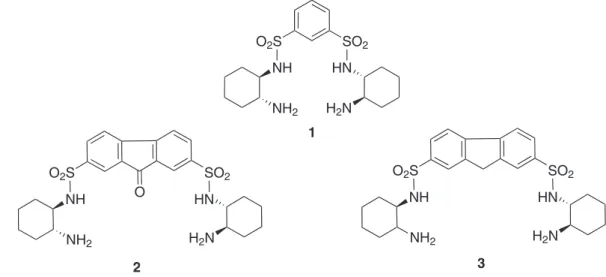
herein we report the synthesis of two new C2-symmetric ligands (2 and 3), in situ formation of the catalysts with [RhIIICl
2(Cp*)]2 and their application in the ATH of twelve
ketones with aqueous sodium formate. Ligands 2 and 3 are derived from (1R,2R)-cyclohexane-1,2-diamine and also from 9-oxo-9H-luorene-2,7-disulfonyl dichloride (for 2) and luorene-2,7-disulfonyl dichloride (for 3) (Figure 1). In comparison to ligand 1, it is expected that the luorene backbone of ligands 2 and 3 will provide more rigidity to the complexes inhibiting any possible tetradentate-coordination, thereby making a more active complex and also enhancing enantioselectivity, especially with bulky ketones.
Experimental
All reagents were commercially available and used without further puriication. Melting points were determined on a Fisher-Johns melting point apparatus and are uncorrected. Infrared (IR) spectra were measured on a Perkin Elmer FT-IR 1600 spectrometer. NMR were recorded with Varian Nova 500 MHz. The spectra were run in CDCl3 with tetramethylsilane (TMS) as internal standard. Mass spectra were obtained on a Hewlett Packard 5989 MS Spectrometer at 70 eV by direct insertion. Rotation was measured with Perkin-Elmer 343 Polarimeter.
General procedure for the preparation of ligands 2 and 3
Bis(sulfonamide) ligand 2 was prepared following reported methodology12 from the corresponding
commercially available 9-oxo-9H-luorene-2,7-disulfonyl dichloride and (1R,2R)-cyclohexane-1,2-diamine. Ligand
3 was prepared following reported methodology13 from
commercially available fluorene, chlorosulfonic acid, phosphorus pentachloride and (1R,2R )-cyclohexane-1,2-diamine. Spectra and analytical data of all compounds are given below.
(1R,2R)-9-Oxo-9H-luorene-2,7-disulfonic acid bis-[(2-aminocyclohexyl)-amide] (2)
To a stirred solution of L-tartrate salt of (1R,2R)- 1,2-diaminocyclohexane (0.79 g, 3 mmol) in aqueous NaOH (2 mol L-1, 10 mL) was added triethylamine (1 mL, 7.5 mmol)
and dichloromethane (50 mL). The mixture was cooled to 0 oC and a solution of 9-oxo-9H-luorene-2,7-disulfonyl
chloride (0.38 g, 1 mmol) in dichloromethane (30 mL) was added over 30 min. After the addition was complete, the mixture was allowed to warm to room temperature and stirred for 24 h. The resulting reaction mixture was washed with aqueous HCl (2 mol L-1, 3 × 50 mL) and the organic
phase was removed. The HCl wash liquor was collected and adjusted to pH ca. 9 by adding NaOH pellets until a yellow precipitate appeared. The basic aqueous solution was then extracted with dichloromethane (3 × 30 mL). The dichloromethane layers were combined, dried over anhydrous MgSO4, iltered and the solvent was removed under reduced pressure to obtain 2 as a pale yellow crystalline solid (0.36 g, 72% yield); mp: decomposes at 280 °C; [α]D25 = +22° (c 0.34, MeOH). IR (ilm) ν
max/cm
-1: 3291,
3254, 3092, 2924, 2905, 2358, 2355, 1716, 1609, 1451, 1319, 1149, 1067, 970, 716. 1H NMR (500 MHz, CDCl
3) d
8.21 (d, J 1.5 Hz, 2H), 8.13 (dd, J 7.8, 1.5 Hz, 2H), 7.80 (7.8 Hz, 2H), 2.78 (td, J 10.6, 3.8 Hz, 2H), 2.39 (td, J 10.9, 4.0 Hz, 2H), 1.96-1.88 (m, 4H), 1.70-1.50 (m, 4H), 1.30-1.02 (m, 8H) 13C NMR (500 MHz, CDCl
3) d 190.4, 145.8, 144.2,
134.8, 133.6, 122.9, 121.8, 61.0, 54.6, 34.6, 32.5, 25.0, 24.6.
Elemental Anal. for C25H32N4O5S2; Calcd.: C, 56.37%; H, 6.06%. Found: C, 56.40%; H, 6.10%.
(1R,2R)-9H-Fluorene-2,7-disulfonic acid bis-[(2-amino-cyclohexyl)-amide] (3)13
To a stirred solution of luorene (1.0 g, 6.25 mmol) in acetic acid (10 mL), chlorosulfonic acid (1.9 g, 18.75 mmol) was added dropwise at 0 °C. The reaction mixture was reluxed for 2 h, cooled and poured into a saturated aqueous solution of NaCl (30 mL) containing NaOH (0.62 g, 15.62 mmol) to obtain a yellow precipitate. The precipitate was washed with a saturated solution of NaCl (3 × 30 mL), iltered and dried overnight at 60 °C to give sodium luorene-2,7-disulfonate (1.62 g, 4.38 mmol, 70%). This salt was mixed with phosphorus pentachloride (2.29 g, 11 mmol) and phosphorus oxichloride (8.22 g, 53.64 mmol). The reaction mixture was reluxed for 6 h and the phosphorus oxychloride was distilled off. The resulting dry residue was pulverized in a mortar and then treated with water. The precipitate was iltered and washed with water to give 9H-fluorene-2,7-disulfonil chloride (1.2 g, 3.28 mmol, 75%) as a light-reddish-brown powder. The procedure to add the trans-(1R,2R )-cyclohexane-1,2-diamine to the sulfonyl groups of the
9H-luorene-2,7-disulfonil chloride and get ligand 3, is was identical to that described for 2. Yellow crystalline solid, (0.38 g, 69% yield); mp decomposes at 285 °C; [α]D25 = −57° (c 0.148, CH
2Cl2).
1H NMR (500 MHz, CDCl
3) d 8.12 (d, J 1.4 Hz, 2H), 7.98 (dd, J 8.0, 1.4 Hz, 2H), 7.95 (8.0 Hz, 2H), 4.06 (s, 2H), 2.79 (td, J 10.5, 4.0 Hz, 2H), 2.37 (td, J 11.0, 4.0 Hz, 2H), 1.95-1.88 (m, 4H), 1.70-1.6 (m, 4H), 1.25-1.04 (m, 8H) 13C NMR (125.72 MHz, CDCl
3) d 144.7, 144.0, 140.4, 126.5, 124.1, 121.2, 60.5, 54.9, 37.1,
35.9, 32.8, 24.9 (2C). Elemental Anal. for C25H34N4O4S2; Calcd.: C, 57.89%; H, 6.61%. Found: C, 57.93%; H, 6.65%.
General procedure for the asymmetric transfer hydrogenation of ketones in water
The metal precursor [RhIIICl
2(Cp*)]2 (0.0025 mmol)
and the chiral ligand 2 or 3 (0.0025 mmol) were mixed with water (0.7 mL) and heated in a water bath at 60 °C for 1 h. Sodium formate (5 equiv. relative to substrate) and the substrate (ratio S/C = 100 as in Table 1; other S/C ratio presented in Table 2) were subsequently added. The reaction mixture was stirred at 40 °C in air for the time indicated in Table 1 and Table 2 for each individual reaction. The reaction mixture was extracted with CH2Cl2 (3 × 10 mL). The CH2Cl2 layers were combined, dried over anhydrous MgSO4, iltered and concentrated in vacuo. The residue containing the alcohol was acetylated using acetic anhydride and 4-DMPA (4-N,N-dimethylamino pyridine).
Results and Discussion
Ligands 2 and 3 complexed with RhIII(Cp*) were used
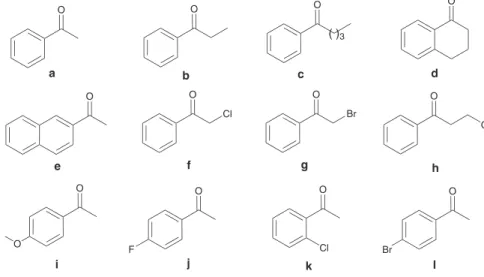
as catalysts for the ATH to a series aromatic prochiral ketones (Figure 2) in aqueous sodium formate. The results are shown in Table 1.
Rhodium Cp* complexed ligands 2 and 3 were tested for catalytic activity in the ATH of aromatic ketones under the same conditions used for ligand 1.10 In general, complexes
2-RhIII(Cp*) and 3-RhIII(Cp*) gave better yields and good
enantioselectivities in the ATH compared with ligand 1 for ketones b, d and e.
In order to test the catalytic properties of these complexes on the ATH of bulky ketones, we reduced
Figure 2. Structures of ketones used in the ATH.
O O
O
Br
O O
Cl
O O
Cl
O O
O
Cl
O
Br
a d
e f g h
i j k
b c
( )3
l O
propiophenone (b), valerophenone (c), tetralone (d), 2’-acetonaphthone (e) and 3-chloropropiophenone (h) to the corresponding alcohols. Results shown on Table 1 indicate good to excellent enantioselctivities and yields.
α- and β-Haloalcohols are important intermediates in the synthesis of physiologically active molecules.2,3,11
Using complexes 2-RhIII(Cp*) and 3-RhIII(Cp*) in the ATH
of 2-chloroacetophenone (f), 2-bromoacetophenone (g) and 3-chloropropiophenone (h), the corresponding chiral alcohols were obtained in 91% ee, > 99% yield, 88% ee,
91% yield and 95% ee, > 99% yield, respectively. Thus, the reduction of halo ketones in aqueous sodium formate provides an excellent and inexpensive synthetic route to synthesize physiologically active 1,2- and 1,3-amino alcohol derivatives.
Substituted aromatic ketones i-l also gave excellent yields and enantioselectivities on the reduction to the corresponding alcohols (Table 1).
In order to study the catalytic activity of the new ligands and the Rh(III) complexes (TON, TOF) in water/HCO2Na ATH, we reduced acetophenone (a) and 4’-luoroacetophenone (j) using different catalyst loading, reaction times and reaction temperatures. Results are shown in Table 2, which indicate that the catalyst activity and the enantioselectivities of both complexes 2-RhIII(Cp*) and 3-RhIII(Cp*) are similar and
constant through 0.25 h to 5 h. Ligand 3 reached TOF of 3,100 mol mol-1 h-1 in the ATH of acetophenone (a) [entry 4
tested for 0.25 h, at 40 oC] and 4,320 ligand mol mol-1 h-1
in the ATH of 4’-luoroacetophenone (j) [entry 8 tested for 0.08 h and 55 oC].
Conclusions
We have synthesized two new chiral C2-symmetric ligands with a rigid luorene ring skeleton with the two cyclohexylamine groups well apart from each other. Both complexes 2-RhIII(Cp*) and 3-RhIII(Cp*) turned out to
be very good catalysts in the ATH of aromatic ketones
Table 1. Enantioselective transfer hydrogenation of ketones with chiral ligands 2 and 3 complexed with [RhIIICl
2(Cp*)]2 using aqueous sodium formate
R
Ar
O R
Ar OH
H HCOO- Na+/H2O
[RhIIICl
2(Cp*)]2, L2orL3
R configuration
ketone 2b 3b
eec Yieldd eec Yieldd
a 95 > 99 94 > 99
b 95 98 93 99
c 100 85 100 87
d 100 98 100 98
e 97 92 97 95
f 90 > 99 92 > 99
g 88 89 87 93
h 95 > 99 96 > 99
i 91 > 99 91 > 99
j 91 > 99 90 > 99
k 89 > 99 89 > 99
l 91 > 99 90 > 99
aAbsolute conigurations are all R, except for f and g;assigned by comparing optical rotations with literature values;10b Ratio substrate/ catalyst (S/C) = 100; c Measured by GC analysis of the acetylated alcohol with chiral capillary column β-DEXTM 120; d Reaction conditions: 0.25 h at 40 °C.
Table 2. Enantioselective transfer hydrogenation of acetophenone (a) and 4’-luoroacetophenone (j) with chiral ligands 2 and 3 complexed with [RhIIICl
2(Cp*)]2 using a mixture of sodium formate/water
HCOO- Na+/H2O
R configurationa R
OH H
R
O [RhIIICl
2(Cp*)]2, L2orL3
entry ketone ratio (S/C) time (h) L-2 L-3
ee (%)b yield (%)c ee (%)b yield (%)c
1 a 100 0.08 94 98 94 99
2 a 200 0.25 95 >99 94 >99
3 a 1000 1 95 >99 94 >99
4 a 2000 2 94 >99 94 >99
5 a 5000 5 95 >99 94 98
6 a 10 000 12 94 97 94 86
7 j 200 0.17 91 >99 90 >99
8 jd 1000 0.67 91 >99 91 >99
using aqueous sodium formate as the hydride source, with excellent enantioselectivities, yields and TOF. With these complexes, excellent enantioselectivities and yields on the ATH of bulky ketones were also achieved, making them good candidates for the ATH of other bulky ketones, or to be anchored to a solid phase for the heterogenization of homogeneous catalysts.
The prochiral α-chlorine, α-bromine and β-chlorine ketones f, g and h were reduced to the corresponding chiral alcohols in very high yields (> 99%) and good enantioselectivities (89-91% ee), providing an alternative synthetic route to obtain 1,2- and 1,3-halo alcohol derivatives.
Acknowledgments
We gratefully acknowledge support for this project by Consejo Nacional de Ciencia y Tecnología (CONACyT grant 37827-E) and Dirección General de Educación Superior Tecnológica (DGEST grant 310.06-P), and postdoctoral fellowship from CONACyT for R. Montalvo-González.
References
1. Lin, G-Q.; Li, Y-M.; Chan, A. S.; Principles and Applications of Asymmetric Synthesis, John Wiley & Sons: New York, 2001; Morrison, J. D.; Asymmetric Synthesis, Academic Press: New York, 1983-1985, vol. 1-5; Noyori, R.;Asymmetric Catalysis in Organic Synthesis, John Wiley & Sons: New York, 1994. 2. Wang, G.; Liu, X.; Zhao, G.; Tetrahedron:Asymmetry 2005,
16, 1873; Lennon, I. C.; Ramsden, J. A.; Org. Process. Res. Dev. 2005, 9, 110; Cederbaum, F.; Lamberth, C.; Malan, C.; Naud, F.; Spindler, F.; Studer, M.; Blazer, H-U.; Adv. Synth. Catal. 2004, 346, 842; Reilly, M.; Anthony, D. R.; Gallagher, C.; Tetrahedron Lett. 2003, 44, 2927; Okano, K.; Murata, K.; Ikariya, T.; Tetrahedron Lett. 2000, 41, 9277; Hennig, M.; Püntener, K.; Scalone, M.; Tetrahedron:Asymmetry 2000, 11, 1849; Hett, R.; Senanayake, C. H.; Wald, S. A.; Tetrahedron Lett. 1998, 39, 1705; Collins, A. N.; Sheldrake, G. N.; Crosby, J.; Chirality in Industry: The Commercial Manufacture and Applications of Optically Active Compounds, John Wiley & Sons: Chichester, 1992.
3. Cederbaum, F.; Lamberth, C.; Malan, C.; Naud, F.; Spindler, F.; Studer, M.; Blazer, H-U.; Adv. Synth. Catal. 2004, 346, 842. 4. Hennig, M.; Püntener, K.; Scalone, M.; Tetrahedron:Asymmetry
2000, 11, 1849.
5. Ikariya, T.; Murata, K. ; Noyori, R.; Org. Biomol. Chem. 2006, 4, 393; M. Samec, J. S.; Backvall, J. E.; Andersson, P. G.; Brandt, P.; Chem. Soc. Rev. 2006, 35, 237; Gladiali, S.; Alberico, E.;
Chem. Soc. Rev. 2006, 35, 226; Clapham, S. E.; Hadzovic, A.; Morris, R. H.; Coord. Chem. Rev. 2004, 248, 2201.
6. Ikariya, T.; Blacker, A. J.; Acc. Chem. Res. 2007, 40, 1300; Shimizu, H.; Nagasaki, I.; Matsumura, K.; Sayo, N.; Saito, T.;
Acc. Chem. Res. 2007, 40, 1385; Johnson, N. B.; Lennon, I. S.; Moran, P. H.; Ramsden, J. A.; Acc. Chem. Res. 2007, 40, 1291; Blaser, H-U.; Pugin, B.; Spindler, F.; J. Mol. Cat. A: Chem.
2005, 231, 1.
7. Hagen, J.; Industrial Catalysis: A Practical Approach, 2nd ed., Wiley-VCH: Weinheim, Germany, 2006, p. 7; Hamada, T.; Torri, T.; Onishi, T.; Izawa, K.; Ikariya, T.; J. Org. Chem. 2004,
69, 7391; Watanabe, M.; Murata, K.; Ikariya, T.; J. Org. Chem. 2002, 67, 1712; Noyori, R.; Ohkuma, T.; Angew. Chem. Int.
Ed. 2001, 40, 40; Matsumura, K.; Hashiguchi, S.; Ikariya, T.; Noyori, R.; J. Am. Chem. Soc. 1997, 119, 8738.
8. Xiao, J.; Wu, X.; Chem. Commun. 2007, 2449.
9. Anastas, P. T.; Warner, J. C.; Green Chemistry: Theory and Practice, Oxford University Press: New York, 2000.
10. Cortez, N. A.; Rodríguez-Apodaca, R.; Aguirre, G.; Parra-Hake, M.; Cole, T.; Somanathan, R.; Tetrahedron Lett. 2006, 47, 8515; Wu, X.; Vinci, D.; Ikariya, T.; Xiao, J.; Chem. Commun.
2005, 4447; Wu, X.; Li, X; Hems, W.; King, F.; Xiao, J.; Chem. Commun. 2004, 1818; Ma, Y.; Liu, H.; Chen, L.; Cui, X.; Zhu, J.; Deng, J.; Org. Lett. 2003, 5, 2103; Liu, S.; Xiao, J.; J. Mol. Cat. A: Chem. 2007, 270, 1; Cortez, N. A.; Aguirre, G.; Parra-Hake, M.; Somanathan, R.; Tetrahedron Lett. 2007, 48, 4335; Cortez, N. A.; Aguirre, G.; Parra-Hake, M.; Cole, T.; Somanathan, R.;
Tetrahedron: Asymmetry2008, 19, 1304; Zhou, Z.; Guo, Y.;
Synth. Commun. 2008, 38, 684; Compared with chloro alcohol sample from Aldrich Sigma, rotation (−) for coniguration (R), based on rotation (+) the coniguration (S) is assigned; Ou, Z.; Wu, J.; Yang, L.; Cen, P.; Korean J. Material Sci. Chem. Eng.
2008, 25, 124.
11. Ohkuma, T.; Tsutsumi, K.; Utsumi, N.; Arai, N.; Noyori, R.; Murata, K.; Org. Lett.2007, 9, 255; Emami, S.; Foroumadi, A.; Falahati, M.; Lotfali, E.; Rajabalian, S.; Ebrahimi, S.-A.; Farahyar, S.; Shaiee, A.; Bioorg. Med. Chem. 2008, 18, 141; Tanis, S. P.; Evans, B. R.; Nieman, J. A.; Parker, T. T.; Taylor, W. D.; Heasley, S. E.; Herrington, P. M.; Perrault, W. R.; Hohler, R. A.; Dolak, L. A.; Hester, M. R.; Seest, E. P.; Tetrahedron: Asymmetry 2006, 17, 2154.
12. Ng, K.; Somanathan, R.; Walsh, P. J.; Tetrahedron: Asymmetry
2001, 12, 1719.
13. Boer, B.; Meng, H.; Perepichka, D. F.; Zheng, J.; Frank, M. M.; Chabal, Y. J.; Bao, Z.; Langmuir 2003, 19, 4272.
Received: June 15, 2009
![Table 2. Enantioselective transfer hydrogenation of acetophenone (a) and 4’-luoroacetophenone (j) with chiral ligands 2 and 3 complexed with [Rh III Cl 2 (Cp*)] 2 using a mixture of sodium formate/water](https://thumb-eu.123doks.com/thumbv2/123dok_br/18994461.461758/4.892.68.796.816.1077/enantioselective-transfer-hydrogenation-acetophenone-luoroacetophenone-ligands-complexed-mixture.webp)
