J. Braz. Chem. Soc., Vol. 18, No. 6, 1281-1284, 2007. Printed in Brazil - ©2007 Sociedade Brasileira de Química 0103 - 5053 $6.00+0.00
Short ReportShort ReportShort ReportShort ReportShort Report
*e-mail: [email protected]
A Mild Procedure for
α
α
α
α
α
,
α
α
α
α
α
-Dichlorination of Cyclic Aryl Ketones using Commercial Bleach
Samir A. P. Quintiliano and Luiz F. Silva Jr.*
Instituto de Química, Universidade de São Paulo, 05513-970 São Paulo-SP, Brazil
Aril cetonas cíclicas α,α-dicloradas foram obtidas pelo tratamento de uma solução metanólica da correspondente cetona com cândida comercial em condições ambiente com rendimentos que variaram de 61 a 92%. A reação ocorre em cetonas contendo tanto grupos doadores quanto retiradores de elétrons, mas parece ser sensível a efeitos estéricos. Além disso, aril-cicloalcanonas com anéis de cinco, seis e sete membros podem ser utilizadas como substrato.
α,α-Dichloro-cyclic aryl ketones were obtained treating a methanolic solution of the corresponding ketone with commercial bleach at ambient conditions in yields varying from 61 to 92%. Electron-donating and -withdrawing groups in the starting ketone are tolerated but the reaction appears to be sensitive to steric effects. Moreover, five-, six-, and seven-membered aryl-cycloalkanones can be used as substrate.
Keywords: bleach, tetralones, ketones, chlorination
Introduction
Over the last decades, α,α-dichloroketones have been used as substrate in several reactions in synthetic organic chemistry, including important steps in the synthesis of natural products.1 Thus, several methods have been developed for the preparation of α,α-dichloroketones, where the most used is the direct dichlorination of the corresponding ketone. This transformation has been performed with cyclic aryl ketones in a variety of different forms, using: i) Cl2 in CH2Cl22 or in DMF;3 ii) thionyl chloride in CCl4;4iii) thionyl chloride followed treatment with H2O2;5 iv) sulfuryl chloride;6 v) 2-chloropyridazin-3(2H)-one in CH2Cl2 in the presence of H2SO4;7 vi) manganese(III) acetate in boiling AcOH in the presence of LiCl;8vii) FeCl
3 in a mixture of AcOH/H2O;
9 and viii)
copper(II) chloride in DMF10 or in acetonitrile.11 In this scenario, we herein present a simple and mild procedure to obtain several α,α-dichloro cyclic aryl ketones using commercial bleach, at room temperature and without the control of the pH, showing the influence of alkyl, electron donating- and electron-withdrawing groups, as well as the ring size of the substrate. Bleach is an inexpensive and environmentally friendly reagent that has a number of applications, including the chlorolactonization of β- and
γ-unsaturated carboxylic acids,12 the oxidation
of alcohols,13 as co-oxidant in TEMPO-catalyzed
oxidations,14 and the dichlorination of dicarbonylic
compounds in AcOH/Me2CO at 0 °C.15 During the
development of this work, a patent by Kumamoto et al.,16 reported the use of bleach for the α,α-dichlorination of a single ketone, namely 5-nitro-1-tetralone, at 50 °C and keeping the pH of the solution around 10.
Results and Discussion
When bleach was added to a methanolic solution of 1-tetralone (1) at room temperature, 2,2-dichloro-1-tetralone was obtained in 90% yield (Table 1, entry 1). The reaction is very clean, with no side reactions. Indeed, the NMR of the crude product does not show the presence of any impurity. Furthermore, the haloform reaction, that could be a side reaction,17 was not observed. Presumably, this transformation occurs by the reaction of the enolate of the ketone with a chloro-containing species in solution, such as chlorine or ClOH. Next, the same protocol was applied to other ketones. Treating tetralones containing an electron-donating substituent in the aromatic ring, such as 2-4 with bleach gave, respectively, the corresponding
1282 A Mild Procedure for α,α-Dichlorination of Cyclic Aryl Ketones J. Braz. Chem. Soc.
influence in the reactivity, which agrees with the result of Kumamoto et al.16 that performed the chlorination of a similar ketone at 50 °C. The influence of alkyl groups was then investigated. The reaction of 4-methyl-1-tetralone (6) with bleach afforded the dichlorinated product in good yield (entry 6). However, when 2-methyl-1-tetralone (7) was treated with bleach only 33% of the starting material was converted to the product even after 4 days of reaction time (entry 7). In summary, tetralones can be dichlorinated in an efficient manner. Electron-donating and withdrawing groups are tolerated but the reaction appears to be sensitive to steric effects.
The reactivity of a cyclohexanone was also investigated. When 4-t-butylcyclohexanone was treated with bleach in conditions similar to that presented above, no reaction was observed. The different behavior between the alkyl and the
aryl ketones may be explained by the difference of the acidity of the α-hydrogen, where the pKa value of aryl ketones (pKa of 1-tetralone in DMSO: 24.718) is nearly two units lower than that of the corresponding alkyl ketone (pKa of cyclohexanone in DMSO: 26.419).
The effect of the ring size was examined for ketones with a five- and a seven-membered ring. The reaction of
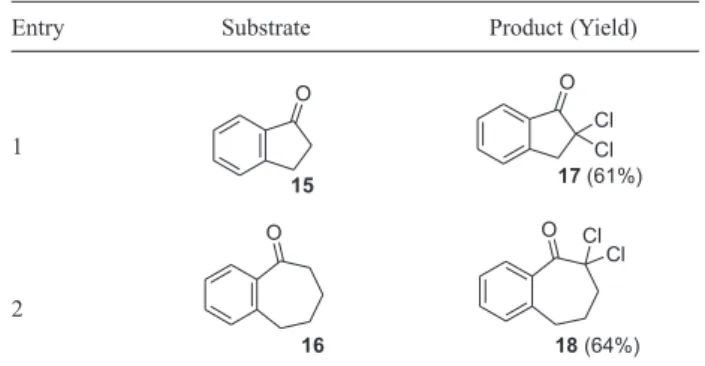
1-indanone and of 1-benzosuberone (15 and 16,
respectively) with bleach gave the expected dichloro ketones in 61 and 64% yield, respectively (Table 2). Although still good, these yields are clearly lower than that obtained for the six-membered ring ketone 1.
Conclusions
In conclusion, a simple, cheap and efficient method for the preparation of α,α-dichlorinated ketones from readily available cyclic aryl ketones and commercial bleach was developed. This protocol avoids the use of hazardous material and/or difficult procedures.
Experimental
The reactions were carried out using Daclor®
commercial bleach (pH 12, 2.0-2.2% of chlorine). The aryl ketones, besides 7-nitro-1-tetralone,20 are commer-cially available. Melting points were determined on a Büchi Melting Point B-545 and are uncorrected. Shimadzu GC-2010 was used to monitor the progress of the reactions.
1H and 13C NMR spectra were recorded on Bruker
spectrometers. IR spectra were measured on a Perkin-Elmer 1750 FT. High resolution mass spectra were performed on a VG Autospec/Fission Instrument and MicroTOF LC from Bruker Daltonics. Although the crude products were often obtained quite pure, analytical pure substances could be obtained by flash chromatography using silica-gel Acros 200-400 Mesh (30% AcOEt in hexanes).
Table 1. Reaction of 1-Tetralones with Bleach in MeOH
Entry Substrate Product (Yield)
1 O 1 O 8(90%) Cl Cl 2 O 2 MeO O 9(87%) Cl Cl MeO 3 O 3 MeO O 10(92%) Cl Cl MeO 4 O 4 OMe O 11(82%) Cl Cl OMe 5 O 5
O2N
O
12(67%) Cl Cl O2N
6 O 6 O 13(82%) Cl Cl 7 O 7 O 14(33%)* Cl
*Conversion estimated by GC analysis.
Table 2. Reaction of Cyclic Ketones with Bleach in MeOH
Entry Substrate Product (Yield)
1283 Quintiliano and Silva Jr.
Vol. 18, No. 6, 2007
2,2-Dichloro-1-tetralone (8). General procedure for the preparation of the dichlorinated ketones
To a stirred solution of 1 (0.045 g, 0.31 mmol) in MeOH (0.8 mL) at rt was added commercial household bleach portionwise (4.5 mL). The solution turned white. After 6 h, H2O was added and the aqueous mixture was
extracted 3 times with Et2O (30 mL). The combined
organic phase was washed with brine, dried over anhyd
MgSO4 and the solvent was removed under reduced
pressure affording 2 (0.059 g, 0.28 mmol, 90%), as a white powder (mp 76.2-77.0 °C; lit.:21 76 °C).
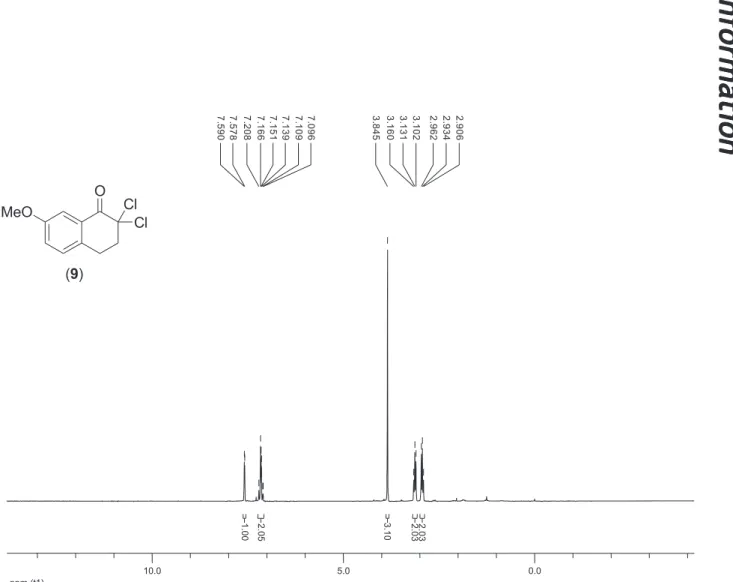
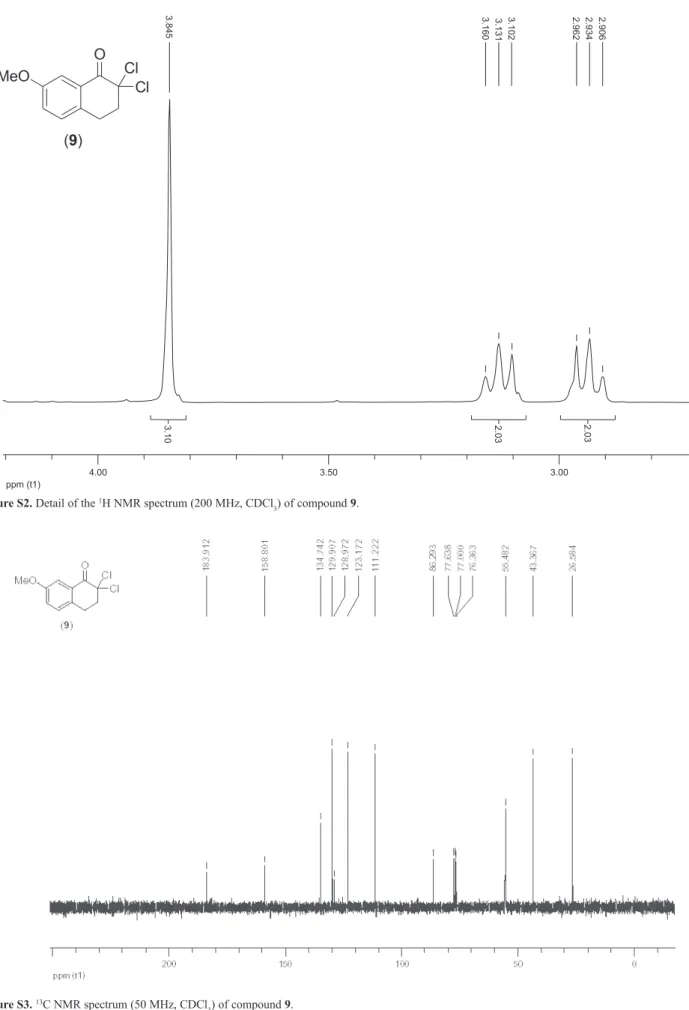
2,2-Dichloro-7-methoxy-1-tetralone (9)
The preparation was performed as above but using 2 (0.036 g, 0.20 mmol), MeOH (0.4 mL) and bleach (2.5
mL) giving 9 (0.045 g, 0.18 mmol, 92%) as a white
powder; mp 92.7-94.1 °C; IR (KBr) νmax/cm-1: 1702, 1025, 709; 1H NMR (200 MHz, CDCl
3) δ2.93 (t, J 5.7 Hz, 2H), 3.13 (t, J 5.7 Hz, 2H), 3.84 (s, 3H), 7.14-7.17 (m, 2H),
7.58 (d, J 2.2 Hz, 1H); 13C NMR (50 MHz, CDCl
3)
δ 26.6, 43.4, 55.5, 86.3, 111.2, 123.2, 129.0, 129.9, 134.8, 158.8, 183.9; LRMS (EI) m/z (rel. int.) 244 (M+, 25%), 209 (24), 120 (100); Anal. calc. for C11H10Cl2O2: C, 53.90; H, 4.11. Found: C, 54.33; H,4.07.
2,2-Dichloro-6-methoxy-1-tetralone (10)
The preparation was performed as above but using 3 (0.036 g, 0.20 mmol), MeOH (0.4 mL) and bleach (2.5 mL) giving 10 (0.045 g, 0.18 mmol, 92%) as a white powder (mp 84.4-86.2 °C; lit.:4 85-87 °C).
2,2-Dichloro-5-methoxy-1-tetralone (11)
The preparation was performed as above but using 4 (0.051 g, 0.29 mmol), MeOH (0.5 mL) and bleach (2.9 mL) giving 11 (0.058 g, 0.24 mmol, 82%) as a pale yellow oil.6
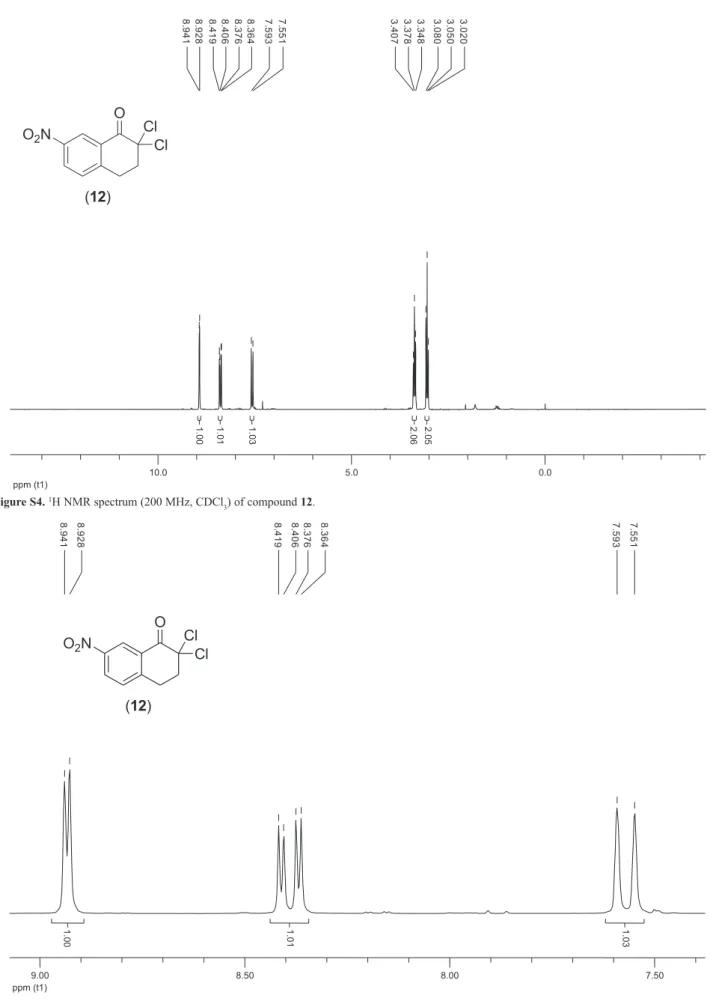
2,2-Dichloro-7-nitro-1-tetralone (12)
The preparation was performed as above but using 5 (0.115 g, 0.60 mmol), MeOH (1.2 mL) and bleach (7.2 mL) giving 12 (0.104 g, 0.40 mmol, 67%) as a pale yellow solid (mp 118.6.-120.2 ºC); IR (KBr) νmax/cm-1: 1711,
1526, 635; 1H NMR (200 MHz, CDCl
3) δ 3.05 (t, J 6.1 Hz, 2H), 3.38 (t, J 6.1 Hz), 7.57 (d, J 8.8 Hz, 1H), 8.39 (dd, J 8.3 and 2.6 Hz, 1H), 8.93 (d, J 2.6 Hz, 1H); 13C NMR (50 MHz, CDCl3) δ 27.5, 42.1, 85.0, 124.8, 128.2, 129.3, 130.5, 147.3, 148.5, 182.2; LRMS: m/z (rel. int.) 259 (M+, 5%), 163 (100), 115 (20); Anal. calc. for C10H7Cl2NO3: C, 46.18; H, 2.71; N, 5.39. Found: C, 46.43; H, 2.89; N, 5.09.
2,2-Dichloro-4-methyl-1-tetralone (13)
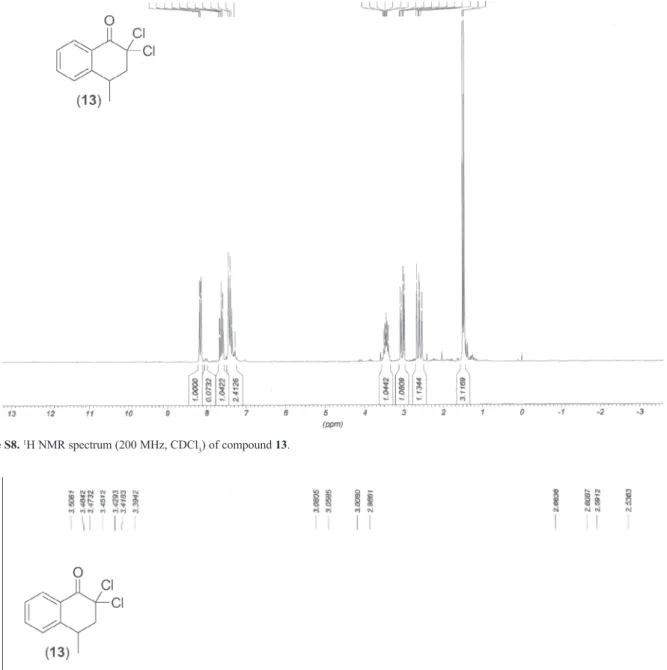
The preparation was performed as above but using 6 (0.086 g, 0.54 mmol), MeOH (1.0 mL) and bleach (5.0 mL) giving 13 (0.101 g, 0.44 mmol, 82%), as a colorless oil; IR (film) νmax/cm-1: 1709, 1216, 822; 1H NMR (200 MHz, CDCl3) δ 1.47 (d, J 7.0, 3H), 2.60 (dd, J 14.5 and 11.0 Hz, 1H), 3.45 (m, 1H), 6.07 (dd, J 14.5 and 4.4 Hz, 1H), 7.42 (d,
J 9.6 Hz, 2H), 7.62 (td, J 7.7 and 1.3 Hz, 1H), 8.15 (dd, J 8.3 and 1.3 Hz, 1H); 13C NMR (50 MHz, CDCl
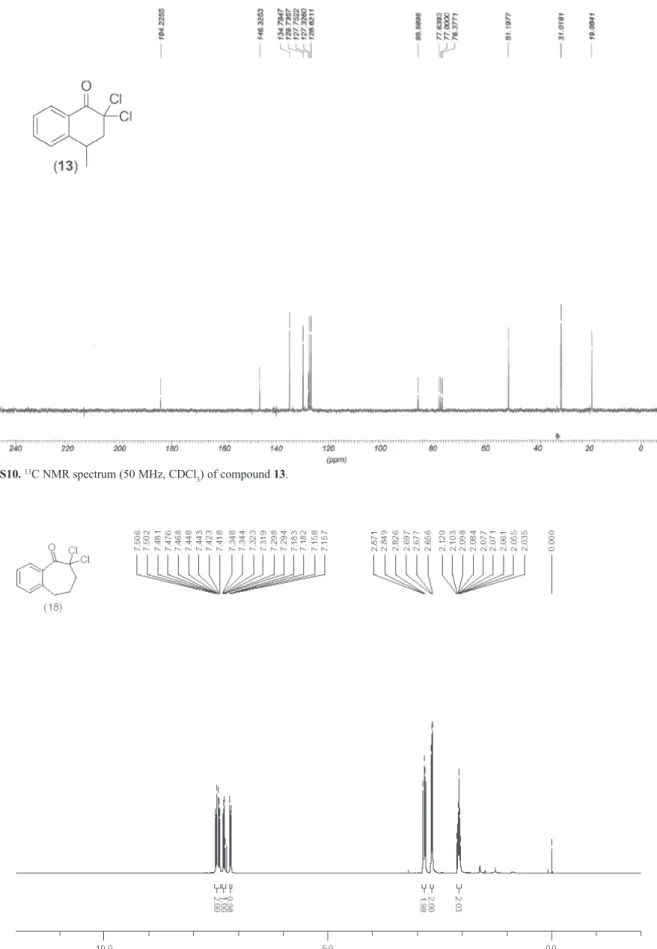
3) δ 19.1, 31.0, 51.2, 85.6, 126.6, 127.3, 127.7, 129.7, 134.8, 146.6, 184.2; LRMS m/z (rel. int.) 228 (M+, 7%), 192 (4), 132 (100); HRMS [ESI(+)] calc. for [C11H10Cl2ONa]+: 251.0006. Found: 250.9997.
Reaction of 7 with bleach in MeOH
The reaction was performed as above but using 7 (0.073 g, 0.46 mmol), MeOH (0.9 mL) and bleach (4.6 mL) giving after 4 days a conversion of 33% to 14 determined by GC analysis. A 2,3:1 mixture of 7:14 was obtained (0.065 g), as a colorless oil; 1H RMN (300 MHz, CDCl
3) δ 1.82 (s, 3H), 2.37-2.28 (m, 1H), 3.37 (ddd, J 17.0, 11.2 and 4.7 Hz, 1H), 8.09 (dd, J 1.2 Hz, 1H), other signals overlap with 7.
2,2-Dichloro-1-indanone (17)
The preparation was performed as above but using 15 (0.115 g, 0.60 mmol), MeOH (1.2 mL) and bleach (7.2 mL) giving 17 (0.104 g, 0.40 mmol, 67%) as a white solid (mp 73.5-75.3 °C; lit.:7 74-75 °C).
2,2-Dichloro-1-benzosuberone (18)
The preparation was performed as above but using 16 (0.115 g, 0.60 mmol), MeOH (1.2 mL) and bleach (7.2 mL) giving 18 (0.104 g, 0.40 mmol, 64%) as a colorless oil; IR (film) νmax/cm-1: 1713, 1245, 953; 1H NMR (200 MHz, CDCl3) δ 2.08 (dddd, J 7.0, 6.6, 6.2 and 5.7 Hz, 2H), 2.68 (dd, J 6.6 and 5.7 Hz, 2H), 2.85 (dd, J 7.0 and 6.3 Hz, 2H), 7.17 (d, J 7.5 Hz, 1H), 7.34 (dd, J 7.5 and 0.9 Hz, 1H), 7.43 (dd, J 7.5 and 1.8 Hz, 1H), 7.49 (dd, J
7.5 and 1.3 Hz, 1H); 13C NMR (50 MHz, CDCl
3) δ 23.8, 32.3, 44.0, 89.4, 127.0, 129.0, 129.3, 132.3, 136.6, 137.0, 195.8; LRMS m/z (rel. int.) 228 (M+, 13%), 165 (54), 131 (100); HRMS [ESI(+)] calc. for [C11H10Cl2ONa]+: 251.0006. Found: 250.9999.
Acknowledgments
1284 A Mild Procedure for α,α-Dichlorination of Cyclic Aryl Ketones J. Braz. Chem. Soc.
Supplementary Information
Supplementary data are available free of charge at http://jbcs.sbq.org.br, as PDF file.
References
1. Greene, A. E.; Deprés, J.-P.; J. Am. Chem. Soc.1979, 101, 4003; Deprés, J.-P.; Greene, A. E.; J. Org. Chem.1980, 45, 2036; Brocksom, T. J.; Coelho, F.; Deprés, J.-P.; Greene, A. E.; De Lima, M. E. F.; Hamelin, O.; Hartmann, B.; Kanazawa, A. M.; Wang, Y.; J. Am. Chem. Soc.2002, 124, 15313; Coquerel, Y.; Greene, A. E.; Deprés, J.-P.; Org. Lett.2003, 5, 4453; Bartoli, G.; Bosco, M.; Carlone, A.; Locatelli, M.; Melchiorre, P.; Sambri, L.; Angew. Chem., Int. Ed.2005, 44, 6219; Yang, D.; Yan, Y.-L.; Zheng, B.-F.; Gao, Q.; Zhu, N.-Y.; Org. Lett.2006,
8, 5757.
2. Stevens, C. L.; Beereboom, J. J., Jr.; Rutherford, K. G.; J. Am. Chem. Soc.1955, 77, 4590; Kumar, S.; Murray, R. W.; J. Am. Chem. Soc.1984, 106, 1040.
3. De Kimpe, N.; De Buyck, L.; Verhé, R.; Wychuyse, F.; Schamp, N.; Synth. Commun.1979, 9, 575.
4. Brown, C. L.; Freiberg, J. A.; Healy, P. C.; Acta Crystallogr., Sect. E: Struct. Rep. Online2002, 58, o1239.
5. Gabbutt, C. D.; Hepworth, J. D.; Heron, B. M.; Tetrahedron
1994, 50, 5245.
6. Hach, V.; Protiva, M.; Chem. Listy1957, 51, 2099; Prugh, J. D.; Deana, A. A.; Wiggins, J. M.; Synthesis1989, 554. 7. Park, Y.-D.; Kim, J.-J.; Cho, S.-D.; Lee, S.-G.; Falck, J. R.;
Yoon, Y.-J.; Synthesis2005, 1136.
8. Tsuruta, T.; Harada, T.; Nishino, H.; Kurosawa, K.; Bull. Chem. Soc. Jpn.1985, 58, 142.
9. Nakatani, Y.; Kakinuma, K.; Matsui, M.; Tetrahedron Lett.
1967, 8, 4085; Nakatani, Y.; Matsui, M.; Hgr. Biol. Chem.1968,
32, 734.
10. Nobrega, J. A.; Gonçalves, S. M. C.; Peppe, C.; Synth. Commun.
2002, 32, 3711.
11. Nefedov, V. A.; Zh. Obs. Khim.1973, 43, 2016.
12. López-López, J. A.; Guerra, F. M.; Moreno-Dorado, F. J.; Jorge, Z. D.; Massanet, G. M.; Tetrahedron Lett.2007, 48, 1749. 13. Königsberger, K.; Chen, G.-P.; Vivelo, J.; Lee, G.; Fitt, J.;
McKenna, J.; Jenson, T.; Prasad, K.; Repic, O.; Org. Process Res. Dev.2002, 6, 665.
14. Anelli, P. L.; Biffi, C.; Montanari, F.; Quici, S.; J. Org. Chem.
1987, 52, 2559; Cunha, P. L. R.; Maciel, J. S.; Sierakowski, M. R.; De Paula, R. C. M.; Feitosa, J. P. A.; J. Braz. Chem. Soc.
2007, 18, 85.
15. Meketa, M. L.; Mahajan, Y. R.; Weinreb, S. M.; Tetrahedron Lett.2005, 46, 4749.
16. Kumamoto, Y.; Takaoka, M.; Wada, M.; Mitsui Chemicals Inc., Japan, JP 2006143611, 2006, p. 13.
17. Rothenberg, G.; Sasson, Y. Tetrahedron1996, 52, 13641; Bjorsvik, H.-R.; Norman, K.; Org. Process Res. Dev.1999, 3, 341. 18. Bordwell, F. G.; http://www.chem.wisc.edu/areas/reich/pkatable/
index.htm.
19. Bordwell, F. G.; Fried, H. E.; J. Org. Chem.1991, 56, 4218. 20. Silva, L. F., Jr.; Sousa, R. M. F.; Ferraz, H. M. C.; Aguilar, A.
M.; J. Braz. Chem. Soc.2005, 16, 1160.
21. De Kimpe, N.; Verhé, R.; De Buyck, L.; Schamp, N.; Synth. Commun.1978, 8, 75.
Received: March 19, 2007 Web Release Date: September 12, 2007
J. Braz. Chem. Soc., Vol. 18, No. 6, S1-S8, 2007. Printed in Brazil - ©2007 Sociedade Brasileira de Química 0103 - 5053 $6.00+0.00
Supplementary InformationSupplementary InformationSupplementary InformationSupplementary InformationSupplementary Information
*e-mail: [email protected]
A Mild Procedure for the
α
α
α
α
α
,
α
α
α
α
α
-Dichlorination of Cyclic Aryl Ketones using Commercial Bleach
Samir A. P. Quintiliano and Luiz F. Silva Jr.*
Instituto de Química, Universidade de São Paulo, 05513-970 São Paulo-SP, Brazil
Figure S1.1H NMR spectrum (200 MHz, CDCl
3) of compound 9.
7.
5
9
0
7.
5
7
8
7.
2
0
8
7.
1
6
6
7.
15
1
7.
1
3
9
7.
109 7.0
9
6
3.
845 3.160 3.13
1
3.
102 2.9
6
2
2.
934 2.9
0
6
O
Cl Cl MeO
(9)
ppm (t1)
0.0 5.0
10.0
S2 A Mild Procedure for the α,α-Dichlorination of Cyclic Aryl Ketones J. Braz. Chem. Soc.
ppm (t1)
3.00 3.50
4.00
3.845 3.160 3.131 3.102 2.962 2.934 2.906
3.10 2.03 2.03
O
Cl Cl MeO
(9)
Figure S2. Detail of the 1H NMR spectrum (200 MHz, CDCl
3) of compound 9.
Figure S3.13C NMR spectrum (50 MHz, CDCl
S3 Quintiliano and Silva Jr.
Vol. 18, No. 6, 2007
Figure S4.1H NMR spectrum (200 MHz, CDCl
3) of compound 12.
8.
9
4
1
8.
928 8.419 8.40
6
8.
37
6
8.
3
6
4
7.
5
9
3
7.
55
1
3.
4
0
7
3.
3
7
8
3.
348 3.08
0
3.
05
0
3.
0
2
0
O
Cl Cl O2N
(12)
ppm (t1)
0.0 5.0
10.0
1.00 1.01 1.03 2.06 2.05
Figure S5. Detail of the 1H NMR spectrum (200 MHz, CDCl
3) of compound 12.
8.
941 8.928 8.419 8.40
6
8.
376 8.36
4
7
.593 7.55
1
O
Cl Cl O2N
(12)
ppm (t1)
7.50 8.00
8.50 9.00
S4 A Mild Procedure for the α,α-Dichlorination of Cyclic Aryl Ketones J. Braz. Chem. Soc.
Figure S6. Detail of the 1H NMR spectrum (200 MHz, CDCl
3) of compound 12.
3
.407 3.37
8
3.
348 3.080 3.0
50
3.
020
ppm (t1)
3.00 3.10
3.20 3.30
3.40 3.50
2.06 2.05
O
Cl Cl O2N
(12)
Figure S7.13C NMR spectrum (50 MHz, CDCl
S5 Quintiliano and Silva Jr.
Vol. 18, No. 6, 2007
Figure S8.1H NMR spectrum (200 MHz, CDCl
3) of compound 13.
Figure S9. Detail of the 1H NMR spectrum (200 MHz, CDCl
S6 A Mild Procedure for the α,α-Dichlorination of Cyclic Aryl Ketones J. Braz. Chem. Soc.
Figure S10.13C NMR spectrum (50 MHz, CDCl
3) of compound 13.
Figure S11.1H NMR spectrum (200 MHz, CDCl
S7 Quintiliano and Silva Jr.
Vol. 18, No. 6, 2007
Figure S12. Detail of the 1H NMR spectrum (200 MHz, CDCl
3) of compound 18.
O Cl Cl
(18)
2.
8
7
1
2.
8
4
9
2.
826 2.6
97
2.
677 2.65
6
2.
12
0
2.
10
3
2.
0
9
8
2.
08
4
2.
07
7
2.
071 2.061 2.0
55
2.
035
ppm (f1)
2.00 2.10
2.20 2.30
2.40 2.50
2.60 2.70
2.80 2.90
1.98 2.00 2.03
Figure S13. Detail of the 1H NMR spectrum (200 MHz, CDCl
S8 A Mild Procedure for the α,α-Dichlorination of Cyclic Aryl Ketones J. Braz. Chem. Soc.
Figure S14.13C NMR spectrum (50 MHz, CDCl