Autoionization of He atoms induced by partially stripped ion impact.
C.F. Mart´ınez
Departamento de F´ısica, Universidad Nacional del Sur, 8000 Bah´ıa Blanca, Argentina.
S. Otranto∗
Departamento de F´ısica, Universidad Nacional del Sur, 8000 Bah´ıa Blanca, Argentina. and Consejo Nacional de Investigaciones Cient´ıficas y T´ecnicas (CONICET).
(Received on 25 January, 2010)
A study of the autoionization process induced by partially stripped ion impact is performed. The Barrachina-Macek model is extended to the case in which the projectile-emitted electron interaction is represented by means of a non-Coulombic central potential at all times. Electron spectra in momentum space are predicted and compared to the Barrachina-Macek model and a recent model in which an asymptotically correct wave function was employed to treat this problem. The presence of rainbow scattering interference in the binary ring profile of the outgoing autoionized electrons for positive ion impact is discussed based on the different models.
Keywords: autoionization, post-collisional interactions, rainbow scattering
1. INTRODUCTION
One of the processes observed during the collision of charged particles and photons with atoms is the single ioniza-tion of the target which is left with one extra unit of positive charge. The ionization can be reached through direct single ionization or the two step Auger effect. For the latter, dur-ing the collision the incident particle (or photon) leaves the target atom in an excited state which then decays in a radia-tionless transition emitting an electron to the continuum. The term Auger effect is usually reserved for electron emission produced after an inner-shell vacancy is created in a many-electron atom [1]. For the particular case in which a two elec-tron atom is involved, the process is known as autoionization. Autoionization can take place either induced by photon or ion impact. In the former, the emitted electron spectrum is isotropic provided that the emitted electron evolves only un-der the influence of the remaining target core. On the other hand, for the latter there is also the influence of the additional field of the projectile ion. Early studies on this issue were per-formed by Barker and Berry in 1966 who employed a classi-cal model to describe the way in which the emitted electron spectrum profile departed from a Lorentzian [2]. For more than a decade, their model was used to describe autoioniza-tion following ion impact. In 1977, Devdarianiet al. devel-oped the first quantum mechanical model [3] that used the same assumptions as those of Barker and Berry, albeit in a quantal format. They assumed that the projectile distorted the electron’s energy but not its trajectory. More recently, van der Straten and Morgenstern employed the Eikonal model in order to introduce the post collisional interaction (PCI) be-tween the emitted electron and the projectile [4]. In 1989, Barrachina and Macek [5] successfully developed a contin-uum distorted wave (CDW) theory that predicted Coulomb focusing during the PCI between projectile and autoionized electron. Their predictions were experimentally verified the same year by Swensonet al. [6]. Thus, the energy and an-gular distribution of the ionized electrons are distorted by the presence of the projectile leading to a non-isotropic spectrum.
∗Electronic address:[email protected]
This model with its subsequent improvements [7–9] ac-count for the Stark effect (which is very important when the impinging ion energy is rather low) and the modification of the intermediate excited state lifetime due to the transient presence of the projectile.
Additional classical studies further concentrated in the classical description of the process trying to explain the Coulomb focusing mechanism in terms of a Coulomb path in-terference mechanism [6, 10]. The authors concluded that this process is a consequence of the electrons being emitted in the forward direction at slightly different emission times so that the electrons follow different paths, but asymptotically have the same velocity. The Coulomb path interference thus repre-sents an ion-atom collision analog to the classical double-slit electron mechanism.
These and other studies which concentrated on the nature of some oscillatory structures near the autoionization peak [11, 12, 17] considered Coulomb-like fully stripped projec-tiles. However, it is known that partially stripped ions show more complex collision dynamics in single ionizing colli-sions. Nearly twenty years ago, oscillations in the emit-ted electron spectrum in the region of the binary peak have been experimentally observed and theoretically reproduced [13, 14]. These oscillations have been attributed to interfer-ence structure in the elastic differential cross section for the scattering of target electrons from the impinging ion and have been associated with the well-known rainbow scattering [15]. In a recent work [16] Otranto and Olson considered the au-toionization of He by partially stripped ion impact within the CDW model. In particular, they generalized the Barrachina-Macek model by replacing the Kummer function proper of the two body Coulomb problem in the continuum by an asymp-totically correct wavefunction for this problem. This model, has the limitation of a doubtful applicability in the reaction zone (where the particles are still rather close to each other) as well as for small values of the relative velocity among the projectile and the emitted electron.
116 C.F. Mart´ınez and S. Otranto
provides a more accurate description of the collision system. In section II we point out the main features of the present model. Results are shown and discussed in section III. Fi-nally, in section IV general conclusions are drawn.
Atomic units are used throughout this work unless explic-itly stated otherwise.
2. THEORETICAL QUANTUM MODELS
We now describe the different distorted wave models that are employed in this work. The autoionization transition am-plitude derived from the time-dependent perturbation theory can be expressed as [18],
b(t) =−i
Z t
0
dt′ei(E−E0)t′−Γ2t′t′i
Zp
vPhΨ−
f| 1 r12
|Φii (1)
whereΨ−f is the final state wave function,Φithe initial state wave function and 1/r12 is the electronic repulsion between the two excited electrons.
2.1. The Barrachina-Macek model
In 1989 Barrachina and Macek proposed [5] the CDW ap-proximation, which utilizes a distorted wave in order to rep-resent the emitted electron-receding projectile interaction,
Ψ−f ≈Ψ−(r)Γ(1+iZp/v′)e
πZp
2v′
×1F1[−iZp/v′; 1;−i(v′|r−vPt|+v′·(r−vPt))] (2) whereris the emitted electron-target radius. Since the in-tegrand of the matrix elementhΨ−f|r1
12|Φii is strongly con-fined to the target nucleus a peaking approximation can be performed leading to the simplified expression,
bBM=−iA0Γ(1−iZp/v′)e
πZp
2v′ (3)
×
Z ∞
0
dt′ei(E−E0)t′−Γ2t′t′i
Zp
vP 1F1[iZp/v′; 1;i(v′vPt′−v′·vPt′)].
This expression separates the postcollisional interaction from a target dependent factorA0and leads to an analytical expression for the transition amplitude since the integral can be solved using standard techniques [19],
bBM = A0Γ(1−iZp/v′)Γ(1+iZp/vP)e
−π2ZpvPh1−vP
v′
i
×(E−E0+iΓ/2)−1−iZp/vP (4) ×2F1
iZp v′; 1+i
Zp vP
; 1;− vPv ′−v
P·v′ E−E0+iΓ/2
This separability allows a straightforward extension of the CDW model to more complex systems as has been shown in the analysis of theNeK−L2,3L2,3(1D2)Auger line by V´ıkor et al.[20].
FIG. 1: Electron distribution in velocity space for the 2s2(1S)
au-toionizing state of He by H+and He+projectiles. Left-column: CP-CDW model Right-column: ACP-CP-CDW model. The impact velocity is 0.316 a.u.
2.2. The ACP-CDW model
For partially stripped ions however, a full solution requires the numerical evaluation of the radial equation for a central potential out to large distances since the integral converg-ing factorΓ/2 is target dependent and usually rather small. In order to give a qualitative description of the new features involved for clothed ions impact, the following approxima-tion which is hereafter termed Asymptotic Clothed Projectile-CDW model (ACP-Projectile-CDW) was introduced by Otranto and Ol-son in 2005. The main advantage is that it keeps the analytic-ity that is so useful in the CDW model,
hΨ−f| 1
r12|Φii ≈A0
Γ(1−iZp/v′)e
πZp
2v′ (5)
×1F1[iZp/v′; 1;i(v′vP−v′·vP)t]
+e
i(vPv′−vP·v′)t
vPt
fnC(θ)ei
Zp v′ ln[2vPv
′t] !
.
FIG. 2: Same as Figure 1 for C+and Ne+projectiles.
fm = fC(θ) +fnC(θ) (6) fnC(θ) =
∞
∑
l=01
v′(2l+1)e
i(2ηl+δl)sinδ
lPl(cosθ)
where we denote byv′the electron-projectile relative velocity, ηl=arg(Γ(1+l−iZp/v′))is the Coulomb phase shift of the l partial wave, δl is the non-Coulomb part phase shift and can be obtained by matching the logarithmic derivative of the inner and outward wave functions in the asymptotic region. The Coulomb scattering amplitude fC(θ)is given by,
fC(θ) = 1 i
Γ(1−iZp/v′)
Γ(iZp/v′) ei
Zp v′ ln[
1−cosθ
2 ]
v′(1−cosθ) (7) wherePl(cosθ)represents thelth order Legendre polynomial [22].
The ACP-CDW amplitude is then obtained after replacing Eq.(5) into Eq. (1) and yields,
bACP−CDW = bBM+A0 1 vP
(2v′vP)i
Zp v′
Γ
2−i E−E0+v ′v
P−v′·vP
−i Zp
vP+
Zp v′
(8)
×Γ i Zp/vP+Zp/v′
fnC(θ).
For a partially stripped ion, the form of the potential is one which is parametrized in such a way that a large range of ionic
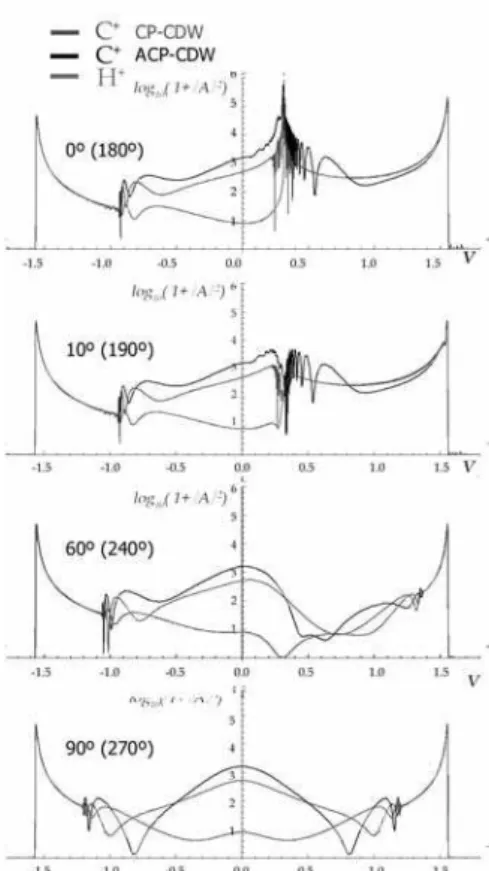
FIG. 3: He+impact velocity profile oflog10(1+|b|2)for selected
cuts of the velocity space: a) θemitter=0◦(180◦), b) θemitter=
10◦(190◦), c)θemitter=60◦(240◦), d)θemitter=90◦(270◦).
species may be easily considered. Thus, to model the emitted electron-projectile interaction we use the Hartree-Fock model potential of Garveyet al. [23] which simulates the interparti-cle separation dependent screening of the ion nuinterparti-clear charge experienced by the electron and is given by,
VP(r) =
[(N−1)(1−Ω(r))−Z]
r
Ω(r) =
η
ξ
(eξr−1) +1 −1
(9)
Here,(N−1)is the number of electrons present in the ion andηandξ are the screening parameters which have been tabulated for ions 26Z654. For heavier ions, the parame-ters may be found by a fit which utilizes points for a reduced parameter form of this potential [24].
The drawback of the model is its inaccurate description of the electrons which are emitted in the forward direction with velocities very close to that of the projectile.
2.3. The CP-CDW model
de-118 C.F. Mart´ınez and S. Otranto
FIG. 4: C+ impact velocity profile oflog10(1+|b|2)for selected
cuts of the velocity space: a) θemitter=0◦(180◦), b) θemitter =
10◦(190◦), c)θemitter=60◦(240◦), d)θemitter=90◦(270◦).
scription of the collision system in this region and the accu-racy of the results obtained should be further examined.
In order to circumvent these issues we now propose a model based on a partial wave expansion for the emitted electron-projectile wave function. We hereafter term this model as Clothed Projectile CDW model or CP-CDW. In this way a more precise description of the electron-projectile in-teraction is obtained.
After solving numerically the radial wave function for the interaction potential, the transition amplitude in the peaking approximation reads:
bCPCDW=−iA0
Z ∞
0
dt′ei(E−E0)t′−Γ2t′t′i
Zp vP
× ∞
∑
l=0Rl(
r−vPt′
)Pl(cos(θ)) 1 v′1/2eiv′·(r−v
Pt′)
!∗
≈ −iA0 ∞
∑
l=0Z ∞
0
dt′ei(E′−E0−vP2/2)t′−Γ2t′t′i
Zp
vP v′−1/2
×Rl(vPt′)Pl(cos(θ)) (10) whereE′is the energy of the electron andθis the polar angle in the projectile frame .
3. RESULTS
We now show and compare the results obtained by means of the three above mentioned models for the autoionization
FIG. 5: Ne+impact velocity profile oflog10(1+|b|2)for selected
cuts of the velocity space: a) θemitter=0◦(180◦), b) θemitter=
10◦(190◦), c)θemitter=60◦(240◦), d)θemitter=90◦(270◦).
of He following the double excitation to the 2s2(1S)state. For the photon impact case, the expected profie for the electronic spectrum consists in a Lorentzian centered around the reso-nant emission velocity ev0=1.5646 a.u. with full width at half maximumΓ=0.00507 a.u. The inverse of theΓ-value is related to the lifetime of the autoionizing state. Although theoretical studies [9] have predicted that the presence of the receding projectile could modify the lifetime of the autoion-izing state, we have employed in our calculations the constant photoionization value above mentioned.
rep-resentation turns hardly visible. In Figure 1 we compare the results obtained by means of the ACP-CDW and CP-CDW models for H+and He+ impact. We observe that the main differences among these two models are obtained in the in-ner part of the binary ring. These are consequence of the different degree of accuracy in the representation of the emit-ted electron-projectile interaction. As mentioned above, the ACP-CDW model is not expected to be accurate at smallv′ values and in this case this limitation traduces in a much more involved oscillatory structure. The CP-CDW model, on the other hand, shows a smooth variation of the ditch-like struc-ture that runs through the inner part of the binary ring as the projectile nuclear charge is increased up to +10. For a better evaluation of these features, in Figs. 3-5 we show selected cuts of the electronic distributions in momentum space. In all cases the Coulomb focusing peak turns now visible in the forward direction for the 0◦cut. We note that all the models provide essentially the same results outside the binary ring. In all cases, the ACP-CDW and CP-CDW models predict an en-hancement of the electronic density in the region where elec-trons backscattered by the projectile are expected. It is this enhancement and the oscillatory nature observed for the dif-ferent cuts what has been interpreted in this context in terms of rainbow scattering [16]. For emission angles<10◦case, the CP-CDW model also shows some oscillatory nature near v′≈0 but in this case is related to the numerical discretiza-tion ofv′-values used. To avoid those oscillations a denser grid inv′ must be considered largely increasing in this way the computational cost.
4. CONCLUSIONS
In this work, we have considered the autoionization of He induced by partially stripped ion impact. A CDW-like model
has been proposed in order to obtain a quantum mechanical description of the autoionization process induced by clothed ion impact. The present model considers for the emitted electron-receding projectile a continuum wave function solu-tion of a model central potential. For such a task we have used the parametrization provided by Garvey et al through which a large range of ionic species may be easily considered. The present model then gives a more precise description of the emitted electron-partially stripped projectile interaction at all times providing an ideal bench test for the applicability of the simpler analytical models here recalled.
Compared to the Barrachina-Macek model we observe that in qualitative terms the ACP-CDW and CP-CDW models pro-vide similar results. A second inspection indicates that differ-ences are obtained in the electronic spectra among these two models. Despite the fact the ACP-CDW model includes the information of the projectile-electron interaction through the non-Coulombic phase shifts, it seems clear that the interfer-ence between the two terms conforming Eq.(8) give rise to large oscillations nearby thev′≈0 region. In this sense, the CP-CDW model then turns a more effective model to treat these processes and should be expected to be much more reli-able. More experimental data for these type of collision pro-cesses would be welcome to help further improve the existing theoretical models.
5. ACKNOWLEDGMENTS
This work has been supported by PGI 24/F049 (UNS), PICT-2007-00887 of the ANPCyT and PIP 112-200801-02760 of CONICET (Argentina).
[1] P. Auger, Jour. Radium 6, 205 (1925).
[2] R. B. Barker, H. W. Berry, Phys. Rev. 151, 14 (1966). [3] A. Z. Devdariani, V. N. Ostrovskii, Yu. N. Sebayakin, Sov.
Phys. JETP 46, 215 (1977).
[4] P. van der Straten, R. Morgenstern, J. Phys. B: At. Mol. Opt. Phys. 19, 1361 (1986).
[5] R. O. Barrachina, J. H. Macek, J. Phys. B: At. Mol. Opt. Phys. 22, 2151 (1989).
[6] J. K. Swenson, C. C. Havener, N. Stolterfoht, K. Sommer, F. W. Meyer, Phys. Rev. Lett. 63, 35 (1989).
[7] J. E. Miraglia, J. Macek, Phys. Rev. A 42, 3971 (1990). [8] I. L. Cordrey, J. H. Macek, Phys. Rev. A 48, 1264 (1993). [9] S. Otranto, C. R. Garibotti, F. D. Colavecchia, G. Gasaneo,
Phys. Rev. A 63, 022713 (2001).
[10] J. K. Swenson, J. Burgd¨orfer, F. W. Meyer, C. C. Havener, D. C. Gregory, N. Stolterfoht, Phys. Rev. Lett. 66, 417 (1991). [11] I. Samengo, R. G. Pregliasco, R. O. Barrachina, J. Phys. B: At.
Mol. Opt. Phys. 32, 1971 (1999).
[12] Sh. D. Kunikeev, V. S. Senashenko, Sov. Phys. JETP 82, 839 (1996).
[13] C. O. Reinhold, D. R. Schultz, R. E. Olson, C. Kelbch, R. Koch
and H. Schmidt-B¨ocking, Phys. Rev. Lett. 66, 1842 (1991). [14] D. R. Schultz and R. E. Olson, J. Phys. B: At. Mol. Opt. Phys.
24, 3409 (1991).
[15] K. W. Ford and J. A. Wheeler, Ann. Phys. (N.Y.) 7, 259 (1959). [16] S. Otranto and R. E. Olson, Phys. Rev. A 72, 022716 (2005). [17] S. Otranto and G. Gasaneo, Phys. Scripta 70, 251 (2004). [18] C. Cohen-Tannoudji, B. Diu, F. Lalo¨e, Quantum Mechanics,
Vol. II (John Wiley & Sons, New York, 1977).
[19] I. S. Gradshteyn and I. M. Ryzhik, Tables of Integrals, Series and Products (London: Academic, 1965).
[20] Gy. V´ıkor, S. Ricz, B. Sulik, L. T´oth, A. K¨ov´er, J. V´egh, J. Phys. B: At. Mol. Opt. Phys. 29, L787 (1996).
[21] L. Schiff, Quantum Mechanics, (McGraw-Hill, New York, 1955)
[22] M. Abramowitz and A. Stegun, Handbook of Mathematical Functions (Washington, DC: NBS, 1964).
[23] R. H. Garvey, C. H. Jackman and A. E. S. Green, Phys. Rev. A 12, 1144 (1975).