O
RIGINALA
RTICLE Revista Brasileira de FisioterapiaObjective structured clinical evaluation
as an assessment method for
undergraduate chest physical therapy
students: a cross-sectional study
Avaliação clínica objetiva e estruturada como um método
para avaliar estudantes de graduação em fisioterapia
respiratória: um estudo transversal
Cibele C. B. M. Silva, Adriana C. Lunardi, Felipe A. R. Mendes, Flavia F. P. Souza, Celso R. F. Carvalho
Abstract
Background: The Objective Structured Clinical Evaluation (OSCE) has been considered a reliable method for the evaluation of students’ clinical skills in health sciences, but it has been rarely applied in the teaching of physical therapy. Objective: To assess the use of the OSCE as a tool to evaluate the abilities of undergraduate chest physical therapy students and to verify the internal consistency of the OSCE exam. Methods: Forty-seven students were evaluated using two types of exams: the traditional exam and the OSCE. Independent educators elaborated the exams. Each question (traditional) or station (OSCE) was given a score ranging from 0.0 to 2.0; being 10.0 the highest possible score of both exams. The relationship between the total score that were obtained from both exams was analyzed using Bland-Altman analysis and Pearson’s correlation coefficient. The internal consistency of the OSCE stations was evaluated by four experienced chest physical therapists and it was tested using Cronbach’s alpha. Results: The students’ average score on the OSCE ranged from 4.4 to 9.6. The internal consistency of the OSCE stations was considered good (0.7). The agreement between exams was analyzed, and it was determined that the exams are not comparable. Examiners also observed a low agreement between the two exams (r=-0.1; p=0.9). Conclusion: Our results showed that OSCE and traditional exams are not interchangeable. The OSCE exam had good internal consistency and is able to evaluate aspects that the traditional exam fails to evaluate.
Keywords: physical therapy; clinical competence; educational measurement; professional competence; program evaluation.
Resumo
Contextualização: A avaliação clínica objetiva e estruturada (OSCE) é considerada um método confiável para avaliar as competências clínicas de estudantes na área de saúde, entretanto tem sido pouco aplicada no ensino de fisioterapia. Objetivo: Analisar o uso da OSCE como uma ferramenta para avaliar as habilidades dos alunos de graduação em fisioterapia respiratória e verificar sua consistência interna. Métodos: Quarenta e sete alunos foram avaliados por meio de dois exames: tradicional e OSCE. As provas foram elaboradas por educadores independentes. Para cada questão (tradicional) ou estação (OSCE), atribuiu-se uma pontuação de 0 a 2. A pontuação máxima possível em ambos os exames foi de 10. As relações entre as pontuações obtidas nos dois exames foram analisadas por meio de Bland-Altman e Correlação de Pearson. A consistência interna das estações da OSCE foi avaliada por quatro fisioterapeutas experientes e foi testada pelo Alfa de Cronbach. Resultados: A pontuação média dos estudantes na OSCE oscilou entre 4,4 e 9,6. A consistência interna das estações da OSCE foi considerada boa (0,7). A concordância entre os exames foi analisada, e determinou-se que os exames não são comparáveis. Os examinadores também observaram uma baixa concordância entre os dois exames (r=-0,1, p=0,9). Conclusão: Nossos resultados mostraram que a OSCE e o exame tradicional não são intercambiáveis. O exame da OSCE teve uma boa consistência interna, sendo capaz de avaliar aspectos que o exame tradicional não avalia.
Palavras-chave: fisioterapia; competência clínica; avaliação educacional; competência profissional; avaliação de programas; projetos de saúde.
Received: 06/09/2011 – Revised: 08/22/2011 – Accepted: 08/26/2011
Physical TherapyDepartment, School of Medicine, Universidade de São Paulo (USP), São Paulo, SP, Brazil
Correspondence to: Celso R. F. Carvalho, Av. Dr. Arnaldo, 455, sala 1210, Faculdade de Medicina, Universidade de São Paulo, CEP 01246-903, São Paulo, SP, Brazil, e-mail: [email protected]
Introduction
Traditional methods that are used to assess clinical skills in health science ields have been deemed insuicient1, and the
paucities noted in this type of evaluation include the lack of objectivity and standardization by the examiners; the inability to test communication skills; the possible practice of favoritism and the failure to predict the future performance of the students2.
herefore, the use of more sophisticated examination methods to assess competencies and clinical skills has been suggested1.
he Objective Structured Clinical Evaluation (OSCE) has been used to evaluate clinical skills3 and has been considered a
reliable method to assess the clinical competence of health sci-ence students4 because it objectively measures technical skills,
attitudes and decision-making strategies5. In this type of exam,
students are assessed in diverse clinical situations. his seems to address the challenge of assessing clinical performance in real-life situations2,although these situations are bounded,
controlled and pre-deined5-8. he OSCE is considered to be a
more efective way to assess problem-solving abilities, critical thinking and communication skills3. It is also considered to be
more objective7 due to a reduced risk of examiner bias9 and the
provision of parity among all students10.
Although the OSCE has been used in Canada to evaluate the clinical knowledge of physical therapists seeking a professional license5, its use to evaluate undergraduate chest physical
ther-apy students is still limited, and studies evaluating its relevance are scarce. Presently, we are aware of only a single study that explores the use of the OSCE with physical therapy students, and it shows a poor internal consistency of the stations and an inability to predict a student’s clinical performance11. herefore,
the aims of this study were to assess the use of the OSCE as a tool to evaluate the abilities of undergraduate chest physical therapy students and to verify its internal consistency.
Methods
Participants
Forty-seven undergraduate physical therapy students in the 3rd year (6th semester) from two consecutive classes from
a public Universidade de São Paulo (USP), São Paulo, SP, Brazil were assessed using traditional and OSCE exams. All students consented to participate in this study.
Study design
his cross-sectional study evaluated students in 2 diferent days at the end of the chest physical therapy course. In the irst day,
they performed theoretical and practical exams (traditional exam) prepared by an educator. In the second day, they performed OSCE exam prepared by other educators from the USP. he students and the educators who prepared the OSCE exams were blinded to the grades obtained on the traditional exam to avoid interference in the exam performance. he contents of the exams included the following: clinical evaluation of the respiratory system, bronchial hygiene and lung expansion techniques, pulmonary rehabilitation, oxygen therapy and discussion of clinical cases based on hospital visits. he study design was approved by the ethics committee of the School of Medicine of the USP (protocol number 7362).
Traditional exam
he traditional exam included four theoretical questions and one practical question. Two points were given for each correct answer, with a maximum score of 10.0 points. he practical ques-tion was randomly chosen by the student (by drawing), and the student was required to perform, for example, a technique that was speciic to bronchial hygiene or lung expansion on another student while the examiner observed. he questions consisted of clinical assessment of the respiratory system, techniques of bronchial hygiene and lung expansion, pulmonary rehabilitation and a case report, which assessed cognitive and psychomotor skills. By deinition, in medicine, a case report is a detailed report of the symptoms, signs, diagnosis, treatment, and follow-up of an individual patient.
Objective structured clinical evaluation
he OSCE was composed of ive stations. Each station was arranged in one of ive classrooms that were all located in the same corridor, in a circuit arrangement, and were identiied by a letter placed on the door ( from A to E). Before entering the sta-tion, students had one minute to read a description of the task to be performed. After entering the station, they had ive minutes to complete the requested task. Four minutes after they had en-tered the station, the coordinator gently knocked on the door to inform the students that they had one minute left to complete the task. After ive minutes, the coordinator opened the door, and students moved on to the next station. Inside each station there was an examiner who was responsible for completing the checklist of activities that the student should have performed; however, this was done only after the students left the station. hroughout the circuit, no comments were allowed between the students, the coordinator and the examiners.
At each station, there was an actor who simulated a real clini-cal practice situation. he simulated activity included a situation involving a multi-professional interaction (which is needed for decision-making), an intervention that is performed on a patient
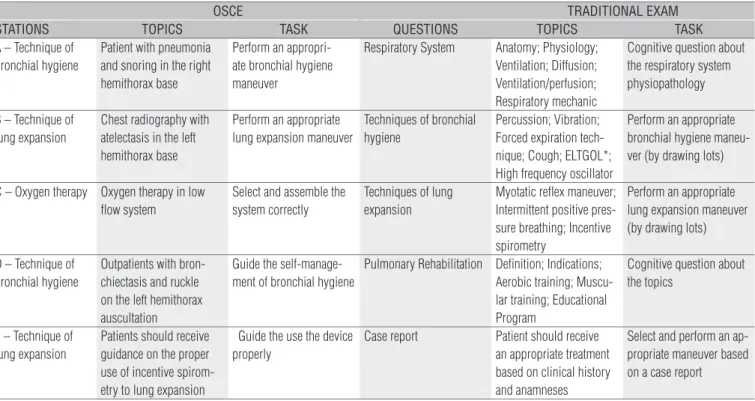
or instructions to the caregiver. All examiners and actors were professionals who had at least ive years of experience. he distri-bution of skills that were assessed in each station is described in Table 1. he skill classiication that was used in the present study (cognitive, psychomotor and attitudinal) was adapted from the classiication that is used for medical students11. Briely, attitudinal
skill was evaluated by the student´s reaction and speech as well as verbal command and intonation with the volunteer-actor and their initiative to solve the task in each station. Psychomotor skill was evaluated as the student´s ability to perform a respiratory maneuver and/or a clinical examination. Cognitive skill was evalu-ated as the student´s capacity to integrate intellectual knowledge to perform a task or to elaborate an adequate clinical conduct to solve a clinical case. To ensure the validity of this classiication for the OSCE that is used in chest physical therapy, four experienced chest physiotherapists reviewed each item on the checklist inde-pendently and rated the skills that were evaluated in each station. here was a meeting to evaluate and discuss speciic questions if there was no consensus about the validity.
Statistical analysis
he data were tested for normality using the Kolmogorov-Smirnov test and were presented as means and standard deviations. he internal consistency of the OSCE stations was tested using Cronbach’s alpha. he agreement between
the total score obtained in both tests was analyzed using Bland-Altman analysis, and the correlation was assessed using Pearson’s correlation coeicient. he level of signiicance for all analyses was set at 5% (p<0.05).
Results
Our results show that the OSCE stations evaluated psycho-motor, cognitive and attitudinal skills (53.6, 14 and 32.4%, re-spectively; Figure 1), and the internal consistency of the OSCE stations was considered good (Cronbach’s alpha=0.7). Students’ performance was considered similar for attitudinal and cogni-tive skills at all stations (on average 76 and 84%, respeccogni-tively). Students’ performance of psychomotor skills showed greater variation between stations (between 36 and 66% on average) (Figure 2).
he average score on the stations (OSCE) was 66.6% rang-ing from 50 to 73%. he students had poorer performances on station C (Figure 3A).
he traditional exam evaluated only cognitive and psycho-motor skills, and the students’ grades ranged from 2.0 to 9.5 points (mean score=7.3) (Figure 3B). Only 8.6% of the students scored below 5.0 points. For the OSCE exam, students’ grades ranged from 4.4 to 9.6 points (mean score=8.0), and only one student’s scored below 5 points. It was observed that there
OSCE TRADITIONAL EXAM
STATIONS TOPICS TASK QUESTIONS TOPICS TASK
A – Technique of bronchial hygiene
Patient with pneumonia and snoring in the right hemithorax base
Perform an appropri-ate bronchial hygiene maneuver
Respiratory System Anatomy; Physiology; Ventilation; Diffusion; Ventilation/perfusion; Respiratory mechanic
Cognitive question about the respiratory system physiopathology
B – Technique of lung expansion
Chest radiography with atelectasis in the left hemithorax base
Perform an appropriate lung expansion maneuver
Techniques of bronchial hygiene
Percussion; Vibration; Forced expiration tech-nique; Cough; ELTGOL*; High frequency oscillator
Perform an appropriate bronchial hygiene maneu-ver (by drawing lots)
C – Oxygen therapy Oxygen therapy in low flow system
Select and assemble the system correctly
Techniques of lung expansion
Myotatic reflex maneuver; Intermittent positive pres-sure breathing; Incentive spirometry
Perform an appropriate lung expansion maneuver (by drawing lots)
D – Technique of bronchial hygiene
Outpatients with bron-chiectasis and ruckle on the left hemithorax auscultation
Guide the self-manage-ment of bronchial hygiene
Pulmonary Rehabilitation Definition; Indications; Aerobic training; Muscu-lar training; Educational Program
Cognitive question about the topics
E – Technique of lung expansion
Patients should receive guidance on the proper use of incentive spirom-etry to lung expansion
Guide the use the device properly
Case report Patient should receive
an appropriate treatment based on clinical history and anamneses
Select and perform an ap-propriate maneuver based on a case report
* Slow full expiration with the open glottis.
Table 1. Summary of the stations/questions and tasks of the OSCE and Traditional Exams. Skills assessed: OSCE-cognitive, psychomotor and attitudinal; Traditional Exam - cognitive and psychomotor.
was an agreement between the two exams grades for 93% of the students (Figure 4), and the variation between the grades that were obtained for the traditional and the OSCE exams occurred independently of the student’s mean inal score. he agreement between both exams was estimated using Bland-Altman analysis; the grades were not comparable in 5 out of 47 students (10.6%) and most students (93.7%) were within 2 standard deviations of the mean (Figure 4). here was no cor-relation between the two exams (r=-0.1; p=0.9).
Discussion
Our results show that students presented distinctly dif-ferent performances on traditional and OSCE exams. In ad-dition, the OSCE exam showed good internal consistency and seemed to assess all of the skills and the competencies that are expected for a chest physical therapy student. hese results suggest that the OSCE could be a good complement to the traditional exam.
he traditional exam focuses on cognitive and psychomotor skills, whereas the OSCE exam was developed to address the
Cognitive Psychomotor
A
Stations 0
20 40
Distribution of successes
60 80 100
(%)
B C D E
Attitude
Figure 2. The mean percentages of students’ correct responses by OSCE station (A to E).
Figure 3. The average of success per station (A to E) in the OSCE (A) and in the traditional exam (B).
A
Stations 0
40 60 60 80
(%)
B C D E
1
Questions
2 3 4 5
0 20
Average of successes
Average of successes
40 60 80
(%)
A
B
Cognitive Psychomotor
A
Stations 0
20 40
Evaluated skills distribution
60 80
(%)
B C D E
Attitude
Figure 1. The figure expresses the distribution of each skill (attitude, cognitive and psychomotor) by OSCE station (A to E).
attitudinal and psychomotor skills that are required to perform basic procedures that are used in clinical practice. he evalu-ation of students based on cognitive skill tends to promote a learning strategy of memorize information, whereas evalua-tions based on the ability to integrate their knowledge tend to
Figure 4. Analysis of agreement between exams using Bland-Altman plot.
Mean
ULA LLA
Diferences
Average of grades 4
-4 -2 0 2 4 6
5 6 7 8 9
ULA=upper limit of the average; Mean=mean difference obtained in the OSCE and the theoretical and practical examination; LLA=lower limit of the average. Each spot represents one student.
develop a more eicient learning strategy12. In the present study,
the lack of association between the students’ performances on a traditional exam and on an OSCE can be explained by the speciicity of each exam, and this may suggest that both exams are complementary and not mutually exclusive, in agreement with other studies13,14.
he OSCE exam was initially proposed by Harden and Gleeson4 in 1975, and since then it has been considered to be
an eicient way to evaluate the clinical competence of vari-ous healthcare professionals, including dentists15, physicians16
and nurses17. Clinical competence includes the ability to solve
problems, to think critically in order to apply clinical reason-ing, to work as a team and to communicate efectively in both verbal and written forms18. All of these skills are also necessary
for a physical therapist; however, to our knowledge, the OSCE exam was described in research only once as an evaluation of undergraduate learning for these students11. In contrast, the
OSCE has been used as a proiciency exam for physical thera-pists in Canada19. he OSCE has also been used to evaluate the
skills of other healthcare professionals, such as dietitians20 and
dentists21, because it reproduces the actual tasks that a
profes-sional must perform in a clinical situation22.
Despite the increasing use of the OSCE, it is important that educators pay close attention to the stations and the checklist preparation to ensure the reliability and validity of this exam16,23.
he internal consistency of the OSCE exam in our study was considered good, as it was higher than the cut of value (0.4) that was suggested by Barman16 and the minimal limit (0.6) that
was proposed by Linn and Gronlund24. he consistency of the
OSCE exam in our study was even higher than the consistency that was described in other studies10,11,23. In our opinion, this is
due to the wide range of skills that were assessed in the OSCE stations in the other studies. Another possible explanation for the higher internal consistency in our OSCE exam is the agree-ment in the skill for each station (cognitive, psychomotor and
attitudinal). Skill analysis was performed prior to the study in an independent manner by four experienced chest physical therapists; after independent analysis, the therapists discussed possible diferences in their opinions and reached a consensus for all stations24.
he main beneit of using the OSCE is the possibility of linking a set of core competencies with the setup of simulated clinical situations that allows the measurement of determined skills. his implies that the OSCE can be considered as a “gold standard” for evaluating healthcare professionals25; however,
some disadvantages of the OSCE have been indentiied. his is the most stressful type of exam for the students, and stress could adversely afect their performance9. his stress did not
seem to occur in our study; students obtained higher scores and demonstrated less variation when evaluated with the OSCE than when evaluated with the traditional exam. Another drawback of the OSCE is the need for a complex organization process including time, cost and assurance of conidentiality. In this study, the OSCE exam required at least 7 chest physical therapists, 5 classrooms and 4 hours to evaluate 12 students.
One limitation of this study is the relatively small sample size; however, the number of students evaluated is similar to previously described11. In addition, we did not assess whether
the OSCE exam was able to predict the students’ performance in practical training or their successful entry into the labor mar-ket. Lastly, whether administering the traditional exam along with the OSCE can improve the evaluation of chest physical therapy students was not directly assessed.
Our results show that the OSCE exam evaluated distinctly diferent skills than the traditional exam for undergraduate chest physical therapy students. he study also showed that our OSCE exam had good internal consistency. hese results suggest that the use of the OSCE to evaluate skills that tradi-tional exam fails and that the OSCE could be used as a comple-ment to a traditional exam.
References
1. Wass V, Van der Vleuten C, Shatzer J, Jones R. Assessment of clinical competence. Lancet.
2001;357(9260):945-9.
2. Agarwal A, Batra B, Sood AK, Ramakantan R, Bhargava SK, Chidambaranathan N, et al. Objective
structured clinical examination in radiology. Indian J Radiol Imaging. 2010;20(2):83-8.
3. Newble D. Techniques for measuring clinical competence: objective structured clinical
examinations. Med Educ. 2004;38(2):199-203.
4. Harden RM, Gleeson FA. Assessment of clinical competence using an objective structured
clinical examination (OSCE). Med Educ. 1979;13(1):41-54.
5. Nayer M. An overview of the objective structured clinical examination. Physiother Can.
1993;45(3):171-8.
6. Mavis BE, Henry RC. Between a rock and a hard place: finding a place for the OSCE in medical
education. Med Educ. 2002;36(5):408-9.
7. Schuwirth LW, van der Vleuten CP. ABC of learning and teaching in medicine: Written assessment.
BMJ. 2003;326(7390):643-5.
8. Troncon LEA. Clinical skills assessment: limitations to the introduction of an “OSCE” (Objective
Structured Clinical Examination) in a traditional Brazilian medical school. Sao Paulo Med J. 2004;122(1):12-7.
9. Bartfay WJ, Rombough R, Howse E, Leblanc R. Evaluation. The OSCE approach in nursing
education. Can Nurse 2004;100(3):18-23.
10. Roberts J, Brown B. Testing the OSCE: a reliable measurement of clinical nursing skills. Can J Nurs Res. 1990;22(1):51-9.
11. Wessel J, Williams R, Finch E, Gémus M. Reliability and validity of an objective structured clinical examination for physical therapy students. J Allied Health. 2003;32(4):266-9.
12. Martenson D, Hakan A, Kerstin G. An integrated final examination in preclinical subjects
for medical students: 10 years of experience. Teaching and Learning in Medicine. 1999;11(1):26-33.
13. Ilic D. Assessing competency in Evidence Based Practice: strengths and limitations of current tools in practice. BMC Med Educ. 2009;9:53-8.
14. Miller GE. The assessment of clinical skills/competence/performance. Acad Med. 1990;65(9 Suppl):S63-7.
15. Larsen T, Jeppe-Jensen D. The introduction and perception of an OSCE with an element of self- and peer-assessment. Eur J Dent Educ. 2008;12(1):2-7.
16. Barman A. Critiques on the Objective Structured Clinical Examination. Ann Acad Med Singapore. 2005;34(8):478-82.
17. Aggarwal R, Mytton OT, Derbrew M, Hananel D, Heydenburg M, Issenberg B, et al. Training and simulation for patient safety. Qual Saf Health Care. 2010;19 (Suppl) 2:i34-43.
18. Simpson EJ. The classification of educational objectives in the psychomotor domain. Washington, DC: Gryphon House; 1972.
19. Miller PA, Cooper MA, Eva KW. Factors predicting competence as assessed with the written component of the Canadian Physiotherapy Competency Examination. Physiother Theory Pract. 2010;26(1):12-21.
20. Pender FT, de Looy AE. The testing of clinical skills in dietetic students prior to entering clinical placement. J Hum Nutr Diet. 2004;17(1):17-24.
21. Gerrow JD, Murphy HJ, Boyd MA, Scott DA. Concurrent validity of written and OSCE components of the Canadian dental certification examinations. J Dent Educ. 2003;67(8):896-901.
22. Reteguiz J, Cornel-Avendaño B. Mastering the OSCE/CSA. New York: McGraw-Hill; 1999.
23. Turner JL, Dankoski ME. Objective structured clinical exams: a critical review. Fam Med. 2008;40(8):574-8.
24. Linn RL, Gronlund NE. Measurement an Assessment in Teaching. 8th ed. New York:
Prentice-Hall; 2000.
25. Miller JK. Competency-based training: objective structured clinical exercises (OSCE) in marriage and family therapy. J Marital Fam Ther. 2010;36(3):320-32.