HEPATITIS
B VIRUS: A PUBLIC HEALTH
PROBLEM
IN VENEZUELA’
Irma Machado
B.,2 Maria
de Monz6n,3
Radl FernBndez,4 Alejandro
Mondolfi,4 JosC R. HernBndez,4 Rafael Vetencourt,5 Carlos Golindano,6
Miguel Garassini, 7 Pedro Grases, Jr.,* Stephen Hadler,’
and Nichob
E. Bianco’
A workshop held in Caracas, Venezuela, on 13-14 May 1983 sought to review the information available about levels of hepatitis B virus infection in that country. This article provides a brief overview of the information presented at that meeting.
Introduction
Hepatitis induced by the hepatitis I3 virus (HBV) constitutes a significant public health problem around the world. The importance of the infection’s epidemiology arises chiefly from the different developmental phases of the disease (acute and chronic) and from the existence of carriers who show no clinical or biochemical evidence of hepatic disease, but who carry hepa- titis B surface antigen in their serum. These carriers are able to transmit the disease agent and are also susceptible to liver disease at some point in their lives (Il.
A recent report pointing to the existence of about two hundred million carriers of the HB virus surface antigen in diverse parts of the world is pertinent in this context (2). Particularly high
carrier prevalences have been observed in Africa and East Asia. Such prevalences tend to vary a good deal in the Americas, ranging from very high in certain Caribbean island countries such as the Dominican Republic to relatively low in various South American countries such as Chile (3, 4).
Regarding Venezuela, one study that dealt with voluntary blood donors in the western por- tion of Caracas found 2.8% of the donors tested to be positive for hepatitis B surface antigen (3). Also, an increase in the number of clinical hepa- titis cases has been reported by the health minis- try’s Public Health Administration in recent years, and high levels of endemicity have been detected among groups of Venezuelan Indians (5, 6, 7).
Responding to these findings, in 1983 the
‘This article will also be published in Spanish in the CECOIC).
Boletin de la Oficina Sanitaria Panamericana. 3Epidemiology Division, Regional Health Administra- The text presented here is derived from the conclusions of tion,State of Zulia, Venezuela.-
a workshoo held in Caracas, Venezuela, on 13-14 May 4Euidemiologv Division. Public Health Administration, 1983. The&study reported in the text and at the workshop Ministry of Health and Social Welfare of Venezuela. was financed by the Ministry of Health and Social Welfare ‘Gastroenterology Service, “Antonio M. Pineda” Hospi- of Venezuela and by FUNDACREDESA (Centro de Es- tal, Barquisimeto, Lara, Venezuela.
tudios Bioldgicos sobre Crecimiento y Desarrollo de la 6Gastroenterology Service, University Hospital of Ca- Poblacih Venezolana), and was sponsored by the Ministry racas, Caracas, Venezuela.
of Health and Social Welfare and by PAHOIWHO. ‘Gastroenterology Service, “Carlos Arvelo” Hospital, ‘National Reference Center for Clinical Immunology Military Health Service, Caracas, Venezuela.
(Centro National de Referencia en Inmunologia Clinico- ‘Digestive Pathology Section, Anatomopathological In- CNRIC), Ministry of Health and Social Welfare and Central stitute, Medical School, Central University of Venezuela, University of Venezuela, site of the World Health Organi- Caracas, Venezuela.
zation Collaborating Center for Clinical Immunology (Cen- ‘Centers for Disease Control, Phoenix, Arizona, United tro Colaborador de la OMS en la Inmunologia Clinico- States.
Machado et al. l HEPATITIS B VIRUS IN VENEZUELA 177
Public Health Administration directed the Na- tional Reference Center for Clinical Immunol- ogy (CNRIC), site of the WHO Collaborating Center for Clinical Immunology (CECOIC) in Venezuela, to organize a workshop for the pur- pose of discussing three basic subjects relating to hepatitis El virus (HBV) in Venezuela. These subjects were (1) the immunoepidemiology of HBV in Venezuela; (2) the clinical-morphologic spectrum of the disease in Venezuela; and (3) the national vaccination program. This article summarizes the proceedings and conclusions of that workshop, which was held in Caracas on 13 and 14 May 1983. Particular attention is given to immunoepidemiologic studies carried out by CNRICKECOIC, the findings of which have been used as a reference in establishing policies for the prevention of hepatitis B# in Venezuela.
Immunoepidemiology
HBV in Western Indian Populations
Between 1979 and 198 1, an epidemic of hepa- titis occurred among the Yucpa Indians of Zulia State. The disease typically followed a severe acute course of short duration, rapidly became chronic, and produced significant mortality. Studies seeking the specific causal agent of the severe clinical pictures involved were able to confirm that there was a high prevalence of HBV carriers possessing markers for the Delta viral agent (6, 7, 9).
The Yucpa are a population of some 5,000 Indians of Carib extraction living in 21 commu- nities in the Perija Mountain Range in western Zulia State on the Venezuelan-Colombian bor- der. Among other things, many Yucpas were found to have severe scabies with open skin lesions, a circumstance that could conceivably have contributed to the persistence of the B virus infection.
Overall, during the three-year 1979-1981 period, 149 cases of viral hepatitis are known to have occurred among the Yucpa; these resulted in 34 deaths and at least 22 cases of chronic hepa- titis. High HBV endemicity was observed, to-
gether with evidence of superinfection by the Delta viral agent in 84% of the HBsAg-positive cases (5).
At the pilot unit of CNRICKECOIC in Cara- cas, we used radioimmunoassay (RIA) testing” to study 20 serum specimens provided by physi- cian-epidemiologists in the affected area. These specimens had been taken from 20 Yucpa In- dians in the community who belonged to families with a history of hepatitis B. As Table 1 shows, 13 (65%) of these specimens tested positively for HBsAg, 10 (50%) were positive for antibody to hepatitis B virus surface antigen (anti-HBs), and 19 (95%) were strongly positive for antibody to hepatitis B virus core antigen (anti-HBc).
For purposes of comparison, 25 serum speci- mens obtained at random from a different Indian population were examined. These specimens, provided by physicians of the Amazon Center for the Investigation and Control of Tropical Dis- eases (Ministry of Health and Social Welfare), were obtained from members of a Yanomami Indian community located in the Parima Moun- tain Range in the Federal Territory of Amazonas in southern Venezuela near the Brazilian border. (The Amerindian Yanomami, unlike the Yucpa, are not of Carib extraction.) Examination of these 25 sera showed a high prevalence of anti- bodies to HBV surface and core antigens (in 80% and 84% of the specimens, respectively), but a relatively low prevalence of HBsAg, which was detected in only one serum (see Table 1).
Survey Data from Other Populations
Besides investigating HBV in Indian popula- tions, CNRICKECOIC has begun an immuno- epidemiologic survey to determine the preva- lence of HBV serologic markers in cross-sec- tions of the population at low risk of infection in the Caracas Metropolitan Area and in zones in the interior of the country. As of this writing, 662 serum specimens from this general popula-
Table 1. Prevalence of HBV serologic markers among groups at high, intermediate, and low levels of risk.
Serologic markers Risk level
NO. tested
HBsAg NO.
positive positive) VJ tested NO.
Ann-HBs No.
positive positive) @
NO.
tested
Anti-HBc No.
positive positive) (% No. tested
HBeAg No.
positive positive) (%
Low risk”. b Intermediate risk High risk:
Indian groups: Yucpa Indians Yanomami Indians Patients undergoing immunodiagnosis’
662 9 (1.3) 662 87 (13.1) 662 60 (9.0) - - -
87 5 (5.7) 74 9 (12.1) 80 1.5 (18.7) - - -
20 I3 (65) 20 IO (50) 20 19 (95) IO 2 (20)
25 I (4) 25 20 (80) 25 21 (84) I 0 (0)
485 112 (23.0) 424 85 (20.4) 430 227 (52.7) 112 14 (12.5)
“A total of 112 sera (16.9%) tested positively for one or more markers.
bin all, 195 of the 662 sera were obtained from “adolescents” (subjects 12 to 19 years old, the average age being 16); none of these sera was positive for HBsAg, but 18 (9.2%) were positive for one or more of the other serologic markers.
‘A total of 128 specimens testing negatively for HBsAg tested positively for one of the other markers.
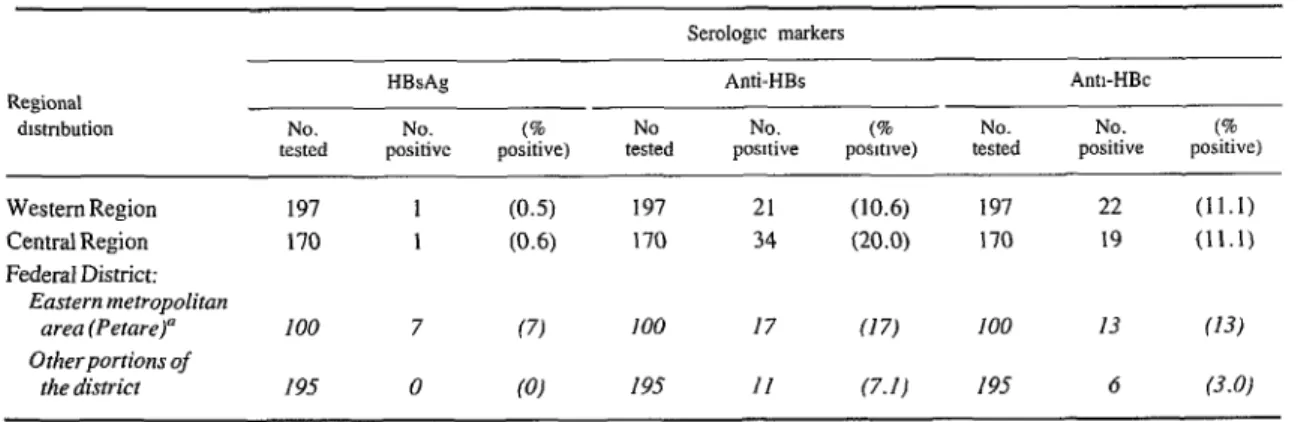
Table 2. Geographic distribution of the 662 low-risk subjects.
Serologtc markers Regional
dlstnbution No. tested
HBsAg NO.
positive positive) (% No
tested
Anti-HBs No.
posnive posltlve) (% No. tested
Ann-HBc No.
positive positive) (%
Western Region Central Region Federal District:
Eastern metropolitan area (Petare)” Other-portions of
the district
197 1 (0.5) 197 21 (10.6) 197 22 (11.1)
170 1 (0.6) 170 34 (20.0) 170 19 (11.1)
100 7 (7) 100 17 (17) 100 13 (13)
195 0 (0) 195 II (7.11 195 6 (3.0)
Machado et al. 0 HEPATITIS B VIRUS IN VENEZUELA 179
tion have been subjected to RIA testing. These samples were obtained from apparently healthy individuals chosen in accordance with a protocol devised by the Center for Biological Studies on Growth and Development of the Venezuelan Population (10). In addition, 87 sera obtained from the medical and paramedical personnel of our laboratory (both temporary and permanent staff members) were integrated into the study as representing a population at intermediate risk of infection with HBV (II). Finally, 485 sam- ples were included that came from subjects with liver disease who were undergoing clinical im- munodiagnosis.
As Table 1 shows, only 1.3% of the 662 speci- mens from the low-risk population of apparently healthy subjects tested positively for HBsAg, as compared to 5.7% of the 87 samples from the intermediate-risk group. However, it is impor- tant to note that varying percentages of anti- bodies to HBsAg were detected in all the popula- tion cross-sections studied (see Tables 1 and 2)) a finding that points to a significant prevalence of acquired immunity. In this same vein, 195 of the 662 sera were obtained from “adolescent” subjects 12-19 years old. None of the sera tested positively for HBsAg, but 18 (9.2%) tested posi- tively for one or more of the other markers.
Regarding the laboratory personnel and liver disease patients, it is interesting that the labora- tory personnel showed a higher prevalence of antibody to core antigen (anti-HBc) than of an- tibody to surface antigen (anti-HBs). Of the 485 patients undergoing immunodiagnosis, 112 yielded sera positive for surface antigen and 12.5% of these 112 were found positive for HBeAg. Also, 50% of those liver disease pa- tients whose sera tested negatively for HBsAg were found positive for anti-HBc.
In general, the data acquired as of 1983 indi- cate that Venezuela’s population is epidemiolog- ically diverse with regard to HBV, the virus being highly endemic among certain groups (such as the Yucpa Indians), moderately en- demic among the tested group of medical and paramedical laboratory workers, and of low en- demicity among apparently healthy members of
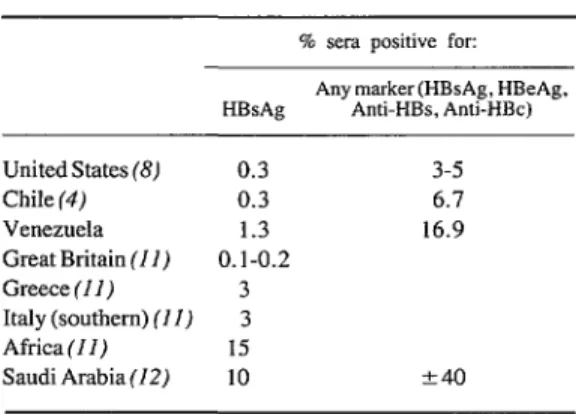
the general population. Within this latter group the highest prevalences of HBV serologic markers nd to be found among residents of mar- ginal areas. The general apparent prevalences of HRsAg and other markers in the Venezuelan population, as indicated by our work as of 1983, together with reported prevalences in seven other countries (2, 4, II, 12, 13), are shown in Tab- le 3.
Table 3. Prevalences of HBV as indicated by the results of serologic studies in Venezuela and seven other
countries or regions.
% sera positive for: Any marker (HBsAg, HBeAg, HBsAg Anti-HBs, Anti-HBc)
United States (8) 0.3 3-5
Chile (4) 0.3 6.7
Venezuela 1.3 16.9
Great Britain (II) 0.1-0.2
Greece(I1) 3
Italy (southern) (II) 3
Africa(II) 15
Saudi Arabia (12) 10 +-40
The Clinical-Morphologic Spectrum of HBV Infection in Venezuela
As was reported during the workshop, a clin- ical follow-up study was made of 108 acute viral hepatitis cases with positive serologic markers for HBV. The patients involved were seen at urban hospitals in the Caracas area and in the state of Lara. The results of the study indicated that a preponderance of the subjects with acute HBV infections were in their twenties and thirties. There was no marked predominance of males or females among the study subjects. Clinical- biochemical symptoms (including elevated lev- els of transaminases and bilirubin) lasted for eight to 12 weeks. The dominant clinical symp- tom was cholestasis.
180 PAHO BULLETIN . vol. 19, no. 2, 1985
patients, tests for antigenemia became negative within six months of their initial illness. Mor- phologically, the observations reported suggest that cases of intensely active chronic hepatitis caused by HBV are the exception in Venezuela. Also, hepatocytes with “ground-glass” proto- plasm indicating the presence of surface antigen are seen less frequently, both in carriers and in other infected subjects, than in countries where the prevalence of HBsAg carriers is higher (see Table 3). However, it has not yet been possible to explain these differences, which indicates a need for a properly controlled comparative study.
Vaccination against HBV
The cost-effectiveness and cost-benefit ratios of such projects as the National Hepatitis B Vac- cination Program to prevent transmission of hepatitis B virus must depend to a great extent on the value of the immunoserologic tests per- formed and the current cost of the vaccine (I I, 14). (Partly because this vaccine must be im- ported, it is not accessible to all communities.)
Also, the survey results available at present in- dicate that the main transmission route-and hence the route most in need of interruption-is from one adult to another.
Conclusions
The studies reported here indicate that the prevalence of HBsAg in Venezuela generally is around 1.3% in apparently healthy subjects, while the overall prevalence of one or more of the HBV markers in apparently healthy subjects is in the range of 16.9%. The evidence available also indicates that the outcome of acute HBV infection is frequently favorable in Venezuela. Finally, data from the survey to detect HBV markers in various Venezuelan populations show that vaccination against HBV is indicated in this country for groups at high and interme- diate risk against the virus. However, it was also emphasized at the workshop that there w,as no indication whatever justifying large-scale vacci- nation or indiscriminate vaccination of the popu- lation at large.
ACKNOWLEDGMENTS
We wish to express our gratitude to the following organizations and their respective directors for organizing the collection and shipment of blood samples: Dr. Hernan Mtndez Castellanos of FUNDACREDESA, Dr. Rafael Mendoza of the Ministry of Health and Social Welfare, and Dr. Luis Yarzabal of the Amazon Center for the Investigation and Control of Tropical Diseases. Our thanks are also extended to Miss Merly B. de MBrquez, immunology technician, for her hard work, and to Miss Amanda Gonzalez for her patience in preparing the manuscript.
SUMMARY
bfachado et al. l HEPATITIS B VIRUS .k VENEZUELA 181
including various findings of a major survey con- ducted by CNRIC.
Overall, available information suggests that while relatively high prevalences of hepatitis B surface anti- gen (HBsAg) and other viral markers are found among certain high-risk groups (including certain Indian populations) and intermediate-risk groups (such as medical laboratory workers), the prevalence of HBsAg among apparently healthy members of the
general Venezuelan population is around 1.3%) while the overall prevalence of HBV serologic markers is in the range of 16.9%. In general, the outcome of acute HBV infections in Venezuela has tended to be favorable; and while there is justification for vaccinat- ing high-risk and intermediate-risk groups against the virus, there is no evidence justifying large-scale or indiscriminate vaccination of the public at large.
REFERENCES
(1) Robinson, W. S. Biology of Human Hepatitis Viruses. In: D. Zakin and T. D. Boyer (eds.). Heputo- logy. W. B. Saunders, Philadelphia, 1982. pp. 863- 910.
(2) McCollum, R. W., and A. J. Zuckerman. Viral hepatitis: Report on a WHO informal consultation. J Med Virol 8:1-29, 1981.
(3) Mazzur, S., N. Nath, C. Fang, M. J. Bas- tiaans, J.L.M. Molinaris, M. Balcaser, S. Beker, E. A. Brunings, A. R. Cameron, V. Farrell, 0. H. Fay, G. Labrador-Gonzalez, G. Gonzalez, A. Gutie- rrez, C. Jaramillo, R. Katz, M. B. Leme Lbpez, E. Levy-Koenig, H. Rodriguez-Moyado, R. A. de Torres, and M. Velasco. Distribution of hepatitis B virus (HBV) markers in blood donors of 13 Western Hemisphere countries: Proceedings of the Red Cross Latin American Hepatitis B Workshop. Bull Pun Am Health Organ 14(1):44-51, 1980.
(4) Velasco, M., M. Gonzalez-Ceron, C. De La Fuente, A. Ruiz, S. Donoso, and R. Katz. Clinical and pathological study of asymptomatic HBsAg car- riers in Chile. Gut 19:569-571, 1978.
(5) Organizacibn Panamericana de la Salud. Hepa- titis grave causada por el virus Delta en Venezuela. Boletin Epidemioldgico 3:8, 1982.
(6) Krugman, S. The newly licensed hepatitis B vaccine: Characteristics and indications for use. JAMA 247:2012-2015, 1982.
(7) Rizzetto, M., M. G. Canese, S. Arico, 0. Crivelli, C. Trepo, F. Bonino, and G. Vemme. Im- munofluorescence detection of new antigen-antibody system (delta/anti-delta) associated to hepatitis B virus in liver and in serum of HBsAg carriers. Gut
18:997-1003, 1977.
(8) United States Centers for Disease Control. In- activated hepatitis B virus vaccine. Morbid&y and Mortality Weekly Reports 3 1:3 17-328, 1982.
(9) Francis, D. P. Selective health care: Strategies for control of disease in the developing world: III. Hepatitis B virus and its related diseases. Reviews of
Infectious Diseases 5:322-329, 1983.
(IO) Machado B., I. Inmunopatologia e inmuno- diagnostic0 de la hepatitis viral inducida por virus B. In: N. E. Bianco and G. Torrigiani (eds.). Inmuno- logic clinica 83. Ediciones de la Biblioteca, Univer- sidad Central de Venezuela, 1983. pp. 43 l-444.
(II) Blackwell Scientific Publications. Viral Hep- atitis. In S. Sherlock (ed.). Diseases of the Liver and Biliary System. London, 1981, pp. 244-269.