ABSTRACT: Mechanized sugarcane (Saccharum spp.) harvest without burning has been increas-ingly adopted in Brazil, increasing trash availability on the fi eld. This study aims at showing the importance of using an integrated framework tool to assess technical and economic impacts of integral harvesting and baling trash recovery strategies and different recovery rates as well as its implications in the sugarcane production, transport and processing stages. Trash recovery using baling system presents higher costs per unit of mass of recovered trash in comparison to system in which trash is harvested and transported with sugarcane stalks (integral harvesting system). However, the integrated agricultural and industrial assessment showed that recover-ing trash usrecover-ing balrecover-ing system presents better economic results (higher internal rate of return and lower ethanol production cost) than the integral harvesting system for trash recovery rates higher than 30 %. Varying trash recovery fraction, stalks productivity and mean transport dis-tance for both integral harvesting and baling systems, sensitivity analyses showed that higher trash recovery fractions associated with higher stalks yields and long transport distances favors baling system, mainly due to the reduction of bulk load density for integral harvesting system under those conditions.
Introduction
Mechanized sugarcane (Saccharum spp.) harvest
without burning has been increasingly adopted in Brazil, mainly due to environmental and legal issues (Fortes et al., 2012), and labor shortage. There are sev-eral benefi ts of trash left on soil surface, such as nu-trient recycling (Oliveira et al., 1999); increase in soil carbon sequestration (Cerri et al., 2011), greenhouse gases emissions reduction (Galdos et al., 2013), weed infestation reduction (Monquero et al., 2008) and sug-arcane yield increase (Gava et al., 2001). On the other hand, the maintenance of large amounts of trash on the soil surface can also result in some negative impacts such as the reduction of ratoon sprouting, increase risk of fi re (Rossetto et al., 2008), greater incidence of sug-arcane insects (Macedo et al., 1997), and diffi culties in the mechanized cultivation (Magalhães et al., 2012). Re-cently, the interest on using sugarcane trash as fuel for heat and power, and also for second generation ethanol has grown (Leite et al., 2009; Dias et al., 2012; Seabra et al., 2010; Suramaythangkoor and Li, 2012). However, large scale use of these residues is still hampered by high recovery costs related to gathering, baling, trans-portation, chopping and residue utilization technology (Michelazzo and Braunbeck, 2008).
In unburned sugarcane harvest, large amounts of residues are left on the fi eld, ranging from 10 to 20 t
ha–1 of dry matter depending on topping height,
sugar-cane variety and yield, crop age, climate, type of soil and other factors (Magalhães et al., 2012). Furthermore, both agronomic and industrial benefi ts and drawbacks
must be evaluated to support the main current question related to this issue: How much trash can be removed from sugarcane fi elds and still improve sustainability of sugarcane production chain?
To assess all these aspects, the Virtual Sugarcane Biorefi nery (VSB) is being constructed in order to eval-uate technical, economic and environmental param-eters of different biorefi nery alternatives considering the entire sugarcane production chain (Cavalett et al., 2012; Dias et al., 2012). This study of trash recovery highlights the importance of using an integrated assess-ment framework to evaluate technical and economic impacts of integral harvesting and baling strategies for different recovery rates as well as its implications for the sugarcane production, transport and processing op-erations.
Materials and Methods
The two main management systems for trash recov-ery were evaluated: Integral harvesting system – Trash is harvested, chopped and transported together with the sugarcane stalks without laying it down to the ground for natural drying. At the industry, trash is (partially) separated from stalks using an air separation system (dry cleaning station) (Hassuani et al., 2005); Baling system – Trash is left on the fi eld for about 15 days after sug-arcane harvesting to decrease its water content through natural drying. After the windrowing of trash, a tractor-propelled baler collects and compresses the trash. After grab loading, the bales are transported by trucks to the industry (Hassuani et al., 2005).
Received September 18, 2012 Accepted July 11, 2013
¹CNPEM/CTBE – Laboratório Nacional de Ciência e Tecnologia do Bioetanol, Polo II de Alta Tecnologia, R. Giuseppe Máximo Scolfaro, 10.000 − 13083-970 − Campinas, SP − Brasil.
²UNICAMP/FEAGRI, Av. Candido Rondon, 501, Cidade Universitária Zeferino Vaz – 13083-875 – Campinas, SP – Brasil.
*Corresponding author <[email protected]>
Edited by: Heitor Cantarella
Technical and economic assessment of trash recovery in the sugarcane bioenergy
Terezinha de Fátima Cardoso¹,²*, Otávio Cavalett¹, Mateus Ferreira Chagas¹, Edvaldo Rodrigo de Morais¹, João Luís Nunes
Carvalho¹, Henrique Coutinho Junqueira Franco¹, Marcelo Valadares Galdos¹, Fábio Vale Scarpare¹, Oscar Antonio Braunbeck¹, Luis Augusto Barbosa Cortez², Antonio Bonomi¹
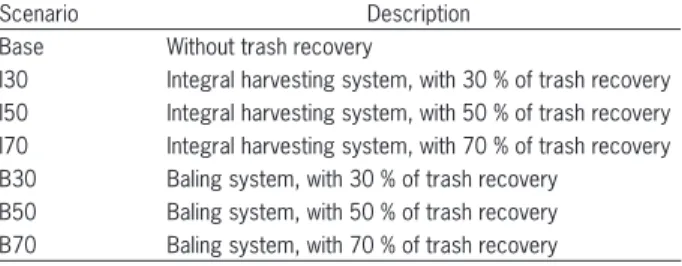
For each of these two systems, three fractions of trash recovery were evaluated. Removing 100 % of trash is considered unfeasible in both scenarios. In the inte-gral harvesting system, part of the trash falls on the soil before and during the harvest operation, while in the baling system is technically and economically unfeasible to collect all the trash present on the soil surface. There-fore, only recovery fractions of 30 %, 50 % and 70 % of the total amount of trash were evaluated and compared to a scenario without trash recovery. In this way, seven scenarios were considered (Table 1).
Agricultural phase
To assess the agricultural phase it was used the CanaSoft model, a computational tool, which has been developed at the Brazilian Bioethanol Science and Tech-nology Laboratory (CTBE) for simulation of important parameters for technical and sustainability assessment of agricultural practices in the sugarcane production chain. This model was developed on spreadsheets and integrates several calculation modules. It contains an in-terface in which the main parameters of production are defi ned (yield, planting and harvesting systems, fertil-izer doses, among others factors). These parameters are considered for the life cycle inventory calculation and also for economic assessment. Both economic and inven-tory calculation are linked to an agricultural database which involves the information about all agricultural operations used in sugarcane production such as agri-cultural performance parameters, types of harvesters, tractor and implements, as well as their weight, costs, diesel consumption, annual use, life span and deprecia-tion, among other parameters.
The basic assumptions for this study were:
• sugarcane yield of 83 t ha–1tons of sugarcane stalks,
av-erage yield of plant cane and four ratoons (IBGE, 2013);
140 kg t–1 of trash (dry basis) per mass of stalks (Ripoli
and Ripoli, 2009; Hassuani et al., 2005);
• mechanized planting using 20 t ha–1of seed cane;
plant-ing every fi ve harvestplant-ing seasons;
• totally mechanized harvesting was considered without pre-harvest burning;
• sugarcane transport trucks with volumetric capacity of 184 m³ and the mean transport distance between fi eld and industry of 30 km. The sugarcane transport density varies according to the trash recovery system.
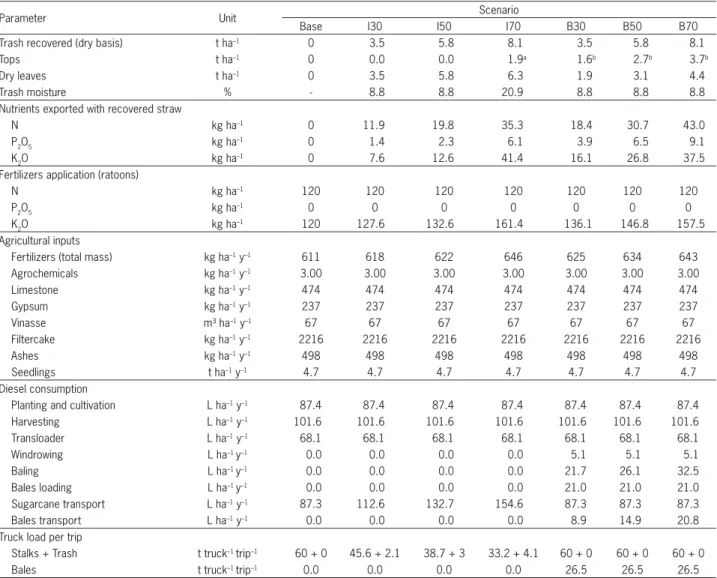
Main agricultural inputs for the different evaluat-ed scenarios are shown in Table 2 as well as the amount of trash recovered in each alternative, with its moisture and nutrients exported to the industry. For the integral harvesting system the trash composition (nutrients and moisture) were based on data from Franco et al. (2012). It was also considered that fi nal trash moisture is the same as that observed by Ripoli and Ripoli (2009) for dry leaves. For baling system, it was assumed that 50 % of the potassium present on tops is recycled during the pe-riod that trash remains in fi eld. As the potassium is pres-ent in ionic form in sugarcane cells, it is released after rupture of cell membrane and can be used by next ratoon (Franco et al., 2007; Malavolta et al., 1997). In this study, it was assumed that the potassium exported by removal of different amount of trash is replaced by commercial fertilizer. As a result, higher fractions of trash removal increase fertilizer application in sugarcane fi eld.
It was considered that the same amount of nitro-gen applied as commercial fertilizer in all the scenarios because the mineralization of nitrogen is substantially slower compared to that of potassium and the recovery rates of N by ratoon from crop residues incorporated into the soil varied from 2 % to 15 % of the total N con-tained in such residues (Ambrosano et al., 2005; Fortes et al., 2012; Gava et al., 2005; Meier et al., 2006; Trivelin et al., 2002; Vitti et al., 2010).
In the baling system, after approximately 15 days in the fi eld, trash is windrowed, baled and transported separately from sugarcane stalks to the industry. It was considered that the fractions recovered in scenarios B30, B50 and B70 can be obtained with adjustments in the trash windrower.
For integral harvesting system, it was considered that different fractions of trash recovery are possible to be obtained after adjusting the primary blower of the harvester. The harvest of trash along with sugarcane stalks leads to lower load density in the transport trucks, affecting operational capacity of the transport. The mag-nitude of these reductions in loading density was esti-mated based on correlations by Hassuani et al. (2005) and are also detailed in Table 2. The diesel consumption was calculated for each mechanized operation consid-ering data related to agricultural performance, engine power, power use factor, maintenance, management and operational effi ciencies, beyond other factors which af-fect diesel consumption and are modeled on CanaSoft.
Industrial phase
In this study, an optimized autonomous distillery with maximization of surplus electricity taken into ac-count (all the bagasse and trash is used as fuels to sup-ply the energy demand and for electricity production) (Dias et al., 2011). Mass and energy balances for the in-dustrial confi gurations were obtained through computer simulations of the different industrial scenarios using
the software Aspen Plus® (Cavalett et al., 2012; Dias et
al., 2012).
Table 1 – Description of evaluated scenarios.
Scenario Description
Base Without trash recovery
I30 Integral harvesting system, with 30 % of trash recovery I50 Integral harvesting system, with 50 % of trash recovery I70 Integral harvesting system, with 70 % of trash recovery B30 Baling system, with 30 % of trash recovery
In the trash recovery by baling system, a higher incorporation of mineral impurities was assumed as the higher fraction of trash is removed, since more soil is col-lected with the trash that is in contact with soil. Accord-ing to Ripoli (2004), the fraction of mineral impurities increases proportionally to the amount of trash recov-ered. The fractions considered are 2 %, 4 % and 8 % of mineral impurities for the scenarios B30, B50 and B70, respectively (Ripoli and Ripoli, 2009; Mello, 2009; Perea et al., 2012). Higher mineral impurities cause a small de-crease in the trash calorifi c value due less lignocellulosic material per volume (Magalhães and Braunbeck, 2010). Other negative effects due to increased mineral impuri-ties in the lignocellulosic material used in the industrial stage such as boiler and blower maintenance and the removal of topsoil rich in organic matter and nutrients were not considered in this study due to lack of data. The technical parameters for ethanol production
in an optimized autonomous distillery are detailed in Cavalett et al. (2012). At the industrial site, trash result-ing from integral sugarcane harvestresult-ing is separated by an air separation system (dry cleaning station) because more trash passing through the mill along with sugar-cane stalks promotes reduction in the sugar separation effi ciency and crushing capacity. For this separation, of trash from stalks, one considered an effi ciency of 70 % according to industrial information (Souza, 2012). For both Base and baling system scenarios (B30, B50 and B70), it was considered a separation of juice (sugar) from fi ber (bagasse) effi ciency of 96.0 %. Reduction in sepa-ration of juice from fi ber (bagasse + residual trash) ef-fi ciency was considered as 95.1 %, 94.5 % and 93.8 % for the scenarios I30, I50 and I70, respectively, based on Camargo et al. (1990).
Table 2 – Agricultural inputs for different trash recovery scenarios.
Parameter Unit Scenario
Base I30 I50 I70 B30 B50 B70
Trash recovered (dry basis) t ha–1 0 3.5 5.8 8.1 3.5 5.8 8.1
Tops t ha–1 0 0.0 0.0 1.9a 1.6b 2.7b 3.7b
Dry leaves t ha–1 0 3.5 5.8 6.3 1.9 3.1 4.4
Trash moisture % - 8.8 8.8 20.9 8.8 8.8 8.8
Nutrients exported with recovered straw
N kg ha–1 0 11.9 19.8 35.3 18.4 30.7 43.0
P2O5 kg ha–1 0 1.4 2.3 6.1 3.9 6.5 9.1
K2O kg ha–1 0 7.6 12.6 41.4 16.1 26.8 37.5
Fertilizers application (ratoons)
N kg ha–1 120 120 120 120 120 120 120
P2O5 kg ha–1 0 0 0 0 0 0 0
K2O kg ha–1 120 127.6 132.6 161.4 136.1 146.8 157.5
Agricultural inputs
Fertilizers (total mass) kg ha–1 y–1 611 618 622 646 625 634 643
Agrochemicals kg ha–1 y–1 3.00 3.00 3.00 3.00 3.00 3.00 3.00
Limestone kg ha–1 y–1 474 474 474 474 474 474 474
Gypsum kg ha–1 y–1 237 237 237 237 237 237 237
Vinasse m³ ha–1 y–1 67 67 67 67 67 67 67
Filtercake kg ha–1 y–1 2216 2216 2216 2216 2216 2216 2216
Ashes kg ha–1 y–1 498 498 498 498 498 498 498
Seedlings t ha–1 y–1 4.7 4.7 4.7 4.7 4.7 4.7 4.7
Diesel consumption
Planting and cultivation L ha–1 y–1 87.4 87.4 87.4 87.4 87.4 87.4 87.4
Harvesting L ha–1 y–1 101.6 101.6 101.6 101.6 101.6 101.6 101.6
Transloader L ha–1 y–1 68.1 68.1 68.1 68.1 68.1 68.1 68.1
Windrowing L ha–1 y–1 0.0 0.0 0.0 0.0 5.1 5.1 5.1
Baling L ha–1 y–1 0.0 0.0 0.0 0.0 21.7 26.1 32.5
Bales loading L ha–1 y–1 0.0 0.0 0.0 0.0 21.0 21.0 21.0
Sugarcane transport L ha–1 y–1 87.3 112.6 132.7 154.6 87.3 87.3 87.3
Bales transport L ha–1 y–1 0.0 0.0 0.0 0.0 8.9 14.9 20.8
Truck load per trip
Stalks + Trash t truck–1 trip–1 60 + 0 45.6 + 2.1 38.7 + 3 33.2 + 4.1 60 + 0 60 + 0 60 + 0
Bales t truck–1 trip–1 0.0 0.0 0.0 0.0 26.5 26.5 26.5
Economic analysis
The amounts of anhydrous ethanol and surplus electricity produced were obtained for each scenario based on the results of the industrial process computer simulations using the VSB tool. Sugarcane total pro-duction cost with different trash recovery alternatives was calculated using the economic module of CanaSoft model in the VSB. These results, along with industrial operational and investment costs, were employed to perform economic analysis, through the determination of internal rate of return (IRR) and production costs us-ing conventional methods of economic viability assess-ment. Ethanol and electricity levelized production costs were obtained through a proportional reduction of their prices, until the IRR is zero. In this condition, capital ex-penditure is recovered and there is no return on capital invested.
Concerning the economic analysis, the following other assumptions were made:
• entire agricultural area required for the sugarcane processed belongs to the mill and an annual opportu-nity cost (leasing) for this land is included in the analy-sis;
• the industrial plant life includes 2 years for construc-tion and start-up plus 25 years of full producconstruc-tion capac-ity;
• value of the plant at the end of the project was consid-ered to be zero;
• sugarcane and trash recovery agricultural production costs were calculated considering a detailed assessment of all the inputs (tractors, implements, harvesters, fuel, labor, fertilizers, agrochemicals, among others) used for its production in the agricultural phase and its transport to the mill;
• ethanol and electricity market prices were assumed as
0.53 US$ L–1 (average of last ten years) and 74.67 US$
MWh–1 (average of last six public auctions for renewable
electricity in Brazil) respectively (Dias et al., 2012). Industrial economic parameters considered for dif-ferent trash recovery scenarios are shown in Table 3.
Results and Discussion
Trash recovery costs
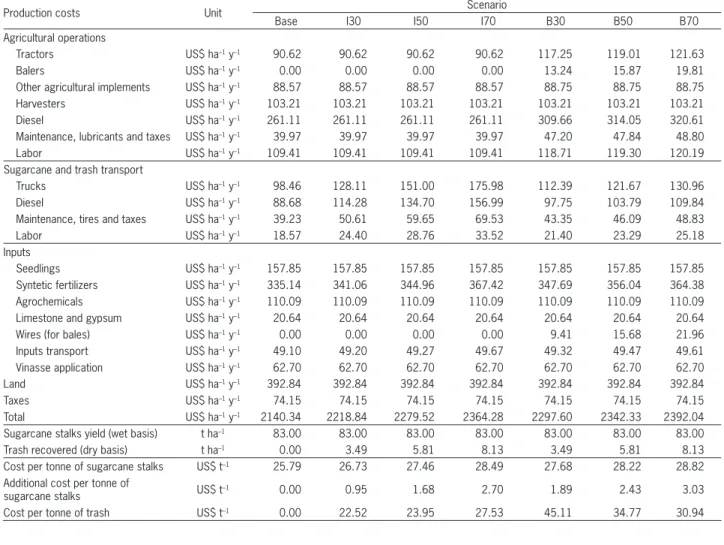
Table 4 shows the sugarcane production costs for different trash recovery alternatives. Trash recovery costs are calculated as the additional costs (per hect-are) of each trash recovery scenario in comparison to the Base scenario (without trash recovery). Sugarcane (and trash) production costs are presented per hectare and per mass of harvested sugarcane stalks, whilst trash recovery costs are presented per mass of removed trash and also the additional cost per mass of harvested sugar-cane stalks compared with the Base scenario.
Higher rates of trash removal indicate higher sugar-cane (and trash) production costs per area in all scenarios, due to higher costs to collect and transport more trash. However, the trends in the trash recovery costs to increased trash recovery rates are not the same for the two recovery systems evaluated in this study (Figure 1). For sugarcane
stalks yield of 83 t ha–1 and mean transport distance of 30
km, integral harvesting system is economically favorable (considering only the trash recovery cost) in comparison to the baling system. Those results are in accordance with Has-suani et al. (2005) and Michelazzo and Braunbeck (2008). For small rates of trash recovery Hassuani et al. (2005) have verifi ed that integral harvest is better than baling. However, the cost of integral harvest increases when large amounts of trash are transported with sugarcane stalks (trend in Fig-ure 1). Considering 50 % of trash recovery, Michelazzo and Braunbeck (2008) concluded that baling system presented higher costs than integral harvest.
Based on the detailed economic model developed to assess the different trash recovery alternatives, a sensitivity analysis was made (Figure 2). Varying the stalks yield (70 t ha–1, 83 t ha–1 and 95 t ha–1) and mean transport distance
(20 km, 30 km, 60 km and 85 km), for each stalks yield the distance was estimated for which the trash recovery costs were the same for integral harvesting and baling systems. For any point below the curves integral harvesting system presents lower costs than baling system, and, conversely, for points above the curves, baling system is better than integral harvesting (Figure 2). Higher trash recovery
frac-Table 3 – Industrial economic parameters for different trash recovery scenarios.
Parameter Scenario
Base I30 I50 I70 B30 B50 B70
Investment (MM US$)
Reception, preparation and juice extraction 24.44 29.52 29.52 29.52 24.77 24.77 24.77 Steam generation, electricity and industrial power system 41.12 49.92 55.26 59.95 50.23 55.74 60.91
Other investments 135.43 135.43 135.43 135.43 135.43 135.43 135.43
Annual costs (MM US$)
Sugarcane stalks and trash 51.89 53.79 55.26 57.31 55.70 56.78 57.99
Labor, other inputs and basic maintenance 17.01 17.53 17.93 18.49 18.05 18.34 18.67
Taxes 0.67 0.73 0.76 0.79 0.73 0.77 0.81
Annual revenues (MM US$)
Ethanol 89.85 88.97 88.38 87.80 89.86 89.85 89.85
tions associated with higher stalk yields and long transport distances favors baling system, mainly due to the reduction of bulk load density for integral harvesting system under those conditions. However, when trash is chopped by the sugarcane harvester, the effect of density reduction would be lower and integral harvesting with trash chopped might be advantageous even under these conditions.
Integrated agricultural and industrial economic analysis
Larger trash recovery rates promote higher elec-tricity surplus, which can be sold to the grid. The in-tegral harvesting system resulted in lower ethanol production than baling system due to higher sugar losses during the extraction operation in the industrial
Figure 1 – Trends in the trash recovery costs for different trash recovery rates.
Table 4 – Sugarcane and trash production costs calculated for the different scenarios.
Production costs Unit Scenario
Base I30 I50 I70 B30 B50 B70
Agricultural operations
Tractors US$ ha–1 y–1 90.62 90.62 90.62 90.62 117.25 119.01 121.63
Balers US$ ha–1 y–1 0.00 0.00 0.00 0.00 13.24 15.87 19.81
Other agricultural implements US$ ha–1 y–1 88.57 88.57 88.57 88.57 88.75 88.75 88.75
Harvesters US$ ha–1 y–1 103.21 103.21 103.21 103.21 103.21 103.21 103.21
Diesel US$ ha–1 y–1 261.11 261.11 261.11 261.11 309.66 314.05 320.61
Maintenance, lubricants and taxes US$ ha–1 y–1 39.97 39.97 39.97 39.97 47.20 47.84 48.80
Labor US$ ha–1 y–1 109.41 109.41 109.41 109.41 118.71 119.30 120.19
Sugarcane and trash transport
Trucks US$ ha–1 y–1 98.46 128.11 151.00 175.98 112.39 121.67 130.96
Diesel US$ ha–1 y–1 88.68 114.28 134.70 156.99 97.75 103.79 109.84
Maintenance, tires and taxes US$ ha–1 y–1 39.23 50.61 59.65 69.53 43.35 46.09 48.83
Labor US$ ha–1 y–1 18.57 24.40 28.76 33.52 21.40 23.29 25.18
Inputs
Seedlings US$ ha–1 y–1 157.85 157.85 157.85 157.85 157.85 157.85 157.85
Syntetic fertilizers US$ ha–1 y–1 335.14 341.06 344.96 367.42 347.69 356.04 364.38
Agrochemicals US$ ha–1 y–1 110.09 110.09 110.09 110.09 110.09 110.09 110.09
Limestone and gypsum US$ ha–1 y–1 20.64 20.64 20.64 20.64 20.64 20.64 20.64
Wires (for bales) US$ ha–1 y–1 0.00 0.00 0.00 0.00 9.41 15.68 21.96
Inputs transport US$ ha–1 y–1 49.10 49.20 49.27 49.67 49.32 49.47 49.61
Vinasse application US$ ha–1 y–1 62.70 62.70 62.70 62.70 62.70 62.70 62.70
Land US$ ha–1 y–1 392.84 392.84 392.84 392.84 392.84 392.84 392.84
Taxes US$ ha–1 y–1 74.15 74.15 74.15 74.15 74.15 74.15 74.15
Total US$ ha–1 y–1 2140.34 2218.84 2279.52 2364.28 2297.60 2342.33 2392.04
Sugarcane stalks yield (wet basis) t ha–1 83.00 83.00 83.00 83.00 83.00 83.00 83.00
Trash recovered (dry basis) t ha–1 0.00 3.49 5.81 8.13 3.49 5.81 8.13
Cost per tonne of sugarcane stalks US$ t–1 25.79 26.73 27.46 28.49 27.68 28.22 28.82 Additional cost per tonne of
sugarcane stalks US$ t–1 0.00 0.95 1.68 2.70 1.89 2.43 3.03
Cost per tonne of trash US$ t–1 0.00 22.52 23.95 27.53 45.11 34.77 30.94
plant (Figure 3). The larger amount of trash processed through the mill also causes higher energy consump-tion (due to larger amount of material to be crushed). Hence, there is lower electricity surplus in the integral harvesting system scenarios compared to baling system scenarios.
For baling and integral harvesting systems, the economic results showed that the higher the fraction of recovered trash, the better the economic performance of the process (Figure 4). The reduction on ethanol produc-tion cost follows the trend of increasing IRR.
The IRR upward trend was more pronounced for baling system scenarios in comparison to integral har-vesting ones (Figure 4). This takes place because increas-ing the cost in the integral harvestincreas-ing system is propor-tional to the increasing amount of trash loaded due to a lower bulk density of the transported material, accen-tuated when transporting some of the tops with higher moisture as in scenario I70. Furthermore, investment in dry cleaning station causes a negative impact on IRR for integral harvesting scenarios. Nevertheless, in the baling system scenarios, higher trash recovery rates promotes higher electricity output and hence, higher IRR and low-er ethanol production cost.
The results indicated that the best option in eco-nomic terms for higher trash recovery fractions is the baling system. All the scenarios with trash recovery are able to decrease the ethanol production costs in com-parison to the Base scenario. This is very important from the consumer point of view, which can benefi t from a biofuel with lower production costs, but also from the demand side that can be stimulated by an ethanol with more competitive prices in comparison to gasoline.
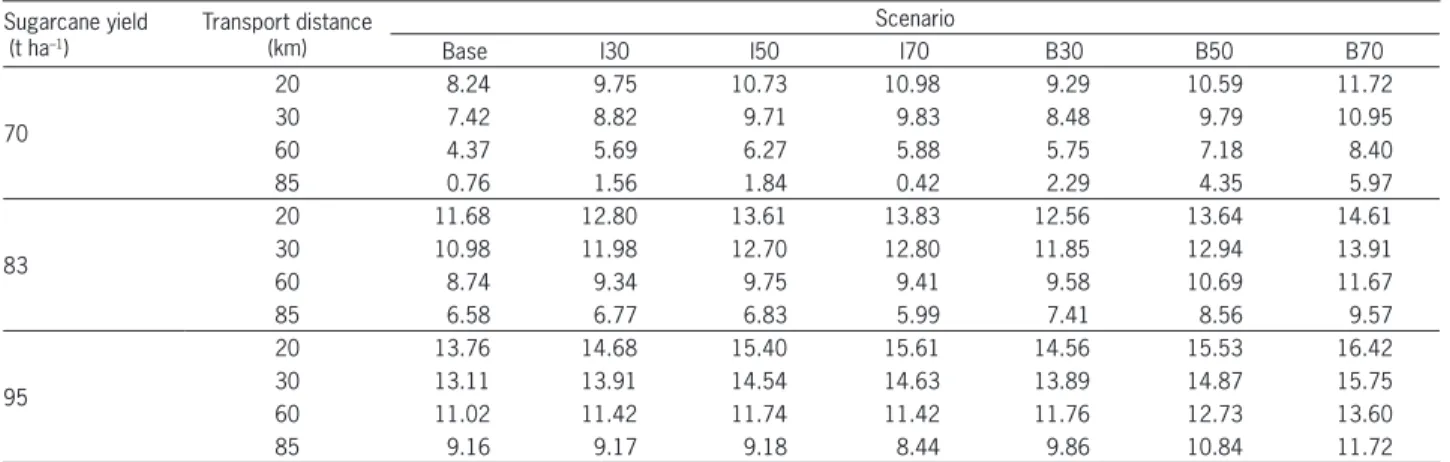
A sensitivity analysis for IRR similar to the one presented in Figure 2 varying stalks productivity (70 t
ha–1, 83 t ha–1 and 95 t ha–1) and mean transport
dis-tance (20 km, 30 km, 60 km and 85 km) was performed considering the integrated agricultural and industrial as-sessment (Table 5). Similarly to the one presented for the trash recovery costs, higher IRRs are obtained for scenarios with baling system in comparison with inte-gral harvesting system for higher stalks productivities and longer transport distances.
Sensitivity analysis varying trash recovery frac-tions, stalks productivity and mean transport distance for both integral harvesting and baling systems showed that higher trash recovery fractions associated with higher stalks productivities and long transport distances favors
Table 5 – Sensitivity analysis for IRR (%).
Sugarcane yield (t ha–1)
Transport distance (km)
Scenario
Base I30 I50 I70 B30 B50 B70
70
20 8.24 9.75 10.73 10.98 9.29 10.59 11.72
30 7.42 8.82 9.71 9.83 8.48 9.79 10.95
60 4.37 5.69 6.27 5.88 5.75 7.18 8.40
85 0.76 1.56 1.84 0.42 2.29 4.35 5.97
83
20 11.68 12.80 13.61 13.83 12.56 13.64 14.61
30 10.98 11.98 12.70 12.80 11.85 12.94 13.91
60 8.74 9.34 9.75 9.41 9.58 10.69 11.67
85 6.58 6.77 6.83 5.99 7.41 8.56 9.57
95
20 13.76 14.68 15.40 15.61 14.56 15.53 16.42
30 13.11 13.91 14.54 14.63 13.89 14.87 15.75
60 11.02 11.42 11.74 11.42 11.76 12.73 13.60
85 9.16 9.17 9.18 8.44 9.86 10.84 11.72
Figure 3 – Ethanol and surplus electricity production considering the different alternatives for trash recovery (See Table 1 for scenarios description).
baling system, mainly due to the reduction of bulk load density for integral harvesting system under those con-ditions. It is important to highlight that some of the nega-tive effects of mineral impurities in the industrial plant, as well as the possibility of an increase on the effi ciency of the dry cleaning station, were not considered in this analysis; these consideration can reduce the economic advantages of the baling system. The analysis performed in this study did not take into consideration the predomi-nantly benefi cial but also some of the negative effects of trash preservation discussed early in this text. These ef-fects are usually site-specifi c and not well defi ned at the moment (see other articles in this Special Issue).
Conclusions
Trash recovery using the baling system presents higher costs per unit of mass of trash recovered in com-parison to system where trash is harvested and trans-ported together with sugarcane stalks (integral harvesting system). However, the integrated agricultural and indus-trial assessment showed that scenarios recovering trash using the baling system present better economic results (higher IRR and lower ethanol production cost) than the integral harvesting system for straw recovery fractions higher than 30 % (considering sugarcane stalks yield of
83 t ha–1 and mean transport distance of 30 km).
References
Ambrosano, E.A.; Trivelin, P.C.O.; Cantarella, H.; Ambrosano, G.M.B.; Schammass E.A.; Guirado N.; Rossi F.; Mendes, P.C.D.; Muraoka, T. 2005. Utilization of nitrogen from green manure and mineral fertilizer by sugarcane. Scientia Agricola 62: 534-542. Camargo, C.A. 1990. Energy Conservation in Industry Sugar
and Alcohol: Recommendations Manual = Manual de Recomendações: Conservação de Energia na Indústria do Açúcar e do Álcool. Instituto de Pesquisas Tecnológicas, São Paulo, SP, Brazil (in Portuguese).
Cavalett, O.; Junqueira, T.L.; Dias, M.O.S.; Jesus, C.D.F.; Mantelatto, P.E.; Cunha, M. P.; Franco, H.C.J.; Cardoso, T.F.; Maciel Filho, R.; Rossell, C.E.V.; Bonomi, A. 2012. Environmental and economic assessment of sugarcane fi rst generation biorefi neries in Brazil. Clean Technologies and Environmental Policy 14: 399-410.
Cerri, C.C.; Galdos, M.V.; Maia, S.M.F.; Bernoux, M.; Feigl, B.J.; Powlson, D.; Cerri, C.E.P. 2011. Effect of sugarcane harvesting systems on soil carbon stocks in Brazil: an examination of existing data. European Journal of Soil Science 62: 23-28. Dias, M.O.S.; Junqueira, T.L.; Cavalett, O.; Cunha, M.P.; Jesus,
C.D.F.; Rossell, C.E. V.; Maciel Filho, R.; Bonomi, A. 2012. Integrated versus stand-alone second generation ethanol production from sugarcane bagasse and trash. Bioresource Technology 103: 152-161.
Dias, M.O.S; Cunha, M.P.; Jesus, C.D.F.; Rocha, G.J.M.; Pradella, J.G.C.; Rossell, C.E.V.; Maciel Filho, R.; Bonomi, A. 2011. Second generation ethanol in Brazil: can it compete with electricity production? Bioresource Technology 102: 8964-8971.
Fortes, C.; Trivelin, P.C.O.; Vitti, A.C. 2012. Long-term decomposition of sugarcane harvest residues in Sao Paulo state, Brazil. Biomass and Bioenergy 42: 189-198.
Franco, H.C.J.; Pimenta, M.T.B.; Carvalho, J.L.N.; Vitti, A.C.; Rossell, C.V.; Braunbeck, O.A.; Magalhães, P.S.G. 2012. How much trash can be removed from sugarcane fi eld for energy production? = ¿Cuánto de la paja se puede quitar del cañaveral para la producción de energía? Asociación Colombiana de Tecnicos de la Caña de Azúcar, Cali, Colombia 1: 385-396 (in Spanish, with abstract in English).
Franco, H.C.J.; Vitti, A.C.; Faroni, C.E.; Cantarella, H.; Trivelin, P.C.O. 2007. Stock of nutrients in crop residues incorporated to the soil during renovation of sugarcane areas. STAB - Açúcar, Álcool e Subprodutos 25: 32-36 (in Portuguese, with abstract in English).
Galdos, M.; Cavalett, O.; Seabra, J.E.A.; Nogueira, L.A.H.; Bonomi, A. 2013. Trends in global warming and human health impacts related to Brazilian sugarcane ethanol production considering black carbon emissions. Applied Energy 104: 576-582. Gava, G.J.C.; Trivelin, P.C.O.; Oliveira, M.W.; Penatti, C.P. 2001.
Growth and accumulation of nitrogen by sugarcane cultivated in soil covered with cane trash. Pesquisa Agropecuária Brasileira 36: 1347-1354 (in Portuguese, with abstract in English). Gava, G.J.C.; Trivelin, P.C.O.; Vitti, A.C.; Oliveira, M.W. 2005.
Urea and sugarcane trash nitrogen balance in a soil-sugarcane crop system. Pesquisa Agropecuária Brasileira 40: 689-695. Hassuani, S.J.; Leal, M.R.L.V.; Macedo, I.C. 2005. Biomass Power
Generation: Sugar Cane Bagasse and Trash. UNDP-UN/CTC, Piracicaba, SP, Brazil.
Instituto Brasileiro de Geografi a e Estatística [IBGE]. 2013. Municipal Agricultural Production = Produção Agrícola Municipal. Available at: http://www.sidra.ibge.gov.br/ [Accessed April 8, 2013] (in Portuguese).
Leite, R.C.C.; Leal, M.R.L.V.; Cortez, L.A.B.; Griffi n, W.M.; Scandiffi o, M.I.G. 2009. Can Brazil replace 5 % of the 2025 gasoline world demand with ethanol? Energy 34: 655-661. Malavolta, E.; Vitti, G.C.; Oliveira, S.A. 1997. Evaluation of
nutritional status of plants: principles and perspectives = Avaliação do estado nutricional das plantas: princípios e aplicações. 2ed. Potafos, Piracicaba, SP, Brazil (in Portuguese).
Macedo, N.; Campos, M.B.S.; Araújo, J.R. 1997. Insects on roots and plant lap, tillering and yield of green and burned cane. STAB - Açúcar, Álcool e Subprodutos 15: 18-21 (in Portuguese, with abstract in English).
Magalhães, P.S.G.; Nogueira, L.A.H.; Canatarella, H.; Rossetto, R.; Franco, H.C.J.; Braunbeck, O.A. 2012. Agro-industrial technological paths. p. 27-69. In: Sustainability of sugarcane bioenergy by Center of Strategic Studies and Management. CGEE, Brasília, DF, Brazil.
Magalhães, P.S.G.; Braunbeck, O.A. 2010. Sugarcane and trash harvesting for ethanol production. p. 465-475. In: Cortez, L.A.B., ed. Sugarcane bioethanol. Blucher, São Paulo, SP, Brazil.
Mello, A.M. 2009. Prismatic baling performance on sugarcane residue collect. 89 p. Dissertation (MS) – Escola Superior de Agricultura Luiz de Queiroz, Universidade de São Paulo, Piracicaba, SP, Brazil (in Portuguese, with abstract in English).
Michelazzo, M.B.; Braunbeck, O.A. 2008. Analysis of six systems of trash recovery in mechanical harvesting of sugarcane. Revista Brasileira de Engenharia Agrícola e Ambiental 12: 546-552 (in Portuguese, with abstract in English).
Monquero, P.A.; Amaral, R.L.; Binha, D.P.; Silva, P.V.; Silva, A.C.; Martins, F.R.A. 2008. Weed infestation maps under different sugarcane harvest systems. Planta Daninha 26: 47-55 (in Portuguese, with abstract in English).
Oliveira, M.W.; Trivelin, P.C.O.; Penatti, C.P.; Piccollo, M.C. 1999. Field decomposition and release of sugar cane trash nutrients. Pesquisa Agropecuária Brasileira 34: 2359-2362 (in Portuguese, with abstract in English).
Perea, L.A.; Biaggioni, M.A.M.; Seraphim, O.J. 2012. Evaluation of methods of trash handling in the sugarcane fi eld and industrialization. Energia na Agricultura 27: 89-108 (in Portuguese, with abstract in English).
Ripoli, M.L.C. 2004. Tests of two sugar cane (Saccharum spp.) biomass obtaining systems for energetic purposes. 213 p. Dissertation (PhD) - Faculdade de Botucatu, SP, Brazil (in Portuguese, with abstract in English).
Ripoli, T.C.C.; Ripoli, M.L.C. 2009. Biomass of Sugarcane: Harvesting, Energy and Environment = Biomassa da cana-de-açúcar: colheita, energia e ambiente. 2ed. Piracicaba, SP, Brazil (in Portuguese).
Rossetto, R.; Cantarella, H.; Dias, F.L.F.; Landell, M.G.A.; Vitti, A.C. 2008. Conservation management and nutrient recycling in sugarcane with a view to mechanical harvesting = Manejo conservacionista e reciclagem de nutrientes em cana-de-açúcar tendo em vista a colheita mecânica. Informações Agronômicas 124: 8-13 (in Portuguese).
Seabra, J.E.A.; Tao, L.; Chum, H.L.; Macedo, I.C. 2010. A techno-economic evaluation of the effects of centralized cellulosic ethanol and co-products refi nery options with sugarcane mill clustering. Biomass and Bioenergy 34: 1065-1078.
Souza, R.T.G. 2012. Technical and economic viability analysis of collecting system of the sugarcane trash by mechanized unburned cane harvest, to increase cogeneration use. 107 p. Dissertation (MS) - Faculdade de Engenharia Agrícola, Universidade Estadual de Campinas, Campinas, SP, Brazil (in Portuguese, with abstract in English).
Suramaythangkoor, T.; Li, Z. 2012. Energy policy tools for agricultural residues utilization for heat and power generation: a case study of sugarcane trash in Thailand. Renewable and Sustainable Energy Reviews 16: 4343-4351.
Trivelin, P.C.O.; Oliveira, M.W.; Vitti, A.C.; Gava, G.J.C.; Bendassolli, J.A. 2002. Nitrogen losses of applied urea in the soil-plant system during two sugar cane cycles. Pesquisa Agropecuária Brasileira 37: 193-201 (in Portuguese, with abstract in English).