Effe ct o f re pe ate d re straint stre ss
o n m e m o ry in diffe re nt tasks
Departamento de Bioquímica, Instituto de Ciências Básicas da Saúde, Universidade Federal do Rio Grande do Sul, Porto Alegre, RS, Brasil G.D. Gamaro,
M.B. Michalowski, D.H. Catelli, M.H. Xavier and C. Dalmaz
Abstract
The present study investigated the effect of repeated stress applied to female rats on memory evaluated by three behavioral tasks: two-way shuttle avoidance, inhibitory avoidance and habituation to an open field. Repeated stress had different effects on rat behavior when different tasks were considered. In the two-way active avoidance test the stressed animals presented memory of the task, but their memory scores were impaired when compared to all other groups. In the habituation to the open field, only the control group showed a signifi-cant difference in the number of rearings between training and testing sessions, which is interpreted as an adequate memory of the task. In the handled and chronically stressed animals, on the other hand, no memory was observed, suggesting that even a very mild repeated stress would be enough to alter habituation to this task. The perfor-mance in the inhibitory avoidance task presented no significant differ-ences between groups. The findings suggest that repeated restraint stress might induce cognitive impairments that are dependent on the task and on stress intensity.
Co rre spo nde nce
G.D. Gamaro
Departamento de Bioquímica ICBS, UFRGS
R. Ramiro Barcelos, 2600 (Anexo) Lab. 32
90035-003 Porto Alegre, RS Brasil
Fax: + 55-51-316-5535 E-mail: gamaro@ vortex.ufrgs.br
Research supported by PRO NEX, FAPERGS and CNPq.
Received January 22, 1998 Accepted November 25, 1998
Ke y wo rds ·Chronic stress ·Memory
·Inhibitory avoidance ·Two-way active avoidance ·O pen field
Intro ductio n
Stress response is an integral part of an adaptive biological system. It is well known that in response to stressful stimuli many hormones and neurotransmitters are released in order to help the organism to function in a dynamic and challenging environment (1). In this situation, adrenomedullary epineph-rine is released and the hypothalamic-pitu-itary-adrenocortical (HPA) axis is activated, releasing hormones such as CRH, ACTH and glucocorticoids (2). In addition, it is well recognized that several hormones
(LTP) (11,12), a long-lasting increase in synaptic excitability that might be involved in the mechanism of memory storage (13-15).
Concerning the effects of chronic stress, evidence suggests that prolonged glucocor-ticoid secretion can have deleterious conse-quences, including damage to the hippo-campus, a target tissue for glucocorticoids (GCs) rich in corticosteroid receptors and with marked sensitivity to GCs (16-18). The hippocampus is a critical site for memory (11,13,19), and the loss of hippocampal neu-rons appears to be associated with the emer-gence of cognitive deficits in aged rats (16). On the other hand, chronically stressed ani-mals do not experience all the hormonal consequences that animals exposed to a single stress episode do (20,21), and it was suggested that previous exposure to chronic stress modified behavior in a novel stress situation (22,23). Therefore, it seems rea-sonable that a previous history of repeated stress would modify behavior in a novel situation and since stress hormones can al-ter memory storage, a repeated stress regime could modify memory.
The present study investigated the effect of repeated stress on memory of adult fe-male rats. Since different tasks used to evalu-ate memory involve different levels of stress, we assessed behavior of animals using three different tasks: two involving avoidance of a stimulus, and one involving habituation to a novel environment.
Mate rial and Me tho ds
Subje cts
Seventy-one female adult Wistar rats (60 days old at the beginning of treatment) from our breeding stock were used. They were housed in groups of 6-8 animals per cage and kept under a normal 12-h dark/light cycle with food and water ad libitum.
Stre ss m o de l
Animals were divided into three groups: stressed, handled and control. Restraint was obtained by placing the animal in a 25 x 7-cm plastic bottle, adjusting it with tape on the outside so that the animal was unable to move. There was a 1-cm hole at one end for breathing. Animals were stressed 1 h/day, 5 days a week for 40 days (24). The immobili-zation procedure was performed between 10:00 and 12:00 h and the behavioral tasks between 14:00 and 16:00 h. In the handled group, animals were manipulated for 2-3 min, but were not submitted to restraint. Control animals were maintained in their home cages untouched. The stress was main-tained during the behavioral task period.
Be havio ral pro ce dure s
Habituation to the open field. A 50-cm high, 40 x 60-cm open field made of brown plywood with a frontal glass wall was used (25). The floor was subdivided with white lines into 12 equal 13.3- by 15.0-cm rec-tangles. Both in the training and in the test session, the animals were gently placed fac-ing the left corner and allowed to explore the arena for 5 min. The performance of rearings, line crossings, and latency to the first cross-ing were counted in both sessions. The dif-ference in the number of rearings between the test and the training trials was used as the measure of retention.
corner, at which point a timer was activated. The timer measured the latency to step down (i.e., placing all four paws on the grid) at which point an intermittent footshock (0.3 mA, 60 Hz) was delivered until the animal climbed back onto the platform. In the test session, the animals were again placed on the platform. No footshock was given in the testing session. A 300-s ceiling was imposed on testing session latency measurements; latencies ³300 s were counted as 300 s. Differences in testing-training session laten-cies were used as retention scores.
Two-way active avoidance. The animals were trained and tested in a two-way active avoidance task in an automatic 50 x 25 x 25-cm opaque acrylic shuttle-box whose floor was a grid of 1-mm diameter bronze bars spaced 10 mm apart (25). Both the training and the test sessions consisted of 30 tone-footshock trials, preceded by 3-min free ex-ploration of the shuttle-box, with no stimula-tion. In each session, the intertrial interval varied at random between 10 and 50 s. Each 7-s tone was immediately followed by a 0.5-mA footshock delivered until the animals crossed the midline. The shock was omitted if the animals crossed to the opposite side of the grid during the tone (avoidance response). The difference in the avoidance responses between the test and the training trials was used as the measure of retention (25).
Statistical analysis
Parametric data are reported as mean ± SEM and were analyzed by one-way ANOVA or by repeated measures ANOVA, followed by the Student-Newman-Keuls test when in-dicated. Comparisons between training and test sessions were made by the Student paired
t-test. Non-parametric data (i.e., latency to step-down from the platform in the test ses-sion of the inhibitory avoidance task) are reported as median (interquartile range) and were analyzed by the Kruskal-Wallis test, followed by the multiple comparison test
based on Kruskal-Wallis scores, when indi-cated.
Re sults
Effe ct o f re pe ate d stre ss o n
the o pe n fie ld task
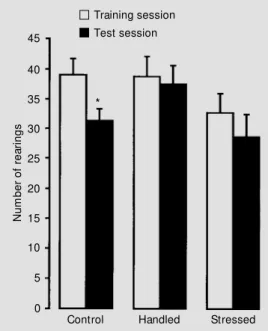
There was no significant difference in training performance between groups in the habituation to the open field, when consider-ing the number of rearconsider-ings (one-way ANOVA; P>0.05). The control group pre-sented a significant difference between train-ing and test sessions (Student paired t-test; P<0.01), which was interpreted as an ad-equate memory of the task (Figure 1). On the other hand, no difference was found in handled and chronically stressed animals (Student paired t-test; P>0.05).
The number of crossings in both sessions was also analyzed. No differences from con-trol values were found in this parameter (control group: 76.4 ± 4.6 for training ses-sion and 72.0 ± 4.1 for test sesses-sion; handled group: 80.7 ± 5.8 for training session and 85.2 ± 5.6 for test session; stressed group: 66.6 ± 7.0 for training session and 66.1 ± 8.5
N
u
m
b
e
r
o
f
re
a
ri
n
g
s
45
40
35
30
25
20
15
10
5
0
*
Training session Test session
Control Handled Stressed
for test session) or in the latency to the first crossing (both ANOVA, with P>0.05).
Effe ct o f stre ss o n the inhibito ry
avo idance task
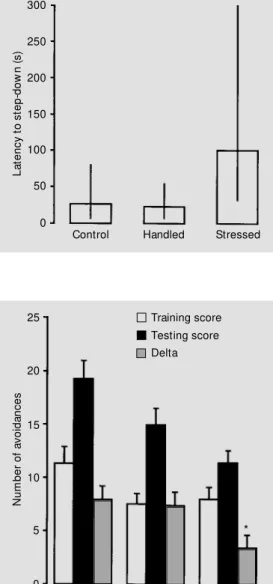
In the step-down inhibitory avoidance task, there was no significant difference be-tween groups in the training session (one-way ANOVA; P>0.05). In the test session, although the chronically stressed group pre-sented an increased latency to step-down from the platform, there was no significant difference in performance between groups
(multiple comparisons based on the Kruskal-Wallis test; P>0.05) (Figure 2).
Effe cts o f re pe ate d stre ss o n two -way
active avo idance
In the two-way active avoidance task, there was no significant difference in train-ing performance between groups (one-way ANOVA; P>0.05). Control and handled ani-mals showed better retention scores (test-training number of avoidances) when com-pared to chronically stressed animals (one-way ANOVA, followed by the Student-Newman-Keuls test; P<0.05) (Figure 3). Comparisons between training and test ses-sions showed significant differences for all groups (Student paired t-test; P<0.001 for control and handled groups, and P<0.05 for chronically restrained group). There were no differences in the number of intertrial cross-ings (i.e., crosscross-ings to the other side of the box not related to the stimulus).
D iscussio n
It has been well established that acute stress or the administration of hormones re-leased by stressful experiences may alter memory of certain tasks (3,4,6). Depending on the level of stress involved, this effect could be a facilitatory or an inhibitory one (3).
Several studies have suggested that ex-posure to glucocorticoids, hormones released by the adrenal cortex during stress, may increase the vulnerability of hippocampal cells to certain insults that can damage hip-pocampal neurons (17,26). The hippocam-pus plays important roles in cognition and neuroendocrine function (13,19), and is known to be important for the consolidation of memories in different tasks, including the tasks studied in this report (27). It should be noted that while deleterious effects of excess glucocorticoid on the brain have been shown, there is little evidence indicating whether
L
a
te
n
c
y
t
o
s
te
p
-d
o
w
n
(
s
)
300
250
200
150
100
50
0
Control Handled Stressed
N
u
m
b
e
r
o
f
a
v
o
id
a
n
c
e
s
25
20
15
10
5
0
Control Handled Stressed
Training score Testing score
*
Delta Figure 2 - Effect of chronic
re-straint stress on performance in the test session of a step-dow n inhibitory avoidance task. Data are reported as median (inter-quartile range) of the latency to step-dow n (N = 10-11 animals/ group). There w as no difference betw een groups (multiple com-parisons based on the Kruskal-Wallis test; P>0.05).
brain function itself is compromised in a situation of repeated stress.
The data reported here suggest that re-peated stress has different effects on rat be-havior when different tasks are considered. The behavioral studies revealed evidence of impairment that was dependent on the task and on the type of chronic stress used, since handling, that can be considered stressful for the animals, also affected performance in the open field task. In the inhibitory avoidance task, there was no significant increase in the latency to step-down, which is not due to an action on motor activity, because this re-peated stress did not modify ambulation in a novel environment. The performance in the two-way active avoidance task was affected only in the repeatedly restrained animals, while in the open field task performance was affected in both the chronically restrained and handled groups, suggesting that even a very mild chronic stress would be enough to alter performance in this task. Our results with the open field task are similar to those obtained by Dachir et al. (9) in a previous study, using implanted corticosterone sus-tained-release pellets for 2 weeks. In that study, chronic corticosterone treatment in-duced habituation impairment that was re-versed by treatment with nimodipine.
It should be noted that the effects of a chronic stress regime are not dependent on the level of stress associated with the memory task: exposure to the open field does not involve pain or a high level of stress, while in the inhibitory avoidance task the animals are exposed to one low intensity foot-shock, and in the two-way active avoidance they receive several foot-shocks.
It was previously observed that chronic stress may depress exploratory activity (22). In the present study, we observed an in-creased latency to step down in the inhibito-ry avoidance and a decreased number of crossings in the open field test, but neither effect was significant. It is important to con-sider that the stressed animals could present
different levels of emotional reactivity inter-fering with memory. It has been shown that exposure to an inescapable shock leads to a deficit in escape behavior (28). In addition, animals submitted to a chronic variable stress regime show escape deficit in a shuttle-box task (29). Both stimuli, inescapable shock and chronic variable stress, are utilized in models of depression (30,31). The repeated restraint stress used in the present study, however, is not considered a model of de-pression. Actually, previous work by Ely et al. (24) has shown that this type of repeated stress can induce a state of anxiety in rats. So, the evaluation of memory in other tasks is also desirable.
In the present work we used female rats to assess the effects of repeated restraint stress on memory. A sex difference in the response of the hypothalamus-pituitary-ad-renal (HPA) axis to stress exists (32,33), with females reacting more robustly than males (32,34). It appears that testosterone can act to inhibit HPA function, whereas estrogen enhances it (32,35). So it is possible that males would have different responses when submitted to this repeated stress.
The possibility of an adaptation of these animals to chronic stress should be consid-ered, in such a way that this task would cause a different degree of stress in chronically stressed and control animals. Studies have demonstrated that prolonged exposure to dif-ferent kinds of stress causes hyperrespon-siveness of the hypothalamus-pituitary-ad-renal axis to a new stimulus, although there is a desensitization of the relative responses of the pituitary ACTH to the primary stressor (21,36). Other studies have shown behavior-al effects of a single restraint stress that are not present after repeated restraint periods in males. Female rats, although less affected by a single restraint, failed to adapt over 5 daily restraint periods (37,38).
more pronounced and persistent in animals deprived of possibilities of social contacts and that isolation can be considered another type of stress (39,40).
These results led us to conclude that
chronic exposure to stressors is capable of modifying memory. Chronic restraint stress causes changes in memory of specific tasks, and these effects are not related to the levels of stress associated with the task.
Re fe re nce s
1. Ursin H & Olff M (1993). The stress re-sponse. In: Stanford S & Salmon P (Edi-tors), Stress: From Synapse to Syn-drome. Academic Press, London, 3-22. 2. Sapolsky RM (Editor) (1992). An
intro-duction to the adrenocortical axis. In:
Stress, the Aging Brain, and the M echa-nisms of Neuron Death. Bradford, M IT Press, Cambridge, 11-27.
3. Gold PE & Van Buskirk R (1978). Posttraining brain norepinephrine con-centrations: correlation w ith retention performance of avoidance training and w ith peripheral epinephrine modulation of memory processing. Behavioral Biol-ogy, 23: 509-520.
4. Izquierdo I & Dias RD (1983). Effect of ACTH, epinephrine, ß-endorphin, nalox-one, and of the combination of naloxone or ß-endorphin w ith ACTH or epineph-rine on memory consolidation. Psycho-neuroendocrinology, 8: 81-87.
5. Bohus B & de Kloet ER (1981). Adrenal steroids and extinction behavior: Antago-nism by progesterone, deoxycorticoster-one and dexamethasdeoxycorticoster-one of a specific cor-ticosterone effect. Life Sciences, 28: 433-440.
6. Gold PE & Van Buskirk R (1975). Facilita-tion of time-dependent memory pro-cesses w ith posttrial epinephrine injec-tions. Behavioral Biology, 13: 145-153. 7. Roozendaal B, Bohus B & M cGaugh JL
(1997). Dose-dependent suppression of adrenocortical activity w ith metyrapone: Effects on emotion and memory. Psy-choneuroendocrinology, 21: 681-693. 8. Flood JF, Vidal D, Bennett EL, Orme AE,
Vasquez S & Jarvik M E (1978). M emory facilitating and anti-amnesic effects of corticosteroids. Pharmacology, Biochem-istry and Behavior, 8: 81-87.
9. Dachir S, Robinzon B, Grauer E & Levy A (1995). Nimodipine counteracts corticos-terone-induced habituation impairments.
Neurobiology of Learning and M emory, 63: 241-245.
10. Venero C & Sandi C (1997). Effects of NM DA and AM PA receptor antagonists
on corticosterone facilitation of long-term memory in the chick. European Journal of Neuroscience, 9: 1923-1928.
11. Foy M R, Stanton M E, Levine S & Thomp-son RF (1987). Behavioral stress impairs long-term potentiation in rodent hippo-campus. Behavioral and Neural Biology, 48: 138-149.
12. Shors TJ, Foy M R, Levine S & Thompson RF (1990). Unpredictable and uncontrol-lable stress impairs neuronal plasticity in the rat hippocampus. Brain Research Bul-letin, 24: 663-667.
13. Izquierdo I (1993). Long-term potentiation and mechanisms of memory. Drug Devel-opment Research, 30: 1-17.
14. Bliss TVP & Collingridge GL (1993). A syn-aptic model of memory: Long-term po-tentiation in the hippocampus. Nature, 361: 31-39.
15. Izquierdo I & M edina JH (1995). Correla-t ion beCorrela-t w een Correla-t he pharm acology of memory and the pharmacology of long-term potentiation. Neurobiology of Learn-ing and M emory, 63: 17-29.
16. Issa AM , Row e W, Gauthier S & M eaney M J (1990). Hypothalamic-pituitary-adrenal activity in aged, cognitively impaired and cognitively unimpaired rats. Journal of Neuroscience, 10: 3247-3254.
17. Sapolsky RM , Packan DR & Vale WW (1988). Glucocorticoid toxicity in the hip-pocampus: in vitro demonstration. Brain Research, 453: 367-371.
18. Sapolsky RM (Editor) (1992). Glucocorti-coids endanger hippocampal neurons. In:
Stress, the Aging Brain, and the M echa-nisms of Neuron Death. Bradford, M IT Press, Cambridge, 119-143.
19. Jarrard LE (1993). On the role of the hip-pocampus in learning and memory in the rat. Behavioral and Neural Biology, 60: 9-26.
20. Hashiguchi H, Ye HSH, M orris M & Alexander N (1997). Single and repeated environmental stress: effect on plasma oxytocin, corticosterone, catecholamines and behavior. Physiology and Behavior, 61: 731-736.
21. Tizabi Y & Aguilera G (1992). Desensitiza-tion of the hypothalamic-pituitary-adrenal axis follow ing prolonged administration of corticotropin-releasing hormone or vaso-pressin. Neuroendocrinology, 56: 611-618.
22. Garcia-M arquez C & Armario A (1987). Chronic stress depresses exploratory ac-tivity and behavioral performance in the forced sw imming test w ithout altering ACTH response to a novel acute stressor.
Physiology and Behavior, 40: 33-38. 23. Cancela LM , Bregonzio C & M olina VA
(1995). Anxiolytic-like effect induced by chronic stress is reversed by naloxone pre-treatment. Brain Research Bulletin, 36: 209-213.
24. Ely DR, Dapper V, M arasca JM , Correa JB, Gamaro GD, Xavier M H, M ichalow ski M B, Catelli D, Rosat R, Ferreira M BC & Dalmaz C (1997). Effect of restraint stress on feed-ing behavior of rats. Physiology and Be-havior, 61: 395-398.
25. Gut ierrez-Figueroa GP, Dalm az C & Izquierdo I (1997). Effects of entorhinal cortex lesions on memory in different tasks. Brazilian Journal of M edical and Bio-logical Research, 30: 769-774.
26. Sapolsky RM , Krey LC & M cEw en BS (1985). Prolonged glucocorticoid exposure reduces hippocampal neuron number: im-plications for aging. Journal of Neurosci-ence, 5: 1222-1227.
27. Izquierdo I & M edina JH (1993). Role of the amygdala, hippocampus and entorhin-al cortex in memory consolidation and ex-pression. Brazilian Journal of M edical and Biological Research, 26: 573-589. 28. Anisman H, de Catanzaro D & Remington
G (1978). Escape performance follow ing exposure to inescapable shock: Deficits in motor response maintenance. Journal of Experimental Psychology, Animal Behav-ior Processes, 4: 197-218.
125-130.
30. Sherman AD, Allers GL, Petty F & Henn FA (1979). A neuropharmacologically-rel-evant animal model of depression. Neuro-pharmacology, 18: 891-893.
31. Willner P & M uscat R (1991). Animal mod-els for investigating the symptoms of de-pression and the mechanisms of action of antidepressant drugs. In: Olivier B, M os J & Slougen JL (Editors), Animal M odels in Psychopharmacology. Birkhaeuser Verlag, Basel, 183-197.
32. Handa RJ, Burgess LH, Kerr JE & O’Keefe JA (1994). Gonadal steroid hormone re-ceptors and sex differences in the hypo-thalamo-pituitary-adrenal axis. Hormones and Behavior, 28: 464-476.
33. Gallucci WT, Baum A, Laue L, Rabin DS, Chrousos GP, Gold PW & Kling M A (1993). Sex differences in sensitivity of
the hypothalamic-pituitary-adrenal axis. Health Psychology, 12: 420-425. 34. Ehlers CL, Kaneko WM , Ow ens M J &
Nemeroff CB (1993). Effects of gender and social isolation on electroencephalo-gram and neuroendocrine parameters in rats. Biological Psychiatry, 33: 358-366. 35. Viau V & M eaney M J (1996). The
inhibito-ry effect of testosterone on hypothalam-ic-pituitary-adrenal responses to stress is mediated by the medial preoptic area. Journal of Neuroscience, 16: 1866-1876. 36. Bhatnagar S & Dallman M (1998).
Neu-roanatomical basis for facilitation of hypo-thalamic-pituitary-adrenal responses to a novel stressor after chronic stress. Neu-roscience, 84: 1025-1039.
37. Kennett GA, Chaouloff F, M arcou M & Curzon G (1986). Female rats are more vulnerable than males in an animal model
of depression: the possible role of seroto-nin. Brain Research, 382: 416-421. 38. Haleem DJ, Kennett G & Curzon G (1988).
Adaptation of female rats to stress: shift to male pattern by inhibition of corticos-terone synthesis. Brain Research, 458: 339-347.
39. Sanchez M M , Aguado F, Sanchez-Toscano F & Saphier D (1998). Neuroen-docrine and immunocytochemical dem-onstrations of decreased hypothalamo-pi-tuitary-adrenal axis responsiveness to re-straint stress after long-term social isola-tion. Endocrinology, 139: 579-587. 40. Janssens CJ, Helmond FA & Wiegant VM