Dopaminergic profile of new
heterocyclic N-phenylpiperazine
derivatives
1Laboratório de Psicofarmacologia, Departamento de Produção de Matéria-Prima,
Faculdade de Farmácia, and 2Programa de Pós-Graduação em Ciências Farmacêuticas,
Universidade Federal do Rio Grande do Sul, Porto Alegre, RS, Brasil
3Laboratório de Avaliação e Síntese de Substâncias Bioativas, Faculdade de Farmácia,
and 4Instituto de Química, Universidade Federal do Rio de Janeiro, Rio de Janeiro,
RJ, Brasil G. Neves1,2, R. Fenner1,
A.P. Heckler1, A.F. Viana1,2,
L. Tasso2, R. Menegatti3,4,
C.A.M. Fraga3,4, E.J. Barreiro3,
T. Dalla-Costa2 and
S.M.K. Rates1,2
Abstract
Dopamine constitutes about 80% of the content of central catechol-amines and has a crucial role in the etiology of several neuropsychiat-ric disorders, including Parkinsons disease, depression and schizo-phrenia. Several dopaminergic drugs are used to treat these patholo-gies, but many problems are attributed to these therapies. Within this context, the search for new more efficient dopaminergic agents with less adverse effects represents a vast research field. The aim of the present study was to report the structural design of two N-phenyl-piperazine derivatives, compound 4: 1-[1-(4-chlorophenyl)-1H -4-pyrazolylmethyl]-4-phenylhexahydropyrazine and compound 5: 1-[1-(4-chlorophenyl)-1H -1,2,3-triazol-4-ylmethyl]-4-phenylhexahydropy-razine, planned to be dopamine ligands, and their dopaminergic action profile. The two compounds were assayed (dose range of 15-40 mg/ kg) in three experimental models: 1) blockade of amphetamine (30 mg/kg, ip)-induced stereotypy in rats; 2) the catalepsy test in mice, and 3) apomorphine (1 mg/kg, ip)-induced hypothermia in mice. Both derivatives induced cataleptic behavior (40 mg/kg, ip) and a hypother-mic response (30 mg/kg, ip) which was not prevented by haloperidol (0.5 mg/kg, ip). Compound 5 (30 mg/kg, ip) also presented a synergis-tic hypothermic effect with apomorphine (1 mg/kg, ip). Only com-pound 4 (30 mg/kg, ip) significantly blocked the amphetamine-in-duced stereotypy in rats. The N-phenylpiperazine derivatives 4 and 5 seem to have a peculiar profile of action on dopaminergic functions. On the basis of the results of catalepsy and amphetamine-induced stereotypy, the compounds demonstrated an inhibitory effect on dopa-minergic behaviors. However, their hypothermic effect is compatible with the stimulation of dopaminergic function which seems not to be mediated by D2/D3 receptors.
Correspondence
S.M.K. Rates
Faculdade de Farmácia, UFRGS Av. Ipiranga, 2752
90610-000 Porto Alegre, RS Brasil
Fax: +55-51-3316-3417 E-mail: [email protected]
Presented at the XVII Annual Meeting of the Federação de Sociedades de Biologia Experimental, Salvador, BA, Brazil, August 28-31, 2002.
Research supported by PROCAD-CAPES.
Received April 18, 2002 Accepted January 8, 2003
Key words
·N-phenylpiperazine
derivatives
·Dopamine
Dopamine belongs to the catecholamine neurotransmitter group and constitutes about 80% of the content of these substances in the brain. At least five different forms of dopa-mine receptors have been cloned from the brain. These receptors are divided into two classes: the D1-like class (including D1 and D5 receptors) and the D2-like class (includ-ing D2, D3 and D4 receptors), differentiated by anatomical, pharmacological and bio-chemical parameters (1).
Dopamine has a crucial role in the etiol-ogy of several neuropsychiatric disorders, including Parkinsons disease, depression and, mainly, schizophrenia. Schizophrenia is a chronic psychiatric illness that affects approximately 1% of the world population. Usually, a schizophrenic patient presents two main kinds of symptoms: positive (delusions, hallucinations) and negative (avolition, an-hedonia, attentional impairment) symptoms. Most of the drugs used for treating this disor-der are D2-like receptor antagonists and are called typical antipsychotics. These drugs are effective only for treating the positive symptoms and present an important profile
of adverse effects, mainly the extrapyrami-dal disturbances such as tardive dyskinesia (2,3).
Clozapine (1) is an atypical antipsychotic drug with high affinity for D4 and 5-HT2 receptors that has a pharmacological profile different from that of classic antipsychotics, being effective in the treatment of positive and negative symptoms and lacking the ex-trapyramidal effects. On the other hand, clozapine (1) tends to induce agranulocyto-sis in 1 to 2% of the patients, which restricts its clinical use in patients that do not respond to classical therapy (2,4). For this reason, the search for new more efficient dopaminergic agents with lower adverse effects is still an extremely active research field.
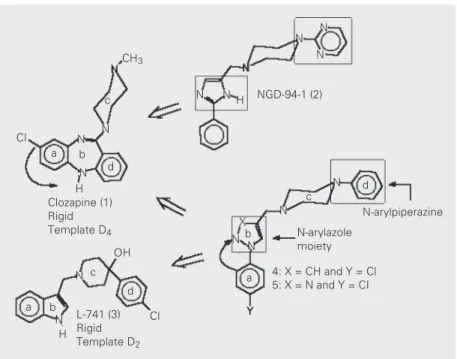
New molecular templates presenting higher functional selectivity for dopamine receptors, such as NGD-94-1 (2) (Ki = 3.8 nM [D4]) and L-741 (3) (Ki = 2.1 nM [D2]) have been described (5,6). We have devel-oped new N-phenylpiperazine derivatives with a potential dopaminergic profile by molecular hybridization of the lead com-pounds clozapine (1) (template D4) and L-741 (3) (template D2). The strategy for ob-taining the structures of
1-[1-(4-chloro-phenyl)-1H
-4-pyrazolylmethyl]-4-phenyl-hexahydropyrazine (compound 4) and isosteric 1-[1-(4-chlorophenyl)-1H -1,2,3- triazol-4-ylmethyl]-4-phenylhexahydropyra-zine (compound 5) is presented in Figure 1. Both compounds bind to dopamine rat brain receptors (Pereira EFR and Albuquerque EX, unpublished results). In the present study we evaluated the in vivo dopaminergic activity of compounds 4 and 5 in three animal mod-els: blockade of amphetamine-induced ster-eotypy in rats, the catalepsy test in mice and apomorphine-induced hypothermia in mice. Male Wistar rats (200 to 250 g) and male Swiss CF-1 mice (20 to 30 g), both from the breeding colony of Fundação Estadual de Produção e Pesquisa em Saúde (Porto Ale-gre, RS, Brazil), were used. The animals had free access to food and water and were kept
Figure 1. Rational structural design of N-phenylpiperazine derivatives 4 and 5 based on the structure of clozapine (1) and L-741 (3).
Clozapine (1) Rigid Template D4
4: X = CH and Y = Cl 5: X = N and Y = CI
N-arylazole moiety
N-arylpiperazine
L-741 (3) Rigid Template D2
NGD-94-1 (2)
Cl
CH3
OH
Cl
H N
N N
N
N N
N N
N H
c N
N N
N
N c
N c
N H b a
d d b a
b X
a
Y
at constant room temperature (22 ± 1ºC) under a 12-h light cycle (lights off at 7:00 pm). All drugs were administered by the intraperitoneal (ip) route (injection volume of 1 ml/kg rat body weight and 1 ml/100 g mouse body weight). Compounds 4 and 5 were suspended in saline with the aid of no more than 5% (v/v) polysorbate 80. The experimental groups consisted of at least 10 animals each.
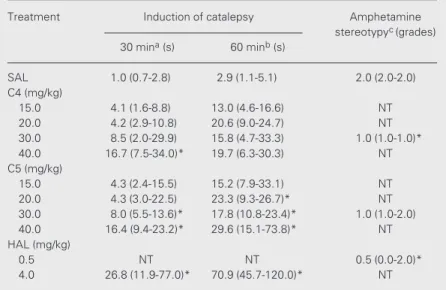
Amphetamine-induced stereotypy was evaluated according to the protocol and doses described by Carlini (7). Thirty minutes after amphetamine (30 mg/kg, ip) administration, the results were scored from 0 to 3 according to increasing intensity of stereotypy (7). This behavior is classically blocked by drugs that inhibit the dopaminergic functions such as neuroleptics (D2 antagonists) (8). Conversely, atypical antipsychotics like clozapine (1) have little or no effect on stereotypy (9). The results are shown in Table 1. Only compound 4 (30 mg/kg, ip) significantly blocked the stereo-typed behavior, although compound 5 (30 mg/ kg, ip) also showed a tendency to block it.
The induction of catalepsy test was adapt-ed from those describadapt-ed by Carlini (7). The mice were placed gently on a wood bar elevated 6.5 cm from the floor. The time spent by the animals in this position was measured 30 and 60 min after the treatments. The results are shown in Table 1. Both de-rivatives induced a time- and dose-depend-ent cataleptic behavior in the animals. Com-pound 5 presented a longer-lasting effect, indicating a possible pharmacokinetic dif-ference between drugs. Despite having vir-tually no strength as an animal behavioral model for antipsychotics, catalepsy tests do have value in the study of neuropharmacol-ogy of extrapyramidal function and as a rapid behavioral screening for predicting the motor side effects of potentially antipsy-chotic drugs (10,11). The extrapyramidal side effects of antipsychotic drugs are re-lated to a blockade of D2 striatal dopamine
receptors (12). However, selective D1
blockers such as SCH23390 also induce marked catalepsy behavior in animals simi-lar to those of opioids and cholinergic ago-nists (10).
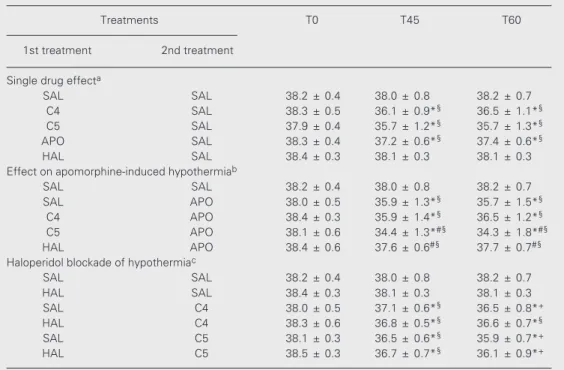
To test the apomorphine (1 mg/kg ip )-induced hypothermia, two treatments were administered to each animal: the first one immediately after measuring the basal rectal temperature (T0) and the second one 30 min later. The rectal temperature was recorded 15 and 30 min after the second treatment (T45 and T60, respectively) (9,13). The re-sults are shown in Table 2. A single adminis-tration of compounds 4 (30 mg/kg, ip) and 5 (30 mg/kg, ip) induced a hypothermic re-sponse which was not abolished by haloperi-dol (0.5 mg/kg, ip) administration. Further-more, a synergistic hypothermic effect
be-tween apomorphine (1 mg/kg, ip) and
com-pound 5 was demonstrated.
Production of hypothermia is a major pharmacological effect of apomorphine in animals. It has been demonstrated that, at
Table 1. Effect of compounds 4 and 5 on the induction of catalepsy and blockade of amphetamine (30 mg/kg)-induced stereotypy in rodents.
Treatment Induction of catalepsy Amphetamine stereotypyc (grades)
30 mina (s) 60 minb (s)
SAL 1.0 (0.7-2.8) 2.9 (1.1-5.1) 2.0 (2.0-2.0) C4 (mg/kg)
15.0 4.1 (1.6-8.8) 13.0 (4.6-16.6) NT 20.0 4.2 (2.9-10.8) 20.6 (9.0-24.7) NT 30.0 8.5 (2.0-29.9) 15.8 (4.7-33.3) 1.0 (1.0-1.0)* 40.0 16.7 (7.5-34.0)* 19.7 (6.3-30.3) NT C5 (mg/kg)
15.0 4.3 (2.4-15.5) 15.2 (7.9-33.1) NT 20.0 4.3 (3.0-22.5) 23.3 (9.3-26.7)* NT 30.0 8.0 (5.5-13.6)* 17.8 (10.8-23.4)* 1.0 (1.0-2.0) 40.0 16.4 (9.4-23.2)* 29.6 (15.1-73.8)* NT HAL (mg/kg)
0.5 NT NT 0.5 (0.0-2.0)*
4.0 26.8 (11.9-77.0)* 70.9 (45.7-120.0)* NT
The treatments were SAL (saline + polysorbate 80 up to 5%, 1.0 ml/100 g mouse body weight, 1.0 ml/kg rat body weight), C4 (compound 4), C5 (compound 5) and HAL (haloperidol) at the doses indicated. The data are reported as medians and interquartile intervals. NT = not tested.
low doses (1 mg/kg), this effect results from the direct agonistic action of apomorphine on both D1 and D2 dopamine receptors lo-cated in the temperature-regulating centers of the hypothalamus (13-15). Functional in-teraction between D1 and D2 receptors has been well documented and these receptors are generally considered to interact syner-gistically. Nevertheless, there is also evi-dence for independent roles of dopamine D1 and D2 receptors in thermoregulation (14,16). On the other hand, the role of serotonin receptors in thermoregulation should also be considered (17).
At the tested dose, haloperidol efficiently blocked the apomorphine effect on the core temperature of the animals. In contrast, it has been reported that higher doses of haloperi-dol induce a hypothermic response which is antagonized by the administration of 5-HT2 agonists (18). Thus, since haloperidol did not affect the N-phenylpiperazine deriva-tive-induced hypothermia, it is plausible to suggest that the mechanism of the hypother-mic effect of compounds 4 and 5 is other than dopamine D2/D3 receptor activation. A hypothermic effect that was not abolished by a selective D2 antagonist was also reported
Table 2. Effect of compounds 4 and 5 on the rectal temperature of mice.
Treatments T0 T45 T60
1st treatment 2nd treatment
Single drug effecta
SAL SAL 38.2 ± 0.4 38.0 ± 0.8 38.2 ± 0.7
C4 SAL 38.3 ± 0.5 36.1 ± 0.9*§ 36.5 ± 1.1*§
C5 SAL 37.9 ± 0.4 35.7 ± 1.2*§ 35.7 ± 1.3*§
APO SAL 38.3 ± 0.4 37.2 ± 0.6*§ 37.4 ± 0.6*§
HAL SAL 38.4 ± 0.3 38.1 ± 0.3 38.1 ± 0.3
Effect on apomorphine-induced hypothermiab
SAL SAL 38.2 ± 0.4 38.0 ± 0.8 38.2 ± 0.7
SAL APO 38.0 ± 0.5 35.9 ± 1.3*§ 35.7 ± 1.5*§
C4 APO 38.4 ± 0.3 35.9 ± 1.4*§ 36.5 ± 1.2*§
C5 APO 38.1 ± 0.6 34.4 ± 1.3*#§ 34.3 ± 1.8*#§
HAL APO 38.4 ± 0.6 37.6 ± 0.6#§ 37.7 ± 0.7#§
Haloperidol blockade of hypothermiac
SAL SAL 38.2 ± 0.4 38.0 ± 0.8 38.2 ± 0.7
HAL SAL 38.4 ± 0.3 38.1 ± 0.3 38.1 ± 0.3
SAL C4 38.0 ± 0.5 37.1 ± 0.6*§ 36.5 ± 0.8*+
HAL C4 38.3 ± 0.6 36.8 ± 0.5*§ 36.6 ± 0.7*§
SAL C5 38.1 ± 0.3 36.5 ± 0.6*§ 35.9 ± 0.7*+
HAL C5 38.5 ± 0.3 36.7 ± 0.7*§ 36.1 ± 0.9*+
The treatments were SAL (saline + polysorbate 80 up to 5%, 1.0 ml/100 g mouse body weight), APO (apomorphine, 1.0 mg/kg), HAL (haloperidol, 0.5 mg/kg), C4 (compound 4, 30.0 mg/kg), and C5 (compound 5, 30.0 mg/kg). T0 is the basal temperature of the animals before any treatment, T45 the rectal temperature 15 min after the second treatment, and T60 the rectal temperature 30 min after the second treatment. The interval between treatments was 30 min. Data are reported as means ± SD in ºC.
*P<0.05 compared to the control group (SAL + SAL) at the same time.
#P<0.05 compared to the apomorphine group (SAL + APO) at the same time point. §P<0.05 compared to the T0 measure in the same group.
+Statistically different from T0 and T45 measures in the same group.
Two-way repeated measures ANOVA followed by the Student-Newman-Keuls post hoc test: a) treatments: F4,197 = 20.56, P<0.001; time: F2,197 = 103.02, P<0.001; time x treatment: F8,197 = 14.92, P<0.001; b)
treatments: F4,182 = 19.52, P<0.001; time: F2,182 = 123.91, P<0.001; time x treatment: F8,182 = 15.43,
P<0.001; c) treatments: F5,248 = 20.71, P<0.001; time: F2,248 = 193.09, P<0.001; time x treatment: F10,248 =
for the selective D1 agonist A68930 (14). In addition, it was reported that clozapine (1)-induced hypothermia in rats is blockaded by selective D1 antagonists, suggesting that this drug may be a partial D1 agonist (19,20). On the other hand, Menon et al. (15) demon-strated that the selective D1 antagonist SCH23390 was not effective in blocking the apomorphine-induced hypothermia but caused a potentiation of the hypothermic effect of quinpirole, a selective D2 agonist. Since compounds 4 and 5 were planned based on the chemical structure of clozapine, it is possible that their hypothermic effects are also mediated by D1 receptor occupation or, perhaps, by interaction with the seroto-nergic system. The hypothermic effects of
compounds 4 and 5 have a magnitude com-parable to that of subcutaneous 10 mg/kg clozapine in rats (20). Other experiments are in progress to elucidate the putative partici-pation of D1 and 5-HT2 receptors in the hypothermic effect of N-phenylpiperazine derivatives.
In conclusion, the N-phenylpiperazine de-rivatives 4 and 5 seem to have a peculiar profile of action on dopaminergic functions. On the basis of the results of catalepsy and amphetamine-induced stereotypy, the com-pounds demonstrated an inhibitory effect on dopaminergic behaviors. However, their hy-pothermic effect is compatible with the stimu-lation of dopaminergic function which seems not to be mediated by D2/D3 receptors.
References
1. Vallone D, Picetti R & Borrelli E (2000). Structure and function of dopamine receptors. Neuroscience and Biobehavioral Reviews, 24: 125-132.
2. Baldessarini RJ (1996). Drugs and the treatment of psychiatric disor-ders: Psychosis and anxiety. In: Hardman JG & Limbird LE (Editors),
Goodman & Gilman´s - The Pharmacological Basis of Therapeutics. 9th edn. McGraw-Hill, New York, NY, USA.
3. Stahl P (2000). Essential Psychopharmacology - Neuroscientific Ba-sis and Practical Applications. 2nd edn. Cambridge University Press, New York, NY, USA.
4. Crismon ML & Dorson PG (1997). Schizophrenia. In: DiPiro JT, Talbert RL, Yee GC, Matzke GR, Wells BG & Posey LM (Editors),
Pharmacotherapy - A Pathophysiological Approach. 3rd edn. Appleton & Lange, Stamford, UK.
5. Thurkauf A, Yuan J, Chen X et al. (1997). 2-Phenyl-4(5)-[[4-(pyrimidin-2-yl)piperazin-1-yl]methyl]imidazole. A highly selective antagonist at cloned human D-4 receptors. Journal of Medicinal Chemistry, 40: 1-3.
6. Kulagowski JJ, Broughton HB, Curtis NR et al. (1996). 3-[[4-(4-Chlorophenyl)piperazin-1-yl]-methyl]-1H-pyrrolo[2,3-b]pyridine: An antagonist with high affinity and selectivity for the human dopamine D4 receptor. Journal of Medicinal Chemistry, 39: 1941-1942.
7. Carlini EA (1973). Farmacologia Prática sem Aparelhagens. Sarvier, São Paulo, SP, Brazil.
8. Verma A & Kulkarni SK (1993). Differential role of dopamine receptor subtypes in thermoregulation and stereotypic behavior in naive and reserpinized rats. Archives Internationales de Pharmacodynamie et de Therapie, 324: 17-32.
9. Moore NC & Gershon S (1989). Which atypical antipsychotics are identified by screening tests? Clinical Neuropharmacology, 12: 167-184.
10. Sanberg PR, Bunsey MD, Giordano M & Norman A (1988). The catalepsy test: its ups and downs. Behavioral Neuroscience, 102: 748-759.
11. Weiss JM & Kilts CD (1998). Animal models of depression and schizophrenia. In: Schatzberg AF & Nemeroff CB (Editors). Textbook of Psychopharmacology. American Psychiatric Press, Washington, DC, USA.
12. Wadenberg M-LG, Soliman A, VanderSpek SC & Kapur S (2001). Dopamine D2 receptor occupancy is a common mechanism
underly-ing animal models of antipsychotics and their clinical effects.
Neuropsycopharmacology, 25: 633-641.
13. Salmi P, Jimenez P & Ahlenius S (1993). Evidence for specific involvement of dopamine D1 and D2 receptors in the regulation of
body temperature in the rat. European Journal of Pharmacology, 236: 395-400.
14. Puech AJ, Frances H & Simon P (1978). Imipramine antagonism of apomorphine-induced hypothermia: A non-dopaminergic interaction.
European Journal of Pharmacology, 47: 125-127.
15. Menon MK, Gordon LI, Kodama CK & Fitten J (1988). Influence of D1
receptor system on the D2-mediated hypothermic response in mice. Life Sciences, 43: 871-881.
16. Salmi P (1998). Independent roles of dopamine D1 and D2/3
recep-tors in rat thermoregulation. Brain Research, 781: 188-193. 17. Salmi P & Ahlenius S (1998). Evidence for functional interactions
between 5-HT1A and 5-HT2A receptors in rat thermoregulatory
mechanisms. Pharmacology and Toxicology, 82: 122-127. 18. Yamada J, Sugimoto Y & Horisaka K (1995). Serotonin2 (5-HT2)
receptor agonist 1(2,5-dimethoxy-4-iodophenyl)-2-aminopropane (DOI) inhibits chlopromazine-induced and haloperidol-induced hypo-thermia in mice. Biological and Pharmaceutical Bulletin, 18: 1580-1583.
19. Salmi P, Karlsson T & Ahlenius S (1994). Antagonism by SCH23390 of clozapine-induced hypothermia in the rat. European Journal of Pharmacology, 253: 67-73.
20. Salmi P & Ahlenius S (1996). Further evidence for clozapine as a dopamine D1 receptor agonist. European Journal of Pharmacology,