aDepartment of Obstetrics and Gynecology, Hospital das Clínicas, São Paulo
University Medical School.
bPediatric Surgery Department, Hospital das Clínicas, São Paulo University
Medical School.
Email: [email protected]
Received for publication on September 26, 2005. Accepted for publication on February 08, 2006.
ORIGINAL RESEARCH
PRENATAL DIAGNOSIS AND PERINATAL OUTCOME
OF 38 CASES WITH CONGENITAL DIAPHRAGMATIC
HERNIA: 8-YEAR EXPERIENCE OF A TERTIARY
BRAZILIAN CENTER
Rodrigo Ruano,a Victor Bunduki,a Marcos Marques Silva,b Carlos Tadashi
Yoshizaki,a Uenis Tanuri,b João Gilberto Macksoud,b and Marcelo Zugaiba
Ruano R, Bunduki V, Silva MM, Yoshizaki CT, Tanuri U, Macksoud JG, Zugaib M. Prenatal diagnosis and perinatal outcome of 38 cases with congenital diaphragmatic hernia: 8-year experience of a tertiary Brazilian center. Clinics. 2006;61(3):197-202.
PURPOSE: To evaluate the perinatal results for neonates with congenital diaphragmatic hernia diagnosed prenatally.
METHOD: We reviewed data from 38 cases of congenital diaphragmatic hernia diagnosed prenatally from January 1995 to December 2003 in the Fetal Medicine Unit of the Department of Obstetrics and Gynecology, São Paulo University Medical School. The main data analyzed were gestational age at diagnosis, fetal karyotyping, side of diaphragmatic defect, presence of associated structural malformations, hepatic herniation, and severe mediastinal shift. Perinatal outcomes were obtained by reviewing hospital documents or by directly calling the patients’ immediate relatives.
RESULTS: Mean gestational age at diagnosis was 29 weeks (range, 16-37 weeks).Thirty (79%) cases had a left diaphragmatic defect and 8 (21%) had a right lesion. Associated structural malformations were observed in 21 (55%) cases, in which 12 fetuses had a normal karyotype and 9 had chromosomal abnormalities. Isolated congenital diaphragmatic hernia was confirmed in 17 (45%) cases. The overall perinatal mortality rate was 92%. Rates of fetal deaths, early neonatal deaths, late neonatal deaths, and survival were 42%, 50%, 0%, and 8%, respectively, in cases with associated structural malformations but normal karyotyping; 56%, 44%, 0%, and 0% for cases with chromosomal abnormalities; and, 0%, 76%, 12%, and 12% in cases with isolated congenital diaphragmatic hernia. The neonatal mortality rate was 89% in cases with isolated congenital diaphragmatic hernia.
CONCLUSION: Perinatal mortality was very high in prenatally diagnosed cases of congenital diaphragmatic hernia. Earlier perinatal deaths are associated with the presence of other structural defects or chromosomal abnormalities. In cases of isolated congenital diaphragmatic hernia, mortality is related to the presence of herniated liver, right-sided lesion, and major mediastinal shift.
KEYWORDS: Ultrasound. Congenital diaphragmatic hernia. Neonatal mortality. Prenatal diagnosis. Fetal malformation.
INTRODUCTION
Congenital diaphragmatic hernia (CDH) - consisting of a diaphragmatic defect that starts early in the embryological period, with consequent herniation of the abdominal
struc-tures into thoracic cavity - occurs in approximately 1 of 2,200 live births.1,2 Herniated abdominal structures, such as stomach and liver, shift fetal lungs, and cause pulmo-nary hypoplasia, which is responsible for the high neonatal mortality rate.3 Although the lungs are shifted during fetal life, the placenta maintains respiratory function, allowing correct gas exchange. However, once the umbilical cord is clamped during birth, the hypoplastic lungs cannot perform adequate gas exchange, leading to severe respiratory dis-tress and neonatal death.4
malfor-mations, excluding chromosomal abnormalities, and plan-ning delivery inside a specialized tertiary center.5 Before the onset of prenatal sonographic diagnosis, the mortality rate was almost 100%, and CDH was considered a lethal
malformation.6 Nowadays, the mortality rate has been
de-creasing among neonates with isolated CDH, varying from 40% to 75% in developed countries.1,7 Nevertheless, in spite of the great advances in prenatal and postnatal diagnosis and management, the mortality rate in neonates with iso-lated CDH is still high.8
Recent research has focused on prenatal predictors of neonatal outcome in isolated CDH cases, such as lung/head ratio9,10 and fetal lung volume,11–16 to differentiate cases with a worse prognosis, in which fetal therapy or termination of pregnancy may be indicated, from those with better prog-nosis, requiring only specialized postnatal care.17–19
In spite of the worldwide, published experience, there are no data about perinatal results in cases of prenatally diag-nosed CDH in Brazil. Therefore, we reviewed all cases of prenatally diagnosed CDH in a specialized tertiary center, focusing on the frequency of associated structural malfor-mations, chromosomal abnormalities, and the mortality rate.
PATIENTS AND METHODS
We reviewed the prenatal database from January 1995 to December 2003 of the Fetal Medicine Unit of the De-partment of Obstetrics and Gynecology, São Paulo Univer-sity Medical School, identifying 38 cases of CDH.
Prenatal characteristics were retrospectively analyzed from the ultrasonographic basic database. The main data analyzed were gestational age at diagnosis, presence of as-sociated structural malformations, fetal karyotyping, side of diaphragmatic defect, mediastinal shift, and liver herniation. Perinatal outcome was reviewed by consulting prena-tal, neonaprena-tal, and pediatric databases, as well as from tel-ephone contacts with parents. Cases were classified accord-ing to perinatal outcome includaccord-ing fetal death, early neonatal death (from birth to 7 days of life), and late neonatal death (after 7 days of life up to 28 days).
RESULTS
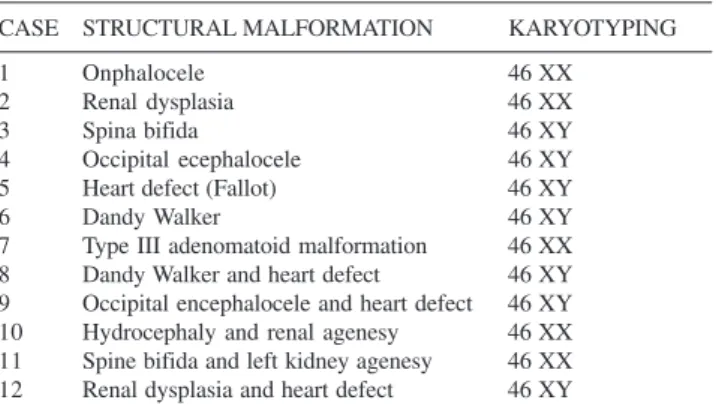
Among the 38 cases of CDH, 30 (79%) had left CDH, and 8 (21%) had right CDH. Mean gestational age at di-agnosis was 29 weeks of gestation (range, 16-37 weeks). Associated structural malformations were observed in 21 cases (55%), of which 12 had normal karyotyping (Table 1). Chromosomal abnormality was observed in 9 cases (24%), including trisomy 18 (n = 4), trisomy 13 (n = 3), 46XX/47XXX (n = 1), and 45X (n = 1). These two last fetuses had heart malformations in association with con-genital diaphragmatic hernia (interventricular defect and aorta coarctation, respectively).
The overall mortality was 92% (35/38). All cases with chromosomal abnormalities died before the 7th day of life (mortality of 100%). Among the 12 cases with associated structural malformation but normal karyotyping, 11 (92%) also died before the 7th day of life (including fetal deaths). Among all the cases, only 3 infants with CDH survived more than 28 days after surgical repair (including 1 neonate with associated omphalocele, but with a normal karyotype) (Table 2).
Isolated CDH was observed in 17 cases (45%). In this group, 15 neonates (88%) died. No fetal death was
ob-Table 2 - Perinatal outcome in cases with congenital diaphragmatic hernia according to associated structural and chromosomal abnormalities
Fetal deathn (%) early NNDn (%) late NNDn (%) Survivaln (%) Totaln (%)
Isolated CDH 0 (0%) 13 (76.4%) 2 (11.8%) 2 (11.8%) 17 (100%)
Associated MF with 5 (41.7%) 6 (50.0%) 0 (0%) 1 (8.3%) 12 (100%)
normal karyotype
Chromosomal abnormalities 5 (55.6%) 4 (44.4%) 0 (0%) 0 (0%) 9 (100%)
CDH: congenital diaphragmatic hernia; MF: structural malformation; early NND: neonatal death before 7 days of life; late NND: neonatal deaths between 7 and 28 days of life; Survival: cases that survived after 28 days of life
Table 1 - Description of the associated structural malformations with normal karyotype
CASE STRUCTURAL MALFORMATION KARYOTYPING
1 Onphalocele 46 XX
2 Renal dysplasia 46 XX
3 Spina bifida 46 XY
4 Occipital ecephalocele 46 XY
5 Heart defect (Fallot) 46 XY
6 Dandy Walker 46 XY
served, 2 neonates (12%) survived up to the 28th day of life and 2 neonates (12%) survived after the 28th day of life (Table 2). Two (12%) neonates underwent surgical re-pair after satisfactory ventilatory condition and preoperative stabilization between 10 and 22 days of life. Among the neonates with isolated CDH, the diaphragmatic defect was on the left in 12 (71%) and on the right in 5 (29%). Herni-ated liver and major mediastinal shift were observed in 7 (41%) and 13 cases (77%), respectively. All neonates with a herniated liver or right-sided CDH died before the 7th day of life. Among 13 neonates with major mediastinal shift, early death occurred in 10 (77%), while it occurred in 2 of 4 (50%) without this occurrence (Table 3).
DISCUSSION
The results demonstrate that other structural abnormali-ties are frequently associated with CDH and that perinatal mortality remains very high, even in neonates with isolated CDH. In this series, because termination of pregnancy (TOP) was not performed, it was possible to evaluate the natural history of CDH in cases with associated structural malformations, chromosomal abnormalities, and even in isolated CDH cases.
Published reports place the incidence of chromosomal and structural abnormalities in association with CDH at 35% to 50%, including trisomies, most commonly trisomy 18. 20–22 In this study, 55% of the neonates had associated malformations, and 24% had chromosomal abnormalities. All neonates with chromosomal abnormalities had other associated structural malformations. Among the neonates with abnormal karyotyping, trisomies 18 and 13 were di-agnosed in 4 (44%) and 3 (33%) cases, respectively. Cases with abnormal karyotyping usually have the poorest prog-nosis, with 100% perinatal mortality, typically earlier, be-cause fetal death occurred more often (56%). In neonates
with associated structural malformation but normal karyo-type, perinatal mortality was also very high (92%). This particular group contributed to the very high perinatal mor-tality observed in our study, mainly to the earlier deaths, ie, fetal demise (42%) and early neonatal deaths (58%). One infant who had an associated omphalocele and nor-mal karyotype survived, probably because of the mild or less severe herniation of abdominal organs into the fetal thorax, leading to milder compression of mediastinal struc-tures and lungs. Both groups are candidates for medical ter-mination of pregnancy (TOP) in countries where this is al-lowed by the local law.
In cases with isolated CDH, perinatal mortality was higher in our series (88%) than reported in the international literature (50–70%).23,24 This could be explained by many factors. First, in our series there was no TOP, while in the international literature, TOP was performed in about 20% to 30% of cases.1 Second, the main prognostic factor con-sidered was the pulmonary size and/or volume, which is
evaluated by the lung-over-head ratio (LOHR)9,10 and the
observed/expected fetal lung volume ratio (o/e-FLV).12,13,16 Cases with LOHR < 1.0 and o/e-FLV < 0.35 are associ-ated with poorer outcome (approximately 90%). In many countries, TOP is performed in cases that have a poorer prognosis, with LOHR < 1.0, right defect, and liver her-niation. In our series, these parameters were not evaluated; therefore, it is not possible to state whether they are simi-lar or comparable populations.
Another possible contributing factor to this difference in perinatal mortality rates is that we included in our study only prenatally diagnosed cases, which are known to have a higher mortality rate than those with only postnatal di-agnosis. Skari et al1 observed that neonatal mortality is 2 to 4 times higher in prenatally diagnosed than in postna-tally diagnosed series. This possibility is supported when the neonatal mortality of 88% in our series is considered in the context of the 40% mortality reported in a previous study published by pediatric surgeons from our hospital; in that study, CDH was diagnosed postnatally.25
Additionally, Harrison et al17 recently demonstrated that adequate and specialized neonatal care can improve neonatal survival to about 70% in cases with prenatally di-agnosed isolated CDH, even in those cases without prena-tal treatment. This finding means that each hospiprena-tal may have different neonatal mortality rates based on the prena-tal selection of population, prenaprena-tal interventions, degree of specialization of neonatal care group, and type of post-natal treatment. Consequently, meta-analysis and multicenter studies have important inbuilt bias and must be analyzed carefully. Nevertheless, in our series, right-sided lesion as well as major mediastinal shift and
herni-Table 3 - Outcome for neonates with isolated CDH, by prenatal ultrasonographic findings
early NND late NND survival
Side of CDH
left CDH 7 3 2
rigth CDH 5 0 0
Herniated liver
present 7 0 0
absent 5 3 2
Major mediastinal shift
present 10 2 1
absent 2 1 1
ated liver were more frequently observed in neonates who died before 7 days of life, and these factors have also been related to a poorer outcome in other studies.1,5,7,16
By analyzing the natural history of CDH, the present study is important for demonstrating that each hospital may experience different neonatal mortality rates in isolated CDH. It also motivates us to review our neonatal care and
our prenatal evaluation of prognosis as well as to consider fetal interventions in selected cases. By improving the neonatal care and prenatal prediction of perinatal outcome in cases with isolated CDH, minimal fetal invasive surgery could be indicated for those cases with a worse prognosis, based on the fact that we cannot offer TOP to those pa-tients.
RESUMO
Ruano R, Bunduki V, Silva MM, Yoshizaki CT, Tanuri U, Macksoud JG, Zugaib M. Diagnóstico pré-natal e evolução perinatal de 38 casos de hérnia diafragmática congênita: 8 anos de experiência de um serviço terciário brasileiro. Clinics. 2006;61(3):197-202.
OBJETIVO: Avaliar os resultados neonatais dos casos de hérnia diafragmática congênita com diagnóstico pré-natal.
PACIENTES E MÉTODOS: De janeiro de 1995 a dezembro de 2003 foram revisados os dados de 38 fetos com hérnia diafragmática diagnosticada durante o período pré-natal na Unidade de Medicina Fetal do Departamento de Obstetrícia e Ginecologia da Faculdade de Medicina da Universidade de São Paulo. Os dados pré-natais analisados
foram: idade gestacional no diagnóstico, cariótipo fetal, lado da lesão, presença de malformação estrutural associada, herniação hepática e desvio garve de mediastino. Os dados perinatais foram avaliados consultando os prontuários médicos ou por contato telefônico.
REFERENCES
1. Skari H, Bjornland K, Haugen G, Egeland T, Emblem R. Congenital diaphragmatic hernia: a meta-analysis of mortality factors. J Pediatr Surg. 2000;35:1187-97.
2. Smith NP, Jesudason EC, Losty PD. Congenital diaphragmatic hernia. Paediatr Respir Rev. 2002;3:339-48.
3. Chinoy MR. Pulmonary hypoplasia and congenital diaphragmatic hernia: advances in the pathogenetics and regulation of lung development. J Surg Res. 2002;106:209-23.
4. Bunduki V, Ruano R, Zugaib. Malformações torácicas não-cardíacas. In: Zugaib M. Medicina Fetal. Segunda edição. Editora Atheneu. 1997. p. 227.
5. Harrison MR, Adzick NS, Estes JM, Howell LJ. A prospective study of the outcome for fetuses with diaphragmatic hernia. JAMA. 1994;271:382-4.
6. Jaffray B, MacKinlay GA. Real and apparent mortality from congenital diaphragmatic hernia. Br J Surg. 1996;83:79-82.
7. Dommergues M, Louis-Sylvestre C, Mandelbrot L, Oury JF, Herlicoviez M, Body G, et al. Congenital diaphragmatic hernia: can prenatal ultrasonography predict outcome? Am J Obstet Gynecol. 1996;174:1377-81.
8. Dimitriou G, Greenough A, Davenport M, Nicolaides K. Prediction of outcome by computer-assisted analysis of lung area on the chest radiograph of infants with congenital diaphragmatic hernia. J Pediatr Surg. 2000;35:489-93.
9. Metkus AP, Filly RA, Stringer MD, Harrison MR, Adzick NS. Sonographic predictors of survival in fetal diaphragmatic hernia. J Pediatr Surg. 1996;31(1):148-51; discussion 151-2.
10. Lipshutz GS, Albanese CT, Feldstein VA, Jennings RW, Housley HT, Beech R, et al. Prospective analysis of lung-to-head ratio predicts survival for patients with prenatally diagnosed congenital diaphragmatic hernia. J Pediatr Surg. 1997;32:1634-6.
11. Walsh DS, Hubbard AM, Olutoye OO, Howell LJ, Crombleholme TM, Flake AW, et al. Assessment of fetal lung volumes and liver herniation with magnetic resonance imaging in congenital diaphragmatic hernia. Am J Obstet Gynecol. 2000;183:1067-9.
12. Mahieu-Caputo D, Sonigo P, Dommergues M, Fournet JC, Thalabard JC, Abarca C, et al. Fetal lung volume measurement by magnetic resonance imaging in congenital diaphragmatic hernia.BJOG. 2001;108:863-8.
13. Paek BW, Coakley FV, Lu Y, Filly RA, Lopoo JB, Qayyum A, et al. Congenital diaphragmatic hernia: prenatal evaluation with MR lung volumetry—preliminary experience. Radiology. 2001;220:63-7.
dias de vida foram respectivamente: (i) para o grupo com malformação estrutural associada e cariótipo normal, de 42%, 50%, 0% e 8%; (ii) para os casos com cromos-somopatia, de 56%, 44%, 0% e 0%; (iii) para os casos com lesões isoladas de 0%, 76%, 12% e 12%. Na hérnia diafragmática congênita isolada, a mortalidade neonatal foi de 88%.
CONCLUSÃO: Em nosso serviço, a mortalidade perina-tal nos casos de hérnia diafragmática diagnosticada durante
o pré-natal é muito alta. Óbitos neonatais precoces estão associados com presença de outros defeitos estruturais ou anomalias cromossômicas. Nos casos de HDC isolada, a mortalidade está relacionada à presença de fígado herniado, lado direito da lesão e desvio grave de mediastino.
14. Ruano R, Benachi A, Martinovic J, Grebille AG, Aubry MC, Dumez Y, et al. Can three-dimensional ultrasound be used for the assessment of the fetal lung volume in cases of congenital diaphragmatic hernia? Fetal Diagn Ther. 2004;19:87-91.
15. Ruano R, Joubin L, Sonigo P, Benachi A, Aubry MC, Thalabard JC, et al. Fetal lung volume estimated by 3-dimensional ultrasonography and magnetic resonance imaging in cases with isolated congenital diaphragmatic hernia. J Ultrasound Med. 2004;23:353-8.
16. Ruano R, Benachi A, Joubin L, Aubry MC, Thalabard JC, Dumez Y, et al. Three-dimensional ultrasonographic assessment of fetal lung volume as prognostic factor in isolated congenital diaphragmatic hernia. BJOG. 2004;11:423-9.
17. Harrison MR, Keller RL, Hawgood SB, Kitterman JA, Sandberg PL, Farmer DL, et al. A randomized trial of fetal endoscopic tracheal occlusion for severe fetal congenital diaphragmatic hernia. N Engl J Med. 2003;349:1916-24.
18. Deprest J, Gratacos E, Nicolaides KH; FETO Task Group. Fetoscopic tracheal occlusion (FETO) for severe congenital diaphragmatic hernia: evolution of a technique and preliminary results. Ultrasound Obstet Gynecol. 2004;24:121-6.
19. Flake AW, Crombleholme TM, Johnson MP, Howell LJ, Adzick NS. Treatment of severe congenital diaphragmatic hernia by fetal tracheal occlusion: clinical experience with fifteen cases. Am J Obstet Gynecol. 2000;183:1059-66.
20. Manni M, Heydanus R, Den Hollander NS, Stewart PA, De Vogelaere C, Wladimiroff JW. Prenatal diagnosis of congenital diaphragmatic hernia: a retrospective analysis of 28 cases. Prenat Diagn. 1994;14:187-90.
21. Thorpe-Beeston JG, Gosden CM, Nicolaides KH. Prenatal diagnosis of congenital diaphragmatic hernia: associated malformations and chromosomal defects. Fetal Ther. 1989;4:21-8.
22. Huddy CL, Boyd PA, Wilkinson AR, Chamberlain P. Congenital diaphragmatic hernia: prenatal diagnosis, outcome and continuing morbidity in survivors. Br J Obstet Gynaecol. 1999;106:1192-6. 23. Flake AW. Fetal surgery for congenital diaphragmatic hernia. Semin
Pediatr Surg. 1996;5:266-74.
24. Clark RH, Hardin WD Jr, Hirschl RB, Jaksic T, Lally KP, Langham MR Jr, et al. Current surgical management of congenital diaphragmatic hernia: a report from the Congenital Diaphragmatic Hernia Study Group. J Pediatr Surg. 1998;33:1004-9.