Submitted 5 August 2015 Accepted 16 September 2015 Published1 October 2015
Corresponding author Adi¨el A. Klompmaker, [email protected]
Academic editor Kenneth De Baets
Additional Information and Declarations can be found on page 28
DOI10.7717/peerj.1301
Copyright
2015 Klompmaker et al.
Distributed under
Creative Commons CC-BY 4.0
OPEN ACCESS
Spider crabs of the Western Atlantic with
special reference to fossil and some
modern Mithracidae
Adi¨el A. Klompmaker1,2, Roger W. Portell1, Aaron T. Klier3,
Vanessa Prueter3and Alyssa L. Tucker2
1Florida Museum of Natural History, University of Florida, Gainesville, FL,
United States of America
2Department of Geological Sciences, University of Florida, Gainesville, FL,
United States of America
3Department of Biology, University of Florida, Gainesville, FL, United States of America
ABSTRACT
Spider crabs (Majoidea) are well-known from modern oceans and are also common in the western part of the Atlantic Ocean. When spider crabs appeared in the Western Atlantic in deep time, and when they became diverse, hinges on their fossil record. By reviewing their fossil record, we show that (1) spider crabs first appeared in the Western Atlantic in the Late Cretaceous, (2) they became common since the Miocene, and (3) most species and genera are found in the Caribbean region from the Miocene onwards. Furthermore, taxonomic work on some modern and fossil Mithracidae, a family that might have originated in the Western Atlantic, was conducted. Specifically,Maguimithraxgen. nov. is erected to accommodate the extant speciesDamithrax spinosissimus, whileDamithraxcf.pleuracanthusis recognized for the first time from the fossil record (late Pliocene–early Pleistocene, Florida, USA). Furthermore, two new species are described from the lower Miocene coral-associated limestones of Jamaica (Mithrax arawakumsp. nov. andNemausa windsoraesp. nov.). Spurred by a recent revision of the subfamily, two known species from the same deposits are refigured and transferred to new genera:Mithrax donovanitoNemausa, andMithrax unguistoDamithrax. The diverse assemblage of decapods from these coral-associated limestones underlines the importance of reefs for the abundance and diversity of decapods in deep time. Finally, we quantitatively show that these crabs possess allometric growth in that length/width ratios drop as specimens grow, a factor that is not always taken into account while describing and comparing among taxa.
Subjects Biodiversity, Biogeography, Paleontology, Taxonomy, Zoology
Keywords Biodiversity, Paleontology, Decapoda, Crustacea, Biogeography, Taxonomy, Majoidea, Systematics, Paleoecology, Reef
INTRODUCTION
camouflage (e.g.,Wicksten, 1993;Guinot, Tavares & Castro, 2013). Today, spider crabs are very diverse with nearly 1,000 species worldwide (Ng, Guinot & Davie, 2008;De Grave et al., 2009). More than 125 species have been found in the fossil record (De Grave et al., 2009;Schweitzer et al., 2010), with the oldest species known from the mid-Cretaceous of Europe (Breton, 2009;Klompmaker, 2013).Collins, Portell & Donovan (2009)provided an overview of fossil decapods, including majoids, known from the Caribbean region. Since then, various new fossil majoid occurrences and new fossil species have been reported for the Western Atlantic (e.g.,Collins et al., 2010;Collins & Donovan, 2012;Feldmann et al., 2013;Frant¸escu, 2013;Varela, 2013;Collins, Garvie & Mellish, 2014;Stepp, 2014).
The Mithracidae sensu Windsor, 2010, and Windsor & Felder, 2014
(=Mithracinae sensuNg, Guinot & Davie, 2008, andDe Grave et al., 2009) are found in
(sub)tropical waters from intertidal to 450 m depth, mainly as reef- and rubble dwellers (Windsor & Felder, 2014). Recently, the family was revised extensively using morphological and molecular analyses resulting in numerous redefinitions and the resurrection and erection of four genera (Windsor & Felder, 2014). As is the case for the Western and Eastern Pacific, the Mithracidae are well-known from the Western Atlantic with over 30 species (e.g.,Rathbun, 1925;Abele & Kim, 1986;Felder et al., 2009;Alves et al., 2012;Windsor & Felder, 2014), the latter authors (p. 154) suggesting it is an “amphi-American” group. Although their fossil record is decent with 25 known species (Schweitzer et al., 2010;Tables 1andS1), mostly originating from the Western Atlantic (Table 1), additional research is required because representatives of many extant genera have a scarce fossil record.
Table 1 The number of reported fossil carapace specimens of species of Mithracidae worldwide and their country of origin and age.Note that
Windsor & Felder (2014)ascribedStenocionopsDesmarest, 1823, andMicippaLeach, 1817, to Mithracidae s.l.; the fossilAntarctomithraxFeldmann, 1994, was not discussed.
Taxon Number of fossil
carapace specimens
Country of origin and age References other than original description
*Antarctomithrax thomsoniFeldmann, 1994 1 Antarctica [Eocene]
Damithraxcf.pleuracanthus(Stimpson, 1871) 1 USA (Florida) [late Pliocene—early Pleistocene]
herein
*Damithrax unguis(Portell & Collins, 2004) 24 Jamaica [early Miocene] herein
Maguimithrax spinosissimus(Lamarck, 1818) 1 Barbados [Pliocene, Pleistocene], Curac¸ao [Pliocene], Jamaica [late Pleistocene]
Collins & Morris (1976);
Morris (1993);Stepp (2014)
*Micippa annamariaeGatt & De Angeli, 2010 3 Malta [late Miocene]
*Micippa antiquaBeschin, De Angeli & Checchi, 2001 2 Italy [early Oligocene] De Angeli & Beschin (2008)
*Micippa hungarica(L¨orenthey inL¨orenthey & Beurlen, 1929) [=Maia austriaca
Bachmayer, 1953;Phrynolambrus weinfurteri
Bachmayer, 1953]
70 Austria [late Miocene], Hungary [middle Miocene], Poland [middle Miocene]
Bachmayer (1953);M¨uller (1974);M¨uller (1984);M¨uller (1996)
Micippacf.thalia(Herbst, 1782–1804) 0 (rostral spines) Japan [Pleistocene] Kato & Karasawa (1998)
Mithraculusaff.coryphe(Herbst, 1782–1804) 1 Jamaica [late Miocene] Collins et al. (2010)
Mithraculuscf.forcepsMilne-Edwards, 1873–1880 5 Jamaica [late Pleistocene] Morris (1993);Collins, Donovan & Stemann (2009)
Mithrax aculeatus(Herbst, 1782–1804) (=Mithrax verrucosusMilne-Edwards, 1832)
5 Barbados [Pliocene, Pleistocene], Jamaica [late Pleistocene]
Collins & Morris (1976);
Morris (1993);Collins, Donovan & Stemann (2009)
*Mithrax arawakumsp. nov. 2 Jamaica [early Miocene] herein
Mithrax hemphilliRathbun, 1892 6 Barbados [Pleistocene] Collins & Morris (1976)
Mithrax “hispidus”(Herbst, 1782–1804) [=M. caribbaeusRathbun, 1920]
7 Barbados [Pliocene, Pleistocene], Cuba [Plio-Pleistocene], Jamaica [late Pleistocene]
Collins & Morris (1976);
Morris (1993);Collins, Dono-van & Dixon (1996);Varela & Rojas-Consuegra (2009);
Varela & Rojas-Consuegra (2011)
Nemausa acuticornis(Stimpson, 1871) 2 Jamaica [late Pleistocene] Collins, Donovan & Stemann (2009)
*Nemausa donovani(Portell & Collins, 2004) 1 Jamaica [early Miocene] herein *Nemausa windsoraesp. nov. 1 Jamaica [early Miocene] herein
Stenocionops coelatus(Milne-Edwards, 1878) 0 (dactylus and propodus)
USA (North Carolina) [early Pliocene]
Young (2014)
*Stenocionops dyeriBlow, 2003 7 USA (Virginia) [Pliocene] herein *Stenocionops primusRathbun, 1935 0 (propodus) USA (Arkansas) [Santonian]
*Stenocionops suwanneeanaRathbun, 1935 0 (propodus) USA (Florida) [late Eocene] Portell (2004)
*Teleophrys acornisPortell & Collins, 2004 1 Jamaica [early Miocene]
Teleophrys ruber(Stimpson, 1871) 1 Barbados [Pliocene] Collins & Morris (1976)
*Thoe asperoidesCollins & Todd (inTodd & Collins, 2005)
1 Panama [late Miocene], Costa Rica
[late Pliocene—early Pleistocene] *Thoe vanuaensis(Rathbun, 1945) 0 (left chela) Fiji [Pliocene]
Notes.
with reproduction was recorded for a modern mithracid species (Cobo & Alves, 2009). Here, we review the fossil record of spider crabs (Majoidea) in the Western Atlantic to elucidate their occurrences through time and their paleobiogeography. Furthermore, various fossil and modern members of the Mithracidae are described or reassigned in the Systematic Paleontology section, and allometric growth of these majoids is discussed because a sufficient number of specimens are available for several species to do so.
MATERIALS & METHODS
We compiled data on all fossil majoid occurrences known from the Western Atlantic (defined here: Argentina to Canada) determined to the genus- and species-levels based on the literature and previously unreported material from the FLMNH Invertebrate Paleontology Collection. Possible majoids not determined to at least the genus-level (e.g.,Vega, Feldmann & Sour-Tovar, 1995;Kornecki, 2014; FLMNH IP Collection) were not included.
For the systematics part, the length and width of crab carapaces were measured with digital calipers accurate to 0.03 mm and the ratio between length and width was calculated where possible. Institutional abbreviations for specimens: FSBC: Fish and Wildlife Research Institute, St. Petersburg, Florida, USA; UF: Florida Museum of Natural History at the University of Florida, Gainesville, Florida, USA. Modern UF specimens are housed in Invertebrate Zoology (IZ); fossil specimens in Invertebrate Paleontology (IP).
The electronic version of this article in Portable Document Format (PDF) will represent a published work according to the International Commission on Zoological Nomenclature (ICZN), and hence the new names contained in the electronic version are effectively published under that Code from the electronic edition alone. This published work and the nomenclatural acts it contains have been registered in ZooBank, the online registration system for the ICZN. The ZooBank LSIDs (Life Science Identifiers) can be resolved and the associated information viewed through any standard web browser by appending the LSID to the prefix http://zoobank.org/. The LSID for this publication is: urn:lsid:zoobank.org:pub:6049E531-ABA7-43EA-8308-EEB5029F667F. The online version of this work is archived and available from the following digital repositories: PeerJ, PubMed Central and CLOCKSS.
RESULTS
Spider crab distribution in the Western Atlantic
Figure 2 Genus-level diversity of all fossil spider crabs in the Western Atlantic from older to younger epochs (A–D) based on occurrence data (Table S1).Genera of Mithracidae s.s. are indicated as gray parts of pie where present. Genus names that were uncertain (aff., ?[genus], or “[genus]”) were not included. Geographic regions were defined as follows: Atlantic coast North America (Canada to Georgia); Gulf of Mexico (incl. Florida); Caribbean (Cuba to Panama to Barbados); Atlantic coast South America (Guyana and further south). The youngest epoch was arbitrarily chosen for genera that could be either from one epoch or the following. No records are known from the Paleocene and Oligocene (range-through assumption not applied here).
Oligocene—early Miocene, nine from the Miocene, ten from the Pliocene, and eight from the Pleistocene (Table S1). Applying the range-through assumption (i.e., a genus is present in the entire interval between its first and last known occurrence) yields similar results (Fig. 1): two for the Late Cretaceous, one for the Paleocene, four for the Eocene, two for the Oligocene, four for the late Oligocene—early Miocene, 11 for the Miocene, 13 for the Pliocene, and 14 for the Pleistocene. All modern majoid families are represented except for the Hymenosomatidae, which do not have a fossil record. Most majoid and all mithracid genera are found in the Caribbean region as opposed to in higher latitudes (Fig. 2). Thus far, eight genera are known from the Miocene—Pleistocene deposits from the Caribbean, whereas no more than three genera have been found in all other regions. An analysis of species diversity shows very similar numbers, with an apparent diversity hotspot in the Caribbean (Table 2).
DISCUSSION
Table 2 Species-level diversity of all fossil spider crabs in the Western Atlantic based on occurrence data (Table S1).Species of Mithracidae s.s. are indicated between brackets. The youngest epoch was arbitrarily chosen for species that could be either from one epoch or the following.
Pleistocene Pliocene Miocene Oligocene Eocene Paleocene Late Cretaceous
Atlantic coast North America (Canada–Georgia) 3 4 1 3 1
Gulf of Mexico Region (incl. Florida) 3 [1] 2 1 1 1
Caribbean Region (Cuba–Panama–Barbados) 9 [7] 8 [5] 9 [7] 1
Atlantic coast South America (Guyana and further south) 3
calcified, comparatively. Although many gaps exist in the fossil record of Western Atlantic majoids, it becomes clear that most families were present in the Western Atlantic in the Late Cretaceous to Paleogene. Given the oldest occurrences of majoids (Breton, 2009; Klompmaker, 2013), it may be speculated that spider crabs originated in Europe after which they crossed the proto-Atlantic to inhabit the Americas. Conversely, Mithracidae s.s. might have originated in the Western Atlantic because the globally oldest confirmed occurrences thus far are early Miocene in age and from that region (Tables 1andS1).
Although the pattern that most fossil majoid genera in the Western Atlantic are found in the Caribbean region (Fig. 2) is consistent with the modern latitudinal diversity gradient for decapods, including Brachyura (e.g.,Abele, 1982;Steele, 1988), much more research has been done in the (sub)tropical Western Atlantic region and exposures may be more numer-ous. However, fossil decapods from the eastern coast of the USA have received considerable attention (e.g.,Rathbun, 1935;Roberts, 1962;Blow & Manning, 1996;Blow, 2003;Feldmann et al., 2013;Frant¸escu, 2013). On the other hand, less research has been done on fossil decapods from Brazil and other South American countries south of the Caribbean region thus far (e.g.,Aguirre-Urreta, 1990;Casad´ıo et al., 2005;Martins-Neto & Dias J´unior, 2007; T´avora, Paix˜ao & Da Silva, 2010). More fossil decapods—including spider crabs—are expected to be present in those regions given the common presence of majoids there today (e.g.,Melo, 1996;Melo, 1998;Coelho & Torres, 1990;Bertini, Fransozo & De Melo, 2004; Mantelatto et al., 2004;Alves et al., 2012;Giraldes, Coelho Filho & Smyth, 2015).
2010;Beschin, Busulini & Tessier, 2015) as are such decapod faunas from the Mesozoic (e.g.,Collins, Fraaye & Jagt, 1995;Fraaije, 2003;Krobicki & Zato´n, 2008;Klompmaker et al., 2013;Klompmaker, Ortiz & Wells, 2013;Robins, Feldmann & Schweitzer, 2013). Moreover, a significant positive correlation exists between global reef abundance and decapod diversity throughout the Mesozoic (Klompmaker et al., 2013). The diverse decapod assemblage from the Duncans Quarry underlines the importance of reefs for the abundance and diversity of decapods in deep time.
SYSTEMATIC PALEONTOLOGY
Order DecapodaLatreille, 1802–1803 Infraorder BrachyuraLinnaeus, 1758 Section EubrachyuraDe Saint Laurent, 1980 Superfamily MajoideaSamouelle, 1819 Family MithracidaeMacLeay, 1838
Maguimithraxgen. nov.
Etymology—Combination of part of the family name of Tobey Maguire, the actor in three Spider-Man movies (2002, 2004, 2007), andMithrax. Gender masculine.
Type species—Maia spinosissimusLamarck, 1818, by present designation, gender mascu-line, extant.
Species included—Maguimithrax spinosissimus(Lamarck, 1818).
Material—UF 12474 (1♀), 11447 (1♂), 11457 (1♀), 31157 (1♂, 1♀), 11388 (1♂, 1♀), all FLMNH IZ collection.
Diagnosis—Carapace slightly longer than wide to about equally wide as long in large specimens (l/w ratio= ∼1.09–0.97) (Fig. 3), maximum reported width without spines 167 mm, rounded to diamond-shaped, without angled transition from antero- to posterolateral margin, covered with spines laterally and tubercles more axially. Upper orbital margin with four to five spines including strong outer orbital spine and axialmost spine; four suborbital spines including two spines on antennal article, axialmost one strongest. Lateral margin bears six spines, anteriormost ones with accessory spines at anterior bases, fifth and sixth spines weaker. Gastric, cardiac, and uro-metagastric regions surrounded by pronounced grooves; other regions less delineated. Chelipeds and other appendages spinose dorsally, less so to smooth ventrally; cheliped propodus with tubercles or spines on upper margins and two to four tubercles on inner side.
Figure 3 Carapace length/width ratio vs. log2carapace width (mm) for extantMaguimithrax spinosis-simus(Lamarck, 1818).Maximum length was determined without the rostral spines and width was measured without the anterolateral spines. Trend line is logarithmic (y= −0.08ln(x)+1.3624). Data inTable S2.
toNemausaas currently defined. The carapace is more rounded to diamond-shaped compared to the pyriform carapaces ofNemausaso that the point of maximum width is reached more anteriorly;D. spinosissimusbears six lateral spines, whereasNemausa bears five such spines; and the spine at the lateral angle is very strong inNemausa compared to other lateral spines, but it is less prominent than others inD. spinosissimus. Molecular phylogenetics support the assertion thatD. spinosissimusdoes not fit within Nemausa(Windsor & Felder, 2014).
The species has been assigned toMithraxas well (e.g.,Provenzano & Brownell, 1977; Wagner, 1990). However,Mithrax, as currently defined, is markedly different in that (1) the third maxilliped endopod merus distomesial margin has a deep, angular excavation at the articulation with the palp inD. spinosissimus, whereas this merus exhibits no pronounced concavity inMithrax(cf.Windsor & Felder, 2014); (2) the ornamentation of the carapace is more varied inMithrax, consisting of more granules; (3) the propodus bears tubercles and spines in the examined specimens ofD. spinosissimus, but it is smooth inMithrax; and (4) molecular phylogenetics separatesD. spinosissimusfromMithrax(Windsor & Felder, 2014).
Figure 4 Dorsal and ventral views of modern male specimens ofMaguimithrax spinosissimusthat differ in size.(A, B) UF 11447, Florida, USA; (C, D) UF 11388, Florida, USA (largest specimen). Note the difference in length/width ratios of the carapace. Scale bar width=30 mm.
also indicated that this taxon “is somewhat the outlier” (p. 155). Finally, all three of the discussed genera possess a lateral angle of the carapace, whereas this area is much more rounded inD. spinosissimus. Thus, we erect a new genus to accommodateD. spinossisimus: Maguimithraxgen. nov.
exhibit a pronounced tooth on the occlusal surface of the dactylus, whereas females do not bear such a tooth.
Stratigraphic and geographic range—Extant only, North Carolina—Venezuela (Williams, 1984;Wagner, 1990).
DamithraxWindsor & Felder, 2014
Type species—Mithrax pleuracanthusStimpson, 1871, extant.
Species included—Damithrax hispidus(Herbst, 1782–1804) [=Maia spinicinctaLamarck,
1818;Mithrax laevimanusDesbonne inDesbonne & Schramm, 1867;Mithrax depres-susMilne-Edwards, 1873–1880(part);Mithrax caribbaeusRathbun, 1920;Mithrax carrib-baeus,Ng, Guinot & Davie, 2008(incorrect spelling)];Damithrax pleuracanthus(Stimpson, 1871);Damithrax tortugae(Rathbun, 1920);Damithrax unguis(Portell & Collins, 2004). Emended diagnosis—Carapace wider than long [for large specimens, about equally long as wide for small specimens], overall shape pyriform; dorsal surface smooth to tuberculate, not obviously setose; [five] lateral spines or teeth, first two commonly with accessory spine, lateral angle with single spine; posterior margin tuberculate. Rostral horns blunt, sparsely setose, tips not converging, not reaching [far] beyond first movable article of antenna. Antenna fused basal article very broad, forming floor of orbit, bearing two or three blunt marginal spines or teeth, anteriormost the largest, decreasing posteriorly (third often very low, or not developed), anterior two visible in dorsal view. Orbit complete, dorsal margin weakly armed behind strong pre-ocular tooth, eyestalk protected above by single blunt dorsal tooth or tubercle separated by closed fissure from two or three blunt post-ocular teeth or tubercles. Third maxilliped endopod merus distomesial margin deeply, angularly excavated at articulation with palp. Cheliped greater than or equal to carapace length; merus dorsal surface spinous, spines not laminar; carpus varied from smooth to rough; propodus smooth; dactylus with enlarged proximal tooth when mature, opposed margins of fingers otherwise crenulate. Pereiopods two to five (ambulatory legs) decreasing in size anterior to posterior; articles finely setose; merus dorsal surface bearing large tubercles and spines, ventral surface with one to six tubercles or spinules; carpus dorsal surface spinous; propodus without spination; dactylus strong, approximately half length of propodus, dactylar lock well developed (adapted afterWindsor & Felder, 2014, changes in brackets). Remarks—The diagnosis ofWindsor & Felder (2014)mentioned that the carapace is wider than long. While this generally applies to large specimens, small specimens can be about equally long as wide or even slightly longer than wide (Fig. 5).
Damithrax unguis(Portell & Collins, 2004)
Figs. 5and6
2004Mithrax unguissp. nov.;Portell & Collins, 2004: p. 117, Fig. 1.6.
Locality—FLMNH-IP XJ015: Duncans Quarry 01, Trelawny Parish, Jamaica (18.4710,
−77.5796 WGS 84).
Figure 5 Carapace length/width ratio vs. log2carapace width (mm) forDamithrax unguis(Portell & Collins, 2004) from the lower Miocene of Jamaica vs. modernDamithrax hispidus(Herbst, 1782–1804) from Florida.Maximum length was determined without the rostral spines and width was measured without the anterolateral spines. Trend lines are logarithmic (y= −0.113ln(x)+1.2088 forD. unguis; y= −0.072ln(x)+1.191 forD. hispidus). Data inTable S2.
Material—Holotype: UF 106697; Paratypes: UF 73089, 73165, 103955, 106768, 106772, 111483; Topotypes: UF 112783–112785, 112795, 112942, 112946, 113010, 113011, 113117, 113586, 113587, 113675, 113677, 255051–255054. All internal molds of carapaces, some RTV silicone rubber casts of external molds of carapaces.
Diagnosis—Pyriform carapace, l/w ratios vary from∼0.90 for the largest specimens of ∼16 mm width, to∼1.00 for small specimens. Short rostrum with two small spines
downturned, slightly longer than axialmost inner orbital spine. Four usually single spines (second one may have accessory small spine anteriorly in some specimens) on anterolateral margin excluding outer orbital spine. Forwardly directed shallow orbit with spines on the upper orbital margin: four upper orbital spines including outer orbital spine with center two converging; suborbital margin with three spines, axialmost one strongest. Smaller orbital spines less pronounced in small specimens. Tubercular gastric and branchial regions.
Description—SeePortell & Collins(2004: p. 117). Measurements—Table S2.
Figure 6 Growth series of dorsal carapaces ofDamithrax unguis(Portell & Collins, 2004) from the lower Miocene coral-associated limestones of the Montpelier Formation in the Duncans Quarry, Jamaica.(A)=is RTV silicone rubber cast of external mold. (B–K)=internal molds. (A) UF 255051; (B) UF 113677; (C) UF 106768 (paratype); (D) UF 255053; (E) UF 112795; (F) UF 112783; (G) UF 112784; (H) UF 106697 (holotype); (I) UF 103954; (J, K) frontal and left-lateral views of UF 113677. Scale bar below (B) applies to (A–H). Scale bar width=10.0 mm.
margins. The species differs fromD. hispidus,D. pleuracanthus, andD. tortugaein that the rostrum is sharp instead of blunt and thatD. unguisseems to have sharper upper orbital spines. Moreover, the length/width ratios separateD. unguisfromD. hispidus(Fig. 5).
Figure 7 Damithraxcf.pleuracanthusfrom the late Pliocene–early Pleistocene of the MacAsphalt Shell Pit, Sarasota County, Florida, USA (UF 29057).(A) Dorsal view; (B) Ventral view; (C) Frontal view; (D) Right-lateral view; (E) Left-lateral view. Scale bar width=10.0 mm.
greater than width for the smallest specimens. Therefore, providing a range of l/w ratios along with specimen sizes for diagnoses and descriptions seems even more useful. Stratigraphic and geographic range—lower Miocene, Jamaica.
Damithraxcf.pleuracanthus(Stimpson, 1871)
Figs. 7–10
Locality—FLMNH-IP SO001: MacAsphalt Shell Pit, Sarasota County, Florida, USA (27.3666,−82.4520 WGS 84).
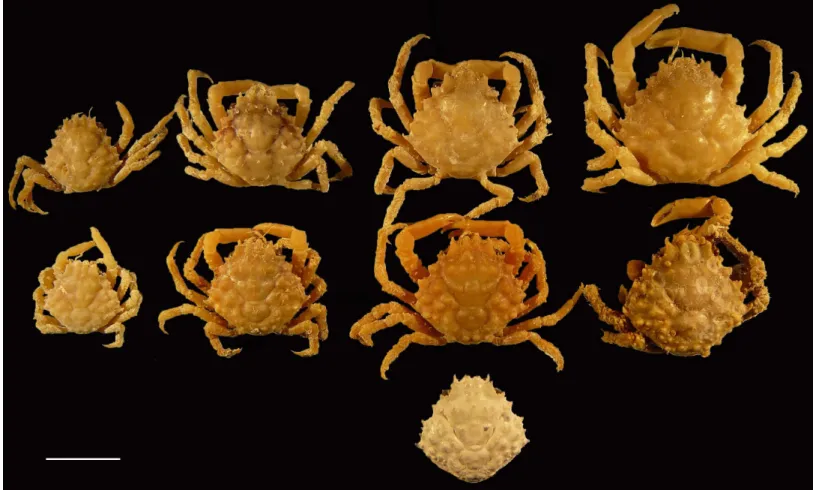
Figure 8 Dorsal views of modern specimens and a single fossil specimen ofDamithraxspp., all from Florida, USA.Upper row from left to right—modernD. hispidus: UF 12475, 11604, 1082, 1086; Middle row—modernD. pleuracanthus: UF 3673, 9588 (largest specimen of lot), 7874, 1052; lower row—fossilDamithraxcf.pleuracanthus: UF 29057. Scale bar width=10.0 mm.
Material—Single carapace (UF 29057), cuticle.
Diagnosis—SeeWilliams(1984: p. 334, 335).
Description—Carapace pyriform, about as long as wide (l/w ratio=1.01), maximum
width at∼61% of carapace length, weakly convex longitudinally and moderately so
Figure 9 Posterior views of similar-sized, modern specimens and a single fossil specimen of
Figure 10 Frontal views of similar-sized, modern specimens and a single fossil specimen of
row of tubercles and granules continuing onto posterolateral margin. Frontal region including epigastric region with double row of tubercles. Hepatic regions small, at lower level compared to gastric region, with single anterolateral spine. Protogastric regions bulbous, with major tubercle laterally and less pronounced tubercle axially. Mesogastric region with tubercle on process; base swollen, divided into three regions, central region oval. Uro- and/or protogastric region small, wider than long. Cardiac region pentagonal to triangular, with concave margins, about equally long as wide, tubercular. Branchial regions confluent. Intestinal region not delineated, with two strong tubercles. Cervical groove moderately deep, with two slits axially, V-shaped overall but rounded axially, bends more laterally near anterolateral margin. Shallow groove extends from cervical groove near base hepatic region to below outer orbital spine. Grooves around cardiac and uro-and/or metagastric regions. Dorsal carapace surface of cuticle with very small pits, armed with tubercles all over, more granules posteriorly; row of five tubercles in center of gastric region. Ventrolateral sides below anterolateral margins contain small spines. Of hardened parts: most of ventral surface, abdomen, and appendages lacking.
Measurements—Excluding spines and rostrum: 13.9 mm long, 13.8 mm wide.
Remarks—The specimen is very well-preserved and is ascribed toDamithraxbecause of the close similarity to extant species, notablyDamithrax hispidus, D. pleuracanthus, and D. tortugae. These modern species were synonymized byWagner (1990), butWindsor & Felder (2009)resurrected them based on molecular evidence and supported by morphological characters of the appendages. Ornamentation on the dorsal carapace, as was used byRathbun (1925), was rejected byWindsor & Felder (2009)because of ontogenetic variability (accessory spines and tubercles become more apparent with age), especially withinD. pleuracanthus. Ontogenetic variability of tubercles on the dorsal carapace was also found forD. hispidusin that the largest specimen (75.4 mm carapace width) exhibits fewer tubercles compared to small specimens (<∼30 mm carapace width)
(A Klompmaker, pers. obs., 2015).Windsor & Felder (2009)suggested that ornamentation on the merus and carpus of the cheliped can be used to distinguish betweenD. hispidus, D. pleuracanthus, andD. tortugae. The FLMNH IZ collection contained sufficient specimens ofD. hispidusandD. pleuracanthusto verify identifications. Indeed, specimens ofD. pleuracanthuscontain more tubercles on the carpus, but ornamental differences were difficult to verify for the merus. While large specimens ofD. hispidus(>∼35 mm carapace
width) often contained two spines on the inner side of the merus, smaller specimens (<∼23 mm carapace width) often contained only a single tubercle, much like similar-sized
among modern species for similar-sized specimens. The fossil specimen conforms best toD. pleuracanthusin terms of coarseness of the tubercles and the presence of a row of small tubercles along the posterolateral margin. Given the lack of chelipeds to confirm species placement and some minor differences that may represent intraspecific variability (e.g., less robust anterolateral spines in the fossil specimen), the ascription is with some query. Nevertheless, this is the first record of this species in the fossil record. The results inWindsor & Felder (2009)and herein suggest that the ascription of fossil specimens toD. hispidus(e.g.,Collins & Morris, 1976;Morris, 1993;Collins, Donovan & Dixon, 1996;Varela & Rojas-Consuegra, 2011) may need to be revisited.
Stratigraphic and geographic range—late Pliocene–early Pleistocene to Recent, North Carolina—Venezuela—Bermuda (Williams, 1984, see alsoTavares & Albuquerque, 1993).
MithraxMilne-Edwards, 1873–1880
Type species—Cancer aculeatusHerbst, 1782–1804(seeWindsor & Felder, 2014), extant. Species included—Mithrax aculeatus(Herbst, 1782–1804) [=Cancer spinosus (Herbst,
1782–1804);Cancer aculeatusFabricius, 1793;Mithrax pilosusRathbun, 1892;Mithrax ver-rucosusMilne-Edwards, 1832;Mithrax plumosusRathbun, 1901;Mithrax trispinosus Kings-ley, 1879];Mithrax armatusDe Saussure, 1853[=Mithrax orcuttiRathbun, 1925];Mithrax
arawakumsp. nov.;Mithrax belliiGerstaecker, 1857;Mithrax besnardiMelo, 1990;Mithrax braziliensis Rathbun, 1892;Mithrax caboverdianusT¨urkay, 1986;Mithrax clarionen-sisGarth, 1940;Mithrax hemphilliRathbun, 1892;Mithrax leucomelasDesbonne in Desbonne & Schramm, 1867;Mithrax tuberculatusStimpson, 1860.
Diagnosis—SeeWindsor & Felder(2014: p. 162, 163).
Mithrax arawakumsp. nov.
Fig. 11
Etymology—Named in honor of the Arawak natives, who settled the island of Xaymaca (Jamaica).
Type material—UF 112682 (holotype, internal mold), UF 112941 (paratype, external mold
+RTV silicone rubber cast).
Type locality—FLMNH-IP XJ015: Duncans Quarry 01, Trelawny Parish, Jamaica (18.4710,
−77.5796 WGS 84).
Type horizon—lower Miocene, Montpelier Formation (uppermost unit) (Mitchell, 2004; Portell & Collins, 2004).
Material—No material known other than type specimens.
Diagnosis—Carapace pyriform, slightly longer than wide (l/w ratio=1.03 for holotype).
Figure 11 Type specimens ofMithrax arawakumsp. nov. from the lower Miocene coral-associated limestones of the Montpelier Formation in the Duncans Quarry, Jamaica.(A, D, E) Holotype, UF 112682, in dorsal, frontal, and left-lateral views, resp.; (B) Paratype, external mold, UF 112941; (C) Paratype, cast of external mold, UF 112941. Scale bar width=10.0 mm.
with small spine at anterior base; last spine at transition from antero- to posterolateral margin, oriented laterally. Posterolateral margin more rounded than anterolateral margin, with single small spine just posterior to previous spine. Frontal region with two longitudinal rims connecting to rostral spines and tubercular epigastric regions. Cervical groove deep and wide, U-shaped. Branchiocardiac groove strongest around cardiac region, weaker more laterally. Dorsal carapace surface armed with tubercles, granules, and spines (especially on branchial regions), not very densely so.
Description—Carapace pyriform, slightly longer than wide (l/w ratio=1.03 for holotype),
maximum width at ∼65% of carapace length, weakly convex longitudinally and
region with two longitudinal rims connecting to rostral spines and tubercular epigastric regions. Hepatic regions small, at lower level compared to gastric region, with single strong anterolateral spine. Protogastric regions bulbous, with major tubercle laterally and less pronounced one axially. Mesogastric region with tubercle on process; base swollen, divided into three regions. Uro- and/or protogastric region small, appears as a laterally elongated tubercle. Cardiac region pentagonal, about equally long as wide, tubercular. Branchial regions weakly divided; epi- and mesobranchial regions confluent, tubercular; metabranchial separated from others, with spines, tubercles, and granules. Intestinal region not delineated, with two strong tubercles. Cervical groove deep and wide, U-shaped, bends more laterally near anterolateral margin to continue on ventral carapace, where it bends forward. Short groove extends from cervical groove near base hepatic region to outer orbital spine. Branchiocardiac groove strongest around cardiac region, weaker more laterally, not expressed to very weak on ventral carapace. Dorsal carapace surface armed with tubercles, granules, and spines (especially on branchial regions), not very densely so; row of five tubercles in center of gastric region. Of hardened parts: most of ventral surface, abdomen, cuticle, and appendages lacking.
Measurements—Excluding spines and rostrum: 14.0 mm long, 13.6 mm wide (UF 112682); length not measurable, 13.0 mm wide (UF 112941).
Remarks—The species appears to fit best inMithraxbecause (1) the carapace is about equally long as wide (l/w ratio=1.03); (2) the dorsal ornamentation has tubercles,
granules, and spines (although less obvious than in mostMithraxspp.); and (3) the orbit is weakly produced and has two spines on the upper margin excluding the outer orbital spine.
The new species differs from all other congenerics. The carapaces ofM. aculeatus, M. armatus, M. bellii,M. besnardi, andM. hemphilliexhibit a dense cover of granules (Rathbun, 1925: pls. 138.3, 139, 140, 142, 144;Garth, 1946: pl. 66, 1958: pl. 40.2;Melo, 1990; A Klompmaker, pers. obs., 2015 FLMNH IZ collection forM. aculeatus), whereas granules are much less abundant in the new species. Additionally,M. besnardihas a higher number of spines on the upper orbital margin (four excluding outer orbital spine instead of two). ForM. braziliensis,Rathbun (1892)mentioned that the regions of this species are weakly defined, unlike the present species. Moreover, the upper orbital margin bears two small spines, whereas the new species bears one small and one larger one excluding the outer orbital spine. Although the ornamentation on the dorsal carapace ofM. caboverdianus seems comparable (tubercles and spines with some interspersed granules) to the new species, the similar-sized holotype inT¨urkay (1986)(15.3 mm long) appears somewhat longer than wide (l/w ratio=1.09) relatively (1.03 forMithrax arawakumsp. nov.),
M. leucomelasis said not to be spinose, the anterolateral margins are only slightly toothed, and the lateral angle does not bear a spine, unlike the specimens herein. Lastly, the new species is less tubercular thanM. tuberculatusfor a similar-sized specimen (Rathbun, 1925: pl. 151.1). Moreover, the rostral horns ofM. tuberculatusare blunt; they are sharp in the new species.
This taxon is of special importance because it constitutes the oldest confirmed record of fossilMithrax. The early Miocene record ofMithraxsp. from Cuba (Varela, 2013) is based on a fixed finger, which may not be sufficient for a genus ascription in light of the recent revision (Windsor & Felder, 2014). The same applies to other appendage fragments attributed toMithraxsp. as well as incomplete carapaces (seeTable S1).
The holotype is an internal mold, whereas the paratype is an external mold. Since the size of the two specimens is similar, the ornamentation can be compared. The cast of the external mold shows ornamentation that is largely the same to that of the internal mold, but some granules appear larger (those near the posterior margin).
Stratigraphic and geographic range—lower Miocene, Jamaica.
NemausaMilne-Edwards, 1873–1880
Type species—Pisa spinipesBell, 1836, subsequent designation, extant.
Species included—Nemausa acuticornis(Stimpson, 1871);Nemausa cornuta(De Saussure, 1857) [=Nemausa rostrataMilne-Edwards, 1873–1880];Nemausa donovani(Portell &
Collins, 2004);Nemausa windsoraesp. nov.;Nemausa sinensis(Rathbun, 1892);Nemausa spinipes(Bell, 1836) [=Mithrax mexicanusGlassell, 1936].
Diagnosis—SeeWindsor & Felder(2014: p. 163, 164), but note that the now included fossil species andN. sinensisall have a tubercular rather than spinous character on the dorsal surface.
Remarks—Mithrax donovani(Fig. 12) is moved toNemausabecause the carapace is longer than wide inNemausa, whereas the carapace length is subequal to the width or wider than long in the diagnosis ofMithrax(seeWindsor & Felder, 2014). The small size of the specimen (6.7 mm maximum width, 8.0 mm preserved length excluding rostrum) suggests that not all characters may have fully developed yet (anterolateral spines, dorsal ornamentation, length/width trajectory), so the ascription to this genus is preliminary until better preserved material is discovered.
As for other spider crabs studied herein, ontogenetic change in the length/width ratios is evident forNemausaas well (Fig. 13). The relationship for the species with the most specimens available,N. acuticornis, is best explained by a logarithmic trend line, suggesting that length/width ratios change faster in smaller specimens.
Nemausa windsoraesp. nov.
Figs. 13and14
Figure 12 The holotype ofNemausa donovani(Portell & Collins, 2004) from the lower Miocene coral-associated limestones of the Montpelier Formation in the Duncans Quarry, Jamaica (UF 103958).(A) Dorsal view; (B) frontal view; (C) angled right-lateral view; (D) upper view of rostrum and orbit; (E) right-lateral view. Scale bar width=5.0 mm for (A–C, E); 1.5 mm for (D).
Type material—Holotype and sole specimen, UF 113651 (internal mold with some cuticle, external mold+RTV silicone rubber cast).
Type locality—FLMNH-IP XJ015: Duncans Quarry 01, Trelawny Parish, Jamaica (18.4710,
−77.5796 WGS 84).
Type horizon—lower Miocene, Montpelier Formation (uppermost unit) (Mitchell, 2004; Portell & Collins, 2004).
Material—No material known other than type specimen.
Diagnosis—Length/width ratio pyriform carapace=1.19; orbital margins with seven
Figure 13 Carapace length/width ratio vs. log2carapace width (mm) forNemausaspp.Nemausa donovaniwas not included because the total length could not be determined. Maximum length was determined without the rostral spines and width was measured without the anterolateral spines. Trend line is logarithmic (y= −0.095ln(x)+1.4013). Data inTable S2.
Description—Carapace pyriform, length/width ratio=1.19, maximum width at 59% of
Figure 14 The holotype ofNemausa windsoraesp. nov. from the lower Miocene coral-associated limestones of the Montpelier Formation in the Duncans Quarry, Jamaica (UF 113651).(A) Dorsal view (internal mold); (B) dorsal view (cast of external mold); (C) frontal view; (D) right-lateral view; (E) external mold; (F) upper margin left orbit; (G) cast showing bases of rostral horns and various orbital spines in more detail. Arrows in (G) indicate suborbital spines and broken outer orbital spine. Scale bar width=20 mm for (A–E); 2.0 mm for (F); 10 mm for (G).
epigastric, branchial, and cardiac regions. Of hardened parts: ventral surface, abdomen, and appendages missing; rostral spines largely missing.
Measurements—Excluding spines and rostrum: 27.7 mm long, 23.3 mm wide, and 14 mm tall (as preserved).
Figure 15 Growth series of dorsal carapaces of modernNemausa acuticornis(Stimpson, 1871) from various localities of the Atlantic coast of Florida, USA.Note that specimens become relatively wider with age. (A) FSBC I-9758; (B) FSBC I-050561; (C) FSBC I-050562 (note the ‘unicorn’ rostrum instead of a double-horned rostrum); (D) FSBC I-050562; (E) FSBC I-050562; (F) FSBC I-050561; (G) FSBC I-050562; (H) FSBC I-050562. Scale bar width=30 mm.
Klompmaker, Hyˇzn´y & Jakobsen, 2015). Here, the difference can at least in part be explained by the fact that still some cuticle is present near/in those tubercles in the external mold, leading to the absence or less obvious tubercles on the cast.
Nemausa acuticornisis consistently more differentiated in the gastric region (e.g., center mesogastric region better defined and outlined:Fig. 14;Rathbun, 1925: pl. 136.1;Felder et al., 2014: Fig. 7C). Moreover, as mentioned byRathbun(1925: p. 391),Fig. 15shows that the suborbital margin ofN. acuticorniscontains only one pronounced spine between the outer orbital spine and the spines on the antennal segment, whereas this specimen bears two distinct spines there. Finally,N. acuticornisis relatively wider for specimens of the same size (Fig. 13).
in the Mithracidae). Moreover, the specimens inRathbun(1925: pl. 137.3 and 137.4) are narrower (Fig. 13), although more specimens are needed to statistically test this difference.
Nemausa sinensishas a lower l/w ratio (1.03 (Garth, 1958: pl. 41.1), 1.06 (Rathbun, 1892: pl. 38.2)) compared toN. windsoraesp. nov. (1.19) (Fig. 13). Furthermore, stronger tubercles are present onN. sinensis.
Very few specimens ofN. spinipesare figured, withRathbun (1925)showing the best image.Nemausa spinipeshas a better defined mesogastric region (Rathbun, 1925: pl. 136.4) and all anterolateral spines are single and not associated with smaller spines as in the specimen under study. The same author also showed a very strong tubercle on the posterior part of the mesogastric region, not seen in the specimen under study; and two instead of one tubercle are present around the location where the mesogastric process would be.
Nemausa donovaniis different in that the mesogastric region is outlined entirely and a distinct elevation is seen in the center of the posterior part of this region, both unlike in the new species. This is unlikely to be related to ontogeny because the mesogastric features appear stable throughout ontogeny in a congeneric species (Fig. 15). Although anterolateral spines become more prominent throughout ontogeny inNemausa(N. acuticornis,Fig. 15), the difference betweenN. donovaniandN.windsoraesp. nov. is much greater, supporting the hypothesis that these are two separate species. Furthermore, N. windsoraesp. nov. bears a denser ornamentation of tubercles, which may only in part be explained by ontogeny (Fig. 15) because even the smallest specimen ofN. acuticornisbears distinct tubercles on the branchial regions, whereas these regions are nearly smooth inN. donovani, unlike forN. windsoraesp. nov.
Stratigraphic and geographic range—lower Miocene, Jamaica.
ACKNOWLEDGEMENTS
ADDITIONAL INFORMATION AND DECLARATIONS
Funding
This work was supported by the Jon L. and Beverly A. Thompson Endowment Fund to AAK. The funders had no role in study design, data collection and analysis, decision to publish, or preparation of the manuscript.
Grant Disclosures
The following grant information was disclosed by the authors: Jon L. and Beverly A. Thompson Endowment Fund.
Competing Interests
The authors declare there are no competing interests.
Author Contributions
• Adi¨el A. Klompmaker conceived and designed the experiments, performed the
experiments, analyzed the data, contributed reagents/materials/analysis tools, wrote the paper, prepared figures and/or tables, reviewed drafts of the paper.
• Roger W. Portell conceived and designed the experiments, contributed
reagents/materials/analysis tools, prepared figures and/or tables, reviewed drafts of the paper.
• Aaron T. Klier, Vanessa Prueter and Alyssa L. Tucker performed the experiments,
analyzed the data, reviewed drafts of the paper.
New Taxa Registration
The following information was supplied regarding the registration of a newly described species:
Zoobank:
Maguimithraxgen. nov.: http://zoobank.org/NomenclaturalActs/BE0D3F8C-7FD8-43A8-A42A-DE797B31A58E
Mithrax arawakumsp. nov.: http://zoobank.org/NomenclaturalActs/971193E9-B5BA-44EA-A889-C11B01B6C785
Nemausa windsoraesp. nov.:
http://zoobank.org/NomenclaturalActs/2A8E6FEB-E453-4FFE-948B-237AE523652F.
Supplemental Information
Supplemental information for this article can be found online athttp://dx.doi.org/
10.7717/peerj.1301#supplemental-information.
REFERENCES
Abele LG, Kim W. 1986.An illustrated guide to the marine decapod crustaceans of Florida.State of Florida, Department of Environmental Regulation, Technical Series8(1):1–760, Parts 1 & 2. Aguirre-Urreta MB. 1990.Nuevos crust´aceos dec´apodos (Brachyura y Anomura) en el Terciario
de Patagonia, Argentina. In:V Congreso Argentino de Paleontolog´ıa y Bioestratigraf´ıa, Tacum´an, 1990, Actas I. 149–154.
Alves DFR, Barros-Alves SDP, Teixeira GM, Cobo VJ. 2012.Mithracinae (Decapoda: Brachyura) from the Brazilian coast: review of the geographical distribution and comments on the biogeography of the group.Nauplius20:51–62DOI 10.1590/S0104-64972012000100006. Artal P, Van Bakel BWM, Onetti A. 2014.A new inachid crab (Brachyura, Majoidea) from the
Middle Eocene of the provinces of Barcelona and Girona (Catalonia, Spain). In: Fraaije RHB, Hy˘zn´y M, Jagt JWM, Krobicki M, Van Bakel BWM, eds.Proceedings of the 5th symposium on Mesozoic and Cenozoic decapod crustaceans, Krakow, Poland, 2013: a tribute to P´al Mih´aly M¨uller,Scripta Geologica,vol. 147. 153–161.
Bachmayer F. 1953.Die Dekapodenfauna des tortonischen Leithakalkes von Deutsch-Altenburg (Nieder¨osterreich).Mitteilungen der Geologischen Gesellschaft in Wien44:237–262.
Bell T. 1836.Some account of the Crustacea of the coasts of South America, with descriptions of new genera and species; founded principally on the collections obtained by Mr Cuming and Mr Miller.The Transactions of the Zoological Society of London 2(1):1–86, pls. 1–17 DOI 10.1111/j.1469-7998.1839.tb00007.x.
Bertini G, Fransozo A, De Melo GA. 2004.Biodiversity of brachyuran crabs (Crustacea:
Decapoda) from non-consolidated sublittoral bottom on the northern coast of S˜ao Paulo State, Brazil.Biodiversity & Conservation13:2185–2207DOI 10.1023/B:BIOC.0000047900.96123.34. Beschin C, Busulini A, De Angeli A, Tessier G. 2007.I Decapodi dell’Eocene inferiore di Contrada
Gecchelina (Vicenza-Italia settentrionale) (Anomura e Brachyura).Museo di Archeologia e Scienze Naturali “G. Zannato”, Montecchio Maggiore (Vicenza)2007:5–76.
Beschin C, Busulini A, Tessier G. 2015.Nuova segnalazione di crostacei associati a coralli nell’Eocene inferiore dei Lessini orientali (Vestenanova-Verona).Lavori Societ`a Veneziana di Scienze Naturali40:47–109.
Beschin C, De Angeli A, Checchi A. 2001.Crostacei decapodi associati a coralli della “Formazione di Castelgomberto” (Oligocene) (Vicenza-Italia settentrionale).Studi e Ricerche - Associazione Amici del Museo - Museo civico “G. Zannato” - Montecchio Maggiore (Vicenza)2001:13–30. Blow WC. 2003.New brachyuran crabs (Crustacea: Decapoda) from the Upper Pliocene Yorktown
Formation of southeastern Virginia.Proceedings of the Biological Society of Washington 116:168–189.
Blow WC, Manning RB. 1996.Preliminary description of 25 new decapod crustaceans from the middle Eocene of the Carolinas, USA.Tulane Studies in Geology and Paleontology29:1–26. Breton G. 2009.Description ofPriscinachus elongatusn. gen., n. sp., and Priscinachidae n. fam.
for the earliest spider crab (Crustacea, Decapoda, Majoidea), from the French Cretaceous (Cenomanian).Geodiversitas31:509–523DOI 10.5252/g2009n3a2.
Casad´ıo S, Feldmann RM, Parras A, Schweitzer CE. 2005.Miocene fossil Decapoda (Crustacea: Brachyura) from Patagonia, Argentina, and their paleoecological setting.Annals of Carnegie Museum74:151–188DOI 10.2992/0097-4463(2005)74[151:MFDCBF]2.0.CO;2.
Coelho PA, Torres MFA. 1990.Revis˜ao das esp´ecies do gˆeneroMithraculusWhite na costa Atlˆantica da Am´erica do Sul (Crustacea, Decapoda, Majidae).Anais Sociedade Norestina de Zoologica3:63–92.
Collins JSH, Donovan SK. 2012.Pleistocene decapod crustaceans of eastern Jamaica.Caribbean Journal of Science46:133–142.
Collins JSH, Donovan SK, Dixon HL. 1996.Crabs and barnacles (Crustacea: Decapoda and Cirripedia) from the Late Pleistocene Port Morant Formation of southeast Jamaica.Bulletin of the Mizunami Fossil Museum23:51–63, pls. 12–19.
Collins JSH, Donovan SK, Stemann TA. 2009.Fossil Crustacea of the Late Pleistocene Port Morant Formation, west Port Morant Harbour, southeastern Jamaica.Scripta Geologica 138:23–53.
Collins JSH, Donovan SK, Stemann TA, Blissett DJ. 2010.Crustaceans of the upper Miocene August Town Formation of southeastern Jamaica.Scripta Geologica, Special Issue7:177–183. Collins JSH, Fraaye RHB, Jagt JWM. 1995.Late Cretaceous anomurans and brachyurans from the
Maastrichtian type area.Acta Palaeontologica Polonica40:165–210.
Collins JSH, Garvie CL, Mellish CJT. 2014.Some decapods (Crustacea; Brachyura and
Stomatopoda) from the Pleistocene Beaumont Formation of Galveston, Texas.Scripta Geologica 147:309–329.
Collins JSH, Morris SF. 1976.Tertiary and Pleistocene crabs from Barbados and Trinidad. Palaeontology19:107–131.
Collins JSH, Portell RW, Donovan SK. 2009.Decapod crustaceans from the Neogene of the Caribbean: diversity, distribution and prospectus.Scripta Geologica138:55–111.
De Angeli A, Beschin C. 2008.Crostacei decapodi dell’Oligocene di Soghe e Valmarana (Monti Berici, Vicenza-Italia settentrionale).Studi e Ricerche - Associazione Amici del Museo - Museo Civico G. Zannato - Montecchio Maggiore (Vicenza)15:15–39.
De Grave S, PentcheffND, Ahyong ST, Chan T-Y, Crandall KA, Dworschak PC, Felder DL, Feldmann RM, Fransen CHJM, Goulding LYD, Lemaitre R, Low MEY, Martin JW, Ng PKL, Schweitzer CE, Tan SH, Tshudy D, Wetzer R. 2009.A classification of living and fossil genera of decapods crustaceans.Raffles Bulletin of Zoology21(Supplement):1–109.
De Jes ´us G ´omez-Cruz A, Berm ´udez HD, Vega FJ. 2015.A new species ofDiaulaxBell, 1863 (Brachyura: Dialucidae) in the Early Cretaceous of the Rosablanca Formation, Colombia. Bolet´ın de la Sociedad Geol´ogica Mexicana67:103–112.
De Saint Laurent M. 1980.Sur la classification et la phylog´enie des Crustac´es D´ecapodes Brachyoures. I. Podotremata Guinot, 1977, et Eubrachyura sect. nov.Comptes Rendus Hebdomadaires des S´eances de l’Acad´emie des Sciences, Paris (D)290:1265–1268.
De Saussure MH. 1853.Description de quelques crustac´es nouveaux de la c ˆote occidentale du Mexique.Revue et Magasin de Zoologie pure et appliqu´ee (s´erie 2)5:354–368.
De Saussure MH. 1857.Diagnoses de quelques crustac´es nouveaux de l’Am´erique tropicale.Revue et Magasin de Zoologie pure et appliqu´ee (s´erie 2)9:501–505.
Desbonne I, Schramm A. 1867.Brachyures. In:Crustac´es de la Guadeloupe d’apr´es un Manuscrit du Docteur Isis Desbonne compare avec les ´Echantillons de Crustac´es de sa Collection et les Derni´eres Publications de M.M. Henri de Saussure et William Stimpson. Premiere partie. Basse-Terre: Imprimerie du Gouvernement, 1–60, pls. 1–8.
soit Relativement a l’utilit´e qu’en Peuvent retirer la M´edecine, l’Agriculture, le Commerce et les Arts. Suivi d’une Biographie des plus C´el`ebres Naturalistes. Ouvrage Destin´e aux M´edecins, aux Agriculteurs, aux Commer¸cans, aux Artistes, aux Manufacturiers, et `a tous Ceux qui ont Int´erˆet `a Connoˆıtre les Productions de la Nature, leurs Caract`eres G´en´eriques et Sp´ecifiques, leur lieu Natal, leurs Propi´et´es et leurs Usages. Strasbourg and Paris: F. G. Levrault et Le Normant, 138–425. Fabricius JC. 1793.Entomologiae systematica emendata et aucta, secundum Classes, Ordines,
Genera, Species, adjectis Synonimis, Locis, Observationibus, Descriptionibus. Vol. 2. Hafniae: C. G. Proft et Storch.
Felder DL, ´Alvarez F, Goy JW, Lemaitre R. 2009.Decapoda (Crustacea) of the Gulf of Mexico, with comments on the Amphionidacea. In: Felder DL, Camp DK, eds.Gulf of Mexico: origin, waters, and biota. College Station: Texas A&M Press, 1019–1104.
Felder DL, Thoma BP, Schmidt WE, Sauvage T, Self-Krayesky SL, Chistoserdov A,
Bracken-Grissom HD, Fredericq S. 2014.Seaweeds and decapod crustaceans on Gulf deep banks after the Macondo oil spill.BioScience64:808–819DOI 10.1093/biosci/biu119. Feldmann RM. 1994.Antarctomithrax thomsoni, a new genus and species of crab (Brachyura;
Majidae) from the La Meseta Formation (Eocene) of Seymour Island, Antarctica.Journal of Paleontology68:174–176DOI 10.1017/S0022336000025725.
Feldmann RM, Schweitzer CE, Baltzly LM, Bennett OA, Jones AR, Mathias FF, Weaver KL, Yost SL. 2013.New and previously known decapod crustaceans from the Late Cretaceous of New Jersey and Delaware, USA.Bulletin of the Mizunami Fossil Museum39:7–37.
Feldmann RM, Schweitzer CE, Bennett O, Frant¸escu OD, Resar N, Trudeau A. 2011.New Eocene Brachyura (Crustacea: Decapoda) from Egypt.Neues Jahrbuch f¨ur Geologie und Pal¨aontologie Abhandlungen262:323–353DOI 10.1127/0077-7749/2011/0202.
Fraaije RHB. 2003.Evolution of reef-associated decapod crustaceans through time, with particular reference to the Maastrichtian type area.Contributions to Zoology72:119–130.
Fraaije RHB, Menkveld-Gfeller UE, Van Bakel BWM, Jagt JWM. 2010.Decapod crustaceans from the type area of the Helvetian Stage (lower Miocene) in the Bern area, Switzerland.Bulletin of the Mizunami Fossil Museum36:1–11.
Frant¸escu AL. 2013.Comparative study of the Eocene fossil decapod crustaceans of the North American Atlantic coast and European Tethyan provinces. D. Philosophy thesis, Kent State University, Ohio, USA.
Garth JS. 1940.Some new species of brachyuran crabs from Mexico and the Central and South American mainland.Allan Hancock Pacific Expeditions5(3):53–127.
Garth JS. 1946.Littoral brachyuran fauna of the Galapagos Islands.Allan Hancock Pacific Expeditions5(10):341–601.
Garth JS. 1958.Brachyura of the Pacific coast of America: Oxyrhyncha.Allan Hancock Pacific Expeditions21(1):1–499.
Gatt M, De Angeli A. 2010.A new coral-associated decapod assemblage from the Upper Miocene (Messinian) Upper Coralline Limestone of Malta (Central Mediterranean).Palaeontology 53:1315–1348DOI 10.1111/j.1475-4983.2010.01008.x.
Gerstaecker A. 1857.Carcinologishes beitr¨age.Archiv f¨ur Naturgeschichte22:101–162, pls. 4–6. Giraldes BW, Coelho Filho PA, Smyth DM. 2015.Decapod assemblages in subtidal and intertidal
zones—importance of scuba diving as a survey technique in tropical reefs, Brazil.Global Ecology and Conservation3:163–175DOI 10.1016/j.gecco.2014.11.011.
Griffin DJG. 1966.A review of the Australian majid spider crabs (Crustacea, Brachyura).Australian Zoologist13:259–298, pls. 15–17.
Guinot D. 2011.The position of the Hymenosomatidae MacLeay, 1838, within the Brachyura (Crustacea, Decapoda).Zootaxa2890:40–52.
Guinot D, Tavares M, Castro P. 2013.Significance of the sexual openings and supplementary structures on the phylogeny of brachyuran crabs (Crustacea, Decapoda, Brachyura), with new nomina for higher-ranked podotreme taxa.Zootaxa3665:1–414
DOI 10.11646/zootaxa.3665.1.1.
Herbst JFW. 1782–1804.Versuch einer naturgeschichte der krabben und krebse, nebst einer systematischen beschreibung ihrer verschiedenen arten. Vol. 1–3. Berlin and Stralsund: Gottlieb August Lange.
Hyˇzn´y M, Schl¨ogl J. 2011.An early Miocene deep-water decapod crustacean faunule from the Vienna Basin (Western Carpathians, Slovakia).Palaeontology54:323–349
DOI 10.1111/j.1475-4983.2011.01033.x.
Jakobsen SL, Collins JSH. 1997.New middle Danian species of anomurans and brachyuran crabs from Fakse, Denmark.Bulletin of the Geological Society of Denmark44:89–100.
Kato H, Karasawa H. 1998.Pleistocene Fossil Decapod Crustacea from the Boso Peninsula, Japan. Natural History Research, Special Issue5:1–31.
Kingsley JS. 1879.On a collection of Crustacea from Virginia, North Carolina, and Florida, with a revision of the genera of Crangonidae and Palaemonidae.Proceedings of the Academy of Natural Sciences of Philadelphia1879:383–427.
Klompmaker AA. 2013.Extreme diversity of decapod crustaceans from the mid-Cretaceous (late Albian) of Spain: implications for Cretaceous decapod paleoecology.Cretaceous Research 41:150–185DOI 10.1016/j.cretres.2012.12.003.
Klompmaker AA, Artal P, Gulisano G. 2011.The Cretaceous crabRathbunopon: revision, a new species and new localities.Neues Jahrbuch f¨ur Geologie und Pal¨aontologie Abhandlungen 260:191–202DOI 10.1127/0077-7749/2011/0170.
Klompmaker AA, Artal P, Van Bakel BWM, Fraaije RHB, Jagt JWM. 2011.Etyid crabs (Crustacea, Decapoda) from mid-Cretaceous Reefal strata of Navarra, northern Spain. Palaeontology54:1199–1212DOI 10.1111/j.1475-4983.2011.01072.x.
Klompmaker AA, Feldmann RM, Schweitzer CE. 2012.A hotspot for Cretaceous goniodromitids (Decapoda: Brachyura) from reef associated strata in Spain.Journal of Crustacean Biology 32:780–801DOI 10.1163/193724012X635340.
Klompmaker AA, Hyˇzn´y M, Jakobsen SL. 2015.Taphonomy of decapod crustacean cuticle and its effect on the appearance as exemplified by new and known taxa from the Cretaceous–Danian crabCaloxanthus.Cretaceous Research55:141–151DOI 10.1016/j.cretres.2014.11.011. Klompmaker AA, Hyˇzn´y M, Portell RW, Kowalewski M. 2015.Growth, inter-and intraspecific
variation, palaeobiogeography, taphonomy and systematics of the Cenozoic ghost shrimp Glypturus.Journal of Systematic Palaeontology Epub ahead of print March 16 2015 DOI 10.1080/14772019.2015.1009505.
Klompmaker AA, Ortiz JD, Wells NA. 2013.How to explain a decapod crustacean diversity hotspot in a mid-Cretaceous coral reef.Palaeogeography, Palaeoclimatology, Palaeoecology 374:256–273DOI 10.1016/j.palaeo.2013.01.024.
Koˇcov´a Veselsk´a M, Koˇc´ı T, Kubajko M. 2014.Dynomenid crabs (Decapoda, Brachyura) and stalked barnacles (Cirripedia, Scalpelliformes) from upper Cenomanian-lower Turonian nearshore, shallow-water strata in the Bohemian Cretaceous Basin, Czech Republic.Scripta Geologica147:49–81.
Kornecki KM. 2014.Cretaceous confluence in the Coon Creek Formation of Mississippi and Tennessee, USA: taphonomy and systematic paleontology of a decapod Konsentrat-Lagerst¨atte. MS Thesis, Kent State University, Ohio, USA.
Krobicki M, Zato ´n M. 2008. Middle and Late Jurassic roots of brachyuran crabs: palaeoenvironmental distribution during their early evolution. Palaeogeography, Palaeoclimatology, Palaeoecology263:30–43DOI 10.1016/j.palaeo.2008.01.025.
Lamarck JBPA. 1818.Histoire naturelle des animaux sans vert`ebres, pr´esentant les caract`eres g´en´eraux et particuliers de ces animaux, leur distribution, leurs classes, leurs familles, leurs genres et la citation des principales esp`eces qui s’y rapportent; pr´ec´ed´e d’une introduction offrant la d´etermination des caract`eres essentiels de l’animal, sa distinction du v´eg´etal et des autres corps naturels, enfin l’exposition des principes fondamentaux de la zoologie. Vol. 5. Paris: Lanoe, 1–612. Latreille PA. 1802–1803.Histoire naturelle, g´en´erale et particuli`ere des crustac´es et des insects. Vol. 3.
Paris: F. Dufart.
Leach WE. 1817.The zoological miscellany; being descriptions of new, or interesting animals. Vol. 3. Covent Garden and London: E. Nodder and Son.
Linnaeus C. 1758.Systema naturae per regna tria naturae, secundum classes, ordines, genera, species, cum characteribus, differentiis, synonymis locis. 10th edition. Vol. 1. Holmiae: Laurentius Salvius. L¨orenthey E, Beurlen K. 1929.Die fossilen Dekapoden der L¨ander der Ungarischen Krone.
Geologica Hungarica, Series Palaeontologica3:1–421.
Luque J, Feldmann RM, Schweitzer CE, Jaramillo C, Cameron CB. 2012.The oldest frog crabs (Decapoda: Brachyura: Raninoida) from the Aptian of northern South America.Journal of Crustacean Biology32:405–420DOI 10.1163/193724012X626539.
MacLeay WS. 1838.On the brachyurous decapod Crustacea brought from the Cape by Dr. Smith. In: Smith A, ed.Illustrations of the zoology of South Africa; consisting chiefly of figures and descriptions of the objects of natural history collected during an expedition into the interior of South Africa, in the years 1834, 1835, and 1836; fitted out by ‘The Cape of Good Hope Association for Exploring Central Africa’: together with a summary of African Zoology, and an inquiry into the geographical ranges of species in that quarter of the globe, invertebratae. London: Smith, Elder & Co, 53–71.
Mantelatto FLM, Faria FCR, Biagi R, Melo GAS. 2004.Majoid crabs community (Crustacea: Decapoda) from infralittoral rocky/sandy bottom of Anchieta Island, Ubatuba, Brazil.Brazilian Archives of Biology and Technology47:273–279DOI 10.1590/S1516-89132004000200015. Martins-Neto RG, Dias J ´unior SC. 2007.The Brazilian paleodecapod fauna: state of the
knowledge.Memorie della Societ`a Italiana di Scienze Naturali e del Museo Civico di Storia Naturale di Milano35(2):76–78.
Melo GAS. 1990.Descric¸˜ao deMithrax (Mithrax) besnardi, sp.n., Esp´ecie abissalb˜entica de ˜aguas meridionais da Am´erica do Sul (Crustacea, Brachyura, Majidae).Atlantica12:19–26.
Melo GAS. 1996.Manual de identificac¸˜ao dos Brachyura (caranguejos e siris) do litoral brasileiro. S˜ao Paulo: Plˆeaide.
Milne-Edwards H. 1832.Observations sur les crustac´es du genreMithrax. In:Magasin de Zoologie. 2 (class 7), 16 pp (unpaginated), pls. 1–5.
Milne-Edwards A. 1873–1880.Etudes sur les Xiphosures et les Crustac´es de la r´egion Mexicaine,´ mission scientifique au Mexique et dans l’Amerique centrale. Recherches zoologiques a l’histoire de la faune de l’Amerique Centrale et du Mexique, part 5. Paris: Imprimerie Nationale.
Milne-Edwards A. 1878. ´Etudes sur les Crustac´es Podophthalmaries de la regi ´on m´exicaine. Recherches zoologiques pour servir a l’histoire de la faune de l’Amerique Centrale et du Mexique. Minist`ere de l’Instrucion Publique5:121–184.
Mitchell SF. 2004.Lithostratigraphy and palaeogeography of the White Limestone Group. Cainozoic Research3:5–29.
Morris SF. 1993.The fossil arthropods of Jamaica. Geological Society of America Memoir 182:115–124DOI 10.1130/MEM182-p115.
M¨uller P. 1974.Decapoda (Crustacea) fauna a budapesti mioc´enb¨ol (2).F¨oldtani K¨ozl¨ony 102:275–287.
M¨uller P. 1984.Decapod Crustacea of the Badenian.Geologica Hungarica, Series Palaeontologica 42:3–317.
M¨uller P. 1996.Middle Miocene decapod Crustacea from southern Poland.Prace Muzeum Ziemi 43:3–16.
Ng PKL, Guinot D, Davie PJF. 2008.Systema Brachyurorum: Part 1. An annotated checklist of extant brachyuran crabs of the world.Raffles Bulletin of Zoology17(Supplement):1–286. Ng PKL, Jeng MS. 1999.The Hymenosomatidae (Decapoda, Brachyura) of Taiwan.Crustaceana
72:531–534DOI 10.1163/156854099503573.
Oss ´o `A, D´ıaz Isa M. 2014.Cantabroxanthus loredoensis new genus, new species (Decapoda, Brachyura, Etyoidea) from the Middle Campanian of Loredo, Ribamont´an al Mar, (Cantabria, northern Spain).Bolet´ın de la Sociedad Geol´ogica Mexicana66:483–489.
Portell RW. 2004.Eocene, Oligocene, and Miocene decapod crustaceans. Florida Fossil Invertebrates5:1–28.
Portell RW, Collins JSH. 2004.Decapod crustaceans of the Lower Miocene Montpelier Formation, White Limestone Group of Jamaica.Cainozoic Research3:109–126.
Provenzano AJ, Brownell WN. 1977.Larval and early post-larval stages of the West Indian spider crab,Mithrax spinosissimus(Lamarck) (Decapoda: Majidae).Proceedings of the Biological Society of Washington90:735–752.
Rathbun MJ. 1892. Catalogue of the crabs of the family Periceridae in the US National Museum. Proceedings of the United States National Museum15:231–277, pls. 28–40 DOI 10.5479/si.00963801.15-901.231.
Rathbun MJ. 1901.The Brachyura and Macrura of Porto Rico.Bulletin of the United States Fish Commission [for 1900]20:1–127.
Rathbun MJ. 1920.New species of spider crabs from the Straits of Florida and Caribbean Sea. Proceedings of the Biological Society of Washington33:23–24.
Rathbun MJ. 1925.The spider crabs of America.Bulletin of the United States National Museum 129:1–613.
Rathbun MJ. 1935.Fossil Crustacea of the Atlantic and Gulf Coastal Plain.Geological Society of America, (special paper)2(i–viii):1–160.