What do Cochrane systematic reviews say about probiotics
as preventive interventions?
Vinícius Lopes Braga
I, Luana Pompeu dos Santos Rocha
II, Daniel Damasceno Bernardo
II,
Carolina de Oliveira Cruz
III, Rachel Riera
IVDiscipline of Evidence-Based Health, Escola Paulista de Medicina (EPM), Universidade Federal de São Paulo (Unifesp), São Paulo (SP), Brazil
INTRODUCTION
More than 400 species of microorganisms dwell in the human gastrointestinal tract.1,2 Balance
between them is vital for the host’s health. Present-day high usage of antibiotics, together with environmental and physiological factors, can alter this ecosystem. his imbalance can cause illnesses such as diarrhea, which was responsible for 1.31 million deaths in 2015, including 499,000 among children under ive.3,4 Some research has shown that use of probiotics can
con-fer some health beneits, such as treatment for diarrheal disease, prevention of systemic infec-tions and other efects.2,5
he 2001 deinition from the World Health Organization (WHO) states that probiotics are “live microorganisms which, when administered in adequate amounts, confer a health beneit on the host”.6 hey are currently presented by media sources as an attractive health promotion
method that prevents or cures a range of clinical situations.7 Indeed, many trials assessing the
efects of probiotics (including using diferent species of microorganisms) as preventive or thera-peutic options for a range of diseases have been conducted and published.2,5 Consequently,
a con-siderable amount of published data is currently available through MEDLINE. Corroborating this, a search in this database carried out on July 26, 2017, using the MeSH (medical subheading) term probiotics, retrieved 12,370 records, which corresponded to an increase of 278% in the number of records over the last ten years (from December 2007 to July 2017).
he questions that therefore arise are: Should probiotics be indicated for preventive pur-poses? And if so, for which patients? Which types of probiotics should be used, and at what dose and for how long?
In this review, we identiied and summarized all Cochrane systematic reviews about the pre-ventive efects of probiotics in clinical practice.
IUndergraduate Medical Student, Escola Paulista
de Medicina (EPM), Universidade Federal de São Paulo (Unifesp), São Paulo (SP), Brazil.
orcid.org/0000-0001-6736-2928
IIUndergraduate Medical Students, Escola
Paulista de Medicina (EPM), Universidade Federal de São Paulo (Unifesp), São Paulo (SP), Brazil.
IIIMD, MSc. Psychologist, Postgraduate Student,
Evidence-Based Health Program, Universidade Federal de São Paulo (Unifesp), and Assistant Researcher, Cochrane Brazil, São Paulo (SP), Brazil. orcid.org/0000-0001-9146-4684
IVMD, PhD. Rheumatologist, Adjunct Professor,
Discipline of Evidence-Based Medicine, Escola Paulista de Medicina (EPM), Universidade Federal de São Paulo (Unifesp), and Assistant Coordinator, Cochrane Brazil, São Paulo (SP), Brazil. orcid.org/0000-0002-9522-1871
KEY WORDS:
Review [publication type]. Probiotics.
Preventive medicine. Evidence-based medicine. Evidence-based practice.
ABSTRACT
BACKGROUND: Probiotics have been used for a range of clinical situations and their use is strongly en-couraged by the media worldwide. This study identiied and summarized all Cochrane systematic reviews about the preventive efects of probiotics in clinical practice.
DESIGN AND SETTING: Review of systematic reviews, conducted in the Discipline of Evidence-Based Medicine, Escola Paulista de Medicina (EPM), Universidade Federal de São Paulo (Unifesp).
METHODS: We included all Cochrane reviews on any probiotics when they were used as preventive in-terventions and compared with no intervention, placebo or any other pharmacological or non-pharma-cological intervention.
RESULTS: 17 Cochrane systematic reviews fulilled our inclusion criteria and were summarized in this re-port. None of the reviews included in the present study provided high-quality evidence for any outcome. The beneits from use of probiotics included decreased incidence of antibiotic-associated diarrhea and
Clostridium diicile-associated diarrhea; decreased incidence of upper respiratory tract infections and du-ration of episodes; decreased need for antibiotics and absences from school due to colds; and decreased incidence of ventilator-associated pneumonia. Probiotics seem to decrease the incidence of gestational diabetes mellitus, birthweight, risk of vaginal infection and incidence of eczema.
OBJECTIVE
To summarize the evidence from Cochrane systematic reviews focusing on probiotics for prevention of any disease or condition.
METHODS
Design
Review of Cochrane systematic reviews.
Setting
Discipline of Evidence-Based Medicine of Escola Paulista de Medicina (EPM), Universidade Federal de São Paulo (UNIFESP).
Criteria for including reviews
• Types of studies
We only included the latest version of completed Cochrane systematic reviews (SR). We excluded any published protocols or any SR marked as “withdrawn” in the Cochrane Database of Systematic Reviews (CDSR).
• Types of participants
We included healthy participants or those diagnosed with any clinical condition or disease.
• Types of intervention
his review included any probiotics that were used as preven-tive interventions and compared with no intervention, pla-cebo or any other pharmacological or non-pharmacological intervention.
• Type of outcomes
We considered any clinical, social and laboratory outcomes, as evaluated in the systematic reviews that were included.
Search for reviews
We carried out a sensitive systematic search in the Cochrane Database of Systematic Reviews (via Wiley) on July 1, 2017. he search strategy is presented in Table 1.
Selection of systematic reviews
Two of the three researchers (VLB, LPDSR and DDB) indepen-dently and randomly selected and evaluated all references that were retrieved through the systematic search, to conirm their eligibility in accordance with the inclusion criteria. Any dis-agreements were resolved by consulting a more experienced author (RR).
Presentation of the results
We presented all the reviews included in this synthesis in a nar-rative manner (qualitative synthesis). he key points considered were their relevance, methods, results, quality of the body of the evidence for each outcome, and applicability.
RESULTS
Search results
he initial search resulted in 39 reviews and 13 protocols. First, we excluded all protocols. Ater full-text assessment, we excluded 23 reviews since they either considered use of probi-otics to be therapeutic interventions rather than preventive inter-ventions or did not analyze probiotics alone. hus, 16 Cochrane systematic reviews fulilled our inclusion criteria and were sum-marized in this report.
Results from systematic reviews
Among the 16 systematic reviews included, a range of probi-otic strains was used. Four systematic reviews tested their use only among adults,8-11 three only among children12-14 and ive
among both adults and children,15-19 while another four
stud-ies did not specify the age range of the population evaluated.20-23
Two systematic reviews addressed prevention of respiratory dis-eases,11,15 nine addressed prevention of gastroenterological
dis-eases,9,10,13,14,16-18,20,21 three addressed gynecological and
obstet-ric diseases,8,22,23 one addressed urological diseases19 and one
addressed immunological/allergic diseases.12 A summary of
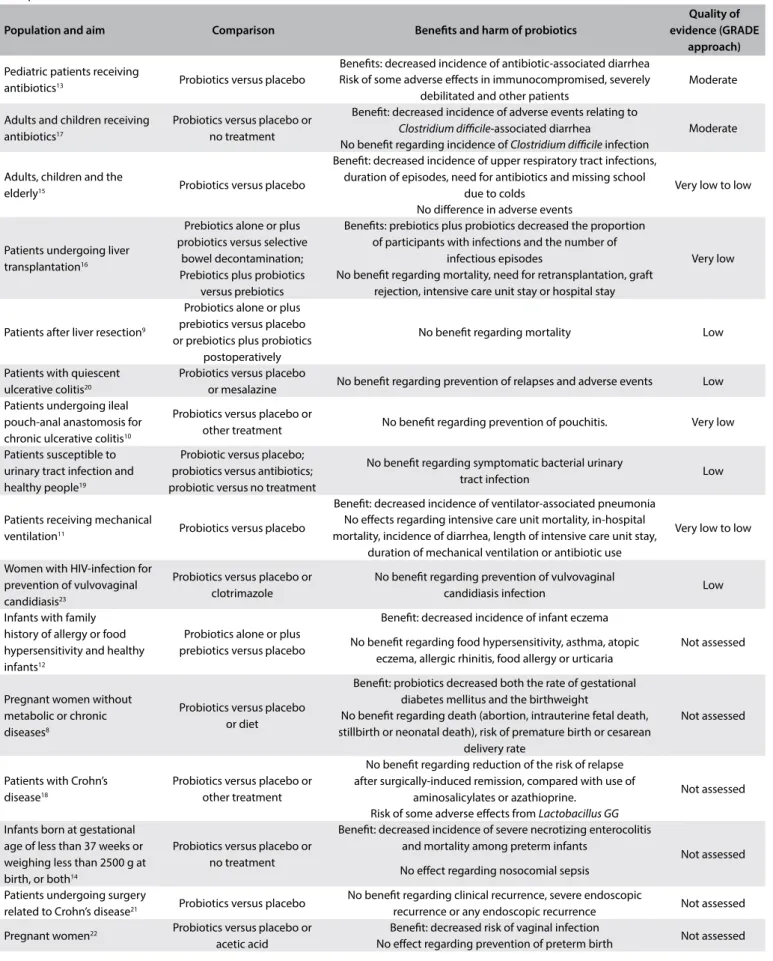
the reviews included is presented below. he main indings for each comparison and the quality of the evidence (based on the GRADE approach) are presented in Table 2.8-23
#1 “Probiotics” OR “Probiotic” OR “lactobacillus” OR “lactobacilus” OR “lactobacilli” OR “lactobacili” OR “betabacterium” OR “lactobacileae” OR “lactobacilleae” OR “lactobacteria” OR “Lactobacillus acidophilus” OR “Lactobacilus acidophilus” OR “Lactobacillus casei” OR “Lactobacilus casei” OR “Lactobacillus delbrueckii” OR “Lactobacilus delbrueckii” OR “Lactobacillus fermentum” OR “Lactobacilus fermentum” OR “Lactobacillus helveticus” OR “Lactobacilus helveticus” OR “Lactobacillus leichmannii” OR “Lactobacilus leichmannii” OR “Lactobacillus plantarum” OR “Lactobacilus plantarum” OR “Lactobacillus reuteri” OR “Lactobacilus reuteri” OR “Lactobacillus rhamnosus” OR “Lactobacilus rhamnosus” OR “biidobacterium” OR “lactococcus” OR “streptococcus thermophilus” OR “saccharomyces” OR “biidobacterium” OR “bacillus subtilis” OR “bacillus licheniformis” OR “bugarian bacillus” OR “enterococcus faecalis” (Probiotics) OR (Probiotic) OR (lactobacillus) OR (lactobacilus) OR (lactobacilli) OR (lactobacili) OR (betabacterium) OR (lactobacileae) OR (lactobacilleae) OR (lactobacteria) OR (Lactobacillus acidophilus) OR (Lactobacilus acidophilus) OR (Lactobacillus casei) OR (Lactobacilus casei) OR (Lactobacillus delbrueckii) OR (Lactobacilus delbrueckii) OR (Lactobacillus fermentum) OR (Lactobacilus fermentum) OR (Lactobacillus helveticus) OR (Lactobacilus helveticus) OR (Lactobacillus leichmannii) OR (Lactobacilus leichmannii) OR (Lactobacillus plantarum) OR (Lactobacilus plantarum) OR (Lactobacillus reuteri) OR (Lactobacilus reuteri) OR (Lactobacillus rhamnosus) OR (Lactobacilus rhamnosus) OR (biidobacterium) OR (lactococcus) OR (streptococcus thermophilus) OR (saccharomyces) OR (biidobacterium) OR (bacillus subtilis) OR (bacillus licheniformis) OR (bugarian bacillus) OR (enterococcus faecalis) in Title, Abstract, Keywords
#2 #1 in Cochrane Reviews (complete)
Moderate quality of evidence
Antibiotic-associated diarrhea among children
he review13 assessed the eicacy and safety of probiotics for
pre-vention of antibiotic-associated diarrhea (AAD) among chil-dren and included 23 RCTs (938 chilchil-dren, aged 0 to 18 years) that compared diferent types of probiotics versus active treat-ment, placebo or no treatment. he incidence of antibiotic-asso-ciated diarrhea was lower in the probiotic group (relative risk, RR 0.46; 95% CI 0.35 to 0.61; number needed to treat [NNT] 10; 22 RCTs; 3,898 participants; I2 = 55%; moderate quality of
evidence). No adverse events attributable to the treatment were found (2455 participants; 16 RCTs) and there was no diference between probiotics and controls regarding the risk of adverse events for the overall population (risk diference [RD] 0.00; 95% CI -0.01 to 0.01; 16 RCTs; 2455 participants). he authors con-cluded that there was moderate quality of evidence that probiot-ics seemed to prevent AAD. However, in some groups of patients such as immunocompromised individuals and others, serious events have been observed, and therefore probiotics should be avoided in these groups. For further details, and to check the pro-biotics used in each study, refer to the original abstract, avail-able at: http://onlinelibrary.wiley.com/doi/10.1002/14651858. CD004827.pub4/full.
Clostridium diicile-associated diarrhea
he review17 evaluated the eicacy and safety of probiotics for
prevention of Clostridium diicile-associated diarrhea (CDAD) and included 31 RCTs (4,492 adults and children), with compari-sons between probiotics and placebo or no treatment. Probiotics presented beneits for reducing the incidence of CDAD (risk ratio [RR] 0.36; 95% CI 0.26 to 0.51; 23 RCTs; 4,213 participants, mod-erate quality of evidence) and of adverse events (RR 0.80; 95% CI 0.68 to 0.95; 26 RCTs; 3,964 participants; moderate quality of evidence). here was no statistical diference between the groups regarding the incidence of C. diicile infection (RR 0.89; 95% CI 0.64 to 1.24; 13 RCTs; 961 participants; moderate quality of evi-dence). he authors concluded that, based on the moderate qual-ity of evidence, use of probiotics seemed to be associated with reduction of CDAD and its adverse events. For further details, and to check the form of probiotics used in each study, refer to the original abstract, available at: http://onlinelibrary.wiley.com/ doi/10.1002/14651858.CD006095.pub3/full.
Very low to low quality of evidence
Acute upper respiratory tract infections
he review15 evaluated the efectiveness and safety of
probiot-ics for prevention of acute upper respiratory tract infections
(URTIs) and included 13 RCTs (3,780 participants) that com-pared probiotics with placebo. Probiotics presented beneits through reducing the following outcomes:
• the number of people who had one or more URTIs (odds ratio, OR 0.53; 95% conidence interval, CI 0.37 to 0.76; 7 RCTs; 1,927 participants; low quality of evidence);
• the number of people who had three or more URTIs (OR 0.53; 95% CI 0.36 to 0.80; three RCTs; 650 participants; low quality of evidence);
• the duration of the event (mean diference [MD] -1.89; 95% CI -2.03 to -1.75; 3 RCTs; 831 participants; low quality of evidence);
• the need for antibiotics (OR 0.65; 95% CI 0.45 to 0.94; 4 RCTs; 1,184 participants; moderate quality of evidence); and • missing school due to colds (OR 0.10; 95% CI 0.02 to 0.47;
1 RCT; 80 children; very low quality of evidence).
No diference between the groups was found regarding adverse events (OR 0.88; 95% CI 0.65 to 1.19; 4 RCTs; 1,234 participants; low quality of evidence). he authors concluded that, based on very low to low quality of evidence due to the heterogeneity between studies, use of probiotics may be associated with reductions in the numbers of URTIs, duration of the event, need for antibiotics and missing school due to URTIs. For further details, and to check the form of probiotics used in each study, refer to the original abstract, available at: http://onlinelibrary.wiley.com/doi/10.1002/14651858. CD006895.pub3/full.
Bacterial sepsis and wound
complications after liver transplantation
he review16 assessed the efects of diferent interventions for
Population and aim Comparison Beneits and harm of probiotics
Quality of evidence (GRADE
approach)
Pediatric patients receiving
antibiotics13 Probiotics versus placebo
Beneits: decreased incidence of antibiotic-associated diarrhea
Moderate Risk of some adverse efects in immunocompromised, severely
debilitated and other patients
Adults and children receiving antibiotics17
Probiotics versus placebo or no treatment
Beneit: decreased incidence of adverse events relating to
Clostridium diicile-associated diarrhea Moderate No beneit regarding incidence of Clostridium diicile infection
Adults, children and the
elderly15 Probiotics versus placebo
Beneit: decreased incidence of upper respiratory tract infections, duration of episodes, need for antibiotics and missing school
due to colds Very low to low
No diference in adverse events
Patients undergoing liver transplantation16
Prebiotics alone or plus probiotics versus selective
bowel decontamination; Prebiotics plus probiotics
versus prebiotics
Beneits: prebiotics plus probiotics decreased the proportion of participants with infections and the number of
infectious episodes Very low
No beneit regarding mortality, need for retransplantation, graft rejection, intensive care unit stay or hospital stay
Patients after liver resection9
Probiotics alone or plus prebiotics versus placebo or prebiotics plus probiotics
postoperatively
No beneit regarding mortality Low
Patients with quiescent ulcerative colitis20
Probiotics versus placebo
or mesalazine No beneit regarding prevention of relapses and adverse events Low Patients undergoing ileal
pouch-anal anastomosis for chronic ulcerative colitis10
Probiotics versus placebo or
other treatment No beneit regarding prevention of pouchitis. Very low
Patients susceptible to urinary tract infection and healthy people19
Probiotic versus placebo; probiotics versus antibiotics; probiotic versus no treatment
No beneit regarding symptomatic bacterial urinary
tract infection Low
Patients receiving mechanical
ventilation11 Probiotics versus placebo
Beneit: decreased incidence of ventilator-associated pneumonia
Very low to low No efects regarding intensive care unit mortality, in-hospital
mortality, incidence of diarrhea, length of intensive care unit stay, duration of mechanical ventilation or antibiotic use Women with HIV-infection for
prevention of vulvovaginal candidiasis23
Probiotics versus placebo or clotrimazole
No beneit regarding prevention of vulvovaginal
candidiasis infection Low
Infants with family history of allergy or food hypersensitivity and healthy infants12
Probiotics alone or plus prebiotics versus placebo
Beneit: decreased incidence of infant eczema
Not assessed No beneit regarding food hypersensitivity, asthma, atopic
eczema, allergic rhinitis, food allergy or urticaria
Pregnant women without metabolic or chronic diseases8
Probiotics versus placebo or diet
Beneit: probiotics decreased both the rate of gestational diabetes mellitus and the birthweight
Not assessed No beneit regarding death (abortion, intrauterine fetal death,
stillbirth or neonatal death), risk of premature birth or cesarean delivery rate
Patients with Crohn’s disease18
Probiotics versus placebo or other treatment
No beneit regarding reduction of the risk of relapse after surgically-induced remission, compared with use of
aminosalicylates or azathioprine. Not assessed Risk of some adverse efects from Lactobacillus GG
Infants born at gestational age of less than 37 weeks or weighing less than 2500 g at birth, or both14
Probiotics versus placebo or no treatment
Beneit: decreased incidence of severe necrotizing enterocolitis and mortality among preterm infants
Not assessed No efect regarding nosocomial sepsis
Patients undergoing surgery
related to Crohn’s disease21 Probiotics versus placebo
No beneit regarding clinical recurrence, severe endoscopic
recurrence or any endoscopic recurrence Not assessed
Pregnant women22 Probiotics versus placebo or
acetic acid
Beneit: decreased risk of vaginal infection
Not assessed No efect regarding prevention of preterm birth
onlinelibrary.wiley.com/doi/10.1002/14651858.CD006660. pub3/full.
Infections after liver resection
he review9 assessed the beneits and harm of diferent
interven-tions for prevention of infectious complicainterven-tions and improving the outcomes ater liver resection. Seven RCTs were included, but only two RCTs (125 participants) evaluated probiotics as pre-ventive interventions. One of these compared use of prebiotics and probiotics versus placebo and found that there was no dif-ference in mortality (RR 0.36; 95% CI 0.10 to 1.35; 44 partici-pants). he other RCT, with 81 participants, compared use of pre-operative and postpre-operative prebiotics and probiotics versus use of postoperative prebiotics and probiotics and found that there was no signiicant diference in mortality (RR 0.39; 95% CI 0.15 to 1.00). Both of these studies presented low quality of evidence.
he authors’ conclusion was that there was no evidence to support or refute the use of any type of treatment to decrease the frequency of infectious complications ater liver resection. For further information, refer to: http://onlinelibrary.wiley.com/ doi/10.1002/14651858.CD006933.pub2/full.
Maintenance of remission in ulcerative colitis
The review20 assessed the efficacy and safety of probiotics for
prevention of relapses in cases of ulcerative colitis. Four RCTs (587 participants) were included and these showed the follow-ing: probiotics versus mesalazine: no difference between the groups regarding the risk of relapse (OR 1.33; 95% CI 0.94 to 1.90; 3 RCTs; 555 participants; low quality of evidence) or the incidence of adverse events (OR 1.21; 95% CI 0.80 to 1.84; 2 RCTs; 430 participants; moderate quality of evidence); probi-otics versus placebo: no difference between the groups regard-ing the risk of relapse (OR 0.27; 95% CI 0.03 to 2.68; 1 RCT; 32 participants; moderate quality of evidence). The authors con-cluded that there was insufficient evidence to support use of probiotics for preventing relapses in cases of ulcerative colitis. For further details, and to check the form of probiotics used in each study, refer to the original abstract, available at: http:// onlinelibrary.wiley.com/doi/10.1002/14651858.CD007443. pub2/full.
Pouchitis after ileal pouch-anal anastomosis for ulcerative colitis
he review10 assessed the efectiveness of diferent interventions
for prevention of pouchitis ater ileal pouch-anal anastomosis in cases of chronic ulcerative colitis. hirteen RCTs were included in this review, but only two studies were about the use of pro-biotics. One RCT assessed prevention of pouchitis in patients with ileal pouch-anal anastomosis and showed that there were no beneits from using Biidobacterium longum, in comparison with
placebo (RR 1.43; 95% CI 0.66 to 3.11; 1 RCT; 12 participants; very low quality of evidence).
Another outcome assessed related to treatment of acute pouchi-tis. One RCT with 20 participants compared the use of Lactobacillus GG with placebo and there was no diference in clinical improve-ment (RR 3.95%; CI 0.14 to 65.9), with very low quality of evidence. he authors’ conclusions, based on the very low quality of evidence, was that probiotics did not seem to prevent pouchitis ater ileal pouch-anal anastomosis in cases of chronic ulcerative colitis or to have any efect in treatments for patients with acute pouchitis. For more information about the other types of treat-ment in this study, refer to this link: http://onlinelibrary.wiley.com/ doi/10.1002/14651858.CD001176.pub3/full.
Urinary tract infections
he review19 evaluated the efects of probiotics for prevention
of urinary tract infections in susceptible or healthy adults and children. Nine RCTs (735 participants) were included and these showed that there was no diference in the risk of symptomatic bacterial urinary tract infection, in comparisons of use of pro-biotics versus placebo (OR 0.82; 95% CI 0.60 to 1.12; 6 RCTs; 352 participants) or use of probiotics versus antibiotics (OR 1.12; 95% CI 0.95 to 1.33; 1 RCT; 158 women).
The authors concluded that, based on the few studies avail-able, which were of small size (low quality of evidence), there was no benefit from using probiotics, in comparison with pla-cebo or no treatment. For further details, and to check the pro-biotics used in each study, refer to the original abstract, avail-able at: http://onlinelibrary.wiley.com/doi/10.1002/14651858. CD008772.pub2/full.
Ventilator-associated pneumonia
he review11 assessed the efects of probiotics for prevention of
ventilator-associated pneumonia (VAP). Eight randomized clin-ical trials (RCTs) (1,083 adults) that compared use of probiot-ics with placebo, usual care and multiple treatment arms were included. Probiotics were shown to present some beneit regard-ing reduction of the incidence of VAP (odds ratio, OR 0.70; 95% CI 0.52 to 0.95; 8 RCTs; 1,018 participants; low quality evidence). No diference was found between the probiotics and control groups in relation to the following outcomes,:
• intensive care unit (ICU) mortality (OR 0.84; 95% CI 0.58 to 1.22; 5 RCTs; 703 participants; very low quality of evidence); • in-hospital mortality (OR 0.78; 95% CI 0.54 to 1.14; 4 RCTs;
524 participants; very low quality of evidence);
• incidence of diarrhea (OR 0.72; 95% CI 0.47 to 1.09; 4 RCTs; 618 participants; low quality of evidence);
• duration of mechanical ventilation (MD -6.15; 95% CI -18.77 to 6.47; 2 RCTs; 203 participants; very low quality of evidence); and
• antibiotic use (OR 1.23; 95% CI 0.51 to 2.96; 1 RCT; 259 par-ticipants; low quality of evidence).
The authors concluded that, based on the low quality of evidence, use of probiotics may be associated with reduction in VAP. For further details, and to check the probiotics used in each study, refer to the original abstract, available at: http:// onlinelibrary.wiley.com/doi/10.1002/14651858.CD011513. pub2/abstract.
Vulvovaginal candidiasis in HIV-infected women
he review23 aimed to assess the efects of many antifungals
that are administered vaginally or orally, including probiotics, for treatment and prevention of vulvovaginal candidiasis (VVC) in HIV-infected women. Two trials (431 participants) on use of probiotics as preventive interventions were included. No difer-ence regarding this outcome was found in comparisons of probi-otics versus clotrimazole (RR 1.11; 95% CI 0.45 to 2.76; low qual-ity of evidence) or versus placebo (RR 0.54; 95% CI 0.26 to 1.13; low quality of evidence). he authors’ conclusion was that no implications for practice could be determined. For other results from this review, refer to this link: http://onlinelibrary.wiley.com/ doi/10.1002/14651858.CD008739.pub2/full.
Quality of evidence not assessed
Allergic disease and food hypersensitivity among children
The review12 assessed the effect of probiotics for prevention
of allergic disease relating to food hypersensitivity among infants. It included 12 RCTs that compared use of probiot-ics with placebo or use of probiotprobiot-ics plus prebiotprobiot-ics with pla-cebo. The overall results from the pooled data showed that the incidence of infant eczema was reduced in the probiot-ics group (RR 0.82; 95% CI 0.70 to 0.95; 5 RCTs; 1,477 par-ticipants; I2 = 63.6%). However, these studies were
hetero-geneous and there was no statistical difference when the analysis was limited to atopic eczema (RR 0.80; 95% CI 0.62 to 1.02). There was also no significant difference regarding the other outcomes evaluated. The authors concluded that there was insufficient evidence to support use of probiot-ics for preventing allergies or food hypersensitivity among infants, given that the findings were inconsistent and there were many follow-up losses. For further details, and to check the form of probiotics used in each study, refer to the orig-inal abstract, available at: http://onlinelibrary.wiley.com/ doi/10.1002/14651858.CD006475.pub2/full.
Gestational diabetes in women without metabolic or chronic diseases
he review8 evaluated the efects of probiotics for prevention of
gestational diabetes mellitus (GDM). One RCT (256 pregnant women) was included and it found that there were beneits from use of probiotics (compared with placebo or diet) for reducing the rate of GDM (RR 0.38; 95% CI 0.20 to 0.70; 225 women) and for reducing the birthweight (MD -127.71 g; 95% CI -251.37 to -4.06; 256 women). No diference between the groups was found for the following outcomes:
• death (OR 2.00; 95% CI 0.35 to 11.35; 256 women);
• risk of premature birth (RR 3.27; 95% CI 0.44 to 24.43; 238 women);
• cesarean delivery (RR 1.23; 95% CI 0.65 to 2.32; 218 women).
All the infants included in this study were within the normal range for birthweight. he authors concluded that use of probi-otics seemed to be associated with reduction in GDM. However, they considered that further studies would be required to conirm these results. For more details, and to check the form of probiot-ics used in each study, refer to the original abstract, available at: http://onlinelibrary.wiley.com/doi/10.1002/14651858.CD009951. pub2/full.
Maintenance of remission of Crohn’s disease
he review18 assessed the efectiveness of probiotics for
mainte-nance of remission in cases of Crohn’s disease. Seven RCTs, com-paring use of probiotics versus placebo, were included. In evalu-ating the risk of relapse among adults, there were no diferences between the following:
• E. coli Nissle and placebo (RR 0.43; 95% CI 0.15 to 1.20; 1 RCT; 20 participants);
• Lactobacillus GG and placebo ater surgically-induced remis-sion (RR 1.58; 95% CI 0.30 to 8.4; 1 RCT; 37 participants) or medically-induced remission (RR 0.83; 95% CI 0.25 to 2.80; 1 RCT; 9 participants);
• Lactobacillus GG and maintenance therapy with aminosalic-ylates or azathioprine (RR 0.67; 95% CI 0.13 to 3.30; 1 RCT; 24 participants).
Regarding the risk of relapse among children, there was no diference between Lactobacillus GG and placebo (RR 1.85; 95% CI 0.77 to 4.40; 1 RCT; 75 participants).
plus conventional maintenance therapy for relapses, according to the clinical disease activity index (CDAI) (RR 0.17; 95% CI 0.02 to 1.23).
he authors concluded that there was no evidence that probiot-ics were beneicial for maintenance of remission in cases of Crohn’s disease. For further details, and to check the probiotics used in each study, refer to the original abstract, available at: http://onlinelibrary. wiley.com/doi/10.1002/14651858.CD004826.pub2/full.
Necrotizing enterocolitis in premature newborns
he review14 assessed the eicacy and safety of probiotics for
prevention of severe necrotizing enterocolitis (NEC) or sep-sis in premature infants. Twenty-four RCTs, comparing use of probiotics with placebo or no treatment, were included. Probiotics showed some beneit regarding reduction of the inci-dence of severe NEC (RR 0.43; 95% CI 0.33 to 0.56; 20 RCTs; 5,529 infants) and all-cause mortality (RR 0.65; 95% CI 0.52 to 0.81; 17 RCTs; 5,112 infants). Comparison between use of pro-biotics and placebo or no treatment showed that there was no statistical diference in the incidence of nosocomial sepsis (RR 0.91; 95% CI 0.80 to 1.03; 19 RCTs; 5,338 infants). he authors concluded that use of enteral probiotics seemed to be associated with reduction of severe NEC and mortality among premature infants. For further details, and to check the form of probiot-ics used in each study, refer to the original abstract, available at: http://onlinelibrary.wiley.com/doi/10.1002/14651858. CD005496.pub4/full.
Postoperative recurrence of Crohn’s disease
he objective of the review21 was to evaluate the medical
thera-pies for prevention of postoperative recurrence of Crohn’s dis-ease. It included 23 RCTs, but only 4 RCTs were about probi-otics. hese RCTs found that there was no diference between probiotics and placebo regarding the risk of clinical recur-rence (RR 1.41; 95% CI 0.59 to 3.36; 3 RCTs; 213 adults), risk of severe endoscopic recurrence (RR 0.96; 95% CI 0.58 to 1.59; four RCTs; 333 adults) or risk of any endoscopic recurrence (RR 0.98; 95% CI 0.74 to 1.29; 3 RCTs; 213 adults). he authors con-cluded that there was no diference in efect between use of pro-biotics and placebo. For information on the other medical thera-pies included in this review, refer to this link: http://onlinelibrary. wiley.com/doi/10.1002/14651858.CD006873.pub2/full.
Preterm labor
he review22 assessed the efectiveness and safety of probiotics
for prevention of premature labor and delivery and included three RCTs (344 pregnant women) that compared use of pro-biotics with acid acetic and placebo. he following results were found: use of probiotics reduced the risk of vaginal infection
in comparison with the controls (acetic acid or placebo) (RR 0.19; 95% CI 0.08 to 0.48; 88 pregnant women); comparison of use of probiotics plus dietary counselling versus control (pla-cebo plus dietary counselling or pla(pla-cebo only) showed that there was no diference between the groups regarding birth at gesta-tional ages of less than 32 weeks (RR 0.65; 95% CI 0.03 to 15.88; 1 RCT; 238 pregnant women) or birth between the gestational ages of 32 and 37 weeks (RR 3.95; 95% CI 0.36 to 42.91; 1 RCT; 238 pregnant women).
he authors concluded that use of probiotics seemed to be associated with lower risk of vaginal infection during pregnancy and that there was insuicient evidence to support their use for prevention of premature birth. For further details, and to check the form of probiotics used in each study, refer to the original abstract, available at: http://onlinelibrary.wiley.com/doi/10.1002/14651858. CD005941.pub2/full.
DISCUSSION
his overview found that despite increasing marketing of probi-otics, there are still few systematic reviews on the preventive use of probiotics and there is a scarcity of high-quality randomized trials. None of the reviews included in the present study provided high-quality evidence for any outcome.
Many clinical trials assessed in this study showed very low or low quality of evidence. Another point that needs to be noted is the huge variety of probiotics that have been considered in RCTs. his made it diicult to identify the individual efect of each pro-biotic agent, and also precluded meta-analyses.
Most of the studies focused on gastrointestinal diseases. We found that there were some beneits from use of probiot-ics, with moderate quality of evidence, regarding their use for decreasing the incidence of antibiotic-associated diarrhea among children13 and the incidence of Clostridium diicile-associated
diarrhea among adults and children.17 Other beneits that were
observed with very low or low quality of evidence were that use of probiotics decreased the incidence of infections and the num-ber of infectious episodes in patients undergoing liver trans-plantation.16 he beneit of decreased incidence of severe
nec-rotizing enterocolitis and mortality among preterm infants was noted in another review, but the quality of its evidence could not be assessed.14
In relation to respiratory diseases, probiotics showed some benefits regarding decreased incidence of upper respiratory tract infections and duration of episodes, the need for antibi-otics and missing school due to colds,15 and regarding the
inci-dence of ventilator-associated pneumonia in patients receiv-ing mechanical ventilation.11 These studies were classified
In three systematic reviews about gynecological and obstetric diseases, we found that there were some bene-fits in relation to decreasing the rate of gestational diabetes mellitus, decreasing both the birthweight8 and the risk of
vaginal infection,22 although the quality of evidence could
not be assessed. One RCT found that there was a benefit in relation to reducing the incidence of eczema among infants with a family history of allergy or food hypersensitivity and among healthy infants.12
Despite the potential beneits of probiotics, we did not ind any high-quality evidence that could change clinical practice or recom-mendations for their use. Furthermore, some probiotics may be harmful in groups of patients such as those presenting immuno-suppression, severe debilitation and other such conditions. On the other hand, it is important to examine the number needed to treat (NNT) and to analyze the cost-efectiveness of use of probiotics. Goldenberg et al. concluded that the NNT to prevent one case of diarrhea was ten. hus, in this example, probiotics reduced the number of cases of diarrhea even with only a few patients treated.13
To prevent Clostridium diicile-associated diarrhea, 29 patients would need to be treated.17
Our systematic review has the advantage of the number of studies included, given that the topic of probiotics is currently a matter of debate and that there are uncertainties regarding their efectiveness. Another advantage is that it summarizes the evidence relating to probiotics and their use that has been gathered in the Cochrane Library, which is recognized as the largest database of systematic reviews, given that the information about probiotics is distributed among many studies.
This overview has some limitations. Our search was con-ducted in a single database, even though the Cochrane Library is recognized as the most important database of systematic reviews. The limited data available is a consequence of the small number of papers, and the low quality of evidence is related to the small sample sizes and bias of the RCTs. Another point that should be noted is the huge variety of prebiotics that have been considered in RCTs, which led to difficulty in identifying the individual effect of each probiotic agent, and also precluded meta-analyses. The NNT was not determined in some reviews, which made it more challenging to analyze cost-effectiveness.
Regarding the implications for practice, our study summa-rizes the use of probiotics as a preventive intervention for some clinical settings and shows the situations in which there is a real beneit. From this, healthcare professionals can decide when to indicate probiotics for patients and can improve outcomes in their hospitals. For example, probiotics can be used to reduce the incidence of vaginal infection during pregnancy and to decrease the incidence of VAP. On the other hand, probiotics should not
be recommended when there is uncertainty about their bene-its and harm.
Here, we make it clear that much needs to be done in rela-tion to studying probiotics. Firstly, basic research is needed in order to elucidate the pathophysiological links between different diseases and use of probiotics. Secondly, RCTs with high-quality evidence are needed, with larger sample sizes and better con-trol over variables. Thirdly, research on the cost-effectiveness of use of probiotics needs to be stimulated, because their use must be analyzed in terms of their consequences for health and economic repercussions.
CONCLUSION
This overview included 16 Cochrane systematic reviews about the use of probiotics as preventive measures within clin-ical practice. There was little scientific evidence to support the use of probiotics. None of the reviews provided high-qual-ity evidence for preventive action achieved through use of probiotics and each review analyzed only a few randomized controlled trials.
REFERENCES
1. Shokryazdan P, Faseleh Jahromi M, Liang JB, Ho YW. Probiotics: From Isolation to Application. J Am Coll Nutr. 2017;1-11.
2. Markowiak P, Śliżewska K. Efects of Probiotics, Prebiotics, and Synbiotics on Human Health. Nutrients. 2017;9(9):pii. E1021.
3. International Vaccine Access Center (IVAC), Johns Hopkins Bloomberg School of Public Health. (2015). Pneumonia and Diarrhea Progress Report 2015: Sustainable Progress in the Post-2015 Era. Available from www. jhsph.edu/research/centers-and-institutes/ivac/resources/IVAC-2015-Pneumonia-Diarrhea-Progress-Report.pdf. Accessed in 2017 (Nov 14). 4. GBD Diarrhoeal Diseases Collaborators. Estimates of global, regional,
and national morbidity, mortality, and aetiologies of diarrhoeal diseases: a systematic analysis for the Global Burden of Disease Study 2015. Lancet Infect Dis. 2017;17(9):909-48.
5. Sun J, Marwah G, Westgarth M, et al. Efects of Probiotics on Necrotizing Enterocolitis, Sepsis, Intraventricular Hemorrhage, Mortality, Length of Hospital Stay, and Weight Gain in Very Preterm Infants: A Meta-Analysis. Adv Nutr. 2017;8(5):749-63.
6. Joint FAO/WHO Working Group Report on Drafting Guidelines for the Evaluation of Probiotics in Food London, Ontario, Canada, April 30 and May 1, 2002. Guidelines for the Evaluation of probiotics in food. Available from: http://www.who.int/foodsafety/fs_management/en/ probiotic_guidelines.pdf. Accessed in 2017 (Nov 14).
7. Stanton C, Gardiner G, Meehan H, et al. Market potential for probiotics. Am J Clin Nutr. 2001;73(2 Suppl):476S-483S.
9. Gurusamy KS, Naik P, Davidson BR. Methods of decreasing infection to improve outcomes after liver resections. Cochrane Database Syst Rev. 2011;(11):CD006933.
10. Singh S, Stroud AM, Holubar SD, Sandborn WJ, Pardi DS. Treatment and prevention of pouchitis after ileal pouch-anal anastomosis for chronic ulcerative colitis. Cochrane Database Syst Rev. 2015;(11):CD001176. 11. Bo L, Li J, Tao T, et al. Probiotics for preventing ventilator-associated
pneumonia. Cochrane Database Syst Rev. 2014;(10):CD009066. 12. Sinn J. Mechanisms of asthma and allergic disease-1075. Probiotics
in infants for prevention of allergic disease and food hypersensitivity. World Allergy Organization Journal. 2013;6(Suppl 1):P72. Available from: https://www.researchgate.net/publication/274954663_Mechanisims_ of_asthma_and_allergic_disease_-_1075_Probiotics_in_infants_for_ prevention_of_allergic_disease_and_food_hypersensitivity. Accessed in 2017 (Oct 31).
13. Johnston BC, Goldenberg JZ, Vandvik PO, Sun X, Guyatt GH. Probiotics for the prevention of pediatric antibiotic-associate diarrhea. Cochrane Database Syst Rev. 2011;(11):CD004827.
14. Alfaleh K, Bassler D. Probiotics for prevention of necrotizing enterocolitis in preterm infants. Cochrane Database Syst Rev. 2008;(1):CD005496. 15. Hao Q, Dong BR, Wu T. Probiotics for preventing acute upper respiratory
tract infections. Cochrane Database Syst Rev. 2015;(2):CD006895. 16. Gurusamy KS, Nagendran M, Davidson BR. Methods of preventing
bacterial sepsis and wound complications after liver transplantation. Cochrane Database Syst Rev. 2014;(3):CD006660.
17. Goldenberg JZ, Ma SS, Saxton JD, et al. Probiotics for the prevention of Clostridium diicile-associated diarrhea in adults and children. Cochrane Database Syst Rev. 2013;(5):CD006095.
18. Rolfe VE, Fortun PJ, Hawkey CJ, Bath-Hextall F. Probiotics for maintenance of remission in Crohn’s disease. Cochrane Database Syst Rev. 2006;(4):CD004826.
19. Schwenger EM, Tejani AM, Loewen PS. Probiotics for preventing urinary tract infections in adults and children. Cochrane Database Syst Rev. 2015;(12):CD008772.
20. Naidoo K, Gordon M, Fagbemi AO, Thomas AG, Akobeng AK. Probiotics for maintenance of remission in ulcerative colitis. Cochrane Database Syst Rev. 2011;(12):CD007443.
21. Doherty G, Bennett G, Patil S, Cheifetz A, Moss AC. Interventions for prevention of post-operative recurrence of Crohn’s disease. Cochrane Database Syst Rev. 2009;(4):CD006873.
22. Othman M, Neilson JP, Alirevic Z. Probiotics for preventing preterm labour. Cochrane Database Syst Rev. 2007;(1):CD005941.
23. Ray A, Ray S, George AT, Swaminathan N. Interventions for prevention and treatment of vulvovaginal candidiasis in women with HIV infection. Cochrane Database Syst Rev. 2011;(8):CD008739.
Sources of funding: None
Conlict of interest: None
Date of irst submission: September 29, 2017
Last received: October 23, 2017
Accepted: October 24, 2017
Address for correspondence:
Daniel Damasceno Bernardo
Liga de Medicina Baseada em Evidências, Escola Paulista de Medicina (EPM), Universidade Federal de São Paulo (Unifesp)
Rua Botucatu, 740 – 3o andar
Vila Clementino – São Paulo (SP) – Brasil CEP 04023-900
Tel. (11) 5576-4203