
A study of pulmonary function in end-stage renal disease
patients on hemodialysis: a cross-sectional study
Ashima Sharma
I, Ashok Sharma
II, Sushila Gahlot
III, Pawan Kumar Prasher
IVDepartment of Physiology, Gian Sagar Medical College & Hospital, Patiala, Punjab, India
INTRODUCTION
Chronic kidney disease (CKD) is a worldwide public health problem and comprises the pres-ence of sustained and irreversible abnormality of renal functions and loss of the kidneys’ abil-ity to maintain homeostasis. CKD results from diferent causes of renal injury and can lead to progressive loss of renal function. It may reach end-stage renal disease (ESRD) ater a variable period of time following the initiating injury. ESRD is the situation when kidney function is insuicient to sustain life and there is then a need for hemodialysis (HD), peritoneal dialysis (PD) or kidney transplantation, to substitute for native kidney function.1 ESRD presents not only as progressive and irreversible loss of excretory function of the kidneys but also as a com-plex syndrome with altered metabolic and endocrine functions. It has efects on almost all body systems, including pulmonary function.2
he relationship between the lungs and the kidneys is clinically important for both health and disease.3 Kidney failure directly and indirectly impacts the mechanical function and ven-tilation of the lungs, and treatment with drugs and HD are responsible for part of this efect.4 Patients with ESRD require dialysis in the form of HD or peritoneal dialysis for survival, because these can partially replace the impaired kidney function, reverse the uremic symptoms and pre-serve patients with ESRD, while they await a deinitive solution through kidney transplantation, if possible.5 Pulmonary function tests have been compared among individuals on HD and peri-toneal dialysis and among kidney transplant recipients, and it was found that pulmonary restric-tive defect was the most common dysfunction in all these groups.6
Further spirometric changes were studied by Lang et al. before and ater HD using diferent dialyzer membranes, and they found that there was no signiicant diference between pre-HD
IMD. Senior Resident, Department of Physiology,
Indira Gandhi Medical College, Shimla, India.
IIMD. Professor, Department of Medicine, Indira
Gandhi Medical College, Shimla, India.
IIIMD. Professor, Department of Physiology, Gian
Sagar Medical College & Hospital, Ramnagar, Patiala.
IVMD, DM. Professor, Department of Medicine,
Gian Sagar Medical College & Hospital, Ramnagar, Patiala.
KEY WORDS:
Kidney diseases. Respiratory function tests. Renal dialysis.
ABSTRACT
BACKGROUND: The aim here was to study acute efects of hemodialysis among end-stage renal disease (ESRD) patients.
DESIGN AND SETTING: Prospective study in tertiary-level care center.
METHODS: Fifty ESRD patients undergoing hemodialysis were studied. Spirometric pulmonary function tests were performed before and after four-hour hemodialysis sessions.
RESULTS: The patients’ average age was 45.8 ± 10.0 years; 64% were males and 64% had normal body mass index. Anemia (94%) and hypoalbuminemia (72%) were common. Diabetes mellitus (68%), hyper-tension (34%) and coronary artery disease (18%) were major comorbidities. Forty-ive patients (90%) had been on hemodialysis for six months to three years. The patients’ pre-dialysis mean forced vital capacity (FVC) and forced expiratory volume in 1 second (FEV1) were below normal: 45.8 ± 24.9% and 43.5 ± 25.9% of predicted, respectively. After hemodialysis, these increased signiicantly, to 51.1 ± 23.4% and 49.3 ± 25.5% of predicted, respectively (P < 0.01). The increase in mean FEV1/FVC, from 97.8 ± 20.8% to 99.3 ± 20.1% of predicted, was not signiicant (P > 0.05). The pre-dialysis mean forced expiratory low 25-75% was 50.1 ± 31% and increased signiicantly, to 56.3 ± 31.6% of predicted (P < 0.05). The mean peak expiratory low was below normal (43.8 ± 30.7%) and increased signiicantly, to 49.1 ± 29.9% of predicted (P < 0.05). Males and females showed similar directions of change after hemodialysis.
and post-HD vital capacity.7 On the other hand, in a similar study on the acute efects of HD, Rahgoshai et al. demonstrated that pulmonary function, and especially forced vital capacity (FVC), improved ater a HD session; while no signiicant improvements in forced expiratory volume in 1 second (FEV1), FVC or FEV1/ FVC ratio were observed.8
Dialysis may have beneicial efects at least in the initial stages of some respiratory disorders among CKD patients without primary lung disease. It may lead to improvement of respiratory symptoms and even pulmonary function test values.9 However, the immune response resulting from contact between blood and bioincompat-ible dialysis ilters may cause complement activation, which can have a deteriorating efect on the respiratory system and can even cause respiratory distress.10
HD-related hypoxemia is another issue among ESRD patients. HD can reduce pulmonary edema around the small airways, and this may lead to dilation of the small airways (decreased closing capac-ity). It also gives rise to improved basal ventilation and perfusion.11 he efects of HD on patients with CKD relate mainly to changes to the volume of body luid, thus leading to reduction of the amount of water in the lungs following dialysis. Hence, HD improves respi-ratory status but it may cause pulmonary complications as well, due to various pulmonary injuries of multifactorial origin. Moreover, the malnutrition and degenerative alterations that can occur in CKD patients persist, thereby worsening muscle loss and predisposing these patients towards fatigue, with increases in respiratory rate and work.12
METHODS
Design: Our study was prospective and was conducted over a one-year period from November 2011 to December 2012, in a tertiary-level care center. It was an observation study. It was con-ducted on 50 ESRD patients undergoing HD. he study was approved by our institution’s research ethics committee.
Inclusion criteria: Ambulatory, clinically stable patients in the age group of 18-60 years, who had been undergoing HD for more than three months, were included in the study.
Exclusion criteria: Patients with histories of smoking (current or previous), acute infection, acute renal failure, chronic lung disease, tuberculosis, skeletal muscle abnormality, decompensated heart fail-ure, arrhythmias or liver cirrhosis, and patients in severe respiratory distress or who were unable to undergo spirometry, as assessed by the clinician administering the treatment, were excluded from the study. he patients were given explanations regarding the purpose of the study and written informed consent was obtained from them. Individuals’ data were recorded on an assessment form. he glo-merular iltration rate (GFR) was estimated by using the empiri-cal formula for creatinine clearance (Cockcrot-Gault equation).
HD was performed using the Fresenius Medical Care 4008-S, a German machine. While the patients’ blood low range was
variable from 300 to 350 ml/min, the dialysate low was constant (500 ml/min). Dialysis was done using a biocompatible membrane and bicarbonate bufer. Intra-dialysis ultrailtration was based on the patients’ condition and on their weight gain during the inter-dialytic period.
he pulmonary function tests were performed using a com-puterized spirometer (“Medicaid Spirometer”). his automatically corrected all gas volumes to body temperature and pressure, sat-urated (BTPS), i.e. a set of conditions at body temperature, with ambient pressure and with saturation with water vapor. Spirograms (low volume and volume-time graphs) were produced, along with numerical data and the predicted percentage values for the spiro-metric parameters. Spirospiro-metric variables were recorded 15 min-utes before and ater the irst HD session of the week.
he data obtained were analyzed statistically with the aid of the Statistical Package for the Social Sciences (SPSS) for personal computer, version 11.0, and paired t tests were used for compar-ative analyses. P < 0.05 was taken to be signiicant and P < 0.01 was taken to be highly signiicant.
RESULTS
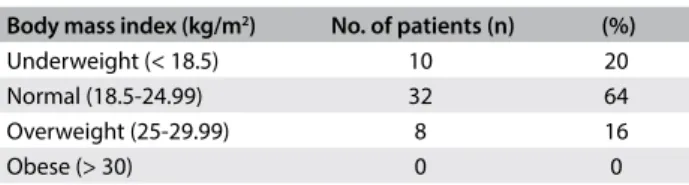
his study was conducted from December 2011 to December 2012. A total of 50 patients met our inclusion criteria and were included in the study. he mean age of the study patients was 45.8 ± 10.0 years (range 24 to 60 years). he majority (62%) of the patients were below ity years of age.Males formed the pre-dominant group among the patients (64%) and 72% of the patients were from a rural background. he majority (64%) of the patients had a normal body mass index (BMI). BMI did not difer statistically according to gender (Table 1).
On investigation, 94% of the patients were anemic (hemoglo-bin < 12 g%). he hemoglo(hemoglo-bin values ranged from 5.0 to 12.5 g/dl (mean ± standard deviation, SD: 9.5 ± 1.6) among all the patients. For males, the hemoglobin range was 7.5-12.5 g/dl (10.2 ± 1.3), while for females, the values were 5.0-11.0 g/dl (8.3 ± 1.5).
he serum albumin levels ranged from 2.4 to 4.2 gm/dl. he mean serum albumin concentration was 3.28 ± 0.48 and 72% of the patients had hypoalbuminemia. Pre-dialysis serum urea levels ranged from 92.0 to 278.0 mg/dl (163.1 ± 39.1 mg/dl), serum creatinine 4.6-19.7 mg/dl (9.9 ± 3.3 mg/dL) and estimated GFR 3.0-19.8 ml/min/1.73 m2 (7.8 ± 3.4 ml/min/1.73 m2). here were no statistical diferences in baseline urea and creatinine levels
Table 1. Body mass index status of study patients (in kg/m2)
Body mass index (kg/m2) No. of patients (n) (%)
Underweight (< 18.5) 10 20 Normal (18.5-24.99) 32 64 Overweight (25-29.99) 8 16
according to gender, but estimated GFR was signiicantly higher in males (8.8 ± 3.5 ml/min/1.73 m2) than in females (6.0 ± 2.3 ml/ min/1.73 m2).
Forty-ive patients (90%) had been on HD for six months to three years and only 10% had been on HD for less than six months. he proportions were identical for males and females (Table 2). he majority (58%) of the study patients (62% of the males and 50% of the females) were undergoing HD twice a week, while 30% of all the patients (31% of the males and 28% of the females) were undergoing HD three times a week. Eight percent of the study patients were on hemodialysis once a week and another four per-cent once every two weeks (Table 3). 68% of the patients were
dia-betic before they were diagnosed as having CKD, while 34% were known to be hypertensive and 18% had coronary artery disease.
he percentages of the predicted spirometric parameters (% pred)and changes to spirometric parameters among our study patients ater hemodialysis are presented in Table 4 and Table 5.
FVC: he mean FVC of the study patients was 45.8 ± 24.9% pred, i.e. well below the normal predicted values for pulmonary function (normal is more than 80% of the predicted values), determined through spirometry. Ater HD, the mean FVC increased to 51.1 ± 23.4% pred, and this increase was statistically highly signiicant (P < 0.01) (Table 4).
FEV1: hemean FEV1 of the study patients was 43.5 ± 25.9% pred, which was also well below the normal predicted values (nor-mal is more than 80% of the predicted values). Ater HD, the mean FEV1 increased to 49.3 ± 25.5% pred, and this increase was statis-tically highly signiicant (P < 0.01) (Table 4).
FEV1/FVC%: he mean FEV1/FVC% of the study patients was 97.8 ± 20.8% pred. Ater HD, the mean FEV1/FVC% increased to 99.3 ± 20.1% pred, but this increase was not statistically signii-cant (P > 0.05) (Table 4).
Forced expiratory low (FEF) 25-75%: he mean FEF 25-75% of the study patients was 50.1 ± 31% pred. Ater HD, the mean FEF 25-75% increased to 56.3 ± 31.6% pred, and this increase was statistically signiicant (P < 0.05) (Table 4).
Peak expiratory low rate (PEFR): he mean PEFR of the study patients was 43.8 ± 30.7% pred, i.e. well below the normal range (normal is more than 80% of the predicted values). Ater HD, the
mean PEFR increased to 49.1 ± 29.9% pred, and this increase was statistically signiicant (P < 0.05) (Table 4).
he overall analysis on pulmonary function in our study revealed that the majority of the patients (82%) had a normal FEV1/FVC ratio (> 70%) and low percentages of the predicted FVC value (< 80% pred), which was indicative of restrictive pul-monary disorder. Moreover, 6% had an FEV1/FVC ratio less than 70%, which indicates obstructive respiratory disorder. However, because these patients also had low FVC, they could be included in the category of mixed respiratory disorder. Only 12% of the study patients had pulmonary function in the normal range.
here were no statistically signiicant diferences in any of the spirometric parameters ater HD when compared on the basis of gender. Males and females showed similar directions of change ater HD (Table 5).
DISCUSSION
he mean age of our study patients was 45.8 ± 10.0 years and 62% of them were < 50 years, thus suggesting that CKD had emerged as an early complication of various disorders. he preponder-ance of males (64%) may have relected either greater prevalence of CKD among males or, alternatively, poor availability of costly HD treatment for female patients, due to various sociocultural and economic constraints. he mean BMI of the study group was 21.6 ± 3.0 kg/m2 and 20% had BMI < 18.5 kg/m2, but the majority
Table 2. Duration of hemodialysis among study patients
Duration of hemodialysis Males (n = 32)
Females (n = 18)
Total (n = 50)
< Six months 3 (9.4%) 2 (11.1%) 5 (10.0%) Six months to one year 12 (37.5%) 7 (38.9%) 19 (38.0%) > One year to three years 17 (53.1%) 9 (50.0%) 26 (52.0%)
Table 3. Frequency of hemodialysis among study patients
Frequency of hemodialysis Total (n = 50) %
Three times a week 15 30
Twice a week 29 58
Once a week 4 8
Once every two weeks 2 4
Table 4. Percentage of predicted spirometric parameters among the study patients (before and after hemodialysis [HD]) (n = 50)
Spirometric parameters Before HD (mean ± SD) After HD (mean ± SD) Paired diferences
Mean SD SEM 95% CI P-value
FVC 45.8 ± 24.9 51.1 ± 23.4 5.3 8.6 1.2 2.8-7.7 < 0.001 FEV1 43.5 ± 25.9 49.3 ± 25.5 5.8 9.4 1.3 3.2-8.6 < 0.001 FEV1/FVC (%) 97.8 ± 20.8 99.3 ± 20.1 1.5 18.0 2.6 -3.6-6.6 0.561 FEF 25-75% 50.1 ± 31.3 56.3 ± 31.6 6.2 20.9 3.0 0.2-12.1 0.043 PEFR 43.8 ± 30.7 49.1 ± 29.9 5.3 13.1 1.9 1.6-9.1 0.006
(64%) of the patients had normal BMI. his was despite chronic illness, but the patients’ obvious water retention and edema may have led to their normal BMI.
Anemia (94%) and hypoalbuminemia (72%) were very preva-lent. his may have been due to higher levels of renal dysfunction and poor nutritional status, relecting both an inlammatory state and poor nutritional status among the patients. he high preva-lence of these conditions may also have been due to a hypercata-bolic state in CKD, caused by accumulation of proinlammatory cytokines and a combination of factors like uremic toxicity, insulin resistance, and amino acid losses13 during the dialysis procedure, rather than mere lack of a high protein diet.14
FVC (forced vital capacity)
he mean FVC of the study group was 45.8 ± 24.9% pred, i.e. well below the normal predicted values for pulmonary func-tion. Ater HD, the mean FVC increased to 51.1 ± 23.4% pred (P < 0.001). Our indings regarding FVC are in agreement with Mehmood.7,15-17 Decreased FVC, restrictive pattern and reduced airlows have been observed through spirometry, in studies by several authors. Chronic subclinical pulmonary edema due to increased capillary permeability and hypoalbuminemia was con-sidered to be the cause for the decreased FVC.11,18
FEV1
he mean FEV1 of our study patients was 43.5 ± 25.9% pred. which was also well below the normal predicted values (normal is more than 80% of the predicted values). It showed a statisti-cally signiicant increase ater HD, to 49 ± 25.5% pred (P < 0.01). However, these low FEV1 values were associated with a normal FEV1/FVC ratio in most of our patients, which suggested that the large airways were not afected in situations of chronic renal fail-ure and that the reduction of FEV1 was primarily due to reduc-tion in FVC, as in restrictive pulmonary disease. Reduced FEV1 as observed in our study patients has also been reported by Maehmood et al. and Nascimento et al.15,16 Inlammation and malnutrition have been found to present signiicant relationships with reduced pulmonary parameters.19
FEV1/FVC percentage ratio
Most of the study patients (82%) had a normal FEV1/FVC ratio (> 70%) and reduced FVC (i.e. < 80% of the predicted values), which was indicative of restrictive pulmonary disorder, while 6% had an FEV1/FVC ratio of less than 70%, thus pointing towards obstructive respiratory disorder. However, the latter patients also presented decreased FVC and could be included in the category of mixed respiratory disorder. Only 12% of the study patients had pulmonary function within the normal range. he mean FEV1/FVC ratio of our patients was 97.8 ± 20.8% pred, and this increased to 99.3 ± 20.1% pred) ater HD, but this increase was not statistically signiicant (P > 0.05). In contrast to FEV1 and FVC, there were no signiicant changes overall or among the sub-groups of the study patients regarding the FEV1/FVC ratio ater HD, because there was corresponding increase in both parame-ters (FVC and FEV1). No signiicant change in this ratio was also observed by Navari et al.4
FEF 25-75% (forced expiratory low over the middle part of FVC) FEF 25-75% is measured from a segment of the FVC that includes low from medium and small airways. Decreased lows are com-mon in the early stages of obstructive disease. In the presence of borderline values for FEV1/FVC, a low FEF 25-75% conirms air-way obstruction and sometime signals decreased cross-sectional area in the small airways. he mean FEF 25-75%among our study patients was 50.1 ± 31.3% pred and, ater HD, it increased to 56.3 ± 31.6% pred, which was a statistically signiicant increase (P < 0.05). Rakovaca et al. found decreased values for FEF 25-75% among ESRD patients.20 Mahmood et al.also observed decreased values that were indicative of small airway disease, in comparison with their controls.15
he improvement in FEF 25-75% that was achieved through HD among our study patients showed that there was a situation of reversible obstruction, comprising removal of excess luid from the lungs that had been compressing the small airways. However, chronic subclinical pulmonary edema leading to peribronchial ibrosis may also contribute towards the persistent abnormalities in the small airways that are relected in reduced FEF 25-75% values.
Table 5. Change in spirometric parameters among patients after hemodialysis
Spirometric parameter
Male (n = 32) Female (n = 18)
P-value
Increase Increase
N % N %
FVC 25 78.1 15 83.3 0.941
FEV1 24 75.0 14 77.8 0.901
FEV1/FVC ratio 21 65.6 10 55.6 0.689
FEF 25-75% 17 53.1 13 72.2 0.307
PEFR 19 59.4 11 61.1 0.856
PEFR (peak expiratory low rate)
Among our study patients, the mean PEFR was 43.8 ± 30.7% pred, i.e. below the normal range. Ater HD, the PEFR increased to 49.1 ± 29.9% pred, and this increase was statistically signii-cant (P < 0.05). Mahmood et al. reported that the values among CKD patients on HD were lower than those of normal sub-jects.15 Reduced PEFR before and even during HD sessions was observed by Davenport, who attributed this to activation of the complement system for neutrophils, monocytes and platelets fol-lowing blood membrane interaction, thereby resulting in appre-ciable airway constriction.21 In contrast to the indings from our study, normal PEFR values were observed by Lang et al.7
CONCLUSION
Pulmonary function abnormalities were common among our study patients, but were signiicantly ameliorated ater HD. he majority of our patients had restrictive and mixed respiratory disorders. In the pulmonary function tests on our ESRD patients, spirometric parameters like FVC, FEV1 and PEFR were less than the normal predicted values (i.e. < 80% of the predicted values) in the majority of these patients. In comparing the pre-HD and post-HD spirometric parameters, there was signiicant improve-ment but normal predicted values were still not achieved.
REFERENCES
1. US Renal Data System, Annual data report: atlas of end-stage renal disease
in the United States. Bethesda: National Institutes of Health. National
Institute of Diabetes and Digestive and Kidney Diseases; 2002. Available
from: https://www.usrds.org/atlas02.aspx. Accessed in 2017 (Sep 11).
2. Brenner BM, Mackenzie HS. Disturbances of renal function. In: Fauci AS,
Braunwald E, Isselbacher KJ, et al., editors. Harrison’s Principles of Internal
Medicine. 17th ed. New York: McGraw-Hill Companies; 2008. p. 1761-71.
3. Pierson JD. Respiratory considerations in the patient with renal failure.
Respir Care. 2006;51(4):413-22.
4. Navari K, Farshidi H, Pour-Reza-Gholi F, et al. Spirometry parameters
in patients undergoing hemodialysis with bicarbonate and acetate
dialysates. Iran J Kidney Dis. 2008;2(3):149-53.
5. Parmar MS. Chronic renal disease. BMJ. 2002;325(7355):85-90.
6. Karacan O, Tutal E, Colak T, et al. Pulmonary function in renal
transplant recipients and end-stage renal disease patients undergoing
maintenance dialysis. Transplant Proc. 2006;38(2):396-400.
7. Lang SM, Becker A, Fischer R, Huber RM, Schil H. Acute efects of
hemodialysis on lung function in patients with end-stage renal disease.
Wien Klin Wochenschr. 2006;118(3-4):108-13.
8. Rahgoshai R, Rahgoshai R, Khosraviani A, Nasiri AA, Solouki M. Acute
efects of hemodialysis on pulmonary function in patients with
end-stage renal disease. Iran J Kidney Dis. 2010;4(3):214-7.
9. Senatore M, Buemi M, Di Somma A, Sapio C, Gallo GC. [Respiratory
function abnormalities in uremic patients]. G ltal Nefrol. 2004;21(1):29-33.
10. Craddock PR, Fehr J, Brigham KL, Kronenberg RS, Jacob HS. Complement
and leukocyte-mediated pulmonary dysfunction in hemodialysis. N
Engl J Med. 1977;296(14):769-74.
11. Zidulka A, Despas PJ, Milic-Emili J, Anthonisen NR. Pulmonary function
with acute loss of excess lung water by hemodialysis in patients with
chronic uremia. Am J Med. 1973;55(2):134-41.
12. Silva VG, Amaral C, Monterio MB, Nascimento DM, Boschetti JR. Efeitos
do treinamento muscular inspiratório nos pacientes em hemodiálise
[Efects of inspiratory muscle training in hemodialysis patients]. J Bras
Nefrol. 2011;33(1):62-8.
13. Lim VS, Ikizler TA, Raj DS, Flanigan MJ. Does hemodialysis increase protein
breakdown? Dissociation between whole-body amino acid turnover
and regional muscle kinetics. J Am Soc Nephrol. 2005;16(4):862-8.
14. Adams GR, Vaziri ND. Skeletal muscle dysfunction in chronic renal failure:
efect of exercise. Am J Physiol Renal Physiol. 2006;290(4):F753-61.
15. Mahmoud BL, Abdulkader A, El-Sharkawy MM, Khalil HH. Assessment
of pulmonary functions in chronic renal failure patients with diferent
haemodialysis regimens. J Egypt Soc Parasitol. 2004;34(3):1025-40.
16. Nascimento MM, Quershi RA, Stenvinkel P, et al. Malnutrition and
inlammation are associated with impaired pulmonary function in patients
with chronic kidney disease. Nephrol Dial Transplant. 2004;19(7):1823-8.
17. Bark H, Heimer D, Chaimovitz C, Mostoslovski M. Efect of chronic renal
failure on respiratory muscle strength. Respiration. 1988;54(3):153-61.
18. Prezant DJ. Efect of uremia and its treatment on pulmonary function.
Lung. 1990;168(1):1-14.
19. Yoon SH, Choi NW, Yun SR. Pulmonary dysfunction is possibly a marker
of malnutrition and inlammation but not mortality in patients with
end-stage renal disease. Nephron Clin Pract. 2009;111(1):c1-6.
20. Rajkovača Z, Kovačević P, Jakovljević B, Erić Z. Detection of pulmonary
calciication in haemodialised patients by whole-body scintigraphy
and the impact of the calciication to parameters of spirometry. Bosn
J Basic Med Sci. 2010;10(4):303-6.
21. Davenport A, Williams AJ. Fall in peak expiratory low during haemodialysis
in patients with chronic renal failure. Thorax. 1988;43(9):693-6.
Conlict of interest: The authors certify that there was no conlict of interest, in any academic, research, copyright or inancial form
Sources of funding: None
Date of irst submission: June 10, 2017
Last received: July 30, 2017
Accepted: August 15, 2017
Address for correspondence:
Ashok Sharma
Indira Gandhi Medical College, IGMC Shimla
Circular Road, Lakkar Bazar, Shimla, Himachal Pradesh 171001, India
Tel. (0177) 2804251
![Table 4. Percentage of predicted spirometric parameters among the study patients (before and after hemodialysis [HD]) (n = 50) Spirometric parameters Before HD (mean ± SD) After HD (mean ± SD) Paired diferences](https://thumb-eu.123doks.com/thumbv2/123dok_br/19028304.474274/3.892.63.829.903.1023/percentage-predicted-spirometric-parameters-hemodialysis-spirometric-parameters-diferences.webp)

