O
RIGINAL
A
R
TICLE
RESUMO
A iden fi cação de variáveis associadas ao po de atenção domiciliária (AD) dos usuários do Sistema Único de Saúde (SUS) contribui para a gestão do cuidado na Rede de Atenção à Saúde (RAS). Obje va-se iden fi car variáveis associadas ao po de AD dos usuários em Unidades Básicas de Saúde (UBS) selecionadas de Belo Horizonte. Estudo transversal em duas UBS com todos os usuários (n=114) em AD da área de abrangência. U lizou-se a análise de regressão logís ca múl pla para seleção (stepwise) de variáveis signifi ca vas. Obteve-se maior comprome mento clínico dos usuários (OR=27,47), estado emocional triste (OR=24,36), risco para úlcera por pressão pela escala de Braden (OR=7,6) e a semidependência para as AVD pelo índice de Katz (OR=63,8) como fortemente associadas ao po de AD (p<0,05). As variáveis fundadas no contexto social, familiar e clínico dos sujeitos subsidiam a abordagem integral e a tomada de decisão da equipe de saúde.
DESCRITORES Atenção Primária à Saúde Serviços de Assistência Domiciliar Padrão de cuidado
Sistema Único de Saúde ABSTRACT
The iden fi ca on of variables associated with the type of home care (HC) of the users of the Unifi ed Health System (UHS) con-tributes to the management of care in the Health Care Network (HCN). The objec ve was to iden fy variables associated with HC users in Basic Health Units (BHU) selected from Belo Horizonte. It was a transversal study in two BHU with all users (n=114) in HC in the covered area. We used a mul ple logistic regression analysis for selection (stepwise) of signifi cant variables. Greater clinical involvement of users (OR=27.47), a sad emo onal state (OR=24.36), risk for pressure ulcer by the Braden scale (OR=7.6) and semidependence by the Katz ADL index (OR=63.8) were obtained and were strongly associated with the type of HC (p<0.05). Variables based on the social, family and clinical context of the subjects subsidized the integral approach and decision-making of the healthcare team.
DESCRIPTORES Primary Health Care Home Care Services Standard of care Unifi ed Health System
RESUMEN
La identificación de variables asociadas al tipo de atención domiciliaria (AD) de los usuarios del SUS contribuye para la gestión del cuidado en la Red de Cuidado de la Salud (RAS). Objetivo: identificar las variables asociadas al tipo de AD requerida por todos los usuarios del SUS en Unidades Básicas de Salud (UBS) de Belo Horizonte. Estudio transversal en dos UBS con todos los usuarios de AD (n=114) en el área de cobertura, análi-sis de regresión logística múltiple para la selección (stepwise) de las variables significativas. Mayor comprometimiento clínico (OR=27,47), el estado emocional triste (OR=24,36), la Escala de Braden (OR=7,6) y índice de Katz (OR=63,8) se asociaron con el tipo de AD (p<0,05). Las variables fundadas en el contexto social, familiar y clínico de los sujetos subsidian el abordaje integral y la toma de decisión del equipo.
DESCRIPTORES Atención Primaria de Salud
Servicios de Atención de Salud a Domicilio Nivel de atención
Sistema Único de Salud
Factors associated with home care:
support for care management within
the SUS
FATORES ASSOCIADOS À ATENÇÃO DOMICILIÁRIA: SUBSÍDIOS À GESTÃO DO CUIDADO NO ÂMBITO DO SUS
LOS FACTORES ASOCIADOS CON LA ATENCIÓN DOMICILIARIA:SUBSIDIOS A LA GESTIÓN DE LA ATENCIÓNEN EL SUS
Maria Raquel Gomes Maia Pires1, Elisabeth Carmen Duarte2, Leila Bernarda Donato Göttems3, Nívea Vieira Furtado Figueiredo4, Carla Aparecida Spagnol5
1 Nurse. Doctorate in Social Policy from the University of Brasilia. Adjunct Professor, Department of Nursing, Universidade de Brasília. Brasília, DF, Brazil.
[email protected]. 2 Biologist. Doctorate in Epidemiology and Biostatistics from McGill University , Canada. Adjunct Professor, Faculty of Medicine, Universidade
de Brasília. Brasília, DF, Brazil. 3 Nurse. Doctorate in Administration from Universidade de Brasília. Professor at the School of Health Sciences of the Ministry
of Health of the Federal District and The Catholic university of Brasília. Brasília, DF, Brazil. 4 Master’s in Nursing, Universidade Federal de Minas Gerais.
Assistant Professor, Centro Universitário Newton Paiva. Belo Horizonte, MG, Brazil. 5 Doctorate in Public Health, Universidade Estadual de Campinas.
INTRODUCTION
The recent na onal policy of Home Care (HC) in the Unifi ed Health System (UHS), defi ned in GM Ordinance No.
2527 of October 27, 2011, revives important discussions, such as the perspec ve of network management, the role of primary care as coordinator of care, and the changes in the technical-assistance model, in construc on.
According to that document, home care within the UHS is considered to be a care modality that is subs tu ve or complementary to what exists, characterized by a set of ac ons for health promo on, preven on, treatment and rehabilita on provided in the home, with guaranteed con -nuity and integra on of care with the Health Care Networks (HCN). Among the ac ons developed, the home visit is nguished as the main ac vity, which includes consulta on of a higher level professional in the home, the iden fi ca on
of the person who cares for the user, planning, performing procedures, and systema c monitoring of the family.
Some studies have dealt with the dis nc on between the concepts of a en on, assistance, care,
home visit or hospitaliza on, depending on the complexity of professional prac ces, the clinical condi on of the user and the use of hospital equipment required, with the intent to categorize the various types of Home Care that can be provided at the residence of the ci zen(1-2). The three types
of home care modali es, now standard-ized, incorporate this discussion from the perspec ve of the HCN, proposed in GM Ordinance No. 4,279 of December 30, 2010, which is the ra onale for why this study adopts the term home care for the diff erent levels of the health system.
The three classifi ca ons of home care in the UHS
pro-vided in the current policy are: HC1 – the responsibility of primary care teams (PCT) and the nucleus of a en on to family health (NAFH), HC2 and HC3, belonging to second-ary care and linked to mul disciplinsecond-ary home care teams (MHCT), formed by physicians, nurses and physiotherapists. In the case of home care of type 3 (HC3), this increases to include the MHCT, the support of the mul disciplinary support team (MST), formed by at least three of the follow-ing professionals: social worker, physiotherapist, speech therapist, nutri onist, den st, psychologist, pharmacist and occupa onal therapist.
The type 1 home care (HC1) is conceptualized as a set of necessary ac ons for users with controlled and compensated health problems, with diffi culty or physical impossibility of commu ng to a health facility, requiring care with lower frequency and need for health resources. For the user in more acute clinical condi ons, with limited mobility and who requires a higher frequency of care, health resources and moni-toring, HC2 is recommended. For people who, in addi on to
mee ng the condi ons for HC2, require the use of con nuous oxygen therapy equipment, noninvasive ven latory support, peritoneal dialysis or paracentesis, HC3 is indicated.
Despite the growth of public and private sector home care services in the country, characteris cs of special pro-grams, punctual, linked to hospitals or emergency care units (ECU), centered on reducing costs, with li le coordina on between levels of care and weaknesses in the use of infor-ma on for ac on planning s ll prevail. On the other hand, there is evidence of change in home care prac ces, either by the innova ons of health teams, or by the tension between the diff erent forms of care – the professional, the c projects of the families, the caregivers and the users(3-4).
A change in the way services are organized is based on the health needs of the popula on, or what it manages to base on studies of the demand for health services(3-5), is a
premise for structuring the HCN from a basis in Primary Care, as the organizing center of care(6).
Care management, or the way in which care is revealed and is organized, occurs in the interac on between
individu-als, capable of emancipatory subversions or imposi ons that are restric ve of human liber es(7). It can ar culate resources and
subjects in the levels of care of the system, contribu ng to an expanded focus of the clinic in the organiza on of the services(8).
The challenges to be overcome for ex-panded care to become reality in healthcare work include the fragmenta on of ac ons, the overly technical training of professionals, lack of planning methods, and li le use of the informa on available for planning(3,6,8-10).
Given the need for reorganization of health teams practices from the HCN perspective, the adop on of classifying typologies according to the demand of the popula on is an important device for the manage-ment of care, for subsidizing planning and the integra on of ac vi es(1-4).
In this context, this study aimed to iden fy the associ-ated variables – in other words, those that most infl uenced
the classifi ca on of the type of HC of the users in the
territory of the Basic Health Units (BHU) – that support the management of care by the health teams, from the perspec ve of the HCN of the UHS.
METHOD
Type of study
This was a transversal inquiry study with a descrip ve and an analy cal step(11). In the descrip ve phase, we
gated the clinical, socioeconomic and family variables that characterized all the users and their caregivers in home care, in the catchment area from two UBS of Belo Horizonte. In
...the adoption of classifying typologies
according to the demand of the population is an important device for
the analy cal phase, based on these variables, probabilis c models of mul ple logis c regressions were es mated to iden fy variables strongly associated with the type of HC classifi ca on demanded by the users.
Scenario and populaƟ on of the study
Two of the BHU territories in Belo Horizonte, with a popula on of 5,736 users over 60 years of age, composed the scenario of inves ga on. A choice of these primary care services was jus fi ed by the exis ng partnership between
the university and the health services, which facilitated discussions to tailor research objec ves to the reality of the Family Health Teams (FHT). The selec on of the BHU was non-probabilis c and inten onal, in view of the applied and exploratory character of the research(12-13).
The inclusion criterion was the census, in other words, it included all 120 people registered for the FHT of the two BHU who received assistance in the modality of professional HC. We interviewed 114 users in Home Care indicated by the FHT, 38 in BHU 1 and 76 in BHU 2. Six other users were interviewed by health professionals of the FHS, in their home visits, to verify the adequacy of instrument for the BHU work, therefore they were not included in the database of the present study.
Instrument and data collecƟ on
Beginning with a literature review of exis ng instru-ments to address the elderly, hypertensive or bedridden users predominant in HC(15), three dimensions were defi ned
that synthesized the theoretical concepts for the care extended to the study popula on. The fi rst dimension,
the social and family context of the user, focused on the dynamics of family life and the social condi ons of the user and the caregiver. The second assessed the degree of dependency for ac vi es of daily living (ADL) and the risk for pressure ulcers (PU). The third examined the interview and clinical fi ndings of the HC user. These dimensions guided
the defi ni on of the variables, the 72 items included in the
instrument for data collec on and a subset of items that guided the classifi ca on of the type of HC for the user,
conducted by interviewers.
The main validated instruments that supported the iden fi ca on or construc on of the ques onnaire items
were(15): a) WHOQOL (WHO Quality of Life), which measures
quality of life; b) the Katz Index, for assessments of ac vi es of daily living (ADL); c) the Braden Scale, for examina on of pressure ulcers; d) the Caregiver Burden Scale, to assess caregiver burden; e) genogram, ecomap and familiogram, to assess the dynamics of family life; f) the Flanagan Scale, which measures subjec ve aspects that are more frequent in the elderly.
The construc on of the ques onnaire occurred in fi ve
steps, beginning with par cipant observa on of the work in the FHT in both of the BHU, with immersion in the ev-eryday services over six months, conduc ng 35 home visits
and iden fying the technologies used by HC professionals. From the three defined dimensions and the literature review of the instruments for use in approaching the user and caregiver, the ques onnaire matrix was constructed, composed of concepts, variables, indicators and items(12).
This step priori zed the iden fi ca on of already validated
items, together with others that were suited to the social, family and clinical approach of the subjects. With a prelimi-nary version of the ques onnaire defi ned, team training of
the interviewers occurred and a pilot study was conducted with 30 users of another BHU that was not part of the sample, in which the quan ty was defi ned by calcula ng
the sampling frac on in the probabilis c sample(13). In the
fourth step, there were two discussion workshops with health professionals of the two BHU for seman c analysis of the items(16) and adapta on of the variables to the work
of FHS, as a subsidy to care management. In the fi h step,
analysis by judges occurred, using 80% as the degree of agreement among the specialists. A er collec ng data, the Pearson correla on was executed between the variables to select the items that would remain in the instrument, to approach the classifi ca on of the user for HC, adop ng a
value of 0.30 (p=0.05) as a reference(17).
The dependent variable type of HC, in the fi nal version
of the data collec on instrument used in the classifi ca on
of the user in HC by the interviewer, was categorized into a seven-point Likert scale, ranging from very close, close and less close to HC1 or HC2, interspersed by zero. During data collec on, indica ons from the literature, offi cial guidelines and the dimensions of the study, synthesized into a set of ques onnaire items in a check list format, were taken as references for the classifi ca on of users.
Thus, for HC type 1, the following were considered: controlled and compensated health problems, some degree of dependence for ADL, inability to travel to a BHU, greater spacing between visits, and less need for more complex procedures. In HC type 2: high degree of clinical compromise (acute or chronic decompensa on), social and epidemio-logical; greater dependence for ADL; impossibility to travel to a BHU; use of equipment; the need for more frequent visits and dependence for more complex procedures. Within this conceptualiza on, the classifi ca on of HC3, present in
the current policy, was considered a varia on of HC2.
The independent variables of the study distributed in the dimensions:
Social and family context: a) metric variables (fam-ily par cipa on in care; personal rela onships; degree of discomfort; and, fa gue in rela on to the ac vi es of the caregiver; sleep quality of the caregiver) and b) categorical variables (age range of the user; gender; educa on; house-hold income; housing condi ons; family profi le; feelings
about the illness and family life; gender of the caregiver; age range of the caregiver; health problems of the caregiver; chief complaint; use of medica ons; caregiver profi le;
caregiver; feelings toward the care and family life; physical safety and protec on; material resources for HC;
Degree of ADL dependence and risk for pressure ulcers: a) metric variables: Katz and Braden scale;
Interview and clinical fi ndings of the users: a) metric
variables: gagging during feeding; quality of sleep; degree of discomfort and fa gue; alcoholism and smoking; physi-cal security; mobility; visual acuity; hearing acuity; mental status assessment; evaluation and assessment of the emo onal state of the communica on and b) categorical variables (health problems of the user; chief complaint; medica on use; dietary intake; fl uid intake; urinary habits;
intes nal habits; assessment of hemodynamics; general appearance; respiratory ausculta on; use of supplemental oxygen; cardiovascular system; abdominal evalua on of members; genitourinary system; nutri onal status; body hygiene; oral hygiene; skin integrity).
Data collec on occurred in a single visit in the home of the user, with a mean applica on me of 45 minutes. The interviewers, previously trained in the pilot test, received new orienta ons and direct supervision of performance during the collec on. We observed the accuracy of the informa on, especially at the moment of classifi ca on of
the user on the type of HC, conducted a er the interview, from the checklist of items with the indica ons of each of the care modali es, which was decisive for the quality and harnessing of all informa on. The inser on of the 114 cases occurred at the end of the collec on, with double entry in the database and checking of archives in the Sta s cal Package for the Social Sciences (SPSS), version 15.0.
Data analysis and ethical aspects
In logis c regression analysis the dependent variable considered was the type of home care, categorized as 0=HC1 and 1=HC2. The exploratory analysis was conducted of the complete database, of missing and atypical cases, and of the normality of the metrics variables. A er the simple descrip ve analysis, the preparatory steps for
variate analysis and the examina on of the correla ons which exist between the independent variables followed to iden fy collinearity.
In crude logis c regression analysis, variables were iden fi ed that were signifi cantly associated with the type
of HC, grouped in hierarchical blocks: sociodemographic, clinical, psychosocial, degree of dependency and house-hold condi ons. The mul ple logis c regression models es mated included all signifi cant variables iden fi ed in the
crude analysis, respec ng the hierarchical blocks previously described. The choice of the fi nal model was based on the
selec on of variables for the step-wise method of es on, considering as the inclusion criterion p<0.05(17). The
odds ra os (OR) were es mated, with their respec ve 95% confi dence intervals (CI95%) and sta s cal signifi cance (p),
for each variable sta s cally associated with the type of HC.
The research was approved by the ethics commi ees on research of the Federal University of Minas Gerais– UFMG (ETIC 449/08) and SMSA/BH (007/2008).
RESULTS
Sociofamiliar context of the user and situaƟ on of the caregivers
Of the 114 users evaluated in the BHU territory, 73.6% were classifi ed as HC1 and 26.3% as HC2 (BHU 1: 72.4% as
HC1, 27.6% as HC2; BHU 2: 80% as HC1; 20% as HC2). The majority of the HC users were women (69.3%), aged 66-95 years (65.7%), having studied, on average, up to primary educa on (89.3%), received up to three mes the minimum wage (72.8%) and lived in condi ons with adequate water and sanita on (93%). They were accompanied by caregiv-ers (76.3%), but some lived alone and did not receive care from another person (23.6%), although they needed it. The caregiver ac vity was exercised by women (83.1%), between 46 and 75 years (65.5%), a family member (95.4%), with educa onal level up to high school (86.1), with no oc-cupa on, or who were re red (80.4%).
Users that expressed their feelings about the dynamics of family life (72.8%) le to do things on a day-to-day basis, such as work or leisure (91.5%), felt sad or lonely (53%) and some reported changes in aff ec ve rela onship between the family members (20%). This situa on was extended to caregivers, who abandoned their social ac vi es or work (73.5%), some mes with feelings of sadness, loneliness or redness (19.5%) and disturbances in family rela onships (32.1%). The caregivers of the users o en felt pain (mean 3.03) and fa gue (mean 3.19) at the end of the day, but were never demo vated to care for the infi rm person at
home (mean 1.86), felt no diffi culty with sleep (47.1%); but were rarely disposed toward leisure ac vi es (mean 3.03). Households generally had adequate condi ons in terms of cleanliness and ven la on (71%), but some items posed a risk for the elderly and bedridden, such as slippery
fl oors (42.9%), fl oor and wall moisture (37.7%), rugs which
increased the possibility of falls (34.2%), steps (82.4%), ramps (42.9%) and uneven surfaces (66.6%).
There was a lack of equipment for home care, such as wheelchairs (31.7%), bedside commodes (32.8%), hospital beds (53.5%), eggshell ma resses (51.2%), walker (44.4%), cane (31.25%) and materials for bandaging/dressings (58.3%).
Dependence in ADL, risk for pressure ulcers, user inter-view and clinical data of the user
Part of the users (41.2%) at risk for pressure ulcer depended on others to perform their ADLs during the day (57.9%), such as bathing, dressing, toile ng, moving around, feeding or maintaining sphincter control; some (32.4%) were dependent for more than fi ve of these six func ons
(99.1%) with the most prevalent being systemic arterial hypertension (HBP, 70%), type II diabetes (DM, 29.8%) and cerebrovascular accident (CVA; 26.3%). These health prob-lems also aff ected the caregivers (70.1%), who reported the presence of HBP (55.7%) and DM type II (29.8%).
Pain was a very frequent sensa on among the users in HC (52.8%), those who always (22.1%) or some mes (30.7%, mean 2.14) felt it, and few reported a disposi on for leisure (mean 1.89, some mes). More than half had diffi culty sleeping (56.1%), rarely or some mes needed medica on for it (73.7%), but there were those who presented constant dependence (18.3%) on pharmaceu cals to fall asleep.
They presented forge ulness in day-to-day life (63%), had locomo on (85%, mean 3.63) and visual diffi cul es, (49%, mean 3.59), but could hear fairly well (57.8%, mean 1.18). Some presented mental confusion (15.7%), diffi culty speaking (36.7%), paresia (21.9%) or plegia (17.5%) of limbs; others were emaciated (28.9%), had dry skin (28.9%), pres-ence of wounds (13.1%) and presented inadequate oral (20.1%) or body (13.1%) hygiene.
Regarding hemodynamic evalua on of the respondents, there were cardiopulmonary altera ons on ausculta on
(19.9%), in the blood pressure levels (44.7%) and in the fl uid
intake (35.9%). Concentrated urine (19.3%), urinary (76.2%) and fecal incon nence (49.9%), decrease in intes nal bowel sounds (14%), dry skin and mucosa (12.2%) were iden fi ed.
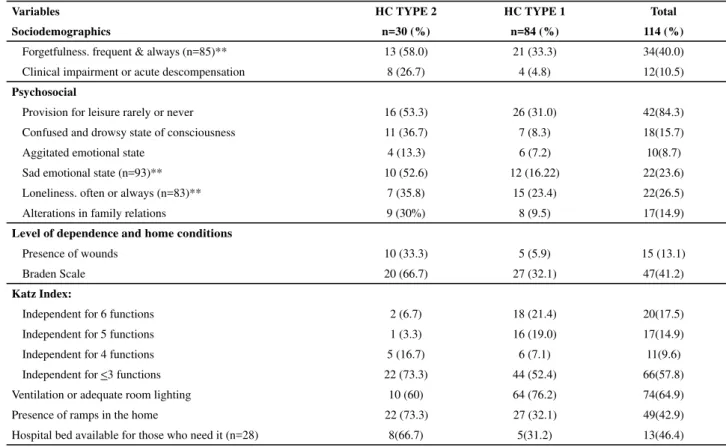
Users who needed type 2 home care (HC2) in general were women (66.7%), more than 61 years of age (86.7%), with some high school educa on (86.7%), with higher clini-cal compromise (26.6%) and psychosocial factors, and with a more pronounced degree of dependence and inadequacies of the household (Table 1).
The crude logis c regression analysis of the sociodemo-graphic, psychosocial, clinical and degree of dependence variables indicated the associa on of the HC2 type for users between 60 and 80 years; with some degree of educa on; with a history of CVA; neoplasms; using medica on; history of gagging; with limited mobility; frequent forge ulness; greater clinical compromise (acute or uncompensated); confused state of consciousness; feelings of sadness; changes in aff ec ve rela onship between family members; weak disposi on for leisure; presence of wounds; pres-sure ulcer risk; need for and availability of hospital beds; semidependence on the Katz index; presence of ramps at home (p≤0.05) (Table 2).
Table 1 – Sociodemographic, clinical, psychosocial, level of dependence, and household condition variables of the users classifi ed in HC1 and HC2 - Belo Horizonte, 2009-2010
Variables HC TYPE 2 HC TYPE 1 Total
Sociodemographics n=30 (%) n=84 (%) 114 (%)
Age
<60 years 4 (13.3) 26 (30.9) 30(26.3)
61-80 18 (60) 25 (29.8) 43(37.7)
81 and more 8 (26.7) 33 (39.3) 41(35.9)
Sex
Female 20 (66.7) 59 (70.2) 79(69.2)
Male 10 (33.3) 25 (29.8) 35(30.7)
With education 26 (86.7) 52 (61.9) 78(68.4)
Income greater than 3 times MW 4 (14.3) 23 (28.0) 27(23.6)
Clinical issues
HBP 23 (76.7) 57 (67.9) 80(70.1)
DM type 2 9 (30) 25 (29.4) 34(29.8)
CVA 12 (40.0) 18 (21.4) 30(26.3)
Alzheimer 2 (6.7) 3 (3.6) 5(4.3)
Neoplasms 4 (13.3) 3 (3.6) 7(6.1)
Osteoarthritis 1 (3.33) 5 (5.95) 6(5.2)
Medication use 26 (86.7) 81 (96.4) 107(93.8)
History of gagging 8 (26.7) 8 (9.5) 16(14.0)
Physical pain in daily life 13 (43.3) 32 (38.1) 45(39.4)
Diffi culty sleeping without using medications 11 (36.7) 22 (26.2) 33(28.9)
Dependence on medication to sleep, frequent & always 10 (33.3) 24 (28.6) 34(29.8)
Table 2 – Crude logistic regression adjusted for selection of associated variables with the type of HC required by users in the HBU territory - Belo Horizonte, 2009-2010
Variables* Crude analysis n=114 Adjusted analysis n=93 OR (CI 95%) p-value OR (CI 95%) p-value
Sociodemographics
Age
<60 years
61-80 4.68 1.27-21.25 0.009 13.29 0.86-204.64 0.064
81 and more 1.58 0.37-7.91 0.49 7.85 0.51–120.29 0.139
Sex 0.84 0.32-2.33 0.72 – – –
With education 4.00 1.21-17.04 0.01 – – –
Income greater than 3 times MW 0.43 0.10- 1.45 0.14 – – –
Clinical issues
HBP 1.56 0.55-4.82 0.36 NI – –
DM type 2 1.01 0.36-2.71 0.98 NI – –
CVA 2.44 0.89-6.53 0.05 – – –
Alzheimer 1.93 0.15-17.64 0.48 NI – –
Neoplasms 4.15 0.65-29.77 0.056 – – –
Osteoarthritis 0.54 0.01-5.19 0.58 NI – –
Medication use 0.24 0.03-1.55 0.056 – – –
History of gagging 3.45 0.99-11.81 0.02 – – –
Physical pain in daily life 1.24 0.48-3.13 0.61 NI – –
Diffi culty sleeping without using medications
1.63 0.60-4.29 0.28 NI – –
...Continuation
Variables HC TYPE 2 HC TYPE 1 Total
Sociodemographics n=30 (%) n=84 (%) 114 (%)
Forgetfulness. frequent & always (n=85)** 13 (58.0) 21 (33.3) 34(40.0)
Clinical impairment or acute descompensation 8 (26.7) 4 (4.8) 12(10.5)
Psychosocial
Provision for leisure rarely or never 16 (53.3) 26 (31.0) 42(84.3)
Confused and drowsy state of consciousness 11 (36.7) 7 (8.3) 18(15.7)
Aggitated emotional state 4 (13.3) 6 (7.2) 10(8.7)
Sad emotional state (n=93)** 10 (52.6) 12 (16.22) 22(23.6)
Loneliness. often or always (n=83)** 7 (35.8) 15 (23.4) 22(26.5)
Alterations in family relations 9 (30%) 8 (9.5) 17(14.9)
Level of dependence and home conditions
Presence of wounds 10 (33.3) 5 (5.9) 15 (13.1)
Braden Scale 20 (66.7) 27 (32.1) 47(41.2)
Katz Index:
Independent for 6 functions 2 (6.7) 18 (21.4) 20(17.5)
Independent for 5 functions 1 (3.3) 16 (19.0) 17(14.9)
Independent for 4 functions 5 (16.7) 6 (7.1) 11(9.6)
Independent for <3 functions 22 (73.3) 44 (52.4) 66(57.8)
Ventilation or adequate room lighting 10 (60) 64 (76.2) 74(64.9)
Presence of ramps in the home 22 (73.3) 27 (32.1) 49(42.9)
Hospital bed available for those who need it (n=28) 8(66.7) 5(31.2) 13(46.4)
...Continuation
Variables* Crude analysis n=114 Adjusted analysis n=93 OR (CI 95%) p-value OR (CI 95%) p-value
Diffi culty sleeping without using medications
1.63 0.60-4.29 0.28 NI – –
Mediations, frequently or always 1.25 0.45-3.30 0.62 NI – –
Diff w/ mobility, frequently or always - - 0.022 NI – –
Forgetfulness, freq or always (n=84)**
2.89 0.95-8.92 0.03 – – –
Clinical compromise (acute or decompensated)
7.27 1.72-35.37 < 0.001 27.47 1.84– 410.88 0.0016
Psychosocial
Disposition for leisure 2.55 0.99-6.54 0.029 – – –
Consciousness: confused and drowsy 6.37 1.92-21.78 <0.001 – – –
Aggitated emotional state 1.97 0.38-9.03 0.31 – – –
Sad emotional state (n=93)** 5.75 1.66-19.59 <0.001 24.36 2.54–234.01 0.006
Loneliness. freq or always (n=83)** 1.91 0.53-6.40 0.24 NI
Alterations in family relations 4.07 1.21-13.62 0.007 – – –
Degree of dependency
Hospital bed available (n=28) 4.4 0.70-29.52 0.06 – – –
Hospital bed (not needed)
Needs and has hospital bed 6.04 1.50-25.95 0.002 – – –
Needs and does not have hospital bed 1.37 0.28-5.37 0.62 – – –
Presence of wound 7.9 2.12-32.19 <0.001 – – –
Braden – risk for pressure ulcer 4.22 1.60-11.45 0.001 7.60 1.23–47.07 0.029
Katz Index: (indep. 6 funtions)
Independent in 5 functions 0.56 0.01-11.95 0.65 6.75 0.14- 326.24 0.334
Independent in 4 functions 7.5 0.86-91.21 0.02 44.66 0.87- 2395.25 0.059
Independent in <3 functions 4.5 0.92-42.87 0.04 63.88 1.44- 2830.18 0.032
Inadequate ventilation/lighting 0.47 0.18-1.27 0.09 - -
-Presence of ramps in home 5.81 2.12-16.86 <0.001 13.15 2.16-79.87 0.005
*The parentheses indicate the categories of reference for analysis (comparison groups); for the other variables, references are omitted and complementary categories (e.g., for income variable, the reference is income is up to 3 minimum wages (MW), and so on). NI=not included in the multivariate model (crude analysis p>0.20) ** Number of responses to the item.
In the adjusted model by logis c regression, variables remained strongly associated with type of HC and the greater clinical involvement of users (OR=27.47, p=0.001), a sad emo onal state (OR=24.36, p=0.006) the risk for pressure ulcers by the Braden scale (OR=7.6, p=0.029) and semidependence by the Katz ADL index (OR=63.8, p=0.036). Furthermore, the presence of ramps in the home (OR=13.14, p=0.005) appeared to be strongly associated with HC2 type, possibly indica ng a consequence of this condi on. Based on a conserva ve decision regarding the adjustment of the other variables in the model and their relevance, the age variable was retained in the fi nal model,
albeit not sta s cally signifi cant (p=0.064)
DISCUSSION
The social, family and clinical profi le of the user in HC
translates the situa on of the elderly popula on that is served by UHS, characterized by: low educa on and income,
generally women, with mobility problems, chronic degen-era ve health problems, dependence for ADLs that demand care at home from family, some mes genera ng dynamic tensions in the home(5,18-20).
The precarious social condi ons, accentuated by the suf-fering of living with a long term infi rmity at home, intensify
the complexity of the situa on that home care health profes-sionals faced, with the ability to generate refl ec ons about
caring and about life itself. Thus, although the possibility of restructuring the health care model exists, there is tension between the diff erent knowledge, reali es and dynamics of life in home care, which is able to generate signifi cant changes
in the approach to health(3-4), the low power of the users to
exert pressure tends to maintain the hegemony of the pro-fessional, by means of a dialec cal rela onship between the aid and the power that characterizes the poli cs of care(7).
applied knowledge and concep ons of care to act in the en-countered reality persists. As the locus of care is inverted from the health service to the home, the logic of care is modifi ed.
In the health services, there is a greater standardiza on of procedures which customarily unify disciplines dealing with human beings, resul ng in imprisonment of care in senseless acts. By entering the homes of people, they are interac ng with the daily living, the confl icts and the
dy-namics of the private lives, as well as the socio-economic poverty of the majority of the Brazilian popula on that uses the UHS. Deprived of the walls, of the manuals and techniques that protect the health services, professionals
fi nd themselves, many mes, with few op ons for
inter-ven ons in the complex situa on encountered, especially that comprehensively address the family, who are deemed part of this enlarged prac ce(8-10), or to devise care within
a rela onship permeated by power, capable of triggering libertarian possibili es in the subjects involved.
In these terms, one should invest in an extended ap-proach of care for the management of disrup ve ons between professionals, users, caregivers and family, in favor of autonomy. A cri cal epistemology and dialec c of care centered in the humanity that is sapiens (wise man) and demens (mad man), reason and madness, communion and destruc on, power and counter-power, body, soul and desire is defended here. One has to invest in the produc on of emancipatory biopoli cs of subjects centered on philosophi-cal, ontologiphilosophi-cal, and ecological and poli cal concep ons, synthesized in the trihedron knowledge for improved care,
delivering care to confront, delivering care to emancipate(8).
The context of life, the material condi ons for HC, the dynamics of family life, the subjec vity of the user and of the caregiver are aspects somewhat deepened through the prac ce of the professionals, who reclaim the lack of references to do it(15,21). The caregiver vulnerability detected
in this and other studies(18), whether physical, social or onal, becomes equally dependent on the HC of the health teams, which increases the complexity of the approaches needed on the part of the professionals, inducing them to work in an interdisciplinary network(3-4,8,21).
From the condi ons of the users and caregivers evalu-ated in this inves ga on, health needs that required priority nursing interven ons were visualized(18-20), coordinated by the
work of teams in the HC UHS. In this sense, the most infl
u-en al variables for the classifi ca on of the user in this study
subsidized a comprehensive look at the reality, contribu ng to the management of care that considered much more than the biological and physical body in the service network. Proof of this is that the items comprising the instrument for ap-proaching the user in HC, in par cular the reduced version of the ques onnaire, proved to be adequate both for research and for the work process of the professionals(15).
The variables iden fi ed that signifi cantly infl uenced
the classi ca on of the HC2 type allowed the intertwining
of clinical and emo onal condi ons, and the socio-family context of the user and of the caregiver. In other words, in the age between 60 and 80 years, the degree of clinical compromise, a sad emo onal state, the risk for pressure ulcers, the semidependence for ADL based on the Katz Index, and the presence of ramps at home showed the interdependence of physical, mental and social aspects in the produc on of the condi ons of health, requiring inter-disciplinary, epistemological and ontological approaches to care within the network of HC.
It is noteworthy that the associa on between the pres-ence of ramps in the home and the HC2 type of classifi
on represented a possible reverse causality bias, due to the transversality of the study and the inability to iden fy the ming of the events. Thus, it is probable that the pres-ence of the ramp did not determine the condi on of the user, but rather that its presence was determined by her condi on, being due to adapta ons made by the family to accommodate the most clinically compromised user (HC2).
Some variables related to the social (absence of the caregiver, elderly caring for elderly, accentuated feelings of sadness and loneliness, altera ons in the aff ec ve re-la onship, changes in the pace of work and family life), environmental (absence of equipment for HC, inadequate household condi ons) and caregiver context (overload, lack of guidance, pain, fa gue, or lack of disposi on for leisure) synthesized the urgent need for plural approaches for care and are translated into signals for health surveil-lance(1-4). In addi on, monitoring the user classifi ca on in
HC by means of variables that signal their health condi on enables teams to strengthen their con nuity of care within the HCN environment.
As a limita on of the study, we point to the fact that the transversal nature of the study did not permit clear establishment of ming of the events being studied. That said, the predominance of the HC1 type in the inves gated popula on, inherent in the profi le of the popula on of the
FHT, pointed to the need for inves ga ons in less homog-enous cases to permit greater generaliza on of the results (external validity).
CONCLUSION
The variables associated with the classifi ca on of the
type of Home Care iden fi ed in this research subsidized
the decision-making of the team about the priori es and the be er form of caring for health needs of those that needed home care in this health territory, substan a ng the expanded management of care in the Health Care Networks of the UHS. The network perspec ve expressed in microtools of the organiza on of health services - such as lines of care, coordina on of the clinic, the cases, health condi ons and wai ng lists - can be enhanced by monitoring variables that infl uence the classifi ca on type of Home Care by the teams,
1. Rehem TCMSB, Trad LAB. Assistência domiciliar em saúde:
subsídios para um projeto de Atenção Básica brasileira.Ciênc
Saúde Cole va. 2005;10 Supl:231-42.
2. Lacerda MR, Giacomozzi CM, Oliniski SR, Truppel TC. Atenção à saúde no domicílio: modalidades que fundamentam sua
prá ca.Saude Soc. 2006;15(2):88-95.
3. Silva KL, Sena RR, Seixas CT, Feuerwerker LCM, Merhy EE. Atenção domiciliar como mudança do modelo
tecnoassistencial.Rev Saúde Pública. 2010;44(1):166-76.
4. Feuerwerker LCM, Merhy EE. A contribuição da atenção domiciliar para a configuração de redes substitutivas de saúde: desins tucionalização e transformação de prá cas. Rev Panam Salud Publica. 2008;24(3):180-8.
5. Thume E, Facchini LA, Tomasi E, Vieira LAS. Assistência domiciliar a idosos: fatores associados, caracterís cas do
acesso e do cuidado.Rev Saúde Pública. 2010;44(6):1102-11.
6. Kuschnir R, Chorny AH. Redes de atenção à saúde: contextualizando o debate. Ciênc Saúde Coletiva. 2010;15(5):2307-16.
7. Pires MRGM. Poli cidade do cuidado e processo de trabalho em saúde: conhecer para cuidar melhor, cuidar para confrontar, cuidar para emancipar. Ciênc Saúde Cole va. 2005;10(4):1025-35.
8. Campos GWS. Clínica e saúde cole va compar lhadas: teoria paidéia e reformulação ampliada do trabalho em saúde. In: Campos GWS, Minayo MCS, Akerman M, Drumond Júnior M, Carvalho YM. Tratado de saúde cole va. São Paulo: Hucitec; 2006. p. 53-92.
9. Silva IZQJ, Trad LAB. O trabalho em equipe no PSF: inves gando a ar culação técnica e a interação entre os
profi ssionais.Interface Comun Saúde Educ. 2005;9(16):25-38.
10. Lopes TC, Mota JAC, Coelho S. Perspec vas de um programa de internação domiciliar neonatal no Sistema Único de Saúde. Rev La no Am Enferm. 2007;15(4):543-48.
11. Hennekens CH, Buring JE. Epidemiology in medicine. Philadelphia: Lippinco Williams & Wilkins; 1987.
12. Sampieri RH, Collado CF, Lúcio PB. Metodologia de pesquisa. São Paulo: McGraw-Hill; 2006.
13. Richardson RJ. Pesquisa social: métodos e técnicas. São Paulo: Atlas; 1999.
14. Pereira ABCNG, Alvarenga H, Pereira Júnior RS, Barbosa MTS. Prevalência de acidente vascular cerebral em idosos no Município de Vassouras, Rio de Janeiro, Brasil, através do rastreamento de dados do Programa Saúde da Família. Cad Saúde Pública. 2009;25(9): 1929-36.
15. Figueiredo NVF. Tecnologias para a assistência domiciliar na Atenção Básica: em busca de ferramentas que subsidiem o trabalho da equipe saúde da família [dissertação]. Belo Horizonte: Escola de Enfermagem, Universidade Federal de Minas Gerais; 2010.
16. Pasquali L. Princípios de elaboração de escalas psicológicas. Rev Psiq Clin. 1998;25(5):206-13.
17. Hair JR, Anderson RE, Tatham RL, Black WC. Análise
mul variada de dados. Porto Alegre: Bookman; 2005.
18. Rodrigues SLA, Watanabe HAW, Derntl AM. A saúde de idosos que cuidam de idosos. Ver Esc Enferm USP. 2006;40(4):493-500.
19. Gaspar JC, Oliveira MAC, Duayer MFF. Perfil dos pacientes com perdas funcionais e dependência atendidos pelo
PSF no município de São Paulo. Rev Esc Enferm USP.
2007;41(4):619-28.
20. Martins JJ, Schneider DG, Coelho FL, Nascimento ERP, Albuquerque GL, Erdmann AL, et al. Avaliação da qualidade
de vida de idosos que recebem cuidados domiciliares.Acta
Paul Enferm. 2009;22(3):265-71.
21. Püschel VAA, Ide CAC, Chaves EC. Modelos clínicos e psicossocial de atenção ao indivíduo e à família na assistência domiciliar: bases conceituais. Rev Esc Enferm USP. 2006;40(2):261-68.
REFERENCES