Juvenal S Dias-da-CostaI Denise P GiganteI Bernardo L HortaI Fernando C BarrosII Cesar G VictoraI
I Programa de Pós-Graduação em Epidemiologia. Universidade Federal de Pelotas. Pelotas, RS, Brasil
II Programa de Pós-Graduação em Saúde e Comportamento. Universidade Católica de Pelotas. Pelotas, RS, Brasil
Correspondence:
Juvenal Soares Dias da Costa Programa de Pós-Graduação em Epidemiologia – UFPEL R. Marechal Deodoro, 1160 96020-220 Pelotas, RS, Brasil E-mail: [email protected] Received: 10/15/2007 Revised: 4/30/2008 Approved: 5/7/2008
Pattern of health services
utilization by adults of the
Pelotas birth cohort from 1982
to 2004-5, Southern Brazil
ABSTRACT
OBJECTIVE: To describe the pattern of health services utilization by young adults.
METHODS: Longitudinal study in Pelotas (Southern Brazil), in which the individuals were identifi ed at birth in 1982 and followed up until 23 years of age. The outcome was defi ned by information collected about visits to health professionals that were attended in the year before the interview, between 2004 and 2005. The places where the visits occurred were categorized as public, private or belonging to health plan systems. Descriptive analyses were carried out for utilization and type of health service. Poisson Regression was employed in the adjusted analysis.
RESULTS: Of the interviewees, 72.0% visited health professionals in the year before the interview; 86.2% (95% CI 84.7;87.7) of the women and 59.3% (95% CI 57.3;61.3) of the men. Even when gynecological visits were excluded, the women still attended more visits than the men, 68.4% (95% CI 66.4;70.4). Health services utilization was more frequent among interviewees of better socioeconomic level. A difference of lower use in relation to non-white skin color was observed only among male youths. There were differences regarding the type of professional visited by men and women and also according to family income. Men and women used more frequently the public system, the health plan system and, in a smaller proportion, the private system.
CONCLUSIONS: The socioeconomic situation infl uenced the utilization and the type of health service, with men and women classifi ed as “poor at the moment”, which indicates lower utilization of services. Such socioeconomic differences may indicate diffi culties in the access to the health system.
DESCRIPTORS: Adult. Health Services, utilization. Health Services Coverage. Socioeconomic Factors. Gender and Health. Cohort Studies. Brazil.
INTRODUCTION
Maternal and child health care has been studied in the birth cohorts of Pelotas.3,4,7,16 In 1982, maternal and child health already seemed adequate in quantitative terms: there was a network of public services in which mothers could receive prenatal care and children could be assisted in their needs of curative and preventive care. However, poor mothers and children with high morbimortality risk presented indicators showing that coverage – enrolment and number of prenatal visits, deliveries performed by doctors, vaccinal coverage and number of preventive visits in the fi rst year of life – was signifi cantly reduced when compared to the one received by mothers and children of higher purchasing power and lower risk.16
The patterns of health services utilization during pregnancy, delivery and in the fi rst year of life were studied again when children belonging to the 1982 and 1993 cohorts were compared.4 The analysis revealed data referring to two distinct moments of the process of sanitary reform that occurred in the municipality of Pelotas, with an increase in the offer of health services between the two periods. In the second cohort, there was an increase in the number of prenatal visits and a higher proportion of women had started the prenatal assistance before the fi fth month of gestation.4 During this period of 11 years, higher proportions of deliver-ies assisted by doctors and cesarean sections were also observed. Concerning child health, although there was an expansion in the vaccinal coverage, a lower average number of visits was observed in the children from the 1993 cohort. Nevertheless, the annual average number of visits was higher than ten, exceeding the seven visits recommended by the Ministry of Health.4 Despite the fact that the majority of the indicators showed high patterns of assistance consumption and indicated improvements during the period, the evaluation of the socioeconomic indicators revealed that the health services continued to concentrate efforts on the popu-lation strata with higher socioeconomic level. These
fi ndings strengthened the social differences that had already been observed in the assistance to mothers and children belonging to the 1982 cohort and confi rmed Hart’s Inverse Care Law (1971).6
A more recent study3 of the three birth cohorts of Pelotas (1982, 1993 and 2004) showed that improvements in the maternal and child health conditions have occurred in all levels of income, gestational risk and insurance public system affi liation. However, increases in the services’ coverage were stronger in the low income group, and these levels were already high in 1982 in the families of higher family income. 3
The present study aimed to describe the pattern of health services utilization by young adults.
METHODS
Methodological information about the study of birth cohort in Pelotas has been published.1,18,19
In the perinatal study conducted in 1982, all children born in the maternity hospitals of Pelotas (responsible for more than 99% of the deliveries) were recruited and their mothers, interviewed. Information on maternal and child health was collected, including prenatal and delivery care. In these interviews, socioeconomic and demographic information of the mothers of the children belonging to the cohort study was also collected. In view of the fact that at the time of the perinatal study the universality of health care had not been implemented yet, the insurance public system affi liation at the mo-ment of delivery was investigated.
Data referring to health services utilization were collect-ed in the last follow-up of the entire cohort, performcollect-ed in 2004 and 2005, when the youths were approximately 23 years old, by means of interviews.
The outcome was considered to be the health service utilization, defi ned by visits to doctors (general practi-tioner, gynecologist, psychiatrist or another specialist), psychologists and nutritionists, attended in the year before the interview. Information about the reason and the place of each visit was also collected. The places where the visits took place were categorized as pub-lic, private and belonging to health plan systems. The services that were considered as public services were state-owned or those affi liated with Sistema Único de
Saúde (SUS – National Health System); private services
were those in which the price of the visits was totally paid by the interviewee; and the last category was when the interviewee mentioned adhesion to some health plan system, either collective or individual.
Skin color was self-classifi ed by the interviewees. The variable family income change between 1982 and 2004-5 was constructed by using tertiles transition in these periods. The interviewees were classifi ed in the following categories: always poor (those belonging to the lower tertile of income both in 1982 and in 2004-5); poor → non-poor (lower tertile to middle or upper tertile); non-poor → poor (middle or upper tertile to lower tertile); and never poor (middle or upper tertile in 1982 and 2004-5). Schooling was measured in complete years of study.
Descriptive analyses were conducted for health service utilization and type. Studies carried out in Brazil have shown that women have attended more healthcare visits than men, justifying a sex-stratifi ed analysis.9,15
The sex-stratifi ed analysis took into account skin color, family income in 1982, family income change between 1982 and 2004-5, and youth’s schooling at the age of 23.
of the adjusted analysis, skin color and family income in 1982 were included. Income change between 1982 and 2004-5 was also analyzed, adjusted for skin color. In the subsequent levels of the analysis, the variables that presented level of signifi cance p<0.2 were maintained. All the variables determining the youth’s schooling were included in the last level of the adjusted analysis.
Oral informed consent was obtained from the people responsible for the children in the 1982-1986 phases of the study, as this was the common practice at the time, when there was no ethics committee at Universidade
Federal de Pelotas. In the recent phases, the
Commit-tee for Ethics in Research of the University, affi liated
to Conselho Nacional de Ética em Pesquisa (CONEP
– National Council for Ethics in Research), approved the study, and the written informed consent was ob-tained from the participants.
RESULTS
A total of 72% of the interviewees visited health profes-sionals in the year before the interview: 86.2% (CI 95%
84.7;87.7) of the women and 59.3% (CI 95% 57.3;61.3) of the men. When gynecological visits were excluded, the women continued attending more visits than the men, 68.4% (CI 95% 66.4;70.4).
The main reasons for visits referred by the interview-ees were classifi ed as factors infl uencing health status (manifestations classifi ed according to the nomencla-ture of the International Classifi cation of Diseases – 10th revision) (39.1%), signs and symptoms considered abnormal (19,1%), diseases of the respiratory system (10.7%), mental disorders (5.4%), external causes (4.3%) and diseases of the skin (4.1%).
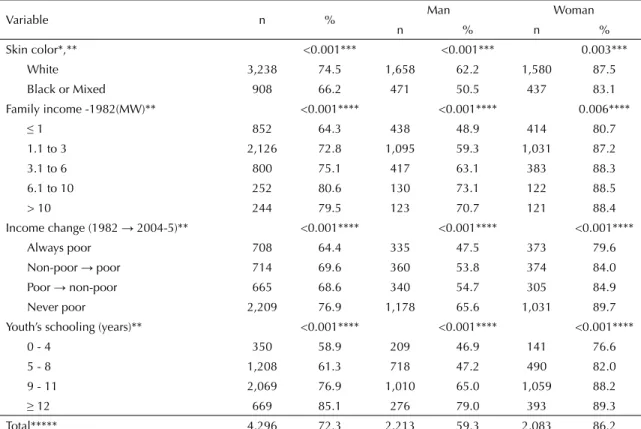
Health service utilization was more frequent among White youths with family income between 6.1 and 10 minimum wages in 1982, as well as those who were classifi ed as poor in 1982 or 2004-5. Lower proportion of medical visits at the age of 23 was observed among youths who had been born with low weight, but this difference was not statistically signifi cant. The visit to a health professional was more frequent among youths who completed high school (Table 1).
Table 1. Prevalence of health service utilization by young adults according to sociodemographic variables. Pelotas, Southern Brazil, 1982 to 2004-5.
Variable n % Man Woman
n % n %
Skin color*,** <0.001*** <0.001*** 0.003***
White 3,238 74.5 1,658 62.2 1,580 87.5
Black or Mixed 908 66.2 471 50.5 437 83.1 Family income -1982(MW)** <0.001**** <0.001**** 0.006****
≤ 1 852 64.3 438 48.9 414 80.7
1.1 to 3 2,126 72.8 1,095 59.3 1,031 87.2
3.1 to 6 800 75.1 417 63.1 383 88.3
6.1 to 10 252 80.6 130 73.1 122 88.5
> 10 244 79.5 123 70.7 121 88.4
Income change (1982 → 2004-5)** <0.001**** <0.001**** <0.001****
Always poor 708 64.4 335 47.5 373 79.6
Non-poor → poor 714 69.6 360 53.8 374 84.0 Poor → non-poor 665 68.6 340 54.7 305 84.9 Never poor 2,209 76.9 1,178 65.6 1,031 89.7 Youth’s schooling (years)** <0.001**** <0.001**** <0.001****
0 - 4 350 58.9 209 46.9 141 76.6
5 - 8 1,208 61.3 718 47.2 490 82.0
9 - 11 2,069 76.9 1,010 65.0 1,059 88.2
≥ 12 669 85.1 276 79.0 393 89.3
Total***** 4,296 72.3 2,213 59.3 2,083 86.2
MW: Minimum wage
* 150 interviewees self-classifi ed themselves as yellow or Indians
** Of 4,297 interviewees in 2004-5 there was lack of information for up to 23 people (0.5% of the interviewees) *** Chi-square test for heterogeneity
**** Chi-square test for linear tendency
Table 1 shows that the results of the association between the independent variables and health services utilization according to the sex of the interviewee were similar to what had been observed for the entire group.
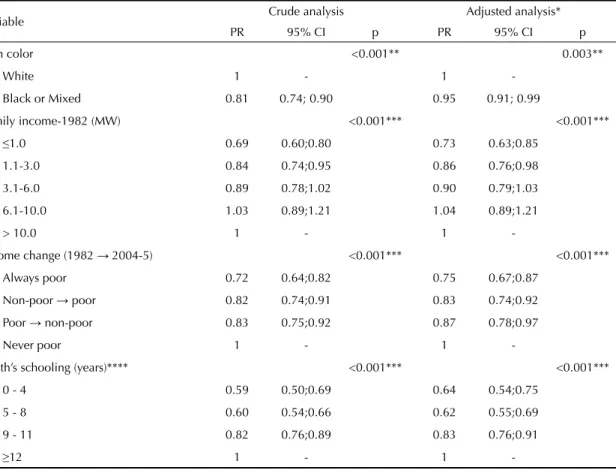
In the adjusted analysis, Black and Mixed men and those who were poor in 1982 and 2004-5 attended less visits in the year before the interview. Health services utilization was directly proportional to the increase in the youth’s schooling (Table 2).
Women’s results were similar to men’s regarding fam-ily income, income change and youth’s schooling. On the other hand, in the adjusted analysis, no relation was observed between skin color and the proportion of women who attended visits in the year before the interview (Table 3).
When the type of professional that was visited was ana-lyzed according to family income and interviewee’s sex, it was observed that the proportion of visits to general practitioners was similar across the different groups
of family income. On the other hand, the proportion of visits to specialists was four times bigger among the men who belonged to the highest income group, compared to those of lowest family income in 1982. Visits to psychiatrist, psychologist and nutritionist were less frequent among men and differed regarding family income, as the proportions of visits to these professionals were higher among youths with higher family income (Figure 1).
Figure 1 shows that the proportion of visits to gen-eral practitioners decreased with the increase in the women’s family income, and, inversely, there was an increase in the proportion of visits to other specialists according to the increase in income. Concerning visits to gynecologists, the proportions were similar across the distinct groups of family income. Similarly to what was observed among men, the proportions of visits to psychiatrists, psychologists and nutritionists were lower than 10% in all groups, achieving 10% only among women from the highest family income groups.
Table 2. Crude and adjusted analyses of the independent variables about health services utilization among male youths. Pelotas, Southern Brazil, 1982 to 2004-5.
Variable Crude analysis Adjusted analysis* PR 95% CI p PR 95% CI p
Skin color <0.001** 0.003**
White 1 - 1
-Black or Mixed 0.81 0.74; 0.90 0.95 0.91; 0.99
Family income-1982 (MW) <0.001*** <0.001***
≤1.0 0.69 0.60;0.80 0.73 0.63;0.85
1.1-3.0 0.84 0.74;0.95 0.86 0.76;0.98
3.1-6.0 0.89 0.78;1.02 0.90 0.79;1.03
6.1-10.0 1.03 0.89;1.21 1.04 0.89;1.21
> 10.0 1 - 1
-Income change (1982 →2004-5) <0.001*** <0.001***
Always poor 0.72 0.64;0.82 0.75 0.67;0.87
Non-poor → poor 0.82 0.74;0.91 0.83 0.74;0.92
Poor → non-poor 0.83 0.75;0.92 0.87 0.78;0.97
Never poor 1 - 1
-Youth’s schooling (years)**** <0.001*** <0.001***
0 - 4 0.59 0.50;0.69 0.64 0.54;0.75
5 - 8 0.60 0.54;0.66 0.62 0.55;0.69
9 - 11 0.82 0.76;0.89 0.83 0.76;0.91
≥12 1 - 1
-MW: Minimum wage
* First level variables (skin color and family income in 1982) were adjusted among themselves and maintained in the analysis model with p<0.2. Income change was adjusted for skin color.
** Wald test for heterogeneity *** Wald test for linear tendency
As for the type of health service used, men and women attended visits more frequently in the public system, in the health plan system and, in a lower proportion, in the private system. Proportionally, the men attended more visits in the private system than the women (Figure 2).
The analysis of the type of health service used in the year before the interview according to change in family income also indicated differences between the catego-ries. The utilization of the public system predominated among approximately half of the interviewees classifi ed in the category middle or high income. This category also contained the largest proportions of utilization of the private services and health plan systems (Figure 3).
In each type of analyzed service, public, private or health plan system, a utilization gradient was observed according to the category of income change. For exam-ple, the percentage of 3.1% of those who always were in the lower category of income and used the private services rose to 8.9% among those who descended from the middle or upper category to the lower one, rose to 11% among those who ascended from the lower cat-egory in 1982 to the middle or upper catcat-egory in 2005,
until it achieved 12.3% among those who were always classifi ed in the middle or upper category. The income change gradients were also observed in the public system. For example, while 83.3% of the interviewees who always were in the low category of income used the public system, the percentage was 67 among those who descended, decreasing to 61.6% among those who ascended from the low category in 1982 to the middle or upper category in 2004-5, achieving 50.0% among those who were always classifi ed in the middle or up-per categories. The up-percentage of utilization of health plan systems also showed differences according to the categories of income change (Figure 3).
DISCUSSION
Youths tend to suffer accidents, violence and have problems deriving from the consumption of licit or illicit drugs. Data from Sistema de Informações de
Mortalidade (Mortality Information System) reveal
that in the state of Rio Grande do Sul, 2,390 individu-als between 20 and 29 years of age died in the year 2000. Of these, 1,416 (59.2%) deaths were classifi ed as
Table 3. Crude and adjusted analyses of the independent variables about health services utilization among female youths. Pelotas, Southern Brazil, 1982 to 2004-5.
Variable Gross analysis Adjusted analysis*
PR CI 95% p PR CI 95% p
Skin color 0.03** 0.11**
White 1 1
Black or Mixed 0.95 0.91; 0.99 0.96 0.92; 1.01
Family income-1982 (MW) 0.006*** 0.03***
≤1.0 0.91 0.84;0.99 0.93 0.86;1.01
1.1-3.0 0.99 0.92;1.06 1.00 0.93;1.07
3.1-6.0 1.00 0.93;1.07 1.00 0.93;1.08
6.1-10.0 1.00 0.91;1.10 1.00 0.92;1.10
>10.0 1 - 1
-Income change(1982 → 2004-5) <0.001*** <0.001***
Always poor 0.89 0.84;0.94 0.90 0.85;0.95
Non-poor → poor 0.94 0.89;0.98 0.94 0.89;0.99
Poor → non-poor 0.95 0.90;1.00 0.96 0.91;1.01
Never poor 1 - 1
-Youth’s schooling (years) <0.001*** 0.003***
0 - 4 0.90 0.80;1.00 0.89 0.80;0.98
5 - 8 0.90 0.90;1.00 0.94 0.88;1.00
9 - 11 1.00 0.90;1.00 0.99 0.95;1.04
≥ 12 1 - 1
-MW: Minimum wage
* First level variables (skin color and family income in 1982) were adjusted among themselves and maintained in the analysis model with p<0.2. Income change was adjusted for skin color.
** Wald test for heterogeneity *** Wald test for linear tendency
a Ministério da Saúde. Secretaria de Vigilância à Saúde. Sistema de Informações sobre mortalidade [internet]. Brasília; 2007. [accessed on 2007 Mar 10]. Available from: http://tabnet.datasus.gov.br/cgi/idb2007/matriz.htm#mort
external causes of morbidity and mortality. In no other age group, during the year 2000, deaths due to external causes had the same importance. The sex-stratifi ed analysis showed that of the 1,416 deaths due to external causes, 1,271 (89.7%) were of men. Even though the predominance of violent deaths among men is evi-dent, external causes are also the main cause of death among women, reaching 27% in the age group 20-29 years.a In the present study, external causes are one of the fi ve main reasons for visits to the health services. However, in Brazil, morbimortality in this age group is very low compared to the others and there are differ-ences in the offer of health services to women and men. Thus, there are no specifi c health programs targeted at
the male population, while women can benefi t from health interventions such as prenatal visits, prevention of gynecologic cancer and family planning. Even in a population of young adults, who are less likely to have diseases, the results of the present study showed that the women attended more visits than the men.
The comparison of the percentages of health services utilization between the population of the Pelotas cohort and another national study revealed differences. Data from Pesquisa Nacional por Amostra de Domicílios
(PNAD – National Survey by Household Sampling), carried out in 1998 by Instituto Brasileiro de
Geogra-fi a e Estatística (Brazilian Institute of Geography and
Statistics), showed that 36% of the men and 56.1% of
Figure 1. Specialization of the visited health professional according to family income in 1982 among youths. Pelotas, Southern Brazil, 1982 to 2004-5.
General
practitioner Other specialist Gynecologist Psychologist Psychiatrist Nutritionist
Family income in 1982 (minimum wages) 0
10 20 30 40 50 60 70
≤1 1,1 to 3 3,1 to 6 6,1 to 10 >10
% interviewees
Women
Family income in 1982 (minimum wages) 0
10 20 30 40 50 60 70
≤1 1,1 to 3 3,1 to 6 6,1 to 10 >10
% interviewees
Men
Figure 2. Type of health service used in the last year according to the interviewee’s sex. Pelotas, Southern Brazil, 1982 to 2004-5.
Men
Health plan 41.4%
Public 42.4% Private
16.2%
Women
Health plan 35.1%
Public 55.5% Private
the women between 15 and 24 years of age, residing in urban zones in Brazil, had attended a medical visit in the last 12 months.10 Thus, by means of the confi dence intervals, it was verifi ed that both the men and the women from the cohort obtained a percentage of visits that was higher than the one found in the country.
Studies about health services utilization can contribute to the organization of assistance, since they allow to establish levels of coverage and to identify excluded population groups. The attributes, for example, that defi ne the quality of health services from the collective point of view are: easy access, equitable distribution of care and effective care at a fi nancial cost that is af-fordable to society.2
The Federal Constitution institutes that the National Health System must offer universal, integral, equitable care and that services must be organized regionally and hierarchically. Both defi nitions are similar regarding easy access and equitable care.
The analysis per type of professional showed differ-ences mainly in relation to access to the medical special-izations by people with higher income. Nevertheless, there is evidence that shows that, for common specifi c diseases, the care provided by general practitioners are as good as that provided by specialists, and even bet-ter when the quality measures (for example, the ones that produce an impact on prevention) are generic. For less common conditions, the care offered by general practitioners with the support of specialists can be bet-ter. However, for rare situations the care provided by specialists is indispensable.13 Thus, this fi nding may be explained by the diffi culty in having access to certain specializations and by cultural factors of better care judgment on the part of the user.
In the adjusted analysis of the present study, the results confi rmed that the socioeconomic situation evaluated by means of income change had an effect on health services utilization in the last year, both in men and in women. The existence of differences between these socioeconomic variables may indicate diffi culties in having access to the health system, which is surprising in view of the offer of health services in Pelotas. The primary care coverage in Pelotas has been established since the 1980s, and has the participation of units of the Municipal Health Department, of the State Health Department and of two universities. A population-based study about the outpatient health service utilization by the adult population of Pelotas in 1992 presented high average of visits (3.0 visits per inhabitant/year).5 Such analysis did not show differences concerning the average number of visits between the economic class categories (classifi cation of Associação Brasileiras
de Empresas de Pesquisa - Brazilian Association
of Research Companies) and social class categories (Bronfman’s classifi cation) that represented the so-cioeconomic variables. However, the study showed signifi cant differences between types of health services and socioeconomic categories. Among the individuals who attended visits in the last three months, 30% used the health plan systems, 29% used the public system and 41% the private system or philanthropic services.5 In 2004, the public health network in Pelotas compre-hended 56 basic health units - approximately 30% of the units offered by Programa Saúde da Família (Family Health Program) -, besides insurance system health services. In almost all the municipality’s neighborhoods and communities, there are public health services, which could justify high percentages of visits in all categories of the income change variable.
The equity principle presupposes that the populations that are most vulnerable socially or that present recog-nized risks to health should have priority in treatment.19 Equity is based on the assumption that the individuals are different; therefore, they deserve different treatment that eliminates or reduces inequality. Studies conducted in Pelotas have revealed lack of equity in health.11,12 However, we observe that the differences due to the socioeconomic situation for certain actions tend to decrease as less disadvantaged individuals achieved larger coverage. The inequities decrease when the richer individuals obtain new minimum levels for the coverage indicators, and then the poor start to have larger access to interventions.17 Therefore, the fi nding concerning the reduction in access observed among men and women who are “poor at the moment” may suggest lack of equity for population groups, and consequently, the need to reorganize the health services.
Figure 3. Type of health service used according to family income change. Pelotas, Southern Brazil, 1982 to 2004-5.
0 10 20 30 40 50 60 70 80 90 100
Always poor
Non poor - poor
Poor - non poor
Never poor %
1. Barros FC, Victora CG, Horta BL, Gigante DP. Metodologia do estudo da coorte de nascimentos de 1982 a 2004-5, Pelotas, RS. Rev Saude Publica.2008;4 2(Supl.2):7-15.
2. Campbell SM, Roland MO, Buetow SA. Defi ning quality of care. Soc Sci Med.2000;51(11):1611-25. DOI: 10.1016/S0277-9536(00)00057-5
3. César JA, Matijasevich A, Santos IS, BarrosA JD, Dias da Costa JS, Barros FC, et al. Utilização de serviços de saúde materno-infantis em três coortes de base populacional no sul do Brasil, 1982-2004. Cad Saude
Publica. 2008; 24(Sup 3): 427-436.
4. Costa JSD, Victora CG, Barros FC, Halpern R, Horta BL, Manzolli P. Assitência médica materno-infantil em duas coortes de base populacional no Sul do Brasil: tendências e diferenciais. Cad Saude
Publica.1996;12(Supl 1):S59-66. DOI:
10.1590/S0034-89101997000400005
5. Costa JSD, Facchini LA. Utilização de serviços ambulatoriais em Pelotas: onde a população consulta e com que freqüência? Rev Saude Publica. 1997;31(4):360-9.
6. Hart JT. The inverse care law. Lancet. 1971;1(7696):405-12.
7. Halpern R, Barros FC, Victora CG, Tomasi E. Atenção pré-natal em Pelotas, Rio Grande do Sul, Brasil, 1993.
Cad Saude Publica. 1998;14(3):487-92. DOI: 10.1590/
S0102-311X1998000300004
8. Marmot M. Health in an unequal world. Lancet.
2006;368(9552):2081-94. DOI: 10.1016/S0140-6736(06)69746-8
9. Mendoza-Sassi R, Béria JU, Barros AJD. Outpatient health service utilization and associated factors: a population-based study. Cad Saude Publica. 2003;37(3):372-8.
10. Pinheiro RS, Viacava F, Travassos V, Brito AS. Gênero, morbidade, acesso e utilização de serviços de saúde
no Brasil. Cienc Saude Coletiva. 2002;7(4):687-707. DOI: 10.1590/S1413-81232002000400007
11. Quadros CA, Victora CG, Costa JSD. Coverage and focus of a cervical cancer prevention program in southern Brazil. Rev Panam Salud Publica.
2004;16(4):223-32. DOI: 10.1590/S1020-49892004001000001
12. Sclowitz ML, Menezes AMB, Gigante DP, Tessaro S. Condutas na prevenção secundária do Câncer de Mama e fatores associados. Rev Saude
Publica. 2005;39(3):340-9. DOI:
10.1590/S0034-89102005000300003
13. Starfi eld B, Shi L, Macinko J. Contribution of primary care to health systems and health. Milbank Q. 2005;83(3):457-502. DOI: 10.1111/j.1468-0009.2005.00409.x
14. Travassos C, Novaes HMD. Investigação e avaliação em serviços de saúde [editorial]. Cad Saude Publica. 2004; 20 (Supl 2):S144-5.
15. Travassos C, Viacava F, Pinheiro R, Brito A. Utilização dos serviços de saúde no Brasil: gênero, características familiares e condição social. Rev Panam Salud Publica.
2002;11(5/6):365-73.
16. Victora CG, Barros FC, Vaughan JP. Epidemiologia da desigualdade. São Paulo: Hucitec; 1989.
17. Victora CG, Vaughan JP, Barros FC, Silva AC, Tomasi E. Explaining trends in inequities: evidence from Brazilian child health studies. Lancet. 2000;356(9235):1093-8. DOI: 10.1016/S0140-6736(00)02741-0
18. Victora CG, Barros FC. Cohort profi le: the 1982 Pelotas (Brazil) birth cohort study. Int J Epidemiol.
2006;35(2):237-42. DOI: 10.1093/ije/dyi290
19. Victora CG, Barros FC, Lima RC, Behague DP, Gonçalves H, Horta BL, et al. The Pelotas birth cohort study, Rio Grande do Sul, Brazil, 1982-2001. Cad
Saude Publica. 2003;19(5):1241-56. DOI: 10.1590/
S0102-311X2003000500003
REFERENCES
This article is based on data from the study “Pelotas birth cohort, 1982” conducted by Postgraduate Program in Epidemiology at Universidade Federal de Pelotas.
The 1982 birth cohort study is currently supported by the Wellcome Trust initiative entitled Major Awards for Latin America on Health Consequences of Population Change. Previous phases of the study were supported by the International Development Research Center, The World Health Organization, Overseas Development Administration, European Union, National Support Program for Centers of Excellence (PRONEX), the Brazilian National Research Council (CNPq) and Brazilian Ministry of Health.
This article underwent the same peer review process as for other manuscripts submitted to this journal. Both authors and reviewers are guaranteed anonymity. Editors and reviewers declare that there are no confl icts of interest that could affect their judgment with respect to this article.