DEVELOPING SUSTAINABLE AND REPLICABLE WATER SUPPLY SYSTEMS IN
RURAL COMMUNITIES IN BRAZIL
In Press at The International Journal of Water Resources Development
Authors:
Francisco Osny Enéas da Silva(1) Tanya Heikkila (2)
Francisco de Assis de Souza Filho (3) Daniele Costa da Silva (4)
(1) Professor of Civil Engineering, University of Fortaleza, State of Ceará, Brazil
(2) Corresponding Author: Associate Professor, School of Public Affairs, 1380 Lawrence Street, Suite 500, University of Colorado-Denver, Denver, CO 80217 USA,
[email protected] phone: 303-315-2269
DEVELOPING SUSTAINABLE AND REPLICABLEWATER SUPPLY SYSTEMS IN
RURAL COMMUNITIES IN BRAZIL
Abstract
This article examines the challenges and opportunities for developing rural water supply programs that can meet multiple sustainability criteria, including social, technical/administrative and environmental criteria, and can be replicated beyond individual communities. It draws lessons from a water supply development project in Northeast Brazil, identifying how environmental and community assessments, community engagement in planning, as well as training, capacity building, and monitoring can help meet sustainability criteria. The article further explores how an institutionalized planning process and partnerships with public agencies and donors are integrated into the project design to support replicability.
INTRODUCTION
One of the United Nation’s 2000 Millennium Goals (MDG’s) is to increase the
proportion of the world’s population that has access to safe drinking water and basic sanitation
(United Nations, 2010). While the international community has made advancements toward this goal over the past decade, progress in rural areas is lagging relative to urban areas (United Nations, 2011). Worldwide, 80 percent of the people who have limited access to drinking water supplies live in rural areas (United Nations, 2010). Even where rural supply systems are developed, many are in disrepair or not functioning properly (Brikke and Bredero, 2003; Moe and Rheingans, 2006; RWSN, 2012).
Various factors may contribute to the difficulty in developing sustainable rural water supply systems. For instance, rural communities are likely to be less capable of achieving economies of scale in water supply and treatment (State of Ceará, 2009). At the same time, households and businesses in rural areas may have more limited capacity than wealthier urbanites to raise the capital needed for water infrastructure, or they may lack the technical expertise needed to operate and maintain water systems. In rural areas that are arid or subject to hydrologic variability, reliable water supply systems may require more energy intensive infrastructure (e.g. to access and deliver distant surface or groundwater sources or to allow for multi-season or multi-year storage), which can add to the financial and technical difficulties facing these communities.
settings. The framework we present initially was implemented and tested in the state of Ceará, in Northeast Brazil between 2008 and 2011. The region is representative of many of the challenges facing rural, semi-arid regions around the world. On average, the rural interior of the state receives between 400 and 800 millimeters of rainfall per year, most of which comes in the rainy season between February and May. About 35% of Ceará’s 8.5 million residents live in rural areas (State of Ceará, 2009), and on average the incomes of rural communities in this region are 50% percent lower than urban areas (Kassouf, 2005). Approximately 19% of the rural population in Ceará lacks access to safe and reliable drinking water supplied to their homes (State of Ceará, 2009).
A number of efforts have been undertaken to establish rural water supply systems in Ceará – most of which emerged since Brazil’s shift to democracy in 1988. Some examples include the Integrated Rural Sanitation System (SISAR), created in 1991 with financial support from the German government and the state government of Ceará (Global Water Partnership, 2012); the São José Project, organized by the State of Ceará with funding from the World Bank to improve the living conditions, including water supply, of poor rural families in Ceará (Binswanger-Mkhize & Eugenius van den Brink, 2009); and the federal government’s program
known as “Training and Social Mobilization for Coexistence in the Semi-Arid: One Million
Rural Cisterns”, which began in July 2003 to provide rural populations with clean water for
drinking and cooking (Gnadlinger, 2003). Despite these efforts, the state still lacks universal access to reliable and safe drinking water and where water supply systems have been developed, they are often unsustainable (State of Ceará, 2010).
components of the framework, which include criteria for sustainable rural water supply systems, as well as mechanisms that support replication of rural water supply projects across multiple communities. We conclude by identifying opportunities and challenges for applying the framework beyond Ceará, Brazil.
A FRAMEWORK TO ADDRESS THE CHALLENGES OF RURAL WATER SUPPLY Multiple Sustainability Criteria
Since the 1990s, with increased recognition of the poor performance and periodic failures of water supply development projects around the world, academics and practitioners have become concerned with understanding the factors that support sustainable rural water supply systems (e.g. see Serageldin, 1994; Katz & Sara, 1997; Kleemeier, 2000). In general, the endurance of a water supply system, as well as the system’s ability to adapt to changing consumer needs or preferences for water quality and quantity, are defining features of water system sustainability (Carter, Tyrell & Howsam, 1999). In this paper, we argue that various interrelated criteria underlie these features of sustainable water supply systems, as depicted below in Figure 1.
[INSERT FIGURE 1 ABOUT HERE]
extent this is because communities engaged in the planning process are more likely to select supply options that they are willing and able to operate and maintain (Montgomery, Bartram & Elimelech, 2009). This is not to suggest that the process must be entirely community-driven;
“polycentric” approaches that engage the private sector, government actors and communities
together can work (Falk, Bock & Kirk, 2009). Successful community engagement goes beyond mere consultation. At a very basic level, it may even start with the community coming to a shared understanding of water as a vital resource for a community’s health and growth (Nayar & James, 2010). It can also include dialogue with the community to explore ideas about infrastructure options, ascertain the community’s preferences for service levels, and clarify the
community’s preferences and responsibilities for financing, operations and maintenance (Katz
and Sara, 1998). Since community members may not quickly or readily agree upon preferred alternatives, successful engagement may also require facilitation and conflict resolution (Gleitsmann et al., 2007).
organizational bodies capable of making decisions about water management and administration. At the same time, active communication by local leaders with community members regarding the planning and operations of a water system can help engender the trust that is essential for social capital building (Montgomery et al., 2009).
In addition to social factors, the technical, administrative, and financial capacities to ensure a system operates effectively over time and at a reasonable cost are important criteria for sustainable rural water supply systems (Harvey & Reed, 2004). Technical capacity depends on the availability of equipment for operating the system, people who can be trained to operate equipment, and the quality of construction of the system (Katz & Sara, 1998). Additionally, sustainable systems are more likely to be found where communities and project operators have adequate administrative and financial capacity for system operations and maintenance (Montgomery et al., 2009). Technical, administrative and financial capacities are not independent from the social factors previously discussed. For instance, the presence of social capital, via prior organizational experience, can make it easier for communities to devise rules for ongoing operations and system administration. At the same time, community engagement in the planning process can contribute to training and skill building that might be needed for technical capacity. Still, communities may not always have the technical capacity on their own for extensive system repairs and maintenance (Kleemeier, 2000). Thus, external technical support needs to be available to help communities maintain and monitor system performance (Gelting & Ortolano, 1998; Lockwood, 2002).
deteriorate the quantity and quality of source water or the ecosystems surrounding it (Carter et al., 1999; Serageldin, 1994). With respect to the first feature, we note that infrastructure choices must be balanced against the other criteria of sustainability, both technical and social. This is because community preferences and technical capacity may not always match the type of system that may be deemed optimal for a given climate or location. In terms of the second feature, we recognize that the environmental impacts or potential degradation of a water source in rural communities are likely to be much lower than in urban settings. However in semi-arid regions, such as Northeast Brazil, the limited availability of freshwater supplies requires attention to the potential for any new system to degrade or overuse those supplies.
Finding Replicable Approaches that Meet Sustainability Criteria
It may be difficult to identify a single design or model for a water supply system can meet all of these criteria across multiple communities. A wide range of technical, institutional, and management options might be deemed appropriate, depending upon the environmental
context of the rural community, as well as the community’s social, technical, administrative and
financial capacity. Therefore, as presented in Figure 1, one of the criteria for project replication is a planning procedure that can accommodate diverse and locally-tailored options. A diversity of options would be important not only for the water supply infrastructure, but also for the financing and management of the infrastructure.
local resource constraints, may allow project sponsors to work with or transfer the approach to community-based organizations, contractors, and government agencies that may be involved in project expansion. Given the diversity of actors who may be involved, it also may be necessary to build common support structures among participants and to institutionalize a shared planning process among them (Lockwood, 2004). Institutionalizing the experiences of the different actors involved in project replication through training and knowledge building may also be essential (Uvin and Miller, 1996; Uvin, Jain and Brown, 2000).
THE RURAL WATER SUPPLY PROJECT IN CEARÁ
because they had the highest percentage of homes lacking access to water supply systems or infrastructure.
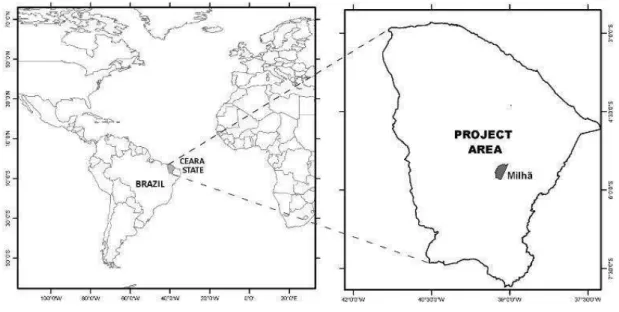
[INSERT FIGURE 2 ABOUT HERE] [INSERT TABLE 1 ABOUT HERE]
The CWC-UFC project team developed two demonstration systems within the Milhã municipal district. One involved the design and construction of a new water supply system in the small community of Ingá (13 families). The second involved expanding an existing water supply distribution system, previously implemented under a government program, which connected three small communities (115 families) in Milhã: Pedra Fina, São João, Transval e Valentim dos Sabinos. The CWC-UFC team designed and participated in the planning, implementation, and monitoring of the projects. The infrastructure for these demonstration projects were built with funds from the CWC-UFC research project, which was supported by a grant from the PepsiCo Foundation. The team worked with a local contractor in the Milhã municipal area to construct the infrastructure. In addition to the demonstration systems installed in the selected communities in Milhã, the project team incorporated the data and information from the project assessment and planning phase, which included a community engagement and survey effort (described in more detail below), to develop a Municipal Water Plan for the entire municipal district of Milhã, as
well as a “Manual of Best Technology Practices”. Both the Municipal Water Plan and manual
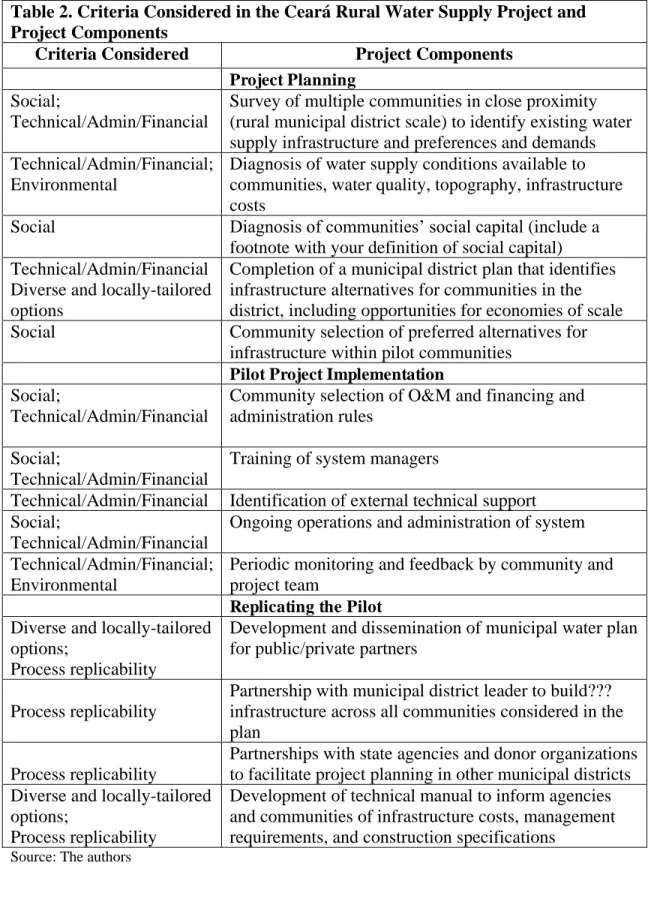
were intended to aid in the replication of the pilot project. Below we describe the details of the project planning and implementation and how the project meets the criteria for sustainability and replicabiilty (also summarized in Table 2).
Project Planning Process
The first step in the project planning process was to conduct an assessment of the current water supply methods used or available in the central region of Ceará (focusing on the three municipal districts previously mentioned), through surveys of the communities. These surveys, conducted in 2008 and early 2009, found that the commonly used supply methods include small wells, rainwater collection, and surface water collection by individual households (e.g. carrying water in barrels from nearby ponds or small reservoirs, or relying on trucked delivery of water collected from distant reservoirs), and small reservoirs. The surveys also examined the effectiveness of these measures, as well as potential interest in alternative methods of capture, distribution and treatment. For instance, community members reported that one common water supply distribution method in rural areas - government-sponsored water trucks that distribute water collected from reservoirs -- has caused public health problems because the water is often untreated. Similarly, communities are dissatisfied with wells as a water supply source because the highly saline groundwater in this region is either nonpotable or requires expensive treatment. Rainwater collection through cistern tanks, another common approach, was reported to be inadequate to supply water for an entire year and susceptible to leakage. During the project planning phase, residents further expressed their desire for systems that allow for flexibility, given that most rainwater is available during a short period of the year, and that the area is subject to periodic droughts.
source water and an in-depth understanding of 1) the topography of the area from water sources to the communities, which affects the costs of the energy needed for pumping; 2) the local geology and road networks that influence selection of pipeline pathways; and 3) land-tenure/ownership and rights of way. This assessment further helped the project team consider environmental criteria, as well as technical and administrative needs for the pilot area. To complement this diagnosis, the research team interviewed community members and leaders of the local community association. The interviews were designed to assess the social capital in the communities in Milhã, specifically their experience and knowledge with managing community-level supply systems and their activity and membership within community associations (created in order for community members to receive benefits and incentives of government programs designed to alleviate rural poverty).
During the meetings, the research team provided design specifications, cost considerations, and water treatment requirements for different supply options in detail to the communities. In response to the discussions at the earlier meetings, the project team developed alternative designs that were discussed later on. One of the water supply options discussed with the community was to link water supply infrastructure between Ingá and Pedra Fina (and its two neighboring villages) to achieve economies of scale and reduce the costs of operation and maintenance for the communities served by the system. Connecting the communities to a municipal system (via a major pipeline) and to an integrated regional system (via pipelines between several municipalities) were also considered. While individual household options were not preferred by the pilot communities, they also decided not to have a system that connected the two communities. Instead Ingá decided to establish its own community system. Pedra Fina and its two neighboring communities, which already had a partially existing system, decided to expand their system and add water treatment infrastructure to the system.
In summary, the planning stages of the project included mechanisms to meet the social criteria for sustainability through community engagement. Also by considering community preferences, physical conditions, and social capital in the design of the project, the project team was better equipped to ensure that the project could meet the technical and environmental criteria of sustainable water supply systems.
Project Implementation
During the implementation phase of the project, which began in late-2010, additional steps were undertaken to support project sustainability. First, both communities worked together through their community associations to decide on rules and procedures for managing project operations and financing, which helped build social capital in the communities. For both projects, the community members entrusted the leadership of the Pedra Fina and Ingá community associations to manage day-to-day system operations, which provided administrative capacity. Additionally, to support technical capacity the research team provided training on the operation of the supply systems in the two pilot locations. This involved instruction on the operation of pumps, regulators and valves in treatment stations and the distribution network.
institution or office that could provide technical assistance to rural supply systems. This is a model that has worked with larger-scale systems built through the state’s SISAR program, but has not yet been applied to small rural communities.
In terms of the financing of operations and maintenance, the communities involved in the pilot projects decided on their own how to allocate costs and administer payments. Monitoring of water meters and collection of payments is undertaken by a community association member. Prior to this decision, the project team discussed likely operations and maintenance costs of the selected infrastructure, so expected total monthly and episodic costs of electricity, supplies, and labor were understood. Alternatives to self-financing are available, such as subsidies from the municipal district or from the federal program that pays for barrel trucks to deliver drinking water to rural communities. However, as recognized in the water development literature, self-financing can support sustainability because it can build community and administrative capacity. The fee implemented in both communities is about $6.00 per household per month. In the integrated system (Pedra Fina and its two neighbors), this charge covers up to 10,000 liters of water and any usage that exceeds this amount is charged on a per liter basis. In a follow-up survey, a couple of households reported paying up to $30 per month because they use water for agricultural purposes. In the community of Ingá, the charge is fixed at about $6.00 per household per month regardless of usage. For both projects the communities have successfully covered the costs of operating the system (including energy costs and treatment), one year after implementation. They also have saved funds that can pay for replacement of depreciated equipment when needed.
research, community members expressed concerns that when leaders for some reason leave the community, a power vacuum or conflicts between members of the community can emerge that threaten the success of the project. There is also the possibility of opportunist leadership among individuals wanting to be in charge of the community associations, who then have no interest in maintaining the system.
Given that both the social and climatic conditions can change in the communities over time, the research team recognized that infrastructure design and operations may need to be adapted over time. Thus, this project includes monitoring and project evaluation that are conducted by local community members and project staff together. Project staff meets with and interviews community members every three to six months to discuss system performance, review any problems identified by the community members and provide technical advice when operational, maintenance, or financing issues arise. These findings are made available to project funders and state government partners in order to provide evidence of possible pitfalls and areas for adaptation and improvement.
new filtration system and modified the pump location in Ingá, in response to these concerns. The modifications did not add to the costs of operations and maintenance for the community. One of the challenges with implementation that has arisen in Ingá stems from their choice to have fixed, rather than variable fees for water use. The community association has reported that one family had begun to use the system for livestock watering, rather than just household consumption and thus their usage far exceeds other community members. The community association recognized it needs to tailor the fees or set rules on the types of uses deemed appropriate for the household supply system.
Project Replication and Expansion
The ultimate success of developing water supply infrastructure for rural communities depends not only on the long term sustainability of the system, but the ability to replicate the project so that other communities can be served as well. Replicating a project in other locations requires tools for analyzing and identifying diverse, locally-tailored options, as well process replication mechanisms.
To meet the criteria for replication, the project team first created and disseminated a
“Municipal Water Plan” or Plano das Agues Municipals (aka PAM), which shows how the
To devise a Municipal Water Plan, the team used the data from the initial assessment conducted in the municipal district of Milhã, prior to the pilot infrastructure projects. The data included the water supply demands, the quality and quantity of the available water sources for all of the small communities in the district, and indicators of social capital in these communities, such as the existing community associations. These data were used to recommend options for new water infrastructure in the communities, including options at local, regional and municipal levels and alternative management and financing models to support these systems.
The project team also engaged with government actors and donors to facilitate the project replication process. This included partnering with the Milhã mayor to identify ways to implement water supply infrastructure from the Milhã Municipal Water Plan in the other communities that were not part of the pilot study. It also involved working closely with the Ceará Secretary of Agriculture’s staff, which has been engaged in the Sao Jose project (aimed at assessing needs and helping fund new water infrastructure in Ceará) to support the Milhã Mayor and to identify opportunities for replicating the Municipal Water Plan process in other rural municipal districts. These efforts have fostered additional linkages between the project and possible funders, including development banks such as the Banco do Nordeste do Brasil (Brazilian Northeast Development Bank), who can then work with the state in replicating project planning and implementation. Finally, as mentioned previously, the project team created a technical manual that provides detailed information on diverse water supply infrastructure design specifications, costs, and reliability for the rural semi-arid region of northeast Brazil.
district, in 2010 the Mayor of Milhã was able to begin planning water infrastructure projects across Milhã, with the support of the State. In 2011 infrastructure was completed in three other Milhã communities beyond the initial two pilot locations, serving over 1,200 people.1
Beyond Milhã, the efforts to engage with the Secretary of Agriculture’s office and potential funders resulted in support for Municipal Water Plans in two other municipal districts -- Senador Pompeu and Deputado Irapuan Pinheiro - where the project team conducted initial scoping and community assessments. (The Total population in the 3 municipal districts is 48,626). To extend these efforts, the state government has begun a process for municipal water plans in 24 additional municipalities in Ceará.
DISCUSSION AND CONCLUSIONS
Developing water supply systems for small communities dispersed in rural areas, especially in semi-arid regions, is an increasing challenge due to the need to meet multiple sustainability criteria – including social, technical/administrative/financial, and environmental – as well as ensure that projects can be replicated To date, actions taken by public authorities and donors have not been able to adequately meet this challenge in Northeast Brazil, as in many rural areas in developing regions of the world. Our research and analysis of a planning and water supply demonstration project in rural areas in the state of Ceará Brazil identified a framework for meeting multiple sustainability criteria, while also creating opportunities for replication.
with community association members. This participation in the planning stage addressed the social criteria for sustainable water supply systems. At the same time, technical and environmental dimensions of sustainability were addressed through analyses of the available water supply sources, alternative infrastructures to deliver those sources, the diverse infrastructure in use and their limitations. During implementation of the pilot infrastructure, the project team undertook a number of steps to promote project sustainability. These included engagement with the community in selecting the rules and procedures for operations, management and financing. These steps also involved training community leaders on operations and creating linkages to external technical support and ongoing monitoring. Given that the long term impacts of the demonstration projects are not yet known, ongoing monitoring of the systems, of community perceptions of water quality and quantity are needed. Such monitoring should include assessing the sustainability of the systems over periods of drought and identifying any long-term impacts the systems may have on social and environmental conditions in the communities.
with the political and administrative capacities needed for replicating the municipal water planning process in other communities in the State.
How effectively this framework can be applied throughout other states in Northeast Brazil and beyond, remains to be seen. Indeed there are likely to be limitations and challenges with this approach, including the initial start-up costs of diagnosing and assessing water supply conditions and community needs in a particular region, the need for trained inter-disciplinary technical staff who can understand the physical, infrastructural, and social systems of rural communities in the region, and the time and effort required for effective and enduring community engagement and monitoring. Additionally, as new water systems are constructed, monitoring by the project staff and technical team becomes more costly and time-consuming. Therefore, more effort is likely to be needed in training communities on monitoring and communication with project sponsors. Related to this issue, project sponsors may need to invest more time than perhaps anticipated on social capital development and community capacity building. Both of the pilot projects were located in communities with some pre-existing community capacity and experience, either from working with existing water supply infrastructure (in the case of one community) or working together on other community issues. Such experience and social capital makes it easier for communities to development management capacity, including new rules needed for governing the new systems.
NOTES 1
REFERENCES
Barnes, R. & Ashbolt, N. (2010). Development of a Planning Framework for Sustainable Rural Water Supply and Sanitation: A Case Study of a Filipino NGO. International Studies of Management & Organization, (40)3, 78–98.
Binswanger-Mkhize, P., Bourguignon, C., & Eugenius van den Brink, R.J. (2002). Agricultural
Land Redistribution: Toward Greater Consensus. Washington D.C.: The World Bank.
Brikke, F. & Bredero, M. (2003). Linking Technology Choice with Operation and Maintenance in the Context of Community Water Supply and Sanitation. Geneva: World Health Organization and IRC Water and Sanitation Centre.
Carter, R. C., Tyrell, S. F. & Howsam, P. (1999). The Impact and Sustainability of Community Water Supply and Sanitation Programmes in Developing Countries. Water and Environment Journal, 13(4), 292-296.
Falk, T.; Bock, B. & Kirk, M. (2009). Polycentrism and poverty: Experiences of rural water supply reform in Namibia. Water Alternatives, 2(1), 115‐137.
Gelting, R.J. & Ortolano, L. (1998). A Model Describing Performance of Rural Drinking Water Systems in Honduras. Water Resources Development, 14(2), 199-215.
Gleitsmann, B. A., Kroma, M. M. & Steenhuis, T. (2007). Analysis of a rural water supply project in three communities in Mali: Participation and sustainability. Natural Resources Forum, 31(2), 142-150.
Global Water Partnership. (2012). Brazil: An innovative management model for rural water supply and sanitation in Ceará State. Case study #411. Retrieved from
Gnadlinger, J. (2003). Rainwater Catchment and Sustainable Development in the Brazilian Semi-Arid Tropics (BSATs) - An Integrated Approach. 11th IRCS Conference, Mexico City. Retrieved from http://www.irpaa.org/publicacoes/files/11thircsc.pdf
Harvey, P., and Reed, R. (2007). Community-managed water supplies in Africa: Sustainable or dispensable? Community Development Journal, 42(3), 365.
Jiménez, A. & Pérez-Foguet, A. (2010). Challenges for Water Governance in Rural Water Supply: Lessons Learned from Tanzania. Water Resources Development, 26(2), 235-248. Kassouf, A.L. (2005). Acesso aos Serviços de Saúde nas Áreas Urbana e Rural do Brasil. Revista
de Economia e Sociologia Rural, 43(1).
Katz, T. & Sara, J. (1998). Making Rural Water Supply Sustainable: Recommendations from a Global Study. UNDP-World Bank Water and Sanitation Program. Washington D.C.
Retrieved from http://www.its.caltech.edu/~e105/readings/rural_water.pdf
Kleemeier, E. (2000). The Impact of Participation on Sustainability: An Analysis of the Malawi Rural Piped Scheme Program, World Development, 28(5), 929-944.
Lam, W. F. (1998). Governing Irrigation Systems in Nepal: Institutions, Infrastructure, and Collective Action. Oakland: CA: Institute for Contemporary Studies (ICS) Press.
Lockwod, H. (2004). Scaling Up Community Management of Rural Water Supply. IRC International Water and Sanitation Centre. Thematic Overview Paper. Mar/2004
Moe, C. & Rheingans, R.D. (2006). Global Challenges in Water, Sanitation and Health. Journal of Water and Health, 4 (Supp1), 41–57.
Nayar, V. & James, A.J. (2010). Policy Insights on User Charges from a Rural Water Supply Project: A Counter-intuitive View from South India. Water Resources Development, 6(3), 403-421.
Ostrom, E. (2000). Social Capital: A Fad or a Fundamental Concept. In Partha Dasgupta and Ismael Serageldin eds. Social Capital: A Multifaceted Perspective (pp. 172-214). Washington, DC: The World Bank.,
Rural Water Supply Network (RWSN). (2012). "Sustainable Rural Water Supplies." Retrieved from http://www.rwsn.ch/prarticle.2005-10-25.9856177177/prarticle.2005-10-26.9228452953State of Ceará (2009). Pacto das Águas. Plano estratégico dos recursos
hídricos do Ceará. INESP.[Water Compact: Strategic plan for water ressources in Ceara.]
Fortaleza, Brazil: Assembléia Legislativa:.
State of Ceará (2010). Caminho das Águas na Rota dos Carros-Pipa. [The path of water in the water truck route.] Coordinated by Mércia Cristina Mangueira Sales. Fortaleza, Brazil: Secretaria do Desenvolvimento Agrario..
United Nations. (2010). The Millennium Development Goals Report 2010. Retrieved from http://www.un.org/millenniumgoals/
United Nations. (2011). The Millennium Development Goals Report 2011 Retrieved from http://www.un.org/millenniumgoals/
Uvin, P., Jain, P.S. & Brown, L.D. (2000). Think Large and Act Small: Toward a New Paradigm for NGO Scaling Up, World Development, 28(8), 1409-1419
Figure 1. A Framework for Sustainable and Replicable Rural Water Supply Systems
Source: The authors
Overarching Sustainability Criteria
Enduring systems that are adaptable in meeting water
quantity and quality needs of the community
Social Criteria
Community support through participation in
project planning, design,
and implementation
Social capital, e.g.
organizational capacity and
shared values for the
system
Technical /Administrative/
Financial Criteria
Quality system design at a low cost
Trained human resources
External support for maintenance/repairs
Rules for O&M, financing and administration
Environmental Criteria
Project is tailored to the climatic conditions and
resource availability
Project does not deteriorate water or
ecosystem quality
Replicability of Projects
Process replicability
Creating planning guidelines and resources for other funders or sponsors
Institutionalizing planning processes, experience and knowledge
Diverse & locally-tailored options
Planning at a scale that allows for consideration of individual,
community, and multi-community
Figure 2. Map of the Project Area
Table 1. Municipal Districts in Ceará Included in Rural Water Supply Study
Municipality Total Population
Urban Population Rural Population Population without Access to
Safe Water Population Population % Population % Population %
Milhã 13,078 5,969 45.6 7,109 54.4 4,275 32.6
Senador Pompeu
26,494 15,715 59.3 10,779 40.7 4,280 16.1
Deputado Irapuan Pinheiro
9,094 4,131 45.4 4,963 54.6 1,910 21.0
Total 48,666 25,815 53.0 22,851 47.0 10,465 21.5
Table 2. Criteria Considered in the Ceará Rural Water Supply Project and Project Components
Criteria Considered Project Components
Project Planning Social;
Technical/Admin/Financial
Survey of multiple communities in close proximity (rural municipal district scale) to identify existing water supply infrastructure and preferences and demands Technical/Admin/Financial;
Environmental
Diagnosis of water supply conditions available to communities, water quality, topography, infrastructure costs
Social Diagnosis of communities’ social capital (include a footnote with your definition of social capital) Technical/Admin/Financial
Diverse and locally-tailored options
Completion of a municipal district plan that identifies infrastructure alternatives for communities in the district, including opportunities for economies of scale Social Community selection of preferred alternatives for
infrastructure within pilot communities Pilot Project Implementation
Social;
Technical/Admin/Financial
Community selection of O&M and financing and administration rules
Social;
Technical/Admin/Financial
Training of system managers
Technical/Admin/Financial Identification of external technical support Social;
Technical/Admin/Financial
Ongoing operations and administration of system Technical/Admin/Financial;
Environmental
Periodic monitoring and feedback by community and project team
Replicating the Pilot Diverse and locally-tailored
options;
Process replicability
Development and dissemination of municipal water plan for public/private partners
Process replicability
Partnership with municipal district leader to build??? infrastructure across all communities considered in the plan
Process replicability
Partnerships with state agencies and donor organizations to facilitate project planning in other municipal districts Diverse and locally-tailored
options;
Process replicability
Development of technical manual to inform agencies and communities of infrastructure costs, management requirements, and construction specifications