Methodological and biological factors
explaining the reduction in dental caries
in Jamaican school children between
1984 and 1995
Rosalie Warpeha,
1Eugenio Beltrán-Aguilar,
2and Ramón Báez
3Objective. To assess the methods used and results found in two surveys, one conducted in 1984 and the other in 1995, that indicated a large reduction in the prevalence and severity of dental caries among children in Jamaica, with special attention focused on methodological dif-ferences between the two surveys and the biological factors that may explain the large reduc-tion in caries.
Methods. In 1984 a modified “pathfinder” methodology was used to measure the prevalence and severity of dental caries in 6-, 12-, and 15-year-old children in Jamaica. A similar survey was conducted in 1995. A comparison of the two surveys showed an 84% reduction in the severity of dental caries at age 12. Both surveys used the same diagnostic criteria and clinical procedures, but the 1984 survey included a higher proportion of rural residents than did the 1995 one.
Results. The data show an epidemiological transition between 1984, when dental caries was highly prevalent and severe, and 1995, when the disease was less prevalent and was concen-trated in a smaller proportion of the population.
Conclusions. Most of the reduction in dental caries between 1984 and 1995 is attributable to the introduction, in 1987, of salt fluoridation. While the 1995 survey included fewer rural areas than the 1984 survey did, that does not invalidate the observed reduction in dental caries. The use of fluoride toothpaste and dietary fluoride supplements as well as access to dental health promotion and preventive and curative services do not seem to be major contributors to the reductions observed.
Dental health, surveys, Jamaica, fluoridation.
ABSTRACT
Prior the 1980s no countrywide data were available on the prevalence and severity of dental caries among chil-dren in Jamaica. However, data from
1967–1968 for 11-year-old children in the metropolitan area of Kingston, the capital, showed a mean number of de-cayed, missing, and filled permanent
teeth (DMFT) of 3.4 (1). Therefore, until the mid-1980s, these were the only data that the Ministry of Health had to formulate policies, plan and im-plement national programs, and train and employ dental personnel for the whole country.
In 1983 the Ministry of Health (MOH) proposed a national caries pre-vention program utilizing fluoridated salt for human consumption (2). Salt 1 (In 1984) Jamaica, Ministry of Health, County of
Cornwall Health Administration, Montego Bay, Jamaica. Send correspondence to: Dr. Rosalie Warpeha. 357 Grove Street, Waltham, Massachu-setts 02453-6018, United States of America; e-mail: [email protected]
2 Oral epidemiologist, Tucker, Georgia, United
States of America.
3 World Health Organization Collaborating Centre
in Oral Health, University of Texas, Health Science Center, San Antonio, Texas, United States of America.
fluoridation was the logical choice be-cause there was one local salt producer but several hundred water supplies for a population of 2.3 million people. Between 1984 and 1987 the MOH con-ducted baseline and feasibility stud-ies, including fluoride levels in water sources, salt usage, fluoride excretion in urine, and oral health status. The oral health status survey was con-ducted in 1984. Of these baseline stud-ies, only the fluoride excretion data and a summary of the oral health sta-tus survey have been published (2, 3). The 1984 survey followed the diagnos-tic criteria and case definition of the World Health Organization (WHO), described in the second (1977) edition of a WHO manual entitled Oral Health Surveys: Basic Methods (4). Sampling followed the “pathfinder” technique recommended by the WHO (4), modi-fied to include a two-stage random se-lection and an element of proportional representation. The sample included 6-, 12-, and 15-year-old schoolchildren.
In 1995, the MOH, with technical as-sistance from the Pan American Health Organization Regional Program of Oral Health, implemented a follow-up oral health status survey to evaluate the impact of the salt fluoridation pro-gram after 8 years of operation (5). This 1995 survey used a simple random method for sample selection. The in-vestigators compared the mean DMFT at age 12 in the two surveys and found an 84% reduction in the severity of dental caries. This reduction was at-tributed to various factors, including the introduction of salt fluoridation in 1987. Upon the release of the 1995 data, independent observers (including one of the authors, EB) raised concerns on the magnitude of such a reduction for the relatively short 8 years that the pro-gram had been in effect, 1987 to 1995.
The sampling methods used in the two surveys differed. In addition, to date, no full description of the 1984 survey has been published. Therefore, in this article we describe the method-ology used in both surveys, report the full set of results of the 1984 baseline study, and provide methodological and biological explanations for the
de-cline in caries prevalence and severity observed between the two surveys.
MATERIALS AND METHODS
Sampling in the 1984 survey
In order to draw a sample, the MOH principal investigator (RW) obtained population distribution data from the Statistical Institute of Jamaica (6) and school enrollments from the Ministry of Education (MOE) (7). The resulting sampling frame represented 100% of the 12-year-olds, 77% of the 6-year-olds, and 81% of the 15-year-olds. The lower percentages of children in the frames for 6- and 15-year-olds were due primarily to three reasons: the ex-istence of over 1 400 small pre-primary schools available for children mainly between 3 and 5 years old (these small schools were not sampled because each contained just a few 6-year-olds); the fact that school enrollment was not yet compulsory; and the trend, partic-ularly true for males, of dropping out of school after age 14. All government and private schools were included in the sampling frame (7). Six-year-old children were sampled from 894 schools; 12- and 15-year-old children were selected from 701 schools.
Additional MOE data classified each school into one of four categories— city, town, rural, or remote—and also provided information on school atten-dance on specific days of the week for each of the categories.4–6 In 1984, school attendance was not compul-sory. In addition, not all parents sent their children to school every day, mostly due to financial constraints or family needs, e.g., market days that re-quired the help of the children. This information guided the scheduling of
dental examinations so that they would be done on days with higher school attendance. Schools with very small enrollments were not sampled, but these accounted for fewer than 1% of the students eligible for selection.
In the first stage of sample selection, schools were classified into three strata: “urban,” “main towns,” or “rural” (6) The urban stratum, the Kingston Metropolitan Region (8), in-cluded the parish of Kingston and its contiguous urban portions of the par-ishes of St. Andrew, St. Catherine, and St. Thomas. The main towns stratum included the remaining 11 parish capi-tals as well as other towns that, accord-ing to census data, had populations ranging from 3 600 to 70 000 inhabi-tants, and such urban amenities as piped water, health facilities, local gov-ernment offices, and trash removal ser-vice. The rural stratum included the rest of the country.
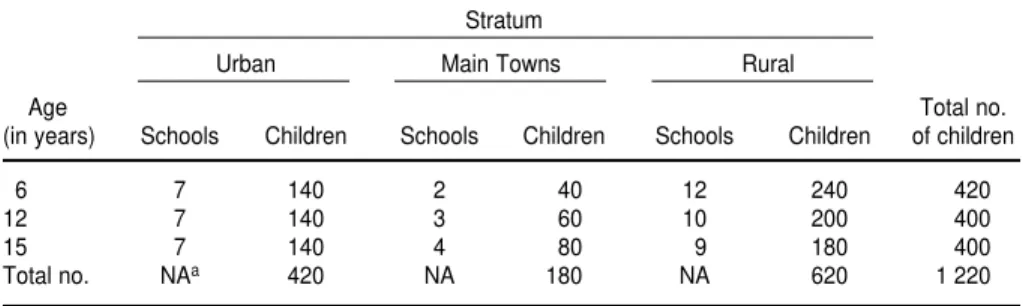
In the second stage of selection, a fixed sample size of 400 children was selected for each of the age groups (Table 1). This number of children was considered sufficient to estimate caries prevalence and severity in each stra-tum and followed the WHO recom-mendations for countries with sus-pected high caries prevalence and unknown variability by socioeconomic status (SES) and geographical location. Using a pre-assigned number of 20 children per school, the number of schools assigned to each stratum fol-lowed the proportional contribution of each stratum in the total population. Therefore, the number of schools in each stratum provided self-weighting for the computation of national statis-tics. The total number of schools lected was 39, as some schools were se-lected for more than one age group. A sample of 6-year-old children from an additional rural school was examined as a replacement for one rural school that did not initially respond but, in the end, agreed to participate. We de-cided to keep both schools in the final sample because they had similar dis-ease prevalence.
In the third stage of selection, 20 children were chosen from each se-4 Jamaica, Ministry of Education, Research Division.
Environmental classification of public primary and all-age schools. Kingston, Jamaica: MOE; 1976.
5 Jamaica, Ministry of Education, Research Division.
Patterns of attendance, primary and all-age schools. Kingston, Jamaica: MOE; 1976.
6 Jamaica, Ministry of Education, Research Division.
lected school and age group, using a table of random numbers. The final sample, a total of 1 220 students, by chance represented all types of schools (private and government–funded) in Jamaica. No attempts were made, however, to estimate the probability of selection of each child in the sample. That is, we analyzed the data assum-ing the same probability of selection for all of the children (simple random sampling selection).
Sampling in the 1995 survey
In the 1995 survey (5), six geograph-ical regions (sampling units) were se-lected and classified into three strata (urban, periurban, and rural). Two sampling units were selected with cer-tainty: Kingston (urban stratum) and St. Catherine (periurban stratum). The other four units, comprising the rural stratum, were the parishes of St. Eliza-beth, St. Ann, Trelawny, and Portland. The final sample included ten ran-domly selected schools: two from Kingston, two from the periurban por-tion of St. Catherine, and six from the four rural parishes. The age groups in-cluded were 6 to 8 years, 12 years, and 15 years. The final sample size of 1 049 subjects was 24% urban, 19% periur-ban, and 57% rural.
Examinations in 1984 and in 1995
In both surveys, the MOE and the school principals granted permission
at the national and local level to sched-ule and implement the surveys.
The 39 schools selected in the 1984 survey were visited by an examination team consisting of one examiner (RW), one assistant, and one recorder, during April to June of 1984. To obtain maxi-mum participation, the team followed MOE recommendations on school at-tendance by weekday, including visit-ing remote rural schools on Tuesdays or Wednesdays.
In 1984 the team followed the ethical standards then applicable, which in-cluded parents providing consent for medical and dental screenings at the beginning of the school year. In addi-tion, children were asked to provide verbal consent before the examination. The examination instruments were chemically disinfected following man-ufacturers’ recommendations. The team provided follow-up referrals for children with dental needs and gave oral hygiene instruction as needed. In order to protect the privacy rights of each participant, the dataset for analy-sis did not include personal identifiers.
The intraoral examinations were car-ried out using natural light, a plane mouth mirror, and a No. 22 explorer. Following the 1977 WHO diagnostic criteria (4), the assessment of dental caries was primarily visual, using the explorer only to confirm, in suspicious areas, the presence of soft dentin. The one examiner (RW) was an experi-enced standardized examiner. The aminer conducted blind duplicate ex-aminations on 10% of the children to assess intraexaminer reliability. From
these duplicate examinations, we cal-culated a kappa statistic of 0.9, equiva-lent to near perfect agreement (9). In addition, children of 12 and 15 years of age were examined for periodontal treatment needs, using the Community Periodontal Index of Treatment Needs (CPITN) (10). The results of the CPITN examinations were reported elsewhere (11). Enamel fluorosis was assessed using Dean’s index (12) following WHO recommendations (4). Data from the original data entry forms were en-tered into a customized program using the Epi Info software program (13), and data analysis was done using SAS computer software (14).
The diagnostic criteria and case defi-nition used in the 1995 survey were those described in the 4th edition of WHO’s Oral health surveys: basic meth-ods(15), with one exception. Dental ex-plorers rather than periodontal probes were used to assess the presence of car-ious lesions, in order to allow compar-isons with the 1984 survey results. Ad-ditional information regarding the 1995 survey is reported elsewhere (5).
We calculated the percent reduction (PR) and compound annual percent re-duction (CAPR) (16) to evaluate changes in the mean number of decayed, miss-ing, and filled teeth between 1984 and 1995. Finally, we plotted the cumulative distribution of the DMFT at age 12 for both surveys to assess epidemiological changes in the prevalence and severity of dental caries (16).
RESULTS
1984 survey
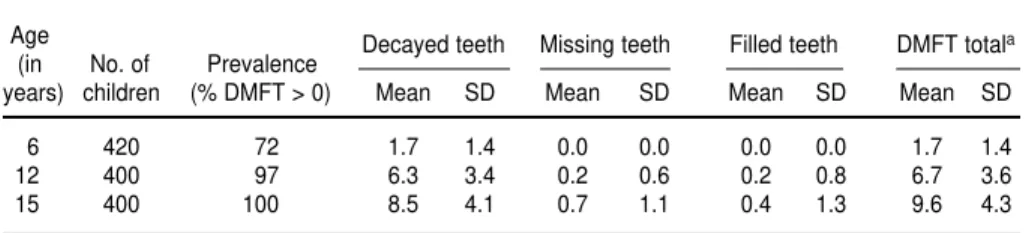
Table 2 shows the age-specific preva-lence and severity of dental caries in the permanent dentition in 1984. Of the children 6, 12, and 15 years of age, re-spectively 72%, 97%, and 100% of them had experienced dental caries, defined as having at least one decayed, missing, or filled permanent tooth (“DMFT“). The mean DMFT values increased with age, from 1.7 teeth at age 6 to 9.6 teeth at age 15. The mean DMFT at age 12 was 6.7 teeth, which included 6.3
de-TABLE 1. Number of schools and children by stratum and age group, oral health survey, Jamaica, 1984
Stratum
Urban Main Towns Rural
Age Total no.
(in years) Schools Children Schools Children Schools Children of children
6 7 140 2 40 12 240 420
12 7 140 3 60 10 200 400
15 7 140 4 80 9 180 400
Total no. NAa 420 NA 180 NA 620 1 220
cayed teeth (teeth with untreated cari-ous lesions), 0.2 missing teeth, and 0.2 filled teeth. Decayed teeth represented 89% of the entire DMFT index at age 15, 94% at age 12, and 100% at age 6.
Data were also collected on the number of decayed, missing, and filled teeth in the primary dentition (“dmft“)
of the 6-year-old children. In that group, 83% of them had one or more primary teeth with dental caries (dmft > 0, data not shown). The mean dmft at age 6 was 4.8 teeth (Table 3).
Females had higher mean DMFT scores than did males, 7.1 versus 6.2 at age 12 (P < 0.01) and 10.2 versus 9.3
at age 15 (P< 0.05). Children in urban areas had lower mean dmft and DMFT scores than did children in main towns and rural areas (Table 3). However, only in the case of the dmft at age 6 and the DMFT at age 15 were the differ-ences statistically significant (Table 3). Between 71% and 76% of first and second permanent molars were af-fected by dental caries at age 12, and between 79% and 86% at age 15 (Table 4). Most of these molars were decayed and required restorative treatment; this was around 69% of these teeth at age 12, and between 63% and 81% at age 15. Approximately 5% of the first permanent molars were missing due to dental caries at age 12, and 13% at age 15. In addition, 8% and 14% of the first permanent molars at ages 12 and 15, respectively, required extraction because of caries (data not shown).
TABLE 2. Age-specific prevalence and severity of dental caries in the permanent dentition of children, oral health survey, Jamaica, 1984
Age Decayed teeth Missing teeth Filled teeth DMFT totala (in No. of Prevalence
years) children (% DMFT > 0) Mean SD Mean SD Mean SD Mean SD
6 420 72 1.7 1.4 0.0 0.0 0.0 0.0 1.7 1.4
12 400 97 6.3 3.4 0.2 0.6 0.2 0.8 6.7 3.6
15 400 100 8.5 4.1 0.7 1.1 0.4 1.3 9.6 4.3
aDMFT = number of decayed, missing, and filled teeth in the permanent dentition.
TABLE 3. Mean number of decayed, missing, and filled teeth in the primary dentition (dmft) and in the permanent dentition (DMFT) of children, by stratum, oral health survey, Jamaica, 1984
dmft and DMFT, mean number and 95% confidence interval (CI)
Stratum
Age Urban Main towns Rural Overall
(in years) Index Mean 95% CI Mean 95% CI Mean 95% CI Mean 95% CI
dmfta 3.9 3.3–4.4 5.4 4.2–6.5 5.2 4.7–5.7 4.8 4.4–5.1
6
DMFT 1.7 1.4–1.9 1.9 1.5–2.3 1.7 1.5–1.9 1.7 1.6–1.9
12 DMFT 6.2 5.6–6.8 7.1 6.3–8.0 6.9 6.4–7.4 6.7 6.3–7.0
15 DMFTa 8.5 7.9–9.2 10.6 9.6–11.5 10.1 9.4–10.7 9.6 9.2–10.0
aStatistically significant differences at the P= 0.05 level between the urban and rural strata, corrected for multiple comparisons using the Bonferroni method.
TABLE 4. Number and percentage of first and second permanent molars by child age and by caries status, oral health survey, Jamaica, 1984a
Total teeth with
Age Teeth erupted Teeth decayed Teeth missing Teeth filled caries experience
(in years) No. % No. % No. % No. % No. %
12
1st molar 1 596 99.8 1 093 68.5 74 4.6 40 2.5 1 207 75.6
2nd molar 1 277 79.8 886 69.4 6 0.5 9 0.7 901 70.6
15
1st molar 1 600 100 1 006 62.9 203 12.7 62 3.9 1 271 79.4
2nd molar 1 583 98.9 1 286 81.2 40 2.5 32 2.0 1 358 85.8
Of the 6-, 12-, and 15-year-old chil-dren, respectively 50%, 32%, and 43% of them needed urgent dental treat-ment to alleviate pain or infection. In addition, 27% of the total sample had palpable lymphadenopathy. Only 23 children showed signs of enamel fluo-rosis, and 21 of these 23 were classified in the very mild category (12). In the 12-year-old group the overall preva-lence of enamel fluorosis was 2.5%.
1995 survey and trends
More-complete results from the 1995 survey are reported elsewhere (5). The percent reduction (PR) and the com-pound annual percent reduction (CAPR) between 1984 and 1995 for the dmft at age 6 and DMFT at ages 12 and 15 are shown in Table 5. For the entire sample (all strata), PR ranged from 52% to 84% and CAPR from 6.5% to 15.1%. The PR for just the urban strata ranged from 46% to 87%, and the CAPR ranged from 5.5% to 16.9%.
DISCUSSION
Trends in dental caries in Jamaica
In 1984, dental caries was a disease affecting almost all the Jamaican chil-dren studied, with a high level of se-verity. Moreover, most affected teeth
were not receiving restorative treat-ment. In 1995, dental caries was a dis-ease concentrated in a smaller pro-portion of the population (5). The epidemiological change between 1984 and 1995 for 12-year-old children is il-lustrated in Figure 1. In these curves, any point represents the “x” propor-tion of the populapropor-tion affected by “y” proportion of the cumulative disease, starting with those most affected. For example, in 1984, 80% of the disease occurred in 60% of the 12-year-old population. In 1995, in contrast, that
level was found only in 22% of the same age cohort.
The decline in disease levels be-tween 1984 and 1995 was 52% at age 6, 84% at age 12, and 68% at age 15 (Table 5). This reduction has been attributed mainly to the implementation of Ja-maica’s salt fluoridation program in 1987 (5). The degree of this reduction, however, could be questioned due to different sampling methods, secular trends that included the effect of eco-nomic and social development and a higher general health and oral health
FIGURE 1. Cumulative disease prevalence (DMFT) among 12-year-old Jamaican children in 1984 and in 1995
100
80
60
40
20
0
0 10 20
1984
30 40 50 60
Cumulative population percentage
70 80 90 100
Cum
ulativ
e DMFT
1995
TABLE 5. Mean dmft and DMFT scores (and standard deviation (SD)) and the total percent reduction (PR) and the compound annual per-cent reduction (CAPR) in those scores among children in all strata of Jamaica and in just the Kingston metropolitan area, oral health sur-veys, Jamaica, 1984 and 1995a
All strata Urban stratum (Kingston metropolitan area)
1984 to 1995 1984 to 1995
No. of PR CAPR No. of PR CAPR
Score/age Year children Mean SD % % children Mean SD % %
dmft (6 yr) 1984 420 4.8 3.8 52 6.5 140 3.9 3.5 46 5.5
1995 121 2.3 2.8 26 2.1 2.7
DMFT (12 yr) 1984 400 6.7 3.6 84 15.1 140 6.2 3.5 87 16.9
1995 362 1.1 1.8 98 0.8 1.6
DMFT (15 yr) 1984 400 9.6 4.3 68 10.2 140 8.5 3.9 69 10.2
1995 310 3.0 3.0 37 2.6 3.2
admft = number of decayed, missing and filled teeth in the primary dentition; DMFT = number of decayed, missing and filled in the permanent dentition.
}
}
}
awareness, and the preventive effect of fluoride vehicles such as toothpaste and fluoride supplements. In the fol-lowing paragraphs, we will address some of these issues.
Methodological factors
The most reliable way to obtain un-biased estimates of disease prevalence is through probability samples. In a probability sample, each individual has a known, but not necessarily equal, probability of being selected (17). These sampling techniques require the enumeration of eligible individuals into a sampling frame and a random selection, using techniques ranging from simple random sampling (all in-dividuals have the same chance to be selected) to the most complex multi-stage sampling processes (e.g., cluster, stratified, systematic, and probability proportional to size). The application of these methods requires expert knowl-edge in sampling and access to reliable information.
In 1971, the WHO, in the first edition of its Oral health surveys: basic methods
text, proposed an alternative, “path-finder” sampling process of stratified cluster sampling (4, 15). This technique was developed to obtain convenience samples (not probability-based ones) from populations. The technique aims to include the most important popu-lation subgroups having, or likely to have, a full spectrum of disease preva-lence, and to collect information from a fixed number of individuals of different age groups in one particular location.
Many investigators who have used the pathfinder method have reported population estimates assuming equal weight to all persons in the sample. Assuming equal weights in a hetero-geneous population can produce bi-ased estimates. The WHO pathfinder protocol specifies that weighting could be applied to the aggregate estimates for the different subgroups, according to their percent contribution at the population level. For example, if the mean DMFT values are 3.0 and 2.0 for the rural and urban areas,
respec-tively, and the rural area represents 80% of the entire population, then the national mean DMFT should be equal to 2.8 (computed as (3.0 ⳯0.8) + (2.0 ⳯
0.2) = 2.8). Assuming equal weights may not be a problem in pathfinder studies where the population is homo-geneous in disease levels (18), but this is the exception rather than the rule in the epidemiology of dental caries, es-pecially in developing countries.
There were some differences in sam-pling design between the 1984 and 1995 Jamaican national surveys. The 1984 survey was a modified pathfinder survey, where careful stratification was carried out before sampling in order to randomly select 39 schools in three strata. A similar technique was used in 1995 to select 10 schools in three strata, but the strata and the crite-ria used to include the schools in each stratum were different. For example, in 1995 the specific towns in the rural stratum (parishes of St. Elizabeth, St. Ann, Trelawny, and Portland) would have been considered main towns in 1984. In consequence, the 1984 survey included a higher proportion of rural residents than the 1995 survey did.
On the other hand, the urban stra-tum in both surveys represents more or less the same populations. Table 5 shows that the PR and CAPR for all the strata and for just the urban stratum were of the same magnitude, suggest-ing that, at least for the urban stratum, the reported differences hold. We cal-culated PR and CAPR for the other strata (data not shown), and only the PR for age 12 seems to be similar across all the strata, between 83% and 87%. With the available data, it remains im-possible to ascertain the prevalence and severity of dental caries in 1995 in a rural area comparable to the one se-lected in 1984.
A final comment is warranted on the calculation of national estimates using the pathfinder method. In the 1984 survey, a weighting factor was used to select the number of schools and students in each stratum. The final sample distribution was 34% urban, 15% main towns, and 51% rural, which is almost the same as the
distribution in the reference popula-tion (33% urban, 15% main towns, and 52% rural). As we have mentioned be-fore, to apply the same weights to every stratum would have yielded bi-ased point estimates. Another way to obtain an unbiased estimate would have been to apply the population weights to the stratum-specific point estimates a posteriori. Whether the weights are applied during the selec-tion process (a priori) or to estimates of equal-size strata (a posteriori) will depend on the size of the sample in each stratum. Applying the weights at the initial process could yield strata with very few individuals. When no weights are available, the investiga-tors should report the full range of data and avoid reporting one value that may be a biased estimate of the entire population.
Biological factors
If we accept that a reduction in den-tal caries prevalence occurred between 1984 and 1995, then the next question is whether or not that reduction could be attributed to the salt fluoridation pro-gram initiated in 1987. Besides salt flu-oridation, four other factors could have contributed to this reduction: the in-creased use of fluoride toothpaste, a change in diet (including a decline in the use of cariogenic carbohydrates), access to dental preventive services, and exposure to natural fluoride levels in the drinking water. It should be noted, however, that with the absence of a control population (that is, a group of people not consuming fluoridated salt), it is impossible to rule out the ef-fect of a secular trend, as has been de-scribed in other populations (16).
by the main Jamaican toothpaste man-ufacturer (20). Therefore, it is unlikely that fluoride toothpaste could have been the main factor in the dental caries reduction observed between 1984 and 1995. It is important to note, however, that fluoride toothpaste and other socioeconomic factors may have contributed to the difference observed in 1984 between urban and rural areas, as toothpaste may have been less fre-quently used in the rural areas.
By the mid-1980s, sweetened snacks and beverages were much more widely available throughout Jamaica than they had been just one or two decades before. In 1984, sugar cane was chewed in the rural areas, but it is unknown whether its use changed in the years between the two surveys. In the early 1980s the annual sugar con-sumption in Jamaica was reported as 46 kg per person (21). If sugar con-sumption between the surveys in-creased or remained the same, then sugar consumption does not have an effect in the observed decline in dental caries. If sugar consumption decreased between surveys, then some of the re-duction in dental caries could be at-tributed to lower sugar consumption. However, with the information avail-able, it is impossible to reach any con-clusion regarding the role of sugar
consumption in the observed reduc-tions of dental caries in Jamaica.
In 1984 the rural areas of Jamaica had less access to preventive and cura-tive dental care than did other areas of the country. This situation improved in the middle to late 1980s as dental auxiliaries, who were persons trained to provide dental health education and dental services at the school level, ex-panded their services beyond urban areas and reached more of rural Ja-maica. It is likely that increased dental health awareness contributed some-what to the caries reductions indicated by the 1984 and 1995 surveys. Never-theless, we do not believe that this contribution alone could explain the degree of reduction observed.
Finally, as of 1983, 70% of the people in Jamaica had access to a public water system, with a mean fluoride concen-tration of 0.22 ppm. Drinking water with the highest mean values, between 0.4 and 0.5 ppm, reached fewer than 20 000 people in 1984 (22). These levels were insufficient for optimal caries pre-vention at the national level. In addi-tion, 30% of the populaaddi-tion, mostly in rural areas, had private or catchment-rainwater supplies. In 1984, dietary flu-oride supplements, multivitamins with fluoride, fluoride rinses, and profes-sionally applied fluoride were not
com-monly used. At best, their preventive effects would have benefited the small proportion of the population of a higher SES, mainly in the Kingston area. We conclude that, despite the differ-ences in sampling between the 1984 and 1995 surveys, and the fact that rural areas were less represented in the 1995 survey, both surveys repre-sented, in the aggregate, the 6-, 12-, and 15-year-old school children in Jamaica at these two points in time. Therefore, the reduction in dental ca-ries observed represented biological factors—including the use of fluorides— in combination with secular trends. However, it is highly probable that the most important factor in this reduction was the consumption, beginning in 1987, of fluoridated salt.
Acknowledgments. We wish to
thank the Ministry of Health and the Ministry of Education of Jamaica and the Pan American Health Organiza-tion for their support during data col-lection. Special thanks also go to the Institute of Social and Economic Re-search of the University of the West In-dies and the WHO Collaborating Cen-tre in Oral Health at the University of Texas in San Antonio for assistance in entry and analyses of the data.
1. Edwards AN. Dental survey, government aided primary schools, Kingston zones— 1967–68. Kingston, Jamaica: Ministry of Health; 1969.
2. Warpeha RA. Dental caries and salt fluorida-tion. Jamaican Pract 1985;5:6–8.
3. Warpeha RA, Marthaler TM. Urinary fluoride excretion in Jamaica in relation to fluoridated salt. Caries Res 1995;29:35–41.
4. World Health Organization. Oral health sur-veys: basic methods. 2nd ed. Geneva: World Health Organization; 1977.
5. Estupiñán-Day SR, Báez R, Horowitz H, Warpeha R, Sutherland B, Thamer M. Salt flu-oridation and dental caries in Jamaica. Comm Dent Oral Epi 2001;29:247–252.
6. Statistical Institute of Jamaica. Population estimates, 1982 census. Kingston, Jamaica: STATIN; 1984.
7. Jamaica, Ministry of Education. Directory of government schools, 1982/83. Kingston, Ja-maica: MOE; 1983.
8. Jamaica, National Planning Agency. Urban growth and management study. Kingston, Ja-maica: NPA; 1978.
9. Landis JR, Koch GG. The measurement of ob-server agreement for categorical data. Biomet-rics 1977;33:158–174.
10. Ainamo J, Barmes DE, Beagrie BG, Cutress TM, Martin J, Sardo Infirri J. Development of the World Health Organization (WHO) Community Periodontal Index of Treatment Needs (CPITN). Int Dent J 1982;32(3):281–291. 11. Warpeha RA, Cochran KP, Jeffcoat MK. Peri-odontitis in 13–year-old Jamaican children. West Indian Dental J 1995;1:13–15.
12. Dean HT. The investigation of physiological effects by the epidemiological method. In:
Moulton FR, ed. Fluorine and dental health. Washington, D.C.: American Association for the Advancement of Science; 1946. pp. 5–31. 13. Dean AG, Dean JA, Coulombier D, Brendel
KA, Smith DC, Burton AH, et al. Epi Info, ver-sion 6: a word processing, database, and sta-tistics program for epidemiology on micro-computers. Atlanta, Georgia, United States of America: Centers for Disease Control and Pre-vention; 1994.
14. SAS Institute Inc. SAS procedures guide, ver-sion 6. Cary, North Carolina, United States: SAS Institute Inc.; 1990.
15. World Health Organization. Oral health sur-veys: basic methods. 4th ed. Geneva: WHO; 1997.
16. Beltrán-Aguilar ED, Estupiñán-Day S, Báez R. Analysis of prevalence and trends of dental caries in the region of the Americas between
Objetivos. Evaluar los métodos utilizados y los resultados obtenidos en dos en-cuestas realizadas en 1984 y 1995 que mostraron una gran reducción de la prevalen-cia y gravedad de la caries dental en niños jamaiquinos, prestando espeprevalen-cial atención a las diferencias metodológicas entre las dos encuestas y a los factores biológicos que podrían explicar la gran disminución de la caries.
Métodos. En 1984 se utilizó una modificación de los métodos de encuesta ex-ploratoria de la Organización Mundial de la Salud para determinar la prevalencia y gravedad de la caries dental en niños jamaiquinos de 6, 12 y 15 años. En 1995 se real-izó una encuesta similar.
Resultados. Las dos encuestas emplearon los mismos criterios diagnósticos y pro-cedimientos clínicos, pero la de 1984 incluyó una mayor proporción de residentes ru-rales que la de 1995. La comparación de ambas encuestas reveló una reducción del 84% en la gravedad de la caries dental a los 12 años de edad. Los datos muestran una transición epidemiológica entre 1984, cuando la caries dental tenía gran prevalencia y gravedad, y 1995, cuando ambas habían disminuido notablemente.
Conclusiones. La reducción de la caries dental entre 1984 y 1995 es atribuible en su mayor parte a la introducción en 1987 de la fluoración de la sal. Aunque la encuesta de 1995 abarcó menos áreas rurales que la de 1984, esto no invalida la reducción de la caries dental que se observó. El uso de dentífricos fluorados, los suplementos di-etéticos de fluoruros y el acceso a los servicios curativos, preventivos y de promoción de la salud dental no parecen haber contribuido de forma importante a la reducción observada.
RESUMEN
Factores metodológicos
y biológicos que explican
la reducción de la caries
dental en escolares
jamaiquinos entre
1984 y 1995
the 1970s and 1980s. Int Dent J 1999;49:322– 329.
17. Levy P, Lemeshow S. Sampling of popula-tions: methods and applications. 2nd ed. New York: John Wiley & Sons, Inc.; 1991. 18. Bourgeois D, Leclercq MH, Barmes D.
Eval-uation of the World Health Organization pathfinder methodology for oral health sur-veys in industrialized countries. Community Dental Health 1992;9(4):381–384.
19. Burt BA, Eklund SA. Dentistry, dental prac-tice, and the community. 5th ed. Philadelphia: W. B. Saunders; 1999.
20. Colgate Palmolive (Ja) Ltd. Market survey. Kingston, Jamaica: Colgate Palmolive (Ja) Ltd.; 1983.
21. Woodward M, Walker ARP. Sugar consump-tion and dental caries: evidence from 90 coun-tries. Br Dent J 1994;176(8):297–302.
22. National Water Commission. Fluoride levels in NWC waters. Kingston, Jamaica: NWC; 1983.