Fisioter. Mov., Curitiba, v. 30, n. 3, p. 501-507, Jul./Sep. 2017 Licenciado sob uma Licença Creative Commons DOI: http://dx.doi.org/10.1590/1980-5918.030.003.AO08
Handgrip and functional capacity in Chronic
Obstructive Pulmonary Disease patients
Força de preensão palmar e capacidade funcional em
portadores de Doença Pulmonar Obstrutiva Crônica
Andrea Lúcia Gonçalves da Silva[a,b], Eduardo Garmatz[b], Cássia da Luz Goulart[a], Lisiane Lisboa Carvalho[a,b], Dannuey Machado Cardoso[a,c], Dulciane Nunes Paiva[a]
[a] Universidade de Santa Cruz do Sul (UNISC), Santa Cruz do Sul, RS, Brazil [b] Hospital Santa Cruz, Santa Cruz do Sul , RS, Brasil
[c] Universidade Federal do Rio Grande do Sul, Porto Alegre, RS, Brazil
[R] Abstract
Introduction: In the Chronic Obstructive Pulmonary Disease (COPD) both pulmonary and systemic con-dition increase dyspnea, intolerance to exercise and inactivity. Objective: To evaluate possible associa-tion between Hand Grip Strength (HGS) and the distance covered in the Six-Minute Walk Test (6MWT) in patients with Chronic Obstructive Pulmonary Disease (COPD). Methods: A cross-sectional study that evaluated 34 patients with COPD from moderate to very severe stages. The HGS test was performed with a manual hydraulic dynamometer (Jamar®, California, USA) with three bilateral measures, allowing
2
60-seconds rest time in-between measurements. Afterwards, the patients were submitted to the 6MWT along a 30-meters level corridor following the rules of the American Thoracic Society. Results: Average age 62.7±7.2 years old, body mass index 26.7±6.9 Kg/m². The value of the HGS in the dominant hand was 28.0±8.7 Kgf and in the non-dominant hand was 26.7±7.7 Kgf (99.2% of the predicted value and 106.3% of the predicted value, respectively). The subjects covered in average 421.0±110.4 meters in the 6MWT and there has been detected direct and significant correlation between the distance covered and the HGS of the dominant hand (r=0,430; p=0,011) and non-dominant (r=0,502; p=0,002). The patients with COPD that presented lower HGS also covered less distance in the 6MWT. Conclusion: The hand grip strength was directly associated with the functional capacity assessed through the distance covered in the Six-Minute Walk Test in the evaluated trial.
Keywords: Hand Strength. Exercise Test. Pulmonary Disease. Chronic Obstructive.
Resumo
Introdução: Nos portadores de Doença Pulmonar Obstrutiva Crônica (DPOC), a disfunção pulmonar, as
mani-festações sistêmicas e o aumento da dispneia podem conduzir à piora progressiva do condicionamento físico, à inatividade e intolerância ao exercício físico. Objetivo: avaliar possível associação entre a força de preensão
palmar (FPP) e a distância percorrida no Teste de Caminhada de Seis Minutos (TC6M) em portadores de DPOC.
Métodos: Estudo transversal que avaliou 34 portadores de DPOC com estadiamento entre moderado a muito
severo. A FPP foi realizada com dinamômetro hidráulico manual (Jamar®, Califórnia, EUA) com três medi
-das bilateralmente, respeitando um tempo de descanso de 60 segundos entre as medi-das. Posteriormente, os
pacientes foram submetidos ao TC6M em um corredor plano de 30 metros, seguindo as normas da American
Thoracic Society. Resultados: Média de idade de 62,7±7,2 anos, índice de massa corporal 26,7±6,9 Kg/m². O
valor da FPP na mão dominante foi 28,0±8,7 Kgf e da mão não dominante foi 26,7±7,7 Kgf (99,2% do predito e 106,3% do predito, respectivamente). Os sujeitos percorreram em média 421,0±110,4 metros no TC6M ten
-do si-do detectada correlação direta e significativa entre a distância percorrida e a FPP da mão -dominante (r=0,430; p=0,011) e não-dominante (r=0,502; p=0,002). Os portadores de DPOC que apresentaram menor FPP apresentaram menor distância no TC6M. Conclusão: A força de preensão palmar esteve diretamente associa-da à capaciassocia-dade funcional avaliaassocia-da através associa-da distância percorriassocia-da no Teste de Caminhaassocia-da de Seis Minutos na
amostra avaliada.
Palavras-chave: Força da mão. Teste de Esforço. Doença Pulmonar. Obstrutiva Crônica.
Introduction
The Chronic Obstructive Pulmonary Disease (COPD) is characterized by persistent and progres-sive obstruction of the superior airways, associated
with an enhanced chronic inflammatory response to
inhalation of pollutants/particles or noxious gases
(1). The inflammatory cells are active and there is an increase in pro-inflammatory plasma cytokine
levels in the systemic circulation, causing oxidative stress that will result in musculoskeletal disorders and reduction of the functional capacity (2). The pulmonary dysfunction, the systemic manifestations
and the increase of dyspnea can lead to progressive worsening of the physical conditioning, inactivity and physical exercise intolerance (3).
As a result, the COPD patient adopts a more sed-entary lifestyle that worsens the quality of life and is the determining factor to the progression of the disease (2, 4). The evaluation of the physical perfor-mance of patients with COPD by using sub-maximal and non-invasive tests, like the Six-Minute Walk Test
(6MWT), besides being easy to apply, can also reflect in activities of daily life, physical fitness, functional
3
COPD, smoking history, dyspnea by the scale Medical
Research Council - MRC and index of BODE - Body
Mass-Index: Airflow Obstruction, Dyspnea and Exercise Capacity).
Handgrip Strength
The HGS test was performed with a manual hy-draulic dynamometer (Jamar®, California, USA), fol-lowing the recommendations of The American Society
of Hands Therapists. The patients remained seated,
with the shoulder abducted, elbow flexed at 90º, fore -arm in neutral position of prono-supination and the
wrist joint between 0º and 30º of dorsiflexion. Three
bilateral measures were taken, allowing 60 seconds rest time in-between measurements, and the average of the measurements of each participant was sepa-rately calculated. The values obtained compared with the ones predicted as reported by Luna-Heredia et al. (9).
6MWT
The 6MWT was performed according to the American Thoracic Society standards to measure the distance the study participants were able to walk within a 6-minute period (10). The study par-ticipants were asked to walk as far as possible at a self-determined speed. No other guidance was pro-vided. The test was carried out by an experienced physical therapist. The percentage predicted in the 6MWT distance was calculated considering gender, age, height, and weight of each subject based on the equation by Enright, et al. (11).
Statistical analysis
The software SPSS (version 20.0) was used to ver-ify the normality of the distribution of data through the test of Shapiro-Wilk, and the results were shown in frequency, average ± standard deviation. The as-sociation between the variables was analyzed by us-ing Spearman’s correlation test and the analysis of the variance for multiple comparisons (ANOVA) by using the post hoc of Tukey test. It was considered
significant a p < 0.05.
the maximal oxygen uptake (VO2max) (6). Another important method to evaluate the changes of periph-eral muscle strength, as this is one of the most im-portant extra pulmonary manifestations of the COPD physiopathology (7), is the Hand Grip Strength (HGS). The HGS has as principle to estimate the musculo-skeletal function through good reproducibility for the measurement of maximal manual voluntary handgrip strength, being considered a good index for overall
muscle strength, and it can also reflect the impair -ment of the functional capacity (8).
We hypothesized that the reduction of hand grip strength is associated with the decrease of functional capacity in patients with COPD. Therefore, our objec-tive was to evaluate the association between hand grip strength and the distance covered in the Six-Minute Walk Test in patients with Chronic Obstructive Pulmonary Disease.
Methods
This descriptive, prospective and transversal study was carried out in the Pulmonary Rehabilitation Program at the Santa Cruz Hospital. It was approved by the Research Ethics Committee of the University of Santa Cruz do Sul (protocol number 435093/2013). The study population was composed of patients di-agnosed with COPD in accordance with the interna-tional criteria (1).
There were forty-one COPD patients eligible in the program, however, only Thirty-four met the following inclusion criteria: age between 40 and 80 years old, with clinical diagnosis of COPD through the pulmo-nary function test by spirometry and clinically stable. COPD patients with musculoskeletal disorders, neu-rological sequelae that would affect the locomotor
system and cognitive deficit, skin lesions on the feet
and/or superior limbs, exacerbations of the disease within the 30 days prior to the study and the ones with lung cancer diagnosis, were excluded.
Clinical Variables
Analysis of the expiratory volume forced in the
4
Direct correlations were observed between the measures of the HGS of the dominant hand and the non-dominant hand with the distance covered in the 6MWT in meters (r = 0.430 p = 0.011) and (r = 0.502; p = 0.002), respectively (Figure 1 and 2).
Results
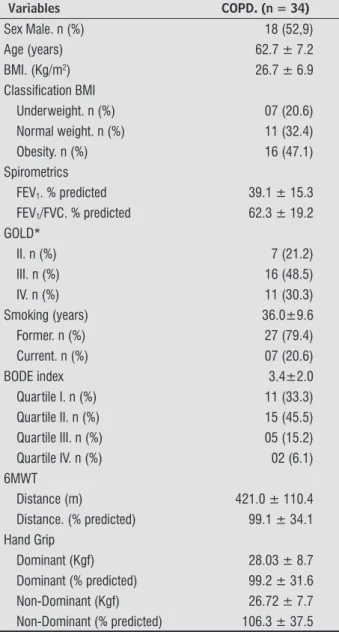
The clinical characteristics and the performance of the 34 COPD patients in the tests are shown in Table 1.
Table 1 - Clinical Characteristics and performance in tests of patients with COPD
Variables COPD. (n = 34)
Sex Male. n (%) 18 (52,9)
Age (years) 62.7 ± 7.2
BMI. (Kg/m2) 26.7 ± 6.9
Classiication BMI
Underweight. n (%) 07 (20.6)
Normal weight. n (%) 11 (32.4)
Obesity. n (%) 16 (47.1)
Spirometrics
FEV1. % predicted 39.1 ± 15.3 FEV1/FVC. % predicted 62.3 ± 19.2 GOLD*
II. n (%) 7 (21.2)
III. n (%) 16 (48.5)
IV. n (%) 11 (30.3)
Smoking (years) 36.0±9.6
Former. n (%) 27 (79.4)
Current. n (%) 07 (20.6)
BODE index 3.4±2.0
Quartile I. n (%) 11 (33.3)
Quartile II. n (%) 15 (45.5)
Quartile III. n (%) 05 (15.2)
Quartile IV. n (%) 02 (6.1) 6MWT
Distance (m) 421.0 ± 110.4
Distance. (% predicted) 99.1 ± 34.1 Hand Grip
Dominant (Kgf) 28.03 ± 8.7
Dominant (% predicted) 99.2 ± 31.6
Non-Dominant (Kgf) 26.72 ± 7.7
Non-Dominant (% predicted) 106.3 ± 37.5
Note: Data are presented as mean ± SD; n (%): number sample (fre-quency); COPD, chronic obstructive pulmonary disease; BMI, body mass index; Classiication of BMI second Cuppari et al. (12); GOLD: Global Initiative for Chronic Lung Disease; FEV1, forced expiratory volume in 1 second; FEV1/FVC=forced expiratory volume in the irst second and forced vital capacity. % predicted secund Pereira et al. (13) BODE index: Body Mass-Index. Airlow Obstruction. Dyspnea and Exercise Capacity; Quartile I: 0 to 2 points; Quartile II: 3 to 4 points; Quartile III: 5 to 6 points; Quartile IV: 7 to 10 points. 6MWT: 6-minute walk test. % predicted secund Enright, et al. (11)
Six-Minute W
alk Distance (m)
600
500
400
300
200
100
10 20 30 40 50
Dominant Hand Grip (Kgf)
r = 0,430 p = 0,011
Six-Minute W
alk Distance (m)
600
500
400
300
200
100
10 20 30 40 50
Non-Dominant Hand Grip (Kgf)
r = 0,502 p = 0,002
The HGS also correlated itself significantly and
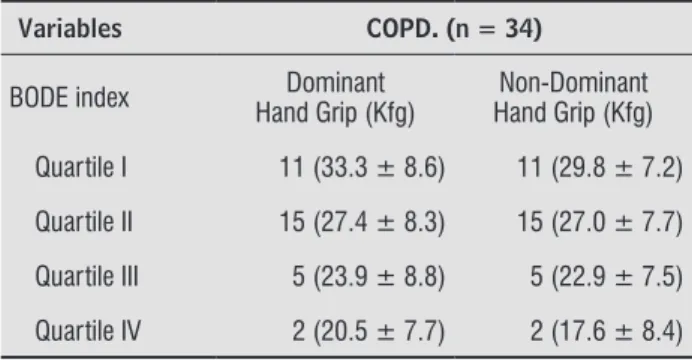
inversely with the BODE Index (Figure 3). It is pos-sible to observe a reduction of HGS related with the worsening of the patients quality of life, which was determined by the quartiles of the BODE index, as
de-scribed in Table 2, although no significant statistical Figure 1 - Correlation between 6MWT (m) and dominant Hand Grip.
5
difference was found (values of p ranging between 0.18 and 0.96).
Figure 3 - Correlation between BODE index and Dominant Hand Grip.
literature that states that hand grip strength and 6MWT are reduced in patients with COPD
particu-larly in those with hyperinflation (14) and patients
with mainly moderate and severe COPD experience a loss of peripheral muscle strength and endurance, exercise capacity and general quality of life (15).
The loss of muscle strength of COPD patients can
be related to exercise restrictions which reflect altera -tions in the respiratory tract, cardiovascular, neuro-muscular and neurosensory system in highly vari-able combinations with multifactorial interactions (15, 16). The changes in the peripheral musculature strength and in muscle mass can be associated with
a systemic inflammation, reduction of the capillaries in the fibers, and also with the oxidative stress (15,
17), which is more accentuated in the lower limbs.
On the other hand, our results meet the findings
of those in the studies, that states that the muscular strength of the upper limbs of COPD patients can be preserved in the distal muscles, due to the fact that they are used in the daily activities, and reduced in the proximal muscles due to increased dyspnea dur-ing the activity sustained by the arm (18, 19, 20). However, studies highlight that there is a very strong correlation between the HGS and the strength of the other peripheral muscles, like the ones evaluated by
the strength of the flexors of the elbow and the knee,
as well as the respiratory muscle strength (maximal inspiratory muscle pressure and maximum voluntary ventilation) (15, 21). In COPD the supply of oxygen to the peripheral and respiratory muscles may be
deficient as a result of hypoxemia (22).
The response obtained in the 6MWT reflects the
effort made in daily life activities and the short dis-tance covered in this test translates such limitations (21). This is because the intolerance to exercise of these subjects is of multifactorial construction in-volving more work and oxygen consumption by the respiratory muscles, the dysfunction of the skeletal muscles of the lower limbs and the mechanism of
lung dynamic hyperinflation, acting alone or in con -junction (23).
In the same way that the 6MWT influences the
BODE index, we found, in our study, a direct associa-tion of HGS with the worsening of this index and the consequent worsening of survival of COPD patients. The BODE is considered an index of multidimensional
(24, 25), classification of the severity of COPD (26,
27) where a score of 3 points or more is associated
10 20 30 40 50
Dominant Hand Grip (Kgf) r = 0,369 p = 0,035 10
8
6
4
2
0
BODE index score
Table 2 - BODE index stratified by the Hand Grip dominant and non-dominant in patients with COPD
Variables COPD. (n = 34)
BODE index Hand Grip (Kfg)Dominant Hand Grip (Kfg)Non-Dominant
Quartile I 11 (33.3 ± 8.6) 11 (29.8 ± 7.2)
Quartile II 15 (27.4 ± 8.3) 15 (27.0 ± 7.7)
Quartile III 5 (23.9 ± 8.8) 5 (22.9 ± 7.5)
Quartile IV 2 (20.5 ± 7.7) 2 (17.6 ± 8.4)
Note: Data are presented as mean ± SD; n (%): number sample (frequency); COPD, chronic obstructive pulmonary disease; Índice de BODE: Body Mass-Index: Airlow Obstruction, Dyspnea and Ex-ercise Capacity BODE index: Body Mass-Index. Airlow Obstruction. Dyspnea and Exercise Capacity; Quartile I: 0 to 2 points; Quartile II: 3 to 4 points; Quartile III: 5 to 6 points; Quartile IV: 7 to 10 points.
Discussion
6
with an increase of mortality and exacerbation rates in patients with COPD (28, 29, 30).
Some limitations can be observed in our study, such as the sample size which does not allow us for many inferences and future perspectives, making it possible to evaluate the effectiveness of pulmonary rehabilitation thru improvement of muscle strength and consequently, the performance in the 6MWT.
Conclusion
The hand grip strength was directly associated with the performance in the Six-Minute Walk Test in our study, where the patients with COPD that present-ed a lower HGS in the dominant and non-dominant hand also covered less distance and worsening of survival. Further studies are necessary to identify
how much the hand grip strength can influence the
performance in the 6MWT in this population.
Support and funding
University of Santa Cruz do Sul-UNISC, DECIT/ SCTIE-MS/FAPERGS/CNPq 1264-2551/13-1 and Hospital Santa Cruz - RS.
References
1. GOLD – Global Initiative for Chronic Obstructive Lung Disease. Global Strategy for the Diagnoses, Manage-ment, and Prevention of Chronic Obstructive Pulmo-nary Disease (updated 2015).
2. Borel B, Provencher S, Saey D, Maltais, F. Re-sponsiveness of Various Exercise-Testing Proto-cols to Therapeutic Interventions in COPD. Pulm Med. 2013;2013:410748.
3. Sun KS, Lin MS, Chen YJ, Chen YY, Chen SCC, Chen W. Is asymptomatic peripheral arterial disease associated with walking endurance in patients with COPD? Int J Chron Obstruct Pulmon Dis. 2015;10:1487-92.
4. Pepin V, Saey D, Laviolette L, Maltais F. Exercise capac-ity in chronic obstructive pulmonary disease: mecha-nisms of limitation. COPD. 2007;4(3):195-204.
5. Holland AE, Spruit MA, Troosters T, Puhan MA, Pepin V, Saey D, et al. An official European Respiratory So -ciety/ American Thoracic Society technical standard: field walking tests in chronic respiratory disease. Eur Respir J. 2014;44(6):1428-46.
6. Pires SR, Oliveira AC, Parreira VF, Britto RR. Teste de caminhada de seis minutos em diferentes faixas etárias e índices de massa corporal. Rev Bras Fisioter. 2007;11(2):147-51.
7. Rausch-Osthoff AK, Kohler M, Sievi NA, Clarenbach CF, van Gestel AJ. Association between peripheral muscle strength, exercise performance, and physi-cal activity in daily life in patients with Chronic Obstructive Pulmonary Disease. Multidiscip Respir Med. 2014;9(1):37.
8. Martin FG, Nebuloni CC, Najas MS. Correlação entre estado nutricional e força de preensão palmar em ido-sos. Rev Bras Geriatr Gerontol. 2012;15(3):493-504.
9. Luna-Heredia E, Martín-Peña G, Ruiz-Galiana J. Handgrip dynamometry in healthy adults. Clin Nutr. 2005;24(2):250-8.
10. ATS Committee on Proficiency Standards for Clinical Pulmonary Function Laboratories. ATS statement: guidelines for the six-minute walk test. Am J Respir Crit Care Med. 2002;166(1):111-7.
11. Enright PL. The six-minute walk test. Respir Care. 2003;48(8):783-5.
12. Cuppari L. Guia de Medicina Ambulatorial e Hospi-talar: Nutrição Clínica no Adulto. São Paulo: Manole; 2002.
13. Pereira CA, Sato T, Rodrigues CS. New reference values for forced spirometry in white adults in Brazil. J Bras Pneumol. 2007;33(4):397-406.
14. Cortopassi F, Divo M, Pinto-Plata V, Celli B. Resting handgrip force and impaired cardiac function at rest and during exercise in COPD patients. Respir Med. 2011;105(5):748-54.
7
25. Chen X, May B, Di YM, Zhang AL, Lu C, Xue CC, et al. Oral Chinese herbal medicine combined with phar-macotherapy for stable COPD: a systematic review of effect on bode index and six minute walk test. PloS One. 2014;9(3):e91830.
26. Sferrazza Papa GF, Battaglia S, Solidoro P. Novelties in COPD prognosis: evolution of survival indexes. Mi-nerva Med. 2015;106(2 Suppl 2):9-16.
27. Silva JRG, Vasconcelos TB, Macena RHM, Bastos VPD, Morano MTAP, Rocha EMM, et al. Análise do índice BODE em pacientes com DPOC severa submetidos a um programa de reabilitação pulmonar. J Health Biol Sci. 2013;1(3):108-15.
28. Martin JM, Carrizo SJ, Casanova C, Martinez-Camblor P, Soriano JB, Agusti AG, et al. Prediction of risk of COPD exacerbations by the BODE index. Respir Med. 2009;103(3):373-8.
29. Dreyse J, Díaz O, Repetto PB, Morales A, Saldías F, Lis-boa C. Do frequent moderate exacerbations contrib-ute to progression of chronic obstructive pulmonary disease in patients who are ex-smokers? Int J Chron Obstruct Pulmon Dis. 2015;10:525-33.
30. Mantoani LC, Hernandes NA, Guimarães MM, Vitoras-so RL, Probst VS, Pitta F. Does the BODE index reflect the level of physical activity in daily life in patients with COPD? Rev Bras Fisioter. 2011;15(2):131-7.
Received in 12/03/2015 Recebido em 03/12/2015
Approved in 10/25/2016 Aprovado em 25/10/2016 16. Rabinovich RA, Vilaró J, Roca J. Evaluation exercise
tolerance in COPD patients: the 6-minute walking test. Arch Bronconeumol. 2004;40(2):80-5.
17. Nussbaumer-Ochsner Y, Rabe KF. Systemic manifesta-tions of COPD. Chest. 2011;139(1):165-73.
18. Malaguti C, Napolis LM, Villaça D, Neder JA, Nery LE, Dal Corso S. Relationship between peripheral muscle structure and function in patients with chronic ob-structive pulmonary disease with different nutritional status. J Strength Cond Res. 2011;25(7):1795-803.
19. Miranda EF, Malaguti C, Dal Corso S. Peripheral mus-cle dysfunction in COPD: lower limbs versus upper limbs. J Bras Pneumol. 2011;37(3):380-8.
20. Oliveira MF, Zelt JT, Jones JH, Hirai DM, O’Donnell DE, Verges S, et al. Does impaired O2 delivery dur-ing exercise accentuate central and peripheral fa-tigue in patients with coexistent COPD-CHF? Front Physiol. 2015;5:514.
21. Rantanen T, Volpato S, Ferrucci L, Heikkinen E, Fried LP, Guralnik JM. Handgrip strength and cause-specific and total mortality in older disabled women: exploring the mechanism. J Am Geriatr Soc. 2003;51(5):636-41.
22. Santos DB, Viegas CAA. Correlation of levels of ob-struction in COPD with lactate and six-minute walk test. Rev Port Pneumol. 2009;15(1):11-25.
23. Nonato NL, Díaz O, Nascimento AO, Dreyse J, Jardim JR, Lisboa C. Behavior of Quality of Life (SGRQ) in COPD Patients According to BODE Scores. Arch Bronconeumol. 2015;51(7):315-21.