Parental Expectation from Children with
Cochlear Implants in Indian Context:
a Questionnaire Based Study
Prawin Kumar
1Himanshu Kumar Sanju
1Rajkishor Mishra
2Varun Singh
1Priyanka Mohan
11Department of Audiology, All India Institute of Speech and Hearing, Mysore, Karnataka, India
2Department of Audiology, Bloom Senso Hearing Centre, Kolkata, West Bengal, India
Int Arch Otorhinolaryngol 2017;21:156–160.
Address for correspondence Himanshu Kumar Sanju, C/O Dr. Prawin Kumar, PhD, Department of Audiology, All India Institute of Speech and Hearing, Mysore 570006, Karnataka, India
(e-mail: [email protected]).
Introduction
Cochlear implant is the most advanced and successful neural prosthesis developed to date. The number of cochlear implant recipients outnumbers the recipients of all other types of neural prostheses by orders of magnitude, and it is the most
effective prosthesis in terms of restoration of function. Cochlear implants can provide hearing in patients with damage to the sensory hair cells in their cochlea. However the effectiveness of the implant and intervention depends on many factors, such as the child’s general developmental potential, age at which implant was done, and anatomy and Keywords
►
cochlear implants
►
parents
►
questionnaires
Abstract
Introduction
Parental support is important in the habilitation/rehabilitation of
chil-dren using cochlear implant devices. Hence, it is important for families to know the
realistic expectations regarding outcomes from CIs.
Objective
The objective of the present study is to know the parents
’
expectation from
children using CIs.
Methods
For this study, we recruited 23 parents of children using CIs. We
adminis-tered 15 questions translated in to Hindi related to communication abilities, social skills,
academic achievement, change in future life, rehabilitation demand, and stress due to
hearing impairment.
Results
The response of the questions (5-point rating scale) related to communication
abilities showed that parents were expecting children using CIs to use the telephone
(95%), to be able to detect soft sounds (99%), to listen in crowds (86%), to be able to
easily understand others (76%), and to show improvement in communication skills
(78%). Similarly, for questions related to social skills showed 90% of the parents
expecting that their children with CIs should be able to easily make friends with normal
hearing peers, and 80% of the parents were expecting the children to achieve high
standards in their reading and writing skills. Questions related to change in future life
showed 86% of the parents expecting their children with CIs to act like normal hearing
children. Further, 78% parents showed positive response regarding importance of
intensive training. However, 70% of the parents reported stress in the family due to the
existence of the hearing impaired child.
Conclusion
Overall, the existing questionnaire-based study showed that parents have
high expectations from their children with cochlear implant.
received
December 20, 2015 accepted
April 12, 2016 published online May 30, 2016
DOI http://dx.doi.org/ 10.1055/s-0036-1584228. ISSN 1809-9777.
Copyright © 2017 by Thieme-Revinter Publicações Ltda, Rio de Janeiro, Brazil
physiology of the inner ear and auditory pathway. Family and parents play an important role in the child’s development in acquiring auditory experience and spoken language. In healthcare, more attention is paid to structured behavioral outcome than to the collection of information of everyday functional level. In pediatric cochlear implantation, the sup-port of parents and family members is very imsup-portant in the habilitation/rehabilitation of children. Studies have empha-sized that goals and wishes of parents should be taken seriously during planning of implantation and habilitation and in setting joint goals of intervention.1Few stakeholders have extensively researched about cochlear implants (CI), while others arrive at the decision-making process with limited information about the technology and its outcomes. Hence, it is important for families to know the realistic expectations regarding outcomes from CIs.
Interviews and open or closed format or semi-structured questionnaires are specifically constructed for pre-implant and follow-up intervention and are more informative than any other instrument. A questionnaire on parental expectations from children with cochlear implant will provide information on real life situations. There are very few studies which explore parental expectations2–4satisfaction with implant habilitation,5 parental stress,6the quality of life of implanted children and that of their families,7using interviews and parental questionnaires. Due to the diversity in the cultural differences and socio-economic status in the Indian context, it is very important to study the change in the quality of life based on parental expectation before and after the implantation. The parental view will provide information to the health care professionals on what is important to families and what variations can help toward better intervention and rehabilitation of the children with CIs. The main domains in which parents expect improve-ment from the cochlear implant for the child include communi-cation abilities, social skills, and academic achievements, as well as a change in their future life, rehabilitation demand, parental satisfaction and a stress-free life. With this in mind, this study aims to understand parents’expectations from children using CIs in the above-mentioned domains in the Indian context.
Method
We recruited children in the age range of 3 to 8 years old (mean age of 5.5 years) using cochlear implant from 2 to 6 years old for the study. We administered a questionnaire composed of 15 questions related to communication
abilities (5 questions), social skills (2 questions), academic achievement (2 questions), change in future life (2 ques-tions), rehabilitation demand (2 quesques-tions), and stress due to hearing impairment (2 questions) on the parents of all the children. Questions were selected from a list prepared by Nemours Clinic, Florida, USA. We translated these ques-tionnaires into Hindi and performed the reverse translation to make sure that the meaning of the content remains the same. Then, a native speaker of Hindi with knowledge of English as well proofread these translated questions in Hindi. Later, we used the same questionnaire for the participants under close supervision of audiologists. These questions were closed-set tasks with a 5-point rating scale. We randomly selected all the parents of CI children based on their willingness to participate in the study. They received a detailed explanation about the purpose of the study. They belonged to low-to-medium socio-economic status and were educated up to graduation. Primarily, the mother tongue of all the participants was Hindi with a little knowledge of English. We took oral informed consent from all participants. The ethical committee of the All India Institute of Speech and Hearing, Mysuru-6, Karnataka, India, approved the study. We analyzed the data using SPSS (version 17), along with descriptive statistics, percen-tages, and proportions of the study subjects, within the context of a particular response.
Results
We described the percentages and proportions of different categories of questionnaires under different headings as a table and graphical representation.
Communication Abilities
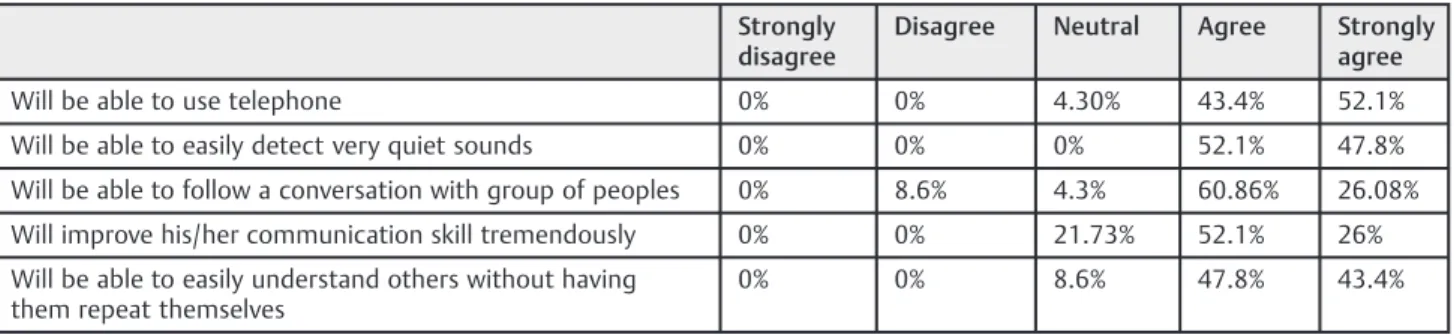
►Table 1 shows the response of the parents on questions related to communication abilities. The table indicates a high expectation of parents in terms of communication abilities from their children.
Social Skills
►Table 2 shows the responses to the questions related to social skills.
Academic Achievement
►Table 3 shows the responses to the question related to academic achievement.
Table 1 Responses obtained for the question asked about expectation of improvement in communication abilities
Strongly disagree
Disagree Neutral Agree Strongly agree
Will be able to use telephone 0% 0% 4.30% 43.4% 52.1%
Will be able to easily detect very quiet sounds 0% 0% 0% 52.1% 47.8%
Will be able to follow a conversation with group of peoples 0% 8.6% 4.3% 60.86% 26.08%
Will improve his/her communication skill tremendously 0% 0% 21.73% 52.1% 26%
Will be able to easily understand others without having them repeat themselves
Change in Future Life
►Table 4shows the responses to the question on changes in future life.
Rehabilitation Demand
►Table 5shows the responses to the question about rehabili-tation demand.
Stress due to Hearing Impairment
►Table 6shows the responses to the question asked about changes in future life.
Discussion
The present study showed parents’ high expectations toward their children from using the cochlear implant.
The parents’response to questions asked about communi-cation abilities revealed their high expectations regarding communication abilities. In fact, 95% of the parents agreed that their child would be able to use the telephone, 100% of the parents had an affirmative response to the question
“Will be able to easily detect very quiet sounds.”Similarly, on the question “Will be able to follow a conversation with group of peoples,”87% of parents agreed. The question asked about their opinion on“Will improve his/her communication skill tremendously,”78% of the parents showed a positive response. Similarly, 90% of the parents gave a positive response on the question“Will able to easily understand others without having them repeat themselves.”The results of the present study showed that parentśexpectations are high toward CI children in the Indian context. The current study also indicated that 90% of the parents expect their Table 2 Responses obtained for the question asked about expectation of improvement in social skills
Strongly disagree Disagree Neutral Agree Strongly agree
Will easily make friends with hearing peers 0% 8.7% 0% 56.52% 34.7%
Will be accepted by his classroom hearing peers 0% 0% 21.7% 21.7% 56.5%
Table 3 Responses obtained for the question asked about expectation of improvement in academic performance
Strongly Disagree
Disagree Neutral Agree Strongly Agree
Will improve tremendously in his/her academic achievement 0% 13% 8.6% 39.1% 39.1%
Will be able to participate easily in regular classroom activities 0% 0% 4.3% 47.8% 47.8%
Table 4 Responses obtained for the question asked about expectation of changes change in future life
Strongly disagree Disagree Neutral Agree Strongly agree
Will be able to function like a child with typical hearing 0% 0% 13.04% 56.5% 30.04%
Will have a dramatic change in his/her life 0% 0% 13% 56.52% 30.04%
Table 5 Responses obtained for the question asked about knowledge of rehabilitation demand among parents
Strongly disagree
Disagree Neutral Agree Strongly agree
Will need to participate in intensive listening training 0% 8.6% 13% 13% 65.2%
Parents of children with cochlear implants will have to put in a lot of effort into the rehabilitation process
0% 17.3% 13% 8.6% 60.8%
Table 6 Responses obtained for the question asked about stress related to hearing impairment
Strongly disagree
Disagree Neutral Agree Strongly agree
Stress in family is related to deafness / hearing impairment 8.6% 21.7% 0% 30.4% 39.1%
child to easily make friends with hearing peers, whereas 76% of the parents gave positive response to the question
“Will be accepted by his classroom hearing peers.” The question related to academic achievement showed that 80% of the parents expected the children to achieve high standards in their reading and writing skills, which en-forces their high expectation toward their children using CI. Similarly, questions related to change in future life showed 86% of parents expecting their children with CIs to act like normal hearing children and that there should be a dra-matic change in his/her life. Furthermore, 78% of parents showed a positive response regarding the importance of intensive training, which indicates awareness about impor-tance of speech-language and listening training among parents. However, 70% of the parents reported stress in the family due to existence of the hearing impaired child.
Stefanini et al8administered a questionnaire on 50 parents or guardians of children using CI, with minimum 1 year and maximum of 3 years of device use, and also demonstrated that parents have high expectations regarding communica-tion, independence, and social participation of children after CI surgery. A similar study done by Nikolopoulos et al2also reported the ability of cochlear implantation to meet or surpass parental expectations in three important outcome domains: communication, listening to speech, and the devel-opment of speech and language. Sach and Whynes9 con-ducted face-to-face semi-structured interviews with 216 families of children using cochlear implant. They reported that outcomes are highly individualistic, although parents had a shared hope of the implant enabling the child to function in a“hearing world.”
In the present study, we also observed that 70% of the parents reported stress due to the existence of a hearing impaired child. Weisel et al10investigated stress, attitudes, and expectations among mothers of deaf children who un-derwent cochlear implantation. They reported no differences emerged in stress levels with different groups of subjects, that is, mothers of CI candidates, 0–3 years post-implantation, and more than three years later. They also reported that high levels of the mother’s and father’s education correlated with lower stress levels.
According to the outcomes of the present study, expect-ations from parents of CI children may be achieved as reported by Piazza et al,11who showed that parents were satisfied by the performance of their children using cochlear implant. Speech language pathologist and audiol-ogist should be aware of the high expectations of parents in terms of communication abilities of children using cochlear implant. The result of the present study can be used to identify specific areas of communication skills where pro-fessionals can work more intensively to meet the demand of parent’s expectations. The result of present study also revealed the expectation of parents regarding improve-ment in social skills in children using cochlear implant. The professional should also focus on the improvement of social skills among children using cochlear implant to meet the parental demand. High demands related to academic achievement toward children using cochlear implant can
be assured if professionals, such as special educators, help the children in an effective way and devise a method toward their achieving success in academics.
The questions related to awareness among parents regard-ing the importance of intensive rehabilitation therapy by the audiologist and the speech language pathologist showed most of the parents were aware of the importance of rehabil-itation therapy (speech, language, and listening). This will help the clinician to give parents a better understanding of home training. However, the present study showed that 17% of parents were unware of the importance of rehabilitation therapy. Specialists should counsel parents regarding the benefits of intensive speech language therapy and listening training. They must ensure that parents of the children using cochlear implant are informed of the benefits of intensive speech language therapy and listening training.
Questions related to stress in the family of the children using CI showed anxiety among parents of children using CI. Realistic counseling by specialists should be effective in reducing stress among parents of children using CI. Quitter et al12 reported that parents of children with cochlear implants have a high degree of stress and poorer psychologi-cal adjustment when compared with parents of normal hearing children. Similarly, Sarant and Garrard13investigated a stress questionnaire among parents of children using CI. They also reported that these parents had a higher incidence of stress than the normative population.
The current study also indicates that 90% of the parents expect that their children with CIs should be able to easily make friends with normal hearing peers. Kluwin and Stewart4conducted an interview study of a random sample of 35 parents whose children had received cochlear implants through a large-scale implant program. Results showed that language and speech, rather than improved social skills or social contact, are the primary benefits of the implant. The outcome of present study showed that parents demand is high for improvement in communication abili-ties, social skills, and academic performance for their children using CI. They were also aware of rehabilitation demand, that is, the importance of intensive speech, language, and listening training after surgery.
Conclusion
References
1 Zaidman-Zait A, Most T. Cochlear implants in children with
hearing loss: maternal expectations and impact on the family.
Volta Review 2005;105(2):129–150
2 Nikolopoulos TP, Lloyd H, Archbold S, O’Donoghue GM. Pediatric
cochlear implantation: the parents’perspective. Arch Otolaryngol
Head Neck Surg 2001;127(4):363–367
3 Kelsay DM, Tyler RS. Advantages and disadvantages
expected and realized by pediatric cochlear implant
recipients as reported by their parents. Am J Otol 1996;17(6):
866–873
4 Kluwin TN, Stewart DA. Cochlear implants for younger children: a
preliminary description of the parental decision process and
outcomes. Am Ann Deaf 2000;145(1):26–32
5 Archbold S, Harris M, O’Donoghue G, Nikolopoulos T, White A,
Richmond HL. Reading abilities after cochlear implantation: the effect of age at implantation on outcomes at 5 and 7 years after implantation. Int J Pediatr Otorhinolaryngol 2008;72(10):
1471–1478
6 Beadle EA, Shores A, Wood EJ. Parental perceptions of the impact
upon the family of cochlear implantation in children. Ann Otol
Rhinol Laryngol Suppl 2000;185:111–114
7 Huttunen K, Välimaa T. Perceptions of parents and speech and
language therapists on the effects of paediatric cochlear implan-tation and habiliimplan-tation and education following it. Int J Lang
Commun Disord 2012;47(2):184–196
8 Stefanini MR, Morettin M, Zabeu JS, Bevilacqua MC, Moret AL.
Parental perspectives of children using cochlear implant. Codas
2014;26(6):487–493
9 Sach TH, Whynes DK. Paediatric cochlear implantation: the views
of parents. Int J Audiol 2005;44(7):400–407
10 Weisel A, Most T, Michael R. Mothers’stress and expectations as a
function of time since child’s cochlear implantation. J Deaf Stud
Deaf Educ 2007;12(1):55–64
11 Piazza E, Kandathil C, Carron JD. Parental expectations and
out-comes of pediatric cochlear implantation. J Miss State Med Assoc
2009;50(10):331–336
12 Quittner AL, Steck JT, Rouiller RL. Cochlear implants in children: a
study of parental stress and adjustment. Am J Otol 1991;12
(Suppl):95–104
13 Sarant J, Garrard P. Parenting stress in parents of children with
cochlear implants: relationships among parent stress, child language, and unilateral versus bilateral implants. J Deaf Stud