ACAROLOGY
Genetic Similarity among
Agistemus pallinii
Matioli
et al
(Acari:
Stigmaeidae) Found in Citrus Orchards in Viçosa, Minas Gerais State,
Brazil
A
NDRÉL M
ATIOLI1, A
NGELOP
ALLINI2, M
ARAG T
AVARES31Instituto Biológico, Lab de Entomologia Econômica, Rodovia Heitor Penteado, km 3, C. postal 70, 13.001-970, Campinas, SP; [email protected]; 2Depto. de Biologia Animal; [email protected]; 3Depto. de Biologia Geral;
[email protected]. Univ. Federal de Viçosa - UFV, 36.570-000, Viçosa, MG Edited by Denise Návia – EMBRAPA/CENARGEN
Neotropical Entomology 38(2):262-266 (2009)
Similaridade Genética entre Agistemus pallinii Matioli et al(Acari: Stigmaeidae) Encontrados em Pomares de Citros em Viçosa, MG
RESUMO - Stigmaeidae são importantes predadores de ácaros e insetos pragas em várias culturas no Brasil. Essa família é considerada a segunda mais importante de ácaros predadores em citros no Brasil. Entretanto, o status taxonômico desses ácaros, principalmente do gênero Agistemus, é difícil de ser analisado com base em caracteres morfológicos. Assim, este trabalho descreve o uso de marcadores polimórfi cos amplifi cados ao acaso (PCR-RAPD) para investigar a similaridade genética de uma população de Agistemus pallinii Matioli et al encontrada em 2004 em pomar de citros em Viçosa, MG, predando Panonychus citri (McGregor). As amplifi cações foram realizadas com 12 iniciadores randômicos (OPAA8, OPAA19, OPAB1, OPAB5, OPAB18, OPAC9, OPAC17, OPAC19, OPAD10, OPAE9, OPAE12 e OPAE17), os quais geraram 119 bandas, sendo 53,8% polimórfi cas. Os coefi cientes de similaridade genética entre os indivíduos variaram de 0,68 a 0,99, indicando alta similaridade entre eles. A análise de projeção gráfi ca 3D mostrou que a maioria dos indivíduos analisados formou um único grupo, confi rmando a alta similaridade genética entre os mesmos. Assim, mesmo considerando o pequeno tamanho de A. pallinii (± 360 μm), a técnica de PCR-RAPD pode ser utilizada para a sua identifi cação, em suporte às análises morfológicas ou em comparações de populações coletadas em diferentes regiões geográfi cas. O presente trabalho representa o primeiro estudo molecular realizado com ácaros da família Stigmaeidae.
PALAVRAS-CHAVE: Ácaro predador, variabilidade genética, marcador molecular
ABSTRACT - Stigmaeidae are very important predators of mite and insect pests on several crops in Brazil. It is considered the second most important family of predatory mites in citrus orchards in Brazil. However, their identifi cation, especially that of the members of the genus Agistemus, is rather diffi cult based only on morphology. Hence, this study describes the use of random amplifi ed polymorphic DNA (RAPD-PCR) markers to determine the genetic similarity of an Agistemus pallinii Matioli et al population found in 2004 in a citrus orchard in Viçosa, Minas Gerais State, Brazil, preying on Panonychus citri (McGregor). Amplifi cations were performed with 12 random primers (OPAA8, OPAA19, OPAB1, OPAB5, OPAB18, OPAC9, OPAC17, OPAC19, OPAD10, OPAE9, OPAE12 and OPAE17), which generated 119 bands, with 53.8% polymorphism. The coeffi cients of genetic similarity among the individuals ranged from 0.68 to 0.99, indicating a high genetic similarity among them. The 3D projection analysis clustered the majority of individuals confi rming their high similarity. Though individuals of A. pallinii are minute (± 360 μm long), the PCR-RAPD technique can still be used for their identifi cation, complementing morphological analyses or for comparison of populations collected in different geographic regions. This is the fi rst molecular study carried out with stigmaeid mites.
Stigmaeidae mites are important predators on several crops in Brazil, such as citrus, coffee, apple, rubber tree and guava, controlling phytophagous and also fungivorous mites (Matioli et al 1998, Ferla & Moraes 2003).
Identification of these mites is primarily based on morphologic and taxonomic characters and by crossbreeding species. However, these protocols are sometimes insuffi cient, especially for Agistemus, making necessary the use of other methods to identify them.
The application of molecular markers to studies on mites recently yielded new insights into their population structures and taxonomic relationships. Molecular markers, such as those generated by RAPD-PCR proved very useful in distinguishing species and in identifying genetic variations within and among populations (Perrot-Minnot & Navajas 1995, De Guzman et al 1997, Edwards et al 1997, Hance etal 1998, Yli-Mattila et al 2000). Edwards et al (1998), for example, used this method to compare three similar species of phytoseiid mites: Typhlodromalus limonicus Garman & McGregor, T. manihoti Moraes and T. tenuiscutus McMurtry & Moraes, concluding that this technique could be used to distinguish other cryptic species, in addition to interbreeding experiments.
Though the Stigmaeidae is considered the second most important predatory mite family in citrus orchards, this method has not yet been applied to their identifi cation or to the comparison of populations collected in different geographic regions. Therefore, in here we report the use of random amplifi ed polymorphic DNA (PCR-RAPD) markers to investigate the genetic similarity of an Agistemus pallinii Matioli et al population found in citrus orchards in Viçosa, Minas Gerais State, Brazil, preying on Panonychus citri McGregor (Acari: Tetranychidae).
Material and Methods
Mites were sampled in a citrus orchard in Viçosa-MG, Brazil, in 2004, and reared under controlled conditions (25°C, 12:12h L:D, and 75% RH). Brevipalpus phoenicis (Geijskes) and P. citri, supplemented with Typha sp. pollen, were offered as a rearing diet (Matioli et al 2007), using citrus leaves as a substrate.
DNA extraction of 33 A. pallinii females followed Groot et al (2005). Individual specimens were placed in a centrifuge tube (0.5 ml) kept in ice, and females were homogeneized in 3 μl of proteinase K (20 mg/ml). Subsequently, 50 μl of a 5% Chelex100® solution was added, samples were briefl y vortexed, incubated at 37°C for 1h and quickly vortexed again after 0.5h. Subsequently, the samples were incubated at 96°C for 8 min and briefl y agitated. The extracted DNA was used immediately or stored at -20°C for two or three weeks for later use.
DNA amplifi cation. The DNA of individual mites was amplifi ed by PCR-RAPD as described by Williams et al (1990) with some modifi cations. Each PCR reaction was set up in a total volume of 25 μl with 1X reaction buffer, 0.1 mM dNTPs, 0.4 μM 10-base primer (Operon Technologies, Alameda, CA, USA), 0.5 U Taq polymerase (Phoneutria, Belo Horizonte, MG, Brazil) and 3 μl DNA template
(unknown concentration), and runin a PTC-100 thermocycler (MJ Research) programmed at 92°C for 30 s, 35°C for 1 min, 3 min and 42 s. to increase to 72°C; 72°C for 2 min (45 cycles); 72°C for 7 min (1x).
Amplifi cation products were separated in 1.2% agarose gels containing 0.2 μg/ml of ethidium bromide in TBE buffer (Tris-borate 90 Mm, pH 8.0, EDTA 10mM). Bands were visualized under UV light and the images were analyzed using the AlphaDigidoc 1201 system (AlphaDigidocTM). A
negative control without genomic DNA was used in each amplifi cation to check for possible contaminants.
Initially, DNA of six specimens of A. pallinii was used in amplifi cation tests to verify the amplifi cation patterns of the RAPD primers. In these amplifi cations 56 primers were tested and 34 produced amplifi cations patterns that could be used in subsequent analyses. However, due to the small amounts of DNA available, the subsequent amplifi cations were carried out only with 12 primers: OPAA8, OPAA19, OPAB1, OPAB5, OPAB18, OPAC9, OPAC17, OPAC19, OPAD10, OPAE9, OPAE12 and OPAE17 (Table 1).
The amplicons produced were scored as present (1) or absent (0), and the constructed data matrix was used for the calculation of the Jaccard´s similarity index (Sij) among the pairs of individuals. The genetic similarity (Sij) was then converted to genetic distances (Dij) using the arithmetic complement of similarity given by the expression: Dij = 1- Sij. This matrix was submitted to a 3D graphic dispersion analysis. The projection effi ciency of the distances in the plane was estimated according to the correlation between the original distances and those showed in the graph. All analyses were carried out using the Genes program (Cruz 2005).
Results and Discussion
The method used in the present work for the extraction of DNA of individual mites was appropriate for the
RAPD-Primer Sequence 5’ – 3’ Nº bands
Nº polymorphic bands
OPAA08 T C C G C A G T A G 4 4
OPAA19 T G A G G C G T G T 8 1
OPAB01 C C G T C G G T A G 15 13
OPAB05 C C C G A A G C G A 14 7
OPAB18 C T G G C G T G T C 11 6
OPAC09 A G A G C G T A C C 12 5
OPAC17 C C T G G A G C T T 5 0
OPAC19 A G T C C G C C T G 10 4
OPAD10 A A G A G G C C A G 9 6
OPAE09 T G C C A C G A G G 10 6
OPAE12 C C G A G C A A T C 9 4
PCR amplifi cations, despite the small size of the mites and, consequently, the small amount of DNA. Our data corroborated that of Yli-Mattila et al (2000), showing the suitability of Chelex 100® in extracting DNA from Euseius finlandicus Oudmans (Acari: Phytoseiidae). The main limitation was the small number of possible amplifi cations that can be carried out with the same sample.
Amplifi cations carried out with the 12 selected primers produced 119 bands, with a range of 4 to 15 bands/primer (Table 1). The mean number of bands produced per primer (9.9) was close to that found for three species of Typhlodromalus (8.1) (Edwards et al 1997) and different strains of Tetranychus sp (8.7) (Hance et al 1998).
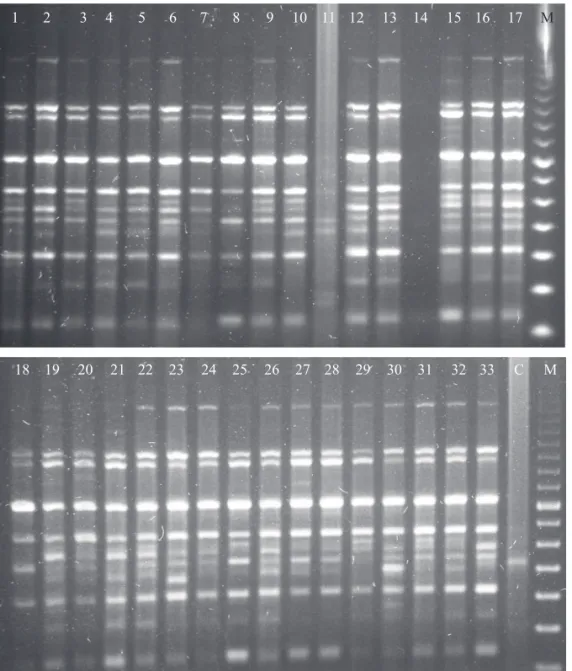
In general, the PCR-RAPD patterns generated were clear and similar in number among individuals, as the one obtained with the primer OPAE12 (Fig 1), allowing the effi cient characterization of the population of A. pallinii analyzed in the present study. However, as the absence of one determined band in only one specimen was considered as a polymorphism, 53.8% of the bands generated (64 bands)
were polymorphic in the analyzed population.
The RAPD technique had already been used for population analyses and identifi cation of different mite species and/or strains. Hernandez et al (1998) obtained RAPD patterns capable of differentiating strains of Boophilus microplus (Canestrini) susceptible from resistant ones. Edwards et al (1998) examined variable RAPD markers in three Typhlodromalus species and found several bands that could be used to distinguish phytoseiid species, while Yli-Mattila et al (2000) tested 20 primers in order to determine specifi c RAPD products to distinguish between strains and mite species.
The mean coeffi cient of similarity obtained for paired comparisons among the 33 of A. pallinii was 0.85 (SD = 0.066), with values ranging from 0.68 to 0.99. The highest similarity (0.99) was observed between 8 and 27, while the lowest (0.68) similarity was between specimens 23 and each of 29 to 32.
This high similarity could be confi rmed in the dispersion graphic analysis (Fig 2) where the distance between points
Fig 1 Representative RAPD amplifi cation pattern of genomic DNA of Agistemus pallinii using the primer OPAE12. (M: molecular weight marker; C: negative control)
1 2 3 4 5 6 7 8 9 10 11 12 13 14 15 16 17 M
is proportional to the dissimilarity between genotypes. Thus, the majority of the analyzed specimens grouped together confi rming the high similarity between them, while the more dissimilar individuals (28, 29, 30, 31, 32, 33 and 23) were more distant graphically. The correlation value (81.5%) obtained from this analysis further showed a good adjustment between the genetic distances and the distances graphically represented.
Strong characters to distinguish among species of Agistemus are limited, most consisting of ratios, easily influenced by the mounting of the mites. Thus, the RAPD-PCR technique can be a useful tool for species identifi cation. Another advantage is that the species identity can be determined quicker. However, this technique must not replace the taxonomy based on morphology. Hance et al (1998), for example, used this technique to compare strains of Tetranychus sp. to complement fecundity and biometry studies. Additionally, the loss of information due to the dominance of the technique can be minimized by increasing the number of loci analyzed (Miller 2000). Through cloning and sequencing of RAPD products it is also possible to develop more specifi c primers (SCARs). Amplifi cation with these primers could result in a more precise identifi cation of species as demonstrated with the identifi cation of different strains of E.fi nlandicus (Yli-Mattila et al 2000).
This is the fi rst molecular study carried out with predatory mites of the genus Agistemus (Stigmaeidae), whose species is diffi cult to determine based on morphologic characters only. The RAPD technique revealed to be a promising tool for the identifi cation of species as well as in intra and inter specifi c diversity studies and serving as a basis for future studies related to other Agistemus species.
Acknowledgments
We thank Drs. Eddie Ueckermann (ARC-Plant Protection Research, Pretoria South Africa), Gilberto Jose de Moraes (Departamento de Entomologia, Fitopatologia e Zoologia, ESALQ/USP, Piracicaba, SP, Brazil), Mario Eidi Sato and Suzete A. L. Destéfano (Instituto Biológico, Campinas, SP, Brazil) for reviewing an early version of this manuscript. CNPq and UFV are thanked for financial and logistic support.
References
Cruz C D (2005) Programa Genes. Versão Windows: aplicativo computacional em genética e estatística. Viçosa, MG.
De Guzman L I, Rinderer T E, Stelzer J A (1997) DNA evidence of the origin of Varroa jacobsoni in the Americas. Biochem Genet 35: 327-335.
Edwards O W, Melo E L, Smith L, Hoy M A (1998) Discrimination of three Typhlodromalus species (Acari: Phtytoseiidae) using random amplifi ed polymorphic DNA markers. Exp Appl Acarol 21: 101-109.
Ferla N J, Moraes G J (2003) Biologia de Agistemus fl oridanus Gonzalez (Acari, Stigmaeidae). Rev Bras Zool 20: 261-264.
Groot T V M, Janssen A, Pallini A, Breeuwer J A J (2005) Adaptation in the asexual false spider mite Brevipalpus phoenicis: evidence for frozen niche variation. Exp Appl Acarol 36: 165-176.
Hance T, Neuberb P, Noel-Lastelle C (1998) The use of fecundity, lobe biometry and the RAPD-PCR technique in order to compare
-1 x 34 -14
z
21 26,5
-8,5 y Y
29 32 31
28
30 33
7
10
23 15 3
14
24 16 17
22 20 2 1 122719
8 5 18
26 25 9 13
2111 4
strains of Tetranychus sp. Exp Appl Acarol 22: 649-666.
Hernandez R, Chen A C, Davey R B, Ivie G W, Wagnenr G G, George J E (1998) Comparison of genomic DNA in various strains of Boophilus microplus (Acari: Ixodidae). J Med Entomol 35: 895-900.
Matioli A L, Leite G L D, Pallini Filho A, Picanço M (1998) Distribuição espacial e temporal e efeitos de diferentes tratos culturais em ácaros associados a laranja Pêra-Rio. Agro-Ciencia (Chile) 14: 395-405.
Matioli A L, Tavares M G, Pallini A (2007) Agistemus pallinii n.sp. (Acari: Stigmaeidae) from citrus orchards in Brazil. Int J Acarol 33: 245-251.
Miller L M (2000) Classifying genealogical origins in hybrid populations using dominant markers. J Hered 91: 46-49.
Perrot-Minnot M J, Navajas M (1995) Biparental inheritance of RAPD markers in males of the pseudo-arrhenotokous mite Typhlodromus pyri. Genome 38: 838-844.
Williams J G K, Kubelik A R, Livak K, Rafalski J A, Tingey S V (1990) DNA polymorphism amplifi ed by arbitrary primers are useful as genetic markers. Nucl Acids Res 18: 6531-6535.
Yli-Mattila T, Paavanen-Huhtala S, Fenton B, Tuovinen T (2000) Species and strain identifi cation of the predatory mite Euseius fi nlandicus by RAPD-PCR and ITS sequences. Exp Appl Acar 24: 863-880.