LETTERS TO THE EDITORS
Reliability of working
memory assessment in
neurocognitive disorders: a
study of the Digit Span and
Corsi Block-Tapping tasks
Rev. Bras. Psiquiatr. 2016;38:262-263doi:10.1590/1516-4446-2015-1879
Working memory (WM) is a core aspect of executive function, related to temporary storage of information to be manipulated and used by other cognitive processes.1Despite the lack of a consensus definition and theoretical model to explain this function, its assessment is a key aspect in clinical practice, both for diagnostic and intervention purposes. Furthermore, as a cognitive process, WM is key to under-standing functional capacity in clinical samples.
The Digit Span and Corsi Block-Tapping tasks are frequently used in WM assessment.2 In both tests, the subject must repeat a series of stimuli in the presented order (forward) or in the inverse order (backward). The Digit Span uses escalating series of numbers from 1 to 9, presented in a randomized fashion, to assess verbal WM. The Corsi Block-Tapping task uses nine cubes placed on a
wooden board to assess visuospatial WM. Both tests are commonly used in neuropsychological assessment of older adults with a diagnostic hypothesis of pathological aging (e.g., minor and major neurocognitive disorders). However, we are unaware of studies investigating the reliability of these tasks for WM assessment in older adults diagnosed with neurocognitive disorders. Test reliability is an impor-tant measure used to estimate test precision and to create reliable change coefficients. These are simple statistical procedures used to examine whether changes in test scores over time (e.g., pre-intervention vs. post-interven-tion, baseline vs. follow-up) are likely due to measurement error (imprecision of test measures) or are associated with an external factor (the intervention, a placebo, or other non-documented causes).3
To analyze the reliability of the Digit Span and Corsi Block-Tapping tasks, we assessed 25 older adults with low formal education referred for neuropsychological assess-ment due to cognitive-functional complaints (13 patients with mild and 12 with major neurocognitive disorder, irrespective of etiological diagnosis). Diagnosis involved cognitive and functional assessment, performed with the Brazilian ver-sions of the Mattis Dementia Rating Scale4and Functional Activities Questionnaire.5 All participants gave written consent. The study was approved by the Universidade Federal de Minas Gerais Ethics Committee and conducted in accordance with the Declaration of Helsinki.
The same examiner administered and scored both tasks in all participants. Two trials were administered for each span (sequence length ranging from 2 to 8), in forward and reverse order, in both tasks. Two errors in the
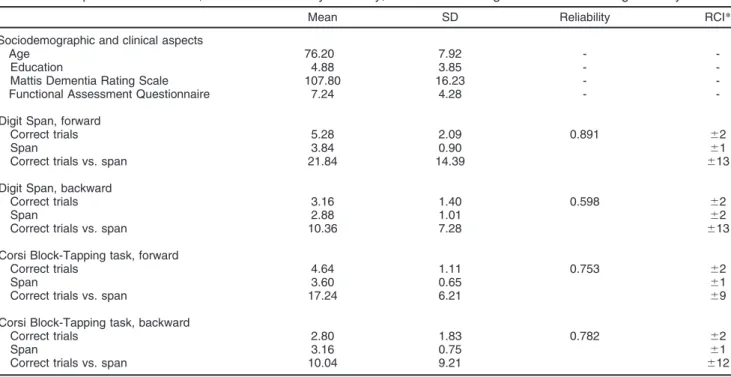
Table 1 Participant characteristics, internal-consistency reliability, and reliable change indexes for working memory tests
Mean SD Reliability RCI*
Sociodemographic and clinical aspects
Age 76.20 7.92 -
-Education 4.88 3.85 -
-Mattis Dementia Rating Scale 107.80 16.23 -
-Functional Assessment Questionnaire 7.24 4.28 -
-Digit Span, forward
Correct trials 5.28 2.09 0.891 62
Span 3.84 0.90 61
Correct trials vs. span 21.84 14.39 613
Digit Span, backward
Correct trials 3.16 1.40 0.598 62
Span 2.88 1.01 62
Correct trials vs. span 10.36 7.28 613
Corsi Block-Tapping task, forward
Correct trials 4.64 1.11 0.753 62
Span 3.60 0.65 61
Correct trials vs. span 17.24 6.21 69
Corsi Block-Tapping task, backward
Correct trials 2.80 1.83 0.782 62
Span 3.16 0.75 61
Correct trials vs. span 10.04 9.21 612
RCI = reliable change index; SD = standard deviation.
*If the difference between two assessments (baseline vs. follow-up, pre vs. post, etc.) is higher or lower than the RCI value, there is only a small probability (po0.05) of the difference being due to measurement error; instead, it is likely associated with an external factor (e.g., the tested intervention, time-related cognitive decline, placebo, or other non-documented factors).
same span prompted interruption of the task. Reliability was estimated by the split-half method, using the first trials from each span to compose the first half and the second trials to compose the second half. Reliable change indexes (RCIs) were calculated for all test measures.
Table 1 shows descriptive data, internal consistency, and reliable change coefficients for each task. Reliability was high for Digit Span forward, low for Digit Span backward, and moderate for the Corsi Block-Tapping task. The RCI for the tasks can be used to track significant changes in longitudinal assessment, although the high variability and moderate reliability of the tasks are likely to hinder assessment of mild or slight changes.
Jonas J. de Paula,1,2Leandro F. Malloy-Diniz,1,3 Marco A. Romano-Silva1,3
1Instituto Nacional de Cieˆncia e Tecnologia em Medicina Molecular
(INCT-MM), Faculdade de Medicina, Universidade Federal de Minas Gerais (UFMG), Belo Horizonte, MG, Brazil.2Departamento de Psicologia, Faculdade de Cieˆncias Me´dicas de Minas Gerais, Belo Horizonte, MG, Brazil.3Departamento de Sau´de Mental, Faculdade de Medicina, UFMG, Belo Horizonte, MG, Brazil.
Submitted Dec 03 2015, accepted Dec 13 2015.
Acknowledgements
This work was supported by the following grants: APQ-01972/12-10, APQ-02755-10, APQ-04706-10, and CBB-APQ-00075-09 from Fundac¸a˜o de Amparo e` Pesquisa do Estado de Minas Gerais (FAPEMIG); 573646/2008-2 from Conselho Nacional de Desenvolvimento Cientı´fico e Tecnolo´gico (CNPq).
Disclosure
The authors report no conflicts of interest.
References
1 Baddeley A. Working memory: theories, models, and controversies. Annu Rev Psychol. 2012;63:1-29.
2 Kessels RP, van den Berg E, Ruis C, Brands AM. The backward span of the Corsi Block-Tapping Task and its association with the WAIS-III Digit Span. Assessment. 2008;15:426-34.
3 Jacobson NS, Truax P. Clinical significance: a statistical approach to defining meaningful change in psychotherapy research. J Consult Clin Psychol. 1991;59:12-9.
4 Foss MP, Carvalho VA, Machado TH, Reis GC, Tumas V, Caramelli P, et al. Mattis dementia rating scale (DRS) normative data for the Brazilian middle-age and elderly populations. Dement Neuropsychol. 2013;7:374-9.
5 Assis Lde O, de Paula JJ, Assis MG, de Moraes EN, Malloy-Diniz LF. Psychometric properties of the Brazilian version of Pfeffer’s Func-tional Activities Questionnaire. Front Aging Neurosci. 2014;6:255.
It is time to prepare mental
health services to attend to
migrants and refugees
Rev. Bras. Psiquiatr. 2016;38:263-264 doi:10.1590/1516-4446-2015-1883
Brazil is a multicultural nation. Since the 1970s, the coun-try has received a substantial number of immigrants and refugees, mainly from Latin America, Europe, Africa, and China. In 2012, over 940,000 people were living in Brazil with a permanent visa.1 Compared to other countries, this still represents a small percentage of the popula-tion (0.9%), but with recent internapopula-tional events, rapid growth is expected. As of March 2015, according to the Brazilian Federal Police, 1,189,947 immigrants with a permanent visa and 4,842 refugees were living in the country.2
The immigration process represents a risk factor for mental health problems, putatively through several path-ways including unfavorable life circumstances (such as wars, extreme poverty, and political persecution); expo-sure to stress; low income; loss of contact with family; losses in social status, culture, and home; and lack of contact with one’s ethnic and cultural group of origin. The fragility of migrant populations has also been linked to marginalization, legal issues, lack of social support, and everyday exposure to stigma and discrimination.3
Furthermore, immigration implies acculturation and con-tinuous adaptation to a new language, different cultural roles, and an unknown and frequently hostile environ-ment, requiring constant effort to survive and succeed.4 Although the impact of a migration experience on the vulnerability to mental disorders and emotional suffering is relatively well described, mental health services in Brazil are still poorly adapted to the needs of immigrants and refugees, and health professionals are largely cul-turally unprepared to establish good rapport with these patients. One study on Bolivian immigrants in the city of Sa˜o Paulo found that 72% of the sample reported experiences of discrimination during medical appoint-ments in the public health system.5
In addition, although the number of immigrants and refugees who seek mental health care in Brazil is growing, there are international data supporting that most mental health resources are underused by this population.6This can be attributed to several barriers to care, including sociocultural differences (in manifestations of symptoms, in expression of emotional suffering and attribution of causes, and in methods used to manage mental health