Self-perception of oral health in older
adults from an urban population in
Lisbon, Portugal
Catarina CarvalhoI, Ana Cristina MansoII, Ana EscovalI, Francisco SalvadoII, Carla NunesI
I Escola Nacional de Saúde Pública. Universidade Nova de Lisboa. Lisboa, Portugal
II Instituto Superior de Ciências da Saúde Egas Moniz. Centro de Investigação Interdisciplinar Egas Moniz.
Caparica, Portugal
ABSTRACT
OBJECTIVE: To analyze if the self-perception of oral health in the urban context is associated with sociodemographic factors that interfere in the life quality of oral health.
METHODS: Cross-sectional study with convenience sample of older individuals (65 years old or more) enrolled in the Agrupamento de Centros de Saúde de Lisboa Norte (ACES Lisboa Norte – Health Centers Groupings North Lisbon). he self-perception of oral health and associated life quality was evaluated by the Geriatric Oral Health Assessment Index and the individuals were classiied according to sociodemographic characteristics. he internal consistency of the questionnaire was evaluated by Cronbach’s alpha (α). Later, we used binary logistic regression models to characterize the factors associated with the self-perception of oral health, considering the sociodemographic variables and the older adults’ clinical conditions of oral health and establishing the crude and adjusted (to age) odds ratios and their 90% conidence intervals. RESULTS: A total of 369 older adults participated in this study, with an average age of 74.2 years (SD = 6.75); 62.9% were female. On average, the index was moderated, with tendency to be high: 32.9 (SD = 3.6; 12-36 interval). he Cronbach’s alpha was high: 0.805. Age, marital status, and the last dental appointment were the factors signiicantly associated with self-perception of oral health. CONCLUSIONS: he study shows that these individuals have a moderate, with tendency to high, self-perception of oral health. he self-perception of oral health assessment allowed us to identify the main associated sociodemographic factors. his instrument can help guiding planning strategies and oral health promotion directed toward a better life quality for this population group.
DESCRIPTORS: Older Adults. Self-Assessment. Oral Health. Socioeconomic Factors. Cross-Sectional Studies.
Correspondence:
Catarina Carvalho Rua Dom Dinis, 22 4º Dto. 1250-077 Lisboa, Portugal E-mail: catarina.ms.carvalho@ gmail.com
Received: 6 Apr 2015
Approved: 15 Jul 2015
How to cite: Carvalho C, Manso AC, Escoval A, Salvado F, Nunes C. Self-perception of oral health in older adults from an urban population in Lisbon, Portugal. Rev Saude Publica. 2016;50:53.
Copyright: This is an open-access article distributed under the terms of the Creative Commons Attribution License, which permits unrestricted use, distribution, and reproduction in any medium, provided that the original author and source are credited.
INTRODUCTION
According to the United Nationsa, the aging of the world population is a lasting
phenomenon with global characteristics, afecting the whole society at all levels and requiring deep social changes.
In Portugal, population aging emphasizes the need for public health policies that focus on the maintenance of a satisfactory life quality at that age. According to the 2011 Censuses, Lisbon presents high level of aging, coming out from 103 older adults per 100 young people, in 2001, to 140 older adults per 100 young people in 2011, and is, at the same time, the city
with lowest percentage of young people (12.9%)b.
Population aging increases the growing need to set acceptable standards of oral health to contribute to a better general health and well-being state12. To this end, we need epidemiological data that quantify the oral health conditions of older adults. his type of information is essential to the planning, organization, and monitoring of the provided oral health services22.
The literature suggests that, in addition to clinical data of evaluation by health professionals, data should be collected on indicators of self-perception, especially relating
to oral health conditions and treatment needs perceived by older adults22. In this sense,
various sociodental indicators have been developed to measure how oral health changes compromise the life quality and well-being of individuals. his includes subjective measures such as pain or discomfort, aesthetic problems, restrictions on feeding, communication, afective relationships, daily activities, and physical and psychological well-being of
individuals11. From the instruments developed to evaluate these indicators, Oral Health
Impact Proile(OHIP), Oral Impacts on Daily Performances(OIDP), Oral Health-Related
Quality of Life(OHRQOL), and Geriatric Oral Health Assessment Index (GOHAI) stand
out3. he latter was developed speciically for the older adults’ population4.
The aim of this study was to analyze if the self-perception of oral health in the urban context is associated with sociodemographic factors that interfere in the life quality of oral health.
MATERIAL AND METHODS
Health Service in Portugal
In Portugal, the Ministry of Health is responsible for the development of health policies, as well as for the management of the National Health Service (NHS). here are ive regional health administrations (ARS) – ARS Alentejo, ARS Algarve, ARS Centro, ARS Lisbon and Tagus Valley, and ARS North – responsible for the execution of the goals of the national health policies, for the development of guidelines and protocols, and for monitoring health care. Decentralization eforts have focused their goals in changing the inancial and management responsibility to the regional level. In practice, however, the autonomy of the regional health authorities is limited to the primary health care. he autonomous regions of Azores and Madeira have efective autonomy in regional health strategies and in the management of budget and expensesc.
he ARS Lisbon and Tagus Valley is in charge of 15 Health Centers Groupings (ACES). hey are: ACES North Lisbon, Central Lisbon, West Lisbon and Oeiras, Cascais, Amadora, Sintra, Loures-Odivelas, Tagus Estuary, Almada-Seixal, Arco Ribeirinho, Arrabida, North West, South West, Middle Tagus, and Wet Area.
he oral health care system in Portugal, a mixture of coexistence between the Beveridgian, Bismarckian, and Private or Liberal models, is strongly conditioned by the low coverage of the NHS and is characterized by three coverage systems: the liberal coverage system or private insurance, the social security system, and the system inanced by taxes10.
a United Nations, Population
Di-vision, Departmenet of Econom-ic and Social Affairs. Old-age dependency ratio 65+/(20-64) by major area, region and country, 1950-2100 (ratio of population 65+ per 100 population 20-64). New York; 2011.
b Instituto Nacional de Estatística.
Censos 2011: resultados defini-tivos - Região Lisboa. Lisboa; 2013 [cited 2014 Feb 16]. Available from: http://censos.ine.pt/xportal/ xmain?xpid=CENSOS&xpgid=ine_ censos_publicacao_
et&contexto=pu& PUBLICACOESpub_ boui=377750&
PUBLICACOESmodo=2&selTab=t ab1&pcensos=61969554
c Direcção-Geral da Saúde
Sample
Cross-sectional study, with non-probabilistic and convenience sample of 369 individuals, corresponding to 5.1% margin of error for a 90% conidence level. Individuals aged 65 years or more were selected, randomly, among those who expected the appointment at the health center, between February 2012 and June 2013. We considered the listing of individuals enrolled in 2008, in the Northern Unit of Lisbon – older adults users of the North Lisbon health centers, which have as reference the Hospitals of Santa Maria and Pulido Valente.
his group consists of ive health centers: Alvalade, Benica, Coração de Jesus, Lumiar, and Sete Rios, in which 295,687 users were registered in 2012, with 62,498 older adults.
he interview was conducted face-to-face by four examiners, properly calibrated and trained according to the biosafety regulations, under the environmental conditions existing in the health centers. We included older people aged more than 65 years, with ability to respond to the questionnaire, regulars at the North Lisbon health centers, who accepted to participate in the study (informed consent).
Data Collection Instrument
The applied questionnaire consisted of three distinct parts. The first one covered the sociodemographic characterization, composed by age, occupation, situation regarding employment, place of birth, marital status, education level, household income, sex, ability of life autonomy, among others. he second included questions about the older adults’ oral health habits, such as: when the last visit to the dentist took place, if they received information on how to do mouth examination to prevent oral cancer, if they use prosthesis, and how they clean it. In the third part, we applied the Geriatric Oral Health Assessment Survey Index (GOHAI) to evaluate the self-perception of oral health, index translated and validated to the Portuguese language6.
he GOHAI consists of 12 questions, related with the inluence of oral health problems in the following physical, psychosocial, and pain or discomfort dimensions:
• he physical function, represented by the pattern of mastication, speech, and swallowing1,23;
• he psychosocial function, represented by the concern about oral health, satisfaction or
dissatisfaction with appearance, self-awareness about their oral health, and by avoiding social contact because of oral problems1,13,23;
• he pain or discomfort, represented by the use of medication to relieve pain or discomfort1,13,23.
For Atchison and Dolan4, the response options can have from three to six categories ( from “always” to “never”). In this study we opted for the simpliied frequency scale suggested by the authors, with three categories: “always”, “sometimes”, and “never” (values of 1, 2, and 3, respectively).
To obtain the inal index, we conducted the simple sum of the values, in a scale of 12 to 36. he GOHAI index classiies the self-perception in “high” (34 to 36 points), “moderate” (30 to 33 points) and “low” (< 30 pontos), by the Atchison and Dolan4 criteria for simpliied scale.
Data analysis
he dependent variable considered was the older adults’ self-perception in relation to oral health; the independent ones were the sociodemographic variables and older adults’ clinical conditions of oral health.
We used descriptive statistics measures ( for the general characterization of data) and
determined the Cronbach’s alpha (α) ( for assessing the internal consistency of the
prosthesis use). We determined the crude and adjusted by age odds ratios and their 90% conidence intervals. A signiicance level of 5% was used.
Ethical remarks
his study was approved by the Ethics Committee of the Direcção Geral da Saúde of the Portuguese Ministry of Health (Process 210, December 17, 2010). All participants signed the informed consent form.
RESULTS
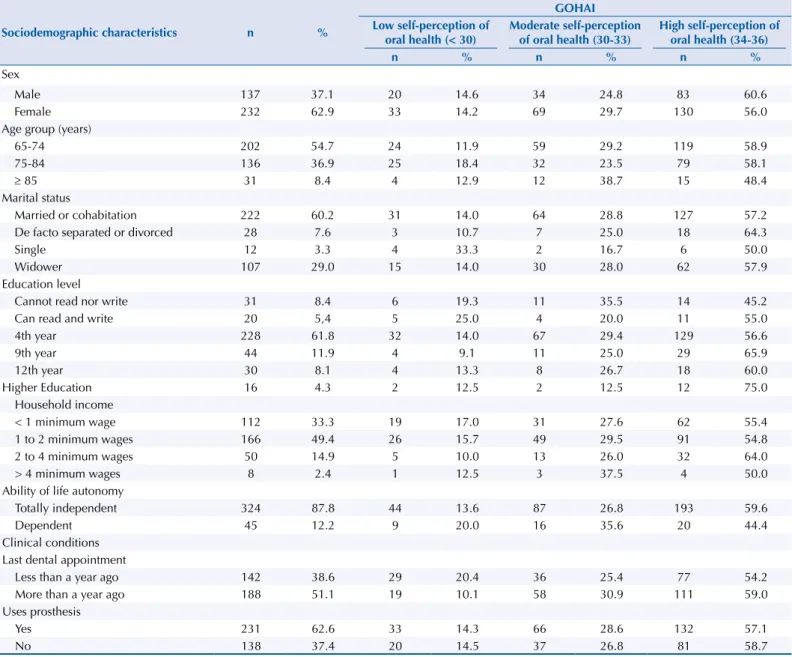
A total of 369 older adults participated in the study, which correspond to 3/5 of the older population enrolled in this group. hey were aged in average 74.2 years (SD = 6.75); 62.9% were female, and 37.1% male. he vast majority was retired (95.0%); 53.9% presented education level up to four years, and 87.8% considered themselves totally independent regarding their daily activities. Only 13.0% knew that there is an oral health professional in the health center to which they belong; 51.1% did not visit a dentist for over a year; 62.6% of individuals used dental prosthesis, and 68.0% were satisied with it (Table 1).
Table 1. Sociodemographic and clinic characteristics distributed according to the categories of self-perception defined by GOHAI.Health
Centers North Lisbon, 2012-2013.
Sociodemographic characteristics n %
GOHAI Low self-perception of
oral health (< 30)
Moderate self-perception of oral health (30-33)
High self-perception of oral health (34-36)
n % n % n %
Sex
Male 137 37.1 20 14.6 34 24.8 83 60.6
Female 232 62.9 33 14.2 69 29.7 130 56.0
Age group (years)
65-74 202 54.7 24 11.9 59 29.2 119 58.9
75-84 136 36.9 25 18.4 32 23.5 79 58.1
≥ 85 31 8.4 4 12.9 12 38.7 15 48.4
Marital status
Married or cohabitation 222 60.2 31 14.0 64 28.8 127 57.2
De facto separated or divorced 28 7.6 3 10.7 7 25.0 18 64.3
Single 12 3.3 4 33.3 2 16.7 6 50.0
Widower 107 29.0 15 14.0 30 28.0 62 57.9
Education level
Cannot read nor write 31 8.4 6 19.3 11 35.5 14 45.2
Can read and write 20 5,4 5 25.0 4 20.0 11 55.0
4th year 228 61.8 32 14.0 67 29.4 129 56.6
9th year 44 11.9 4 9.1 11 25.0 29 65.9
12th year 30 8.1 4 13.3 8 26.7 18 60.0
Higher Education 16 4.3 2 12.5 2 12.5 12 75.0
Household income
< 1 minimum wage 112 33.3 19 17.0 31 27.6 62 55.4
1 to 2 minimum wages 166 49.4 26 15.7 49 29.5 91 54.8
2 to 4 minimum wages 50 14.9 5 10.0 13 26.0 32 64.0
> 4 minimum wages 8 2.4 1 12.5 3 37.5 4 50.0
Ability of life autonomy
Totally independent 324 87.8 44 13.6 87 26.8 193 59.6
Dependent 45 12.2 9 20.0 16 35.6 20 44.4
Clinical conditions Last dental appointment
Less than a year ago 142 38.6 29 20.4 36 25.4 77 54.2
More than a year ago 188 51.1 19 10.1 58 30.9 111 59.0
Uses prosthesis
Yes 231 62.6 33 14.3 66 28.6 132 57.1
No 138 37.4 20 14.5 37 26.8 81 58.7
he application of GOHAI resulted in mean values close to the upper limit of the measure variation scale for the global index (mean = 32.9; SD = 3.6) and for its three dimensions, being possible to say that the older adults favorably evaluated their oral health (Table 2). he majority (57.7%) of individuals showed high self-perception of oral health, with values greater than 33; 27.9% showed moderate self-perception (values between 30 and 33); and only 14.4%, low self-perception (values below 30).
To determine the internal consistency of the questionnaire, we used the Cronbach’s alpha (α), obtaining a value of α = 0.805. Individuals aged 75-84 years have 1.670 (90%CI 1.003–2.783; p = 0.098) more probability to present self-perception of low oral health than older adults with 65-74 years. The older, with more than 85 years, have equal probability of presenting self-perception of low oral health than individuals with 65-74 years (Table 3).
Regarding the last dental appointment, older adults who had the appointment less than a year ago have 2.283 (90%CI 1.350–3.859; p = 0.010) more probability to present self-perception of low oral health than individuals who had the appointment more than a year ago.
Single individuals, 3.221 (90%CI 1.110–9.349; p = 0.071), are more likely to present self-perception of low oral health than individuals married or in cohabitation, after adjusted to age.
Regarding the last dental appointment, individuals who had the appointment less than a year ago have 2.361 (90%CI 1.391–4.009; p = 0.010) more probability to present self-perception of low oral health than individuals who had the appointment more than a year ago, after adjusted to age.
Table 2. Older adults’ self-perception of oral health: mean, confidence interval, and GOHAI variation
amplitude. Health Centers North Lisbon, 2012-2013.
Variable Mean 90%CI Variation amplitude
GOHAI 32.85 32.5–33.2 16 to 36
Physical dimension 10.7 10.6–10.9 4 to 12
Psychosocial dimension 8.4 8.3–8.5 4 to 9
Pain or discomfort dimension 13.7 13.5–13.8 6 to 15
GOHAI: Geriatric Oral Health Assessment Index
Table 3. Factors associated with the older adults’ self-perception of low oral health. Health Centers North Lisbon, 2012-2013.
Variable ORcrude 90%CI p ORadjusted to age 90%CI p
Age (years) 0.245
65-74*
75-84 1.670 1.003–2.783 0.098
≥ 85 1.099 0.424–2.844 0.871
Marital status 0.320 0.255
Married or cohabitation*
De facto separated or divorced 0.739 0.258–2.122 0.638 0.698 0.242–2.015 0.577
Single 3.081 1.071–8.860 0.080 3.221 1.110–9.349 0.071
Widower 1.005 0.575–1.755 0.989 0.883 0.494–1.577 0.724
Last dental appointment 0.033 0.026
More than a year ago*
Less than a year ago 2.283 1.350–3.859 0.010 2.361 1.391–4.009 0.008
Does not know 1.348 0.557–3.262 0.579 1.345 0.554–3.268 0.583
DISCUSSION
Older adults, aged 65 years old or more, enrolled in the Health Centers Grouping North Lisbon, present a self-perception of moderate, with tendency to high, oral health. From the studied sociodemographic variables, only age, marital status, and the last dental appointment were factors signiicantly associated with self-perception of oral health.
Currently, there is an increasing interest in studies of self-perception of health for knowing and monitoring it, and studies of this nature are increasingly recommended by the World Health Organization (WHO)18. his study came to add new data to this ield, hitherto little explored in Portugal.
he average age found among the older adults of this study was 74.15 years, and this value
is close to the most recent data on the Portuguese population of older adultsd and also to
the average found in other studies, which ranged between 67.1 and 73.5 years1,22. More than
half of the sample consisted of women, and the 2011 Censuses help to explain these results, because they indicate that the preponderance of the female population is enhanced as age increases, due to the higher life expectancy at birth of women.
As to the education level, most individuals had only the fourth year of schooling, which corresponds to the data of the 2001 Labor Inquiry, which found that the older adults’
population holds, generally, low levels of educationd. he household income is a really
important variable in the analysis of the older adults’ health situation. In this study, approximately 50.0% of the sample has incomes between one and two minimum wages,
being these data according to the data provided by Eurostate.
he high percentage of individuals entirely independent may be due to the fact that the study has been performed in health centers, where they go with the capacity to do so.
he average of the GOHAI values in this study (32.9) suggested moderate self-perception of oral health of the population under study, although the analysis by classes refers to a higher perception. With median 34.0 and mode 36.0, we consider that the population of this study
has a moderate, with tendency to high, perception, as in the original version of the GOHAI1
and in other studies5, in China, Japan16, and Arabia2. Ribeiro et al., in 2012, justify these results
insofar as the older adults consider their oral health condition as good, although they have many dental losses and signiicant oral amendments. his apparent contradiction is explained by the lack of information in this age group in taking naturally that aging is associated with inevitable disabilities, such as tooth loss20.
he questionnaire presented good internal consistency (α = 0.81), indicating the validity of all questions. his also occurred in the original version in English1, which obtained Cronbach’s alpha coeicient of 0.79, and in the Portuguese version, with alpha of 0.7685. he internal
consistency was evaluated in several other countries (Spain, China, France, Sweden, Malaysia, Japan, Germany, Turkey, Jordan, and Mexico)13, obtaining á values between 0.75 (in Turkey)
and 0.92 (in Germany)21.
he most afected domain of GOHAI was the psychosocial one, suggesting that the older adults have limited their contact with other people because of the appearance of their teeth. Furtado et al.8, in 2011, and Cárdenas et al.4, in 2012, also found that the psychosocial domain is the most afected one, mainly because the older adults feel uncomfortable to eat
in front of others because of their teeth problems. Fonseca et al.7, in 2011, observed that
the most afected domain was the physical or functional one, especially in the discomfort in swallowing food. he fact that senior citizens can express themselves, share joys and anxieties, talk with others about a part of life, enjoy food, and be nourished by them are
very important performances8.
Regarding the age group, younger seniors (aged 65-74 years) showed greater self-awareness of their problems in oral health. In fact, Nunes et al.17, in 2012, showed that advancing age
dInsituto Nacional de Estaísica.
Censos 2011: resultados dei
-niivos - Região Lisboa. Lisboa; 2013 [cited 2014 Feb 16]. Avail
-able from: htp://censos.ine.pt/ xportal/xmain?xpid=CENSOS&x
-pgid=ine_censos_publicacao_de
-t&contexto=pu&PUBLICACOES
-pub_boui=377750&PUBLICACOES
-modo=2&selTab=tab1&pcen
-sos=61969554
eEUROSTAT. Populaion structure
contributed to worsen the self-perception of the oral health state, noting greater tendency for values of self-perception of low of oral health in individuals between 75-84 years. Miranda et al.15, in 2011, found better results in seniors over 75 years old, and the authors relate
these values to the older adults’ adaptation process or the recognition of the deterioration of health conditions as normal in aging.
As for marital status, single individuals were the ones who showed lower values of self-perception, similar results to other studies15,17-19. his may be due to the high impact
of loneliness on life quality, suggesting that individuals who live alone may present lower emotional stability which, in turn, induces a low perception level9.
Regarding the last dental appointment, individuals who had the last appointment less than a year ago have a higher tendency to present lower values of self-perception of oral health. In fact, older adults tend to visit a dentist only when they have oral problems associated
with pain or discomfort14. Still, those visits are determined by bad past experiences or
phobias, which could generate a vicious cycle: less visits can exacerbate problems of oral health. On the other hand, this tendency toward a lower self-perception of oral health may be related to a greater awareness of older adults regarding their oral health, considering the recent visit to their dentist6.
It is still likely that the low association of these variables in relation to the self-perception of oral health can be explained by the low prevalence of a dentist visit in the previous year. his may relect the lack of access to the services of medical-dental assistance, which in Portugal are mostly private3.
Regarding the limitations of this study, one of them is the fact of not carrying out clinical examination with the questionnaire, which should be implemented in the future, making it possible to evaluate the behavior of the clinical conditions of the oral cavity in relation to the self-perception of each one and vice versa. Additionally, the sample was of convenience and of relatively small size, which can condition the representativeness of the studied population. For example, the fact that there are usually more women in health centers and that they naturally have an increased availability to take part, can condition the representativeness of the sample6,19. To obtain more solid and useful conclusions for society, it is necessary to carry
out more comprehensive and representative studies and with a larger number of participants.
his study represents a starting point so that we can know better the oral health conditions of the older users of primary health care. he study also shows the usefulness of GOHAI to guide the planning strategies and oral health promotion directed toward a better life quality of this population group.
In this sense, it is important to educate about oral health, instilling prevention measures, which, in addition to reducing the problems, help to aware every one about their real needs for treatment.
REFERENCES
1. Atchison KA, Dolan TA. Development of the Geriatric Oral Health Assessment Index. J Dent
Educ. 1990;54(11):680-7.
2. Atieh MA. Arabic version of the Geriatric Oral Health Assessment Index. Gerodontology.
2008;25(1):34-41. DOI:10.1111/j.1741-2358.2007.00195.x
3. Bravo M, Cortés J, Casals E, Llena C, Almerich-Silla JM, Cuenca E. Basic oral health goals for
Spain 2015/2020. Int Dent J. 2009;59(2):78-82. DOI:10.1922/IDJ_2035Cortes05
4. Cárdenas SD, Vergara KA, Martínez KR. Impacto de la salud oral en la calidad de vida de
adultos mayores. Rev Clin Med Fam. 2012;5(1):9-16. DOI:10.4321/S1699-695X2012000100003
5. Carvalho C, Manso AC, Escoval A, Salvado F, Nunes C. Tradução e validação da versão
portuguesa do Geriatric Oral Health Assessment Index (GOHAI). Rev Port Saude Publica.
6. Dolan TA, Atchison KA, Huynh TN. Access to dental care among older adults in the United
States. J Dent Educ. 2005;69(9):961-74.
7. Fonseca PHA, Almeida AM, Silva AM. Condições de saúde bucal em população idosa
institucionalizada. Rev Gaucha Odontol. 2011;59(2):193-200.
8. Furtado DG, Forte FDS, Leite DFBM. Uso e necessidade de prótese em idosos:
reflexos na qualidade de vida. Rev Bras Cienc Saude. 2011;15(2):183-90.
DOI:10.4034/RBCS.2011.15.02.08
9. Haikal DSA, Paula AMB, Martins AMEBL, Moreira AN, Ferreira EF. Autopercepção da saúde
bucal e impacto na qualidade de vida do idoso: uma abordagem quanti-qualitativa. Cienc Saude
Coletiva. 2011;16(7):3317-29. DOI:10.1590/S1413-81232011000800031
10. Kravitz AS, Treasure ET. EU manual of dental practice: version 4. Wales: Council of European Dentists; 2008.
11. Locker D, Allen F. What do measures of ‘oral health-related quality of life’ measure? Community
Dent Oral Epidemiol. 2007;35(6):401-11. DOI:10.1111/j.1600-0528.2007.00418.x
12. Mariño R, Abala C, Sanchez H, Cea X, Fuentes A. Self-assessed oral-health status
and quality of life of older Chilean. Arch Gerontol Geriatr. 2013;56(3):513-7.
DOI:10.1016/j.archger.2012.12.004
13. Martinicorena FJC. Medición de la salud y la enfermedad en odontología comunitaria. In: Sala EC, García PB, editores. Odontología preventiva y comunitária: princípios, métodos y aplicaciones. 3.ed. Barcelona: Masson; 2005. p.337-69.
14. Mesas AE, Andrade SM, Cabrera MA. Factors associated with negative self-perception of oral
health among elderly people in a Brazilian community. Gerodontology. 2008;25(1):49-56.
DOI:10.1111/j.1741-2358.2007.00196.x
15. Miranda LP, Silveira MF, Miranda LP, Bonan PRF. Autopercepção das condições bucais em
uma população de idosos da cidade de Montes Claros, Minas Gerais, Brasil. Rev Bras Geriatr
Gerontol. 2011;14(2):251-69. DOI:10.1590/S1809-98232011000200007
16. Naito M, Suzukamo Y, Nakayama T, Hamajima N, Fukuhara S. Linguistic adaptation and validation of the General Oral Health Assessment Index (GOHAI) in an elderly Japanese
population. J Public Health Dent. 2006;66(4):273-5.
17. Nunes APN, Barreto SM, Gonçalves LG. Relações sociais e autopercepção da
saúde: projeto envelhecimento e saúde. Rev Bras Epidemiol. 2012;15(2):415-28.
DOI:10.1590/S1415-790X2012000200019
18. Peres MA, Masiero AV, Longo GZ, Rocha GC, Matos IB, Najnie K, et al.
Auto-avaliação da saúde em adultos no Sul do Brasil. Rev Saude Publica. 2010;44(5):901-11.
DOI:10.1590/S0034-89102010000500016
19. Reichert FF, Loch MR, Capilheira MF. Autopercepção de saúde em adolescentes, adultos e
idosos. Cienc Saude Coletiva. 2012;17(12):3353-62. DOI:10.1590/S1413-81232012001200020
20. Ribeiro D, Pires I, Pereira ML. Comportamentos e auto-percepção em saúde oral de uma
população geriátrica da região do Porto, Portugal. Rev Port Estomatol Med Dent Cir Maxilofac.
2012;53(4):221-6.
21. Sánchez-García S, Heredia-Ponce E, Juárez-Cedillo T, Gallegos-Carrillo K, Espinel-Bermúdez C, Fuente-Hernández J, et al. Psychometric properties of the General Oral Health Assessment
Index (GOHAI) and dental status of an elderly Mexican population. J Public Health Dent.
2010;70(4):300-7. DOI:10.1111/j.1752-7325.2010.00187.x
22. Silva DD, Held RB, Torres SVS, Sousa MLR, Neri AL, Antunes JLF. Autopercepção da saúde
bucal em idosos e fatores associados em Campinas, SP, 2008-2009. Rev Saude Publica.
2011;45(6):1145-53. DOI:10.1590/S0034-89102011005000068
23. Silva SRC, Castellanos Fernandes RA. Autopercepção das condições de saúde bucal por idosos.
Rev Saude Publica. 2001;35(4):349-55. DOI:10.1590/S0034-89102001000400003
Authors’ Contribution: Conception and planning of the study: CC, AM, AE, FS, CN. Data collection: CC, AM, FS. Data analysis and interpretation: CC, CN. Preparation or writing of the manuscript: CC Critical review of the manuscript: CC, AM, AE, FS, CN. Final approval: CC, AM, AE, FS, CN.