DEVELOPING AND EVALUATION OF A WEBSITE ABOUT
CHILDREN’S LANGUAGE DEVELOPMENT: PORTAL DOS
BEBÊS – DESENVOLVIMENTO DA LINGUAGEM
Elaboração e avaliação de um website sobre o desenvolvimento da
linguagem infantil: portal dos bebês – desenvolvimento da linguagem
Aline Martins(1), Elen Caroline Franco(1), Magali de Lourdes Caldana(3)
(1) Faculdade de Odontologia de Bauru / Universidade de São
Paulo – FOB/USP, Bauru, São Paulo, Brasil.
(2) Fonoaudiologia da FOB/USP – Bauru, SP, Brasil.
Financial disclosure: Tutorial Education Program – MEC/Sesu
Conlict of interest: non-existent
and, it is mostly carried out in the family and school
environment through verbal instructions during
daily activities such as breastfeeding / feeding and
bathing2. Therefore, even before learning how to
speak, children have access to values, beliefs and rules, acquiring knowledge of their culture and their
language3.
Considering that, parents and/or caregivers
have a major role in the development of language,
by assigning meaning and intention to the child communication and mainly by assuming the position
of representative of the language.
For the interaction between parents and/or caregivers with the child becomes more effective, it is important to know how to make enriching commu
-nication. Thus, it is necessary to inform people about the most complex and important aspects for the development of language, enabling health
INTRODUCTION
The ability on language acquisition is a superior
ability of human being. Through it, communication becomes possible in order to express ideas, emotion and desire, as well as contribute to the development of other ields such as cognition and contribute to communicative functions1.
From the very beginning we are exposed to favorable development of language stimuli. The irst way of child socialization occurs through language
ABSTRACT
Purpose: to design and develop a website in the ield of speech therapy with a focus on development
of babies from 0 to 48 months, and furthermore, to evaluate the quality of the content presented and
technological resources used. Methods: in the irst phase of the project a survey of data through
review of literature about development and acquisition of child language was conducted. Then this content was inserted into the website and rated by 20 parents and / or caregivers. Results: the
Portal dos Bebês website – Desenvolvimento da Linguagem was developed with language directed to
parents and / or caregivers, and their content was divided into three themes: “Language Development”, “Speech and Language” and “Language and Environment”. With regard to the quality of content and presentation, the website was rated as “excellent” by all participants in the sample. Regarding the review of the vocabulary used and the presentation of content, 70% and 75% respectively, considered the website as “excellent”. Regarding the visual presentation, 85% of participants rated as “excellent”. The type of navigation was rated as “satisfactory” by 50% of participants. As to the extent that parents and / or caregivers think about the site most rated as “excellent” the aid that it gives in the language
development child. Conclusion: the Portal dos Bebês website – Desenvolvimento da Linguage can
be accessed by online address http://portaldosbebes.fob.usp.br, and its contents and technological resources were assessed as satisfactory to excellent by parents and / or caregivers participating.
by signing the authorization for the use of sounds and images. The recording data was made in a very familiar environment for the child.
Some other aspects that were considered when building the website, relate to the accessibility and usability that are fundamental to digital inclusion, aiming at ease of use. Such assumptions were guaranteed by a designer from the Institution Educational Technology team, as well as by profes
-sionals responsible for implementing the website that it was performed by a private company.
After the development of online content it started the second stage of the study in which the researcher contacted parents and / or caregivers of infants 0-48 months by sending them a letter or email explaining the purpose of the study. People contacted to participate in the study received a Term of Free and Informed Consent and after the reading it was given
the option to accept or decline their participation
by signing the term. Both options allowed access to the contents of the Portal dos Bebês, however, for those who refused to participate it was not given the questionnaire for evaluating the content of the Website.
Participants had access to the entire contents of the Portal dos Bebês, yet the survey was conducted on topics related to Language Developmental, covering the topics “Language Development”, “Speech and Language” and “Language and Environment”. After signing the consent form partici
-pants had two weeks to access the website and
complete the survey.
The questionnaire evaluated the presentation
and quality of content, visual presentation, appropri
-ateness to the public, the importance of the website and the attitudes presented towards the children.
Regarding the irst aspect the evaluated items were consistency between the content and the theme, vocabulary and form of presentation of concepts. On the visual quality it was judged the page quality, pictures, videos and type of navigation. Regarding the suitability to the audience, the reviewer judged if it was appropriate or not. Considering the importance of the website it was judged if the material helps in enhancing interaction with the child language development, also if the acquired knowledge can be used in everyday language, and if they would recommend the material to other
parents and / or caregivers. Concerning the latter
point it was veriied if the parents already had these attitudes towards children before.
All aspects were analyzed using a four-item scale, classiied as Poor, Average, Satisfactory and Excellent, and to each given concept, the evaluator had the opportunity to justify their response and
make suggestions.
promotion and prevention to the population. It is also important that the teacher knows about the stages of acquisition and regular development of
speech and language, and so, they may be able to notice the variations in child development and are
aware about the ways of stimulating oral language
and communication skills4.
It is of great importance to increase access to health information in a way to enable the community to use this knowledge in making decisions. Given this necessity it is possible to make use of distance
education technologies, so that through them it may
be possible that information reaches parents in places that there is no professional.
The use of technology, combined to the speech therapy knowledge, has been described in other
studies5-8, and the results are motivating for further research.
Therefore, the present study had as objective to design and to develop a website in the ield of speech therapy with a focus on language development of babies from 0 to 48 months, and furthermore, to evaluate the quality of the content presented and technological resources that it was used.
METHODS
The research related to the development of this study was approved by the Research Ethics Committee of our Institution, protocol number 88/2010 and there was parental consent by signing an informed consent.
The study included 20 parents and / or caregivers
of 0-48 months –children. As a criteria for inclusion
parents and / or caregivers must have taken care
of at least one child with age up to 48 month, have
internet access and do not have a degree in Speech Pathology.
The development of the study consisted of three steps. Firstly, we performed a comprehensive data collection through literature review on the devel
-opment of language, communication skills of infants, the importance of stimulation early in life, and the best way to make interaction between parents and baby richer and the different environments of child development. The content collected was organized in texts and topics, using a simple, clear and friendly
language so that any population appropriates the
knowledge.
In order to facilitate the interpretation of content, illustrative images and video were used. Three children, two girls (5 and 8 months) and a boy (2 years and 6 months) were ilmed in everyday activ
Part I: Results of the development of the website Portal dos Bebês – Language Development
The section on language website “Portal dos Bebês – Desenvolvimento da Linguagem” was elaborated from the consultation of an extensive bibliography, no limit date of publication, which was
sought in books, journal articles and reports in the
Web posted by educational institutions.
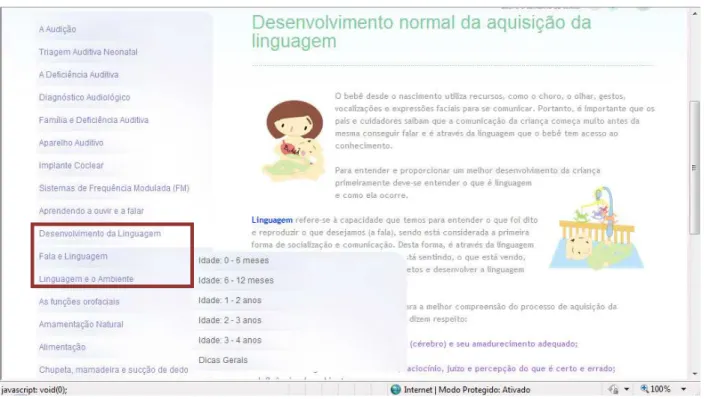
The language used was directed to parents and / or caregivers, in other words, easy to understand, not using technical terms in the ield of Speech Pathology. The content was divided in the following themes “Language Development”, “Speech and Language” and “Language and Environment” presented in igure 1. This division was made, seeking to facilitate website navigation and for
parents and / or caregivers so they could have autonomy to navigate content according to their needs and interests.
Once collected the surveys, the third step was performed in which the data were treated statistically as it was performed descriptive statistic to tabulate
the responses obtained through questionnaires to
verify the reported importance by the participants as
to the content.
RESULTS
The results will be presented in two parts: devel
-opment of the content for the website Portal dos Bebês – Language Development (http://portaldos
-bebes.fob.usp.br) and evaluating the content.
see, to form concepts of actions, objects and shapes
and develop oral language. Also it is displayed the
important factors for a successful development of language and attitudes which parents and / or caregivers must take if the baby has any change in the appropriate course of language development.
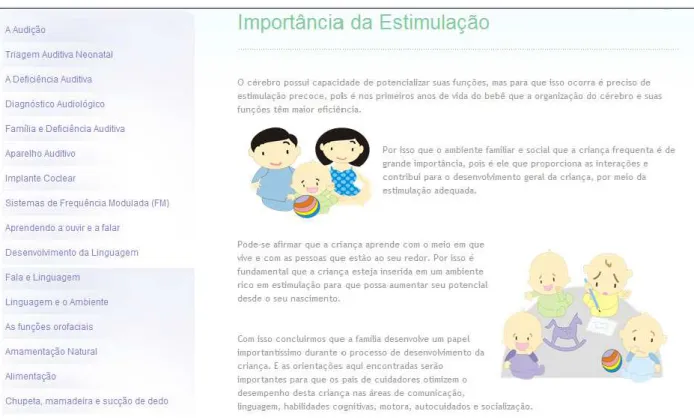
The subsection two (2) explains the importance of stimulation and interaction between baby and family and peers (Figure 2).
The irst item “Language Development” is composed of two sub items, for the normal devel
-opment of language acquisition and importance of stimulation and interaction. In subsection one (1)
language is described as the ability to understand
what it was said and play what we want, which is considered the primary way of socialization and
communication. Thus, it is through language that
babies begin to understand what they feel, what they
Figure 2 – Subclause Language Development: Importance of Stimulation
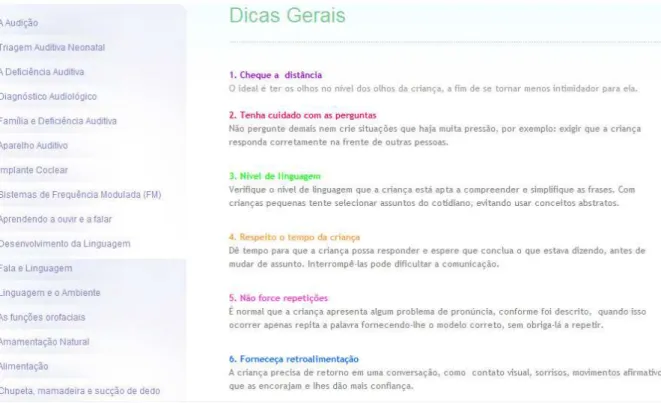
The “Speech and Language” item is divided into six sub items that address the development of language and conversational skills. These are
separated by aged 0 to 6 months, 6 to 12 months, 1
to 2 years 2 to 3 years and 3 to 4 years. Within each subsection it was approached what is expected for each age, communication skills presented, the
development of language and tips for parents and / or caregivers to know how to stimulate their child and enhance their development. To facilitate the acquisition of knowledge short videos of children in routine activities were inserted. The last subsection of this context discusses general tips and stimulation
The last subsection was “Super Protective parents”. Parents have a duty to protect their children, but when that protection becomes excessive, the development of these children can be seriously compromised. Therefore, it was described
some attitudes that parents should not take their children in language and tips to better encourage them, promoting their communicative potential.
Part II: Evaluation of the website Portal dos Bebês – Language Development by parents and / or caregivers
The website “Portal dos Bebês – Desenvolvimento da Linguagem” was rated by 20 parents and / or caregivers of infants from 0-48 months. Of these 20 participants, there were 2 caregivers, 4 fathers and 14 mothers. The age of participants varied from 24-55 years. All of them had completed secondary level at least; six of them had inished graduation and one of them had inished post-graduation.
Regarding to the quality of content and presen
-tation, the website was rated as “excellent” by all participants in the sample, when asked about the consistency between the topic and the subject proposed which is the development of children’s language. Regarding the review of the vocabulary used and the presentation of content, 70% and 75% respectively, considered the website as “excellent”, conforms illustrated in Figure 4.
The last item on the language part of the website entitled “Language and Environment” addresses child development in different environments. The sub-items are divided into “Working parents”, “Children in the Daycare Center”, “Twin Children“ and “Super protective Parents”.
The subsection “Working parents” was created because, in most families, both men and women work and a frequent concern is how to reconcile work and homework and education and child care. Therefore, the content covers how to improve the quality of communication between parents and
children.
The choice of sub-item “Children in Daycare Center” took place because many working parents worry when they need to leave their children in daycare. In this subsection it was described the role
that daycare has on child development, the
impor-tance of the contact between children and adults and the main factors that must be considered when
choosing a daycare center.
Another topic is titled “Twin Children”, this item on development of twins is a discussed aspect. This topic was selected because of the pregnancy of twins being pointed in the literature as a risk factor for the development of language, a condition that
may be related to genetic, environmental and
inter-actional factors.
(Figure 5). This result, as was justiied by the evalu
-ators, is due to the dificulty of navigation in sub items from the side menu bar.
Regarding the visual presentation, 85% of participants rated the quality of the pages presented and igures as “excellent”, the type of navigation was rated as “satisfactory” by 50% of participants
Figure 4 – Evaluating of presentation and quality of content
acquisitions that appear during this period of devel -opment9,10. It was also observed in this study, the
parents’ dificulty in adjusting to new expressions of their children, in which 17 parents and / or caregivers do not know how to deal with situations of devel
-opment of the children and do not have knowledge of the importance of stimulation.
Children have great potential for learning11, the
early years are essential for the vital processes of development occur in all domains of the functions. At birth, the child’s brain responds to spoken language already, but progressive maturation of interhemi
-spheric functional connectivity is established with the language exposure1.
The knowledge of parents and / or caregivers concerning the normal development of language acquisition is fundamental so that they know how to deal and what to expect of children at each stage of development, without requiring beyond or below what the child can provide. Moreover, with the development of this study, it was attempted to provide knowledge for parents and / or caregivers can identify as early as possible so that, if necessary, the intervention process is performed.
When parents and / or caregivers were asked about the importance of the website for the devel
-opment of language and their attitudes to children, three of them replied that their attitudes towards them were the same as described by the website, but they found the content very important to assist children’s language development. The other 17
parents and / or caregivers reported that they had
all described attitudes and that after seeing the website and browsing through its contents, some attitudes towards children have changed or at least attempted to modify, improving the development potential of themselves.
DISCUSSION
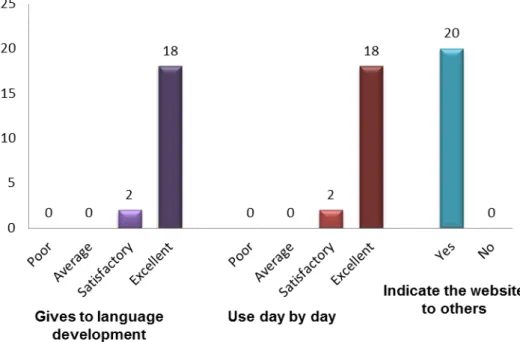
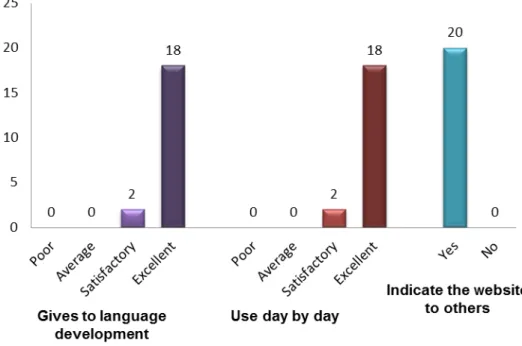
Parents and / or caregivers have a fundamental role of strengthening the skills, giving communicative intent to the actions of children and observing the course of their development. However, parents and / or caregivers may not have suficient knowledge of language development and the importance of stimulation. So the new capabilities of the child can be a challenge for them, they need to adapt to new requirements and learn how to deal with the Regarding the importance of the site parents and
/ or caregivers it can be observed in Figure 6 that it
was mainly rated as “excellent” the aid that gives to language development of the child and that the
proposed strategies and content are important for
the use day by day. All parents and / or caregivers
of the sample reported in the survey that they would indicate the website to others.
of the website was the one that required longer time, because of the concern of the researchers to
develop a material that addresses important content in a clear and objective manner, stimulating reading
and navigation of the website interactively.
In this context, it is important to consider that the learning process is inluenced by many aspects and that there are differences in how people learn. According to this, people retain more information when these are acquired along with illustrations,
pictures and videos17. For this reason, researchers
took great care on the quality of images and videos, as this study was rated between good and excellent
by users.
CONCLUSION
The planning and design of the website required most of the time, as required extensive research for the selection, deinition and organization of content.
The process of evaluation by parents and / or caregivers was effective to check out quality to the material and achieve the stated goal of taking infor
-mation about the children’s language development for parents and / or caregivers.
These guidelines allow prevention of delays in development and enable an early diagnosis of impaired oral communication. Thus, the creation of the website is of great importance, as it combines the basic information about children’s language development, allowing access to guidance when
needed. From this study, anyone can have access to
such information by address http://portaldosbebes. fob.usp.br, which was reported as satisfactory to excellent by parents and / or caregivers.
It is very important to increase access to health information for the community to use this knowledge when making decisions. For this, the internet has been a valuable tool for dissemination of speech therapy knowledge. As for virtual mentoring programs is crucial that they are a source of infor -mation and social support playing an important role
in the transmission of information12.
According to the Brazilian legislation, distance education is a way of teaching that enables self-learning, with the mediation of systematically organized teaching resources, presented in various media of information, used isolated or combined,
and transmitted by various media13. In the area
of Speech Pathology in 2009, the Federal Board of Speech Pathology regulated the practice of
telehealth through Resolution 36614.
The use of the Internet makes available infor
-mation using multimedia features, with access to a wide extent and cost, plus the ability to reach remote locations and include various groups of
population15. Faced with this it was found that the
best way to provide knowledge and guide parents
and / or caregivers about child development so
that they can take more assertive attitudes towards children was creating the website “Portal dos Bebês – Desenvolvimento da Linguagem”.
A review of this material by users was of great importance for improving the website. Several studies that verify the acceptance of the population
had the opposite telehealth user approval12,16. The
same result was found in this study, in which all evaluators classiied the website as satisfactory and excellent.
The creation of website makes it easier and standardizes the orientations to parents, focusing
REFERENCES
1. Perani D, Saccuman MC, Scifo P, Anwander A, Spada D, Baldoli C et al. Neural language networks at birth. Proc Natl Acad Sci USA. 2011;108(45):1-6. 2. Scopel RR, Souza VC, Lemos SMA. A inluência do ambiente familiar e escolar na aquisição e
no desenvolvimento da linguagem: revisão de
literatura. Rev CEFAC. 2012;14(4):732-41.
3. Rowe ML. A longitudinal investigation of the role of quantity and quality of child-directed speech in vocabular development. Child Dev. 2012;83(5):1762-74.
4. Mendonça JE, Lemos SMA. Promoção da saúde e ações fonoaudiológicas em educação infantil. Rev
CEFAC. 2011;13(6):1017-30.
5. Blasca WQ, Maximino LP, Galdino DG, Campos K, Picolini MM. Novas tecnologias
educacionais no ensino da audiologia. Rev CEFAC.
2010;12(6):1017-24.
6. Silva ASC, Rizzante FAP, Picolini MM, Campos K, Correa CC, Franco EC et al. Bauru school of
dentistry tele-health league: an educational strategy
applied to research, teaching and extension
among applications in tele-health. J. Appl. Oral Sci. 2011;19(6):599-603.
7. Correa CC, Martins A, Pardo-Fanton CS,
Silva ASC, Barros GTT, Wen CL et al. Ações de teleducação interativa em saúde vocal baseadas na
RESUMO
Objetivo: criar e desenvolver um website na área de fonoaudiologia com enfoque no desenvolvimento
da linguagem de bebês de 0 a 48 meses, além de avaliar a qualidade do conteúdo apresentado e os recursos tecnológicos utilizados. Métodos: na primeira fase do projeto foi realizado um levanta
-mento de dados por meio de revisão de literatura sobre o desenvolvi-mento e aquisição da linguagem infantil. Em seguida esse conteúdo foi inserido no website e avaliado por 20 pais e/ou cuidadores.
Resultado: o website Portal dos Bebês – Desenvolvimento da Linguagem foi desenvolvido com lin
-guagem voltada a pais e/ou cuidadores, e seu conteúdo foi dividido em três temas: “Desenvolvimento da Linguagem”, “Fala e Linguagem” e “Linguagem e o Ambiente”. No que se refere à qualidade do conteúdo e da apresentação, o website foi avaliado como “excelente” por todos os participantes da
amostra. Quanto à avaliação sobre o vocabulário utilizado e a forma de apresentação do conteúdo, 70% e 75% respectivamente, consideraram o website como “excelente”. Em relação à apresentação visual, 85% dos participantes classiicaram como “excelentes”, já o tipo de navegação foi classiicado como “satisfatório” por 50% dos participantes. Quanto à importância que os pais e/ou cuidadores jul
-gam sobre o site a maioria classiicou como “excelente” o auxilio que o mesmo dá no desenvolvimento da linguagem da criança. Conclusão: o website Portal dos Bebês – Desenvolvimento da Linguagem
pode ser acessado pelo endereço online http://portaldosbebes.fob.usp.br, e seu conteúdo e recur
-sos tecnológicos utilizados foram avaliados como satisfatório a excelente pelos pais e/ou cuidadores
participantes.
DESCRITORES: Desenvolvimento da Linguagem; Linguagem Infantil; Educação a Distância
dinâmica do projeto jovem doutor. Distúrb. Comun. 2012;24(3):359-68.
8. Picolini MM, Blasca WQ, Richieri-Costa A, Maximino LP. A elaboração de um ambiente virtual de aprendizagem em síndromes genéticas. Rev
CEFAC. 2013;15(2):382-90.
9. Lopes RCS, Oliveira DS, Vivian AG, Bohmgahren LMC, Piccinini CA. Sentimentos maternos frente ao desenvolvimento da criança aos 12 meses: convivendo com as novas aquisições infantis. Psic.:
Teor. e Pesq. 2007;23(1):5-16.
10. Paula LIC, Pires CD, Mascarenhas TS, Costa JPL, Brito LMO. Percepção da associação entre estimulação ambiental e desenvolvimento normal por mães de crianças nos três primeiros anos de
vida. Rev Paul Pedriatr. 2013;31(2):211-7.
11. Marinho MFJ. A mente do seu ilho: como estimular as crianças e identiicar os distúrbios psicológicos na infância. Ciência & Saúde Coletiva.
2010;15(2):609-10.
12. Shohan S, Heber M. Characteristics of a virtual community for individuals who are d/Deaf and hard of hearing. American Annals of the deaf.
2012;157(3):251-63.
[acesso em 2007 mar 23]. Disponível em http:// www.mec.gov.br/home/legislacao/default.htm 14. Spinardi-Panes AC, Lopes-Herrera SA, Maximino LP. Aspectos éticos e legais na prática da telessaúde em Fonoaudiologia. Rev CEFAC. 2013;15(4):1040-3.
15. Wen CL. Telemedicina – visão sob foco de uma
disciplina. Rev Telem Telessaude. 2006;2(2):20.
Received on: January 29, 2014 Accepted on: May 09, 2014
Malling address: Elen Caroline Franco
Al. Dr. Octávio Pinheiro Brisolla, 3-21 B, Santa Tereza
Bauru – SP – Brasil CEP: 17012-059
E-mail: [email protected]
16. Campos K, Oliveira JRM, Blasca WQ. Processo de adaptação de aparelho de ampliicação sonora individual: elaboração de um DVD para auxiliar a orientação a indivíduos idosos. Rev Soc Bras
Fonoaudiol. 2010;15(1):19-25.