SEMANTIC CHANGES IN THE STATEMENTS OF CHILDREN
IN THE PROCESS OF DEVELOPMENT OF ORAL LANGUAGE:
PRELIMINARY STUDY
Variações semânticas nos enunciados de crianças em processo
de desenvolvimento da linguagem oral: estudo preliminar
Tatiana Rocha Silva(1), Denise Brandão de Oliveira e Britto(2)
(1) Pontifícia Universidade Católica de Minas Gerais, Belo Horizonte, MG, Brazil.
(2) Pontifícia Universidade Católica de Minas Gerais, Belo Horizonte, MG, Brazil.
Study developed at Centro Clínico de Fonoaudiologia (Clinical Center for Speech – Language Pathology and Audiology), Ponti-fícia Universidade Católica de Minas Gerais – PUC Minas – Belo Horizonte (MG), Brazil.
Conlito de interesses: inexistente
words is fundamental for understanding of the acquisition process and language development 2.
The semantics is the coating intellectual and rational of the language. Is the responsible by under-standing the value of things of the world. It depends much more of the enunciate/interlocutor than of the enunciator/ announcer. The semantic is the responsible great by understanding and unpleas-antness among people. It is also the responsible
by expansion of the tongue by of the resource of
the polysemy. This is the attribution of many senses for an only word. The sense different submitted by
same word depends on context wherein she is used
or for which she is directed 3,4.
The human language is polysemic, because the signs, having an arbitrary character and gaining their value in relations with other signs, suffer changes of
meaning in each context. The polysemy depends on the fact of the signs be used in different contexts 5,6.
The semantic studying not only the meaning of
words, but also the of the utterances and texts. The semantic is fully context-dependent. As there silent
language, only of thinking, the behavior and the
INTRODUCTION
The human holds a mental lexicon, and this is
accessed when there the desire to represent, by words, an object, an action, an attribute, an event. The learning of words and how to use them accord-ingly is a fundamental aspect of the language devel-opment 1,2.
The process of lexical acquisition is complex
and the their research requires a look from different perspectives. The learning of words more than any other aspect of the linguistic acquiring is found at intersection of the cognitive and linguistic devel-opment. Understanding how children learn new
ABSTRACT
Purpose: to analyze the semantics of the statement of changes were in the process of development of language. Methods: the study included 10 children in the process of development of language, between three and four years, without complaint and / or hearing and cognitive impairments. Data collection was performed through the observation and recording, audio and video, playful interaction situations Results: in the statements of children aged 3 years, it was observed that there was a
higher occurrence of super-extension only in relation to sub-extension (p=0,039) and that there was a trend to higher incidence when compared with the proximity phonologic (p=0,053), deitic (p=0,053) and relation of contiguity (p=0,083). In the statements of children aged 4 years, there was a higher occurrence of periphrasis in relation to sub extension (p=0,012) and proximity phonologic (p=0,012).
There was no difference between the semantic changes studied between the ages of 3 and 4 years.
Conclusion: the variations were most frequent semantic super-extension and periphrasis.
discern meaning of each word and of the speech produced by people constitute a task that depends
both on external factors as internal possibilities of
each subject 11-15.
There are individual differences in language development both during periods in which certain characteristics should appear as the speed and in the quality of language. These factors are relate the internal capabilities of each individual and to the environment, that must be rich in stimuli and enable
various experiments 16,17.
The language is shown by a clear link between
gestures, word, syntax and communicative intent or
desire and wanting to transmit one or more persons an message for this to be reciprocated. No doubt, develop language is more than talk. Is be an active partner the different social relations and this means that the language must communicate about what the individual wants, whether, knows and feels.
This language should also relect that the individual
understood, the sense implied therein and not
always explained, nay, the intentions, desires, wills,
requirements of the other should be interpreted for the child can interact 18,19.
The individual act whereby the tongue is used
irst inserts the announcer as parameter under
conditions necessary of the enunciation. Before the enunciation, the language is not but the possibility of speaking. After the enunciation, the language is performed in an instance of discourse, emanating from a speaker, sound form that reaching a listener and that raises another enunciation of return 20.
Learning and knowing a language implies knowledge of the meanings agreed of certain sounds chains, knowing these units combine other wider, also carrying meanings. The importance of semantic in the acquisition and development of language states in that the fact of a language there through the content that conveys, once the child learn under his pragmatic aspects and semantic before focusing in morphological and syntactic aspects 21,22.
It is known that there is a strong synchronism
between the development lexical and the phono -logical system. There are children with little phonetic repertoire that tend to have relatively few words
stored in the lexicon, and children with wide vocab -ulary and relatively complete repertoire. If a child has few phonemes at hand and attempts to produce large number of different words, she simply not can, because it does not have enough sounds to produce these words, producing, then, homonymous forms,
the that makes his speech dificult to understand 22.
The semantic acquisitions of language depend on the degree of comprehension of the subject (level
experiments and of the internal organization of the personality are externalized by a language which
can be interpreted adequately or inadequately the intention of the speaker 7.
The studies about semantic development are intended of understand the process of acquisition of the meaning of words by children. Moreover, these
studies allow to understand as children expand
your vocabulary, with which speed and, mainly, which the phenomena that characterizing the use
of words during the development lexical. The lexical
acquisition relates to the ability of understand and produce various kinds of meanings 1,7,8.
It is noticed that, among researchers, there is a tendency in detach that the principle that governs the categorization and the concept formation is the analogy or analogical reasoning. It is understood by analogy the feature that allows put two concepts in relation, whether closer or farther. When transferring concepts of an semantic domain to another, can be produced the that that cognitive linguistics called of metaphor 4.
However, the cognitive linguistics revolutionized the study of the metaphors to propose that the metaphor is conceptual, related to the functions of thought and of language and, hence, inherent in human cognition. By integrating cognition, think and speak metaphorically would independent skills of intentionality and consciousness, may be issued effortless by ordinary people. Moreover, the conceptual system is, partly, metaphorically structured, in other words, the metaphor has an important function in the formation of concepts e of the language 6.
The notion of semantic introduces the domain of language in employment and in action, so observed in the language its mediating function between man and the man, between man and the world, between spirit and things, transmitting information,
communi-cating the experiment, enforcing adherence, raising
the response, begging, constraining; and in abstract, organizing all the life of the men. Is the language as instrument of the description and of the reasoning. Only the operation semantic of the language allows integration of society and the appropriateness to the world, and consequently the normality of thought and the development of consciousness 9-11.
All stimuli of the environment are generally interesting for the young child. And for good devel-opment of the language the curiosity for new and
the experience are essential so that all information
are added and integrated with older and so inter-nalized. So, the most information should, poste-riorly, result in communication and in language. So, discover, recognize, know, understand and
The children were selected from the Outpatient Voice, of Orofacial Motricity, of Speech and of Oral Language of the Centro Clínico de Fonoaudiologia. It is noteworthy that the children selected were in speech therapy weekly by having several complaints, eg, hoarseness, mouth breathing and changes in speech.
The responsible by the children that arrive at Centro Clínico de Fonoaudiologia da PUC Minas authorize previously, through the Consent Term, the observation and recording procedures in academic
and scientiic activitie. Therefore, this was used as
authorization for the data collection.
The semantic changes in the statements of children were analyzed by observing and recording, in audio and video, of the treatment thereof in the Centro Clínico de Fonoaudiologia da PUC Minas. For data collection we used digital camcorder of the brand Samsung, model SMX-C200BNXAZ.
Each record had, in average, of 20 to 30 minutes in duration. The copyrighted material was assisted and the situations of play interactions, with thera-pists, were transcribed and the content productions analyzed based in the discourse of children, ie, were analyzed the semantic relations or the meanings that the words have in his respective comparing the
ability to understand and expression semantics.
After transcription of the situations of play
interac-tions the semantic changes found were classiied in contiguity relation, super extension, sub extension, proximity phonological, periphrasis, nonverbal semiotic, deictic and variations unclassiied 17,19.
It is understood by contiguity relation the
substitution the word expected by another, involving
sense relations. These relations can be the part for the whole, the contingent for the content, the material for the object, the place by brand, the product by brand, the gender by species, the possessor
by possessed, and vice versa. Example: cop by
“man” 17,19.
The super extension is the use of word of the
same semantic ield of the word expected, attrib -uting a trace signifying that not has. Thus, there
an expansion of the semantic ield of the word. Example: “Dog” for cat. The sub extension is the use of an word to represent only a subset of traces
of signiication that the word has. So, there an reducing the semantic ield of the word. Example:
“whelp” for teddy bears 17,19.
The proximity phonological is the use of an
word that has phonology similar the expected word. Example: “stufing” by breaded. The periphrasis is
the substitution the word expected by word or phrase that designate function, action or place. Example:
giraffe – have there at the zoo. The nonverbal semiotic is the use of gestures or onomatopoeia for world around you). The things and the objects will,
through the symbolic function, acquire a “consis-tency” different. They begin to have an independent
existence, independently of the inluence that is exerted on them. The name gives the object a new
power, a new structure that associates a concept
to a signiicant, situation that will awaken in the
child the pleased to appoint. She knows that the object remains equal to itself and that the word, this
association between meaning / signiicant, remains
unchanged 23.
Do not just be a desire to communicate, there is also a need of there is something to be commu-nicated, namely, a content. Everyone has ideas, feelings, concepts, desires and emotions, and is
exactly talking about this: about things, about their experiences, ideas and desires. This is content that the express language by means of the semantic
relationships or the meanings that words have.
There is a search for the words that can express all
the that goes on in the mind, and this should happen
to any signiicant extent, namely, so that is commu -nicable, that makes sense to the listener 24.
Therefore, this research was justiied by the
possibility of understanding the building process semantics and its relationship to the development of oral language. Thus, the objective of the study was to analyze semantic changes in the statements of children in the process of development of oral language.
METHODS
The procedures in this study were approved by the Research Ethics Committee of Pontifícia Universidade Católica de Minas Gerais (PUC
Minas), under protocol number 0083.0.213.000-11 (Resolution 196/96 National Health Council
– CONEP).
This study was characterized by a pilot study, of descriptive typology, and qualitative and quantitative analysis. Were invited to participate in the research 10 children between 3 and 4 years, being 5 at the age of 3 years and 5 at age 4 years.
The participants of the research were selected in Centro Clínico de Fonoaudiologia (Clinical Center for Speech – Language Pathology and Audiology) of the Pontifícia Universidade Católica de Minas Gerais (PUC Minas). The subjects of this research were selected by means of the non-random sampling technique, of the type convenience sampling.
compare these variations in a same group, to
determine if the difference is statistically signiicant. It was adopted the level of signiicance of 5% (p ≤ 0,05). It was considered as trend to statistical signii
-cance the results signiicant at level of 10% (p ≤
0,10).
RESULTS
The mean age of the study population was 3,5
years (standard deviation 0,71), being 8 (80%) of the male and 2 (20%) of the female.
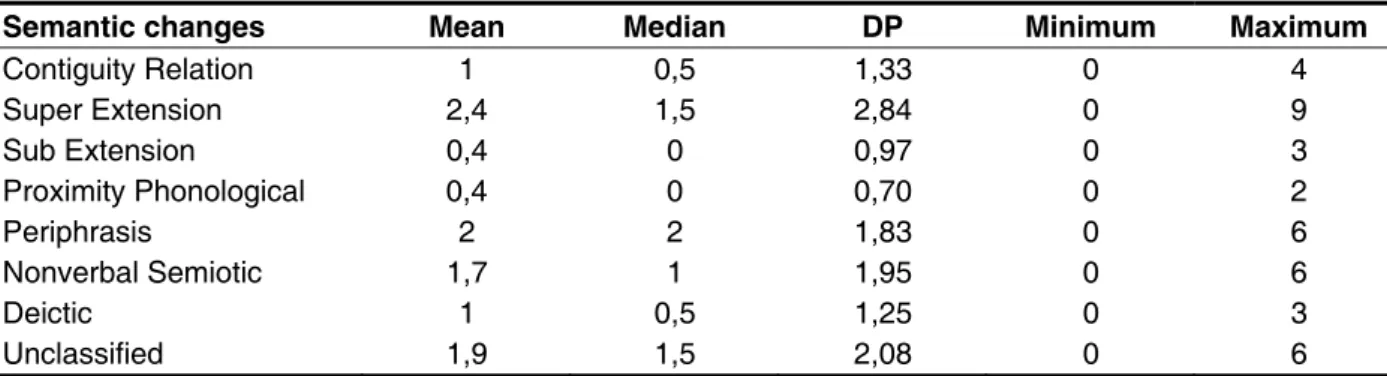
In the descriptive analysis of entire sample
observed that the super extension was the semantic
change with higher occurrence, then of the variations
unclassiied. On the other hand, the sub extension and the proximity phonological were the semantic
changes with a lower incidence. The average
occur-rence of super extension was of 2,4 times, whereas the average occurrence of sub extension and proximity phonological was of 0,4 times, in other words, the average occurrence of super extension
was greater than the average occurrence of the too
designate the igure. Example: church – puts hands juxtaposed. The deictic is the use of a pronoun or
adverb for name the igure. Example: train – that
17,19.
Were considered variations unclassiied those
that not matched the above classiications and/or were not found in the literature queried. Example:
when the child does not name, or says he does not know, or when he says “frame” for window.
Then the data collected were tabulated and subjected to statistical analysis. The statistical analysis was performed by of the software MINITAB
14. Initially was performed the descriptive analysis of the sample in relation the number of occurrences of semantic changes considering all participants. This descriptive analysis understood measures of central tendency (mean and median), of dispersion
(standard deviation) and of position (maximum and
minimum).
Besides descriptive statistics was performed the inferential statistics by of the test nonparametric Mann-Whitney. This test was conducted with the objective of compare the occurrence of semantic changes among groups (3 and 4 years), beyond
Semantic changes Mean Median DP Minimum Maximum
Contiguity Relation 1 0,5 1,33 0 4
Super Extension 2,4 1,5 2,84 0 9
Sub Extension 0,4 0 0,97 0 3
Proximity Phonological 0,4 0 0,70 0 2
Periphrasis 2 2 1,83 0 6
Nonverbal Semiotic 1,7 1 1,95 0 6
Deictic 1 0,5 1,25 0 3
Unclassified 1,9 1,5 2,08 0 6
Table 1 – Measures of central tendency, dispersion and position for the occurrences of Semantic changes considering all informants (n=10) in absolute values
Legend: DP = standard deviation
semantic changes found in the statements of the children regardless of age (Table 1).
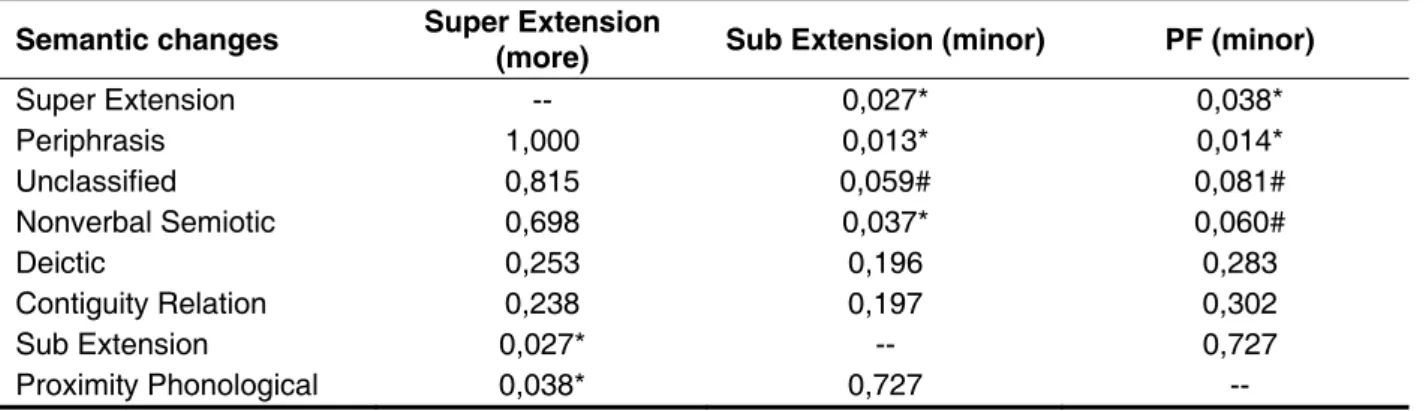
In inferential statistical analysis of entire sample observed that there higher occurrence of the
super extension compared with the sub extension (p=0,027) and proximity phonological (p=0,038).
It has also that there lower occurrence of the sub
extension in relation the super extension (p=0,027),
periphrasis (p=0,013), nonverbal semiotic
(p=0,037) and trend toward a lower incidence compared with the variations semantic unclassiied (p=0,059). Observed that there lower occurrence of the proximity phonological in relation the super extension (p=0,038), periphrasis (p=0,014) and
Semantic changes Super Extension (more) Sub Extension (minor) PF (minor)
Super Extension -- 0,027* 0,038*
Periphrasis 1,000 0,013* 0,014*
Unclassified 0,815 0,059# 0,081#
Nonverbal Semiotic 0,698 0,037* 0,060#
Deictic 0,253 0,196 0,283
Contiguity Relation 0,238 0,197 0,302
Sub Extension 0,027* -- 0,727
Proximity Phonological 0,038* 0,727 --
Table 2 – Comparison of the semantic changes with those of highest and lowest occurrence in all informants
* Signiicant values (p≤0,05) – Test Mann-Whitney
# Trend towards statistical signiicance – Test Mann-Whitney
Legend: PF = proximity phonological
nonverbal semiotic (p=0,060) and with the varia
-tions semantic unclassiied (p=0,081) (Table 2).
In the statements of the children aged 3 years
veriied that the super extension was the semantic changes more frequent. The sub extension, the
proximity phonological and the deictic were the
changes that had lower occurrence. The average
occurrence of super extension was of 3,8 times, whereas the average occurrence of sub extension, proximity phonological and deictic was of 0,6 times,
in other words, the average occurrence of super
Figure 1 – Mean of occurrence of the semantic changes in the ages 3 years and 4 years
extension was greater than the average occurrence
of the too semantic changes found in the statements of the children aged 3 years (Figure 1).
Still of the super extension be the semantic
change of higher occurrence, in the statements of the children aged 3 years, observed that there
trend toward a of the super extension only in relation
the sub extension (p=0,039) and that trend toward a higher occurrence compared with the proximity phonological (p=0,053), deictic (p=0,053) and conti
-guity relation (p=0,083). For the semantic changes
less frequent, observed that there lower occurrence
Semantic changes Extension Super (more)
Sub Extension (minor)
Proximity Phonological
(minor) Deictic (minor)
Super Extension -- 0,039* 0,053# 0,053#
Nonverbal Semiotic 0,203 0,607 0,813 0,813
Unclassified 0,133 0,607 1,000 1,000
Periphrasis 0,136 0,478 0,570 0,570
Contiguity Relation 0,083# 0,478 0,733 0,733
Sub Extension 0,039* -- 0,797 0,979
Proximity Phonological 0,053# 0,797 -- 1,000
Deictic 0,053# 0,797 1,000 --
Table 3 – Comparison of the semantic changes with those of highest and lowest occurrence in the age 3 years
* Signiicant values (p≤0,05) – Test Mann-Whitney
# Trend towards statistical signiicance – Test Mann-Whitney
lower incidence of the proximity phonological and of the deictic only compared with the super extension (p=0,053) (Table 3).
The periphrasis was the semantic change more frequent in the statements of the children aged
4 years, then of the variations unclassiied. The changes less frequent were the sub extension and the proximity phonological. The average occurrence
of periphrasis was of 3 times, whereas the average
occurrence of sub extension and proximity phono
-logical was of 0,2 times, in other words, the average occurrence of periphrasis was greater than the
average occurrence of the too semantic changes found in the statements of the children aged 4 years (Figure 1).
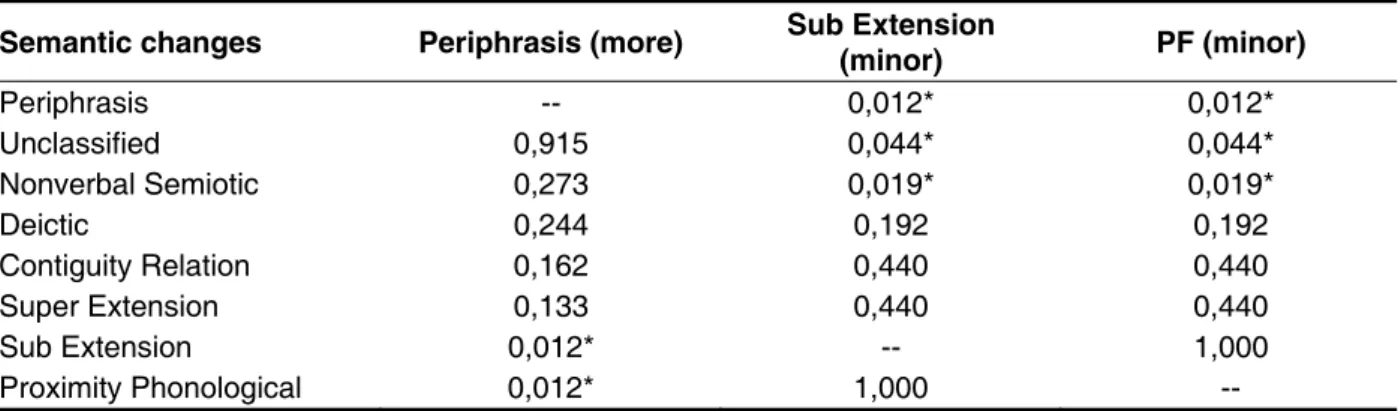
Through statistical analysis inferential observed that, in the statements of the children aged 4 years, there higher occurrence of the periphrasis in relation
the sub extension (p=0,012) and proximity phono
-logical (p=0,012). On the other hand, there lower occurrence of the sub extension and of the proximity
phonological compared with the periphrasis
Semantic changes Periphrasis (more) Sub Extension (minor) PF (minor)
Periphrasis -- 0,012* 0,012*
Unclassified 0,915 0,044* 0,044*
Nonverbal Semiotic 0,273 0,019* 0,019*
Deictic 0,244 0,192 0,192
Contiguity Relation 0,162 0,440 0,440
Super Extension 0,133 0,440 0,440
Sub Extension 0,012* -- 1,000
Proximity Phonological 0,012* 1,000 --
Table 4 – Comparison of the semantic changes with those of highest and lowest occurrence in the age 4 years
* Signiicant values (p≤0,05) – Test Mann-Whitney Legend: PF = proximity phonological
(p=0,012), with the variations semantic unclassiied (p=0,044) and with the nonverbal semiotic (p=0,019)
(Table 4).
In the comparative analysis of the semantic changes in the statements of the children aged 3 years and of 4 years observed that no there difference
showed that the conceptual system organized into categories 1,10.
Tonietto, Parente, Duvignau, Gaume e Bosa 10
also reported that the conceptual categories are
not classes closed. Unlike, seem to be ill-deined.
For this reason, in the dynamic linguistics, concepts of a category or semantic domain are easily used in another domain, evidencing the linguistic and
cognitive lexibility 10.
In this study there was no, in the statements of the
children, the using concepts of a semantic ield that were used in other semantic ield. It is noteworthy that have been observed variations unclassiied
and that the average occurrence these variations was greater in the age 4 years. In a similar study observed, also, that no there the using concepts of
a semantic ield in another category, but there were
items that were not named in the vocabulary test and the occurrence of no appointment was greater in the age 3 years 8.
During the initial acquisition of the lexicon, this
possibility of put two concepts or terms in relation raises, sometimes, linguistic productions judged
outside the norm. In effect, in the process of lexical
development, the announcer apprentice produces deviant statements in relation for adult use 10.
In this study the semantic changes observed were the contiguity relation, super extension,
sub extension, proximity phonological, periph-rasis, nonverbal semiotic and deictic. In another study with a sample of 400 children aged 3 to 6 years have been observed the semantic deviations by
contiguity relation, super extension, proximity morphological, proximity phonological,
antonymy, deictic, periphrasis and designation nonverbal8. It is noticed that only the variations sub
extension, proximity morphological and antonymy
no were common the two studies. This fact can be
justiied by difference of age range of the children
studied and by the small sample.
The children in the process of lexical acquisition
can commit many semantic deviations in function of not having still well organized the set of traces of
signiication that differentiate the use of one word from another in the different linguistic contexts. Thus, the term deviation is utilized with the inality of
represent the lack of correspondence between the meaning of the word of the adult language and the meaning of that word in the child’s language 8,17.
The semantic deviations can occur by a number of factors. Some occur because the child not can rescue of the memory the phonological form correct of the word, other by analogy, others in function of
the words can be used always in a same context. However, deviations as the super extension, for example, can occur because of the words share super extension (p=0,110), sub extension (p=1,000),
proximity phonological (p=0,518), periphrasis (p=0,113), nonverbal semiotic (p=0,452), deictic (p=0,432) and variations unclassiied (p=0,330).
DISCUSSION
Acquire words is not just talk, but under-stand the spoken word and look for it in memory. Furthermore, is using the skills metalinguistic to conclude something about the words heard. It can not be passive in the that concerns the language. It is essential that the individual to use their cognitive capacity to understand and intervene in the world.
Without a broad repertoire of words, becomes dificult
for children create new conceptual categories. With few categories, the search for meaning and under-standing becomes slower, complicating the acqui-sition of rules to form words or to accompany the communicative situations 13,14.
There are several study investigating the process
of lexical acquisition, but there is still no consensus
about as the children can correctly associate a new word to a concept, whereas there are so many possibilities to the meaning of a word. Despite the differences, the researchers agree that the
acqui-sition task lexical presents, on one side, numerous
challenges and, for other, can be facilitated by linguistic and social factors 2.
The theories of lexical development suggest
that the development of the concepts occurs in
steps or successive stages of greater complexity as
cognitive development progresses. Therefore, more developed cognitive structures allow the formation of concepts increasingly abstract and elaborate 10,11.
In the present study we observed that in the state-ments of the children aged 4 years the periphrasis
was the semantic changes of higher occurrence while that in the aged 3 years the super extension
was the changes of higher occurrence. In another study assessing the performance of children in an vocabulary test the semantic deviations more frequent in the ages 3 and 4 years were the super extension and the contiguity relation, being that the children smaller presented a number higher occur-rence that the bigger in the two deviations 8.
Several studies have sought to understand as the concepts are constructed and organized. Benedict
1 showed that memory semantics is organized by
From this assumption perceives that numerous
variables characterized lexical development. So, becomes dificult present evolutionary milestones
of the semantic development and of the linguistic skills.
The studies on the acquisition lexical revealed quite as the children begin to acquire a lexicon.
However, yet, known to relatively little about as
the children build its irst insights as that learn new
words 19.
CONCLUSION
Despite the small number of study participants, the data obtained deserve some consideration. Is,
of fact, dificult to establish procedures that can,
actually, to account of the evolution of development semantic. However, any procedure will not deplete the production possibilities and, consequently, of use of words that someone is able to produce and understand, but can characterize the performance in particular linguistic situation. So, the elaboration of procedures for evaluation of semantic becomes possible.
From the results of this study, can conclude that the semantic changes had an average occur-rence different in the groups studied. But, in the
comparison between groups no signiicant differ -ences were observed.
The similar studies number is reduced, conirming the methodological dificulty and logistics this type of
study. Thus, other studies should be conducted with a greater casuistry and having different inclusion criteria that include children in different stages of language development.
perceptual or functional traits. And, still there is the deviations that occur for communicative purposes,
in other words, the child super extend or sub extend
the meaning of a word by the fact of has not acquired a most appropriate 19.
The children begin to babble around 6 to 9 months and the irst words appear around 10 to 15 months, being that the short words are acquired irst of the that the more extensive. The semantic devia
-tions are part of the acquisition process early lexical,
disappearing or decreasing as the child increases your vocabulary 9,22.
In this study there was no difference between the ages of 3 and 4 years for the semantic changes studied. But in another study difference was observed between the ages of 3 and 4 years and no difference was observed between the ages of 5 and 6 years. The authors found yet that how much most the younger higher occurrence of items not named and that how much most increasing age lower occurrence of semantic deviations. By establishing a relationship between the age and the different types of deviations the authors observed that from 4 years no child made use of designations nonverbal and from 5 years no child made use of periphrasis 8.
There is, however, the question of as the
inluence of the middle has one effect in the task of
acquiring words. There are authors that investigated as children solve the shapes of words homonymous, in other words, as they learn to distinguish, linguisti-cally and conceptually, different concepts that have the same name. These authors, concluded that the
inluence of the means, in the which the children are
11. Bei-Lopes DM, Rodrigues A, Rocha LC.
Habilidades linguístico-pragmáticas em crianças normais e com alterações de desenvolvimento de linguagem. Pró-Fono. 2004;16(1):57-66.
12. Araújo MVM, Marteleto MRF, Schoen-Ferreira TH. Avaliação do vocabulário receptivo de crianças
pré-escolares. Estud. psicol. 2010;27(2):169-76. 13. Bei-Lopes DM, Gândara JP, Felisbino FS. Categorização semântica e aquisição lexical:
desempenho de crianças com alteração do desenvolvimento da linguagem. Rev. CEFAC.
2006;8(2):155-61.
14. Berk LE. Desarrollo del niño y del adolescente. Madrid: Prentice-Hall Iberia; 2001.
15. Johnson KN, Karrass J, Conture EG, Walden T. Inluence of stuttering variation on talker group classiication in preschool children: preliminary indings. J. commun. disord. 2009;42:195-210. 16. Sandri MA, Meneghetti SL, Gomes E. Peril
comunicativo de crianças entre 1 e 3 anos com desenvolvimento normal de linguagem. Rev.
CEFAC. 2009;11(1):34-41.
17. Clark EV. The lexicon in acquisition. Cambridge: Cambridge University Express; 1993.
18. Hoff E, Naigles L. How children use input to acquire a léxicon. Child. dev. 2002;73(2):418-33. 19. Schnack CM, Ostermann AC. Infância e família:
desenvolvimento infantil na perspectiva da fala em
interação. Psicol. relex. crit. 2010;23(2):299-307.
20. Hage SRV, Resegue MM, Viveiros DC, Pacheco
EF. Análise do peril das habilidades pragmáticas
em crianças pequenas normais. Pró-Fono.
2007;19(1):49-58.
REFERENCES
1. Benedict HE. Early lexical development: comprehension and production. J. child lang. 1979;6(2):183-200.
2. Souza DH. As crianças e o mundo das palavras: considerações sobre a pesquisa em
desenvolvimento lexical. Psicol. relex. crit. 2008;21(2):195-202.
3. Mota NB, Kaminski TI, Nepomuceno MRF, Athayde ML. Alterações no vocabulário expressivo
de crianças com desvio fonológico. Rev. soc. bras.
fonoaudiol. 2009;14(1):41-7.
4. Ricoeur P. A metáfora viva. São Paulo: Edições Loyola; 2000.
5. Fiorin JL. Introdução à linguística II:princípios de
análise. 2ª ed. São Paulo: Contexto; 2003.
6. Lakoff G, Johnson M. Metáforas da vida cotidiana.
Campinas: Educ; 2002.
7. Bastos DA, Bei-Lopes DM, Rodrigrues A.
Habilidade de organização hierárquica do sistema
lexical em crianças com distúrbio especíico
de linguagem. Rev. soc. bras. fonoaudiol.
2006;11(2):82-9.
8. Hage SRV, Pereira MB. Desempenho de
crianças com desenvolvimento típico de linguagem
em prova de vocabulário expressivo. Rev. CEFAC. 2006;8(4):419-28.
9. Benveniste É. Problemas de linguística geral II. Campinas: Pontes; 1989.
10. Tonietto L, Parente MAMP, Duvignau K, Gaume B, Bosa CA. Aquisição inicial do léxico verbal e aproximações semânticas em português. Psicol. relex. crit. 2007;20(1):114- 23.
RESUMO
Objetivo: analisar as variações semânticas do enunciado de crianças em processo de desenvolvi -mento da linguagem. Métodos: participaram deste estudo 10 crianças em processo de
desenvolvi-mento da linguagem, entre três e quatro anos, e sem queixa e/ou alterações auditivas e cognitivas. A
coleta de dados foi realizada por meio de observação e registro, em áudio e vídeo, de situações de interação lúdica. Resultados: nos enunciados das crianças na faixa etária de 3 anos, observou-se
que houve maior ocorrência da superextensão apenas em relação à subextensão (p=0,039) e que houve tendência a maior ocorrência quando comparada com a proximidade fonológica (p=0,053), dêitico (p=0,053) e relação de contiguidade (p=0,083). Nos enunciados das crianças na faixa etária de 4 anos, houve maior ocorrência da perífrase em relação à subextensão (p=0,012) e proximidade fonológica (p=0,012). Não houve diferença entre as variações semânticas estudadas entre as faixas
etárias de 3 e 4 anos. Conclusão: as variações semânticas mais frequentes foram a superextensão
e a perífrase.
DESCRITORES: Linguagem Infantil; Semântica; Simbolismo; Desenvolvimento da Linguagem;
23. Saussure F. Natureza do signo lingüístico. In: Curso de linguística geral. São Paulo: Cultrix; 1978.
p.79-84.
24. Stennes LM, Burch MM, Sen MG, Bauer PJ.
A longitudinal study of gendered vocabulary and communicative action in young children. Dev.
psychol. 2005;41(1):75-88. 21. Feldman HM, campbell TF, Kurs CMR.
Concurrent and predictive validity of parent reports of child language at ages 2 and 3 years. Child. dev.
2005;76(4):856-68.
22. Athayde ML, Mota HB, Mezzomo CL.
Vocabulário expressivo de crianças com
desenvolvimento fonológico normal e desviante. Pró-Fono. 2010;22(2):145-50.
Received on: August 23, 2012 Accepted on: February 13, 2013 Mailing address:
Tatiana Rocha Silva
Rua Boninas, 1070 – Pompeia Belo Horizonte – MG – Brasil
CEP: 30280-220