502
RESUMO: “Atividade imunomoduladora e antibacteriana de extratos de espécies da família Rutaceae.” A família Rutaceae apresenta espécies vegetais muito bem distribuídas no Semi-Árido Brasileiro e comumente usadas em medicina popular. Espécies dessa família tem diversas atividades biológicas descritas na literatura. Neste trabalho, atividades imunomoduladora e bactericida são descritas para o extrato acetato de etila e clorofórmico de três espécies da família (Esenbeckia
grandilora Mart., Pilocarpus spicatus A.St.-Hil. e Galipea simplicifolia Schult.). Todas as amostras foram inicialmente avaliadas quanto à sua citotoxicidade, com objetivo de determinar a LC50. O potencial imunomodulador foi avaliado em culturas de esplenócitos murinos estimulados ou não com concanavalina A e também em reação mista linfocitária (RML),usando também esplenócitos de camundongos BALB/c (H-2d) imunizados com esplenócitos de camundongos C57Bl/6 (H-2b). Quatro amostras tiveram os mais elevados valores percentuais de inibição da proliferação de linfócitos ativados pela concanavalina A e foram avaliados em RML. A atividade antibacteriana dos extratos foi também avaliada e a concentração mínima inibitória (CMI) para duas amostras ativas foi de 1.0 e 5.0 mg/mL, respectivamente para as espécies Esenbeckia grandilora Mart. and Galipea simplicifolia Schult. Assim, os dados aqui apresentados reforçam informações da literatura cientíica relacionados à atividade biológica para muitas espécies da família Rutaceae e incentivam outros estudos com estas visando descobrir substâncias ativas, potenciais candidatas a novos fármacos.
Unitermos: Atividade imunomoduladora, Rutaceae, atividade antibacteriana.
ABSTRACT: Rutaceae is a taxon with species very well distributed in Brazilian semi-arid area, commonly used in folk medicine. Species from this genus have diverse biological activity described in literature. In this work, immunomodulatory and bactericidal activity are described for chloroform and ethyl acetate extracts of three of them (Esenbeckia grandilora Mart., Pilocarpus spicatus A.St.-Hil. and Galipea simplicifolia Schult.). Initially all the samples had their cytotoxicity evaluated, aiming to determine the LC50. The immunomodulatory potential was evaluated in cultures of murine splenocytes stimulated or not with concanavalin A and in a mixed lymphocyte reaction (MLR) using splenocytes from BALB/c (H-2d) mice immunized with splenocytes from C57Bl/6 (H-2b) mice. Four samples had higher values of lymphoproliferation inhibition in concanavalin A-stimulated cultures and were evaluated in MLR. The antibacterial activity of extracts was also evaluated and the minimal inhibitory concentrations (MIC) for two active samples were 1.0 and 5.0 mg/ml for extracts from Esenbeckia grandilora Mart. and Galipea simplicifolia Schult., respectively. Thus, our results reinforce data of literature relating biological activity for many species of the Rutaceae family and encourage studies with these species aiming to discover active compounds, candidates to new medicines.
Keywords: Immunomodulatory activity, Rutaceae, antibacterial activity. Revista Brasileira de Farmacognosia
Brazilian Journal of Pharmacognosy 20(4): 502-505, Ago./Set. 2010
Ar
tigo
Received 27 June 2009; Accepted 12 November 2009
Immunomodulatory and antibacterial activities of extracts from
Rutaceae species
José Fernando Oliveira Costa,
1Paulo Juiz,
1André São Pedro,
1Juceni P. de L. David,
2Jorge M. David,
3Ana Maria Giulietti,
4Flávio França,
4Ricardo Ribeiro dos Santos,
1,5Milena B. P. Soares
*,1,51Fundação Oswaldo Cruz, Centro de Pesquisas Gonçalo Moniz, Laboratório de Engenharia Tecidual e
Imunofarmacologia, Rua Waldemar Falcão, 121, Candeal, 40296-750 Salvador-BA, Brazil,
2Laboratório de Produtos Naturais, Departamento do Medicamento, Faculdade de Farmácia,
Universidade Federal da Bahia, Barão de Jeremoabo, Ondina, 40170-115 Salvador-BA, Brazil,
3Departamento de Química Orgânica, Instituto de Química, Universidade Federal da Bahia, Barão de Jeremoabo,
Ondina, 40170-115 Salvador-BA, Brazil,
4Departamento de Ciências Biológicas, Universidade Estadual de Feira de Santana, Campus km 3, BR 116,
44031-460 Feira de Santana-BA, Brazil,
5Hospital São Rafael, Av. São Rafael, 2152, São Marcos, 41253-190 Salvador-BA, Brazil.
503
INTRODUCTION
The Rutaceae family is constituted of about 1800 species distributed in approximately 156 genera found in tropical and subtropical regions of the world. In Brazil,
28 genera were identiied so far, including 182 species.
Many species from Ruta and Citrus genus are commonly used in folk medicine (Joly, 1985; Cortez, 2006). In the Caatinga, a typical vegetation from the semi-arid region in
Northeastern Brazil, a checklist of biodiversity identiied
twenty genera of Rutaceae family with 88 species (Barbosa, 2006).
The Rutaceae family has been found to contain many secondary metabolites such as alkaloids, coumarins and lignans with a large spectrum of biological activities, such as antiprotozoal activity against Leishmania parasites, peripheral stimulants of parasympathetic nervous system and apoptosis inductor (Cortez, 2006; Roy, 2005).
Terpenoids are other common compounds identiied in
this family (Mafezoli, 2000). Little is known, however, about the pharmacological potential of Rutaceae species found in the Caatinga. This work aimed to study the immunomodulatory and antibacterial activities of eight extracts prepared from three species of Rutaceae native from the semi-arid area of Northeastern Brazil: Esenbeckia grandilora Mart., Pilocarpus spicatus A.St.-Hil. and
Galipea simplicifolia Schult.
MATERIALS AND METHODS
Preparation of extracts
Plant specimens were collected in the municipality of Rio de Contas, State of Bahia, Brazil (Table 1) and dried
at 40º C. Vouchers were prepared, identiied and deposited
at the Herbarium from the State University of Feira de Santana (HUEFS). Dried aerial parts of plants were used to prepare an hydroalcoholic extract through maceration in methanol and water (MeOH:H2O 6:4). The extracts were then partitioned using chloroform and ethyl acetate,
successively. The inal product was concentrated, dried
and dissolved using dimethyl sulfoxide (Sigma, St. Louis,
MO) adjusting to a inal concentration of 10 mg/mL for use
in biological assays. Samples were sterilized with gamma radiation (dose of 60,000 rads in a 137Cs source irradiator
purchased from CisBio International, France).
Animals
Male and female 4-6 weeks old BALB/c mice were used as spleen cell donors. All mice were raised and maintained at the animal facilities at Gonçalo Moniz Research Center, Fiocruz (Salvador, Brazil). Mice were provided rodent diet and water ad libitum. All mice were
sacriiced and treated according to the Oswaldo Cruz
Foundation guidelines for laboratory animals. The work
was approved by the institutional ethics Committee.
Cytotoxicity assay (lethal concentration for 50% of cells - LC50)
The cytotoxicity of the extracts was established using BALB/c mice splenocytes (5x10⁶ cells/well)
cultured in 96 plate-well in Dulbecco’s Modiied Eagle’s
Medium (DMEM, Sigma Chemical Co., St. Louis, MO) supplemented with 10% of fetal calf serum (FBS; Cultilab, Campinas, SP, Brazil) and gentamycin (Novafarma, Anápolis, GO, Brazil) at 50 µg/mL. Each extract was
evaluated in three concentrations (1, 10, and 100 μg/mL),
in triplicates. A positive control was made with cells treated with a 1% saponin solution. Cultures were incubated in the presence of 3H-thymidine (1 μCi/well) during 24 h at 37 ºC
and 5% CO2. After this period, the content of the plate was harvested to determine the 3H-thymidine incorporation
using a Beta Radiation Counter (β-matrix 9600, Packard,
Meriden, CT). The viability of the cells was determined by 3H-thymidine incorporation and the cytotoxicity was
calculated in relation to untreated cultures.
Lymphoproliferation assay
BALB/c splenocytes suspensions were prepared in RPMI medium (Life Technologies, GIBCO-BRL, Gaithersburg, MD) supplemented with 10% fetal calf serum (Hyclone, Logan, UT), 2 mM of L-glutamine, 0.1% RPMI 1640 vitamins solution (Sigma), 1 mM of sodium
pyruvate, 10 mM of Hepes, 50 μM of 2-mercaptoethanol, and 50 μg/mL of gentamycin (Sigma). Splenocytes were
cultured in 96-well plates at 4x10⁵ cells/well, in 200 μL,
in triplicate wells, in the presence of concanavalin A at 2 µg/mL (Con A) alone or various concentrations of plant extracts preparations, as described in Table 1. After 48
h, plates were pulsed with 1 μCi of 3H-thymidine for 12
h, and proliferation was assessed by measurement of 3
H-thymidine uptake, as described above. The percentage of proliferation inhibition by the extracts was determined in relation to controls stimulated by mitogen in absence of samples.
Mixed lymphocyte reaction (MLR)
BALB/c (H-2d) mice were weekly immunized
with C57Bl/6 (H-2b) splenocytes intraperitoneally (107
cells/mouse). After three weeks of immunization, mice
were sacriiced for spleen cell preparation in DMEM
medium supplemented as described above. Spleen cells were cultured in 96 plates at 5x10⁵ cells/well in the absence
or in the presence of irradiated C57Bl/6 splenocytes at 106
cells/well (dose of 3000 rad) and extracts, in triplicates. After 72 h of culture, plates were pulsed with 3H-thymidine
(1 μCi) for 12 h for proliferation assessment, as described
above.
Immunomodulatory and antibacterial activities of extracts from Rutaceae species
504 Rev. Bras. Farmacogn. Braz. J. Pharmacogn.
20(4): Ago./Set.2010
José Fernando Oliveira Costa, Paulo Juiz, André São Pedro, Juceni P. de L. David, Jorge M. David, Ana Maria Giulietti et al.
Bactericidal assays
Extracts had their antimicrobial activity
evaluated at irst through disc diffusion in Agar medium
method, proposed by Kirby Bauer and described in the Farmacopéia Brasileira (1988). Escherichia coli and
Staphylococcus aureus strains were used. The active extracts were evaluated aiming to identify the minimal inhibitory and bactericidal concentration (MIC and MBC, respectively). The MIC was obtained through dilution in 96-well plates using Mueller Hinton broth (BD, Sparks, MD, USA). The concentrations without grown of bacteria, when observed at microscopy, were used for minimal bactericidal activity determination with culture in plates containing Agar nutrient (BD, Sparks, MD, USA), a solid medium, at 37 oC during 24 h. MBC was considered the
one without growing of bacteria observed.
IC50 calculation and statistical analyses
The inhibitory concentrations for 50% of inhibition (IC50) of lymphoproliferation were calculated
based in a nonlinear regression (curve it) and the
statistical analyses were made by one-way ANOVA and Newman-Keuls multiple comparison test using GraphPad Prism version 4.00 for Windows, GraphPad Software (San Diego, CA).
RESULTS
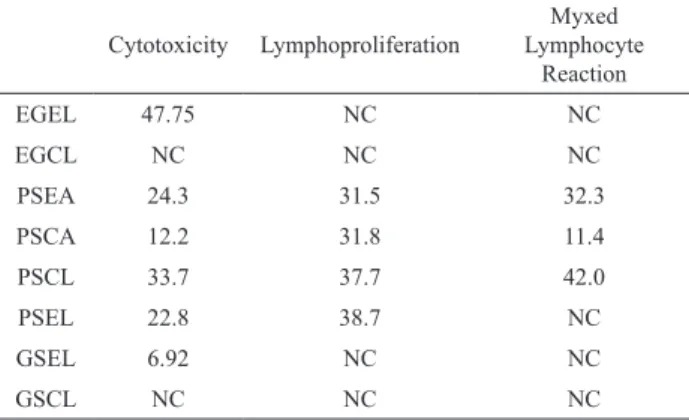
Three species of Rutaceae family had their chloroform and ethyl acetate extracts prepared from different parts of the vegetable, generating eight extracts for investigation of bactericidal and immunomodulatory activities (Table 1). The samples had their cytotoxicity assayed and LC50 values are presented in Table 2. Among the eight samples, EGEL was the one with higher LC50 value. After, PSEA, PSEL and PSCL had the most elevated values of LC50 (Table 2). PSEA was the sample with lowest LC50 value (higher cytotoxicity).
The immunomodulatory activity of the extracts was evaluated using lymphocytes proliferation assays. In
the irst assay, lymphocytes were activated by the mitogen
concanavalin A. The four most active samples were PSEA (31.5 µg/mL), PSCA (31.8 µg/mL), PSCL (37.7 µg/mL), and PSEL (38.7 µg/mL) (Table 1). The second assay for immunomodulatory activity used was the mixed lymphocyte reaction (MLR). Three samples had IC50 values calculated, as shown in Table 1: PSEA (32.3 µg/ mL), PSCA (11.4 µg/mL), and PSCL (42.0 µg/mL), being the PSCA the most active extract in this assay. EGCL and GSCL were not active.
The antibacterial activity of extracts was also evaluated. The minimal inhibitory concentration (MIC and MBC) against S. aureus for EGEL and GSEL were 1.0 and 5.0 mg/mL, respectively. EGEL, EGCL and GSCL were also active against S. aureus in 25%, 30 % and 50% of growth inhibition when compared to the inhibition produced by gentamycin.
DISCUSSION
Rutaceae species are widely known by their ethnobotanical uses in many countries in the world (Lorenzi, 2002; Moshi, 2002). Diverse biological activities of species from this family have been demonstrated, such as anti-ulcer (Li, 2005), giardicidal (Amaral, 2006), acetylcholinesterase inhibition (Barbosa-Filho, 2006), antiplasmodial (Dolabela, 2008), and trypanocidal activity
(Mafezoli, 2000). Limonoids and lavonoids are among the
active chemical components of Rutaceae species already reported (Nakagawa, 2006).
In this work the bactericidal and
immunomodulatory activities of three Rutaceae species from Brazilian semi-arid region were analyzed. Leaves or aerial parts of the vegetable were used to prepare extracts with different solvents, allowing the extraction of compounds with different polarities from different organs of the plant.
The cytotoxicity of extracts from the three Rutaceae species studied (Esenbeckia grandilora,
Pilocarpus spicatus and Galipea simplicifolia) was irst investigated to determine the LC50 values. PSCA, EGCL,
and GSEL had lower LC50 values. The irst two were
Sample Specie Localization of collect
(Rio de Contas/Bahia State/Brazil) Solv ent used Vegetable part Voucher specimen number
EGEL Esenbeckia grandilora Mart. 13o35'S/41o39'W ethyl acetate leaves HUEFS 59.790
EGCL Esenbeckia grandilora Mart. 13o35'S/41o39'W chloroform leaves HUEFS 59.790
PSEA Pilocarpus spicatus A.St.-Hil. 13o36'15"S/41o45'34''W ethyl acetate aerial parts* HUEFS 59.786
PSCA Pilocarpus spicatus A.St.-Hil. 13o36'15"S/41o45'34''W chloroform aerial parts* HUEFS 59.786
PSCL Pilocarpus spicatus A.St.-Hil. 13o36'15"S/41o45'34''W chloroform leaves HUEFS 59.786
PSEL Pilocarpus spicatus A.St.-Hil. 13o36'15"S/41o45'34''W ethyl acetate leaves HUEFS 59.786
GSEL Galipea simplicifolia Schult. 13o35'S/41o39'W ethyl acetate leaves HUEFS 59.792
GSCL Galipea simplicifolia Schult. 13o35'S/41o39'W chloroform leaves HUEFS 59.792
Table 1. Extracts prepared from Rutaceae family species.
505
Rev. Bras. Farmacogn. Braz. J. Pharmacogn. 20(4): Ago./Set. 2010
Immunomodulatory and antibacterial activities of extracts from Rutaceae species
prepared with chloroform and the last one with ethyl acetate. The ethyl acetate extract from leaves of Galipea
simplicifolia (GSEL) had the lowest LC50 (6.92 µg/mL), indicating a high toxicity.
Four samples inhibited lymphocyte proliferation induced by concanavalin A and three of them inhibited the MLR. Although there are data from the literature reporting biological activity of species from the Rutaceae family,
our results did not conirm this at least for these three
studied species studied regarding immunomodulatory
potential. This afirmative is based on values of IC50
related to the LC50 ones. If observed, the samples inhibited the lymphocyte proliferation in both models but the cytotoxicity values, expressed as LC50, were very similar to the IC50 values. This means that the inhibition of lymphoproliferation observed may be due to the cytotoxic
effects and not by a speciic mechanism. This highlights
the need of toxicological tests for the use of these plant species based in folk medicine, since biological activity is popularly considered but not its toxicity.
For the samples assayed, two of them presented antibacterial activity, EGEL and GSEL. According to the consulted literature, none of these genera had bactericidal
activity reported so far. Thus, by the irst time is reported
the bactericidal activity for these taxa.
In summary, our results show the pharmacological potential for the three species from Rutaceae family, especially regarding bactericidal activity. Further studies are needed in order to identify the active compounds
present in these extracts aiming to the identiication of
those with low toxicity.
Table 2. IC50 and LC50 values (µg/mL) of samples.
Cytotoxicity Lymphoproliferation
Myxed Lymphocyte
Reaction
EGEL 47.75 NC NC
EGCL NC NC NC
PSEA 24.3 31.5 32.3
PSCA 12.2 31.8 11.4
PSCL 33.7 37.7 42.0
PSEL 22.8 38.7 NC
GSEL 6.92 NC NC
GSCL NC NC NC
NC= non-calculated; IC50 = inhibitory concentration for 50 % and LC50= lethal concentration for 50 %.
ACKNOWLEDGEMENTS
This work was supported by CNPq, FAPESB, IMSEAR, RENORBIO, FINEP, MCT and FIOCRUZ.
REFERENCES
Amaral FMM, Ribeiro MNS, Barbosa-Filho JM, Reis AS, Nascimento RFF, Macedo RO 2006. Plants and chemical constituents with giardicidal activity. Rev Bras
Farmacogn 16: 696-720.
Barbosa MRV, Sothers C, Mayo S, Gamarra-Rojas CFL, Mesquita AC 2006. Checklist das plantas do Nordeste Brasileiro: Angiospermas e Gymnospermas. Brasília: Ministério de Ciência e Tecnologia.
Barbosa-Filho JM, Medeiros KCP, Diniz MFFM, Batista LM, Athayde-Filho PF, Silva MS, da-Cunha, EVL, Almeida JRGS, Quintans-Júnior LJ 2006. Natural products inhibitors of the enzyme acetylcholinesterase. Rev Bras
Farmacogn 16: 258-285.
Cortez LER, Cortez DAG, Ferreira AG, Vieira PC, Silva MFGF, Fernandes JB 2006. Constituintes químicos de Almeidea
coerulea (Nees & Mart.) A. St.-Hil. Rutaceae. Rev Bras
Farmacogn 16: 164-169.
Dolabela MF, Oliveira SG, Nascimento JM, Peres JM, Wagner H, Póvoa MM, Oliveira AB 2008. In vitro antiplasmodial activity of extract and constituents from Esenbeckia
febrifuba, a plant traditionally used to treat malaria in the Brazilian Amazon. Phytomedicine 15: 367-372.
Joly AB 1985. Botânica - introdução à taxonomia vegetal. São Paulo: Companhia Editora Nacional.
Li Y, Xu C, Zhang Q, Liu JY, Tan RX 2005. In vitro
anti-Helicobacter pylori action of 30 Chinese herbal medicine used to treat ulcer diseases. J Ethnopharmacol 98: 329-333.
Lorenzi H, Matos FJA 2002. Plantas Medicinais no Brasil. Nativas e exóticas. São Paulo: Editora Instituto Plantarum. Mafezoli J, Vieira PC, Fernandes JB, Silva MFGF, Albuquerque
S 2000. In vitrto activity of Rutaceae species against the trypomastigote form of Trypanosoma cruzi. J
Ethnopharmacol 73: 335-340.
Moshi MJ, Kagashe GAB, Mbwambo ZH 2005. Plants used to treat epilepsy by Tanzanian traditional healers. J
Ethnopharmacol 97: 327-336.
Nakagawa H, Takaishi Y, Tanaka N, Tsuchiya K, Shibata H, Higuti T 2006. Chemical constituents from the peels of
Citrus sudachi. J Nat Prod 69: 1177-1179. Farmacopéia Brasileira. 4.ed. São Paulo: Atheneu,1988. Roy MK, Thalang VN, Trakoontivakorn G, Nakahara K 2005.
Mahanine, a carbazole alkaloid from Micromelum
minutum, inhibits cell growth and induces apoptosis in U937 cells through a mitochondrial dependent pathway.