Article
ISSN 0102-695X doi: 10.1590/S0102-695X2011005000053 Received 19 Dec 2010 Accepted 12 Jan 2011 Available online 1 Apr 2011 Revista Brasileira de Farmacognosia
Brazilian Journal of Pharmacognosy 21(2): 209-215, Mar./Apr. 2011
Evaluation of the acute toxicity of
dolabelladienotriol, a potential antiviral from
the brown alga
Dictyota pfafi i
, in BALB/c
mice
Valéria Garrido,
1,3Gerlinde A. P. B.Teixeira,
3Valéria L.Teixeira,
2Patrícia Ocampo,
4Wilton J. Ferreira,
2Diana N. Cavalcanti,
2Sylvia M. N. Campos,
3Monique de M. B. Pedruzzi,
3Patricia
Olaya,
3Claudio C. C.dos Santos,
4Viveca Giongo,
1Izabel C. P.
Paixão
*,11Laboratório de Virologia Molecular, Departamento de Biologia Celular e
Molecular, Programa de Pós-graduação em Neuroimunologia, Instituto de Biologia, Universidade Federal Fluminense, Brazil,
2Departamento de Biologia Marinha, Instituto de Biologia, Universidade
Federal Fluminense, Brazil,
3Departamento de Imunobiologia, Programa de Pós-graduação em
Neuroimunologia, Instituto de Biologia, Universidade Federal Fluminense, Brazil,
4Laboratório de Imunologia Clínica, Departamento de Imunologia, Instituto
Oswaldo Cruz/Fiocruz, Brazil.
Abstract: Dolabelladienotriol is a product extracted from the brown marine alga Dictyota pfaffii from Brazil that has been shown to have antiviral activity and low cytotoxicity. Our studies have evaluated the acute toxicity of dolabelladienotriol in BALB/c mice for ten days after administration of a single dose. Among the parameters considered were behavior, weight, biochemical and histological analyses of blood samples taken at three different times (Bs.0, Bs.1 and Bs.2) and optical microscopic examination of organs like liver, kidney, stomach and small intestine. Mice deaths were not observed at any dose during the ten day period. There were some changes in the biochemical analysis results for urea nitrogen (BUN) and alanine aminotransferase (ALT), but the changes were not significantly different from the reference levels of the animals before administration of the substance. Histological analyses of tissues were very similar for all animals. The alterations in liver and kidney tissues did not affect the animals´ behavior at any concentration, not even at 50 mg/kg, where the most significant changes in tissues were seen. This study indicates that dolabelladienotriol has low toxicity in administered dose range.
Keywords:
Dictyota pfaffii dolabelladienotriol
acute toxicity BALB/c mice diterpene antiviral
Introduction
Marine organisms, including algae, are potentially unlimited sources of highly bioactive metabolites that represent useful prototypes for the development of new pharmaceutical agents. Algae can be classified by size as micro- or macroalgae, each being further classified according to their characteristics. Thus, marine macroalgae are further classified as green, brown and red algae. Both the crude extract and purified products derived from algae usually give a good yield of their by-products and may have therapeutic activity (El Gamal, 2010). Although
Evaluation of the acute toxicity of dolabelladienotriol, a potential antiviral from the brown alga Dictyota pfafii, in BALB/c mice
Valéria Garrido et al.
al., 2004; Cirne-Santos et al., 2008; 2006).
Pre-clinical trials are required for the determination of the degree of toxicity and efficacy of a new drug. These trials are performed in four separate stages, according to the exposure time, and are classified as: acute, repeated doses, sub-chronic and chronic toxicity (Botham, 2004; Goldim, 2007). The aim of the present study was to assess the acute toxicity of the diterpene dolabelladienotriol, a promising antiviral substance in mice.
According to the latest statistics of Unaids (Uniting the world against AIDS), a Joint United Nations Programme on HIV/AIDS, published in 2008, the number of the people living with HIV worldwide had reached an estimated 33.4 million and continues to grow. It was also forecasted that 2.7 million [2.4-3.0 million] new HIV infections and 2 million [1.7-2.4 million] deaths due to AIDS-related illnesses would occur during the year of 2008 (UNAIDS, 2009).
New drugs that are approved have been divided into seven groups: nucleoside reverse transcriptase inhibitors (NRTI), nucleotide reverse transcriptase inhibitors (NtRTI), non-nucleoside reverse transcriptase inhibitors (NNRTI), protease inhibitors (PI), fusion inhibitors (FI), co-receptor inhibitors (CRI), and integrase inhibitors (INI). This arsenal of drugs permits many combinations of antiretroviral drugs, an approach known as mega-HAAR (mega-Highly Active AntiRetroviral therapy) or salvage therapy, which often increases the drugs' side-effects and treatment costs. Moreover, if an HIV infection becomes sufficiently resistant to antiretroviral drugs, treatment becomes more complicated and the prognosis may deteriorate. However, treatment options tend to improve as additional new drugs enter into clinical trials (Mehellou & De Clercq, 2010). Infections with herpes simplex virus types 1 and 2 (HSV-1 and HSV-2) are among the commonest human viral infections. These are DNA viruses that belong to the Alphaherpesvirinae family, a subfamily of the Herpesviridae that are transmitted across epithelial cells of both the mucosal surface and the skin when interruptions are present. Having crossed the epithelial barrier, they migrate to nerve tissues, where they persist in a latent state. Although HSV-1 predominates in orofacial lesions and is typically found in the trigeminal ganglia, while HSV-2 predominates in the genital tract and is most commonly found in the lumbosacral ganglia, both viruses can infect either area (Anzivino et al., 2009).
Antiviral agents for the treatment of herpes include acyclovir and its derivatives. Since they are nucleoside analogues that function as DNA chain terminators, preventing the elongation of the viral DNA, they act as inhibitors of the DNA polymerase of the virus (De Clercq, 2004). Nonetheless, some of these
antiviral agents might produce toxic side-effects and the emergence of virus strains resistant to commonly used anti-herpes virus drugs is a growing problem, particularly in immunocompromised patients (Bacon et al., 2003). Thus, there is a need to develop new drugs with antiviral action and, preferentially, of lower cost.
Materials and Methods
Plant material
The brown alga Dictyota pfaffii Schnetter (Dictyotaceae, Phaeophyceae) was collected at Atol das Rocas reef, Rio Grande do Norte State (lat. 03o51’03”S, long. 33o40’29”W), Brazil, in June, 2000,
at a depth of 6-9 m. The voucher specimen (HRJ 9117) was deposited in the Herbarium of the University of Rio de Janeiro, Brazil.
Compounds
The diterpene
8,10,18-trihydroxy-2,6-dolabelladiene or 8,10,18-trihydroxy-2,6-dolabelladienetriol (1) was obtained by reduction of the major natural product from Dictyota pfaffii (Abrantes et al., 2010; Barbosa et al., 2004; Barbosa et al., 2003; Santos et al., 2008; Cirne-Santos et al., 2006). The diterpene, at over 99% purity, was diluted in 100% dimethyl sulfoxide (DMSO-Merck) and stored at -20 °C. The resulting DMSO concentrations during the assays were below 0.1%, a level that is not significantly cytotoxic (Abrantes et al., 2010).
H
HO HO HO
1
Acute toxicity study in mice
Healthy female BALB/c mice (weight: 22-30 g; age: 8-16 weeks old) were obtained from the Animal Facility at the Federal Fluminense University (Niteroi-RJ, Brazil). The animals were housed in plastic cages with 12 h light cycle at a constant temperature (28±1
oC) and in conventional sanitary conditions. They also
had free access to acidified tap water and conventional mouse diet throughout the experiment. The experimental protocol was approved by the animal ethics commission under protocol number 21/08.
Evaluation of the acute toxicity of dolabelladienotriol, a potential antiviral from the brown alga Dictyota pfafii, in BALB/c mice
Valéria Garrido et al.
subcutaneous (s.c.) dose of 15, 20, 25 or 50 mg/kg of dolabelladienotriol (1) resuspended in an average volume of 100 µL of 1% DMSO. The negative control group received a single subcutaneous dose of 100 µL of 1% DMSO, while the positive control group received 50 mg/kg of acyclovir (ACV). Three bleedings (Bs.0, Bs.1, Bs.2) were performed. Bs.0 corresponds to the bleeding prior to the administration of the substance; Bs.1 was performed on the 5th day and Bs.2 on the 10th day after
administration of the substance. Immediately after the administration of dolabelladienotriol, all animals were observed for 2 h to determine whether there were any behavioral changes. After this time, the animals were checked every 24 h and body weight was measured on the day before the substance was administered and on the 10th day after treatment.
Biochemical analyses
For the biochemical analyses, after standing for 60 min, blood was centrifuged at 1500 g for 15 min to obtain the serum, which was stored at 4 oC until
blood biochemistry was performed. The determinations of the concentrations of urea nitrogen (BUN), creatinine, alanine aminotransferase (ALT), uric acid and total protein were performed using the respective GoldAnalisa kits-MG, Brazil. Titration was performed with an AUSJENA spectrophotometer.
Histological analyses
On the 10th day after the administration of
dolabelladienotriol (1), all animals were euthanized with CO2. After the macroscopic analysis of the abdominal cavity, the liver, kidneys, stomach and small intestine were removed for histological analyses. All specimens were fully immersed in approximately five times their volume of Carson's fixative and stored at room temperature for 24 h before processing (Carson, 1997; Jones, 2007). Tissue slices were processed (Lison, 1960) and stained with hematoxylin /eosin.
Statistical analyses
Results were expressed as the mean±standard deviation. Body weight and biochemical tests were analyzed by Two Way repeated ANOVA followed by Student-Newman-Keuls Multiple Comparison Test using the Instat. v. 3.3. Software. Statistical significance was assumed when p-values were smaller than 0.05 and are represented as *p<0.05, **p<0.01, ***p<0.001.
Results
No behavioral changes or deaths were
observed in any animal of the experimental groups after receiving 15, 20, 25 or 50 mg/kg of dolabelladienotriol (1) resuspended in a mean volume of 100 µL of 1% DMSO during the acute phase (the 10-day observation period). We also did not observe any deaths or behavioral changes in the negative control group that only received 100 µL of 1% DMSO s.c. However, in the positive control group, which received 50 mg/kg ACV (provided by Quality Pharmacy), two of the five mice died.
All animals were weighed before the first bleeding and on the 10th day after the administration
of the substance. The weight of each individual animal within the groups ranged from 24 to 29 g and showed no significant change on the last day in the experimental groups. Animals that received acyclovir started in the same weight range, but, at the end of the 10-day experimental period, had lost approximately 6.0±2.0 g, which is equivalent to 35% of their body weight. Animals that only received 1% DMSO had no significant weight loss (Figure 1).
0 5 10 15 20 25 30 35
15 * 20 * 25 * 50* DMSO
1% ACV-50
Weight (g)
Concentration (mg/kg)
0 day
10 day
Figure 1. Body Weight of the BALB/c mice before and after administration of dolabelladienotriol (15, 20, 25 or 50 mg/kg)* and controls (1% DMSO or ACV-50 mg/kg). All animals were weighed before (day 0) and after (day 10) the administration of dolabelladienotrio and the mean of each group (five animals/group) is presented. No significant changes were observed except for the positive control group that received ACV (p>0.05).
Evaluation of the acute toxicity of dolabelladienotriol, a potential antiviral from the brown alga Dictyota pfafi i, in BALB/c mice
Valéria Garrido et al.
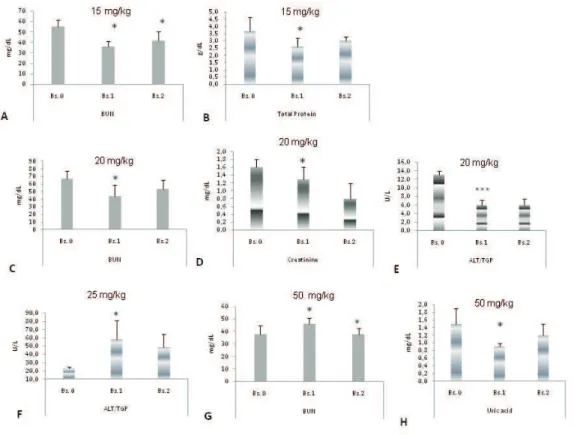
2D); and in ALT (U/L): Bs.0 13±1.0)/Bs.1 6±1.2 (p<0.001) (decrease) (Figura 2E). At a dose of 25 mg/kg of dolabelladienotriol, only ALT presented an increase: Bs.0 23±1.9/Bs.1 58±22.8 (p<0.05) (Figure 2F). At 50 mg/kg of dolabelladienotriol, there was a significant increase in BUN: Bs.0 38±6.8/Bs.1 46±4.6 and Bs.2 38±4.5 (p<0.05) (Figure 2G), as well as a decrease of uric acid Bs.0 1.5±0.4/Bs.1 0.9±0.1 (p<0.05) (Figure 2H). The 1% DMSO control did not show a significant change, while ACV (50 mg/kg) provoked a significant decrease in BUN: Bs.0 63±2.3/Bs.1 43±2.6 (p<0.001), followed by an increase: Bs.2 81±5.7 (p<0.01). None of the biochemical analyses showed any really large change relative to the reference levels for these animals (data not shown).
In the histological analyses, all of the animals that received dolabelladienotriol (1) presented a moderate increase in mitosis of hepatocytes. The groups that received 15, 20 or 25 mg/kg of the experimental substance had a moderate vascular congestion (Figure 3A), while the group that received 50 mg/kg
of dolabelladienotriol presented edema in the liver parenchyma (Figure 3B). In the kidneys, focal areas of hydropic cells were present in the medulla of all groups that received dolabelladienotriol, regardless of the dose (Figure 3C). Furthermore, a moderate interstitial vascular congestion was observed in the group that received 50 mg/kg (Figure 3D). No significant histological changes were observed in the other organs analyzed or in the animals in the negative control group (1% DMSO) (data not shown). On the other hand, animals in the positive control group (that received 50 mg/kg of ACV) presented vascular congestion and inflammatory infiltration in the liver (Figure 3E). The kidneys of the animals from this group presented acute tubular necrosis (Figure 3F).
Discussion
In the previous in vitro studies, performed by our group at the Federal Fluminense University (Brazil) (Barbosa et al., 2004; Cirne-Santos et al., 2008; Cirne-Santos et al., 2006), a concentration of
Figure 2. Biochemical parameters in BALB/c mice after the administration of dolabelladienotriol (15, 20, 25 or 25mg/kg) by sc route. A. Values for BUN at 15 mg/kg of dolabelladienotriol (1); B. Values for Total Protein at 15 mg/kg of dolabelladienotriol; C. Values for BUN at 20 mg/kg of dolabelladienotriol; D. Values for creatinine at 20 mg/kg of dolabelladienotriol; E. Values of ALT at 20 mg/kg of dolabelladienotriol; F. Values of ALT at 25 mg/kg of dolabelladienotriol; G. Values for BUN at 50 mg/kg of dolabelladienotriol; H. Values for uric acid at 50 mg/kg of dolabelladienotriol. Values represent the mean±SEM. (n=5/group).
Evaluation of the acute toxicity of dolabelladienotriol, a potential antiviral from the brown alga Dictyota pfafi i, in BALB/c mice
Valéria Garrido et al.
from marine species for antiviral activity has yielded a considerable number of active crude aqueous or organic solvent extracts, from which thousands of new compounds have been derived. Many of these have already been tested for their pharmacological properties as potential antiviral drugs at the preclinical and clinical stages. Over forty compounds are commercially available on the pharmacological market, including alternative antiviral medicines. The growing interest in marine-derived antiviral compounds, along with the development of new technologies for marine organism culture and extraction, will significantly expedite the current exploration of the marine environment for compounds with significant pharmacological applications and will continue to be a promising strategy and trend in modern medicine.
Brown algae of the family Dictyotaceae and of the genus Dictyota, which is represented by more than forty species, produce a significant number of secondary metabolites, especially diterpenes. Several groups in other countries are already exploring the in
the 50 μM of dolabelladienotriol was used. For in vivo
toxicity tests, the doses used were calculated starting
with a dose equivalent to 50 μM, which was increased
gradually up to a ten-fold dose. As a reference we used the OECD 402 guideline published in 1987 (Botham, 2004; OECD, 1987). The results indicated that doses up to 50 mg/kg of dolabelladienotriol (1) did not lead to the animals’ death.
Available treatments for many viral diseases are still limited, which demonstrates the need for research in this area. Furthermore, the increasing appearance of viral resistance to the available treatments further underscores this necessity. Although marine organisms that contain bioactive substances have been known for many centuries, systematic investigations of marine natural products only
began fi fty years ago (Yasuhara-Bell & Lu, 2010). One
of these products is acyclovir, a well-known synthetic antiviral product that acts against HSV and is derived from arabinosyl nucleosides of the sponge Tethya cripta
(Elion et al., 1977).
The screening of natural products derived
Figure 3. Histology of the liver (A & B) and the kidney (C & D) of BALB/c mice 10 days after the sc administration of dolabelladienotriol (1) or of 50 mg/kg ACV (E & F). A. a typical section of the liver with moderate mitoses of hepatocytes and vascular congestion after the administration of any dose of dolabelladienotriol (15, 20, 25 or 50 mg/kg) (400x); B. distended hepatocytes after the administration of 50 mg/kg dolabelladienotriol (400x); C. a typical section of the kidney with the presence of focal hydropic cells after the administration of any of the doses of dolabelladienotriol (200x); D. moderate vascular congestion of the kidney 10 days after the administration of 50 mg/kg of dolabellanodienotriol (200x); E. typical histological changes in the liver
after the administration of 50 mg/kg of ACV (positive control), with regional infl ammatory infi ltration (black arrow) and vascular
Evaluation of the acute toxicity of dolabelladienotriol, a potential antiviral from the brown alga Dictyota pfafii, in BALB/c mice
Valéria Garrido et al.
vitro effects of diterpenes with encouraging results for antiviral activity (Abrantes et al., 2010; Khan et al., 2005; Siamopoulou et al., 2004; Suzuki et al., 2002). Several studies with natural products demonstrate their potential role in inhibiting certain diseases, as well as their good performance during the active stage of viral replication. It has also been discovered that they are less toxic and can provide low-cost products (Kuo et al., 2008; Talarico et al., 2004; Zhang et al., 2007), which is the case of dolabelladienotriol. Prior in vitro
experiments showed that it is not only a promising natural product for the inhibition of HIV-1 and HSV-1, but also that it has low cytotoxicity (Abrantes et al., 2010; Barbosa et al., 2004; Cirne-Santos et al., 2008).
The aim of this study was to assess the level of toxicity of dolabelladienotriol, a natural product derived from brown algae, Dictyota pfaffii, in experimental animals. This is a necessary procedure to meet the international standards established by the OECD commission (Organization for Economic Cooperation and Development, Paris, 1987) before clinical trials can be performed (Botham, 2004; Goldim, 2007).
Acute toxicity tests were performed by in bolus administration of dolabelladienotriol (1), via the subcutaneous route, at doses of 15, 20, 25 or 50 mg/kg in mice, which were subsequently observed during ten days. The results revealed that dolabelladienotriol is not significantly toxic. Biochemical data showed that the changes in the ALT and BUN enzymes did not exceed the established limits of the reference samples obtained from the same animals before the administration of dolabelladienotriol (data not shown).
One of the organs most affected by chemical agents is the liver because it is responsible for the biotransformation of many chemicals in the body (Bishop et al., 2000). In our work, we observed discrete biochemical and histological changes after the administration of dolabelladienotriol, showing that some injuries might occur and might not be completely reversible. In fact, others have shown that applications of plant extracts or their products can cause changes in the tissues of organs such as the liver, kidney and others (Baliga et al., 2004; Lima et al., 2009; Mariz et al., 2006; Mukinda & Syce, 2007; Omar et al., 1996; Rauber et al., 2006). The rationale for choosing acyclovir (de Miranda et al., 1981) as the control (50 mg/kg) was to compare dolabelladienotriol with a drug already used as an antiviral agent against HSV-1 in the clinical setting. Our work demonstrated the safety of this new product since the signs of toxicity were noticeably higher in the animals tested with ACV (kidney necrosis was found in almost all of the animals and two out of the five mice died) than with dolabelladienotriol (no behavioral changes, no kidney necrosis and no deaths), confirming its low toxicity.
The low acute toxicity or good short term safety in BALB/c mice of dolabelladienotriol, a product extracted from Dictyota pfaffii, indicates the desirability of extending this study to pre-clinical tests on animals infected with HSV in order to determine the long-term toxicity and range of effective therapeutic dosages of dolabelladienotriol (1).
Acknowledgment
The authors are grateful to the Conselho Nacional de Desenvolvimento Científico e Tecnológico for financial support and for Productivity Fellowships to ICNPP and VLT. WJF thanks the CNPq for providing a DSc degree fellowship.
References
Abrantes JL, Barbosa J, Cavalcanti D, Pereira RC, Fontes FCL, Teixeira VL, Moreno STL, Paixão, IC 2010. The effects of the diterpenes isolated from the Brazilian Brown Algae Dictyota pfaffii and Dictyota menstrualis against the herpes simplex type-1 replicative cycle. Planta Med 76: 339-344.
Anzivino E, Fioriti D, Mischitelli M, Bellizzi A, Barucca V, Chiarini F, Pietropaolo V 2009. Herpes simplex virus infection in pregnancy and in neonate: status of art of epidemiology, diagnosis, therapy and prevention. Virol J 6: 40-51.
Bacon TH, Levin MJ, Leary JJ, Sarisky RT, Sutton D 2003. Herpes simplex virus resistance to acyclovir and pencyclovir after two decades of antiviral therapy. Clin Microbiol Rev 16: 114-128.
Baliga MS, Jagetia GC, Ulloor JN, Baliga MP, Venkatesh P, Reddy R, Rao KV, Baliga BS, Devi S, Raju SK, Veeresh V, Reddy TK, Bairy KL 2004. The evaluation of the acute toxicity and long term safety of hydroalcoholic extract of Sapthaparna (Alstonia scholaris) in mice and rats. Toxicol Lett 151: 317-326.
Barbosa JP, Pereira RC, Abrantes JL, Cirne-Santos CC, Rebello MA, Frugulhetti ICP, Teixeira VL 2004. In vitro antiviral diterpenes from the Brazilian brown alga Dictyota pfaffii. Planta Med 70: 856-860. Barbosa JP, Teixeira VL, Villaça RC, Pereira HS, Abrantes JL,
Frugulhetti ICNP 2003. A dolabellane diterpene from de Brazilian brown alga Dictyota pfaffii. Biochem Syst Ecol 31: 1451-1453.
Bishop ML, Duben-Engelkirik JL, Fody EP 2000. Clinical Chemistry. Principies, Procedures, Correlations. Philadelphia.
Botham PA 2004. Acute systemic toxicity-prospects for tiered testing strategies. Toxicol In Vitro 18: 227-230. Carson FL 1997. Histotechnology: A Self Instructional Text.
Chicago, IL.
Evaluation of the acute toxicity of dolabelladienotriol, a potential antiviral from the brown alga Dictyota pfafii, in BALB/c mice
Valéria Garrido et al.
Rebello MA, Castello-Branco LR, Abreu CM, Tanuri A, Frugulhetti ICNP, Bou-Habib DC 2008. The dolabellane diterpene Dolabelladienetriol is a typical noncompetitive inhibitor of HIV-1 reverse transcriptase enzyme. Antiviral Res 77: 64-71. Cirne-Santos CC, Teixeira VL, Castello-Branco LR,
Frugulhetti, ICNP, Bou-Habib DC 2006. Inhibition of HIV-1 replication in human primary cells by a dolabellane diterpene isolated from the marine algae Dictyota pfaffii. Planta Med 72: 295-299.
De Clercq E 2004. Antiviral drugs in current clinical use. J Clin Virol 30: 115-133.
De Miranda P, Good SS, Laskin OL, Krasny HC, Connor JD, Lietman PS 1981. The disposition of acyclovir in different species. J Pharmacol Exp Ther 219: 309-315.
El Gamal AA 2010. Biological importance of marine algae. SPJ 18: 1-25.
Elion GB, Furman PA, Fyfe JA, De Miranda P, Beauchamp L, Schaeffer HJ 1977. Selectivity of action of an antiherpetic agent, 9-(2-hydroxyethoxymethyl) guanine. Proc Natl Acad Sci USA 74: 5716-5720. Goldim JR 2007. A Avaliação ética da investigação científica
de novas drogas: a importância da caracterização adequada das fases da pesquisa. Rev HCPA. 27: 1. Jones ML 2007. How formalin affects the outcome of routine
and special stains. Biotech Histochem 82: 155-159. Khan MT, Ather A, Thompson KD, Gambari R 2005. Extracts
and molecules from medicinal plants against herpes simplex viruses. Antiviral Res 67: 107-119.
Kuo YC, Lee YC, Leu YL, Tsai WJ, Chang SC 2008. Efficacy
of orally administered Lobelia chinensis extracts on herpes simplex virus type 1 infection in BALB/c mice. Antiviral Res 80: 206-212.
Lima LB, Vasconcelos CF, Maranhao HM, Leite VR, Ferreira PA, Andrade BA, Araujo EL, Xavier HS, Lafayette SS, Wanderley AG. 2009. Acute and subacute toxicity of Schinus terebinthifolius bark extract. J Ethnopharmacol 126: 468-473.
Lison L 1960. Histochimie et cytochimie animals, principes et méthodes. Gauthier-Villars, Paris.
Mariz SR, Cerqueira GS, Araújo WC, Duarte JCL 2006. Estudo toxicológico agudo do extrato etanólico de partes aéreas de Jatropha gossypiifloria L. em ratos. Rev Bras Farmacogn 16: 372-378.
Martins VG 2009. Avaliação da toxicidade de substâncias antivirais derivadas de algas marinhas e substâncias sintéticas em camundongos BALB/c. Dissertação de Mestrado, Programa de Neuroimunologia, Universidade Federal Fluminense, Niterói, RJ, Brazil.
Mehellou Y, De Clercq E 2010. Twenty-six years of anti-HIV
drug discovery: where do we stand and where do we go? J Med Chem 53: 521-538.
Mukinda JT, Syce JÁ 2007. Acute and chronic toxicity of
the aqueous extract of Artemisia afra in rodents. J Ethnopharmacol 112: 138-144.
Omar RF, Gourde P, Desormeaux A, Tremblay M, Beauchamp D, Bergeron MG 1996. In vivo toxicity of foscarnet and zidovudine given alone or in combination. Toxicol Appl Pharmacol 139: 324-332.
OECD Guidelines for the Testing of Chemicals 1987. OECD 402. Acute Dermal Toxicity. Organisation for Economic Cooperation and Development, Paris. Acess on http://www.oecdbookshop.org/oecd/display. asp?K=5LMQCR2K7PTL&DS=Test-No.-402-Acute-Dermal-Toxicity.
Rauber C, Mello FBD, Mello JRBD 2006. Avaliação toxicológica pré-clínica do fitoterápico contendo Aristolochia cymbifera, Plantago major, Luehea grandiflora, Mirocarpus frondosus, Pipatdena colubrina (Cassaú Composto) em ratos Wistar. Acta Sci Vet 34: 15-21.
Siamopoulou P, Bimplakis A, Iliopoulou D, Vagias C, Cos P, Berghe DV, Roussis V 2004. Diterpenes from the brown algae Dictyota dichotoma and Dictyota linearis. Phytochemistry 65: 2025-2030.
Suzuki M, Yamada H, Kurata K 2002. Dictyterpenoids A
and B, two novel diterpenoids with feeding-deterrent activity from the Brown Alga Dilophus okamurae. J Nat Prod. 65: 121-125.
Talarico LB, Zibetti RG, Faria PC, Scolaro LA, Duarte ME, Noseda MD, Pujol CA, Damonte EB 2004. Anti-herpes simplex virus activity of sulfated galactans from the red seaweeds Gymnogongrus griffithsiae and Cryptonemia crenulata. Int J Biol Macromol 34: 63-71.
Uniting the world against AIDS (UNAIDS) 2009. Joint United Nations Programme on HIV/AIDS. WHO. Geneva-Switzerland. AIDS Epidemic Update-December, http://www.unaids.org/en/.
Yasuhara-Bell J, Lu Y 2010. Marine compounds and their
antiviral activities. Antiviral Res 86: 231-240.
Zhang Y, But PP, Ooi VE, Xu HX, Delaney GD, Lee SH, Lee
SF 2007. Chemical properties, mode of action, and in vivo anti-herpes activities of a lignin-carbohydrate complex from Prunella vulgaris. Antiviral Res 75: 242-249.
*Correspondence
Izabel C. P. Paixão
Laboratório de Virologia Molecular, Departamento de Biologia Celular e Molecular, Programa de Pós-graduação em Neuroimunologia, Instituto de Biologia, Universidade Federal Fluminense
Campos do Valonguinho, Outeiro de São Batista s/n, Sl. 303, 24020-150 Niterói-RJ, Brazil