Endovascular repair of abdominal aortic aneurysm: a
single-center results analysis
*
Correção endovascular do aneurisma da aorta abdominal: análise dos resultados de único centro
Eduardo Rafael Novero1, Patrick Bastos Metzger2, Fernanda Maria Resegue Angelieri2, Marcelo Bueno de Oliveira Colli2, Samuel Martins Moreira3, Nilo Mitsuru Izukawa4, Fabio Henrique Rossi5, Antonio Massamitsu Kambara6
Objective: To evaluate immediate and mid-term outcomes in a series of patients submitted to endovascular repair of infrarenal abdominal aortic aneurysm in a reference center for cardiovascular medicine. Materials and Methods: The present retrospective study included a series of patients treated in the period from January 2009 to July 2010, and evaluated demographic characteristics, technical success, therapeutic success, morbimortality, immediate complications and perioperative reintervention rate in a one-year follow-up. Results: The authors evaluated 102 consecutive patients with a mean age of 72 ± 9 years (79% were men). Technical success was observed in 97.1% of cases, and therapeutic success, in 81%. Perioperative mortality was 0.9% and one-year mortality rate was 7.8%. Reintervention was necessary in 18.8% of the patients during follow-up. Conclusion: The outcomes observed in the present study justify performing such a procedure in patients with suitable anatomy.
Keywords: Aneurysm; Vascular graft; Atherosclerosis.
Objetivo: Avaliar os resultados clínicos imediatos e em médio prazo do tratamento endovascular em pacientes porta-dores de aneurisma da aorta abdominal em um centro de referência para doenças cardiovasculares. Materiais e Métodos: Estudo retrospectivo de uma série de pacientes submetidos a tratamento endovascular de aneurisma da aorta abdominal, no período de janeiro de 2009 a julho de 2010. Foram avaliados as características demográficas, o sucesso técnico, o sucesso terapêutico, a morbimortalidade, as complicações e a taxa de reintervenções periopera-tórias imediatos, e após um ano de acompanhamento. Resultados: Foram analisados 102 pacientes consecutivos com idade média de 72 ± 9 anos, sendo 79% deles do sexo masculino. Houve sucesso técnico em 97,1% e êxito terapêutico em 81% dos casos. A mortalidade perioperatória foi de 0,9% e a anual, de 7,8%. Foram necessárias reinter-venções em 18,8% dos pacientes durante o seguimento. Conclusão: Em nosso estudo, os resultados obtidos justifi-cam a realização desse procedimento nos pacientes com anatomia adequada.
Unitermos: Aneurisma; Prótese vascular; Arterioesclerose. Abstract
Resumo
* Study developed at Instituto Dante Pazzanese de Cardiolo-gia, São Paulo, SP, Brazil.
1. MD, Interventional Cardiologist, Foreign Trainee at Centro de Intervenções Endovasculares (CIEV), Instituto Dante Pazza-nese de Cardiologia, São Paulo, Brazil.
2. MDs, Vascular Surgeons, Trainees at Centro de Interven-ções Endovasculares (CIEV), Instituto Dante Pazzanese de Car-diologia, São Paulo, SP, Brazil.
3. MD, Vascular and Endovascular Surgeon, Assistant at Di-vision of Medical Radiology, Instituto Dante Pazzanese de Car-diologia, São Paulo, SP, Brazil.
4. PhD, Surgeon-in-Chief, Medical Division of Vascular Sur-gery, Instituto Dante Pazzanese de Cardiologia, São Paulo, SP, Brazil.
5. PhD, MD, Physician Assistant, Medical Division of Vascu-lar Surgery, Instituto Dante Pazzanese de Cardiologia, São Paulo, SP, Brazil.
6. PhD, Titular Member of Colégio Brasileiro de Radiologia e Diagnóstico por Imagem (CBR), Head of Division of Medical Radiology, Instituto Dante Pazzanese de Cardiologia, São Paulo, SP, Brazil.
Mailing Address: Dr. Patrick Bastos Metzger. Centro de Inter-venções Endovasculares (CIEV). Avenida Doutor Dante Pazzane-se, 500, Vila Mariana. São Paulo, SP, Brazil, 04012-909. E-mail: [email protected]
Novero ER, Metzger PB, Angelieri FMR, Colli MBO, Moreira SM, Izukawa NM, Rossi FH, Kambara AM. Endovascular repair of abdomi-nal aortic aneurysm: a single-center results aabdomi-nalysis. Radiol Bras. 2012 Jan/Fev;45(1):1–6.
open surgical treatment. Nowadays, with the accumulated experience and the devel-opment of safer and more flexible endo-grafts, the endovascular treatment can be considered both for patients presenting surgical risk and those with anatomical characteristics favorable for conventional open surgical treatment(2).
Endovascular repair is precisely indi-cated for patients presenting high surgical risk, the elderly, and for those cases where there are anatomical difficulties for the open surgery approach (hostile abdomen). The open surgical repair is considered effective and definitive, with graft failure rate of only 0.3% per year. However, such a technique presents non-negligible morbi-mortality rates, many times requiring
pro-INTRODUCTION
Infrarenal abdominal aortic aneurysms (AAA) occur in 1% of the women and in 6% of men aged above 64. Aneurysm rup-ture is fatal in 80% to 90% of the cases, as pre-hospital deaths are taken into consid-eration(1). Considerable advances have been observed in the treatment of such a disorder. Undoubtedly, the endovascular technique, initially presented by Parodi and later developed by many researchers, has allowed the delivery of treatment for pa-tients who would otherwise be at high risk if they were submitted to conventional
longed recovery periods, sometimes reach-ing several months in the event of compli-cations. On the other hand, the rate of reintervention in the endovascular treat-ment is not negligible, and is actually higher as compared with the open surgery approach(3–6).
The present study is aimed at evaluat-ing immediate and medium-term clinical outcomes in a series of patients submitted to endovascular repair of AAA in a refer-ence center for cardiovascular medicine.
MATERIALS AND METHODS
Type of study
The present retrospective, longitudinal and observational study was developed at Instituto Dante Pazzanese de Cardiologia, São Paulo, SP, Brazil, in the period from January 2009 to July 2010, evaluating the outcomes of 102 patients submitted to endovascular repair of AAA.
Inclusion and exclusion criteria
The present study included both symp-tomatic and asympsymp-tomatic women and men with indication for endovascular repair of abdominal aortic aneurysms with > 55 mm in diameter for the male or 50 mm for the female patients, as well as for type I or type III endoleak repair in previously treated patients.
Patients with proximal aneurysmal neck < 15 mm in length, presence of thrombus or calcification > 50% of the neck diameter, aneurysmal neck angulation > 65°, aorto-iliac bifurcation > 90°, external aorto-iliac arter-ies diameter < 7 mm, serum creatinine lev-els > 2.0 mg/dl or creatinine clearance < 30 ml/min were excluded from the study (Fig-ure 1).
The patients who met the inclusion cri-teria were considered as having favorable anatomy and were consecutively referred for endovascular treatment. Anesthesia and/or cardiovascular risks were not taken into consideration for inclusion/exclusion of patients.
In all of the cases, the diagnosis and therapeutic planning were based on com-puted tomography angiography, with pre-operative arteriography being the optional diagnostic method.
Surgical technique
All the procedures were performed in the Hemodynamics Laboratory of Instituto Dante Pazzanese de Cardiologia, in São Paulo, SP, Brazil.
The patients were treated under general inhalation anesthesia. Antimicrobial pro-phylaxis was performed with 1.5 g of cefuroxime, at the moment of the anes-thetic induction. The preferred approach was through the common femoral artery, either unilateral or bilaterally according to the type of intervention or endograft to be deployed. In the cases where such an ap-proach was not feasible the external iliac artery was approached by means of retro-peritoneal access.
The radiographic control was per-formed by an Artis flat panel apparatus (Siemens; Munich, Germany). The follow-ing devices were utilized: Anaconda™ (Vascutek, Terumo; Inchinnan, Scotland), Aorfix™ (Lombard Medical Technologies PLC; Oxfordshire, UK), Apolo® (Nano;
Florianópolis, SC, Brazil), Endurant™ (Medtronic; Minneapolis, MN, USA), Ex-cluder® (Gore Medical; Flagstaff, AZ,
USA), PowerLink System® (Endologix;
Irvine, CA, USA), Talent® (Medtronic;
Minneapolis, MN, USA), and Zenith Flex®
(Cook Medical; Bloomington, IN, USA). All the patients underwent intraoperative arteriography. The immediate postopera-tive management of all the patients was carried out in the intensive care unit.
Postoperative follow-up
The patients were followed-up on an outpatient basis 15, 30, 180 and 360 days after the repair. After the first year, the fol-low-up was performed once a year. Com-puted tomography angiography was per-formed on the 1st and on the 12th month of the outpatient follow-up. Color Doppler ultrasonography was utilized in cases where CT angiography was contraindicated.
Outcomes and definitions
Primary and secondary outcomes were defined as follows:
1 – Technical success: when the objec-tive of deploying the endograft in the af-fected area was achieved, with or without endoleaks or other events that could influ-ence the favorable evolution of the aneu-rysm.
2 – Therapeutic success: when the endograft deployment occurred without endoleaks or other events that could affect the favorable evolution of the aneurysm.
3 – Perioperative mortality: number of deaths recorded within the first 30 days after the procedure.
4 – Annual mortality: number of deaths occurred within the 12-month follow-up.
room and within 30 days after the interven-tion.
6 – Reintervention rate: interventions performed for the maintenance of satisfac-tory endograft function and exclusion of the aneurysmal sac, or for the resolution of complications associated with the interven-tion.
Secondary outcomes
1 – Length of hospital stay: time elapsed between hospital admission and patient’s discharge.
2 – Procedural time: time elapsed be-tween anesthesia induction and surgical site closure.
Endoleaks
1 – Initial or primary endoleak: those endoleaks originated during the initial pro-cedure or diagnosed within the first 30 days.
2 – Secondary endoleaks: those diag-nosed after 30 days from the initial proce-dure.
RESULTS
The follow-up comprised 102 patients submitted to infrarenal AAA repair. The mean age of the patients was 72 ± 9 years, and 79% of them were men. The predomi-nant risk factor was hypertension in 100 tients (99%), 23 (22%) were diabetic pa-tients, 23 (22%) were smokers, 47 (46%) were former smokers, and 51 (50%) pa-tients presented dyslipidemia. Obesity with body mass index > 40 was present in 5 patients of the studied population.
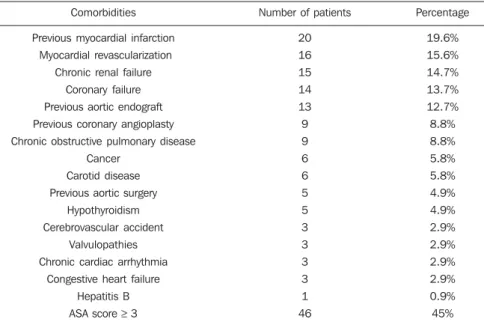
Amongst the comorbidities, a high in-cidence of ischemic cardiomyopathy (57.8%) was found, and in a lesser degree, chronic renal failure (14.7%). A significant percentage of patients with previous endovascular repair of aortic aneurysm were also found (12.7%) (Table 1).
Most patients (76%) underwent elective treatment (asymptomatic abdominal aneu-rysms) while 24% were emergencially treated because of alarm symptoms of alarm symptoms (abdominal pain or tomo-graphic signs of imminent aneurysm rup-ture). Presence of aneurysm was the indi-cation for treatment in 88.2% of the cases, while management of endoleak after
endovascular repair of AAA was the indi-cation in 11.8% of the cases.
The aneurysms morphology was pre-dominantly fusiform, being found in 98 of the patients (96.1%). The remaining four patients had saccular aneurysms (3.9%). The types of treated aneurysms were clas-sified according to the classification
uti-lized in the EUROSTAR study, as follows: type A in 28 patients (27.4%); type B in 48 patients (47.0%); type C in 10 patients (9.8%); type D in 13 patients (12.7%); type E in 1 patient (1%). In 2 cases (2%), the indication was repair of abdominal aortic pseudoaneurysm (Figure 2). The mean di-ameter of the aneurysms was 61 ± 1.0 mm. Table 1 Comorbidities in the studied population (total number = 102 patients).
Comorbidities
Previous myocardial infarction Myocardial revascularization
Chronic renal failure Coronary failure Previous aortic endograft Previous coronary angioplasty
Chronic obstructive pulmonary disease Cancer
Carotid disease Previous aortic surgery
Hypothyroidism Cerebrovascular accident
Valvulopathies Chronic cardiac arrhythmia
Congestive heart failure Hepatitis B ASA score ≥ 3
Number of patients
20 16
15 14 13 9
9 6 6 5
5 3 3 3
3 1 46
Percentage
19.6% 15.6%
14.7% 13.7% 12.7% 8.8%
8.8% 5.8% 5.8% 4.9%
4.9% 2.9% 2.9% 2.9%
2.9% 0.9% 45%
ASA, American Society of Anestesiology.
The bifurcated endograft was the most utilized model, in 98% of the cases, and the mono-iliac endograft was utilized in only 2 patients (2%). The most utilized devices were the following: 23 (22.5%) Talent, 19 (18.6%) PowerLink System, 19 (18.6%) Zenith Flex, 17 (16.7%) Excluder, 9 (8.8%) Endurant, 8 (7.8%) Anaconda, 5 (4.9%) Aorfix, 2 (2%) Apolo.
General inhalation anesthesia was uti-lized in all cases. Technical success was achieved in 97.1% of the cases. In 99 pa-tients, the endograft could be deployed in the desired site. In three cases the endograft could not be advanced to the desired loca-tion because of technical or anatomic dif-ficulties (presence of calcifications or tor-tuosity).
Therapeutic success was achieved in 81% of the cases, that is to say, in 83 pa-tients the endograft was deployed without endoleaks or other events that could affect a favorable outcome of the intervention.
In 16 cases (15.7%) hypogastric artery embolization was required. Neither pelvic nor intestinal were observed in any case and erectile dysfunction was not reported during follow-up.
The rate of complications was 19%, and the most frequent intraoperative complica-tions were the following: active bleeding in the surgical site in 6 cases (5.8%), femo-ral lesion in 3 cases (2.9%) periphefemo-ral em-bolism in 3 cases (2.9%) and renal artery occlusion in 2 cases (1.9%), without pro-gression to renal failure in these patients. In-hospital postoperative complications were the following: infections in 4r cases (3.9%) [2 cases of surgical wound infection (50%) and 2 cases of respiratory tract in-fection (50%)], and acute renal failure in 2 patients (1.9%). The perioperative mor-tality rate was 0.9%. One patient submit-ted to emergency aortic repair died because of aneurysm rupture.
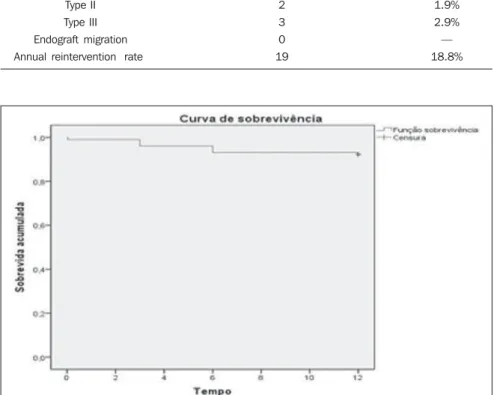
The total rate of endoleaks was 19.6%, with type I and III endoleaks being present in 16.6% of cases. No case of endograft mi-gration was observed during follow-up. The rate of reintervention within one year was 18.8% resulting from management of types I and III endoleaks (Tables 2 and 3). The annual mortality rate observed during follow-up was 7.8%. One death occurred because of vascular causes (Figure 3).
The mean procedural time was 93 min-utes (ranging from 65 to 130 minmin-utes) and the mean hospital stay time was 5.2 days, with a variation of 9 days.
DISCUSSION
Over the past decade, the technique of endovascular repair of AAA has been de-veloped as an alternative to open surgery. The impact of new devices and the two-decade experience from learning have led to the decrease in the operative mortality rate, as reported by several publications(7,8).
The EVAR-I study(9) has demonstrated a decrease in perioperative mortality from 4.7% with open repair to 1.7% with endo-vascular repair, corresponding to a relative risk decrease of 65%. The EUROSTAR(10) study presented a 30-day mortality rate of 1.7% for minimally invasive treatment, while the DREAM(11) study presented a perioperative mortality rate of 4.6% for open surgery versus 1.2% for endovascular
repair. Brazilian authors have reported a less significant decrease (6.5% versus 5.5%
with conventional and endovascular repair, respectively)(12,13).
Table 2 Characteristics of primary endoleaks.
Endoleak types
Total
Type Ia Type Ib Type II Type IIIa
Type IV
Number of patients
21
8 2 1 7
3
Percentage
19.6%
7.8% 1.9% 0.9% 6.8%
2.9%
Table 3 Rate of secondary endoleaks, endograft migration and annual reintervention rate.
Endoleak types
Total Type Ia Type II Type III
Endograft migration Annual reintervention rate
Number of patients
8 3 2 3
0 19
Percentage
7.8% 2.9% 1.9% 2.9%
— 18.8%
In the authors’ experience, the 30-day mortality rate was 0.9%. One patient died during intervention on a ruptured AAA. The operative mortality for ruptured AAA is above 40% for open surgery(14). Large randomized studies comparing open sur-gery versus endovascular repair in this type
of medical emergency are yet to be com-pleted, such as the case of the IMPROVE study(15).
The annual mortality rate in the present study was 7.8% (Figure 3). There was one death due to vascular causes related to an-eurysm rupture. Ischemic cardiomyopathy was most frequent comorbidity in the present study population, with a high num-ber of patients presenting previous myocar-dial infarction, myocarmyocar-dial revasculariza-tion and coronary angioplasty (Table 1). Cardiac deaths were predominant, with highest prevalence of cardiogenic shock and cardiac arrest.
The success of the endovascular tech-nique depends on the continued exclusion of the aneurysmal sac(7). The positioning and deployment of the endograft for such a purpose is not always achievable, hence the importance of complementary preop-erative studies such as CT angiography and arteriography to evaluate the feasibility of the procedure. Such studies allow the analysis of the aneurysmal diameter, the anatomic evaluation of the proximal and distal necks and the definition of iliac and femoral accesses, which constitute indis-pensable practices in this type of interven-tion.
The rate of technical success was 97.1%, as in three patients the endograft could not be positioned and deployed be-cause of underestimation of the degree of calcification and tortuosity of the access. In the EUROSTAR study(10) the endograft de-livery system could not be appropriately advanced in 0.8% of the cases.
The primary objective of every endo-vascular repair of aortic aneurysm is to pre-vent the aneurysm rupture and the poten-tially associated death. Other objectives include the reduction of the aneurysm size and the absence of endoleaks as markers of continued rupture risk.
The rate of initial therapeutic success was 81%, measured as a function of the in-cidence of endoleaks in the primary
proce-dures. In the EUROSTAR study(10) the in-cidence of initial endoleaks was the follow-ing:type I endoleak, 4.4%; type II, 9%; type III, 2.4%. In the present study population, the rate of initial endoleaks was 19.6% corresponding to: type Ia, 7.8% (8 cases); type Ib, 1.9% (2 cases); type II, 0.9% (1 case); type III, 6.8% (7 cases); type IV, 2.9% (3 cases). Such high rate of endoleaks was analyzed in detail. The percentage of types I and III endoleaks was 16%. In the population with type I endoleaks, 6 patients presented a minimum degree of leakage, which had spontaneously resolved at the time of the 30-day follow-up. In 3 cases of type III endoleak, the same phenomenon was observed. This fact sensibly reduces the rate of reintervention due to endoleak to 11%, a rate that is similar to other reports. As the aneurismal necks were evaluated in patients with type I endoleak, 4 patients were found with neck length between 15 and 17 mm, 2 patients with cone-shaped neck, and in 4 patients, the angulation was close to 65°.
In one of their most important studies, Stanley et al. have analyzed the morphol-ogy of aneurysms as a predictor of endo-leaks and complications, demonstrating that the presence of morphologies different from those recommended resulted in a four-fold increase in the occurrence of type I endoleaks, and the noncompliance with more than one recommendation multiplied such risk(16). The authors of the present study have undoubtedly explored the lim-its of the therapeutic endovascular inter-vention.
According to May et al., intraoperative complications may be observed in approxi-mately 20% of the patients treated by endo-vascular approach. Some complications are inversely related to the length of the aneur-ismal neck, that is, the shorter the length of the neck, the more difficult it is to deploy the endovascular device(17). Also the greater the number of comorbidities, the higher the probability of intra- and postop-erative adverse events. The DREAM study, which has compared the operative mortal-ity and complications in surgical treatments with endovascular repair within 30 days, concluded that the endovascular repair is preferable because of the lower rates of mortality and complications, and also
be-cause of the significant reduction of the incidence of systemic complications(11). In the EVAR-I study, the rate of complications was 35%, while in the EVAR-II it was 33%(9,18).
In the present casuistry, the total rate of complications was 19% within the 30-day periprocedural period. Intraoperative bleeding in the surgical site was present in 6 cases (in 5 cases, at the level of the in-guinal region, and 1 case of retroperitoneal hematoma), and femoral injury in 3 cases. Such complications were the ones most frequently observed in the present study. Undoubtedly, the profile of the utilized materials, in association with unfavorable surgical practices, does influence such rate. Reitervention is performed in order to maintain the endografts function and, in some cases, for the resolution of remote complications. According to Sampram et al.(19), main indications for reintervention are the following: a) endoleaks; b) endograft migration; c) occlusion of iliac branches; d) postoperative hemorrhage; e) renal oc-clusion. Less frequently, distal emboliza-tion, infection and aneurysm rupture are observed.
In the present study, most of the reinterventions occurred for endoleaks re-lated to the initial procedure (11%) and, to a lesser degree, for secondary endoleaks (7.8%) observed after the 30-day peripro-cedural period. The annual rate of reinter-vention was 18.8%. The EVAR-I study presented a reintervention rate of 20% in a four-year follow-up; and in the EVAR-II study, such a rate was 26%. On the other hand, the DREAM and EUROSTAR stud-ies presented rates of 14.3% and 13.5%, respectively, in a three-year follow-up(9– 11,18). The DREAM study has shown that
the rate of reintervention was threefold higher in the first nine months for the endovascular repair as compared with open surgery, with such rates becoming equal at the two-year follow-up(11). In such a study, the main reason for reintervention was the onset of types I and II endoleaks.
endoleaks, and decrease in the number of type II endoleaks. The annual rate of sec-ondary reintervention was 16.2%(20). In the present casuistry, the percentages of sec-ondary endoleaks were the following: type I, 2.9%; type II, 1.9%; type III, 2.9%; main-taining the high indices of endoleak types I and III as causes for reintervention dur-ing one-year follow-up.
In the EUROSTAR study, with a five-year follow-up, the main indication for reintervention was the type II endoleak, followed by the type III(10). One should highlight that, in the present study, the pa-tient who presented type II endoleak did not undergo reintervention since no aneurys-mal sac increase was detected at CT an-giography, as well as in the cases of type IV endoleaks, where no further endoleak was observed during tomographic follow-up, thus being thus considered as sponta-neous resolution.
CONCLUSION
The results obtained by means of endovascular repair of AAA are associated with low indices of complications in the short and medium-terms. Such rates of complication and reintervention are simi-lar to those obtained in other Brazilian and international reference centers. Such re-sults support the performance of such pro-cedure in patients with suitable anatomy.
REFERENCES
1. Mastracci TM, Cinà CS; Canadian Society for Vascular Surgery. Screening for abdominal
aor-tic aneurysm in Canada: review and position statement of the Canadian Society for Vascular Surgery. J Vasc Surg. 2007;45:1268–76.
2. Parodi JC, Palmaz JC, Barone HD. Transfemoral intraluminal graft implantation for abdominal aortic aneurysms. Ann Vasc Surg. 1991;5:491–9. 3. Lederle FA, Wilson SE, Johnson GR, et al. Im-mediate repair compared with surveillance of small abdominal aortic aneurysms. N Engl J Med. 2002;346:1437–44.
4. Hallett JW Jr, Marshall DM, Petterson TM, et al. Graft-related complications after abdominal aor-tic aneurysm repair: reassurance from a 36-year population-based experience. J Vasc Surg. 1997; 25:277–84.
5. Johnston KW. Nonruptured abdominal aortic an-eurysm: six-year follow-up results from the multicenter prospective Canadian aneurysm study. Canadian Society for Vascular Surgery Aneurysm Study Group. J Vasc Surg. 1994;20: 163–70.
6. Silvestre JMS, Motta F, Sardinha WE, et al. Endovascular treatment of infrarenal abdominal aortic aneurysm in patients with favorable anatomy for the repair – initial experience in a university hospital. J Vasc Bras. 2011;10:31–9.
7. Matsumura JS, Brewster DC, Makaroun MS, et al. A multicenter controlled clinical trial of open versus endovascular treatment of abdominal aor-tic aneurysm. J Vasc Surg. 2003;37:262–71. 8. Blankensteijn JD, de Jong SE, Prinssen M, et al.
Two-year outcomes after conventional or endo-vascular repair of abdominal aortic aneurysms. N Engl J Med. 2005;352:2398–405.
9. Greenhalgh RM, Brown LC, Kwong GP, et al. Comparison of endovascular aneurysm repair with open repair in patients with abdominal aor-tic aneurysm (EVAR trial 1), 30-day operative mortality results: randomised controlled trial. Lancet. 2004;364:843–8.
10. Harris PL, Vallabhaneni SR, Desgranges P, et al.
Incidence and risk factors of late rupture, conver-sion, and death after endovascular repair of infrarenal aortic aneurysms: the EUROSTAR experience. European Collaborators on Stent/ graft techniques for aortic aneurysm repair. J Vasc Surg. 2000;32:739–49.
11. Prinssen M, Verhoeven EL, Buth J, et al. A ran-domized trial comparing conventional and endo-vascular repair of abdominal aortic aneurysms. N Engl J Med. 2004;351:1607–18.
12. Mendonça CT, Moreira RCR, Timi JRR, et al. Comparação entre os tratamentos aberto e endo-vascular dos aneurismas da aorta abdominal em pacientes de alto risco cirúrgico. J Vasc Bras. 2005;4:232–42.
13. Mendonça CT, Moreira RCR, Carvalho CA, et al. Tratamento endovascular de aneurismas da aorta abdominal em pacientes de alto risco cirúrgico. J Vasc Bras. 2009;8:56–64.
14. Pae SJ, Carr JA. Ruptured abdominal aortic an-eurysm in community practice: age and operative variables predict survival. Am Surg. 2007;73: 912–6.
15. IMPROVE Trial, Powell JT, Thompson SG, Thompson MM, et al. The immediate manage-ment of the patient with rupture: open versus endovascular repair (IMPROVE) aneurysm trial – ISRCTN 48334791 IMPROVE trialists. Acta Chir Belg. 2009;109:678–80.
16. Stanley BM, Semmens JB, Mai Q, et al. Evalua-tion of patient selecEvalua-tion guidelines for endolu-minal AAA repair with the Zenith Stent-Graft: the Australasian experience. J Endovasc Ther. 2001; 8:457–64.
17. May J, White GH. Endovascular treatment of aor-tic aneurysm. In: Rutherford RB, editor. Vascular surgery. 5th ed. Philadelphia, PA: WB Saunders; 2000. p. 1281–95.
18. EVAR trial participants. Endovascular aneurysm repair and outcome in patients unfit for open re-pair of abdominal aortic aneurysm (EVAR trial 2): randomised controlled trial. Lancet. 2005;365: 2187–92.
19. Sampram ES, Karafa MT, Mascha EJ, et al. Na-ture, frequency, and predictors of secondary pro-cedures after endovascular repair of abdominal aortic aneurysm. J Vasc Surg. 2003;37:930–7.