Conservation status assessment of the amphibians and reptiles of Uruguay
Andrés Canavero
1,2,3, Santiago Carreira
2, José A. Langone
4, Federico Achaval
2,11, Claudio Borteiro
5,
Arley Camargo
2,6, Inés da Rosa
2, Andrés Estrades
7, Alejandro Fallabrino
7, Francisco Kolenc
8,
M. Milagros López-Mendilaharsu
7, Raúl Maneyro
2,9, Melitta Meneghel
2, Diego Nuñez
2,
Carlos M. Prigioni
10& Lucía Ziegler
21. Sección Ecología Terrestre, Facultad de Ciencias, Universidad de la República, Uruguay. ([email protected]; [email protected]) 2. Sección Zoología Vertebrados, Facultad de Ciencias, Universidad de la República, Uruguay. ([email protected])
3. Center for Advanced Studies in Ecology & Biodiversity y Departamento de Ecología, Pontificia Universidad Católica de Chile. 4. Departamento de Herpetología, Museo Nacional de Historia Natural y Antropología, Uruguay.
5. Río de Janeiro 4058, Montevideo 12800, Uruguay.
6. Department of Biology, Brigham Young University, Provo, Utah 84602, USA. 7. Karumbé. Av. Giannattasio km. 30.500, El Pinar, Canelones, 15008, Uruguay.
8. Universidad de la República, and Universidad Católica del Uruguay. Montevideo, Uruguay.
9. Museu de Ciência e Tecnologia and Faculdade de Biociências, Pontifica Universidade Católica do Rio Grande do Sul, Brazil.
10. Secretaría de Medio Ambiente, Intendencia Municipal de Treinta y Tres, Uruguay. 11. In memoriam.
ABSTRACT. The native species of amphibians and reptiles of Uruguay were categorized according to the IUCN Red List criteria. Out of 47 amphibian species, seven are listed as Critically Endangered (CR), five as Endangered (EN), one as Vulnerable (VU), three as Near Threatened (NT), and two as Data Deficient (DD); the remaining species are considered to be Least Concern (LC). Among the 64 species of reptiles evaluated, one is listed as Critically Endangered (CR), seven as Endangered (EN), two as Vulnerable (VU), one as Near Threatened (NT) and seven as Data Deficient (DD); the rest are considered to be Least Concern (LC). The use of these results as an additional criterion in the definition of protected areas in Uruguay will contribute towards the conservation of the aforementioned threatened species and their associated ecosystems.
KEYWORDS. Thretened species, Red List, herpetofauna, IUCN.
RESUMEN. Evaluación del estado de conservación de los anfibios y reptiles del Uruguay. Las especies nativas de anfibios y reptiles de Uruguay fueron categorizadas de acuerdo a los criterios de la Lista Roja de UICN. De las 47 especies de anfibios, siete se encuentran En Peligro Crítico (CR), cinco En Peligro (EN), una Vulnerable (VU), tres Casi Amenazadas (NT), y dos con Datos Deficientes (DD); las especies restantes son consideradas como Preocupación Menor (LC). Entre las 64 especies de reptiles evaluados, una se encuentra en Peligro Crítico (CR), siete En Peligro (EN), dos como Vulnerables (VU), una Casi Amenazadas (NT) y siete con Datos Deficientes (DD); las especies restantes son consideradas como Preocupación Menor (LC). El uso de estos resultados como un criterio adicional en la definición de áreas protegidas en Uruguay contribuirá hacia la conservación de dichas especies amenazadas y sus ecosistemas asociados.
PALABRAS CLAVE. Especies amenazadas, Lista Roja, herpetofauna, IUCN.
The ultimate goal of conservation biology is to
provide scientific concepts and data to design effective
management strategies for the conservation of
biodiversity. The design of a conservation system/
network must be based on sound knowledge of species’
life histories, as well as an understanding of the
functioning of ecosystems and the social component that
interacts with natural environments (P
RIMAK& R
ODRIGUES,
2001). Unfortunately, efforts and decisions regarding
conservation are being taken based on a poor knowledge
of the biology of species or the functioning of ecosystems,
due to the asymmetries between the time required to
generate such knowledge against the urgency of
particular conservation actions (S
OULÉ& O
RIANS, 2001;
M
CC
ALLUM, 2007).
It was in this context that the IUCN (International
Union for the Conservation of Nature) “Red List of
Threatened Species” arose as a tool to help in the rapid
assessment and monitoring of the conservation status
of biodiversity using all available information (H
ILTON-T
AYLOR, 2000). Based on this categorization method, 5,918
amphibians and 664 of the 8,240 known species of reptiles
have been assessed on a global scale (IUCN, 2006b). As
a result, 31 % of amphibian and 51 % of reptile species
fell into one of the threat categories. In recent years (from
1996 until 2006), there has been a sustained increase in
the number of species occupying each of the threat
categories (IUCN, 2006a).
As in other regions of the world (see M
ILLERet al
.,
2007), evaluate the conservation status of amphibian and
reptile species at a national level has been one of the
main interests of Uruguayan herpetologists in the last
years. That interest motivated the publication of several
categorization schemes, such as those proposed by
A
CHAVAL& O
LMOS(2007), M
ANEYRO& L
ANGONE(2001;
amphibians), M
ORALESF
AGUNDES& C
ARREIRA(2001;
snakes), C
ARREIRA(2004; lizards), and C
ARREIRAet al.
(2007, turtles) using the methodology of R
ECAet al
. (1994),
which has been widely applied in southern South America
(G
RIGERA& U
BEDA, 2000). The process of elaboration of
With the participation of the IUCN Uruguayan Committee,
two biodiversity groups were created to bring together
the researchers working locally on each zoological group:
Amphibia and Reptilia. Each of these working groups
proposed initiatives to complete the categorization of
both taxonomic groups at a regional (national) level using
the IUCN criteria. Later, a Uruguayan Fauna Red List
Workshop, sponsored by the IUCN Regional Office for
South America (Quito, Ecuador), took place in November
2000 in Montevideo. A working agenda was set at this
meeting, which resulted in the creation of the Red List of
Amphibians and Reptiles of Uruguay following the
categories and criteria suggested by IUCN (2003, 2006a).
The aim of this work is to report the results of this
assessment at national level.
MATERIAL AND METHODS
The categorization of amphibian and reptile species
present in Uruguay followed the criteria established by
the IUCN (2006a) and using the guidelines for the
application of the IUCN Red List Categories and Criteria
at regional levels (IUCN, 2003). Global categorizations
for amphibians were taken from IUCN (2006b) and for
reptiles from IUCN (2006a). Amphibians nomenclature and
systematics followed F
AIVOVICHet al
. (2005), F
ROSTet al
.
(2006), and G
RANTet al
. (2006). Common names for
amphibians followed A
CHAVAL& O
LMOS(2007). The
nomenclature and systematics of reptiles followed
C
ARREIRAet al.
(2005) with some modifications: the name
for the genus
Echinanthera
Cope, 1894
is replaced by
Taeniophallus
Cope, 1895 (S
CHARGELet al
., 2005) and
Liophis miliaris semiaureus
(Cope, 1862) is replaced by
Liophis semiaureus
(G
IRAUDOet al
., 2006). Common
names for reptiles follow A
CHAVAL& O
LMOS(2007) and
T
IPTON(2005).
The information used as a basis to assess each
species was taken from published sources (A
CHAVAL,
2001; C
ARREIRAet al
., 2005; N
ÚÑEZet al
., 2004) as well as
from personal observations of authors. Introduced
amphibian and reptile species (
Lithobates catesbeianus
(Shaw, 1802),
Hemidactylus mabouia
(Moreau de Jonnès,
1818) and
Tarentola mauritanica mauritanica
(Linnaeus,
1758)) were not assessed, and the category assigned to
these species is Not Applicable (NA) (IUCN, 2003).
For all the species, all the IUCN criteria were
analyzed. However, as a consequence of the type of
available information for each taxon, the criteria applied
in the support of the categories among amphibian species
were those related to the geographic distribution (criterion
B) quantified as the extent of occurrence (B1) or the area
of occupancy (B2). Other important variables such as
habitat fragmentation, continuous decline in the extent
of presence (observed, inferred or projected), area, habitat
extent and/or quality and number of localities or
subpopulations, were also taken into account within these
two sub-criteria (B1 and B2). In addition to criterion B,
the reduction in population size (A) and restricted or very
small population (D) criteria were also applicable in the
reptile assessment (for more detailed description of the
IUCN criteria, see IUCN, 2006a).
In the case of amphibians and the majority of reptile
species, excluding sea turtles, we consider that all species
have breeding populations and that Uruguayan
populations may experience a negligible “rescue effect”
from populations outside the country (B
ROWN& K
ODRIC-B
ROWN, 1977; H
ANSKI& G
YLLENBERG, 1993). Thus, based
on the conceptual scheme for assigning an IUCN Red
List Category at the regional level (IUCN, 2003), and
because it is unlikely that individuals from extra-regional
populations would be able to survive and reproduce
within the region, we suggest that, in these cases, the
assigned regional category be left unchanged. Since sea
turtles (
Caretta caretta
(Linnaeus, 1758),
Chelonia mydas
(Linnaeus, 1758),
Lepidochelys olivacea
(Eschscholtz,
1829),
Dermochelys coriacea
(Vandelli, 1761)) are
considered as visitors, and the conditions outside and
within the region are deteriorating (step 2e and 2f in IUCN,
2003), the assigned regional category should be left
unchanged (IUCN, 2003).
We compared the percentages of each threat
category for Uruguayan amphibians and reptiles at both
global and regional (national) scales (
sensu
IUCN, 2006a)
(Figs. 1-4).
RESULTS AND DISCUSSION
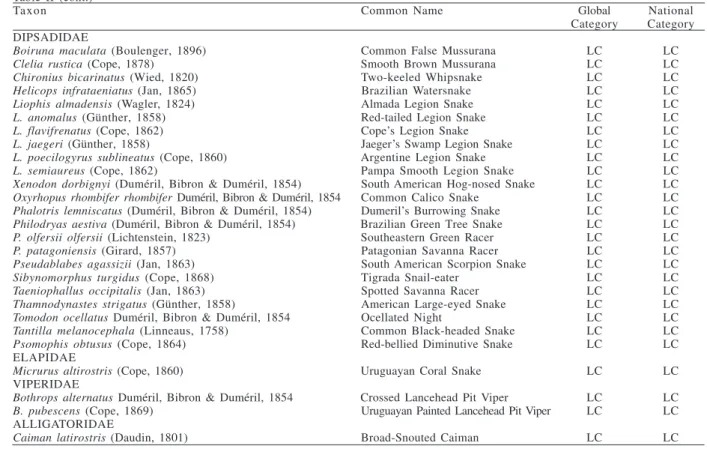
Of the 47 native amphibian and 64 native reptile
species evaluated, 23 species were classified in a threat
category (CR, EN, VU), four were Near Threatened (NT)
and nine were considered as Data Deficient (DD). So, a
total of 75 species could be considered as Least Concern
(LC), this represents 67.6 % of herpetofauna from Uruguay
(Tabs. I, II).
The conservation status of the amphibians of
Uruguay appears to be critical due to the relatively high
proportion of Critically Endangered species (CR = 14.9 %),
which is twice that of the global average (7.4 %) (S
TUARTet al
., 2004), and Endangered species (EN =10.6 %). On a
different note, the low proportion of Data Deficient taxa
(DD = 4.3 %
vs
. 24.1 % globally) reflects a relatively
well-developed knowledge of the distribution of the
Uruguayan amphibian fauna.
It is important to point out that 12.7 % of the
Uruguayan amphibian species were recorded or described
during the last six years (
Scinax aromothyella
Faivovich,
2005,
Melanophryniscus pachyrhynus
(Miranda-Ribeiro,
1920),
Rhinella achavali
(Maneyro, Arrieta & Sá , 2004);
Physalaemus cuvieri
(Fitzinger, 1826),
Hypsiboas
albopunctatus
(Spix, 1824),
Leptodactylus furnarius
Sazima & Bokermann, 1978) (C
ANAVEROet al
., 2001; K
WETet al
., 2002; M
ANEYROet al
., 2004; B
ORTEIROet al
., 2005;
P
RIGIONIet al
., 2005; M
ANEYRO& B
EHEREGARAY, 2007).
The above mentioned species are known from very few
localities, but their categorization was very different
because of the unequal knowledge about their life history
and local populations. For instance, we have good
records on the life history of
Hypsiboas albopunctatus
,
Leptodactylus furnarius
, and
Physalaemus cuvieri
(see
specimens of
P. cuvieri
were recorded in a particular
locality, although this locality was surveyed intensively
during two years (Raúl Maneyro, pers. comm.). On the
other hand, the abundance of
L. furnarius
recorded in a
given locality in the course of one year was thirty times
lower than that of a syntopic species
Leptodactylus
gracilis
(Duméril & Bibron, 1841) (N
L
.
furnarius
= 11; N
L. gracilis
= 375), based on catalog information of the
Vertebrate Collection of the Faculty of Sciences
(Universidad de la República, Uruguay). These localities
are situated in regions with forestry production and close
to urban zones (A
CHKARet al
., 2004). This fact allows us
to categorize
Hypsiboas albopunctatus
,
Leptodactylus
furnarius
, and
Physalaemus cuvieri
in the CR category.
On the other hand, species such as
Melanophryniscus
pachyrhynus
(with one record, B
ORTEIROet al.
, 2005) and
Scinax aromothyella
(P
RIGIONIet al.
, 2005; B
ORTEIROet
al.
, 2007; K
OLENCet al.
, 2007), also recently recorded (as
mentioned above), were categorized as DD because of
the lack of knowledge of their life history traits and the
absence of other local data.
In the present study, the regional categories of two
nearly endemic species (
Melanophryniscus montevidensis
(Philippi, 1902) and
M. orejasmirandai
Prigioni &
Langone, 1986) did not agree with the Global Amphibian
Assessment (GAA) by IUCN (2006b) (Tab. I). This is a
consequence of the newly acquired, highly detailed
information on the distribution and natural history of
these species provided by specialists working at the
national level (K
OLENCet al
., 2003; K
WETet al
., 2005;
M
ANEYRO& C
ARREIRA, 2006), which was not available to
the authors of the GAA at the time of the first
comprehensive assessment (K
OLENCet al
., 2003; K
WETet al
., 2005; M
ANEYRO& C
ARREIRA, 2006).
Because
Rhinella
achavali
was recently described
(M
ANEYROet al
., 2004), this species needs to be evaluated
for the first time at the global level (IUCN, 2006a). Based
on scientific collection records, mostly from the original
description and the recent report from Rio Grande do Sul,
Brazil (K
WETet al
., 2006), we propose that
R. achavali
be
considered under the Least Concern (LC) global category.
However, we propose that the species be considered
under the Near Threatened (NT) category at the national
level, in view of land use regulations for the areas
occupied by the species. These areas are considered to
have favourable soils for the afforestation industry, which
means that habitats in those areas will eventually change
in a few years as a consequence of the forest industry.
Compared to amphibians, reptiles have a greater
proportion of insufficiently known taxa (DD = 10.9 %)
and only one species is categorized as Critically
Endangered (CR = 1.6 %). Similarly to amphibians, 10.6 %
of the reptiles are in the Endangered category (EN).
Compared to the global situation, a much higher
proportion of Uruguayan reptiles are assigned to any of
the threat categories (total CR, EN, VU, NT = 17.2 %
vs
.
66.7 % globally). It is noteworthy that the Uruguayan
analysis for reptiles includes 100 % of the known
fauna, whereas only 8 % of the total species were
included in the global analysis. Most of the reptile
Table I. Amphibians of Uruguay with global and national threat categorizations for each species. Species are grouped by taxonomic families and the scientific and common names are provided. For a detailed description of the IUCN codes that define criteria, see IUCN (2006a).
Threatened species (CR, EN, VU)
Taxon Common Name Global National
Category Category ANURA
BUFONIDAE
Melanophryniscus devincenzii Klappenbach, 1968 Rivera Red Belly Toad EN EN B2ab(iii) M. montevidensis (Philippi, 1902) Montevideo Red Belly Toad VU EN B1b(i,iii,iv)
M. orejasmirandai Prigioni & Langone, 1986 Orejas Miranda Red Belly Toad VU CR B1ab(iii)
CERATOPHRYIDAE
Ceratophrys ornata (Bell, 1843) Ornate Horned Frog/ N T CR B1ab(i,ii,iii,iv)
Bell’s Horned Frog + 2ab(i,ii,iii,iv)
HYLIDAE
Argenteohyla siemersi (Mertens, 1937) Red-Spotted Argentina’s Frog EN CR B2a(ii)b(i, ii, iii, iv)
Hypsiboas albopunctatus (Spix, 1824) Spotted Treefrog LC CR B2ab(iii)
Lysapsus limellus Cope, 1862 Uruguay Harlequin Frog LC EN B1ab(iii)+2 ab(iii)
LEIUPERIDAE
Physalaemus fernandezae (Müller, 1926) Whistling Dwarf Frog LC EN B1a(ii)b(iii) +2 a(ii)b(iii)
P. cuvieri (Fitzinger, 1826) Ranita de Cuvier LC CR B1a(ii)b(iii)
Pleurodema bibroni Tschudi, 1838 Four-Eyed Frog N T VU B1ab(i,ii,iii,iv)
+ 2ab(i,ii,iii,iv) LEPTODACTYLIDAE
Leptodactylus furnarius Sazima & Bokermann, 1978 Campo Grande Frog LC CR B1a(ii)b(iii)
L. podicipinus (Cope, 1862) Pointed Belly Frog LC CR B1a(ii)b(iii)c(iii)
GYMNOPHIONA CAECILIIDAE
Chthonerpeton indistinctum (Reinhardt & Lütken, 1862) Agentine Caecilian LC EN B1b(i,iii,iv) Near Threatened Species (NT)
ANURA BUFONIDAE
Rhinella achavali (Maneyro, Arrieta & de Sá, 2004) Achaval’s Toad LC N T Melanophryniscus sanmartini Klappenbach, 1968 San Martín Red Belly Toad N T N T LEPTODACTYLIDAE
Leptodactylus chaquensis Cei, 1950 Cei’s White Lipped Frog LC N T
Data Deficient Species (DD) ANURA
BUFONIDAE
Melanophryniscus pachyrhynus (Miranda-Ribeiro, 1920) DD DD
HYLIDAE
Scinax aromothyella Faivovich, 2005 DD DD
Species Categorized as Least Concern (LC) ANURA
BUFONIDAE
Rhinella arenarum (Hensel, 1867) Common Toad LC LC
R. dorbignyi (Duméril & Bibron, 1841) D´Orbigny’s Toad LC LC
R. fernandezae (Gallardo, 1957) Bella Vista Toad LC LC
R. schneideri (Werner, 1894) Cururú Toad LC LC
Melanophryniscus atroluteus (Miranda - Ribeiro, 1920) Uruguay Red Belly Toad LC LC
CYCLORAMPHIDAE
Limnomedusa macroglossa (Duméril & Bibron, 1841) Rapids Frog LC LC
Odontophrynus americanus (Duméril & Bibron, 1841) Common Lesser Escuerzo LC LC
HYLIDAE
Dendropsophus minutus (Peters, 1872) Lesser Treefrog LC LC
D. nanus (Boulenger, 1889) Dwarf Treefrog LC LC
D. sanborni (Schmidt, 1944) Sanborn’s Treefrog LC LC
Hypsiboas pulchellus (Duméril & Bibron, 1841) Montevideo Treefrog LC LC Phyllomedusa iheringii Boulenger, 1885 Southern Walking Leaf Frog LC LC
Pseudis minuta Günther, 1858 Lesser Swimming Frog LC LC
Scinax berthae (Barrio, 1962) Dwarf Snouted Treefrog LC LC
S. fuscovarius (A. Lutz, 1925) Snouted Treefrog LC LC
S. granulatus (Peters, 1871) Granular snouted Treefrog LC LC
S. nasicus (Cope, 1862) Lesser Snouted Treefrog LC LC
S. squalirostris (A. Lutz, 1925) Striped Snouted Treefrog LC LC
S. uruguayus (Schmidt, 1944) Schmidt’s Uruguay Treefrog LC LC
LEIUPERIDAE
Physalaemus biligonigerus (Cope, 1861) Weeping Frog LC LC
P. gracilis (Boulenger, 1883) Graceful Dwarf Frog LC LC
P. henselii (Peters, 1872) Hensel’s Dwarf Frog LC LC
P. riograndensis Milstead, 1960 Río Grande Dwarf Frog LC LC
Pseudopaludicola falcipes (Hensel, 1867) Hensel’s Swamp Frog LC LC
LEPTODACTYLIDAE
Leptodactylus gracilis (Duméril & Bibron, 1841) Dumeril’s Striped Frog LC LC
L. latinasus Jiménez de la Espada, 1875 Oven Frog LC LC
L. mystacinus (Burmeister, 1861) Moustached Frog LC LC
L. ocellatus (Linnaeus, 1758) Criolla Frog LC LC
MICROHYLIDAE
species were first assessed at the global level (IUCN,
2006a), with some exceptions such as:
Anisolepis
undulatus
(Wiegmann, 1834),
Caiman latirostris
(Daudin,
1801)
, Calamodontophis paucidens
(Amaral, 1935),
Acanthochelys spixii
(Duméril & Bibron, 1835) and the
sea turtles.
The differences observed between the national and
global analyses as they pertain to Uruguay might be due
to two main causes. First, the geographical location of
Uruguay is transitional between northern, subtropical and
southern, cooler temperate biogeographical realms.
Because the geographical distribution (and more
specifically, the extent of presence) is a highly weighted
variable in IUCN (2006a) categories, those species barely
reaching Uruguay at their southernmost distributions
(
Hypsiboas albopunctatus
,
Leptodactylus chaquensis
Cei, 1950,
L. furnarius
,
L. podicipinus
(Cope, 1862),
Lysapsus limellus
Cope, 1862,
Physalaemus cuvieri,
Leptophis ahaetulla marginatus
(Cope, 1862)) can
mistakenly be included in a threatened category.
Second, many of the localities occupied by species
placed in a threat category are situated in regions with an
established forest industry, rice and soybean fields or
zones where urban growth and development have recently
accelerated (A
CHKARet al
., 2004). Examples of threatened
amphibian species with distributions restricted to areas
with forestry impact are:
Rhinella achavali
,
Hypsiboas
albopunctatus
,
Leptodactylus furnarius
,
Melanophryniscus
devincenzii
Klappenbach, 1968,
M. orejasmirandai
,
M.
pachyrhynus
,
M. sanmartini
Klappenbach, 1968,
Physalaemus cuvieri
, and
Scinax aromothyella
. Species
occurring in rice-crops zones are:
Leptodactylus
chaquensis
,
L. podicipinus
,
Lysapsus limellus
,
and
Chthonerpeton indistinctum
(Reinhardt & Lütken, 1862).
In areas of accelerated urban development, we find
Argenteohyla siemersi
(Mertens, 1937),
Ceratophrys
ornata
(Bell, 1843),
Melanophryniscus montevidensis
,
Physalaemus fernandezae
(Müller, 1926), and
Pleurodema bibroni
Tschudi, 1838. This situation also
holds for reptiles because several species in the threat
categories are observed in areas with similar
anthropogenic development (i.e.
Calamodontophis
paucidens
,
Taeniophallus poecilopogon
(Cope, 1864)).
The single rattlesnake species present in Uruguay
(
Crotalus durissus terrificus
(Laurenti, 1768)) constitutes
an example of a species that, like those mentioned above,
shows no apparent conservation threats at a global level,
while at the national scale its distribution has been
notoriously reduced, presently restricted to a few localities
in the north of the country (C
ARREIRAet al
., 2005). Habitat
destruction and fragmentation are repeatedly invoked
factors in species categorization, whereas information
regarding population sizes and dynamics is very scarce,
except for the sea turtles and
Caiman latirostris
(B
ORTEIROet al
., 2006). Sea turtles comprise a particular case because
they do not reproduce in Uruguayan beaches, although
the Uruguayan maritime space is an important feeding
area for the sea turtle populations of the southern Atlantic
(L
ÓPEZ-M
ENDILAHARSUet al
., 2006).
Another threat for biodiversity that has been
detected in the last years in Uruguay, but that perhaps
could have an impact comparable to habitat loss and
environmental contamination, is the introduction of alien
species and diseases (A
LFORD& R
ICHARDS, 1999). M
AZZONIet al
. (2003) reported the presence of an infectious disease
parasite, the fungus
Batrachochytrium dendrobatidis
,
in a North American bullfrog farm near Montevideo.
Later, L
AUFERet al
. (2008) reported the presence of the
North American bullfrog (
Lithobates catesbeianus
) in
the wild; such an occurrence has been found to have
negative effects on native amphibian species via
competition and predation (A
DAMS, 2000; B
LAUSTEIN& K
IESECKER, 2002; B
OONEet al
., 2004). Both invasions
pose a risk to the native amphibian species because
L.
catesbeianus
can act as a vector and a reservoir
(H
ANSELMANNet al
., 2004) for pathogenic
micro-organisms, especially
Batrachochytrium dendrobatidis
,
which is responsible for chytridiomycosis, an emerging
infectious disease associated to global amphibian
declines (P
ECHMANN& W
ILBUR, 1994; L
ONGCOREet al
.,
1999; L
IPSet al
., 2001; Y
OUNGet al
., 2001; C
OLLINS&
S
TORFER, 2003; D
ASZAKet al
., 2003; S
EMLITSCH, 2003; S
TUARTet al
., 2004). The occurrence of both the invading species
and the parasite in the Uruguayan national territory is
almost unknown, but given the serious risk that both
species represent (the fungus and the bullfrog), we call
for an immediate response from the scientific community
and the local authorities.
It is important to consider that several species of
reptiles and amphibians have been recently recorded for
Uruguay, and because of that, updated information on
the distribution and natural history of these species is
scarce and fragmented. The species recently added to
the Uruguayan fauna are
Rhinella achavali
(M
ANEYROet al
., 2004),
Melanophryniscus pachyrhynus
(B
ORTEIROet al
., 2005),
Physalaemus cuvieri
(M
ANEYRO&
B
EHEREGARAY, 2007),
Scinax aromothyella
(P
RIGIONIet
al
., 2005),
Atractus reticulatus
(Boulenger, 1885)
(C
ARREIRAet al
., 2004) and
Waglerophis merremi
(Wagler,
1824) (C
ARREIRAet al
., 2005). We believe it is important to
set as priority goals for the near future the gathering of
information for evaluating the species that are currently
in the Data Deficient category (DD) as well as encouraging
those actions that will promote the protection of the
species included in threat categories. In particular, IUCN
Red List categories are useful to define priority areas for
conservation, and for that reason, the existence of Data
Deficient taxa raises questions that are difficult to answer
in order to provide timely and informed actions towards
biodiversity protection.
Finally, taking in mind the information stated above,
we are allowed to recommend that the “
in situ
”
Table II. Reptiles of Uruguay with global and national threat categorizations for each species. Species are grouped by taxonomic families and the scientific and common names are provided. For a detailed description of the IUCN codes that define criteria, see IUCN (2006a).
Species within Threat Categories (CR, EN, VU)
Taxon Common Name Global National
Category Category TESTUDINES
CHELONIIDAE
Caretta caretta (Linnaeus, 1758) Loggerhead Turtle EN EN A1abd
Chelonia mydas (Linnaeus, 1758) Green Turtle EN EN A1bd
Lepidochelys olivacea (Eschscholtz, 1829) Olive Ridley Sea Turtle EN EN A1bd
DERMOCHELYIDAE
Dermochelys coriacea (Vandelli, 1761) Leatherback Turtle CR CR A1abd
CHELIDAE
Phrynops williamsi Rhodin & Mittermeier, 1983 William’s Side-Necked Turtle LC EN B2 ab(iv) SAURIA
LEIOSAURIDAE
Anisolepis undulatus (Wiegmann, 1834) Wiegmann’s Tree Lizard VU VU B1ab(iv)
SERPENTES ANOMALEPIDIDAE
Liotyphlops ternetzii (Boulenger, 1896) Ternetzi’s Slender Blindsnake LC EN B2ab(iv) DIPSADIDAE
Calamodontophis paucidens (Amaral, 1935) Xadrez Snake VU VU B1+2c, D2
Taeniophallus poecilopogon (Cope, 1863) Pampa Savanna Racer LC EN B2ab(ii)
VIPERIDAE
Crotalus durissus terrificus (Laurenti, 1768) South American Rattlesnake LC EN B1ab(i)
Near Threatened Species (NT) TESTUDINES
CHELIDAE
Acanthochelys spixii (Duméril & Bibron, 1835) Black Spine-Necked Swamp Turtle N T N T Data Deficient Species (DD)
AMPHISBAENIA RHINEUROIDEA
Leposternon microcephalum Wagler, 1824 Smallhead Worm Lizard LC DD
SERPENTES BOIDAE
Eunectes notaeus Cope, 1862 Yellow Anaconda LC DD
DIPSADIDAE
Atractus reticulatus (Boulenger, 1885) Common Tellurian Snake LC DD
Leptophis ahaetulla marginatus (Cope, 1862) Blue Parrot Snake LC DD
Xenodon histricus (Jan, 1863) Jan’s Hog-nosed Snake DD DD
Thamnodynastes hypoconia (Cope, 1860) Argentine Large-eyed Snake DD DD
Waglerophis merremi (Wagler, 1824) Merrem’s False Pit Viper LC DD
Species Categorized as Least Concern (LC) EMYDIDAE
Trachemys dorbigni (Duméril & Bibron, 1835) Orbigni’s Slider Turtle LC LC CHELIDAE
Hydromedusa tectifera Cope, 1869 South American Side-Necked Turtle LC LC Phrynops hilarii (Duméril & Bibron, 1835) Hilarie’s Side-Necked Turtle LC LC AMPHISBAENIDAE
Amphisbaena darwinii darwinii Duméril & Bibron, 1839 Darwin’s Ringed Worm Lizard LC LC
A. munoai Klappenbach, 1960 Munoa Worm Lizard LC LC
Anops kingii Bell , 1833 King’s Worm Lizard LC LC
PHYLLODACTYLIDAE
Homonota uruguayensis (Vaz-Ferreira & Sierra de Soriano, 1961) Uruguay Marked Geko LC LC IGUANIDAE
Liolaemus wiegmannii (Duméril & Bibron, 1837) Wiegmann’s Tree Iguana LC LC
TROPIDURIDAE
Stenocercus azureus (Müller, 1882) Spotted Lizard LC LC
Tropidurus torquatus (Wied, 1820) Amazon Lava Lizard LC LC
ANGUIDAE
Ophiodes intermedius Boulenger, 1894 Middle Worm Snake LC LC
O. aff. striatus (Spix, 1825) Striped Worm Lizard LC LC
O. vertebralis Bocourt, 1881 Jointed Worm Lizard LC LC
SCINCIDAE
Mabuya dorsivittata Cope, 1862 Paraguay Mabuya LC LC
GYMNOPHTHALMIDAE
Cercosaura schreibersii Wiegmann, 1834 Schreiber’s Many-Fingered Teiid LC LC
TEIIDAE
Cnemidophorus lacertoides Duméril & Bibron, 1839 Bibron’s Whiptail LC LC
Teius oculatus (D’Orbigny & Bibron, 1837) Fourtoed Whiptail Lizard LC LC
Tupinambis merianae (Duméril & Bibron, 1839) Black Tegu LC LC
LEPTOTYPHLOPIDAE
Acknowledgments. The authors acknowledge the critical review of Dra. Ariadne Angulo. Except for sea turtles, the categorization of threatened species was based on geographic distributions. With this in mind, we highlight the importance of the information extracted from vouchers in local scientific collections from the Museo Nacional de Historia Natural y Antropología and the Facultad de Ciencias. Andrés Canavero, Inés da Rosa, and Lucía Ziegler received a grant from PEDECIBA, Biología (Uruguay). Raúl Maneyro also acknowledges a doctoral fellowship from Coordenação de Aperfeiçoamento de Pessoal de Nível Superior (CAPES) at the Pontifícia Universidade Católica do Rio Grande do Sul, Brasil.
REFERENCES
ACHAVAL, F. 2001. Actualización sistemática y mapas de distribución
de los reptiles del Uruguay. Smithsonian Herpetological Information Service 129:1-37.
ACHAVAL, F. & OLMOS, A. 2007. Anfibios y reptiles del Uruguay (3ra edición corregida y aumentada). Montevideo, Zonalibro Ediciones. 160p.
ACHKAR, M.; DOMÍNGUEZ, A. & PESCE, F. 2004. Diagnóstico socioambiental participativo en Uruguay. Montevideo, El Tomate Verde Ediciones. 157p.
ADAMS, M. J. 2000. Pond permanence and the effects of exotic
vertebrates on anurans. Ecological Applications 10:559-568. ALFORD, R. A. & RICHARDS, S. J. 1999. Global amphibian declines:
a problem in applied ecology. Annual Review of Ecology and Systematics 30:133-165.
BLAUSTEIN, A. R. & KIESECKER, J. M. 2002. Complexity in
conservation: lessons from the global decline of amphibian populations. Ecology Letters 5:597-608.
BOONE, M. D.; LITTLE, E. E. & SEMLITSCH, R. D. 2004. Overwintered
bullfrog tadpoles negatively affect salamanders and anurans in native amphibian communities. Copeia 2004:683-690. BORTEIRO, C.; KOLENC, F.; TEDROS, M. & GUTIÉRREZ, F. 2005.
Melanophryniscus pachyrhynus [Geographic Distribution]. Herpetological Review 36:199-200.
BORTEIRO, C.; NIETO, C. & KOLENC, F. 2007. Amphibia, Anura,
Hylidae, Scinax aromothyella: Distribution extension and habitat. Checklist 3:98,99.
BORTEIRO, C.; PRIGIONI, C.; GARCÍA, J. E.; TEDROS, M.; GUTIÉRREZ, F. &
KOLENC, F. 2006. Geographic distribution and conservation
status of Caiman latirostris (Crocodylia, Alligatoridae) in Uruguay. Phyllomedusa 5:97-108.
BROWN, J. H. & KODRIC-BROWN, A. 1977. Turnover rates in insular
biogeography: effect of immigration on extinction. Ecology 58:445-449.
CANAVERO, A.; NAYA, D. E. & MANEYRO, R. 2001. Leptodactylus furnarius Sazima y Bokermann, 1978 (Anura: Leptodactylidae). Cuadernos de Herpetología 15:89-91. CARREIRA VIDAL, S. 2004. Estado de conservación de la fauna de
Sauria y Amphisbaenidae (Reptilia, Squamata) de Uruguay. Cuadernos de Herpetología 18:49-52.
CARREIRA, S.; ESTRADES, A. & ACHAVAL, F. 2007. Estado de conservación
de la fauna de tortugas (Reptilia, Testudines) de Uruguay. Boletín de la Sociedad Zoológica del Uruguay 16:20-25. CARREIRA, S.; MENEGHEL, M. & ACHAVAL, F. 2004. Atractus reticulatus
(NCN). Uruguay. Herpetological Review 35:189.
___. 2005. Reptiles de Uruguay. Montevideo, DI.R.A.C. (Facultad de Ciencias, Universidad de la República). 639p.
COLLINS, J. P. & STORFER, A. 2003. Global amphibian declines: sorting
the hypotheses. Diversity and Distributions 9:89-98. DASZAK, P.; CUNNINGHAM, A. A. & HYATT, A. D. 2003. Infectious
disease and amphibian population declines. Diversity and Distributions 9:141-150.
FAIVOVICH, J.; HADDAD, C. F. B.; GARCIA, P. C. A.; FROST, D. R.; CAMPBELL,
J. A. & WHEELER, W. C. 2005. Systematic review of the frog
family Hylidae, with special reference to Hylinae: phylogenetic analysis and taxonomic revision. Bulletin of the American Museum of Natural History 24:1-240.
FROST, D.; GRANT, T.; FAIVOVICH, J.; BAIN, R.; HAAS, A.; HADDAD, C. F. B.; DE SÁ, R. O.; CHANNING, A.; WILKINSON, M.; DONNELLAN, S.; RAXWORTHY,
C.; CAMPBELL, J.; BLOTTO, B.; MOLER, P.; DREWES, R. C.; NUSSBAUM,
R.; LYNCH, J.; GREEN, D. & WHEELER, W. 2006. The Amphibian
Tree of life. Bulletin of the American Museum of Natural History 297:1-370.
GIRAUDO, A. R.; ARZAMENDIA, V. & CACCIALI, P. 2006. Geographic
variation and taxonomic status of the southernmost populations of Liophis miliaris (Linnaeus, 1758) (Serpentes: Colubridae). The Herpetological Journal 16:213-220.
Table II (cont.)
Taxon Common Name Global National
Category Category DIPSADIDAE
Boiruna maculata (Boulenger, 1896) Common False Mussurana LC LC
Clelia rustica (Cope, 1878) Smooth Brown Mussurana LC LC
Chironius bicarinatus (Wied, 1820) Two-keeled Whipsnake LC LC
Helicops infrataeniatus (Jan, 1865) Brazilian Watersnake LC LC
Liophis almadensis (Wagler, 1824) Almada Legion Snake LC LC
L. anomalus (Günther, 1858) Red-tailed Legion Snake LC LC
L. flavifrenatus (Cope, 1862) Cope’s Legion Snake LC LC
L. jaegeri (Günther, 1858) Jaeger’s Swamp Legion Snake LC LC
L. poecilogyrus sublineatus (Cope, 1860) Argentine Legion Snake LC LC
L. semiaureus (Cope, 1862) Pampa Smooth Legion Snake LC LC
Xenodon dorbignyi (Duméril, Bibron & Duméril, 1854) South American Hog-nosed Snake LC LC Oxyrhopus rhombifer rhombifer Duméril, Bibron & Duméril, 1854 Common Calico Snake LC LC
Phalotris lemniscatus (Duméril, Bibron & Duméril, 1854) Dumeril’s Burrowing Snake LC LC
Philodryas aestiva (Duméril, Bibron & Duméril, 1854) Brazilian Green Tree Snake LC LC
P. olfersii olfersii (Lichtenstein, 1823) Southeastern Green Racer LC LC
P. patagoniensis (Girard, 1857) Patagonian Savanna Racer LC LC
Pseudablabes agassizii (Jan, 1863) South American Scorpion Snake LC LC
Sibynomorphus turgidus (Cope, 1868) Tigrada Snail-eater LC LC
Taeniophallus occipitalis (Jan, 1863) Spotted Savanna Racer LC LC
Thamnodynastes strigatus (Günther, 1858) American Large-eyed Snake LC LC
Tomodon ocellatus Duméril, Bibron & Duméril, 1854 Ocellated Night LC LC
Tantilla melanocephala (Linneaus, 1758) Common Black-headed Snake LC LC
Psomophis obtusus (Cope, 1864) Red-bellied Diminutive Snake LC LC
ELAPIDAE
Micrurus altirostris (Cope, 1860) Uruguayan Coral Snake LC LC
VIPERIDAE
Bothrops alternatus Duméril, Bibron & Duméril, 1854 Crossed Lancehead Pit Viper LC LC
B. pubescens (Cope, 1869) Uruguayan Painted Lancehead Pit Viper LC LC
ALLIGATORIDAE
Recebido em junho de 2008. Aceito em agosto de 2009. ISSN 0073-4721 Artigo disponível em: www.scielo.br/isz
GRANT, T.; FROST, D. R.; CALDWELL, J. P.; GAGLIARDO, R.; HADDAD, C.
F. B.; KOK, P. J. R.; MEANS, D. B.; NOONAN, B. P.; SCHARGEL, W.
E. & WHEELER, W. C. 2006. Phylogenetic systematics of
dart-poison frogs and their relatives (Amphibia: Athesphatanura: Dendrobatidae). Bulletin of the American Museum of Natural History 299:1-262.
GRIGERA, D. & UBEDA, C. 2000. Antecedentes de la recalificación
de los anfibios y reptiles de la República Argentina. In: LAVILLA,
E. O.; RICHARD, E. & SCROCCHI, G. J. eds. Categorización de los anfibios y reptiles de la República Argentina. Tucumán, Asociación Herpetológica Argentina. p.3-9. HANSELMANN, R.; RODRÍGUEZ, A; LAMPO, M.; FAJARDO-RAMOS, L.; ALONSO
AGUIRRE, A.; MARM KILPATRICK, A.; RODRÝGUEZ, J. P. & DASZAK, P.
2004. Presence of an emerging pathogen of amphibians in introduced bullfrogs Rana catesbeiana in Venezuela. Biological Conservation 120:115-119.
HANSKI, I. & GYLLENBERG, M. 1993. Two general metapopulation
models and the core-satellite species hypothesis. The American Naturalist 142:17-41.
HILTON-TAYLOR, C. 2000. 2000 IUCN Red List of Threatened Species. Gland and Cambridge, IUCN. 61p.
IUCN. 2003. Guidelines for Application of IUCN Red List Criteria at Regional Levels: Version 3.0. Gland and Cambridge, IUCN Species Survival Commission. 26p. IUCN. 2006a. 2006 IUCN Red List of Threatened Species.
Avaliable at: <http://www.iucnredlist.org>. Accessed on: 23.09.2006.
IUCN (Conservation International and Nature Serve). 2006b. Global Amphibian Assessment. Avaliable at: <http:// www.globalamphibians.org>. Accessed on: 31.10.2006. KOLENC, F.; BORTEIRO, C.; TEDROS, M.; NIETO, M.; GUTIÉRREZ, F. &
PRIGIONI, C. 2003. Primer hallazgo de Melanophryniscus orejasmirandai Prigioni & Langone, 1986 (Anura: Bufonidae) fuera de su localidad típica y algunos comentarios sobre su biología. Boletín de la Sociedad Zoológica del Uruguay (2º época) 14:29-31.
KOLENC, F.; BORTEIRO, C.; TEDROS, M. & PRIGIONI, C. 2007. The
tadpole of Scinax aromothyella (Anura: Hylidae) from
Uruguay. Studies on Neotropical Fauna and Environment 42:175-180.
KWET, A.; SOLÉ, M.; MIRANDA, T.; MELCHIOR, J.; NAYA, D. & MANEYRO,
R. 2002. First record of Hyla albopunctata Spix, 1824 (Anura:
Hylidae) in Uruguay, with comments on the advertisement call. Boletín Asociación Herpetológica Española 13:15-19. KWET, A.; MANEYRO, R.; ZILLIKENS, A. & MEBS, D. 2005.
Advertisement calls of Melanophryniscus dorsalis (Mertens,
1933) and M. montevidensis (Philippi, 1902), two parapatric species from southern Brazil and Uruguay, with comments on morphological variation in the Melanophryniscus stelzneri
group (Anura: Bufonidae). Salamandra 41:1-18.
KWET, A.; DI-BERNARDO, M. & MANEYRO, R. 2006. First record of
Chaunus achavali (Anura, Bufonidae) from Rio Grande do
Sul, Brazil, with a key for the identification of the species in the Chaunus marinus group. Iheringia, Série Zoologia, 96:479-485.
LAUFER, G.; CANAVERO, A.; NÚÑEZ, D. & MANEYRO, R. 2008. Bullfrog
(Lithobates catesbeianus) invasion in Uruguay. Biological Invasions 10(7):1183-1189.
LIPS, K. R.; REASER, J. K.; YOUNG, B. E. & IBÁÑEZ, R. 2001.
Monitoreo de Anfibios en América Latina: Manual de Protocolos. Herpetological Circular 30:1-115.
LONGCORE, J. E.; PESSIER, A. P. & NICHOLS, D. K. 1999.
Batrachochytrium dendrobatidis gen. et sp. nov., a chytrid pathogenic to amphibians. Mycologia 91:219-227. LÓPEZ-MENDILAHARSU, M.; ESTRADES, A.; CARACCIO, M. N.; CALVO, V.;
HERNÁNDEZ, M. & QUIRICI, V. 2006. Biología y Ecología de las
Tortugas Marinas en la Zona Costera Uruguaya. In: MENAFRA,
R.; RODRÍGUEZ-GALLEGO, L.; SCARABINO, F. & CONDE, D. eds.
Bases para la conservación y manejo de la Costa Uruguaya. Montevideo, Vida Silvestre Uruguay. p.247-258. MANEYRO, R.; ARRIETA, D. & DE SÁ, R. O. 2004. A new toad (Anura:
Bufonidae) from Uruguay. Journal of Herpetology 38 :161-165.
MANEYRO, R. & BEHEREGARAY, M. 2007. First record of Physalaemus cuvieri Fitzinger, 1826 (Anura, Leptodactylidae) in Uruguay,
with comments on the anuran fauna along the borderline Uruguay-Brazil. Boletín de la Sociedad Zoológica del Uruguay 16:36-41.
MANEYRO, R. & CARREIRA, S. 2006. Herpetofauna de la costa
uruguaya. In: MENAFRA, R.; RODRÍGUEZ-GALLEGO, L.; SCARABINO, F.
& CONDE, D. eds. Bases para la conservación y manejo de la Costa Uruguaya. Montevideo, Vida Silvestre Uruguay. p.233-246.
MANEYRO, R. & LANGONE, J. A. 2001. Categorización de los anfibios
del Uruguay. Cuadernos de Herpetología 15:107-118. MAZZONI, R.; CUNNINGHAM, A. A.; DASZAK, P.; APOLO, A.; PERDOMO, E.
& SPERANZA, G. 2003. Emerging pathogen of wild amphibians
in frogs (Rana catesbeiana) farmed for international trade. Emerging Infectious Diseases 9:995-998.
MCCALLUM, M. L. 2007. Amphibian decline or extinction? Current
declines dwarf background extinction rate. Journal of Herpetology 41:483-491.
MILLER, R. M.; RODRÍGUEZ, J. P.; ANISKOWICZ-FOWLER, T.;
BAMBARADENIYA, C.; BOLES, R.; EATON, M. A.; GÄRDENFORS, U.;
KELLER,V.; MOLUR, S.; WALKER, S. & POLLOCK, C. 2007. National
threatened species listing based on IUCN criteria and regional guidelines: Current status and future perspectives. Conservation Biology 21:684-696.
MORALES FAGUNDES, S. & CARREIRA, S. 2001. Calificación del estado
de conservación de la fauna de ofidios (Reptilia, Squamata, Serpentes) de Uruguay. FACENA 16:45-51.
NÚÑEZ, D.; MANEYRO, R.; LANGONE, J. A. & DE SÁ, R. O. 2004.
Distribución geográfica de la fauna de anfibios del Uruguay. Smithsonian Herpetological Information Service 134 :1-69.
PECHMANN, J. H. & WILBUR, H. M. 1994. Putting declining amphibian
populations in perspective: natural fluctuations and human impacts. Herpetologica 50:65-84.
PRIGIONI, C.; BORTEIRO, C.; TEDROS, M. & KOLENC, F. 2005. Scinax aromothyella [Geographic distribution]. Herpetological Review 36:464.
PRIMAK, R. B. & RODRIGUES, E. 2001. Biologia da conservação. Londrina, E. Rodrigues. 328p.
RECA, A.; UBEDA, C. & GRIGERA, D. 1994. Conservación de la fauna
de tetrápodos. I. Un índice para su evaluación. Mastozoología Neotropical 1:17-28.
SCHARGEL, W. E.; RIVAS FUENMAYOR, G. & MYERS, C. W. 2005. An
enigmatic new snake from cloud forest of the Península de Paria, Venezuela (Colubridae: Genus Taeniophallus?). American Museum Novitates 3484:1-22.
SEMLITSCH, R. D. 2003. Amphibian Conservation. Washington D. C., Smithsonian Books. 336p.
SOULÉ, M. E. & ORIANS, G. H. 2001. Conservation biology: research priorities for the next decade. Washington D. C., Island. 307p.
STUART, S. N.; CHANSON, J. S.; COX, N. A.; YOUNG, B. E.; RODRIGUES,
A. S. L.; FISCHMAN, D. L. & WALLER, R. W. 2004. Status and
trends of amphibian declines and extinctions worldwide. Science 306:1783-1786.
TIPTON, B. L. 2005. Snakes of the Americas, checklist and lexicon. Malabar, Krieger Publisher. 477p.
YOUNG, B. E.; LIPS, K. R.; REASER, J. K.; IBÁÑEZ, R.; SALAS, A. W.;
CEDEÑO, J. R.; COLOMA, L. A.; RON, S.; LA MARCA, E.; MEYER, J.
R.; MUÑOZ, A.; BOLAÑOS, F.; CHAVES, G. & ROMO, D. 2001.