Activity and Residual Effect of Two Formulations of
Lambdacyhalothrin Sprayed on Palm Leaves to
Rhodnius prolixus
Miguel Angel Mazariego-Arana
+, Eduardo Ramírez-San Juan*/
++,
Ricardo Alejandre-Aguilar*/
++, Benjamín Nogueda-Torres*/
++Facultad de Ciencias Químicas, Campus IV, Universidad Autónoma de Chiapas, km 1.5 Carretera Puerto Madero, 30700 Tapachula, Chiapas, México *Escuela Nacional de Ciencias Biológicas, Instituto Politécnico Nacional, Colonia Santo Tomás,
México, D.F.
The insecticidal activity and residual effect of two formulations of lambdacyhalothrin were evaluated with
Rhodnius prolixus; laboratory and field tests were conducted in the State of Chiapas, Mexico.
The results indicate that the lethal concentrations of the active ingredient of SC (LC50 = 2.37 and LC90 = 8.5 mg, a.i./m2) were 4-8 times than those with the insecticide WP applied on R. prolixus bugs in palm leaves, a common building material for thatched roofs. Other investigators in South America recommended applying 30 mg a.i./m2 in porous materials; we obtained that the products WP and SC were 3.5 and 16 times more effective on palm leaves. Regarding the evaluation of the residual effects in field spraying, there was up to 15 months persistence after the application of WP in two doses (8.6 mg a.i./m2 and 3.752 mg a.i./m2) with SC. We consider R. prolixus highly susceptible to the employed pyrethroids; they could be used to control this vector in the state of Chiapas, Mexico.
Key words: Rhodnius prolixus - Chagas disease - pyrethroids - vector control - Chiapas - Mexico
American trypanosomiasis is a zoonosis of great im-portance in Latin American countries and is produced by the hemoflagellate parasite Trypanosoma cruzi. This pro-tozoan lives and proliferates in the gut of blood-sucking Reduviidae insects and can be transmitted to humans, producing heart and intestinal lesions described as Chagas disease (Ferro et al. 1995). Transmission by insect vectors represents 80% of all the cases of this illness (Dias & Schofield 1999).
The “domestic” species of triatomines, the most im-portant vectors of Chagas disease, are very sensitive to control sprayings with modern insecticides and changes to hygienic house conditions. In this case the determina-tion of the basic susceptibility of the target vector, as well as the residual effect of the product (OPS 1984) is of major importance.
Considering the success of the Southern Cone initia-tive, and the Andean initiative in 1997 as a reference, the success of the Central American initiative for the control of Chagas disease vectors (Moncayo 1999, Ponce 1999) was promising.
Our results from previous studies conducted during 1997-2000 in the state of Chiapas, Mexico, indicate that
Rhodnius prolixus is the main vector in houses in the rural areas in the Guatemala border. Several authors con-sider R. prolixus as good candidate for eradication in
Work supported by CONACYT, PROMEP and SIINV-UNACH.
+Corresponding autor. Fax: +52-962-51555. E-mail:
++Fellowship of COFAA-IPN
Received 7 March 2001 Accepted 8 January 2002
Central America (Schofield & Dujardin 1997, Dujardin et al. 1998, Ponce 1999). On the other hand Triatoma dimidiata, distributed in the wild in the coastal areas of Chiapas could not be considered as a candidate for eradi-cation (Dias & Schofield 1999, Acevedo et al. 2000).
The purpose of this paper, was to carry out a biossay to determine mortality of laboratory grown R. prolixus
fifth-instar nymphs when exposed to contact with three doses of two formulations (WP and SC) of lambda-cyhalothrin under laboratory conditions and to determine the residual effect on R. prolixus applying the insecticide on palm leaves roofs in field conditions. R. prolixus is considered the most important triatomine species in the state of Chiapas, Mexico.
MATERIALS AND METHODS
Triatomines - The tests were performed on fifth-instar nymphs of R. prolixus bugs obtained from a colony main-tained in our laboratory at 29 ± 1°C, 87 ± 3% RH, and fed on rabbits once per week (Ryckman 1951). These bugs come from insects captured inside houses in Palenque, northern Chiapas.
Susceptibility to insecticide - Ten fifth-instar nymphs were placed on palm leaves previously sprayed with lambdacyhalothrin (Commodore® WP 10 and Demand® SC 2.5) by 60 min and observing the percent of mortality after 24 h (Mazariego-Arana 1997). Palm leaves were treated with two surfaces each time for different dose and each of these tests were repeated at least three times. In the control group were used palm leaves not treated pre-viously. The percentage of mortality obtained with each dose were plotted in a log-probit scale with the help of a computer program (Raymond 1996). The LC50 and LC90 were then obtained, together with the 95% upper and lower confidence limits.
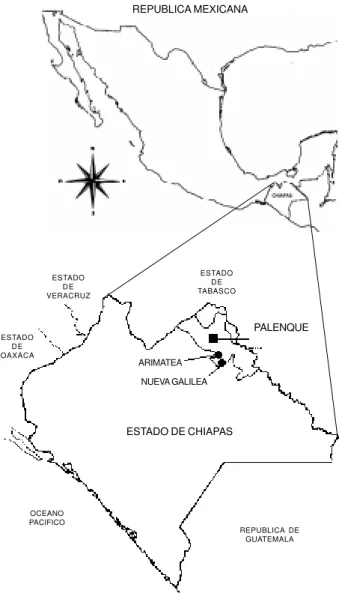
municipality of Palenque, Chiapas, Mexico, close to the border with Guatemala (Fig. 1). These communities are 8 km apart and about 29 km from the city of Palenque.
Insecticides and spraying - Designated houses were sprayed with lambdacyhalothrin WP and SC using 8 L Hudson X-pert spraypacks. All internal wall and roofs surfaces were sprayed. A total of 60 houses were treated in the two communities. Spraying was completed in five days and was done in autumn (November 1997) as fol-lows: (1) three concentrations were prepared with the in-secticides WP (8.6, 16.7, 23.7 mg a.i./m2) and SC (1.876, 3.752, 5.628 mg a.i./m2), according to the values for LC90 obtained in the susceptibility tests. Each concentration was sprayed on at least 10 houses following Mexican regu-lations (NOM-049-SSA1-1993); (2) before the treatment the kitchen utensils, food, personal clothing and bed clothing were removed from the houses. Domestic ani-mals were taken far away from the application area. The owners were instructed to keep doors and windows closed
during 2 h after the application of the insecticide and then to ventilate the houses before transferring the utensils back to the interior; (3) at the moment of spraying on the palm roofs, three filter papers were pinned at various heights to roofs of each of three houses selected at ran-dom. After spraying, these papers were sealed into indi-vidual plastic bags to determine the amount of insecticide applied by differences of weight.
Evaluation of the residual effects - Evaluated at 24 h and at 1, 3, 6, 9, 12, 15 and 18 months after spraying by exposing to 24 and 48 h of ten R. prolixus nymphs on the indoor insecticide-treated surfaces of palm leaves. It was carried out by holding the insects in place by using the AGA boxes attached to the treated surfaces of the roofs (Cruzado & Molina 2000). After 24 h, insects were re-moved, mortality rates were recorded and live insects were transferred onto filter paper and observed in the labora-tory for seven days in order to observe the delayed effect of the insecticide. The tests were always performed fixing the boxes to different positions on the same roofs of each of the test houses. A control group was established in houses not sprayed.
RESULTS
Householders were generally pleased by the spray-ing. All were satisfied with the applied product, with sev-eral noting that it did not smell nor leave any obvious deposit. Many were particularly pleased at the rapid ac-tion against cockroaches and scorpions that fell shortly after spraying. However they did not allow us to search for triatomines inside their houses.
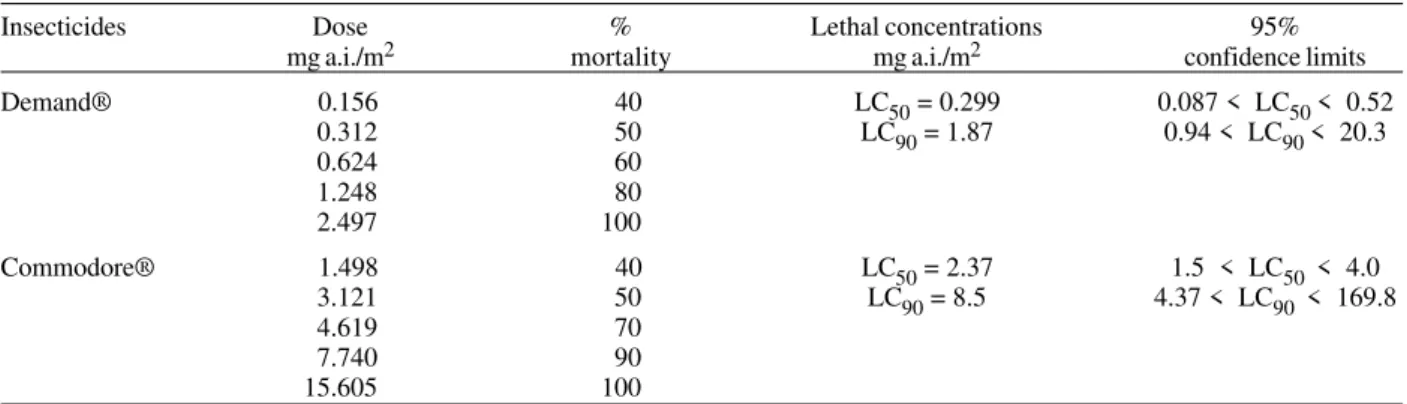
Table I shows the results of the susceptibility assays. The dose utilized in the field spraying were: the dose 1 of WP was of 8.6; dose 2 was of 16.7 and the dose 3 was of 23.7 mg a.i./m2 (one, two and three times the LC90). For SC the dose were 1.876, 3.752 and 5.628 mg a.i./m2.
The amount of insecticide applied inside the houses determined with filter papers is shown in Table II.
The first evaluation of the residual effect of the insec-ticides were performed at 24 h after spraying by exposing fifth-instar R. prolixus on three palm roofs resulting in a 100% mortality rate (for WP in dose 1). Evaluation of the residual effects was repeated one, three and six months after the insecticide application at the same houses, 100% effectiveness was observed up to six months after spray-ing. After nine months the effectiveness began to decline slightly (93.3%; Fig. 2). It was also observed that in dose 2 the effectiveness was 100% up to 12 months, begin-ning to decline after 15 months to 93.3%. In dose 3, the effectiveness was 100% up to 12 months, beginning to decline after 15 months to 96.6%. With the SC, it was ob-served that for dose one the effectiveness was 100% up to three months, beginning to decline after six months to 96.6% and to 33.3% after 18 months. It was also observed that for dose two the effectiveness was 100% up to 9 months, beginning to decline slightly to 96.6% after 12 months and to 63.3% after 18 months. For dose 3, 100% effectiveness was observed up to 12 months, beginning to decline to 93.3% after 15 months and to 86.6% after 18 months, this is illustrated in Figs 3 and 4.
REPUBLICA MEXICANA
ESTADO DE CHIAPAS NUEVA GALILEA ARIMATEA
PALENQUE ESTADO
D E TABASCO ESTADO
D E VERACRUZ
ESTADO D E OAXACA
OCEANO PACIFICO
REPUBLICA DE GUATEMALA
DISCUSSION
Synthetic pyrethroids such as permethrin and deltamethrin seem to retain their superficial toxicity for much longer than organochlorines, organophosphates or carbamates. Field trials with these compounds, at much lower doses than those used for BHC (Lindane), show that a single application can keep houses free from appar-ent infestation for several months, in some cases more than a year (Pinchin et al. 1980, 1981, Schofield 1985). These compounds, although more expensive (nearly 10-20 times the price of the BHC), offer an excellent alterna-tive for the control of triatomines. Particularly, the insecti-cidal activity of lambdacyhalothrin on R. prolixus is su-perior to that of other pyrethroids (Oliveira-Filho 1999).
Assays of susceptibility with Demand® and Commo-dore® - In Table I, we can observe that the concentra-tions obtained for the Demand® formulation are 4-8 times smaller (LC50 = 0.299 and LC90 = 1.87 mg/m2) that those obtained for Commodore® (LC50 = 2.37 and LC90 = 8.5 mg/m2). In the same way Demand® resulted in the same effectiveness with 16 times less product and Commodore® with 3.5 times less than the 30 a.i. mg/m2, used by Ferro et al. (1995).
The above-mentioned confirms the necessity of car-rying out tests of susceptibility of local triatomines to each new insecticide formulation on different materials.
Residual effects of insecticides - Encouraging results were obtained with the two commercial preparations. With WP in dose 1 (8.6 mg/m2) an absolute efficiency was ob-tained for up to 15 months after its application, at which time a significant decline was observed in its residual efect on palm leaves (test z). In the case of SC (1.876 mg/m2) an absolute efficiency was obtained for up to 9 months after its application, at which time a significant decline was ob-served in it efficiency (Fig. 2). Carrying out this same test for dose 2, for SC (3.752 mg/m2), an absolute efficiency was obtained for up to 15 months after its application, while for WP (16.7 mg/m2) for up to 18 months (Fig. 3). These same results were obtained for doses 3 of both preparations.
The references on the use of pyrethroid insecticides report for studies conducted in Paraguay and Brazil an absolute effectiveness for up to 18 months with the lambdacyhalothrin (Oliveira-Filho et al. 1988, Ferro et al. 1995) and Mazariego-Arana (1997) working with alfacypermethrin and lambdacyhalothrin found an abso-lute effectiveness for up to 14 months in a laboratory study carried out in Mexico city.
From our results, we consider that for WP the applica-tion of a dose of 8.6 mg/m2 could be used to keep palm roofs free R. prolixus in the localities mentioned. In the case of SC, an application of a dose of 3.752 mg/m2 gave the same results for up to 15 months. Since we found
TABLE I
Susceptibility assays using fifth-instar Rhodnius prolixus nymphs exposed to the two formulations of the lambdacyhalothrin applied on palm leaves
Insecticides Dose % Lethal concentrations 95%
mg a.i./m2 mortality mg a.i./m2 confidence limits
Demand® 0.156 40 LC50 = 0.299 0.087 < LC50 < 0.52 0.312 50 LC90 = 1.87 0.94 < LC90 < 20.3
0.624 60
1.248 80
2.497 100
Commodore® 1.498 40 LC50 = 2.37 1.5 < LC50 < 4.0 3.121 50 LC90 = 8.5 4.37 < LC90 < 169.8
4.619 70
7.740 90
15.605 100
Ten fifth-instar R. prolixus nymphs were exposed to the insecticides on surfaces of 80.1 cm2. The LC50 and LC90 (lethal concentration) were plotted in a log.probit graph, calculations made with a computer program (Raymond 1996).
TABLE II
Amounts of insecticides in filter paper placed on the palm roofs during spraying
Lambdacyhalothrin Dose one mg a.i. /m2 Dose two mg a.i./m2 Dose three mg a.i. /m2
formulations Obtained Mean Obtained Mean Obtained Mean
WP 10 8.04 16.08 25.28
10.34 9.19 18.38 17.23 24.13 25.66
9.19 (8.6) a 17.23 (16.7) 27.57 (23.7)
SC 2.5 1.87 4.6 6.84
2.11 1.98 4.5 4.4 7.12 6.73
1.96 (1.876) 4.1 (3.752) 6.24 (5.628)
Fig. 2: percent of mortality on the fifth-instar nymphs of Rhodnius prolixus bugs after 24 h of exposure to the treated palm leaves roofs with lambdacyhalothrin dose one of SC (1.87) and WP (8.6 mg a.i. /m2)
Month % mo rt a lit y f o r Rhodni us pr ol ix us 20 40 60 80 100
Time vs mortality produced for Commodore (WP) Time vs mortality produced for Demand (SC)
* * * * * *
* Significantly different respect of 100% of efficiency
24 h 1 m 3 m 6 m 9 m 12 m 15 m 18 m
Fig. 3: percent of mortality on the fifth-instar nymphs of Rhodnius prolixus bugs after 24 h of exposure to the treated palm leaves roofs with lambdacyhalothrin dose two of SC (3.75) and WP (16.7 mg a.i. /m2)
Month % mo rt a li ty fo r R hodni us pr ol ix us 20 30 40 50 60 70 80 90 100
Time vs Mortality produced for Commodore (WP) Time vs Mortality produced for Demand (SC)
*
*
* significantly different respect of 100% of efficiency
24 h 1 m 3 m 6 m 9 m 12 m 15 m 18 m
Fig. 4: percent of mortality on the fifth-instar nymphs of Rhodnius prolixus bugs after 24 h of exposure to the treated palm leaves roofs with lambdacyhalothrin dose three of SC (5.63) and WP (23.7 mg a.i. /m2)
% m o rt a li ty fo r Rhodn ius p rol ix us Month 84 86 88 90 92 94 96 98 100 102
Time vs Mortality produced for Commodore (WP) Time vs Mortality produced for Demand (SC)
24 h 1 m 3 m 6 m 9 m 12 m 15 m 18 m
similar effects with the compounds tested, the selection of the doses and of the commercial preparation depends largely on their costs.
R. prolixus appears as a highly susceptible organism to both tested products in lower dosages than insecti-cides currently employed against other domestic triatomines in Chagas Disease Control Programmes, our results may contribute to determine the most effective formulations when using the pyrethroid insecticide lambdacyhalothrin.
ACKNOWLEDGEMENTS
To Zéneca Mexicana S. A., for the donation of the insecti-cide formulation; to the Centro de Investigación de Paludismo/ SS for the training and advice in the use of the spraypacks. To Amparo López, Herminio Escobar-Castillo, David Pérez-Gallegos, Izael Aguirre-López, Carlos Hiram Molina-Ventura and Fausto Raúl Cruzado-Mazariego for laboratory and field assistance. To the local authorities of Palenque, Chiapas for their support, and to the people of the communities of Arimatea and Nueva Galilea for their cooperation and trust.
REFERENCES
Acevedo F, Godoy E, Schofield CJ 2000. Comparison of inter-vention strategies for control of Triatoma dimidiata in Nica-ragua. Mem Inst Oswaldo Cruz 95:867-871.
Cruzado-Mazariego FR, Molina-Ventura CH 2000. Pruebas de Campo para el Control en la Transmisión de Trypanosoma cruzi a Través del Insecticida Piretroide Lambdacialotrina en Casas-habitación de Localidades del Municipio de Palenque, Chiapas, Thesis, Facultad de Ciencias Químicas, Universidad Autónoma de Chiapas, México.
Dias JCP, Schofield CJ 1999. The evolution of Chagas disease (American tripanosomiasis) control after 90 year since Carlos Chagas discovery. Mem Inst Oswaldo Cruz 94
(Suppl. I): 103-121.
Dujardin JP, Muñóz M, Chávez T, Ponce C, Moreno J, Schofield CJ 1998. The origin of Rhodnius prolixus in Central America.
Med Vet Entomol 12: 113-115.
Ferro AE, Rojas de A, Ferreira ME, Simancas LC, Rios LS, Rosner M 1995. Residual effect of lambdacyhalothrin on
Triatoma infestans. Mem Inst Oswaldo Cruz 90: 415-419. Mazariego-Arana MA 1997. Evaluación del Control de Triatominos (Insecta: Hemiptera) a través de Insecticidas,
MSc Thesis, Escuela Nacional de Ciencias Biológicas, Instituto Politécnico Nacional, México.
NOM-Norma Oficial Mexicana, NOM-049-SSA1-1993. Requisitos sanitarios para el almacenamiento, distribución, venta y aplicación de plaguicidas de uso doméstico, Secretaría de Salud y Asistencia, México.
Oliveira-Filho AM 1999. Differences of susceptibility of five triatomine species to pyrethroid insecticides - Implications for Chagas disease vector control. Mem Inst Oswaldo Cruz 94 (Suppl. 1): 425-428.
Oliveira-Filho AM, Figueiredo MJ, Melo MTV, Santos CE, Silva EL, Dias JCP, Teixeira-Neto I, Brasil LA, Bastos LC, Deus LF 1988. Evaluation of the pyrethroid lamb-dacyhalothrin (OMS 3021) as a control agent for triatomines. 5th Meeting for Applied Research into the Control of Chagas’ Disease, Araxá, Minas Gerais, Brazil, Appendix 6, Abstract A. 2-21.
OPS-Oficina Panamericana de Salud 1984. Boletín Técnico No. 26, Enfermedad de Chagas, México.
Pinchin R, de Oliveira-Filho AM, Fanara DM, Gilbert B 1980. Ensaio de campo para avaliação das posibilidades de uso da decametrina (OMS 1998) no combate a triatomineos. Rev
Bras Malariol Doenças Trop 32: 36-41.
Pinchin R, de Oliveira-Filho AM, Gilbert B 1981. Field trial of permethrin for the control of Triatoma infestans. Bull PAHO 15: 370-376.
Ponce C 1999. Elimination of the vectorial transmission of Chagas disease in Central American countries: Honduras.
Mem Inst Oswaldo Cruz 94 (Suppl. I): 417-418.
Raymond M 1996. Probit analysis program. Laboratoire de Genetique Institut de la Science de l’Evolution. U.S.T.L., Place E. Bataillon 34060, Montepellier, Cedex France. Ryckman RE 1951. Laboratory culture of triatominae with
ob-servations on behavior and a new feeding device. J Parasitol 83: 210-214.
Schofield CJ 1985. Control of Chagas disease vectors. British Med Bull 41: 187-194.
Schofield CJ, Dujardin JP 1997. Chagas disease vector control in Central America. Parasitol Today 13: 141-144. WHO-World Health Organization 1991. Control of Chagas