Arq Neuropsiquiatr 2006;64(3-B):727-730
1Divisão de Neurologia e Epidemiologia, Universidade Federal da Bahia, Salvador BA, Brasil (UFBA); 2Professor, Universidade Estadual de Feira de Santana BA, Brasil; 3Estudante de Medicina UFBA; 4Secretaria de Saúde do Estado da Bahia; 5Brazilian Committee for Treatment and Research in Multiple Sclerosis (BCTRIMS).
Received 1 March 2006, received in final form 29 May 2006. Accepted 21 June 2006.
Dr. Ailton Melo - Avenida Magalhães Neto 735 / 802 - 41820-011 Savador BA - Brasil. E-mail:[email protected]
CLINICAL AND EPIDEMIOLOGICAL PROFILE
OF MULTIPLE SCLEROSIS IN A REFERENCE
CENTER IN THE STATE OF BAHIA, BRAZIL
Eduardo Cardoso
1,2,5, Thiago Fukuda
3, Júlio Pereira
3, Jamile Seixas
3,
Rafael Miranda
3, Bernardo Rodrigues
1, Thaís Saback
3, Renata Andrade
3,
Grace Cardoso
1, Rosa Martinez
4, Juliane Avena
4, Ailton Melo
1,5ABSTRACT - Multiple sclerosis (MS) is an autoimmune, demyelinating and degenerative disease that affects the central nervous system. Its prevalence and clinical aspects vary according to the continent considered, being more frequent in Caucasians and young individuals aged 20 to 40 years. Epidemiological data from Brazil show that prevalence is variable, being more frequent in the Southern and Southeastern areas of the country, rather than in the Northern and Northeastern areas. The purpose of this paper is to describe MS clinical and epidemiological features in the State of Bahia, in the Brazilian Northeastern region. Thus, we held a cross-sectional study over the period from February to May, 2005, in the Multiple Sclerosis Patient Support Center (“Núcleo de Apoio aos Pacientes com Esclerose Múltipla”) of Bahia, which included all patients with a diagnosis of MS seen over this period of time. A total of 121 patients were investigated, being 80.2% females (female:male ratio=4:1), with higher frequency in mulatto individuals (64%), and the relapsing-remitting type (91.3%). Most patients (68.7%) had mild MS, and blacks were prone to worse prognosis compared to other patients.
KEY WORDS: multiple sclerosis, epidemiology, reference center.
Perfil clínico e epidemiológico da esclerose múltipla em um centro de referência do Estado da Bahia
RESUMO - A esclerose múltipla (EM) é doença auto-imune, desmielinizante e degenerativa que afeta o sis-tema nervoso central. Sua prevalência e seus aspectos clínicos variam de acordo com o continente estuda-do, sendo mais freqüente em caucasianos e indivíduos jovens entre a terceira e quarta décadas de vida. Dados epidemiológicos sobre o Brasil demonstram que a prevalência é variável, sendo mais freqüente nas regiões sul e sudeste que no norte e nordeste. O objetivo desse estudo é descrever as características clíni-cas e epidemiológiclíni-cas da EM no Estado da Bahia, nordeste brasileiro. Assim, realizamos estudo de corte transversal durante o período de fevereiro a maio de 2005, no Núcleo de Apoio ao Pacientes com Esclerose Múltipla da Bahia, incluindo todos os pacientes consecutivos, com diagnóstico de EM, atendidos nesse período. Foi estudado um total de 121 pacientes, 80,2% do gênero feminino com uma relação de 4:1 com o gênero masculino, sendo observado maior freqüência de mulatos (64%) e da forma surto-remissão (91,3%). A maioria dos pacientes (68,7%) foi classificada como EM leve, sendo que os negros apresentaram indícios de pior prognóstico em relação aos outros pacientes.
PALAVRAS-CHAVE: esclerose múltipla, epidemiologia, centro de referência.
Multiple sclerosis (MS) is an autoimmune, demyeli-nating, degenerative disease that affects the central nervous system1. Its etiology is still unknown, but it
is assumed this is an interaction among genetic, infec-tious and environmental factors to favor its develop-ment2. The types of MS are relapsing-remitting,
pri-mary progressive and secondary progressing. The
pre-valence of MS is variable. In Northern European coun-tries and in North America, its prevalence is estimat-ed in 300/100000, whereas in Africa and equatorial zones, the estimated prevalence is lower than 5/ 1000003.
728 Arq Neuropsiquiatr 2006;64(3-B)
and orientals. This disease is more frequent in women (female: male ratio ranging from 1.2:1 to 5:1) compar-ed to men3. Young adults aged 20 to 40 years are
af-fected the most, and in developed countries MS is the main cause of disability for this age group, sec-ond to external causes1.
National studies have shown great MS epidemi-ological variability over Brazilian states, due to the particular features of each population investigated. For Bahia, no studies so far have described the parti-culars of this disease, not withstanding the state’s demographic data. Thus, the purpose of this study is to describe the clinical and epidemiological charac-teristics of MS patients who live in the state of Bahia.
METHOD
A cross-sectional study was held from February to May 2005 at Multiple Sclerosis Patient Support Center (“Núcleo de Apoio ao Paciente com Esclerose Múltipla” - NAPEM), within the Magalhães Neto Outpatient Clinic, Professor Edgar Santos University Hospital (HUPES), Federal University of Bahia (UFBA). All consecutive patients who came for a medical visit over the period of time of the study, with a confirmed diagnosis of MS based on the criteria by McDo-nald et al. (2001) established by a NAPEM physician were included.
Data were collected from a standardized clinical form by the study investigators. To prevent biases, training ses-sions on how to fill out the form were held.
The epidemiological variables were: gender, age at onset of disease, length of time with the disease, color of the skin, level of education. The clinical variables were the Kurtze scale (EDSS), which is validated to assess neurolog-ical impairment in MS patients, and the clinneurolog-ical manifesta-tion of the disease.
After data collection, a databank was built, with the use of software SPSS v.9.0, and the presented variables were described by measures of frequency, dispersion, and cen-tral tendency (mean and median).
RESULTS
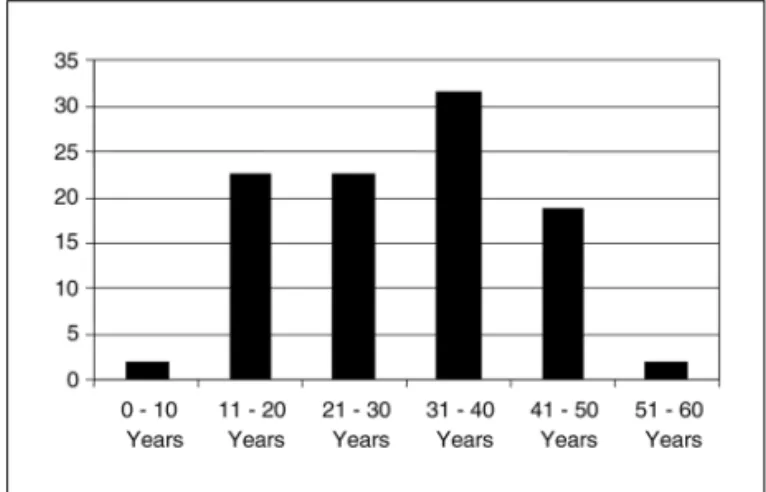
A total of 121 patients were included; of them, 97 (80.2%) were females, with a female: male ratio of 4:1. Mean age at onset was 31.1±11.02 years, being 31.46±10.70 for females, compared to 29.69±12.37 for males. For 11 patients (9.1%), their age at onset was under 18 years. In most patients, symptoms started between the second and fourth decade of life (Fig 1). The relapsing-remitting clinical type was the most frequent one, with 91.3% of the sample, compared to 6.1% of the primary progressive and 1.7% of the secondary progressive type. The most frequent site of disease onset was the optical pathways (34.4%) and spinal cord (34.4%), followed by compromised
telencephalon (19.4%), cerebellum (7.5%), and brain-stem (4.3%) (Fig 2).
In our population, mulattos were affected the most (64%), followed by whites (27%), and blacks (9%). There were clinical differences among the groups; in our study the blacks were more clinically compromised on EDSS measurement compared to whites and mulattos (Table 1).
In terms of severity of the disease, mean EDSS sco-re was 3.21±2.27, with a median of 3; a high propor-tion of patients had mild disease (68.4%), compared to 21.1% with moderate, and 10.5% with severe dis-ease. In spite of the sample having only 10 patients with the progressive forms of the disease, a very low number, one could note the severity of the disease, as its mean EDSS score was 5.1±1.91, versus the relaps-ing-remission type, which had a mean EDSS score 2.91±2.14.
Mean of annual relapsing was 0.93±1.06 relaps-es/ year; it was higher in those younger than 18 years of age at onset of disease (2.0±2.08 relapses/year) versus those who were older than 18 years at onset (0.76±0.69 relapses/year).
Fig 1. Distribution of patients according to the decade of life of MS symptoms onset.
Arq Neuropsiquiatr 2006;64(3-B) 729
Table 1. Clinical and epidemiological features of patients, according to the color of their skin (black, mulatto and white).
Features Blacks Mulattos Whites
Gender
Males, % 20 19.7 20
Females, % 80 80.3 80
EDSS score 5.50 ±2.31 3.26±2.31 2.38 ±1.89
Time with the disease (months) 93.44±72.08 88.06±71.43 83.29±78.78 Age at onset (years) 31.28±9.2 31.44±11.49 30.28±10.70 Total number of relapses 4.50±5.7 3.74±2.64 4.91±4.96 Time until diagnosis (months) 65.13±52.55 52.76±48.01 48.08±52.94 Clinical type of the disease
Relapsing-Remitting, % 90 92.5 89.7
Primarily progressive, % 0 6 6.9
Secondarily progressive, % 0 1.5 0
Table 2. Comparison of results from 10 epidemiological investigations on MS carried out in Brazil.
Authors Sample Gender Mean age Ethnicity Clinical type Poser criteria
ratio F:M at onset (%) (%) (%)
Moreira et al.9 302 3.1;1 37.7 94.0 W 72.0 RR MS established
5.0 Bl 14.0 PP 1.0 As 14.0 SP
Tilbery et al.12 214 2.9:1 28 (SR) 96.0 W 82.0 RR MS established 36 (PP) 4.2 Bl 18.0 PP
0.5 As
Arruda et al.4 200 1.8:1 32.0±9.9 98.5 W 91.0 RR A – 61.0
1.5 Bl 8.0 PP B – 21.0
1.0 SP C – 8.0 Callegaro et al.5 120 1.6:1 27.9±8.9 79.2 W 85.0 RR MS established
10.0 M 10.2 PP 10.0 Bl 4.2 SP
0.8 As
Papaiz-Alvarenga et al.11 88 3:1 27.9±11.3 68.2 W 88.6 RR A – 74.0
31.8 Bl 4.5 PP B – 5.3
6.8 SP C – 17.8 Lana-Peixoto et al.7 67 2.3:1 28.9±10.4 76.0 W – MS established
19.4 M 4.5 Bl
Leite et al.8 51 2.1:1 34.5±13.9 62.7 W 47.0 RR 45 MS established 37.4 no W 19.7 PP 6 likely
33.3 mixed
Oliveira et al.10 50 2:1 32.5±9.6 64.0 W 60.0 RR 76.0 established 34.0 M+W 30.0 PP 24.0 likely
2.0 As 10.0 SP
Ferreira et al.6 118 4.1:1 33.2±11.5 (SR) 5.9 W 70.4 RR 82.2 CD 41.1±13.8 (PP) 0.8 Bl 5.9 PP 5.1 CL 30.3±11.6 (SP) 93.2 Pd 23.7 SP 12.7 LD Souza-Cardoso et al.13 121 4:1 31.1±11.02 27 W 91.3 RR MS defined by
64 Pd 6.1 PP
9 Bl 1.7 SP Mcdonalds criteria
730 Arq Neuropsiquiatr 2006;64(3-B)
As for immunomodulators, 93.3% of the patients used it actively. Rebif®was used by 45.5% of the
pa-tients, followed by Copaxone®, 23.3%; Betaferon®,
20.2%; and Avonex®, 7.9%. Rebif®was the first
im-munomodulator to be dispensed by the State of Ba-hia Health Secretariat.
Table 2 shows a comparison of this investigation with other published studies on the epidemiology of MS in the Brazilian states.
DISCUSSION
This investigation, carried out in the reference cen-ter for MS of the State of Bahia, showed that, in spite of MS being an urban disease, with well-defined diag-nostic criteria, the medical and epidemiological fea-tures of the disease vary according to the geograph-ical area under investigation, as we can see from the different Brazilian states4-13. Thus, while we estimate
a prevalence of less than 5% for the Northeastern region 5%6,13, prevalence in the Southern and
South-eastern regions range between 15% to 18%4,5,7-12. On
the other hand, the higher frequency of the optical pathways and the spinal marrow as the site of first symptoms observed in this study confirm data from other Brazilian authors, who point a higher propor-tion of Devic’s disease among black-colored individ-uals, and Lana-Peixoto7stressed out similarities with
the Asian type. On the other hand, Arruda et al. ob-served a frequency of only 3.5% of Devic’s disease in a study carried out in the State of Paraná, and they believe such low frequency is due to the small preva-lence of blacks and orientals in their sample4. The
few studies carried out in Africa showed that preva-lence of MS is low in that continent14-17; however, it
increases among African descendants living in the United States, who have a smaller risk of developing MS compared to Caucasians18. This data show that
there is possibly a gene protection factor among Afri-can or AfriAfri-can-descendent populations for the onset of disease, which is less expressed in the North-Ame-rican population due to gene mixing or environmen-tal factors yet to be identified.
One aspect that should be mentioned is a
possi-ble selection bias in our sample, as many patients are referred to NAPEM for treatment, and access to a neurologist is easier for patients of the State’s capi-tal city. When we compare our sample to that of oth-er Brazilian states, we see that, diffoth-erently from the Southern and Southeastern regions, there is a big population of mulattos and blacks with MS in the Northeastern Region4-13, which justifies large-scale
epidemiological studies to determine differences among populations of all Brazilian regions.
REFERENCES
1. Noseworthy JH, Lucchinetti C, Rodriguez M, Weinshenker BG. Multiple sclerosis. N Engl J Med 2000;343:938-951.
2. Kurtzke JF, Page WF. Epidemiology of multiple sclerosis in US veter-ans: VII. Risk factors for MS. Neurology 1997;48:204-213
3. Compston A, Coles A. Multiple sclerosis. Lancet 2002; 359:1221-1231. 4. Arruda WO, Scola RH, Teive HAG, Werneck LC. Multiple sclerosis: re-port on 200 cases from Curitiba, Southern Brazil and comparison with other Brazilian series. Arq Neuropsiquiatr 2001;59:165-170. 5. Callegaro D. Contribuição ao estudo clínico evolutivo da esclerose
múltipla: análise de 120 pacientes. Tese. Universidade de São Paulo. São Paulo, 1989.
6. Ferreira ML, Machado MI, Vilela ML, et al. Epidemiology of 118 cases of multiple sclerosis after 15 years of follow-up on the reference cen-ter of Hospital da Restauracao, Recife, Pernambuco, Brazil. Arq Neu-ropsiquiat 2004;62:1027-1032.
7. Lana-Peixoto M, Lana-Peixoto MIV. Is multiple sclerosis in Brazil and Asia alike? Arq Neuropsiquiatr 1992;50:119-125.
8. Leite ACCB, Andrade C, Novis S. Esclerose múltipla no Rio de Janeiro: apresentação clínica em 51 casos. Arq Neuropsiquiatr 1990;48(Supl):S66. 9. Moreira MA, Felipe E, Mendes MF, Tilbery CP. Esclerose múltipla: estu-do descritivo de suas formas clínicas em 302 casos. Arq Neuropsiquiatr 2000;58:460-466.
10. Oliveira EML, Annes M, Oliveira ASB, Gabbai AA. Esclerose múltipla: estudo clínico de 50 pacientes acompanhados no Ambulatório de Neurologia UNIFESP-EPM. Arq Neuropsiquiatr 1999;57:51-55. 11. Papais-Alvarenga RM, Santos CMM, Abreu JS, et al. Esclerose
múlti-pla: perfil clínico e evolutivo no município do Rio de Janeiro. Rev Bras Neurol 1995;31:75-87.
12. Tilbery CP, Felipe E, Moreira MA, Mendes MF, França AS. Interferon beta-1a na esclerose múltipla: experiência de um ano em 62 pacientes. Arq Neuropsiquiatr 2000;58:452-459.
13. Cardoso E, Fukuda T, Melo A, et al. Epidemiologia da esclerose múlti-pla no Estado da Bahia. Arq Neuropsiquiatr 2005;63(Supl 1):S18. 14. Foster RM, Harries JR. Multiple sclerosis in the African. Br Med J
1970;3:628.
15. Ames FR, Bowen RM. First coloured South African with multiple scle-rosis confirmed by necropsy. J Neurol Neurosurg Psychiatry 1979;42: 731-733.
16. Kioy PG. Emerging picture of multiple sclerosis in Kenya. East Afr Med J 2000;78:93-96.
17. Modi G, Mochan A, Modi M, Saffer D. Demyelinating disorder of the central nervous system occurring in black South Africans. J Neurol Neurosurg Psychiatry 2001;70:500-505.