Physiotherapy and Occupational Therapy Outpatient Unit, University Hospital - State University of Campinas Medical School Hospital, Campinas SP, Brazil (UNICAMP): 1Physiotherapist, Master Degree Student; 2Physiotherapist, Master in Surgery; 3Neurosurgeon,
Associate Professor. This research was supported by FAPESP grants 05/51565-1 and CNPq 302189/2004-1. Received 24 November 2005, received in final form 10 May 2006. Accepted 15 June 2006.
Dra. Roberta de Oliveira - Rua Senador Vergueiro 687 / 133 - 13480-900 Limeira SP - Brasil. E-mail: [email protected]
POST-STROKE MOTOR AND FUNCTIONAL EVALUATIONS
A clinical correlation using Fugl-Meyer assessment scale,
Berg balance scale and Barthel index
Roberta de Oliveira
1, Enio Walker Azevedo Cacho
2, Guilherme Borges
3ABSTRACT – Stroke is one of the major causes of morbidity and mortality. Sequels deriving from this event may lead to motor disability and from mild to severe deficits. In order to better classify sensory-motor dys-function, balance and ability to perform activities of daily living, quantitative and qualitative evaluation scales have been used. Objective: To correlate the scales Fugl-Meyer assessment scale, Berg balance scale and Barthel index. Twenty subjects with sequel after a single, unilateral stroke in chronic phase (>6 months post ictus) were evaluated for about one hour. Results: Barthel scale was statistically related to the total motor score of Fugl-Meyer assessment (r=0.597, p=0.005). The lower limb section at Fugl-Meyer had pos-itive correlation with Berg scale (r=0.653, p=0.002) and with the balance section of Fugl-Meyer own scale (r=0.449, p=0.047). Both balance scales were correlated one with other (r=0.555, p=0.011). Statistical diver-gence appeared when Barthel’s Index was correlated with Berg’s Scale (r=0.425, p=0.062), and it is not sta-tistically significant. Conclusion: The use of both quantitative and qualitative scales was shown to be a good measuring instrument for the classification of the general clinical performance of the patient, espe-cially when positively related joint evaluations are applied.
KEY WORDS: Fugl-Meyer assessment scale, Berg balance scale, Barthel index, stroke.
Avaliações motoras e funcionais pós-AVC: correlação clínica usando a escala de desempenho físico de Fugl-Meyer, a escala de equilíbrio de Berg e o índice de Barthel
RESUMO - O acidente vascular cerebral (AVC) é reconhecido como uma das maiores causas de morbidade e mortalidade. Seqüelas decorrentes deste evento podem levar a inabilidade motora e déficits leves a graves. Para classificar melhor a disfunção sensitivo-motora, o equilíbrio e as habilidades para as atividades de vida diária, escalas de avaliações quantitativas e qualitativas estão sendo utilizadas. Objetivo: Corre-lacionar a escala de desempenho físico de Fugl-Meyer, a escala de equilíbrio de Berg e o índice de Barthel.
Método: Foram selecionados 20 sujeitos com sequela de um único e unilateral AVC em fase crônica (>6 meses pós ictal), que passaram pelas avaliações por cerca de uma hora. Resultados: A escala de Barthel correlacionou-se com a pontuação motora total de Fugl-Meyer (r=0,597, p=0,005). A seção para membros inferiores de Fugl-Meyer teve correlação positiva com a de Berg (r=0,653, p=0,002) e com a seção de equi-líbrio da própria escala de Fugl-Meyer (r=0,449, p=0,047). Ambas as escalas de equiequi-líbrio tiveram corre-lação entre si (r=0555, p=0,011). A divergência estatística apareceu quando se correlacionou a Escala de Barthel com o Índice de Berg (r=0,425, p=0,062), não sendo estatisticamente significativo. Conclusão: O uso de escalas quantitativas e qualitativas mostrou ser um bom instrumento de medida para a classificação do quadro físico geral do paciente, ainda mais quando são aplicadas avaliações em conjunto que se rela-cionam positivamente.
PALAVRAS-CHAVE: escala de desempenho físico de Fugl-Meyer, escala de equilíbrio de Berg, índice de Barthel, acidente vascular cerebral.
Recently evaluation instruments able to design the neurological profile of patients with stroke sequel are being widely publicized. These instruments help health care professionals to measure the impairment
based on scores and are both valuable qualitative and quantitative instruments, being able to predict the recovery prognosis of these patients4. Another
advantage would be the possibility of dividing pa-tients into groups according to their level of impair-ment, in order to make research or even to prescribe a more adequate therapeutic strategy.
Recent studies5have been considering the issue
of correlating scales in order to have accuracy about their use in patient’s evaluation as a whole person, apart from also focusing on both dichotomy of upper and lower extremity impairments6.
The objective of this investigation was to verify the correlations among Fugl-Meyer Assessment Scale (FM), Berg Balance Scale and Barthel Index in post-stroke hemiparetic patients. Research Ethical Commit-tee of our Institution (UNICAMP) approved this report.
METHOD
Twenty patients from both sexes, with their ages rang-ing from 25 to 69 years of age were selected in a non-prob-abilistic manner from the Physiotherapy and Occupational Therapy Ambulatory of the University Hospital - UNICAMP. They had a previous history of a single and unilateral stroke, with a minimum of 6 months and a maximum of 15 years since the lesions had occurred and had not presented oth-er associated neurological pathology, including cognitive impairment.
After collecting of personal data, the patients were un-dergone to a clinical evaluation that had approximately 1 hour duration, using the scales of Fugl-Meyer1, Berg2and
Barthel3. The evaluations were carried out by two
experi-enced physiotherapists, familiarized with the scales (RO, EWAC).
The Fugl-Meyer physical performance scale assesses five dimensions of impairment, including three aspects of motor control, such as the amplitude of joint movement, pain, sensitivity, motor impairment of the upper and lower extre-mities and balance. The data are scored in an ordinal scale of 3 (0=no performance; 2=complete performance) applied to each item7. The total motor score is equal to the
classi-fication of the upper limb (UL) plus the lower limb (LL), cor-responding to 100 total scores (UL=66, LL=34). The total FM score, including the other items, corresponds to 226 scores in the final sum.
The Berg Balance Scale comprises of 14 tasks where each
performance. The total score for all tasks consists of 56 scores, being from 0 to 20 considered a poor balance and from 40 to 56, a good balance2.
The Barthel Index assesses activities related to clothing, nourishment, personal hygiene and transfers, each item receiving a score of 0, 5, 10 or 15, reaching a total of 100 scores for individuals who are independent to perform Ac-tivity Daily Life (ADL)3.
In order to describe the sample profile according to the study variables, descriptive statistics of common variables were calculated, including both mean values and standard deviation (SD). Spearman’s correlation coefficient was used to analyze the correlation among the numerical scores of the scales. The significance level adopted for the statistical tests was 5% (p<0.05).
RESULTS
The mean age of the selected patients was 47.9 years (10.79 SD), with predominance of both male sex (60%) and the ischemic type of lesion (75%). De-ficit of the right body prevailed in 60% of the sub-jects. The time elapsed after stroke had a mean of 3.63 years (3.02 SD).
For the clinical scales, in Table is demonstrated both the mean and the standard deviation of the main items evaluated, where it can be seen that in relation to balance, the mean was relatively elevat-ed, although the patients had a mean quite below the normal score concerning the level of motor im-pairment.
Correlating the total motor score of FM to the Barthel Index, we were able to observe that the cor-relation was statistically significant (r=0.597; p=0.005), showing that the lower the level of motor impair-ment, the better will be the individual functional capacity (Fig 1).
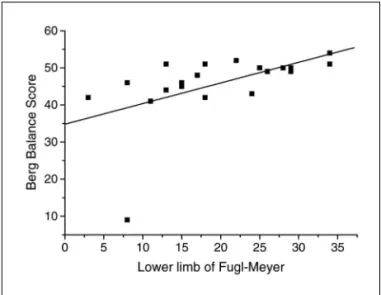
The level of motor impairment of LL (FM) signif-icantly correlated with the balance scores of Berg (r= 0.65305; p=0.0018) (Fig 2) and with the balance sec-tion of FM (r=0.44872; p=0.0472) (Fig 3).
Regarding to the Berg Balance Scale and the bal-ance section of FM, a strong statistical correlation was found between them (r=0.55457; p=0.0112) (Fig 4).
When the balance scores were separately
correlat-Table. Mean scores in clinical evaluations.
Fugl-Meyer Total Balance Berg Barthel
UL and LL (100) Fugl-Meyer (226) Fugl-Meyer (14) (56) (100)
Mean 53.35 170.50 10.80 45.65 90.75
SD 28.44 31.91 1.24 9.41 5.45
ed (Berg and balance section of FM) to the level of functional capacity (Barthel), a significant statistical correlation was found only for the balance section of FM (Berg, r=0.425; p=0.062; FM, r=0.55006; p= 0.0120).
DISCUSSION
The utilization of both quantitative and qualita-tive scales has been occupying more space in reha-bilitation programs, although little is known about its effectiveness, since there are only few studies con-cerned with correlating evaluations with the neural recovery process8. In a research conducted by Ferrucci
et al. it was proven that there was improvement of the post-stroke functional performance (Barthel) of subjects, accompanied by a reduction in the level of motor impairment evaluated by the FM scale8. Other
investigations9also employed the Barthel Index for
the functional classification of the individual and de-monstrated that this scale may be very useful in the standardization of ADL recovery for post-stroke hemi-paretic patients. Bohannon et al. reported that the balance scales required research to correlate them with the evolution of motor recovery of post-stroke patients and with the changes related to function10.
In this study, it was concluded that the ordinal balan-ce evaluation scales are positively correlated with the functional independence measure (FIM)11-14.
Level of functional performance versus motor
im-pairment – Ferrucci et al. reported that their study
found considerable statistical significance when the FM scale was correlated with the Barthel Index8. This
information corroborates that one found in this study, where we were able to observe that the Barthel Index was shown to be a statistically significant scale if cor-related with the total motor impairment level of FM.
Fig 1. Relationship of the total motor score of the Fugl-Meyer
and Barthel Index scales. Fig 2. Relationship between the lower limb section of the Fugl-Meyer Scale and Berg Balance Scale.
Fig 3. Relationship between the balance and lower limb sec-tions of the Fugl-Meyer Scale.
and functional abilities has been reported11. However,
two distinct factors contribute to the post-stroke functional recovery: the neurological recovery and the capacity of the patient in transporting and adapt-ing the acquired functional abilities to his/her own environment4. One of the ways to investigate the
na-ture of the relationship among different mechanisms is the comparison of clinical changes in the patients through the utilization of validated functional meas-ures12. There was no extremity predominance for
motor impairment level (UL=51.51%; LL= 55.88%). Other studies also show that UL and LL levels of im-pairment are similar in motor recovery6,9,13.
While changes related to UL and LL are equiva-lent to the impairment level, there is a great diver-gence when this impairment is reported in the form of functional abilities. Desrosiers et al. reported that LL has a faster functional recovery rate than UL, alth-ough it is still being discussed why during the training period, LL recovery stops, while the UL continues pro-gressing6. Scales that depend on the classification from
one or more tests, with the total score calculated afterwards (ex. Barthel), are frequently associated to problems in both interpretation and usage4, as there
may be divergence among the examiners. In addition, scales that present many items to be scored may not be reliable. Wade et al. report that there are many difficulties in measuring the individual functional abil-ities using only a ADL scale, suggesting that more than a scale should be employed so that one may complete the other4. Some suggested scales are: the Functional
Independence Measure14, Frenchay Arm Test15and
Chedoke McMaster16, among others.
In this study, we realized that the non-sensitivity of Barthel’s scale to assess the isolated extremities, since only two of the evaluated items refer to LL (wal-king 50 m and climbing stairs) and the other ones are related to the UL or to transfers.
Regarding to UL graduation in the Barthel Index, Olsen suggests that the functional improvement of patients with severe post-stroke impairment may pro-bably be attributed to the use of compensatory stra-tegies involving the non-paretic limb9. In other words,
it does not matter how the patient performs the task; the important thing is for him/her to perform it re-gardless of the use of compensatory strategies or not.
Level of motor performance versus balance – The
relationship between balance and locomotion con-trol has been previously documented10in hemiplegic
patients, whose impairment of the automatic
pos-ing balance are directly involved with coordinated and regulated activity of both trunk and limbs17. It
may be demonstrated in this study, where a moder-ate relationship was observed between the level of motor impairment and balance. Even with the acti-vation of compensatory strategies, such as the use of stabilizing responses of the non-paretic lower extrem-ity for postural stabilextrem-ity as a result of the absence of effective motor patterns with the paretic member12,
both measures reflect the same impairment profile. This is partly due to the capacity of FM to measure the ability to dissociate and/or segment the move-ments of the affected limbs, which are essential for the performance of both predictive and proactive balance postural strategies, measured by the Berg Balance Scale and the balance section of FM. More-over, there are several studies that demonstrate a significant correlation between the balance section of FM and the balance test of Berg with the LL sec-tions of FM18. In this investigation, we observed a
good relationship of the LL motor score of FM with the balance test of Berg and also a small relationship with the balance section of FM.
The suggestion from Portney and Watkins should be emphasized, that when the correlation varies from 0.00 to 0.25, it indicates small or no relationship; bet-ween 0.25 and 0.50, a small degree of relationship; between 0.50 and 0.75, a moderate to good degree of relationship; and values above 0.75 are taken into consideration for having an excellent degree of rela-tionship19.
Balance description and level of motor impair-ment of the lower extremities present a positive rela-tionship with the level of independent locomo-tion10,20, besides the fact that balance is clearly
supe-rior to walking scales in motor impairment descrip-tion10.
Independent locomotion is directly linked to both balance and motricity of the lower extremities20,21. In
hemiplegic individuals, Bohannon attributes the walk-ing capacity to balance and to their level of motor impairment10.
Level of functional capacity versus balance – Some
researches have been demonstrating a significant relationship between the measures of balance obtain-ed by means of ordinal scales with the performance of functional tasks, such as the ability to transfer22,
walk10and climb stairs23. In this study, a relationship
fin-dings from Berg et al., which reported an intense cor-relation between the scores obtained in both scales for individuals with stroke2. Nichols et al. reported
in their study that patients with hemiparesis could learn compensatory strategies to control their bal-ance24. The patients can perform functional activities
adapting themselves to the imposed conditions giv-en by the impairmgiv-ent. So, at the dressing activity even with the balance compromised, the patient can perform this task lying down and not impeding this one to be performed. The ability of maximum lean-ing for both sides and forward and also the symmet-rical sitting was not strongly correlated to the func-tion24.
Other studies report the relationship of balance measures with other functional measures such as FIM14, apart from demonstrating great
responsive-ness and highly significant changes compared with the period of sensory-motor recovery of individuals following stroke10. However Nichols et al. reported
that even after two (2) weeks into intensive rehabil-itation, there were no significant correlation between the postural control measures and FIM scores24.
Balance is also an important predictor of senso-ry-motor and functional rehabilitation results post-stroke25. Functional improvement may be attributed
to the “true” physiological recovery derived from “normal” balance responses and compensatory strate-gies mainly related to the non-impaired half body or a combination of both12. Compensatory motor
pat-terns are adaptive movements that reflect the effect of the lesion, the mechanical characteristics of the motor system and the environmental demands placed on the individual26. Clinically, the functional
rehabil-itation cannot be differentiated from compensatory strategies based only on functional measures12, but
rather through ordinal balance scales such as the Berg Balance Scale27and from sensory-motor performance
measures, such as that of FM28.
In conclusion, quantitative and qualitative meas-uring scales are good instruments for post-stroke patients evaluation. We observed that the scales, when employed together with others that comple-ment them, make possible to design the general mo-tor performance of the patient in an elucidamo-tory man-ner. The motor impairment is directly proportional to the correlated variables. Thereby, the more severe the motor impairment is, the larger will be the defi-cits that will follow the patient, such as balance and ADL abilities, however statistical significance was not found between them.
REFERENCES
1. Fugl-Meyer AR, Jaasko L, Leyman L, Olsson S, Steglind, S. The post-stroke hemiparetic patients: a method for evaluation of physical per-formance. Scand J Rehab Med 1975; 7:13-31.
2. Berg KO, Maki BE, Williams JI, Holliday PJ, Wood-Dauphinee SL. Clinical and laboratory measures of postural balance in an elderly pop-ulation. Arch Phys Med Rehab 1992;73:1073-1080.
3. Mahoney FI, Barthel D. Functional evaluation: the Barthel Index. Maryland St Med J 1965;14: 56-61.
4. Wade DT, Langton-Hewer R, Wood VA, Skilbeck CE, Ismail HM. The hemiplegic arm after stroke: measurement and recovery. J Neurol Neu-rosurg Psychiatry 1983;46:521-524.
5. Valach L, Signer S, Hartmeier A, Hofer K, Steck GC. Chedoke-McMaster stroke assessment and modified Barthel Index self-assessment in patients with vascular brain damage. Int J Rehab Res 2003;26:93-99. 6. Desrosiers J, Malouin F, Richards C, Bourbonnais D, Rochette A, Bravo
G. Comparison of changes in upper and lower extremity impairments and disabilities after stroke. Int J Rehab Res 2003;26:109-116. 7. Cacho EWA, Melo FRLV, Oliveira R. Avaliação da recuperação
moto-ra de pacientes hemiplégicos atmoto-ravés do Protocolo de Desempenho Físico de Fugl-Meyer. Revista Neurociências 2004,12:94-102. Errata 12: 221.
8. Ferrucci L, Bandinelli S, Guralnik JM, et al. Recovery of functional sta-tus after stroke: a postrehabilitation follow-up study. Stroke 1993;24: 200-205.
9. Olsen TS. Arm and Leg paresis as outcome predictors in stroke reha-bilitation. Stroke 1990;21:247-251.
10. Bohannon RW. Standing balance, lower extremity muscle strength, and walking performance of patients referred for physical therapy. Percept Motor Skills 1995;80:379-385.
11. Fugl-Meyer AR. Assessment of motor function in hemiplegic patients. In Bueger AA (ed). Neuropsychological aspects of rehabilitation med-icine. Springfield: Charles C Thomas, 1976.
12. Garland SJ, Willems DA, Ivanova TD, Miller KJ. Recovery of standing balance and functional mobility after stroke. Arch Phys Med Rehabil 2003,84:1753-1759.
13. Duncan PW, Propst M, Nelson SG. Reliability of the Fugl-Meyer assess-ment of sensorimotor recovery following cerebrovascular accident. Phys Ther 1983;10:1606-1610.
14. Granger C, Hamilton B, Sherwin F. Guide for the use of the uniform data set for medical rehabilitation. Geneva: WHO, 1990.
15. Skilbeck CE, Wade DT, Langton-Hewer R, Wood VA. Recovery after stroke. J Neurol Neurosurg Psychiatry 1983;46:5-8.
16. Gowland C, VanHullenaar S, Torresin W, et al. Chedoke McMaster stroke assessment. Hamilton: Chedoke - McMaster Hospitals and McMaster University, 1995.
17. Karatas M, Cutin N, Bayramoglu M, Dilek A. Trunk muscle strength in relation to balance and functional disabilty in unihemisphere stroke patients. Am J Phys Med Rehabil 2004;83:81-87.
18. Di Fabio RP, Badke MB. Relationship of sensory organization to bal-ance function in patients with hemiplegia. Phys Ther 1990;70:542-548. 19. Portney L, Watkins M. Foundation of clinical research: application to
practice. Upper Saddle River: Appleton and Lange, 1993: 446-449. 20. Keeman MA, Perry JH, Jordan C. Factors affecting balance and
ambu-lations following stroke. Clin Orthop 1984;182:165-171.
21. Horak FB. Clinical measurement of postural control in adults. Phys Ther 1987;67:1881-1885.
22. Bohannon RW. Determinants of transfer capacity in patients with hemi-plegia. Physiother Can 1988;40:236-239.
23. Bohannon RW, Walsh S. Association of paretic lower extremity mus-cle strength and balance with stair climbing ability in patients with stroke. J Stroke Cerebrasvasc Dis 1991;1:129-133.
24. Juneja G, Czyrny JJ, Linn RT. Admission balance and outcomes of pa-tients admitted for acute inpatient rehabilitation. Am J Phys Med Rehabil 1998;77:388-393.
25. Nichols DS, Miller L, Colby LA, Pease WS. Sitting balance: its relation to function in individuals with hemiparesis. Arch Phys Med Rehabil 1996;77:865-869.
26. Shepherd RB. Adaptive motor behavior in response to perturbations of balance. Physiother Theor Pract 1992;8:137-143.
27. Stevenson TJ, Garland SJ. Standing balance during internally produced perturbations in subjects with hemiplegia: validation of the balance scale. Arch Phys Med Rehabil 1996;77:656-662.