Moacir Guilherme da Costa(a) Camila Alessandra Pazzini(b) Mariele Cristina Garcia Pantuzo(a) Maria Letícia Ramos Jorge(c) Leandro Silva Marques(c)
(a) Department of Orthodontics, School of Dentistry, Univ Vale do Rio Verde - UninCor, Três Corações, MG, Brazil.
(b) Department of Orthodontics, School of Dentistry, Univ Federal de Minas Gerais - UFMG Belo Horizonte, MG, Brazil. (c) Department of Pediatric Dentistry, School
of Dentistry, Univ Federal dos Vales do Jequitinhonha e Mucuri - UFVJM, Diamantina, MG, Brazil.
Corresponding Author: Leandro Silva Marques
Email: [email protected]
Is there justification for prophylactic
extraction of third molars? A systematic
review
Abstract: The present systematic review was performed to investigate if there is evidence justifying the prophylactic extraction of third molars, one of the most frequent procedures in oral surgery. A series of searches was carried out for randomized, clinical trials and systematic reviews in seven databases (MEDLINE, BBO, LILACS, Web of Science, EMBASE, BIREME and Cochrane Library), with no restrictions regarding year or language. A supplemental manual search of the references of retrieved articles was also performed. The search strategy resulted in 260 papers. Both the data extracted and the quality of each paper were evaluated independently by two reviewers. After selection based on the preestab-lished eligibility criteria, four papers qualiied for the inal analysis. A medium degree of quality and methodological consistency was found in three studies, and low quality was found in one study. No studies showed a high degree of consistency. The most signiicant law was an inadequate sample size. The results of the present review indicate a lack of scientiic evidence to justify the indication of the prophylactic extraction of third molars.
Descriptors: Tooth Extraction; Molar, Third; Pathology; Crowding.
Introduction
Third molar extraction is one of the most frequent procedures in oral surgery. Ten million teeth are extracted from approximately ive million individuals every year in the United States alone, with an annual cost of over US$3 billion.1 In England and Wales, expenditures on
prophylac-tic extractions between 1995 and 1996 amounted to approximately £5.2 million.2 The reason for these extractions is the high incidence of
impac-tion, often associated with a number of oral problems, such as pericoro-nitis, periodontal defects in the distal region of the second molar, caries in the third or second molars, different types of odontogenic cysts and tumors, and crowding of the lower incisors.3–6
Although a number of studies have been published on third molar ex-traction, the conlicting results hinder the decision-making process. The controversies are related to inadequate study designs, small sample size, insuficient monitoring time and methodological laws. 3–28
The aim of the present study was to perform a systematic review of the literature, to discuss consensual aspects and controversies related to third molar extraction, and to answer the following question: Is there
Declaration of Interests: The authors certify that they have no commercial or associative interest that represents a conflict of interest in connection with the manuscript.
Submitted: Aug 31, 2012
evidence to justify the prophylactic extraction of third molars?
Methodology
Search strategy
A series of searches was performed for texts published up to August 30, 2012, with no restric-tions regarding language, age, gender or date of publication. The following key words were used:
• “asymptomatic impacted third molar,”
• “pericoronitis,”
• “periodontal problems, third molar,”
• “complication asymptomatic third molar,”
• “impacted third molar complications,” • “third molar, surgery, causes,” and
• “extraction of third molars, crowding lower jaw.”
The following databases were searched:
• Latin American and Caribbean Center on
Health Sciences Information - BIREME (www.
bireme.br): Lilacs (Literature in Health Sciences
published in Latin America and the Caribbean since 1982), Medline via OVID (International Medical and Biomedical Literature, compiled since 1965), and EMBASE via OVID.
• Web of Science (www.thomsonisi.com):
data-base of sciences, social sciences, arts and human-ities;
• Cochrane Library: access to databases on
sys-tematic reviews of controlled studies of the Co-chrane Collaboration, evaluation of health tech-nologies, Cochrane Oral Health Group’s Trials Register; the Cochrane Central Register of Con-trolled Trials (CENTRAL); BBO (Brazilian Bib-liography of Dentistry).
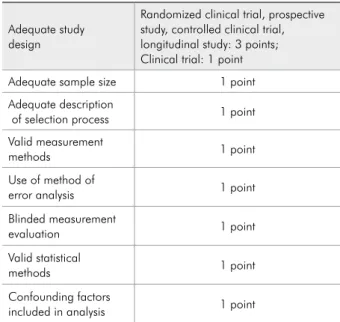
A series of manual searches was also performed, based on the lists of references of the articles re-trieved from the different databases. Data were col-lected on author, year of publication, study design, study groups, methods/measures and results. A qual-ity assessment of preestablished characteristics was performed, to document the methodological strength of each paper.11,12 The eight variables investigated in
the quality assessment are listed in Table 1.
Sample size was considered adequate when the sample size calculation was presented. Measurement methods were considered valid when a measurement error test was presented. Each study was classiied based on the scores attributed:
• low quality (0 to 5 points), • medium quality (6 to 8 points) or • high quality (9 to 10 points).
Data extraction and the quality assessment of each paper were performed independently by two researchers, who selected papers based on a reading of the title and the abstract. All papers that appeared to meet the eligibility criteria were selected. A high level of agreement between the researchers was found in this step. A manual search of the reference lists from the selected papers was also performed to obtain additional relevant publications that might have been missed in the database searches.
Selection criteria
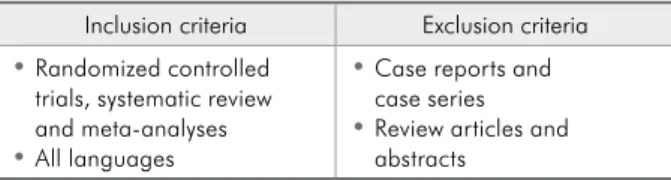
Only randomized controlled clinical trials and systematic reviews addressing the main indications, the effect of prophylactic third molar extraction and the non-intervention (maintenance) of asymptomat-ic impacted third molars were selected for the pres-ent review (Table 2).
Table 1 - Scores used for quality analysis of papers se-lected.
Adequate study design
Randomized clinical trial, prospective study, controlled clinical trial, longitudinal study: 3 points; Clinical trial: 1 point
Adequate sample size 1 point
Adequate description
of selection process 1 point
Valid measurement
methods 1 point
Use of method of
error analysis 1 point
Blinded measurement
evaluation 1 point
Valid statistical
methods 1 point
Confounding factors
Quality of the studies
A medium degree of quality and methodologi-cal consistency was found in three studies and low quality was found in one study (Table 4). No studies showed a high degree of consistency. The most sig-niicant law was an inadequate sample size. Other laws included the failure to declare the blinded as-sessment of the measurements and confounding
fac-Data acquisition and analysis
Data were collected on conditions that could in-dicate the prophylactic extraction of impacted third molars:
• pericoronitis,
• caries and periodontal problems in the distal re-gion of the second molars,
• odontogenic cysts and tumors, and
• crowding of the lower incisors.
Results
The search strategy yielded 260 papers. Four studies qualiied for the inal analysis (Table 3), fol-lowing a selection based on the preestablished eli-gibility criteria. The complete texts of these papers were obtained for analysis.
Table 2 - Initial inclusion and exclusion criteria for the stud-ies retrieved.
Inclusion criteria Exclusion criteria • Randomized controlled
trials, systematic review and meta-analyses • All languages
• Case reports and case series • Review articles and
abstracts
Table 3 - Studies selected.
Author Study groups Sample Age Measurement method Results
Mettes
et al.
(2005)27
Systematic review assessing the effect of prophylactic extraction of third molars in adolescents and adults, in comparison to non-intervention
_ _ Searches in Medline
and Cochrane through August 4, 2004; randomized or controlled clinical trials were selected
No evidence was found to support or refute the routine prophylactic extraction of asymptomatic impacted third molars
Van der Sanden
et al.
(2005)26
Dental students who received a clinical practice guide for the management of asymptomatic third molars
36 impacted lower third molars; 102 students participated in the study (51 in each group—test and control); randomized selection Three age groups: 19–25, 26–40 and 41–60 years
The intervention and control groups received a questionnaire, and the data were submitted to analysis of co-variance and the chi-square test
The use of a clinical practice guide for the management of asymptomatic third molars is effective and enhances the decision-making process for dental surgeons
Harradine
et al.
(1998)22
Randomized allocation of post-treatment orthodontic patients submitted to extraction of lower third molars to monitor the effect of the extractions on crowding of the lower incisors
Total of 164 (90 women and 74 men)
14 years and 10 months for participation in the study, with 66 months of follow-up
Patients were allocated based on a list, and were contacted after 5 years. Models were constructed, measurements were made and data were submitted to the Minitab program and GLIM statistical software
No significant differences in lower incisor crowding were found between patients from whom third molars were extracted and those on whom no intervention was performed; thus, the prophylactic extraction of third molars is not justified Lindqvist and Thilander (1982)23 Randomized allocation of patients submitted to extraction of third molars removed on one side and maintained on the other side (control); after three years, radiographs were taken and study models were made
23 boys and 29 girls with impacted third molars on both sides of the mandible
15.5 years; range: 13 to 19 years
Radiographs and study
tors. Only one paper adequately described the meth-od of error analysis.
Discussion
None of the studies fulilled the eligibility cri-teria established for the present systematic review. This inding demonstrates the scarcity of consistent papers and inadequate scientiic evidence that could otherwise allow surgeon dentists to make decisions regarding reliable indications for the prophylactic extraction of third molars and the determination of which cases should be followed up. Meta-analysis and heterogeneity were not performed due to the small number of studies with different methodolo-gies found.
The prophylactic extraction of asymptomatic impacted wisdom teeth is deined as the (surgical) removal of wisdom teeth in the absence of local dis-ease.28 In this context, critical appraisal of the
lit-erature reveals that prophylactic extraction of third molars occurs in a disorderly manner without clear-ly deined criteria. Approximateclear-ly 75% of individu-als who receive regular dental care have their third molars removed.4 In addition to the pathological
conditions sometimes caused by these teeth, other criteria are used to justify the decision to extract, in-cluding indications for orthodontic, prosthetic or re-storative purposes.13,14 Moreover,the risks of surgery
and associated complications are justiied and uni-formly accepted by the majority of dental surgeons, when there is clinical, radiological or laboratorial
evidence of acute or chronic periodontitis, caries, pericoronitis, harmful effects on second molars or disease.15,16
Authors enumerate the main reasons leading to the prophylactic extraction of third molars, but these indications do not have suficient evidence on which to base such a decision.3–6 Partially erupted third
molars have the greatest likelihood of developing pericoronitis, and are therefore indicated for pro-phylactic extraction.9,10 Mohammed-Ali et al.17
re-port two cases of osteomyelitis in the mandible, with development secondary to pericoronitis in partially erupted third molars. McArdle and Renton18
indi-cate the prophylactic extraction of third molars for the prevention of caries on the distal face of the sec-ond molars. According to Allen et al.19, it is common
to ind caries on the distal surface of second molars when third molars are either completely or partially erupted. Should conservative treatment be elected, interproximal radiographs are recommended.
Kan et al.8 justiies prophylactic extraction in
cases of periodontal defects. However, Richardson and Dodson20 state that the indication for third
mo-lar extraction should be evaluated carefully in indi-viduals with a healthy periodontium in the region of the second molar, since this procedure heightens the risk of greater probing depth and attachment loss. The extraction of lower third molars could lead to periodontal defects in the distal region of the adja-cent second molar.21
Harradine et al.22 conclude that the extraction of Table 4 - Quality evaluation of the studies retrieved.
Articles design Sample sizeStudy descriptionSelection measurement Valid methods
Method of error analysis
Blinding in measurement
Adequate statistics provided
Confounding factors considered
Quality standard judgement Mettes et al.
(2005)27 RCT Inadequate Adequate Yes No No No ND Low
Van der Sanden et al.
(2005)26 RCT Inadequate Adequate Yes No ND Yes ND Medium
Harradine
et al. (1998) RCT/P Inadequate Adequate Yes Yes ND Yes ND Medium Lindqvist and
Thilander
(1982) 23 RCT Inadequate Adequate Yes No No Yes ND Medium
third molars to reduce or prevent late crowding of the incisors is not justiied, and should therefore not be considered as having a scientiic basis. Likewise, Lindqvist and Thilander23 evaluated adolescents
with non-erupted third molars, and could not pre-dict which patients would beneit and which would suffer negative consequences in regard to late crowd-ing followcrowd-ing extraction of impacted third molars.
The consequences of extraction for patients should also be analyzed. Song et al.2 suggest that a
“wait-and-see conduct” could be a promising strat-egy. Jerjes et al.24 enumerated postoperative
com-plications stemming from third molar extractions performed by residents and specialists; trismus, alveolar osteitis and paresthesia of the lingual and inferior alveolar nerves were reported among ex-tractions performed by residents, and postoperative bleeding was reported among extractions performed by specialists.
Countries such as the United States and the United Kingdom spend large amounts of money on these procedures annually, using funds that could otherwise be spent on other health programs.1,2 The
extraction of asymptomatic impacted third molars that could remain disease-free for an undetermined amount of time places an unnecessary burden on healthcare funds. The assessment of health risks and cost effectiveness regarding the prophylactic extrac-tion of asymptomatic impacted wisdom teeth should play a more prominent role in the decision-making process.25
Insecurity in making diagnosis and the lack of a protocol for the extraction or non-extraction of third molars are clearly demonstrated.26 When a
clinical practice guide was given to dentists, a dras-tic reduction in the number of indications for extrac-tion occurred. In other words, when dentists have a
greater scientiic foundation, they modify how they conduct themselves in the decision-making process from a clinical standpoint. Further studies on this issue are eagerly awaited, insofar as dental surgeons should base their justiications for prophylactic third-molar extractions on scientiic evidence and studies that can reliably clarify indications for ex-traction or non-intervention.27
The clinical implications of how asymptomatic impacted third molars should be handled were well described by Mettes et al.27:
“The dental clinician, who examines healthy individu-als in the course of assigning a recall interval, should be responsible for monitoring third molars in recurrent communication with patients and, where there are more complex cases, with the oral and maxillofacial surgeon as a consultant. Special attention should be paid to the onset of pathology, based on explicit terminology and deinitions, the monitoring and registration of morbid-ity and qualmorbid-ity of life aspects (i.e. patients’ perspective, values and attitudes). Clinicians should make it clear to adult patients with asymptomatic third molars that there is no evidence one way or the other about the ben-eits or otherwise of removing these molars. The same communication strategy to adolescents and their parents regarding the impact of surgical removal on late lower incisor crowding should be advocated.”
Conclusions
The data encountered in the present systematic review demonstrate the lack of studies on which to base adequate clinical decisions regarding indica-tions for the prophylactic extraction of third molars. The only scientiic proof points to the non-indica-tion of prophylactic extracnon-indica-tion for the purpose of preventing late crowding of the lower incisors.
References
1. Friedman JW. The prophylactic extraction of third mo-lars: a public health hazard. Am J Public Health. 2007 Sep;97(9):1554-9.
2. Song F, O’Meara S, Wilson P, Golder S, Kleijnen J. The ef-fectiveness and cost efef-fectiveness of prophylactic removal of wisdom teeth. Health Technol Assess. 2000 Jul;4(15):1-55.
3. Laskin DM. Evaluation of the third molar problem. J Am Dent Assoc.1971 Apr;82(4):824-8.
4. Schulhof RJ. Third molars and orthodontic diagnosis. J Clin Orthod. 1976 Apr;10(4):272-81.
6. Stanley HR, Alattar M, Collett WK, Stringfellow HR Jr, Spiegel EH. Pathological sequelae of “neglected” impacted third molars. J Oral Pathol. 1988 Mar;17(3):113-7.
7. McArdle LW, Renton TF. Distal cervical caries in the man-dibular second molar: an indication for the prophylactic re-moval of the third molar?. Br J Oral Maxillofac Surg. 2006 Feb;44(1):42-5.
8. Kan KW, Liu JK, Lo EC, Corbet EF, Leung WK. Residual periodontal defects distal to the mandibular second molar 6-36 months after impacted third molar extraction. J Clin Periodontol. 2002 Nov;29(11):1004-11.
9. Wang XL. [Correlation study on acute pericoronitis and the position of the mandibular impacted third molar]. Shanghai Kou Qiang Yi Xue. 1995 Jun;4(2):70-2. Chinese.
10. Yamalik K, Bozkaya S. The predictivity of mandibular third molar position as a risk indicator for pericoronitis. Clin Oral Investig. 2008 Mar;12(1):9-14.
11. Antczak AA, Tang J, Chalmers TC. Quality assessment of randomized control trials in dental research I. Methods. J Periodontal Res. 1986 Jul;21(4):305-14.
12. Jadad AR, Moore RA, Carroll D, Jenkinson C, Reynolds DJ, Gavaghan DJ, McQuay HJ. Assessing the quality of reports of randomized clinical trials: is blinding necessary?. Control Clin Trials. 1996 Feb;17(1):1-12.
13. Chaparro-Avendaño AV, Pérez-García S, Valmaseda-Castellón E, Berini-Aytés L, Gay-Escoda C. Morbidity of third molar extraction in patients between 12 and 18 years of age. Med Oral Patol Oral Cir Bucal. 2005 Nov-Dec;10(5):422-31. 14. Kruger E, Thomson WM, Konthasinghe P. Third molar
out-comes from age 18 to 26: findings from a population-based New Zealand longitudinal study. Oral Surg Oral Med Oral Pathol Oral Radiol Endod. 2001 Aug;92(2):150-5.
15. Marciani RD. Third molar removal: an overview of indi-cations, imaging, evaluation, and assessment of risk. Oral Maxillofac Surg Clin North Am. 2007 Feb;19(1):1-13. 16. Bagheri SC, Khan AH. Extraction versus nonextraction
man-agement of third molars. Oral Maxillofac Surg Clin North Am. 2007 Feb;19(1):15-21.
17. Mohammed-Ali RI, Collyer J, Garg M. Osteomyelitis of the mandible secondary to pericoronitis of an impacted third molar. Dent Update. 2010 Mar;37(2):106-8.
18. McArdle LW, Renton TF. Distal cervical caries in the man-dibular second molar: an indication for the prophylactic
re-moval of the third molar?. Br J Oral Maxillofac Surg. 2006 Feb;44(1):42-5.
19. Allen RT, Witherow H, Collyer J, Roper-Hall R, Nazir MA, Mathew G. The mesioangular third molar-to extract or not to extract? Analysis of 776 consecutive third molars. Br Dent J. 2009 Jun 13;206(11):586-7.
20. Richardson DT, Dodson TB. Risk of periodontal defects after third molar surgery: An exercise in evidence-based clinical decision-making. Oral Surg Oral Med Oral Pathol Oral Radiol Endod. 2005 Aug;100(2):133-7.
21. Sammartino G, Tia M, Bucci T, Wang HL. Prevention of man-dibular third molar extraction-associated periodontal defects: a comparative study. J Periodontol. 2009 Mar;80(3):389-96. 22. Harradine NW, Pearson MH, Toth B. The effect of extraction of third molars on late lower incisor crowding: a randomized controlled trial.Br J Orthod. 1998 May;25(2):117-22. 23. Lindqvist B, Thilander B. Extraction of third molars in cases
of anticipated crowding in the lower jaw. Am J Orthod. 1982 Feb;81(2):130-9.
24. Jerjes W, Upile T, Nhembe F, Gudka D, Shah P, Abbas S, et al. Experience in third molar surgery: an update. Br Dent J. 2010 Jul 10;209(1):E1.
25. Edwards MJ, Brickley MR, Goodey RD, Shepherd JP. The cost, effectiveness and cost- effectiveness of removal and re-tention of asymptomatic, disease free third molars. Br Dent J. 1999 Oct 9;187(7):380-4.
26. Van der Sanden WJ, Mettes DG, Plasschaert AJ, Grol RP, Mulder J, Verdonschot EH. Effectiveness of clinical practice guideline implementation on lower third molar management in improving clinical decision-making: a randomized controlled trial. Eur J Oral Sci. 2005 Oct;113(5):349-54.
27. Mettes TG, Nienhuijs ME, Van der Sanden WJ, Verdonschot EH, Plasschaert AJ. Interventions for treating asymptomatic impacted wisdom teeth in adolescents and adults. Cochrane Database Syst Rev. 2005 Apr;18(2):CD003879.