*Correspondence: E. Bondan. Departamento de Patologia Ambiental e Ex-perimental. Universidade Paulista, Rua Caconde, 125/51 - 01425-011 - São Paulo - SP, Brasil. E-mail: [email protected]
A
vol. 52, n. 4, oct./dec., 2016 http://dx.doi.org/10.1590/S1984-82502016000400006
Astrocytic expression of GFAP and serum levels of IL-1
β
and TNF-
α
in rats treated with different pain relievers
Gisele Ferreira Amaral
1, Pietro Domingues Dossa
1, Lígia Bocamino Viebig
1, Fabiana Toshie
Camargo Konno
1, Amanda Consoli
2, Maria de Fátima Monteiro Martins
1,3, Flávio Cesar Viani
3,
Eduardo Fernandes Bondan
1,3*1Department of Environmental and Experimental Pathology, University Paulista, São Paulo, SP, Brazil, 2Department of
Psychobiology, Federal University of São Paulo, São Paulo, SP, Brazil, 3Department of Veterinary Medicine, University
Cruzeiro do Sul, São Paulo, SP, Brazil
Pro-inlammatory cytokines and glial cells, especially microglial cells, have been implicated in persistent pain sensitization. Less is known about the role of astrocytes in pain regulation. This study aimed to observe the expression of the astrocytic biomarker glial ibrillary acidic protein (GFAP) and the serum levels of interleukin 1 beta (IL-1β) and tumor necrosis factor alpha (TNF-α) after short-term administration of central pain relievers in rats not submitted to noxious stimuli. Male Wistar rats were divided into ive groups, receiving for nine days- (1) amitriptyline (Amt-10 mg/kg/day, by gavage); (2) gabapentin (Gb-60 mg/kg/day, by gavage; (3) methadone (Me-4.5 mg/kg/day, intraperitoneal route [IP]); (4) morphine (Mo-10 mg/kg/day, IP); or (5) 0.9% saline solution, IP. Brain samples were collected for immunohistochemical study of GFAP expression in the mesencephalon and nucleus accumbens (NAc). The area of GFAP-positive cells was calculated using MetaMorph software and serum levels of IL-1β
and TNF-α were measured by enzyme-linked immunosorbent assay. Serum TNF-α levels were decreased in the groups treated with Mo, Me and Gb, but not in the Amt-treated group. IL-1β decreased only in rats treated with Me. The astrocytic expression of GFAP was decreased in the brainstem with all drugs, while it was increased in the NAc with Amt, Me and Mo.
Uniterms: Neuropathic pain/treatment. Astrocytes/pain regulation. Analgesics/tests/treatment. Cytokines. Glial Fibrillary Acidic Protein/study
INTRODUCTION
Although pain is traditionally considered to be neuronally mediated, recent research shows an important role of glial cells in persistent pain sensitization. There is abundant evidence that certain pro-inlammatory cytokines such as interleukin 1 beta (IL-1β) and tumor necrosis factor alpha (TNF-α) are involved in the process of pathological pain (Watkins, Milligan, Maier, 2003; Hutchinson et al., 2007; Ji, Berta, Nedergaard, 2013) and many pain relievers are known to diminish central and peripheral cytokine production (De Waal, Van Der Laan, Van Loveren, 1998; Kenis, Maes, 2002; Hutchinson, Somogyi, 2004; Vallejo, De Leon-Casasola, Ramsun, 2004; Sacerdote, 2006; Bao
et al., 2014). Moreover, blood-borne cytokines have been
shown to cross the blood-brain barrier, despite their large size and low lipid solubility, by using bidirectional and saturable transport systems (Banks, Kastin, Broadwell, 1995), thus permitting the existence of cross-talk between the immune and neuroendocrine systems in the so-called neuroimmune-endocrine axis.
G. F. Amaral, P. D. Dossa, L. B. Viebig, F. T. C. Konno, A. Consoli, M. F. M. Martins, F. C. Viani, E. F. Bondan 624
of pain (Ossipov, Dussor, Porreca, 2010). These “top-down” modulatory pathways are opioid-sensitive and the actions of, for example, exogenous or endogenous opiates, cannabinoids, serotonin/norepinephrine reuptake blockers, and nonsteroidal anti-inlammatory drugs, mimic, in part, the actions of opiates.
Although microglial cells have been widely implicated in the development of chronic pain, less is known about the role of astrocytes in its regulation. Due to the complexity of the central circuitry for pain modulation, the precise mechanisms by which distinct pain relievers act remain unknown, as well as the efects of such drugs on central nervous system (CNS) cells - neurons and glial cells, especially astrocytes.
Pain modulators include a wide variety of drugs, with distinct mechanisms of action, such as tricyclic antidepressants (TCAs) that act primarily as serotonin/ norepinephrine reuptake inhibitors (e.g., amitriptyline - Amt), opioid agonists (e.g., morphine – Mo - and methadone - Me) and GABAergic medications that modulate the activity of chloride channels (e.g., gabapentin - Gb) (Lynch, Watson, 2006).
Many different types of signalling molecules are able to trigger and/or regulate astrocyte function and can be released by all cell types of the CNS tissue, including neurons, microglia, oligodendrocyte lineage cells, pericytes, endothelia and other astrocytes, as well as by invasive inlammatory/immune cells. These molecular signals include (a) large polypeptide growth factors and cytokines; (b) mediators of innate immunity such as lipopolysaccharide and other Toll-like receptor ligands; (c) neurotransmitters such as glutamate, dopamine and norepinephrine; (d) purines (e.g., adenosine triphosphate); (e) reactive oxygen species; (f) products associated with systemic metabolic activity (e.g., ammonium) and (g) regulators of cell proliferation, such as endothelin (Sofroniew, 2009). Astrogliosis may be induced by molecular signals that stimulate astrocyte activity and/or afect neurotransmitter release (Sofroniew, Vinters, 2010).
In such context, the aim of this study was to determine, after the administration of short-term therapeutic doses of Amt, Gb, Me or Mo in rats not submitted to any noxious stimuli, the astrocyte response in the mesencephalon and nucleus accumbens (NAc), through the expression of the astrocytic biomarker GFAP (glial ibrillary acidic protein), as well as the possible changes in the serum levels of IL-1β and TNF-α by such drugs.
MATERIAL AND METHODS
The animal procedures were performed in accordance
with the guidelines of the Committee on Care and Use of Laboratory Animal Resources and Brazilian Institutional Ethics Committee guidelines, Universidade Paulista (protocol no. 235/14, CEUA/ICS/UNIP, 16/04/2014). The experiments were performed in accordance with good laboratory practice protocols and all eforts were made to minimize the sufering of the animals.
Male Wistar rats were divided into five groups of six individuals, receiving for nine days - (1) 0.9% saline solution by the intraperitoneal route (IP); (2) Mo (10 mg/kg/day, IP); (3) Me (4.5 mg/kg/day, IP); (4) Gb (60 mg/kg/day, by gavage); or (5) Amt (10 mg/kg/day, by gavage). On the tenth day, the rats were anaesthetized with xylazine combined with ketamine (10 mg/kg and 90 mg/kg, respectively, IP) and tiopenthal (30 mg/kg, IP) for thoracotomy, and blood was collected by cardiac puncture. The samples were centrifuged in 5 mL conical tubes at 1500g for 15 minutes and serum was stored at -80° C. The rats were immediately subjected to intracardiac perfusion with buffered 10% formaldehyde solution. Their brains were then removed and kept for at least 48 hours in the same ixative for immunohistochemical study of GFAP expression in the mesencephalon and NAc. Coronal sections were made to collect the NAc and the mesencephalon and the tissue was embedded in parain for processing according to conventional histological procedures. The NAc area was chosen due to its role in processing rewarding and/or reinforcing stimuli, and the mesencephalon (PAG), for its participation in the pain desensitization pathway. The expression of the astrocyte marker GFAP was analyzed using immunohistochemical staining in sections of the mesencephalon and NAc from all groups. Coronal sections were mounted on silanized slides and submitted to GFAP immunostaining using the avidin-biotin peroxidase complex method, according to Bondan
et al. (2013). Briefly, the sections were deparaffinized
in xylene and rehydrated in a crescent-graded series of ethanol solutions. Antigen retrieval was achieved by transferring the slides to 10 mM sodium citrate buffer (pH 6.0) at 95° C for 20 minutes. Endogenous peroxidase
was blocked by 3% hydrogen peroxide for 10 minutes at room temperature. Two washes with Tris/HCl bufer pH 6.0 (Wash bufer 10x, S3006, Dako, Glostrup, Danmark) were performed between incubations. Polyclonal rabbit anti-GFAP immunoglobulin (Z0334, Dako), at a dilution of 1:1000, was used as the primary antibody, for 16 hours, followed by the application of a biotinylated secondary antibody (Dako Universal LSABTM 2 System - HRP,
(DAB, K3467, Dako). Sections were then counterstained by Harris´ modiied haematoxylin solution, dehydrated and mounted in Entellan (Merck, Germany). Negative controls for immunostaining (sections lacking primary antibody application) were also prepared.
Ten photomicrographs of each mesencephalon section and four of each NAc section were randomly taken with the same microscope using a 40x objective. The area of astrocyte processes, marked in brown, was automatically calculated in pixels using MetaMorph® software that was calibrated with digital colour ilters that regulated red, green, and blue areas, in such a manner that only positive cells were included and background staining was excluded from the measurement.
Serum levels of IL-1βb and TNF–α were determined in triplicate using an enzyme-linked immunosorbent assay (ready-to-use sandwich ELISA) according to the manufacturer’s instructions (rat IL-1β Platinum ELISA kit, BMS630, and rat TNF-α Platinum ELISA kit, BMS622, eBioscience, San Diego, California, USA).
For statistical analyses, homoscedasticity was verified using Bartlett’s test. Normality was verified using the Kolmogorov-Smirnov test. Data were analyzed by one-way analysis of variance (ANOVA) and Tukey-Kramer multiple comparisons test. Statistical signiicance was set at p < 0.05.
RESULTS
No mortality was found in rats treated with the doses and drugs used in this experiment.
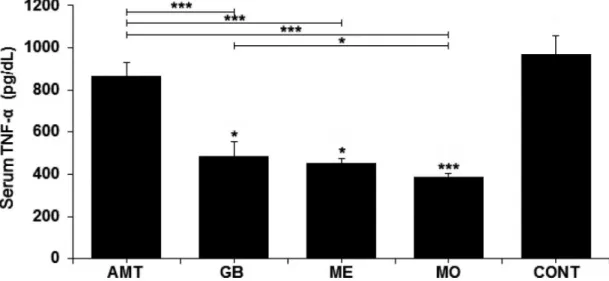
The serum levels (in pg/dL) of TNF-α and IL-1β from the experimental groups are presented, respectively, in Figures 1 and 2. It was observed that, on the tenth day of the experiment, TNF-α decreased compared to control rats (968.31±88.66 pg/dL) in the groups receiving Gb (484.53±70.28 pg/dL), Mo (388.53±17.37 pg/dL) and Me (451.87±22.47 pg/dL), but not in the Amt-group (867.87±61.57 pg/dL). Highly signiicant diferences (p < 0.001) were seen between groups Amt vs. Gb, Amt vs. Mo and Amt vs. Me. A signiicant diference (p < 0.05) was found between Gb vs. Mo groups.
As for IL-1β, serum levels decreased only in the group treated with Me (261.56±41.79 pg/dL) compared to control rats (404.52±95 pg/dL, p < 0.05) and no signiicant diferences were seen between groups that received the drugs for pain relief.
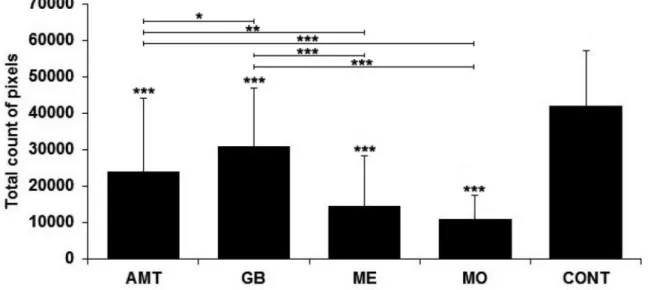
The expression of the astrocytic marker GFAP (represented in total pixel counts) in the mesencephalon and in the NAc can be seen, respectively, in Figures 3 and 4. In the mesencephalon, GFAP immunoreactivity decreased (p < 0.001) in the groups treated with Amt (24,031.48±20,235.34 pixels), Gb (31,033.12±15,923.32 pixels), Me (14,713.75±13,744.54 pixels) and Mo (11,004.82±6,593.14 pixels) in relation to controls (42,243±14,916.46 pixels). Signiicant diferences were found between Mo vs. Amt (p < 0.001) , Mo vs. Gb (p < 0.001), Me vs. Amt (p < 0.01), Me vs. Gb (p < 0.001) and Gb vs. Amt (p < 0.05), but not in Mo vs. Me. As for the NAc, GFAP increased (p < 0.001) in the groups treated with Amt (20,382.75±14,830.65 pixels), Me (24,075.04±21,023.05 pixels) and Mo (37,232.63±21,888.26 pixels), compared
FIGURE 1 - Serum concentrations (represented as mean ± standard deviation) of TNF-α (pg/dL) in the diferent experimental groups
G. F. Amaral, P. D. Dossa, L. B. Viebig, F. T. C. Konno, A. Consoli, M. F. M. Martins, F. C. Viani, E. F. Bondan 626
to controls (5,602.0±4,797.88 pixels), but not in the Gb-group (3,827.58±3,579.64 pixels). Signiicant diferences were found between Mo vs. Amt (p < 0.01), Mo vs. Gb (p < 0.001), Mo vs. Me (p < 0.05), Me vs. Gb (p < 0.001), Me vs. Gb (p < 0.001) and Gb vs. Amt (p < 0.001), but not in Me vs. Amt.
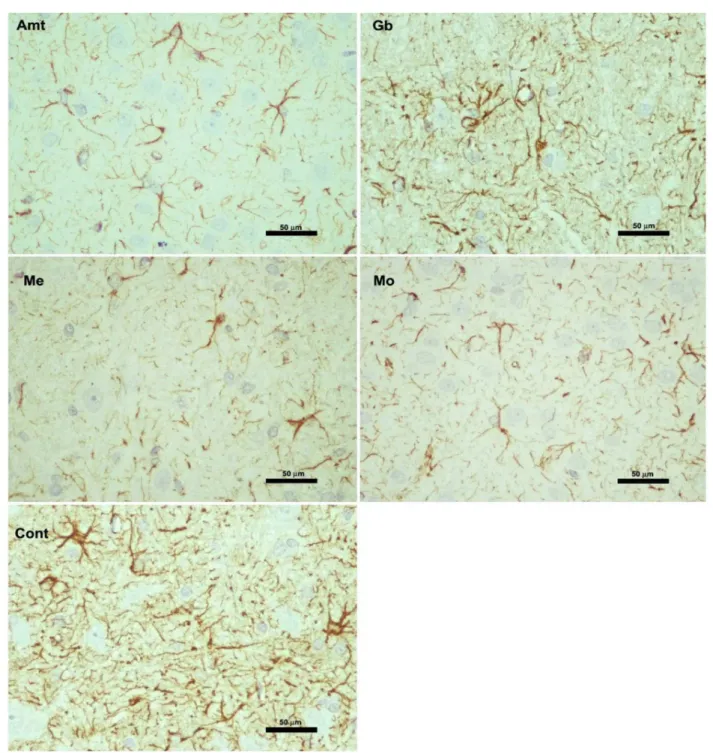
Astrocytic GFAP immunoreactivity in the mesencephalon and NAc of the diferent experimental groups are, respectively, presented in Figures 5 and 6.
DISCUSSION
Activation of glial cells and neuro-glial interactions are emerging as key mechanisms underlying chronic pain (Watkins, Milligan, Maier, 2003). Accumulating evidence has implicated three types of glial cells in the development and maintenance of chronic pain, namely the microglia and astrocytes of the CNS and the satellite glial cells of the dorsal root and trigeminal ganglia (Ji, Berta, Nedergaard, 2013).
FIGURE 2 - Serum concentrations (represented as mean ± standard deviation) of IL-1β (pg/dL) in the diferent experimental groups
(n=6 per group). AMT - amitriptyline; GB - gabapentin; ME - methadone; MO - morphine; CONT - control group. Data were analyzed by one-way ANOVA followed by Tukey-Kramer test. Asterisk shows signiicant diference for comparison between drug group vs. control group. *p < 0.05. No diferences were found between AMT, GB, ME and MO groups.
FIGURE 3 - Total count in pixels of GFAP immunoreactive astrocytes (represented as mean ± standard deviation) in the
A number of events, including CNS injury, infection and pain states, lead to hypertrophy of both microglia and astroglia, with a concomitant increased production of a variety of proinlammatory cytokines and other potentially pain-enhancing substances. Increased numbers of such cells and expression of markers such as OX-42 (for microglia) and GFAP (for astrocytes) can be used to identify glial cell activation (McMahon, Cafferty, Marchand, 2005). Microglia appear to be more important in the initial phases of neuropathic pain, while astrocytes are more relevant for later phases (Raghavendra, Tanga, DeLeo, 2004). Although glial activation has been extensively studied in the spinal cord (Scholz, Woolf, 2007), less is known about the microglial and astrocyte responses in brain areas when a noxious stimulus is applied to the periphery.
Current therapeutic strategies for neuropathic pain aim to reduce the excitability of neurons in the peripheral nervous system (PNS) or the CNS by modulating the activity of ion channels (Gb, pregabalin, carbamazepine, lidocaine and capsaicin) or by mimicking and enhancing endogenous inhibitory mechanisms (TCAs, duloxetine and opioids). Preclinical studies have explored other routes for neuropathic pain relief by modulating immune and glial responses. For example, global inhibitors of glial metabolism, such as luorocitrate, propentofylline, minocycline and terilunomide, reduce cytokine release and attenuate pain-responsive behaviour in several animal models of neuropathic pain (Scholz, Woolf, 2007).
When astrocytes and microglia are not in their activated state, they do not appear to be important regulators
of pain transmission; however, when glia become activated, pain is afected. Peripheral immune-activated signalling to the CNS induces sickness responses, including enhanced pain responsivity, fever, increase in sleep, decreases in food and water intake, and generalized suppression of behaviour (Watkins et al., 2007).
Opioids such as Mo and Me are known to have profound suppressive effects on the immune system (Van der Laan et al., 1995; De Waal, Van der Laan, Van
Lovenren, 1998; Hutchinson, Somogyi, 2004). Three distinct opioid receptor classes have been identiied and cloned, and are designated μ-,κ- and δ, and all of them are widely distributed in the CNS and PNS. The expression of opioid receptors on cells of the immune system was irst implicated by the ability of opioids to alter immune functions (Rittner, Machelska, Stein, 2005). Different opioids have been reported to exert immunosuppressive and modulatory effects on a variety of immune cells, including T and B cells, macrophages and natural killer (NK) cells. Moreover, they have been shown to diminish the levels of inflammatory cytokines, including IL-2, interferon gamma (IFN-γ), and TNF-α, while enhancing the levels of anti-inlammatory cytokines like IL-4 during immune/inflammatory processes (Suo, Weber, 1998; Sacerdote, 2006; Kafami et al., 2013). Methadone (Me),
for instance, a potent μ-opioid receptor agonist, has been shown to diminish neuroinflammation and severity of symptoms in experimental autoimmune encephalomyelitis (Kafami et al., 2013). On the other hand, Monibi et al.
(2015) did not ind any alteration in leucocyte TNF-α,
IL-FIGURE 4 - Total count in pixels of GFAP immunoreactive astrocytes (represented as mean ± standard deviation) in the NAc
G. F. Amaral, P. D. Dossa, L. B. Viebig, F. T. C. Konno, A. Consoli, M. F. M. Martins, F. C. Viani, E. F. Bondan 628
6, IL-10 production, on early leucocyte apoptosis and on neutrophil phagocytic function after a 24-hour infusion of morphine (Mo) or buprenorphine in healthy dogs.
Our results show that healthy rats treated for nine days with the opiate agonists Mo and Me presented decreased serum levels of TNF-α, although only Me decreased IL-1β. Gb-treated rats also exhibited decreased serum levels of TNF-α. The rats used in this investigation were apparently healthy and were not submitted to any
noxious stimuli, inflammation or damage to the PNS/ CNS or at peripheral sites; despite this, acute opioid administration is known to have inhibitory effects on humoral and cellular peripheral immune responses including antibody production, NK cell activity, cytokine expression, and phagocytic activity. Opiates behave like cytokines, modulating the immune response by interacting with their receptors in the CNS and in the periphery (Vallejo, De Leon-Casarola, Ramsun, 2004).
FIGURE 5 - Astrocytic immunostaining for GFAP in the ventral surface of the mesencephalon of the diferent experimental groups.
The PAG of the mesencephalon has been reported to be one of the primary neural foci for the action of centrally administered Mo in eliciting the suppression of splenic NK cell activity. This immunosuppression has been hypothesized to be due to the activation of the hypothalamic-pituitary-adrenal axis or of the sympathetic nervous system or both. Although PAG is involved in the regulation of many physiological functions including pain, fear and anxiety, autonomic
regulation, vocalization, aggressive and reproductive behavior, the relationship between PAG and immunity remains obscure (Suo, Weber, 1998; Vallejo, De Leon-Casarola, Ramsun, 2004).
GABAergic medications, such as Gb, appear to reduce the reinforcing efects of cocaine by attenuating cocaine-induced dopamine release in the NAc and corpus striatum (Gerasimov et al., 2001; González et al., 2007).
Gabapentin (Gb) also enhances the antinociceptive efect
FIGURE 6 - Astrocytic immunostaining for GFAP in the core region of the NAc of the diferent experimental groups. Amt -
G. F. Amaral, P. D. Dossa, L. B. Viebig, F. T. C. Konno, A. Consoli, M. F. M. Martins, F. C. Viani, E. F. Bondan 630
of Mo and attenuates Mo tolerance probably through up-regulation of the anti-inlammatory cytokine IL-10 and inhibition of proinlammatory cytokines in the rat spinal cord (Lee et al., 2013; Bao et al., 2014); efects that may
explain the decreased TNF-α levels in the Gb-treated rats from our investigation. Rossi and colleagues (2013) demonstrated that Gb also reduced reactive gliosis and dendritic loss caused by glutamate excitotoxicity after pilocarpine-induced status epilecticus.
Administration of Amt in association with Mo not only has preserved the antinociceptive efect of Mo, but also attenuated astrocyte activation in the rat spinal cord dorsal horn (Huang et al., 2012). It also up-regulated
glutamate transporters in Mo-tolerant rats, attenuating Mo tolerance, and suppressed neuroinlammation in this site by inhibiting pro-inflammatory cytokine (TNF-α, IL-1β, IL-6) expression (Tai et al., 2006). In vitro
studies with human whole blood have also reported that TCAs (e.g. imipramine and clomipramine) and selective serotonin reuptake inhibitors (e.g. citalopram and sertraline) were able to inhibit the production of the proinflammatory cytokines IL-1, IL-2, IL-6, TNF-α, IFN-γ, while stimulating the negative immunoregulatory cytokine IL-10 (Kenis, Maes, 2002; Schiepers, Wichers, Maes, 2005). Our results showed that Amt did not afect TNF-α and IL-1β levels in serum. Although there are many conlicting results in the literature, the lack of efects of antidepressants on cytokine release in humans was also found by Anisman et al. (1999) and Rothermundt et al.
(2001), in relation to IL-1β production, and by Landmann
et al. (1997) for TNF-α.
Glial ibrillary acidic protein (GFAP) is the main intermediate filament protein in mature astrocytes, and up-regulation of its expression is one of the main characteristics of the astrocyte reaction commonly observed after CNS injury (Middeldorp, Hol, 2011). The exact function of GFAP remains obscure, despite the huge number of studies using it as a marker for astrocytes; however, it has been suggested that GFAP helps astrocytes to maintain mechanical strength, as well their shape (Middeldorp, Hol, 2011). TNF-α, a pluripotent cytokine that is reportedly mitogenic to astrocytes, is associated with the overexpression of GFAP, probably via activation of the mitogen activated protein kinase (MAPK) termed Erk2 (extracellular signal-regulated protein kinase) (Zhang et al., 2000).
Interleukin 1 beta (IL-1β) is also identiied as a potent inducer of several members of the TNF superfamily, as well as chemokines, growth factors, extracellular matrix proteins and matrix metalloproteinases, although repressing genes of the transforming growth factor (TGF)
family and cytoskeleton proteins (John et al., 2005).
Human fetal astrocyte cultures showed, after hours of stimulation with IL-1β, a morphological conversion from lat, polygonal cells to small, contracted, highly branched cells, displaying intense GFAP and vimentin immunoreactivity in the perikarya and processes.
The periaqueductal gray (PAG) matter of the midbrain plays a key role in the central analgesic system (for review, see Ossipov, Dussor, Porreca, 2010). In our study, GFAP immunoreactivity in the mesencephalon tended to diminish in rats treated with Amt, Gb, Me and Mo compared to the control group. Lazriev et al. (2001)
showed that high doses of Mo appeared to decrease the total length of astrocyte processes and branching of individual astrocytes in the caudate nucleus. However, it induced hyperplasia and elongation of astrocytic processes in the NAc and lateral septal nucleus.
In contrast, Song and Zhao (2001) demonstrated that chronic Mo administration caused glial activation in the spinal cord and brain, and co-administration of Mo with a glial activation inhibitor resulted in maintenance of analgesic eicacy and a corresponding reduction of glial activation. They linked for the irst time opioid-induced glial activation with the development of tolerance. A dose of 50 mg/kg/day (a dose ive times greater than the dose used in our investigation) by the IP route was used for nine days to induce systemic tolerance and on the tenth day its analgesic efect disappeared as detected by behavioral testing. In these systemically Mo-tolerant rats, GFAP immunostaining was increased signiicantly in the spinal cord, posterior cingulate cortex and hippocampus, but not in the thalamus and this increase was attributed primarily to hypertrophy of astrocytes rather than their proliferation or migration since counts of astroglial cells demonstrated no signiicant diference compared with the control group. It is important to notice that, in contrast with the investigation performed by Song and Zhao (2001) with Mo, our investigation has used (for all drugs) doses that are equivalent to the therapeutic ones and no noxious stimulus was applied to produce pain.
The most characterized change in brain neurochemistry caused by drugs of abuse is an increase in extracellular dopamine levels in the NAc of the basal forebrain, and the indings of many studies suggest that this plays a pivotal role in the rewarding and positive reinforcing efects of μ-agonists, like Mo (Olds, 1982; Pontieri, Tanda, Di Chiara, 1995) and Me (Di Chiara, Imperato, 1988). Di Matteo et al. (2000) showed that
failed to demonstrate any alteration of the dopamine level within the NAc using Gb or even after cocaine self-administration, triggered relapse and cocaine-enhanced NAc dopamine in rats. Our results suggest that drugs which, according to previous studies, exhibit the capacity of increasing dopamine concentrations in the NAc, such as Amt, Me and Mo, also induced an increased GFAP immunoreactivity in this region, probably by enhancing the astrocyte activity of clearing excess dopamine. It is recognized that this neurotransmitter may be actively and specifically removed from the extracellular space by astrocytes and neurons through (1) dopamine transporters and, afterwards, either recycled into vesicles or (2) metabolized by the glial/neuronal enzymes monoamino oxidase B (MAO B) and catechol-O-methyl transferase (COMT) (Karakaya, Kipp, Beyer, 2007). Excess dopamine can cause auto-oxidation to ortho-quinone and consequently oxidative damage and schizophrenia-like symptoms (Whitehead et al., 2001).
CONCLUSION
Serum TNF-α levels decreased in the groups that received short-term doses of Mo, Me and Gb, but not in the Amt-treated group. On the other hand, IL-1β has decreased only in rats treated with Me. As for GFAP expression, all drugs decreased astrocyte immunostaining in the mesencephalon, although Amt, Me and Mo caused increased GFAP reactivity in the NAc. Thus, it can be assumed that the pain relievers Gb, Me and Mo (even with the therapeutic doses that were employed in this study) impaired IL-1β and/or TNF-α release. On the other hand, all drugs seemed to modify astrocytic expression of GFAP, but the effect varied according to the region observed (Amt, Gb, Me and Mo decreased this expression in the mesencephalon, while Amt, Me and Mo increased it in the NAc, probably due to the augmented activity of astrocytes in removing the excess of dopamine).
It is important to notice that the pain relievers used in this investigation afected astrocyte behavior and cytokine release in healthy rats that were not submitted to painful conditions, even though it was not possible to determine which cells had the cytokine production impaired. Astrocytes appeared to phenotypically react to distinct classes of pain modulators, probably inluencing neurons and the entire CNS microenvironment in physiological conditions. Further studies must be performed in order to make clear the efects of these pain relievers on astrocytes from other CNS regions, both in the absence and in the presence of noxious stimuli.
REFERENCES
ANISMAN, H.; RAVINDRAN, A.V.; GRIFFITHS, J.; MERALI, Z. Interleukin-1 beta production in dysthymia before and after pharmacotherapy. Biol. Psychiatry, v.46,
n.12, p.1649-1655, 1999.
BANKS, W.A.; KASTIN, A.J.; BROADWELL, R.D. Passage of cytokines across the blood-brain barrier.
Neuroimmunomodulation, v.2, n.4, p.241-248, 1995.
BAO, Y.H.; ZHOU, Q.H.; CHEN, R.; XU, H.; ZENG, L.; ZHANG, X.; JIANG, W.; DU, D. Gabapentin attenuates morphine tolerance through interleukin-10. NeuroReport,
v.25, n.2, p.71-76, 2014.
BONDAN, E.F.; MARTINS, M.F.M.; VIANI, F.C. Decreased astrocytic GFAP expression in streptozotocin-induced diabetes after gliotoxic lesion in the rat brainstem. Arq. Bras. Endocrinol. Metabol., v.57, n.6, p.431-436, 2013.
DE WAAL, E.J.; VAN DER LAAN, J.W.; VAN LOVEREN, H. Effects of prolonged exposure to morphine and methadone on in vivo parameters of immune function in
rats. Toxicology, v.129, n.2-3, p.201-210, 1998.
DI CHIARA, G.; IMPERATO, A. Opposite effects of mu and kappa agonists on dopamine release in the nucleus accumbens and in the dorsal caudate of freely moving rats.
J. Pharmacol. Exp. Ther., v.244, n.3, p.1067-1080, 1988.
DI MATTEO, V.; DI MASCIO, M.; DI GIOVANI G.; ESPOSITO, E. Acute administration of amitriptyline and mianserin increases dopamine release in the rat nucleus accumbens: possible involvement of serotonin 2C receptor.
Psychopharmacology, v.150, n.1, p.45-51, 2000.
GERASIMOV, M.R.; SCHIFFER, W.K.; GARDNER, E.L.; MARSTELLER, D.A.; LENNON, I.C.; TAYLOR, S.J.; BRODIE, J.D.; ASHBY JR, C.R.; DEWEY, S.L. GABAergic blockade of cocaine-associated cue-induced
increases in nucleus accumbens dopamine. Eur. J.
Pharmacol., v.414, n.2-3, p.205-209, 2001.
GONZÁLEZ, G.; DESAI, R.; SOFUOGLU, M.; POLING, J.; OLIVETO, A.; GONSAI, K.; KOSTEN, T.R. Clinical eicacy of gabapentin versus tiagabine for reducing cocaine use among cocaine dependent methadone-treated patients.
G. F. Amaral, P. D. Dossa, L. B. Viebig, F. T. C. Konno, A. Consoli, M. F. M. Martins, F. C. Viani, E. F. Bondan 632
HUANG, Y.N.; TSAI, R.Y.; LIN, S.L.; CHIEN, C.C.; CHENG, C.H.; WU, C.T.; YEH, C.C.; WONG, C.S. Amitriptyline attenuates astrocyte activation and morphine tolerance in rats: role of PSD-95/NR1/nNOS/PKCγ signaling pathway.
Behav. Brain Res., v.229, n.2, p.401-411, 2012.
HUTCHINSON, M.R.; BLAND, S.T.; JOHNSON, K.W.; RICE, K.C.; MAIER, S.F.; WATKINS, L.R. Opioid-induced glial activation and implication for opioid analgesia, dependence, and reward. Sci. World J., v.7, n.2, p.98-111, 2007.
HUTCHINSON, M.R.; SOMOGYI, A.A. (S)-(+)-methadone is more immunosuppressive than the potent analgesic (R)-(-)-methadone. Int. Immunopharmacol., v.4, n.12,
p.1525-1530, 2004.
JI, R.R.; BERTA, T.; NEDERGAARD, M. Glia and pain: Is chronic pain a gliopathy? Pain, v.154, n.1, p.10-28, 2013.
JOHN, G.R.; LEE, S.C.; SONG, X.; RIVIECCIO, M.; BROSNAN, C.F. IL-1 regulated responses in astrocytes: relevance to injury and recovery. Glia, v.49, n.2,
p.161-176, 2005.
KAFAMI, L.; ETESAMI, I.; ENAYATI, N.; GHIAGHI, R.; AMINIAN, A.; DAHPOUR, A. Methadone diminishes neuroinlammation and disease severity in EAE through modulating T cell function. J. Neuroimmunol., v.255, n.1-2,
p.39-44, 2013.
KARAKAYA, S.; KIPP, M.; BEYER, C. Oestrogen regulates the expression and function of dopamine transporter in astrocytes of the nigrostriatal system. J. Neuroendocrinol.,
v.19, n.9, p.682-690, 2007.
KENIS, G.K.; MAES. M. Effects of antidepressants on the production of cytokines. Int. J. Neuropsychopharmacol., v.5, n.4, p.401-412, 2002.
LANDMANN, R.; SCHRAUB, B.; LINK, S.; WACKER, H.R. Unaltered monocyte function in patients with major depression before and after three months of antidepressive therapy. Biol. Psychiatry, v.41, n.6, p.675-681, 1997.
LAZRIEV, I.L; KIKNADZE, G.I.; KUTATELADZE, I.I.; NEBIERIDZE, M.I. Efect of morphine on the number and branching of astrocytes in various regions of rat brain. Bull. Exp. Biol. Med., v.131, n.3, p.248-250, 2001.
LEE, B.S.; JUN, I.G.; KIM, S.H.; PARK, J.Y. Intrathecal gabapentin increases interleukin-10 expression and inhibits pro-inlammatory cytokine in a rat model of neuropathic
pain. J. Korean Med. Sci., v.28, n.2, p.308-314, 2013.
LYNCH, M.E.; WATSON, P.N. The pharmacotherapy of chronic pain: A review. Pain Res. Manag., v.11, n.1, p.11-38, 2006.
McMAHON, S.B.; CAFFERTY, W.B.J.; MARCHAND, F. Immune and glial cell factors as pain mediators and
modulators. Exp. Neurol., v.192, n.2, p.444-462, 2005.
MIDDELDORP, J.; HOL, E.M. GFAP in health and disease.
Progr. Neurobiol., v.93, n.3, p.421-443, 2011.
MONIBI, F.A.; DODAM, J.R.; AXIAK-BECHTEL, S.M.; AMORIM, J.; ZHANG, Y.; TSURUTA, K.; MANN, F.A.; DE CLUE, A.E. Morphine and buprenorphine do not alter leucocyte production capacity, early apoptosis, or neutrophil phagocytic function in healthy dogs. Res. Vet. Sci., v.99,
n.10, p.70-76, 2015.
OLDS, M.E. Reinforcing efects of morphine in the nucleus
accumbens. Brain Res., v.237, n.2, p.429-440, 1982.
OSSIPOV, M.H.; DUSSOR, G.O.; PORRECA, F. Central modulation of pain. J. Clin. Invest., v.120, n.11, p.37-87,
2010.
PENG, X.Q.; Li, X.; LI, J.; RAMACHANDRAN, P.V.; GAGARE, P.D.; PRATIHAR, D.; ASHBY JR, C.R.; GARDNER, E.L.; XI, Z.X. Efects of gabapentin on cocaine self-administration, triggered relapse and cocaine-enhanced nucleus accumbens dopamine in rats. Drug Alcohol Depend., v.97, n.3, p.207-215, 2008.
PONTIERI, F.E.; TANDA, G.; Di CHIARA, G. Intravenous cocaine, morphine, and amphetamine preferentially increase extracellular dopamine in the “shell” as compared with the “core” of the rat nucleus accumbens. Proc. Natl. Acad. Sci. USA, v.92, n.26, p.12304-12308, 1995.
RAGHAVENDRA, V.; TANGA, F.Y.; DeLEO, J.A. Complete Freund´s adjuvant-induced peripheral inlammation evokes glial activation and proinlammatory cytokine expression in the CNS. Eur. J. Neurosci., v.20, n.2, p.467-470, 2004.
RITTNER, H.L.; MACHELSKA, H.; STEIN, C. Leucocytes in the regulation of pain and analgesia. J. Leukoc. Biol., v.78,
ROSSI, A.R.; ANGELO, M.F.; VILLAREAL, A.; LUKIN, J.; RAMOS, A.J. Gabapentin administration reduces reactive gliosis and neurodegeneration after pilocarpine-induced
status epilepticus. PlosOne, v.8, n.11, p.1-13, 2013.
ROTHERMUNDT, M.; AROLT, V.; PETERS, M.; GUTBRODT, H.; FENKER, J.; KERSTING, A.; KIRCHNER, H. Inlammatory markers in major depression and melancholia.
J. Afect. Disord., v.63, n.1-3, p.93-102, 2001.
SACERDOTE, P. Opioid and the immune system. Palliat. Med.,
v.20, n.1, p.9-15, 2006.
SCHIEPERS, O.J.G.; WICHERS, M.C.; MAES, M. Cytokines and major depression. Prog. Neuro-Psycopharmacol. Biol. Psychiatry, v.29, n.2, p.201-217, 2005.
SCHOLZ, J.; WOOLF, C.J. The neuropathic pain triad: neurons,
immune cells and glia. Nat. Neurosc., v.10, n.11,
p.1361-1368, 2007.
SOFRONIEW, M.V. Molecular dissection of reactive astrogliosis and glial scar formation. Trends Neurosci., v.32,
n.1, p. 638-647, 2009.
SOFRONIEW. M.V.; VINTERS, H.V. Astrocytes: biology and pathology. Acta Neuropathol., v.119, n.1, p.7-35, 2010.
SONG, P.; ZHAO, Z.Q. The involvement of glial cells in the development of morphine tolerance. Neurosc. Res., v.39,
n.3, p.281-286, 2001.
SUO, J.L.; WEBER, R.J. Immunomodulation mediated by microinjection of morphine into the periaqueductal gray matter of the mesencephalon. In: FRIEDMAN, H.; MADDEN, J.J.; KLEIN, T.W. (Eds) Drugs of abuse, immunomodulation, and AIDS. Heidelberg: Springer, 1998.
v.437, p.177-182.
TAI, Y.H.; WANG, Y.H.; WANG, J.J.; TAO, P.L.; TUNG, C.S.; WONG, C.S. Amitriptyline suppresses neuroinlammation and up-regulates glutamate transporters in
morphine-tolerant rats. Pain, v.124, n.1-2, p.77-86, 2006.
VALLEJO, R.; DE LEON-CASASOLA, O.; RAMSUN, B. Opioid therapy and immunosuppression: a review. Am. J. Therap., v.11, n.5, p.354-365, 2004.
VAN DER LAAN, J.W.; KRAJNC, E.I.; KRAJNC-FRANKEN, M.A.M.; VAN LOVEREN, H. Immunotoxicological screening of morphine and methadone in an extended 28 day study in rats. Int. J. Immunopharmacol., v.17, n.6,
p.535-543, 1995.
WATKINS, L.R.; MILLIGAN, E.D.; MAIER, S.F. Glial proinlammatory cytokines mediate exaggerated pain states: implications for clinical pain. Adv. Exp. Med. Biol., v.521,
p.1-21, 2003.
WATKINS, L.R.; HUTCHINSON, M.R.; LEDEBOER, A.; WIESELER-FRANK, J.; MILLIGAN, E.D.; MAIER, S.F. Glia as the “bad guys”: implication for improving clinical pain control and the clinical utility of opioids. Brain Behav. Immun., v.21, n.2, p.131-146, 2007.
WHITEHEAD, R.E.; FERRER, J.V.; JAVITCH, J.A.; JUSTICE, J.B. Reaction of oxidized dopamine with endogenous cysteine residues in the human dopamine transporter. J. Neurochem., v.76, n.4, p.1242-1251, 2001.
ZHANG, L.; ZHAO, W.; ALKON, D.L.; BARKER, J.L.; CHANG, Y.H.; WU, M.; RUBINOW, D.R. TNF-alpha induced over-expression of GFAP is associated with MAPKs. Neuroreport, v.11, n.5, p.409-412, 2000.
Received for publication on 19th February 2016