A
R
T
I
G
O
T
É
C
N
I
C
O
C
I
E
N
T
Í
F
I
C
O
Introduction
In recent years, considerable attention has been dedicated to the study of synthesis, structures and properties of electroconducting polymers. The con-siderable interest in this class of materials has led to a large number of important applications such as re-chargeable batteries, modified electrodes, capacitors and biosensors among many others[1,2]. For such ap-plications, electrochemically synthesized polymer films on relatively cheap and commercially available metal substrates have attracted special interest.
Many studies related to polymerization of polypyrrole and polyaniline on oxidisable metals, such as carbon steel[3,4], stainless steel[5] and aluminum[6-7], aimed at the corrosion protection of these substrates. Polymerization of conducting polymers on aluminum is particularly interesting due to possible use as ca-pacitors[3,8] and rechargeable batteries[2, 9,10].
Several workers[6,7,10-14] have reported the use of aluminum as substrate to support conducting poly-mers such as polypyrrole and polyaniline, from or-ganic or aqueous electrolytes comprised of the monomer and different counter-anions. The main problem with the electrogeneration of polypyrrole onto reactive metals, such as aluminum, is related to
Preparation and Surface Analysis of
PPY/SDBS Films on Aluminum Substrates
Lisete C. Scienza
Departamento de Engenharia Química, UCS
George E. Thompson
Corrosion and Protection Centre, UMIST (UK)
Abstract: Polypyrrole films were generated on high purity aluminum substrates under anodic polarization from aqueous electrolytes comprised of pyrrole and sodium dodecylbenzene sulfonate. The methods employed to characterize the polymer films included scanning electron microscopy, Fourier-transform infrared and X-photoelectron spectroscopy and X-ray diffraction. PPY/SDBS films revealed nodular morphology with occasional appearing of “dendrites”, high level of protonation, excess of counter-anions ([S]/[N] > [N+]/[N])
and high degrees of disorder.
Keywords: Polypyrrole films, aluminium, electrosynthesis.
Autor para correspondência: Lisete C. Scienza Departamento de Engenharia Química, UCS, C. P.: 1352, CEP. 95001-970, Caxias do Sul, RS. E-mail: [email protected]
the interference of the anodic/passive behavior of the metal during the polymerization process in the pro-duction of well-adhering polymer films. Oxide films formed on the metal surface act as barriers for elec-tron transfer during electropolymerization, which give rise to inhibition of the process if a passive layer is formed or reduced current densities if a porous layer is formed[15].
In this work, polypyrrole (PPY) films were galvanostatically synthesized on aluminum surface, in presence of a surfactant counter-anion. The pro-duced polymer film was investigated further through the surface analysis techniques mentioned previously.
Experimental
Polym er Synthesis
Highly pure raffinal aluminum sheets (0.0004±2% Si, 0.0006±2 % Fe, 0.0003±1 % Cu, 0.0015±3 % Mg, < 0.0001 % Mn, < 0.0001 % Ni, < 0.0001 % Cr, < 0.0002 % Zn and < 0.0001 % Ti.), of 0.1 cm thick-ness were first mechanically polished with SC 600 grit paper, followed by vigorous washing and drying in cold air stream.
The synthesis solution was prepared employing pyrrole (Aldrich), which was first distilled under ni-trogen and kept refrigerated until use. Dodecylbenzene sulfonic acid sodium salt (Fluka) was used as received. Deionised water was used as solvent and the solution of 0.1 M of pyrrole (PY) and 0.1 M of sodium dodecylbenzene sulfonate (SDBS) was prepared around one hour before the experiment. The chemi-cal structure of the chemichemi-cals employed are shown in Figure 1.
Potentiodynamic polarization curves were per-formed in order to determine the potential (or cur-rent) when polymerization takes place. Potentials were applied from Eocp (open circuit potential) to 2000 mVSCE, at 2 mV/s scan rate. A three-electrode
configuration electrochemical cell was employed where the working electrode was the aluminum sheet (4 x 1.5 x 0.1 cm), the counter-electrode was an auste-nitic stainless steel sheet and the reference electrode
was a saturated calomel electrode (SCE) and
associ-ated a Luggin capillary. The data were plotted in graphs of the potential applied (mVSCE) with the
loga-rithm current density (mA/cm2).
For characterization of the polymer film, the specimens were submitted to the polymer synthesis, performed under 2 mA/cm2 of current density over 20 minutes, in an aqueous electrolyte comprised of 0.1 M of pyrrole (PY) and 0.1 M of sodium dodecylbenzene sulfonate (SDBS). After synthesis the polymer-coated electrodes were rinsed thoroughly in deionised water, dried in cold air stream and placed in a desiccator prior to use in subsequent test.
Polym er Characterization
In order to check the adhesion of the polymer films on the electrodes, a cross cut adhesion test was performed for dried and wet specimens (“wet adhe-sion”). This test was based on ASTM D3359. A multi-blade Erichen Multicross Hatch Cutter, model 295/I cutting tool, was employed to form a lattice pattern of six cutting edges and the results were classified according to the standard descriptions.
For SEM observations, the bulk specimens (0.25 cm2) were mounted on brass stubs using a highly con-ductive paint. No conducting coating was applied over the polymer surface. The specimens were examined in an ISI-DS 130 scanning microscope operating at 19 kV.
PPY powder was scratched from the metal elec-trodes surface and mixed with KBr to form pellets. Infrared spectra were recorded in the transmission mode using a Perkin-Elmer FT-IR spectrometer model 1760. To generate the FT-IR spectrum, 15 scans were performed for each sample.
XRD spectra of PPY-coated samples were re-corded in the reflectance mode using CuKa radiation on a Philips X’pert MPD theta/theta system in the range of 3°≥θ≥ 38°.
XPS measurements were made on a VG Scientific ESCALAB I spectrometer with AlKa source (1486.6eV), with electrical input power of 200 W and take-off angle of 10°. The pass energy was 100 eV for qualitative surveys and 20 eV for quantitative data. The pressure in the analysis chamber was maintained at 10-12 bar during measurements. The energy calibra-tion of the system was checked with gold standard us-ing the 4f7/2 line. The spectra were summed, smoothed and reconstructed using Gaussian-shaped components. Figure 1. Chemical structure of the materials employed.
N
H SO3Na
(CH2)11 CH3
5α
β4
α2
3β
Results and Discussion
Potentiodynamic polarization curves were per-formed to determine the anodic behavior of the aluminum electrodes in the absence and presence of the monomer. Based on the electrochemical poten-tial-current response and visual observations, it is possible to predict the conditions (current and poten-tial) in which the polymerization of pyrrole proceeds. Based on the electrochemical and visual obser-vations during the dynamic polarization shown in Figure 2, it is possible to describe the electrochemical process as follows: starting from the open circuit po-tential (Eocp= -1480 mVSCE), current densities
in-crease significantly until about 200 mVSCE above
Eocp. After this period, in the absence of the monomer (curve a), a porous oxide film grows and the E-i re-sponse shows a tendency to attain a limiting current, which indicates that the process is controlled by the migration of Al3+ and O2- ions in the oxide film on the aluminum electrode. The oxide growth proceeds until higher potentials (namely 2000 mVSCE).
The situation changes when pyrrole is present in the solution (curve b). Point A represents the open circuit potential. Between A and B the behavior is similar in both electrolytes, i.e., the aluminum oxide film grows on the electrode surface. However, when the oxidation potential of the monomer is achieved (point B, about 550 mVSCE), termed polymerization
potential (Epol), the polymerization reaction becomes preferential and polypyrrole deposits start to appear
on the electrode surface, which is accompanied by a rapid increase in the current density. In this stage, it is believed that the polymerization conditions increase the flaws density in the oxide film, thus allowing po-lymerization to take place. At point C, the increase in polymer film thickness is responsible for the nearly constant current.
With the sequence of the dynamic polarization, polymer nuclei present three-dimensional (3-D) growth, which occurs faster than the increase of the nuclei population density. At some stage, PPY nuclei spread over the surface, forming agglomerates of polymer termed polypyrrole clusters. These merge with adjacent clusters to form a black polymer film, which covers the macroscopic surface of the elec-trode. This process is revealed in Figure 3.
The behavior for the potential during the galvanostatic synthesis of polypyrrole is shown in Fig-ure 4. As soon as the current is applied, small polypyrrole deposits (nuclei) develop rapidly over the electrode surface. It is suggested that a fast generation of oligomers occurs, followed by immediate nuclea-tion at a limited number of sites (flaws). These nuclei Figure 2. Anodic polarization curves for aluminum electrodes in (a)
0.1M SDBS electrolyte (no pyrrole) and (b) 0.1M PY:0.1M SDBS elec-trolyte. Scan rate: 2 mV/s.
-2000 -1500 -1000 -500 0 500 1000 1500 2000 2500
0.001 0.01 0.1 1 10 100
i (mA/cm )2
(a) (b)
A
C B
E
(mV/sec)
Figure 3. Optical (left) and scanning electron micrographs (right) of
the aluminum electrodes at different potentials of the anodic polariza-tion curve in 0.1 M PY:0.1 M SDBS solupolariza-tion: (a) E = 600 mVsce; (b) E = 1000 mVsce ; (c) E = 1600 mVsce. Images reveal formation of agglomerates (clusters) in (b) and continuous film of polypyrrole in (c).
10µm
50µm
50µm (a)
(b)
grow to form clusters, which merge with adjacent nuclei and clusters to form a continuous black poly-mer film, which covers the macroscopic electrode surface. The absence of an induction time, common for oxidisable metal electrodes, may be due to the presence of the pre-existent air-formed alumina film on the metal surface, which prevents the active dis-solution of the metal before polymer nucleation has proceeded.
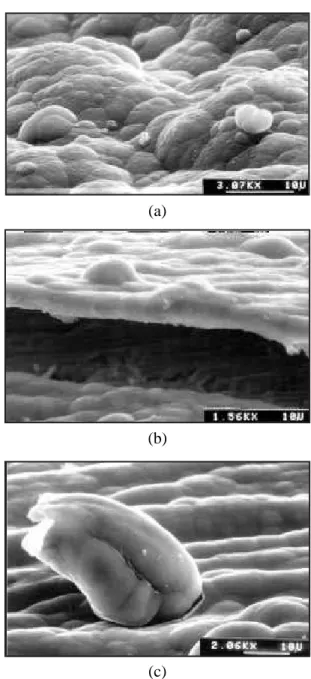
Scanning electron images of the PPY/SDBS film on aluminum are shown in Figure 5. During the po-lymerization, polymer films appear to have instanta-neous three-dimensional growth of hemispherical deposits, which generate a film of nodular morphol-ogy. This morphological appearance is similar to PPY films obtained from different electrolytes[19,20]. Ac-cording to Myrick et al.[21] a spherical growth occurs when the polymer growth proceeds from fixed, finite nuclei with a rate that is independent of the direction of growth, the resulting growth morphology is spheri-cal or hemispherispheri-cal. Employing an electrolyte of similar composition and indium-tin oxide as substrate, Naoi and co-workers[20] considered a columnar struc-ture for the polypyrrole film formed. However, this structure was not evident in our results.
Frequently occurring different forms of anomalous growth, called “dendrites” by some researchers, as shown in Figure 5(c). These dendrites are emerging structures of polypyrrole which appear over the polymer surface on the electrode. In the work of Unsworth et al.[22], den-dritic structures were due to surface adsorption of the O2 bubbles, which is particularly evident at low values of pH (< 7). Where the adsorbed bubbles act as nuclea-tion sites for enhanced growth. Generally, once a den-drite is initiated it grows proportionally faster than the rest of the polymer. In our work, using an electrolyte with pH around 10, dendrites formation was attributed to high local current densities originated from the flaws present in the air-formed alumina film.
The polymer coating failed in the dry and wet adhesion tape test, presenting classification 1B and 0B according to ASTM D3359, respectively. The poor adhesion indicates the absence of strong inter-action of relatively thick polypyrrole films electrogenerated on aluminum in the presence of sur-factant counter-anion.
Figure 6 shows the FT-IR spectrum of the PPY/ SDBS film. The broad peak at 3428 cm-1 corresponds to N-H stretch. The incorporation of the counter-anion in the polymer is evidenced by the peaks at 2924 and
0 500 1000 1500 2000 2500 3000 3500
0 200 400 600 800 1000 1200
Time (seconds)
Potencial
(mV)
Figure 4. Potential-time behavior during the electrochemical synthesis
of the PPY/SDBS film on aluminum under 2 mA/cm2.
Figure 5. Scanning electron micrographs of the PPY/SDBS film on
aluminum: (a) polymer surface appearance, (b) polymer layer partially detached from the metal surface, and (c) anomalous growth (dendrites) on the polymer surface.
(a)
(b)
2840 cm-1, assigned to aliphatic–CH
3 and –CH2, re-lated to the alkyl chain attached to the benzene ring of the dodecylbenzene sulfonate anion. Further evidence of the presence of this anion in the polymer film is revealed by peaks at 1297 cm-1 and 1660 cm-1, which may be assigned to SO2 stretch in sulphonates[23]. The band around 2350 cm-1 was considered an artifact. An interesting feature to be considered is a strong C-H peak at 720 cm-1, detected in the pyrrole (monomer) spectrum, but absent in the polymer spectrum. Accord-ing to Iroh and Su[24], this peak is assigned to C-H wag vibrations arising from adjacent 2,5 hydrogen atoms on the pyrrole ring, which disappear during the oxidative coupling (anodic polymerization) of pyrrole. In the XPS survey spectrum for the PPY/SDBS film, Figure 7, carbon, nitrogen, oxygen and sulfur were detected. The fitting data for the C1s spectra, Figure 8(a), show its deconvolution leads to four main components at about 284.0±0.1 eV, 285.5±0.2 eV, 286.1±0.1 eV and 287.6±0.2 eV, which may be attributed to βC, αC, C-O, C=O groups respectively. From the literature[25], many common nitrogen funcionalities give N1s binding energies (BEs) in the narrow region of 399-401 eV. For polypyrrole films and powders, deconvolution of the N1s signal may lead to three components associated with vari-ous intrinsic oxidation states and protonation lev-els: imine-like (=N-), amine-like (-NH-) and positively charged nitrogen atoms (-N+H-), corre-sponding respectively to BEs about 397.8 eV, 399.7 and >400.5 eV[26]. The N1s core-level spectrum, Figure 8(b), reveals the presence of a major compo-nent at a BE of 400.1 eV, which is assigned to the neutral amine nitrogen component. The BE tail was deconvoluted to a peak at about 402.0 eV, corre-sponding to the positive charged nitrogen. The
ab-sence of the imine-like nitrogen (=N-) at 397.8 eV may indicate that the protonation of PPY occurs preferentially at imine groups[27]. The more electron deficient nitrogen species may be attributed to delocalisation of electron density from polypyrrole ring, associated with the formation of electronic de-fects (polarons and bipolarons). Protonation level, [N+]/[N] ratio, of 0.26 was found and the [S]/[N] ratio was greater than the [N+]/[N] ratio, which sug-gests that substantial amounts of the electrolyte re-main in the polymer film despite the extensive washing procedure employed after polymerization. The polymer film was mechanically removed from the electrode and the electrode surface investi-gated. The XPS analysis of the aluminum substrate beneath the polymer film revealed the presence of carbon, oxygen, nitrogen, sulfur and aluminum. The presence of nitrogen suggests that a colorless poly-Figure 7. XPS survey spectrum of the PPY/SDBS polymer film
galvanostatically deposited on aluminum electrode Survey
01s
C1s
N1s
S2p Si2p 14
12
10
8
6
4
2
0
1000 800 600 400 200 0
Binding Energy / eV
k Counts
Figure 8. C1s (a) and N1s (b) core-level spectra for the PPY/SDBS
polymer film galvanostatically generated on aluminum electrode.
(a)
(b) Figure 6. FT-IR spectrum for the PPY/SDBS film galvanostatically
mer film, probably formed during the early stages of polymerization, remains attached to the metal after removal of the black polymer film.
The diffractogram for PPY/SDBS films (Figure 9) shows maximum broad scattering, characteristic for polypyrrole films[28], which indicates a highly amorphous structure. According to Warren et al.[29], it is possible to distinguish the presence of two types of solid state order, one concerned with the polymer backbone (18°≤2θ°≤25°) and the other associated with broad distribution of the scattered intensity at about 2θ=20°, is typical of PPY/sulfate and sulfonate films(30). The broad scattering around 2θ=18.5° corresponds to a d-spacing around 0.48 nm, which may be assigned to scattering of PPY chains at a spacing close to the interplanar Van der Waals distance for aromatic groups[31]. The strong low-an-gle peak (2θ=3.8°), with a d-spacing about 2.32 nm, correlates with the length of the alkyl-side chain of the surfactant anion[32]. The relatively high intensity of the low-angle peak implies a relatively degree of anion order in this system.
Conclusions
Polypyrrole can be grown in aqueous 0.1M PY and 0.1M SDBS on aluminum surfaces under galvanostatic conditions. The mechanism consists in the generation of oligomers with subsequent deposi-tion at the flaws of the pre-existent air-formed alumina film. The polymer growth proceeds covering the mac-roscopic surface of the electrode. The hemispherical shape of the nuclei originates a polymer film with nodular morphology.
FT-IR spectra revealed the presence of most or-ganic groups expected in polypyrrole films. The
oc-currence of the peak corresponding to N-H indicates that pyrrole moieties are possibly present.
XPS data revealed that nitrogen occurs in this polymer in two different oxidation states, amine-like and positively charged nitrogen. The protonation oc-curs preferentially at imine nitrogen groups and the dodecylbenzene sulfonate anion is present in excess related to the positively charged nitrogen.
Although the molecular organization of the gen-erated polymer film was revealed as highly disordered and non-crystalline (liquid-like structure), a relatively high degree of anion order was found.
Acknowledgments
The authors are grateful to CAPES for the finan-cial support to this research.
References
1. Arbizzani, C.; Matragostino, M. & Scrosati, B. - in Hand-book of Organic Conductive Molecules and Poly-mers, H. S. Hawa, Ed; John Wiley & Sons, Chichester, Vol. 4, 595 (1997).
2. Scrosati, B. - Applications of Electroactive Polymers, Chapman & Hall, London (1993).
3. Araujo, W. S.; Margarit, I. C. P.; Ferreira, M.; Mattos, O. R. & Lima Neto, P. - Electrochimica Acta, 46,1307 (2001).
4. Fornari Jr., C. C. M.; Aeiyach, S.; Ferreira, C. A. - Anais do XII Simpósio Brasileiro de Eletroquímica e Eletroanalítica, Gramado, 141 (2001).
5. Moraes, S. R.; Vilca, D. H. & Motheo, A. J. - Anais do XII Simpósio Brasileiro de Eletroquímica e Eletroanalítica, Gramado, 822, (2001).
6. Scienza, L. C. & Thompson, G. E. - Anais do Latincorr’2000 – 7th Ibero-American Congress of Corrosion
Protec-tion, Cartagena, paper 048-T06 (2000).
7. Lu, W-K and Elsebaumer, R. L. - Anais do Annual Tech-nical Conference, 1276 (1998).
8. Kudoh, Y.; Fukuyama, M. & Yoshimura, S. - Synth. Met., 66,157 (1994).
9. Kanatzids, M. G. - Chemical Engineering News, 3, 36 (1990).
10. Rodrigues, J.; Otero, T. F.; Grande, H.; Moliton, J. P.; Moliton, A. & Trigaud, T. - Synth. Met., 76, 301 (1996).
11. Scienza, L. C. & Thompson, G. E. - in Anais do 13° Congresso Brasileiro de Engenharia e Ciência dos Materiais, Curitiba, 3899 (1998).
12. Hulse, P. & Beck, F. - J. Electrochem. Soc., 137, 2067 (1990).
13. Scienza, L. C.; Thompson, G. E. - in Anais do XII Simpósio Brasileiro de Eletroquímica e Eletroanalítica, Gramado, 481 (2001).
14. Vilca, D. H.; Moraes, S. R. & Motheo, A. J. - in Anais do XII Simpósio Brasileiro de Eletroquímica e Eletroanalítica, Gramado, 232 (2001).
15. Rodriguez, J.; Grande, H.-J. & Otero, T. F. - Handbook of Conducting Molecules and Polymers, H. S. Nawa, Ed; John Wiley & Sons, Chichester, Vol. 2, 415 (1997).
16. De Paoli, M. A.; Peres, R. C. D.; Panero, E. & Scrosati, B. - Electrochem. Acta, 37, 1173 (1992).
17. Mitchell, G. R. & Geri, A. - J. Phys. D: App. Phys., 20, 1346 (1987).
18. Ferreira, C. A.; Aeiyach, S.; Delamar, M. & Lacaze, P. C. - Surf. Interf. Anal., 20, 749 (1993).
19. Sutton, S. J. & Vaughan, A. S. - Polymer, 36, 1849 (1995).
20. Naoi, K.; Oura, Y.; Maeda, M. & Nakamura, S. -J. Electrochem. Soc., 142, 417. = 15 (1995)
21. Myrick, M. L.; Noll J. D. & Nicholson, M. A. -J. Electrochem. Soc., 1998, 145, 179.
22. Unsworth, J.; Innis, P. C.; Lunn, B. A.; Jin, Z. & Norton, G. P. - Synth. Met., 53, 59 (1992).
23. Su, W. & Iroh, J. O. - Polymer Preprints, 39, 159, (1998).
24. Iroh, J. O. & Su, W. - J Appl. Pol. Sc., 66, 2433 (1997).
25. Briggs, D. & Seah, M. P. - Practical Surface Analysis by Auger and X-ray Photo-electron Spectroscopy, John Wiley & Sons, Chichester, Vol. 3, 363 (1987).
26. Kang, E. T.; Neoh, K. G. & Tan, K. L. - Handbook of Conducting Molecules and Polymers, H. S. Nawa, Ed; John Wiley & Sons, Chichester, Vol. 3, 121 (1997).
27. Tan, K. L.; Tan, B. T. G. & Neoh, K. G.- J. Mat. Sc., 27, 4056 (1992).
28. Saunders, B. R.; Murray, K. S.; Fleming, R. J.; Cervini, R. & Allen, N. S. - in Handbook of Organic Con-ductive Molecules and Polymers, H. S. Nawa, Ed; John Wiley & Sons, Chichester, Vol. 3, 633 (1997).
29. Warren, L. F.; Walker, J. A.; Anderson, D. P.; Rhodes, C. G. & Buckey, L. J. - J. Electrochem. Soc., 36, 2286 (1989).
30. Wernet, W.; Monkenbusch, M. & Wegner, G. -Makromol. Chemie, Rap. Comm. 5, 157 (1984).
31. Wynne, R. J. & Street, G. B. - Macromolecules, 18, 2361 (1985).
32. Wegner, G. & Ruhe, J. - Faraday Discuss. Chem. Soc., 88, 333 (1989).