Tools for assessing damage in concrete afected
by AAR coming from ine and coarse aggregates
Técnicas para a avaliação da deterioração proveniente
da reação álcali-agregado (RAA) gerada pela presença
de agregados reativos graúdos e miúdos
Abstract
Resumo
Over the last few years, comprehensive management programs for the diagnosis and prognosis of alkali-aggregate reaction (AAR) in aging concrete structures were developed in North America, based on a series of laboratory test procedures. Although promising, these lab-procedures presented
several parameters whose impacts were not completely understood, which signiicantly reduced their applicability for the appraisal of deteriorated concrete structures in service. In this context, it has been suggested that two lab-tools, the Stif ness Damage Test (SDT) and the Damage Rating Index (DRI) could reliably assess the condition of concrete afected by AAR. This paper presents the condition assessment of 25, 35 and 45 MPa AAR afected concrete specimens incorporating i ne and coarse reactive aggregates and presenting diferent distress degrees (i.e. expansion levels from 0.05 to 0.30%) through the use of an innovative multi-level approach. Results show that both SDT and DRI are suitable for assessing damage in AAR afected concrete through their output parameters. Yet, they present a complementary character, which illustrates the need for a multi-level approach.
Keywords: stif ness damage test, damage rating index, condition assessment, multi-level approach, alkali-aggregate reaction (AAR).
Nos últimos anos, diversos programas de gestão para o diagnóstico e prognóstico da reação álcali-agregado (RAA) em estruturas de concreto fo-ram desenvolvidos na América do Norte, com base em uma série de procedimentos experimentais em laboratório. Apesar de promissores, esses
procedimentos apresentaram uma série de parâmetros cujo impacto não foi amplamente avaliado e discutido, o que reduziu signiicativamente
a utilização destas técnicas na avaliação de estruturas de concreto deterioradas em serviço. Neste contexto, sugere-se que duas técnicas
labo-ratoriais, o ensaio de Deterioração de Rigidez (SDT) assim como a avaliação microscópica do Índice de Deterioração (DRI) destacam-se como ensaios capazes de avaliar de maneira coniável e precisa o estado de deterioração do concreto afetado pela RAA. Este trabalho apresenta a utilização dos métodos descritos acima na avaliação da deterioração de diferentes concretos (25, 35 e 45 MPa) afetados pela RAA, incorporando agregados reativos graúdos e miúdos e apresentando diferentes níveis de expansão (0,05 à 0,30%). Os resultados demonstram que tanto o SDT como o DRI são adequados para avaliar o nível de deterioração do concreto afetado pela RAA. Entretanto, estes apresentam um caráter com -plementar, o que ilustra a necessidade de uma abordagem “multinível” quando da utilização dos mesmos na avaliação de estruturas em serviço.
Palavras-chave: Deterioração de Rigidez (SDT), Índice de Deterioração (DRI), avaliação do estado de deterioração, avaliação multinível, reação álcali-agregado (RAA).
a Department of Civil Engineering, University of Ottawa, Ottawa, Canada; b Department of Geological Engineering, Laval University, Quebec, Canada; c Department of Civil Engineering, Laval University, Quebec, Canada;
d Department of Civil Engineering and Applied Mechanics, McGill University, Montreal, Canada.
L. F. M. SANCHEZ a
B. FOURNIER b
M. JOLIN c
J. BASTIEN c
D. MITCHELL d
1. Introduction
Alkali-silica reaction (ASR), one of the most common deleterious
mechanisms identiied in concrete structures worldwide, consists
in a chemical reaction between “unstable” silica mineral forms (i.e. minerals that are susceptible for presenting dissolution under al-kaline environments) within the aggregate materials and the alkali hydroxides (Na, K – OH) dissolved in the concrete pore solution. It generates a secondary alkali-silica gel that induces expansive pressures within the reacting aggregate material(s) and the ad-jacent cement paste upon moisture uptake from its surrounding environment, thus causing microcracking, reduction of material’s properties (mechanical/durability) and, in some cases, functionality
in the afected structure [1].
Over the years, several approaches and recommendations, in-cluding a comprehensive variety of laboratory tests, have been developed worldwide to assess the potential alkali reactivity of
concrete aggregates and the efectiveness of preventive measures
(e.g. control of the concrete alkali content, use of supplementary
cementitious materials, etc.) before their use in the ield. Despite
some issues with some of these test procedures, the majority of experts agree that, in general, it is now possible to construct concrete infrastructures with minimum or calculated risk of ASR.
However, there is currently no consensus about the most eicient
method(s) (surface treatments for moisture control, chemical treat-ments, strengthening, stress relief (slot cutting), etc.) that should be implemented, and when, for the rehabilitation of concrete
struc-tures/structural elements sufering from ASR.
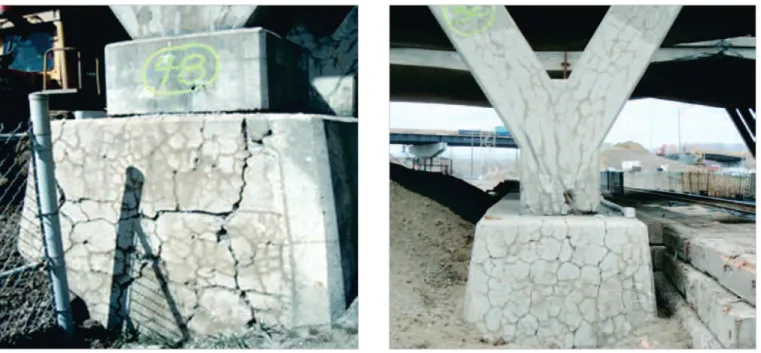
In this context, one of the biggest challenges in dealing with ASR damaged aging concrete structures is to establish the correlation between ASR distress “signatures” (i.e. ASR distress illustrated in
Figure 1) and the loss/reductions in mechanical properties,
physi-cal integrity, durability and performance of the afected material,
as well as their structural implications. Recent studies dealing with the evaluation of the mechanical performance of aging concrete
suggest that both the Stifness Damage Test (SDT) and the Dam
-age Rating Index (DRI) can provide a diagnostic evaluation of the “damage degree” of concrete afected by ASR [2-4].
1.1 Stifness Damage Test (SDT)
In the early 1990’s, Crisp and co-workers proposed to use the SDT to quantify the degree of distress in concrete due to ASR [5, 6]. The test method was actually developed by Walsh [7] who observed
a good correlation between the crack density and the cycles of loading/unloading (stress/strain relationship) of rock specimens.
Crouch [8], following those results, proposed a new test procedure
(Stifness Damage Test - SDT) based on cyclic compression load-ing of concrete specimens (cylinders or cores) (Figure 2). A review
on the SDT development as a diagnostic tool for assessing ASR afected concrete is presented in [2].
Sanchez et al. [2, 3] actually pursued the work of Smaoui and co-workers [9], by applying the SDT procedure to either specimens cast in the laboratory, presenting diferent mix-designs (25, 35 and 45 MPa) and incorporating a wide range of reactive aggre
-gates (i.e. coarse vs. ine reactive aggre-gates, ≠ lithotypes, etc.),
or concrete cores extracted from an extremely damaged concrete
overpass in Quebec City (Canada). The goal of those studies was to verify the inluence of the test loading level and of several in -put parameters (concrete environment, humidity, specimen size, etc.) on the output test analyses. Likewise, the evaluation of the
output test responses against the expansion levels of the afected
Figure 1
specimens was performed. Based on the above studies, the
authors presented the following main conclusions: 1) the SDT
should be carried out with a percentage of the concrete strength
instead of using a ixed load [2] (as originally proposed by [5, 6 and 9]); 2) the use of 40% of the design concrete strength seems
to be the best approach for distinguishing damaged concrete
specimens with regard to their expansion levels [2]; 3) the use of
percentages up to 40% of the design concrete strength enables the use of the same specimen for supplementary analyses, such as compressive or tensile strength, since the test seems to keep
its “non-destructive” character up to that point [2]; 4) the output
parameters, such as the hysteresis area (HA) and the plastic
deformation (PD) over the ive cycles, as well as the modulus of elasticity (ME) (as an average value of the second and third cycles), seem to be the most diagnostic output results of the test;
5) the use of indices (Stifness Damage Index - SDI and Plastic Deformation Index - PDI) instead of absolute HA or PD values,
which take into account the ratio “dissipated energy/total energy” implemented in the system, better represents the real “damage”
of the afected materials (Figure 3). Actually, this approach de -creases the impact of a poor selection of maximum loading level
for stifness damage testing and provides a better understanding of ASR evolution as a function of its expansion [10] and inally; 5)
several input parameters, such as the concrete’s cure history, the sample’s geometry and size, and the sample’s location within the
structural member, seem to strongly inluence the output analy
-ses of the SDT [3].
1.2 Damage rating index (DRI)
The DRI is a microscopic analysis performed with the use of a stereomicroscope (about 15-16x magniication, Figure 4A) where
damage features, generally associated with ASR, are counted through a 1 cm² grid drawn on the surface of a polished concrete
section (Figure 4B). The number of counts corresponding to each
type of petrographic features (Figure 4C) is then multiplied by weighing factors, whose purpose is to balance their relative im-portance towards the mechanism of distress (for instance ASR)
(Figure 4D) [4]. It is important to mention that the factors used in
the method were chosen on a logical basis, but relatively
arbi-trarily [11]. Ideally, a surface of at least 200 cm² should be used for DRI analysis, and it may be greater in the case of mass con -crete incorporating larger size aggregate particles. However, for
comparative purposes, the inal DRI value is normalized to a 100 cm² area [11-13].
Villeneuve et al. [11] recently indicated that the variability be
-tween diferent operators performing the DRI could be signiicant
-ly reduced by improving the deinition/description of the diferent
damage features, modifying some weighing factors, as well as
Figure 2
Set-up used for the stiffness damage test
Figure 3
by appropriate training of the petrographers using reference
sec-tions. Moreover, the authors proposed to use identical factors for
the two categories of opened cracks in the aggregate particles (factor of 2) or cracks in the cement paste (factor of 3), with or
without reaction products; this was done to reduce the variability associated to the diiculty in positively recognizing the presence
of reaction products in cracks of the polished sections (Figure 4C). Consequently, the two types of cracks could be grouped to-gether having the same weighing factors if one considers that a crack is an indication of damage, either with or without reaction products. Also, larger weighing factors were selected for cracks in the cement paste, compared to that in the aggregate particles (i.e. factor of 3 vs. 2), to indicate a relatively greater importance
regarding the durability of the afected concrete element. Finally,
it was found that eliminating the counts of the number of voids with reaction products in the cement paste and the reaction rims
from the calculation of the DRI values also contributes at reduc -ing the variability between the operators and are not really direct indications of “damage” in concrete.
Since the process of damage generation varies through the type/
nature of reactive aggregate used (ine vs. coarse aggregate, lithotype, etc.), the DRI should ideally assess the nature and de -gree of distress features and correlate them with either the expan-sion attained by the distressed concrete or, ideally, with losses in
mechanical properties [11-13]. Such information is, however, cur -rently very limited.
Figure 4
A) DRI stereomicroscope; B) 1 cm² grid drawn on a polished concrete specimen;C) DRI weighing factors
proposed as by [11]; D)
≠
petrographic features to be noted through a DRI evaluation [4]
Petrographic features Abbreviation Weighing factor
Cracks in coarse
aggregate CCA 0.25
Opened cracks in coarse
aggregates OCA 2
Crack with reaction product in coarse
aggregate
OCAG 2
Coarse aggregate
debonded CAD 3
Disaggregate/corroded
aggregate particle DAP 2
Cracks in cement paste CCP 3
Cracks with reaction
product in cement paste CCPG 3
A
B
1.3 Scope of the work
This paper discusses the use of the SDT and DRI for quantify -ing and understand-ing damage in concrete due to ASR, when the
reaction is generated either in the coarse or in the ine aggregate.
In order to best achieve this objective, extensive testing was per-formed on (well-controlled) laboratory-made and cured concrete
specimens of diferent mix designs (25, 35 and 45 MPa) and incor
-porating coarse or ine reactive aggregates.
2. Materials and experimental program
2.1 Materials and mixture proportions
Three types of non-air entrained concrete mixtures (25 MPa, 35 MPa and 45 MPa mix design strengths) and two highly-reactive aggregates (New Mexico gravel-NM and Texas sand-Tx) were selected for the study. The coarse aggregates ranged from 5 to 20 mm in size. Non-reactive ine and coarse aggregates (Lav sand in the case of NM mixtures and HP coarse aggregate for Tx mixes) were used in combination with the above reactive aggregate materials for concrete manufacturing. Table 1 gives
the detailed concrete mixture proportions. After casting, the specimens were placed for 24 h in the moist curing room, and then they were demolded and left in this room for further 24 h. Small holes, 5 mm in diameter by 15 mm long, were drilled in both ends of each test cylinders and stainless steel gauge studs were glued in place, with fast-setting cement slurry, for
longitu-dinal expansion measurements. After completion of the irst 48
h at 23ºC and 100% R.H., the “0” length reading was performed and the specimens were placed in sealed plastic (22 L) contain-ers lined with damp cloth (4 cylindcontain-ers per bucket). All buckets were then stored at 38°C and 100% R.H., and all the test
cylin-ders were monitored regularly for length variations. Moreover, as per ASTM C 1293, all containers were cooled to 23°C for 16 ± 4 h prior to periodic axial expansion measurements. Then, test
cylinders were removed from the high-temperature storage
con-ditions for SDT and DRI testing when they reached the expan -sion levels chosen for this research, i.e. 0.05% ± 0.01%, 0.12% ± 0.01%, 0.20% ± 0.01% and 0.30% ± 0.01%.
Once the above expansion levels were reached, the specimens
were wrapped in plastic ilms and stored at 12°C until testing (be
-cause of testing capacity issues). Prior to testing, both ends of
each cylinder were carefully mechanically ground to avoid any in-terference from the stainless steel gauge studs used for expansion measurements. Also, even though they were wrapped in plastic
ilm prior to testing, the specimens were restored for 48 h in the moist curing room, protected from running water, before stifness
damage testing, in order to allow appropriate saturation of the test specimens, following the procedure proposed for concrete cores
extracted from real concrete structures (CSA A23.2-14C) [3].
2.2 Methods for assessment and analysis
2.2.1 Stifness Damage Test (SDT)
Test cylinders were subjected to ive cycles of loading/unloading at a controlled loading rate of 0.10 MPa/s. All the specimens were
tested at a strength level corresponding to 40% of the 28-day
con-crete mix design strength, according to [2]. The results presented
in this paper correspond to the average values obtained on three
afected specimens at a given expansion level.
2.2.2 Damage Rating Index (DRI)
The DRI was performed on slabs cut and polished from specimens afected by the three distress mechanisms described before, and
for all expansion levels selected for this work. Counts of cracking in the aggregate particles were made in particles down to 1 mm
in size, instead of 2 mm normally used in the original method [4]. The latest weighing factors proposed by Villeneuve et al. [11] were used for the calculation of the DRI output values (Figure 4C).
3. Results
3.1 Stifness Damage Test (SDT)
Figure 5 presents the SDT results in terms of SDI and PDI indices
against the expansion levels of all the specimens used in this work.
Looking at the SDI values (Figures 5A), one observes that this index may distinguish quite well the diferent expansion levels (or diferent amounts of internal cracking) for all the concrete mixtures,
aggregates and strengths. In general, there is either a concave or a linear trend (depending on the concrete strength) of this variable
Table 1
Concrete mix designs used in the study
Ingredients 25 MPa - materials (kg/m
3)1 35 MPa - materials (kg/m3) 45 MPa - materials (kg/m3)
Texas sand NM gravel Texas sand NM gravel Texas sand NM gravel
Cement 314 (101) 314 (101) 370 (118) 370 (118) 424 (136) 424 (136)
Sand 790 (304) 714 (264) 790 (304) 714 (264) 790 (304) 714 (264)
Coarse
aggregate 1029 (384) 1073 (424) 1029 (384) 1073 (424) 1029 (384) 1073 (424)
Water 192 (192) 192 (192) 174 (174) 174 (174) 157 (157) 157 (157)
against the expansion level of afected specimens, ranging from
about 0.08 for sound concretes up to 0.30 for 0.30% of expansion.
3.2 Damage Rating Index (DRI)
The detailed results of the DRI determinations, i.e. in terms of
the relative importance of each of the various petrographic
fea-tures of deterioration, are illustrated in Figure 6. At irst glance,
the following general trends can be observed from the graphs: 1) a commonly found feature of “deterioration” in all polished sec-tions corresponds to Closed cracks within the aggregate particles (CCA - blue charts). In the case of Tx mixtures, this distress fea
-ture type is even more apparent; 2) a progressive increase in
the number of cracking within both the aggregate particles (OCA, OCAG - red and green charts) and the cement paste, with and
without gel (CCP, CCPG - orange and light blue charts) is found with increasing expansion of the test specimens; 3) the DRI val -ues correlate well with the expansion levels measured for all the
mixtures and aggregates selected for the study; 4) an interesting and diferent behavior could be noticed for the 45 MPa concrete mixtures compared to both 25 and 35 MPa mixes. Higher DRI
numbers were found at low expansion levels, yet they remained stable up to 0.12%, while increasing almost linearly and similarly to the other mixtures from about 0.12% up to the highest
expan-sion levels tested in this study (0.30%); 5) the DRI values seem to be not afected by the deleterious expansion process whether it originates from the ine (Tx) or the coarse (NM) aggregate and;
6) the data indicate that a certain degree of damage already
ex-ists in the test specimens (DRI ranging between 100 and 140,
from some cracking in the aggregate particles and in the cement
paste) for concrete specimens showing no signiicant expansion level (35 MPa mixtures).
4. Discussion
4.1 SDT damage assessment
According to [2, 3], the SDT, through its output parameters, is able
to measure the progress of inner distress (i.e. cracking extent) as a
function of expansion in concrete damaged due to ASR. Moreover, Sanchez [10] found that the use of the SDI and PDI indices, which
take into account the ratio “dissipated energy/total energy” and “plastic deformation/total deformation” implemented in the system, respectively, would both better represent the real “damage” of the
afected materials and also decrease the impact of a poor selection of maximum loading level for the test. The data presented in Figure 5 clearly illustrates that both the SDI and PDI were able to distin -guish the progress of damage as a function of expansion when the
distress is induced either by the ine (i.e. Tx mixtures) or coarse (i.e. NM mixes) aggregate particles.
The indices above showed to present a linear or concave trend against the expansion attained by the distressed samples. There -fore, this phenomenon could partially explain the concave trend
of the SDT results. Moreover, another important point that should
be considered regarding the curve’s shape is the presence of gel in ASR systems. Since it is considered that the gel may migrate
through the cracks with the progress of expansion [14], this phe
-nomenon might likely diicult the “cracks closure” over stifness
damage testing (i.e. compression cycles), thus leading to lower
SDI and PDI values towards higher expansion levels.
4.2 DRI damage assessment
According to [4], the DRI is able to evaluate either the distress
characteristics or the distress development (i.e. expansion level)
Figure 5
Stiffness Damage Test results in terms of indices for the 25, 35 and 45 MPa mixtures: A) Stiffness Damage
Index (SDI) and; B) Plastic Deformation Index (PDI)
25, 35 and 45 MPa mixtures: SDI vs. expansion 25, 35 and 45 MPa mixtures: PDI vs. expansion
B
B
of AAR, whatever is the reactive aggregate type (ine vs. coarse) and concrete strength (25, 35 and 45 MPa), as illustrated in
Figure 6. Overall, two interesting distress patterns can be seen as a function of ASR expansion: 1) all the mixtures showed the presence of Closed cracks within the aggregate particles (CCA - blue sections), which is likely due to weathering of the aggre-gates and crushing procedures as proposed by Sanchez et al.
[4]. This feature was even more evident in Tx mixtures, mainly in the non-reactive HP coarse aggregate particles, since HP is a limestone and presents both lower stifness and hardness com
-pared to NM aggregate. However, even though these features
are not truly distress signatures, they still should be counted as they represent “fragile” sites of the aggregates particles which would be likely used as “fast tracks” for either the alkalis
penetra-tion or even distress development [4]; 2) while ASR progresses, the afected specimens showed to increase both their number of
Opened cracks within the aggregate particles (with and without gel) and the Cracks in the cement paste (with and without gel) as a function of their increasing expansion. However, as by to
[4], in the beginning of ASR, the distress features are more likely
found within the aggregate particles whereas for higher
expan-sion levels (i.e. ≥ 0.20%), the amount of cracks in the cement
paste becomes quite important.
4.3 SDT & DRI coupling
The output parameters of both SDT and DRI presented a good
correlation towards the expansion level achieved by the distressed
specimens afected by diferent damage mechanisms, which
means that they both correlate well with each other. However, in-stead of just correlating data between the above tools, according to
[10], it is necessary to really understand what each tool measures; the SDT provides an indication of the extent of inner cracking with
-in a damaged material while the DRI (through its weigh-ing factors)
measures the characteristics and the progress/development (i.e.
expansion level) of a given damage mechanism. Therefore, the
mechanical and microscopic tools discussed throughout this paper present some complementary character and need to be used to-gether for the full assessment of distress in concrete.
5. Conclusions
As part of this study, the reliability of the Stifness Damage Test
(SDT) and Damage Rating Index(DRI) for assessing damage in
25, 35 and 45 MPa AAR-afected concrete, incorporating ine and coarse reactive aggregates was appraised. The main conclusions
from the above investigations are presented hereafter:
Figure 6
DRI charts for all the mixtures analyzed over the study. The common legend for all graphs is given in Figure 4C
DRI number
CCA OCA OCAG CAD DAP CCP CCPG
Tx + HP ASR 25 MPa
0.05% 0.12%
0.20% 0.30%
700
900
800
600
500
400
300
200
100
0
Tx + HP ASR35 MPa Tx + HP ASR45 MPa NM + Lav ASR25 MPa NM + Lav ASR35 MPa NM + Lav ASR45 MPa
0.05% 0.12%
0.20% 0.30%
0.00%
0.05% 0.12%
0.20% 0.30%
0.05% 0.12%
0.20% 0.25%
0.05% 0.12%
0.20% 0.25%
0.00%
0.05% 0.12%
n both the Stifness Damage Test (SDT) and the Damage Rating Index (DRI) were able to distinguish the progress of “damage”
(i.e. cracking) as a function of expansion for test specimens
afected by ASR coming either the reactive ine or coarse ag
-gregate and presenting diferent compressive strengths (25, 35 and 45 MPa);
n the most common microscopic feature seen through ASR
dis-tress is the Opened cracks (with and without gel) in the reactive aggregate particles. As ASR progresses, and for higher expan-sion levels (i.e. 0.20%) the presence of cracks in the cement
paste becomes more important;
n the SDT, through its output parameters, measures the amount
of inner cracking in distressed concrete. On the other hand, the
DRI measures the characteristics and the progress/develop
-ment (i.e. expansion level) of a damaged mechanism. Thus, they present a complementary character;
n inally, although the SDT and DRI have shown great potential in
the condition assessment of laboratory specimens (i.e. unrein-forced concrete samples cast in the laboratory and undergoing free expansion), the use of the above tools for assessing cores extracted from real structures is quite limited, and needs to be evaluated so that the tools could potentially become important engineering procedures.
6. Acknowledgements
The funding of this project was provided by a grant from the Que
-bec Department of Transportation, under the supervision of Mr. Alain Hovington and Mrs. Nadia Pouliot. The authors would like to thank Mr. René Malo and Mr. Mathieu Thomassin from “le Centre
de Recherche sur les Infrastructures en Béton (CRIB)” at Laval University, as well as the undergraduate research assistants who helped with the manufacturing and testing of the test specimens
used in this project. L. Sanchez beneited from a Vanier scholar
-ship inanced by NSERC (Natural Sciences and Engineering Re -search Council of Canada).
7. References
[1] Fournier, B.; Bérubé, A. 2000. Alkali-aggregate reaction in
concrete: a review of basic concepts and engineering
implica-tions. Canadian Journal of Civil Engineering, 27 (2): 167-191. [2] Sanchez, L.F.M.; Fournier, B.; Jolin M.; Bastien, J. 2014.
Evaluation of the Stifness Damage Test (SDT) as a tool for
assessing damage in concrete due to ASR: test loading and
output responses for concretes incorporating ine or coarse
reactive aggregates. Cement and Concrete Research, 56: 213-229.
[3] Sanchez, L. F. M.; Fournier, B.; Jolin M.; Bastien, J. 2015. Evaluation of the Stifness Damage Test (SDT) as a tool for
assessing damage in concrete due to ASR: input parameters and variability of the test responses. Construction and
Build-ing Materials, 77: 20-32.
[4] Sanchez, L. F. M.; Fournier, B.; Jolin M.; Duchesne, J. 2015. Reliable quantiication of AAR damage through assessment of the damage rating index (DRI). Cement and Concrete Re -search, 67 : 74-92.
[5] Crisp, T. M.; Waldron. P.; Wood. J. G. M. 1993. Development of
a non-destructive test to quantity damage in deteriorated
con-crete. Magazine of Concrete Research, 45 (165): 247-256. [6] Crisp, T. M.; Wood, J. G. M.; Norris, P. 1989. Towards quan
-tiication of microstructural damage in AAR deteriorated con
-crete. International Conference on Recent Developments on the Fracture of Concrete and Rock. The University of Wales, Cardif, September 1989, 9p.
[7] Walsh. J. B. 1965. The efects of cracks on the uniaxial elas -tic compression of rocks. Journal of Geophysical Research, 70: 339 - 411.
[8] Crouch. R. S. 1987. Speciication for the determination of stif -ness damage parameters from the low cyclic uniaxial
com-pression of plain concrete cores. Revision A. Mott. Hay & An
-derson. Special Services Division. Internal Technical Note. [9] Smaoui. N.; Bérubé. M.A.; Fournier. B.; Bissonnette. B.; Du
-rand. B. 2004. Evaluation of the expansion attained to date by concrete afected by ASR - Part I: Experimental study. Canadian Journal of Civil Engineering, 31: 826-845. [10] Sanchez, L. F. M. 2014. Contribution to the assessment of
damage in aging concrete infrastructures afected by alkali-aggregate reaction. PhD thesis, Laval University, Department of Geology and Geological Engineering, Quebec, Canada. [11] Villeneuve, V.; Fournier, B.; Duchesne, J. 2012. Determina
-tion of the damage in concrete afected by ASR – The Dam
-age Rating Index (DRI). 14th International Conference on Alkali-Aggregate Reaction (ICAAR). Austin, Texas (USA), May 2012.
[12] Powers, L.; Shrimer, F. H. 2009. Quantiication of ASR in concrete: An introduction to the Damage Rating Index. ICMA conference. International Cement Microscopy Association/ Society of Concrete Petrographers joint meeting, Quebec City, Canada, May 2009.
[13] Grattan-Bellew, P.E.; Mitchell, L.D. 2006. Quantitative pe
-trographic analysis of concrete –The Damage Rating Index (DRI) method, a review. Proc. Marc-André Bérubé sympo
-sium on AAR in concrete, CANMET/ACI Advances in con
-crete technology seminar, Montréal, Canada, May 31 & June
1, 2006.
[14] Sanchez, L. F. M.; Multon. S.; Sellier, A.; Cyr, M.; Fournier, B., Jolin M. 2014. Comparative study of a chemo–mechani -cal modeling for alkali silica reaction with experimental