PoS(ICRC2015)629
Muon Array with RPCs for Tagging Air showers
(MARTA)
Pedro Abreu, Pedro Assis, Pedro Brogueira, Ruben Conceição, Patrícia Gonçalves, Mário Pimenta, Bernardo Tomé
Laboratório de Instrumentação e Física Experimental de Partículas - LIP and Instituto Superior Técnico - IST, Universidade de Lisboa - UL, Portugal
Sofia Andringa, Alberto Blanco, Nuno Carolino, Lorenzo Cazon, Orlando Cunha, Francisco Diogo, João Espadanal, Miguel Ferreira, Paulo Fonte, Luis Lopes, Ricardo Luz, Luis Mendes, Américo Pereira, Catarina Espírito-Santo, Raul Sarmento∗, Helmut Wolters
Laboratório de Instrumentação e Física Experimental de Partículas - LIP, Portugal E-mail:[email protected]
Marcos Cerda, Carlos Scarso
Observatorio Pierre Auger, Argentina
Geraldo Cernicchiaro, Daniela Maurizio, Ronald Shellard, Fabio Silva
Centro Brasileiro de Pesquisas Físicas - CBPF, Brazil
Roberta Colalillo, Fausto Guarino
Istituto Nazionale di Fisica Nucleare - INFN, Sezione di Napoli, Italy
Ugo Giaccari, João de Mello Neto
Universidade Federal do Rio de Janeiro, Brazil
Peter Mazur
Fermilab, USA
Rogério Menezes, Jaime Souza
Universidade Federal Fluminense - UFF, Brazil
Raul Prado, Vitor de Souza
Universidade de São Paulo, Instituto de Física de São Carlos - IFSC/USP, Brazil
Jan ˇRídký, Petr Trávní ˇcek, Jakub Vícha
Institute of Physics of the Academy of Sciences of the Czech Republic, Czech Republic
Enrique Zas
Universidad de Santiago de Compostela - USC, Spain
c
PoS(ICRC2015)629
experiments due to their fast timing properties and spatial resolution. The operation of a ground array detector poses challenging demands, as the RPC must operate remotely under extreme en-vironments, with limited power and minimal maintenance. In its baseline configuration, each MARTA unit includes one 1.5x1.2 m2RPC, with 64 pickup electrodes (pads). The DAQ sys-tem is based on an ASIC, allowing one to read out the high number of channels with low power consumption. Data are recorded using a dual technique: single particle counting with a simple threshold on the signal from each pad and charge integration for high occupancy. The RPC, DAQ, High Voltage and monitoring systems are enclosed in an aluminum-sealed case, providing a com-pact and robust unit suited for outdoor environments, which can be easily deployed and connected. The RPCs developed at LIP-Coimbra are able to operate using very low gas flux, which allows running them for few years with a small gas reservoir. Several full-scale units are already installed and taking data in several locations and with different configurations, proving the viability of the MARTA concept. By shielding the detector units with enough slant mass to absorb the electro-magnetic component in the air showers, a clean measurement of the muon content is allowed, a concept to be implemented in a next generation of UHECR experiments. The specificities of a MARTA unit are presented, which include particle counting with high efficiency, time resolu-tion and spatial segmentaresolu-tion. The potential of the MARTA concept for muon measurements in air showers is assessed, as well as tentative methods for calibration and cross-calibrations with existing detectors.
The 34th International Cosmic Ray Conference, 30 July- 6 August, 2015
The Hague, The Netherlands
PoS(ICRC2015)629
Muon Array with RPCs for Tagging Air showers (MARTA) Raul Sarmento
1. Introduction
Considerable progress has been made towards understanding the nature of the highest energy cosmic rays with recent results from experiments like the Pierre Auger Observatory [1] and Tele-scope Array. Despite this fact, long-standing questions regarding their composition, origin and acceleration mechanisms remain unanswered. Upgrades to current experiments and the next gen-eration UHECR experiments should amongst others tackle issues concerning the mass composition at and above the ankle region of the energy spectrum and the origin of the flux suppression, while looking to identify astrophysical sources and probing the hadronic physics of the first, highly ener-getic interactions at the top of the atmosphere.
To reach these goals it is paramount to obtain as much information as possible from air show-ers. A combined measurement of both the electromagnetic and muonic components stands as a viable option for the middle-term future that should highly impact current analyses. Following this aim, the potential of using RPC technology in a dedicated array for muon measurements is being explored, as described in this paper.
MARTA (Muon Array with RPCs for Tagging Air showers) is an innovative concept designed to fulfill the requirements of large-scale UHECR array experiments while providing high accuracy muon measurements. These requirements demand low cost detector units that can be deployed in many small standalone stations, that must operate stably in outdoor environments with minimal maintenance while performing reliably with high efficiency and low power consumption.
2. MARTA unit
Description
Resistive Plate Chambers (RPC) have been widely used in nuclear and particle physics exper-iments due to their robustness, low cost per unit area and reliable performance with high particle detection efficiency and excellent spatial and time resolutions. The detectors developed for the MARTA project accomplish these features by following the characteristic RPC principles of
op-eration [2]: the mm-thick gaseous volumes are defined by highly resistive parallel plates in the
external side of which HV electrodes create an intense and uniform electric field. Avalanches of electrons develop from the primary ionization clusters created by the passage of charged particles and induce signals in the readout electrodes. The presence of the high resistivity plates avoids electrical discharges affecting all the detector.
The chosen design for the MARTA RPC was developed in LIP-Coimbra [3,4]. It is based on
a multi-gap gaseous volume, combining thin gas gaps for fast detector response to avalanche de-velopment and resulting time resolutions below 300 ps, with 2 mm total gas thickness that provide detection efficiencies above 95%.
Three 2 mm thick soda-lime glass plates (resistivity ∼ 1010 Ω·m) with 1.2 × 1.5 m2 area,
separated by nylon monofilaments, define two 1 mm gaps for the active, gaseous volume. The external side of the outer resistive plates is covered with layers of resistive acrylic paint for applying the high voltage and grounding. The detector is glued to a 3 mm thick box of acrylic, on top of which is placed the readout electrode plane where the signal is picked up by induction. This way, the readout is physically separated from the active region of the detector. The readout plane is
PoS(ICRC2015)629
segmented in 14 × 18 cm2pickup electrodes for a total of 64 pads distributed in a 8 ×8 matrix. The pads are spaced by 1 cm through the application of a guard ring (resistance ∼ 100 MΩ) connected to the ground potential, the readout area being 90% of the total area. The signal from each pad is transmitted to the electronics by means of coaxial cables connected to the DAQ boards. Inter-Integrated Circuit (I2C) sensors are attached for monitoring the temperature, pressure and relative humidity.
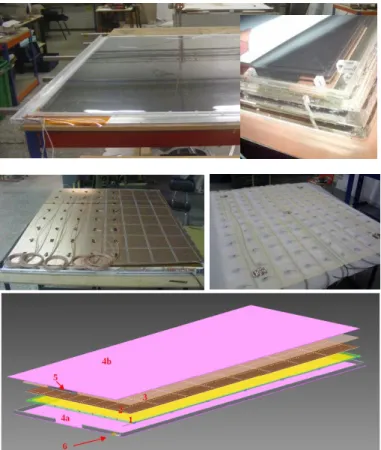
The MARTA unit is assembled by placing the RPC, DAQ, high voltage and monitoring system inside a 3 mm thick aluminum case, with all joints sealed with silicon glue. Figure1shows pictures and a scheme of the MARTA unit. The enclosure of the high voltage electrode and the active detector layers inside the acrylic box achieves at once high voltage insulation, gas tightness and a reduced number of feedthroughs - two for the gas and two for the high voltage. Additionally, the opted asymmetric design, with all gaps on the same side of the readout electrode, has the advantage of easing the cabling by having it on only one side of the detector.
7
The RPC Module
Gaseous volume
1 mm gap
1.9 mm glass
Aluminium case almost 100% tight
Pad Plane
More than 10 RPCs units already
constructed and in operation in 4
different places (Coimbra, Lisboa,
Santiago de Compostela, Malargue).
Atmospheric
Sensors Plane
Modular, robust and easy to operate
1,6 m
1,3 m
Figure 1: Photos and scheme of the RPC detector. Top row: 1.2 × 1.5 m2RPC (left) with detail of the
gas-tight plastic box (right). Middle row: cabled pad plane (left) and I2C sensors placed above (right). Bottom
row: scheme of the RPC box (1), readout plane (2), I2C sensors layer (3), aluminum case base, cover and junction (4a, 4b, 5), and feedthroughs for gas and high voltage (6).
The sealed aluminum case provides both electromagnetic isolation and environmental protec-tion to the full set including RPC, DAQ, high voltage and monitoring system, this way forming a compact and robust unit suited for outdoor environments, which can be readily transported, de-ployed and connected.
PoS(ICRC2015)629
Muon Array with RPCs for Tagging Air showers (MARTA) Raul Sarmento
DAQ
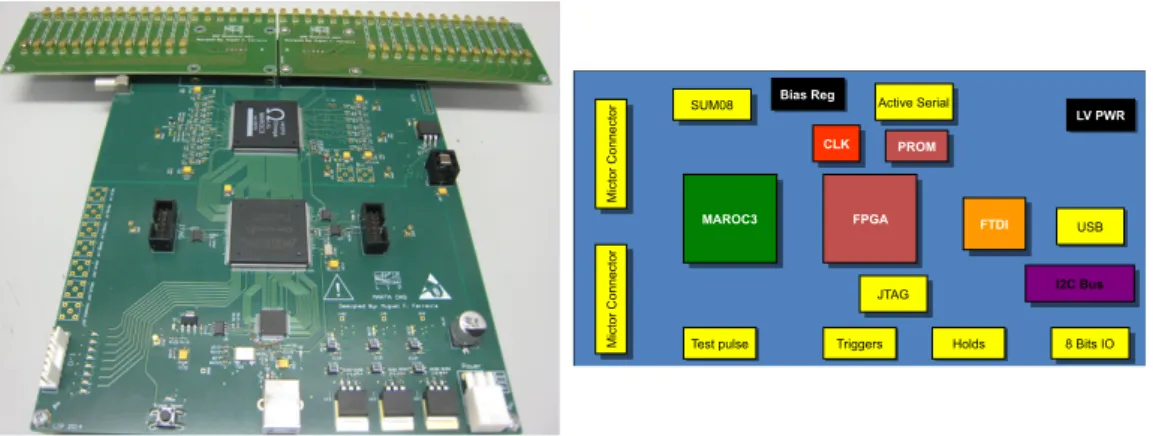
For the front-end and readout electronics an integrated solution developed at LIP-Lisbon was chosen that is compact and provides operation with low power consumption, through the use of an Application-Specific Integrated Circuit (ASIC) coupled to FPGAs. Figure2shows a picture and a scheme of the MARTA DAQ, based on an ASIC of the type MAROC3 (from version 3 of the
"Multi Anode ReadOut Chip") [5], that is connected to the readout via a mezzanine board to which
the readout cables are welded.
11"
MARTA%DAQ%PCB%%
6th%Marta%Progress%Mee=ng6%%%%2nd%March%%%6%%%%Miguel%Ferreira%%%6%%%%LIP%
3"
Marta%DAQ%Board%
MAROC3 FPGA USB
Test pulse Bias Reg CLK PROM LV PWR JTAG SUM08 I2C Bus 8 Bits IO Mi ct or C on ne ct or Mi ct or C on ne ct or FTDI Triggers Holds Active Serial 6th%Marta%Progress%Mee=ng6%%%%2nd%March%%%6%%%%Miguel%Ferreira%%%6%%%%LIP%
Figure 2: Photo of the MARTA DAQ and scheme of its main components.
A hybrid mode will be used for the DAQ: the MAROC3 is able to output 64 digital lines signaling if a channel is above a programmable threshold, as well as to measure the charge present in all channels given a global trigger. Given the low occupancy in each pad per event, it is possible to treat the signal in each of the 64 pads by performing a simple threshold comparison and feeding it to an FPGA after conversion to a digital signal. Digital counting of the particles crossing the detector with the information of the time and position is therefore achieved. For stations very close to shower cores it is expected that each pad will have several particles crossing it. In such case, the MAROC3 will be used to estimate the deposited charge that, when divided by the mean charge, gives the number of particles crossing each pad.
Successful tests of the MAROC3 boards have been performed with charge and efficiency mea-surements of atmospheric muons using RPCs, meamea-surements of the electronics dead time pending. This solution allows to readout the high number of channels with low power consumption. The collected data consist, besides of the signal from each pad and the charge value, of the slow control - high voltage and monitoring I2C - outputs.
Performance
Extensive R&D on RPC for the MARTA units has been performed (see [3, 4] for details). The gas used in the baseline detector configuration is R-134a (tetrafluorethane). A reduced electric field value of 240 Td results in stable, avalanche mode operation of the detector with a fraction of streamers below 10% while measuring cosmic muons. The performed tests also showed that an average single-muon charge produced of a few tens of pC with good charge resolution is attainable, resulting in 90 - 95 % efficiency at the plateau. Uniform detection efficiency was observed across the detector. Automatic high voltage adjustment to the ambient conditions based on the measured
PoS(ICRC2015)629
temperature and pressure values in the RPC, in order to keep a constant reduced electric field and efficiency, has been successfully implemented.
The long-term performance of the detector was assessed in LIP-Coimbra by the continuous monitoring, during a period of more than one and a half years, of the current, charge, background counting rate, streamers fraction and detection efficiency, while keeping track of the ambient tem-perature, pressure and relative humidity. Different gas fluxes were used during this period, ranging from 12 to 0.4 cc/min - the latter equivalent to a gas consumption of 1 kg/year, and the operational parameters remained stable, proving that MARTA units are able to operate in the long term using very low gas flux and therefore run for few years with a small gas reservoir.
There are about twenty MARTA units installed and taking data in locations in Portugal (Coim-bra, Lisbon), Spain (Santiago de Compostela), Brazil (Rio de Janeiro) and Argentina (Malargue). These units have served as test-beds for the DAQ developments that converged into the baseline DAQ design and are used for different purposes: as individual units for tests, performance studies, preliminary shower measurements and mounted in telescope or hodoscope configurations for per-formance and muon response studies [6]. Such successful applications prove the viability of the MARTA concept as a tool for muon detection in UHECR experiments.
3. MARTA array
Electromagnetic shielding
The MARTA concept consists in measuring the muonic component of extensive air showers by shielding the detector units with enough slant mass to absorb most of the electromagnetic particles. This concept allows several options to be used as a shield, like sand by burying the detectors few meters underground or structures made in common materials like concrete. The use of existing detectors in UHECR array experiments as shields for the electromagnetic component is also a suitable option. This option has the added advantage of allowing detector cross-calibrations by combining both detectors data.
As an example, a mass overburden of the order of 150 g/cm2from a 1.5 m thick layer of water,
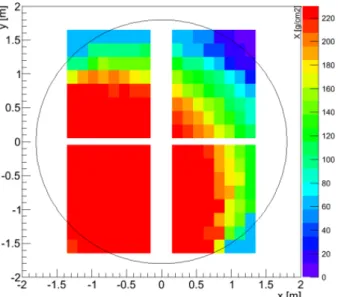
for instance from a water-Cherenkov detector, is estimated to be enough for appropriate reconstruc-tion of muonic showers for a wide range of energies and zenith angles. The segmentareconstruc-tion allows the definition of fiducial areas in the RPC surface, with small electromagnetic contamination, that can be mapped according to the mass overburden above each individual pad, estimated from the
shower direction, as is schematically shown in Figure3. Higher mass overburden corresponds to
smaller electromagnetic contamination, purer muonic signal and also higher energy threshold for the detected muons.
Muon counting in air showers
The portability of the MARTA units makes it possible to place more than one unit in the same array station for a total detection area of a few square meters and few hundred pads. As has been previously described, the RPC segmentation in pads allows the digital counting of muons with
a position resolution of 14 × 18 cm2. This corresponds to a maximum particle density of 35.6
PoS(ICRC2015)629
Muon Array with RPCs for Tagging Air showers (MARTA) Raul Sarmento
1
MARTA- Muon Auger RPC Tank Array
Second report on the Auger Data Challenge
Version 2.0 - 15/05/2014
This document updates the MARTA results for the Auger Simulation Challenge presented in its
version as of March 4, 2014 (Version 1.0). The results are based on the simulations available at the
FZK server by April 23, which correspond to about 60% of the final sample.
1) Performance of individual stations
The first crude and biased estimator of the number of muons in MARTA is, in each event, the
number of hits in the pads within the fiducial area (N
MARTAF). The fiducial area is defined, in a first
exercise, as the set of pads in a given event that has a slant mass greater than 167 g·∙cm
-2. The
number of pads within the fiducial area is then a function of the shower geometry (polar angle θ):
for a vertical event all the pads sitting below the tank are contained in the fiducial area, while at
θ=40
othis number of pads is of the order of 2/3 of the total, i.e. 166 pads (see fig. 1).
Fig.1 – Slant mass crossed in the MARTA station before reaching each of the RPC pads, for an
incidence at Theta=40º.
In the digital mode, each pad counts just one or zero and has a dead time (driven by electronics) of
50 ns. Particles hitting the same pad in this deadtime are counted as a single hit. This leads to
pile-up effects that become important close to the shower core. A correction is applied following the
same procedure used by AMIGA. Simultaneously, the integrated charge per pad in the first 100 ns
is recorded (analogic mode). This allows to have an estimation of the number of particles up to
50-100 particles per pad. MARTA will therefore be able to count up to 12 000 – 24 000 particles per
station (the maximal dynamic range of the MAROC 3 within MARTA is under investigation).
Figure 3: Slant mass crossed before reaching four MARTA units below a 150 g/cm2vertical water equivalent mass, for incident particles at 40 degrees zenith angle.
shower at 40◦. Due to the spread of the shower muon arrival times and the small dead time of the readout, pile-up effects become relevant only at smaller distances and the number of muons can be successfully recovered, in the case exemplified, up to about 300 m by application of dedicated algorithms [7]. For the purpose of measuring the signal very near the shower core at the highest energies, the analog channel is expected to provide counting capabilities up to 20000 particles, tests at high fluxes to be performed with the current concept.
Many potentialities arise by having the knowledge of the position and time of individual muons measured in each MARTA station. A particular one is the measurement of muonic longitudinal
shower profile by the Muon Production Depth (MPD) technique [8], opening the way for the
de-termination of the Xµmax. MPD systematic uncertainties would benefit from not having to account
for a broad detector time response to single muons [9]. Also, the atmospheric muon flux can be
used to calibrate/monitor the pads efficiency, estimations of the background signal from muons in the pad area ranging from 5 to 10 Hz.
Detector cross-calibrations and cross-analyses
The redundant use of two detection systems that are both sensitive to the same shower com-ponent presents several potentialities in terms of the study of the detector’s response, allowing one to search for systematic effects and reducing global uncertainties associated with the detection sys-tem. Single particle detector response can be systematically studied by combining data from both detectors, as has been shown by accurate atmospheric muon measurements performed with RPC
described in [6] correlating the muon direction and signal. Such can also be accomplished with
single muons from air showers, since by combining the MPD algorithm with the hit position one is able to reconstruct the muon trajectory.
The continuous monitoring of the detector response to muons with MARTA arising from cross-calibration analyses should impact the interpretation of the air-shower data from individual array
PoS(ICRC2015)629
stations. Additionally, there is the potential to explore new variables and increase the amount of reconstructed information by cross-analyses. For example, in the case of a MARTA complemen-tary array detector that also measures the electromagnetic shower particles, the correlation of the both detectors information allows to detect simultaneously both the electromagnetic and muonic components of the air shower with estimated improvement of the energy reconstruction.
4. Conclusions
We have presented the case for using RPC technology, which combines high particle detection efficiency with excellent spatial and time resolutions, in a dedicated array for muon measurements in UHECR experiments. This option is currently being explored by the MARTA project and has led to the development of compact, autonomous detector units that are performing reliably with low gas and power consumptions. The use of MARTA units shielded with material for absorption of the electromagnetic component is suitable for accurate measurements of the muonic compo-nent, while allowing cross-calibration procedures for control of systematic effects, and is expected to contribute to strongly enhance the analyses and interpretation of air shower data in the next generation UHECR experiments.
Acknowledgements
R. Sarmento acknowledges the financial support of Fundação para a Ciência e a Tecnologia through grant SFRH/BPD/84304/2012. The authors thank the Pierre Auger Observatory for pro-viding logistic support.
References
[1] Pierre Auger Collaboration, The Pierre Auger Cosmic Ray Observatory, accepted for publication in Nucl. Instrum. Meth. A(2015) doi:10.1016/j.nima.2015.06.058.
[2] P. Fonte, Review of RPC simulation and modelling, PoS RPC2012 (2012) 033.
[3] L. Lopes, P. Fonte, and M. Pimenta, Study of standalone RPC detectors for cosmic ray experiments in outdoor environment, JINST8 (2013) T03004.
[4] L. Lopes, P. Assis, A. Blanco, M.A. Cerda, N. Carolino, O. Cunha, et al., Resistive Plate Chambers for the Pierre Auger array upgrade, JINST9 (2014) C10023.
[5] S. Blin, P. Barrillon, and C. de La Taille, MAROC, a generic photomultiplier readout chip, JINST 5 (2010) C12007.
[6] P. Assis for the Pierre Auger Collaboration, Measurement of the water-Cherenkov detector response to inclined muons using an RPC hodoscope, Proc. 34thICRC(2015).
[7] A.D. Supanitsky, A. Etchegoyen, G. Medina-Tanco, I. Allekotte, M. Gomez Berisso, and M.C. Medina, Underground muon counters as a tool for composition analyses, Astropart. Phys. 29 (2008) 461-470.
[8] L. Cazon, R. A. Vazquez, and E. Zas, Depth development of extensive air showers from muon time distributions, Astropart. Phys.23 (2005) 393-409.
[9] Pierre Auger Collaboration, Muons in air showers at the Pierre Auger Observatory: Measurement of atmospheric production depth, Phys. Rev. D90 (2014) 012012.